ScholarlyCommons
Publicly Accessible Penn Dissertations
1-1-2012
Evaluating Intradistrict Resource Allocation and its
Implications for Equity: A Case Study
Stephanie Levin
University of Pennsylvania, [email protected]
Follow this and additional works at:http://repository.upenn.edu/edissertations
Part of theEducational Administration and Supervision Commons, and theEducation Policy Commons
This paper is posted at ScholarlyCommons.http://repository.upenn.edu/edissertations/536
For more information, please [email protected].
Recommended Citation
Levin, Stephanie, "Evaluating Intradistrict Resource Allocation and its Implications for Equity: A Case Study" (2012).Publicly Accessible Penn Dissertations. 536.
Equity: A Case Study
Abstract
Financial and human capital resources play a vital role in the ability of a school to fulfill its mission of educating students. Access to these resources varies - and this variation is often due to districts' allocation of resources among schools. Research on equity often disregards this concern and focuses attention on differences among district-wide revenue sources. My dissertation explores the implications for equity of intradistrict resource allocation through an examination of school disparities and district practices in a mid-sized urban school district.
First, I establish a comprehensive equity framework which joins together principles of adequacy and vertical equity. Then, using financial, personnel, student enrollment/ demographic, and student achievement and behavior data from the Allentown, Pennsylvania School District (ASD), I employ a mix of quantitative and qualitative methods to ascertain how resources are directed to schools in accordance with the comprehensive equity framework. I describe resource allocation using horizontal equity statistics and I provide context by evaluating the relationship between student outcomes and attending a particular school. Subsequently, I test: adequacy, looking at school outcomes for the entire student population and various subgroups with higher needs; vertical equity, identifying how inputs are allocated differentially based on schools' characteristics and demographics; and, comprehensive equity, a construct incorporating both adequacy and vertical equity designed to measure the justness of the district's approach to resource allocation. I also measure the portion of resource allocation in unexplained by vertical and comprehensive equity and conduct a simulation of
weighted student funding.
Qualitative analysis, comprised of interviews with district administrative personnel - at the central office and in schools - provides context and the rationale for district resource allocation policies. Overall findings uncover a misalignment between school-level student needs and resources in the ASD. Results are strongest when considering human capital resources, including teacher effectiveness and teacher efficacy. Based on my findings, I conclude that the ASD does not achieve comprehensive equity in school year 2009-2010. This case study provides a window into equal educational opportunity within school districts and offers a template for districts seeking to determine the extent to which they are serving students equitably.
Degree Type Dissertation
Degree Name
Doctor of Philosophy (PhD)
Graduate Group Education
First Advisor Richard M. Ingersoll
Equity, intradistrict resource allocation, resource allocation, School finance
Subject Categories
Educational Administration and Supervision | Education Policy
EVALUATING INTRADISTRICT RESOURCE ALLOCATION AND
ITS IMPLICATIONS FOR EQUITY: A CASE STUDY
Stephanie Levin
A DISSERTATION
in
Education
Presented to the Faculties of the University of Pennsylvania
In
Partial Fulfillment of the Requirements for the
Degree of Doctor of Philosophy
2012
Supervisor of Dissertation:
_______________________________________ Richard M. Ingersoll, Professor of Education
Graduate Group Chair:
________________________________________ Stanton E.F. Wortham, Professor of Education
Dissertation Committee:
Richard M. Ingersoll, Professor of Education
Margaret E. Goertz, Professor Emeritus of Education
Sigal R. Ben-Porath, Associate Professor of Education
EVALUATING INTRADISTRICT RESOURCE ALLOCATION AND ITS
IMPLICATIONS FOR EQUITY: A CASE STUDY
COPYRIGHT
2012
Stephanie Levin
This work is licensed under the Creative Commons Attribution‐NonCommercial‐ ShareAlike 3.0 License
DEDICATION
ACKNOWLEDGEMENTS
I have been very fortunate to have taken this journey with the guidance and
support of many extraordinary people. The members of my dissertation committee, Dr.
Richard Ingersoll, Dr. Peg Goertz, Dr. Sigal Ben Porath, and Dr. Lawrence Miller,
stand out for their insight and dedication.
First and foremost, I must thank Peg Goertz. She encouraged me to apply to
graduate school, and then took me on as an advisee – for which I will always be
grateful. Her integrity, intelligence and competence as a researcher and teacher are unmatched. I know that in my career I will often try to put myself in Peg’s shoes and
imagine how she would address a particularly complicated research question. If I am
successful in channeling Peg, I will be a great researcher.
I have also been extremely fortunate to have Sigal Ben Porath as a mentor and
role model. Through course work and support on my dissertation, Sigal encouraged me
to examine my beliefs and practices as a researcher and as a scholar. My work is much
stronger due to Sigal’s efforts on my behalf.
I am especially appreciative of Richard Ingersoll, who took on the role of
Dissertation Chair although my work was new to him and he had many other
obligations. Richard has been supportive throughout, expressing confidence in my
abilities to achieve my academic and professional goals.
Lastly, Larry Miller agreed to join my Committee and add valued expertise in
public budgeting and school finance. His support has strengthened my work and has
invigorated my aspiration to focus my research on issues of finance and equity.
The scholarly sustenance and camaraderie I received as an IES pre-doctoral fellow at
Penn greatly enhanced my experiences as a doctoral student. This is primarily due to
my association with Dr. Rebecca Maynard, Dr. Laura Perna, Dr. Laura Desimone, and
Dr. Henry May, all of whom played an important role in my professional development.
Many others at the University of Pennsylvania, Graduate School of Education deserve
mention and applause for their thoughtful advice and encouragement over the years. Dr.
are my colleagues, Eric Hochberg, Laura Hawkinson, Jessica Beaver, and Lisa Merrill,
with whom I have had the sincere pleasure of sharing this experience.
Before I started my doctoral studies at Penn, there were other wonderful mentors that
helped me on this journey. Dr. Wendy Wolf, Robert Brand and Dr. Ted Hershberg have
inspired me as all provide excellent examples of how to have a career driven by a
passion for ensuring equal opportunities.
Also, I am especially appreciative of my friends who have put up with my
absences, encouraged me to keep working, and helped me over the past few years in so
many ways.
To my family, I owe my greatest thanks. My parents and sisters have been there
every step of the way. And my amazing children, Errol, Alana and Willow, have been
my motivation. It is my deepest wish that the sacrifices they made in having their Mom doing “homework” all the time will pay off in their own lives as they pursue and
achieve their own goals. Finally, my deepest and most heartfelt gratitude goes to my
wonderful husband, who made this all possible.
This dissertation is possible because of the support and commitment of Dr.
Gerald Zahorchak and the staff of the Allentown school district. These busy educators
and administrators throughout the district shared their time and expertise to support my
research. Special thanks go to Jerry Zahorchak, Trevor Jackson, Brian Cote, and Rita
ABSTRACT
EVALUATING INTRADISTRICT RESOURCE ALLOCATION AND ITS IMPLICATIONS FOR EQUITY: A CASE STUDY
Stephanie Levin Richard M. Ingersoll
Financial and human capital resources play a vital role in the ability of a school
to fulfill its mission of educating students. Access to these resources varies – and this
variation is often due to districts’ allocation of resources among schools. Research on
equity often disregards this concern and focuses attention on differences among
district-wide revenue sources. My dissertation explores the implications for equity of
intradistrict resource allocation through an examination of school disparities and district
practices in a mid-sized urban school district.
First, I establish a comprehensive equity framework which joins together
principles of adequacy and vertical equity. Then, using financial, personnel, student
enrollment/ demographic, and student achievement and behavior data from the
Allentown, Pennsylvania School District (ASD), I employ a mix of quantitative and
qualitative methods to ascertain how resources are directed to schools in accordance
with the comprehensive equity framework. I describe resource allocation using
horizontal equity statistics and I provide context by evaluating the relationship between
student outcomes and attending a particular school. Subsequently, I test: adequacy,
looking at school outcomes for the entire student population and various subgroups
with higher needs; vertical equity, identifying how inputs are allocated differentially
construct incorporating both adequacy and vertical equity designed to measure the
justness of the district’s approach to resource allocation. I also measure the portion of
resource allocation in unexplained by vertical and comprehensive equity and conduct a
simulation of weighted student funding.
Qualitative analysis, comprised of interviews with district administrative
personnel – at the central office and in schools – provides context and the rationale for
district resource allocation policies. Overall findings uncover a misalignment between
school-level student needs and resources in the ASD. Results are strongest when
considering human capital resources, including teacher effectiveness and teacher
efficacy. Based on my findings, I conclude that the ASD does not achieve
comprehensive equity in school year 2009-2010. This case study provides a window
into equal educational opportunity within school districts and offers a template for
TABLE OF CONTENTS
LIST OF TABLES ... XII LIST OF FIGURES ... XIII
CHAPTER 1 - INTRODUCTION ... 1
Significance of the Study ... 4
Methods ... 8
CHAPTER 2 - LITERATURE REVIEW ... 12
A Critical Review of Equity Models ... 13
Horizontal equity. ... 15
Vertical equity. ... 16
Vertical Equity in Practice ... 19
Equal outcomes ... 21
Adequacy ... 23
Comprehensive Equity Framework. ... 27
The Equity Framework in Practice ... 31
Allocation Policies. ... 32
Institutional Procedures ... 33
Understanding resource allocation within an equity framework ... 34
Organizational concerns ... 36
Political influence ... 39
External forces ... 41
Court cases ... 42
Title I ... 42
Local Education Foundations ... 45
Factors Impacting Resource Allocation. ... 46
District limitations ... 46
Distribution of human capital resources ... 47
District hiring practices ... 48
Seniority ... 49
Salaries ... 50
Working conditions ... 51
Hiring preferences ... 52
Teacher labor market ... 53
Teacher mobility ... 57
Weighted Student Funding. ... 57
Measuring Intradistrict Equity ... 62
Challenges to studying intradistrict resource allocation. ... 63
Lack of data. ... 63
Expenditure data does not tell the whole story. ... 63
Allocation of shared resources ... 64
Methods employed in studying resource allocation. ... 65
Inputs ... 66
Human capital resources ... 66
Experience ... 68
Credentials... 69
Content knowledge/ pedagogical knowledge ... 69
General academic ability and intelligence ... 70
Certification status... 72
National Board Certification status ... 74
Relationship among teacher characteristics ... 75
Value-added measures ... 76
Teacher efficacy measures ... 82
Outcomes - variables of interest. ... 84
Reviewing the research. ... 84
Findings - Evaluating Equity in Resource Allocation. ... 87
Horizontal equity ... 88
Vertical Equity ... 90
Adequacy ... 92
Summary ... 94
CHAPTER 3 – BACKGROUND AND DATA ... 97
Pennsylvania’s Definition of Equity ... 97
Governance and Resource Allocation in Allentown School District ... 99
Data Collection ... 100
Growth Index ... 107
Teacher efficacy ... 108
CHAPTER 4 – METHODOLOGY ... 119
The Case Study ... 119
Site Selection. ... 119
Research Questions ... 121
Resources. ... 121
Qualitative Research ... 124
Sampling. ... 124
Interview Strategies and Protocol. ... 125
Analysis Methods. ... 126
Quantitative Research ... 126
Horizontal Equity ... 127
Equivalent Outcomes ... 127
Vertical Equity. ... 128
Horizontal equity post vertical equity ... 130
Adequacy. ... 131
Relative Adequacy (or Relative Adequacy Deficit) ... 132
Comprehensive Equity ... 132
Constructions of School Budgets. ... 134
Simulation ... 136
Data Constraints ... 137
CHAPTER 5 – DISTRICT CONTEXT AND QUALITATIVE FINDINGS ... 140
Overview ... 140
The Allentown School District Has Great Needs ... 140
Change over time ... 143
Demographic changes ... 143
Enrollment ... 145
Changes in human capital ... 146
Student outcomes ... 150
ASD budget ... 153
Expenditures ... 153
Funding sources ... 156
Structure of budget ... 165
Personnel budget ... 166
Program area budgets... 167
Principals’ “discretionary” budgets ... 168
The funding gap ... 169
Current resource allocation in Allentown ... 170
Variability among school outcomes ... 177
Describing the process of resource allocation in Allentown ... 178
Lack of transparency ... 179
Poor communication between central office and schools ... 181
No district agenda to guide resource allocation policies beyond horizontal equity. ... 185
Principal budgets ... 187
Special education ... 187
Professional Development ... 189
Teacher hiring ... 189
Teachers are not considered a resource ... 190
The need to augment resources drives school funding decisions ... 192
There is little focus on discrepancies in inputs among schools ... 195
Community involvement ... 200
Summary of qualitative findings ... 201
CHAPTER 6 – QUANTITATIVE ANALYSIS AND RESULTS... 204
Overview ... 204
Equity Findings ... 204
Adequacy ... 205
Academic Achievement. ... 206
Additional outcome measures considered for adequacy ... 211
Vertical Equity ... 215
Vertical Equity Analysis ... 217
Considering specific needs ... 224
School budgeted dollars versus centrally budgeted dollars ... 227
Comprehensive Equity ... 232
Comprehensive Equity Analysis ... 233
Average teacher salaries. ... 240
School budgeted dollars versus centrally budgeted dollars ... 242
Horizontal equity post vertical equity ... 243
Implications of ASD resource allocation ... 244
Influence of additional resources ... 244
Spending decisions ... 245
Middle Schools ... 247
A Weighted Formula Approach – Implications for ASD ... 248
School level impact ... 248
Impact of current ASD budget allocation on equity ... 254
Relationship between need and student outcomes ... 254
Relationship between need and resources ... 256
Relationship between resources and student outcomes... 256
Summary ... 263
CHAPTER 7 – CONCLUSION ... 267
Implications ... 269
Adding to the research ... 270
Providing a framework ... 278
Recommendations ... 279
Study Limitations ... 280
Future Research ... 282
APPENDIX A: STUDIES OF INTRADISTRICT RESOURCE ALLOCATION ... 284
APPENDIX B: CENTRALLY-BUDGETED EXPENDITURES ALLOCATED TO SCHOOLS ... 303
APPENDIX C: INTERVIEW PROTOCOL ... 304
APPENDIX D: SURVEY ON TEACHER EFFICACY ... 307
LIST OF TABLES
TABLE 1. VALUE OF FORMULA FOR FACTOR RELATED TO STUDENT-BASED NEED ... 99
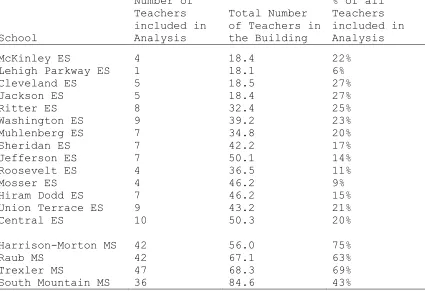
TABLE 2. NUMBER AND PERCENTAGE OF TEACHER-LEVEL VALUE ADDED SCORES BY SCHOOL ... 107
TABLE 3. MEAN AND STANDARD DEVIATION FOR SCHOOL AVERAGE RESPONSE TO TEACHER SELF-EFFICACY SURVEY ... 112
TABLE 4. TEACHER COLLECTIVE EFFICACY, BY SCHOOL ... 114
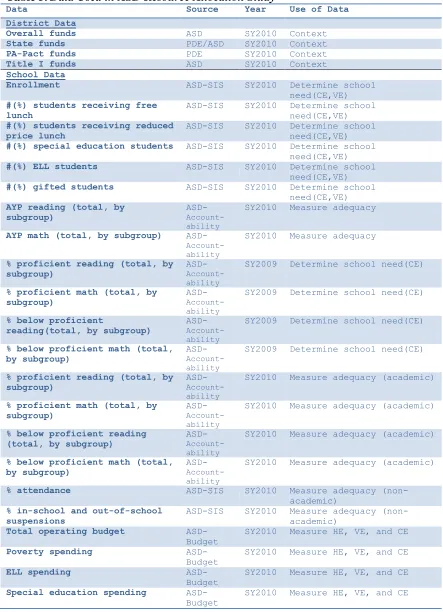
TABLE 5. DATA USED IN ASDRESOURCE ALLOCATION STUDY ... 117
TABLE 6. VALUE OR FORMULA FOR FACTOR RELATED TO STUDENT-BASED NEED ... 129
TABLE 7. VALUE OR FORMULA FOR FACTOR RELATED TO STUDENT-BASED NEED ... 133
TABLE 8. POVERTY LEVEL,SY2005 ... 142
TABLE 9. COLLEGE ATTAINMENT,SY2005... 142
TABLE 10. GRADUATION RATE (SY2008) AND PERCENT OF STUDENTS PLANNING TO FURTHER THEIR EDUCATION (SY2007,SY2010) ... 143
TABLE 11. CHANGE IN POPULATION IN RENTER-OCCUPIED UNITS,1990-2008... 144
TABLE 12. SPECIAL EDUCATION IN ASD,SY2008-2011 ... 145
TABLE 13. DISTRICT ADEQUATE YEARLY PROGRESS (AYP)STATUS,SY2003-2010 ... 152
TABLE 14. BASIC EDUCATION FUNDS,SY2004-2011 ... 160
TABLE 15. ASDALLOCATION OF PA-PACTFUNDS,SY2009 ... 162
TABLE 16. GENERAL FUND FISCAL GAP ANALYSIS,SY2009-2011... 170
TABLE 17. HORIZONTAL EQUITY STATISTICS FOR ELEMENTARY SCHOOLS IN ASD,SY2010 ... 172
TABLE 18. HORIZONTAL EQUITY STATISTICS FOR MIDDLE SCHOOLS IN ASD,SY2010 ... 174
TABLE 19. MEASURE OF EQUIVALENT OUTCOMES FOR ASDELEMENTARY SCHOOLS,SY2010 ... 178
TABLE 20. ADEQUACY DEFICIT FOR ASDACADEMIC ACHIEVEMENT,SY2010 ... 210
TABLE 21. ADEQUACY DEFICIT FOR ASDNON-ACADEMIC ACHIEVEMENT,SY2010 ... 212
TABLE 22. NEEDS INDEX FOR ELEMENTARY AND MIDDLE SCHOOLS IN ALLENTOWN,SY2010 ... 217
TABLE 23. VERTICAL EQUITY AMONG ELEMENTARY SCHOOLS IN ASD,SY2010 ... 218
TABLE 24. VERTICAL EQUITY AMONG MIDDLE SCHOOLS IN ASD,SY2010 ... 219
TABLE 25. REVIEW OF HORIZONTAL EQUITY STATISTICS FOR OPERATING FUNDS PER WEIGHTED STUDENT, SY2010 ... 223
TABLE 26. REVIEW OF HORIZONTAL EQUITY STATISTICS FOR EXPENDITURES PER STUDENT IN POVERTY, EXPENDITURES PER ELLSTUDENT, AND EXPENDITURES PER SPECIAL EDUCATION STUDENT,SY2010 ... 224
TABLE 27. CENTRALLY-BUDGETED EXPENDITURES PER STUDENT IN POVERTY, PER SPECIAL EDUCATION STUDENT, AND PER ELLSTUDENT,SY2010 ... 229
TABLE 28. CORRELATION COEFFICIENTS RELATING SCHOOL-BUDGETED AND CENTRALLY-BUDGETED EXPENDITURES TO HIGH NEEDS STUDENTS,SY2010 ... 232
TABLE 29. COMPREHENSIVE EQUITY AMONG ELEMENTARY SCHOOLS IN ASD,SY2010... 234
TABLE 30. COMPREHENSIVE EQUITY AMONG MIDDLE SCHOOLS IN ASD,SY2010 ... 235
TABLE 31. SUMMARY OF EVIDENCE ON EQUITY IN ASD,SY2010 ... 239
TABLE 32 ... 241
TABLE 33. SIMULATION OF WEIGHTED FUNDING -COMBINED EXPENDITURES FOR MIDDLE AND ELEMENTARY SCHOOL,SY2010 ... 250
TABLE 34. SIMULATION OF WEIGHTED FUNDING- EXPENDITURES FOR MIDDLE SCHOOLS AND ELEMENTARY SCHOOLS CONSIDERED SEPARATELY, SY2010 ... 251
TABLE 35. COMPARISON OF EQUITY STATISTICS FROM QUALITY COUNTS 2012 AND THE ASD ... 271
LIST OF FIGURES
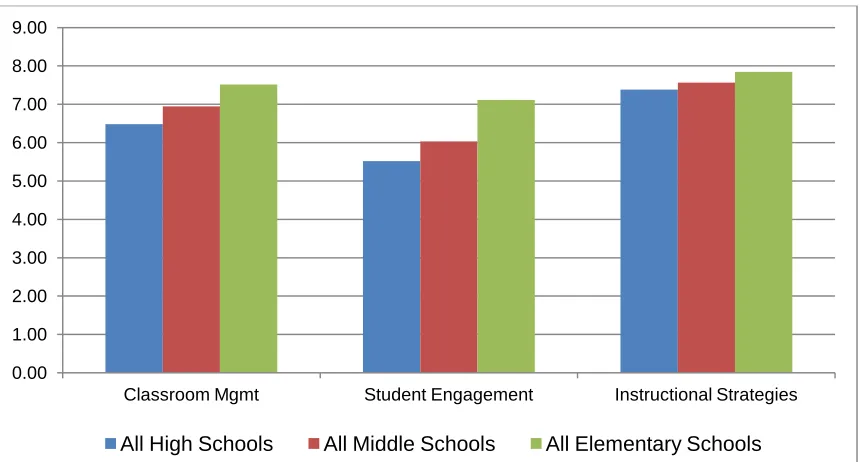
FIGURE 1. SCHOOL LEVEL COMPARISON OF TEACHER RESPONSES TO SELF-EFFICACY SURVEY ... 110
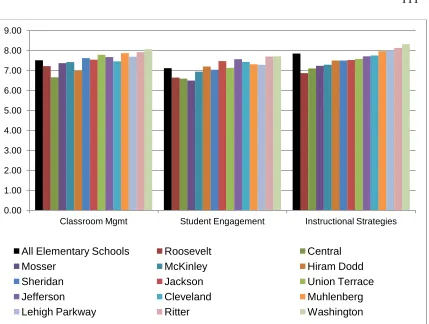
FIGURE 2. ELEMENTARY SCHOOL TEACHER RESPONSES TO SELF-EFFICACY SURVEY, BY SCHOOL ... 111
FIGURE 3. MIDDLE SCHOOL TEACHER RESPONSES TO SELF-EFFICACY SURVEY, BY SCHOOL ... 111
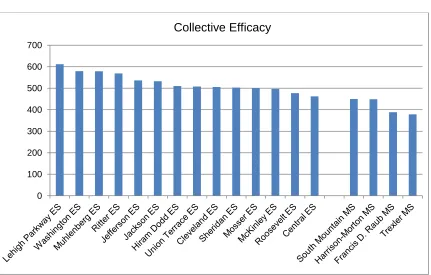
FIGURE 4. TEACHER COLLECTIVE EFFICACY, BY SCHOOL ... 115
FIGURE 5. ASD CENTRAL AND SCHOOL-RELATED EXPENDITURES (TOTAL $212.6M), SY2009-2010... 135
FIGURE 6. REGIONAL ANALYSIS OF NEED ... 141
FIGURE 7. CHANGES IN POVERTY: PERCENTAGE OF STUDENTS IN THE ASD ELIGIBLE FOR FREE AND REDUCED-PRICE LUNCH, SY2002-2010 ... 144
FIGURE 8. ASD STUDENT ENROLLMENT, SY2002-2010 ... 146
FIGURE 9. ASD PROFESSIONAL PERSONNEL, SY2005-2010 ... 147
FIGURE 10.ASD TOTAL FULL-TIME EQUIVALENT TEACHERS, SY2000-2010 ... 148
FIGURE 11. ASD AVERAGE YEARS OF TEACHER EXPERIENCE, SY2005-2010 ... 149
FIGURE 12. ASD AVERAGE SALARY FOR PROFESSIONAL PERSONNEL, SY2005-2010 ... 149
FIGURE 13. PERCENT PROFICIENT AND ABOVE ON PSSA (MATHEMATICS), SY2001-2010 ... 150
FIGURE 14. PERCENT PROFICIENT AND ABOVE ON PSSA (READING), SY2002-2010 ... 151
FIGURE 15. ASD GRADUATION RATES, SY2002-2009 ... 152
FIGURE 16. ASD INSTRUCTIONAL AND NON-INSTRUCTIONAL EXPENDITURES, SY2002-2010 ... 154
FIGURE 17. ASD SALARIES, EMPLOYEE BENEFITS, AND NON-PERSONNEL EXPENSES, SY2002-2010 .... 155
FIGURE 18. ASD SPECIAL AND GIFTED EDUCATION EXPENDITURES, SY2002-2010 ... 156
FIGURE 19. LOCAL, STATE AND FEDERAL REVENUES, SY2005-2010 ... 157
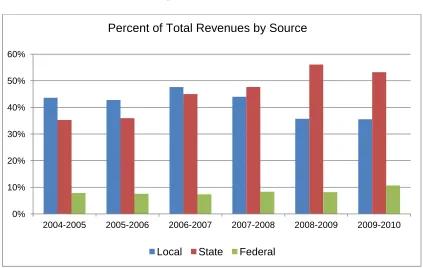
FIGURE 20. PERCENT OF TOTAL REVENUES, BY SOURCE, SY2005-2010 ... 157
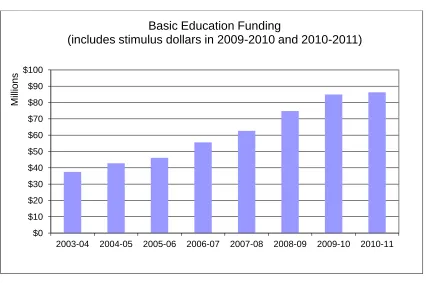
FIGURE 21. BASIC EDUCATION FUNDING, SY2004-2010 ... 160
FIGURE 22. GENERAL FUND FISCAL GAP, SY2009-2011 ... 170
FIGURE 23. PERCENTAGE PROFICIENT AND ABOVE ON PSSA (MATH AND READING), BY SCHOOL, SY2010 ... 207
FIGURE 24. PERCENTAGE PROFICIENT AND ABOVE ON PSSA (MATH), BY SCHOOL AND SUBGROUP, SY2010 ... 208
FIGURE 25. PERCENTAGE PROFICIENT AND ABOVE ON PSSA (READING), BY SCHOOL AND SUBGROUP, SY2010 ... 209
FIGURE 26. AYP STATUS, SY2010 ... 211
FIGURE 27. IN-SCHOOL AND OUT-OF-SCHOOL SUSPENSIONS AS A PERCENT OF ENROLLMENT DAYS (ELEMENTARY SCHOOLS), SY2010 ... 213
FIGURE 28. IN-SCHOOL AND OUT-OF-SCHOOL SUSPENSIONS AS A PERCENT OF ENROLLMENT DAYS (MIDDLE SCHOOLS), SY2010 ... 214
FIGURE 29. IN-SCHOOL AND OUT-OF-SCHOOL SUSPENSIONS AS A PERCENT OF ENROLLMENT DAYS (ELEMENTARY SCHOOLS), SY2010 ... 215
FIGURE 30. OPERATING FUNDS PER WEIGHTED STUDENT COUNT, SY2009-2010 ... 223
FIGURE 31. EXPENDITURES PER STUDENT IN POVERTY, SY2010 ... 225
FIGURE 32. EXPENDITURES PER SPECIAL EDUCATION STUDENT, SY2010 ... 226
FIGURE 33. EXPENDITURES PER ENGLISH LANGUAGE LEARNER STUDENT, SY2010 ... 226
FIGURE 34. CENTRALLY-BUDGETED EXPENDITURES PER STUDENT IN POVERTY, SY2010 ... 230
FIGURE 35. CENTRALLY-BUDGETED EXPENDITURES PER SPECIAL EDUCATION STUDENT, SY2010 ... 230
FIGURE 36. CENTRALLY-BUDGETED EXPENDITURES PER ENGLISH LANGUAGE LEARNER STUDENT, SY2010 ... 231
FIGURE 37: DISTRIBUTION OF AVERAGE TEACHER SALARY WITHIN THE TWO HIGHEST AND TWO LOWEST NEED SCHOOLS, SY2010 ... 242
FIGURE 38. OPERATING FUNDS AND TOTAL SALARY (PPE), SY2010 ... 245
FIGURE 39. THE FINANCIAL IMPACT OF A VERTICAL EQUITY WEIGHTED FORMULA APPROACH ... 253
FIGURE 40. THE FINANCIAL IMPACT OF A COMPREHENSIVE EQUITY WEIGHTED FORMULA APPROACH .. 254
FIGURE 42. RELATIONSHIP BETWEEN SCHOOLS' COMPREHENSIVE NEEDS INDEX AND PER PUPIL
OPERATING FUNDS IN EACH BUILDING, SY2010 ... 256 FIGURE 43. RELATIONSHIP BETWEEN SCHOOL-BASED OPERATING FUNDS AND PERCENT PROFICIENT AND
ABOVE ON THE PSSA (MATH), SY2010 ... 257 FIGURE 44. RELATIONSHIP BETWEEN EACH SCHOOL'S COMPREHENSIVE EQUITY NEEDS INDEX AND EACH
SCHOOL'S AVERAGE TEACHER SALARY, SY2010 ... 258 FIGURE 45. RELATIONSHIP BETWEEN EACH SCHOOL'S COMPREHENSIVE EQUITY NEEDS INDEX AND EACH
SCHOOL'S STUDENTS PER STAFF AND STUDENTS PER TEACHER RATIOS, SY2010 ... 259 FIGURE 46. RELATIONSHIP BETWEEN EACH SCHOOL'S COMPREHENSIVE EQUITY NEEDS INDEX AND EACH
SCHOOL'S PERCENTAGE OF EFFECTIVE AND HIGHLY EFFECTIVE TEACHERS, SY2010 ... 260 FIGURE 47. RELATIONSHIP BETWEEN EACH SCHOOL'S COMPREHENSIVE EQUITY NEEDS INDEX AND EACH
SCHOOL'S AVERAGE TEACHER EFFICACY (CLASSROOM MANAGEMENT, STUDENT ENGAGEMENT, AND INSTRUCTIONAL STRATEGIES), SY2010 ... 261 FIGURE 48. RELATIONSHIP BETWEEN EACH SCHOOL'S COMPREHENSIVE EQUITY NEEDS INDEX AND
AVERAGE YEARS OF TEACHING EXPERIENCE IN EACH SCHOOL, SY2010 ... 262 FIGURE 49. RELATIONSHIP BETWEEN EACH SCHOOL'S COMPREHENSIVE EQUITY NEEDS INDEX AND
CHAPTER 1 - INTRODUCTION
Financial and human capital resources play a vital role in the ability of a school
to fulfill its mission of educating students. Access to these resources varies – and this
variation is often due to districts’ allocation of resources among schools. Research on
equity often disregards this concern and focuses attention on differences among
district-wide revenue sources. My dissertation explores the implications for equity of
intradistrict resource allocation through an examination of school disparities and district
practices in a mid-sized urban school district.
Both the state and the federal government contribute significantly to school
district revenues. However, with the exception of Title I requirements, neither entity
mandates specific distributions of resources among schools, programs, or classrooms
within a district. Even state requirements that all students be provided an adequate or
thorough and efficient education have seldom been pursued below the district level.1 Pennsylvania’s former education finance reform agenda is a prime example of
state policy designed to improve spending equity for individual students through
allocation of funds to school districts. In 2008, the Pennsylvania state legislature voted
to alter the state’s basic education funding formula to address both inadequate funding
and serious inequities among school districts. Similar to other states’ approaches to
address inequities, this action requires restructuring at the interdistrict, rather than
intradistrict level. The formula adopted by the State is based on an adequacy target
1 There have been only two major cases that look at resource allocation below the district level: Hobson
determined to provide all students with the necessary resources to become proficient on
state assessments and to meet state standards in twelve academic areas. It includes
weights to provide additional funds for economically disadvantaged students and
English Language Learners (ELL).2 With this policy, the State aimed to address a
multifaceted vision of equity; primarily, the new funding formula was designed to
achieve adequacy, an outcomes-based principle whereby all students are provided the
necessary resources to reach a predetermined standard. To realize this objective,
Pennsylvania’s new funding formula addressed vertical equity, an inputs-based
measure, by providing additional resources for students with additional needs. Also, the
new funding formula sought to improve horizontal equity, an inputs-based measure
requiring equivalent resources for all similarly situated students, by increasing the
State’s financial contribution such that children are not penalized due to the wealth of
their district3.
While the new funding policy seemed promising, realizing these ideals of equity
cannot be accomplished by the State alone. Districts, not states, are responsible for
allocating resources generated from all levels of government at the building or student
level. These district level allocation decisions impact how students with different
educational needs are served. My dissertation evaluates intradistrict resource allocation
using a conceptual framework built on theories of equity.
2
District size and regional cost differences are also incorporated in the funding formula. While higher weights for special education students had been recommended, they were not included in the revised funding formula.
The data used in this dissertation is drawn from a case study of a mid-sized, urban
school district, the Allentown School District (ASD). This case study seeks to answer
the following research questions:
1. How are resources allocated among schools?
2. What is the rationale for resource allocation patterns among schools?
3. Using a comprehensive equity framework which encompasses adequacy and
vertical equity, what are the implications of resource allocation patterns?
4. What would be the financial impact of an alternative approach to resource
allocation aligned with the comprehensive equity framework?4
ASD, the third largest urban school district in Pennsylvania5, offers a rich environment
for research. Approximately 18,000 students are served in two early learning centers,
14 elementary schools, 4 middle schools, and 2 high schools. Seventy-eight percent of
students in the district are classified as economically disadvantaged6, 84% of students
in the district are non-white, and 64% are Hispanic. In the 2009-2010 school year, 8 of
20 schools met Adequate Yearly Progress goals; the graduation rate for the district was
70%; and 57% of all students tested proficient or above in math7. Leadership in the
district supported a thorough assessment of budgeting practices as well as an analysis of
the distribution of teachers among schools.
4 School-year 2009-2010 data is used answer these research questions. 5
The Allentown School District is approximately two-thirds the enrollment size of Pittsburgh, Pennsylvania.
6 These students are eligible for free and reduced priced lunch.
Significance of the Study
Though there is a sizeable body of research on interdistrict equity, the research on
intradistrict resource allocation is relatively sparse as most U.S. school finance research
that discusses equity focuses on the district. Concerns regarding the equal distribution
of resources, the appropriate enhancements to ‘level the playing field’, and the impacts
of resources on student outcomes have driven research almost exclusively at the federal
and state levels. Too little is known about the decisions districts make when
determining how to allocate resources to schools and students (Betts, Rueben, &
Danenberg, 2000). Below the district level, all schools are supported by the same state
aid package and local tax base and formulas to allocate dollars to schools are not
designed to address disparities in wealth (Schwartz, Stiefel & Rubenstein, 2008).
However, there are serious implications for equity at the school, program, and
classroom level, as well (Monk & Hussain, 2000; Roos, 1998; Satz, 2008). Rubenstein,
Stiefel, and Schwartz (2006) point out that the focus on “total or average resources at
the district level implicitly assumes that the average resources reach all schools more or
less evenly within a district” (p. 3). While state and local policies may be intended to
provide for all students equally, institutional, organization, political¸ and economic
factors can derail this objective (Picus, 1995; Roza & McCormick, 2006). Research has
shown that much of the variation in resources happens at the school level within, not
between, districts (Betts et al., 2000; Clotfelter, Ladd, Vigdor & Wheeler, 2007;
Imazeki & Goe, 2009; Rubenstein et al., 2006). Furthermore, even in schools that have
taught by less qualified teachers (Roos, 1998). By not paying attention to how districts
allocate resources, policy makers miss potential large-scale inequities.
In recent years, there has been increasing interest in resource allocation below
the district level. Researchers have debated the value of money in improving student
outcomes, and many have come to the conclusion that the way in which money is spent
is as important as the amount of money spent (Odden, Goertz, Goetz, Archibald, Gross,
Weiss & Mangan, 2008). Analysis of resource allocation below the district level
provides valuable information about the relationships between expenditures and student
outcomes (Stiefel, Rubenstein & Berne, 1998). Also, patterns of inequitable distribution
of resources become more evident. This information should lead to more efficient and
fairer spending decisions by educators, helping them to target effective interventions to
students in need (Schwartz et al., 2008). As demonstrated in the following chapter,
evaluations of equity among schools within districts have found uneven distributions of
resources, with less privileged students most often receiving inferior resources, such as
less experienced teachers (Schwartz et al., 2008).
Another reason that the examination of how districts allocate resources has
become particularly advantageous is that, under our present accountability system,
schools are held responsible for student outcomes. Standards-based reform under the
federal No Child Left Behind (NCLB) Act requires schools to demonstrate the
proficiency of all their students (Odden, Goetz, & Picus, 2008). It is important that
schools understand what resources are necessary to meet this goal (Denison, Stiefel,
to investigate the extent to which schools of different types are playing on a level
playing field in terms of their access to the teaching and leadership resources that are
essential for meeting the achievement goals required under … accountability systems”
(p. 6). The focus on school accountability has led to the proliferation of assessments to
determine if students are achieving proficiency goals. Data collection and analysis has
improved greatly in recent years. Assessment results, integrated into sophisticated data
systems that link students and teachers over time, are now becoming available to help
determine if an adequate education is being provided within schools and districts
(Odden et al., 2008). Schools and districts can investigate the impact of classroom
effects (e.g., teachers), school effects (e.g., peers), and student mobility on student
achievement outcomes (Denison et al, 2009).
In 2005, California passed the first legislation of its kind requiring schools to
provide data on per pupil expenditures. This data must represent the actual salaries of
school personnel along with information on teacher credentials and experience
(Rubenstein et al., 2006). As required, online school accountability report cards
disclose school-level average teacher salaries. Analysis of this data reveals significant
intradistrict inequities8 (Miller, 2010). This appears to be the beginning of a national
trend, as Elementary and Secondary Education Act (ESEA) reauthorization discussions
have included calls for different measures of school-level comparability as well as
school-level reporting of teacher characteristics and teacher spending.
Challenges to evaluating intradistrict equity – including the complexity of
district budgets, lack of accessible data at the school level, and difficulty in allocating
shared resources – impede research. Addressing these challenges is imperative,
however, as much of the variation in resources happens at the school level within, not
between, districts (Betts et al., 2000; Imazeki & Goe, 2009; Roza, 2005; Rubenstein,
Schwarz, Stiefel, & Hadj Amor, 2007). Insufficient focus on district level
decision-making has left a gap in our knowledge as to the ability of districts to achieve equitable
resource allocation (Lankford, Loeb & Wyckoff, 2002; Miller & Rubenstein, 2008;
Rubenstein, Schwartz, Stiefel & Hadj Amor, 2007). Additional research is necessary to
highlight inequities where they exist.
In addition to a lack of understanding about intradistrict inequities, there is a
lack of evidence on the comparative efficacy of various resource allocation strategies.
For example, investigations into the impacts of weighted student funding initiatives9
have shown them to have positive, though often small, effects on equity (Carr, Gray, &
Holley, 2007; Chambers, Levin & Shambaugh, 2010; Roza & Hawley-Miles, 2004).
Yet, Baker (2009) points out that much of this research neither isolates the impacts of
the change to the allocation formulas, nor adequately considers the merit of the weights
used to direct additional funds to high cost students. Additional research is necessary to
help policymakers understand the implications of different resource allocation policies,
including impacts on opportunities and outcomes for students, so that they may make
informed decisions that will support the learning of all children.
My research, a mixed methods case study of a mid-sized, urban school district
helps to fill this gap in the literature by offering a unique view into resource allocation
below the district level; insight into how and why a district’s resource allocation
decisions are made; and an analysis of how a district’s allocation decisions might
impact equity.
Methods
Using financial, personnel, student enrollment/ demographic, and student
achievement data10, I employ a mix of quantitative and qualitative methods to ascertain
how resources are directed to students. First, I describe ASD resource allocation using
horizontal equity statistics. I provide additional context by evaluating the relationship
between student outcomes and attending a particular school through the use of an
unconditional 2-level model. I then test: (1) adequacy, looking only at school outcomes – both at the school level, taking into account the entire student population, and based
on outcomes of various student populations with higher needs; (2) vertical equity, identifying how inputs are allocated differentially based on schools’ characteristics and
demographics; and, (3) horizontal equity post vertical equity, identifying how much of resource allocation in unexplained by vertical equity. Lastly, I test comprehensive equity, a construct I have developed which incorporates both adequacy and vertical
equity and is designed to measure the effectiveness of the district’s approach to
resource allocation.
My measurement of adequacy is quite strait forward. I consider a number of
student outcomes (i.e., state assessment results, attendance, and suspensions) at the
school level as well as at the subgroup level within schools – and employ simple
statistical measures of dispersion to quantify the variation among schools.
In the remaining analysis, I take an analytical approach similar in theory to
methodology used by researchers to examine equity among school districts, whereby
regression analysis is used to determine whether funds allocated to districts match the
weights occurring in the state’s funding formula (Toutkoushian and Michael, 2007).
Given a limited sample size, and the desire to have a single measure with which to
evaluate district equity, I construct an index to use as a single weight at the school level
to account for school-wide needs given a school’s particular student population. By
altering my needs index to reflect differing theories of equity, I evaluate both vertical
equity and comprehensive equity in the Allentown School District. This model allows
me to examine the unexplained variations in per-pupil funding after taking into account
the additional needs of certain subgroups of students11 - a construct which I refer to as
“horizontal equity post vertical equity.” By correlating the needs index with various
resources, I am able to identify the direction, size, and strength of the relationship
between resources and school characteristics (as defined by the characteristics of the
student population – e.g., % poverty).While much of the analysis of equity has been
conducted at the district level, my research focuses its investigation at the building
level, comparing all elementary schools and all middle schools.
I employ qualitative research methods, composed of a review of district and
state financial documents and interviews with senior district administrators and a
School Board member, to illuminate the quantitative findings by providing a
description of the current resource allocation system and its rationale. Qualitative
research is useful in identifying impediments to greater equity among schools.
To address the final research question, “What would be the financial impact of
an alternative approach to resource allocation aligned with the comprehensive equity
framework?" I conducted a simulation. The simulation illustrates the implications of
two possible changes to the allocation of resources: the first change is based on the
State’s approach to funding districts and is consistent with vertical equity, and the
second change builds on this by also accounting for students’ prior academic
performance and is consistent with the district’s mission of having all students achieve
pre-determined12 academic and social outcomes.
Ultimately, this research project describes district resource allocation practices
and how these practices result in a misalignment between school-level student needs
and financial and human capital resources.
The remainder of this dissertation is organized into six chapters: a literature
review; background and data; methodology; district context and qualitative findings;
quantitative analysis and results; and my conclusion. The literature review begins with
an appraisal of various conceptions of equity leading to a framework used first to
evaluate existing studies of intradistrict resource allocation – and, later, to inform the
research questions and analysis of resource allocation in the Allentown School District.
This chapter also includes a discussion of intradistrict resource allocation policies and
procedures and completed studies of intradistrict resource allocation. Chapter Three
presents background information on both state and district policies to provide context
for the case study; the sources and collection methods of my data are also reviewed. A
description of the analyses follows, and specific research methods are explicated. In the
fifth and sixth chapters, I present my research findings from both quantitative and
qualitative analysis and the final chapter provides a summary of major findings,
CHAPTER 2 - LITERATURE REVIEW
The organization of this review of pertinent research reflects my approach to
understanding how districts allocate resources among students. The first section offers a
critical review of conceptions of equity consistent with a social justice perspective
calling for equal educational opportunity for all students. A theoretical framework for
grounding an analysis of resource allocation is derived from this review. The next
section explains the mechanisms for resource allocation from districts to schools,
programs, and classrooms. The first part of this section describes allocation policies
including institutional procedures and organizational concerns that influence allocation
patterns, such as incorrect (and correct) assumptions of need, administrative inertia, and
school reform initiatives. The political influence of key stakeholders (i.e., teacher
unions, connected parents, and the business community) and external requirements (i.e.,
court cases and supplemental federal funds) are also considered. Following this general
review is an examination of the constraints on school districts which limit their ability
to promote equitable outcomes for students. These constraints are categorized as local
education agency policies and practices and the teacher labor market. Weighted student
funding, an approach to resource allocation designed to address concerns of governance
and fairness, is also reviewed. The third section of this chapter offers a summary of the
major studies of intradistrict resource allocation, beginning with an assessment of
challenges to this line of inquiry and a discussion of the research methods employed
and ending with a review of the measures of inputs (i.e., teacher characteristics) used in
intradistrict resource allocation utilizing the different theories of equitypresented
earlier in this paper. Studies are categorized according to their authors’ intention of
testing the existence of horizontal equity, vertical equity, and/or adequacy.
A Critical Review of Equity Models
Given the many views of what constitutes equity, analysis and evaluation of the
equitable allocation of resources at the school district level or elsewhere requires that
the concept be clearly defined. This section of the literature review explores definitions
of “equity” in relation to equal educational opportunity. Consideration of the
implications of four distinct approaches to equal educational opportunity – all which
have been quantified in the school finance literature - leads to a fifth approach which
capitalizes on the positive aspects and addresses the weaknesses of existing
interpretations of equity.13
While “equity” is generally conceived of as fairness in resource allocation by
economists, political scientists, and philosophers, the various disciplines use the term
for somewhat different ideas. Many legal scholars and philosophers characterize equity
in education as “equal educational opportunity”; however, the appropriate meaning of
this phrase has been debated for decades (Coleman, 1975). Peterson and Woessmann
(2007) acknowledge two interpretations of “equal educational opportunity:”
“For some, equal opportunity means only that everyone is treated the same way within the school house and each is given instruction appropriate to his or her ability, so that all are given the same chance to build on the capabilities they bring to the school door. For others, equal opportunity asks schools to remedy
13 In 1964, James Coleman struggled with a similar task after being commissioned by the United States Department of Health, Education, and Welfare “to assess the availability of equal educational
the deficiencies that some children bring with them to school so that only random chance determines which members of the next generation rise to the highest positions of society.” (p. 4)
The first definition offered above is embraced by Peterson and Woessmann (2007)
as all that is required and feasible in a democratic society which values individual
liberty. This vision of equal educational opportunity calls for equivalent resources for
all students. The second definition of equal educational opportunity put forth above is
consistent with Rawls’ views on social justice, whereby students should have access to
resources such that their subsequent opportunities are equalized (Berne & Stiefel, 1984;
Rawls, 1971). This goal holds regardless of whether the focus is on inputs into the
education system or student outcomes. Inputs refer to resources dedicated to schooling
(i.e., money, human capital), and outcomes refer to results (i.e., knowledge acquired,
income, life satisfaction). An additional version of equal educational opportunity, one
that gained more traction in recent years as a result of the persistent ambiguities of
equity, requires that each student is prepared to perform at (at least) an adequate level
such that he/she can succeed economically, politically and socially.
Approaches to equal educational opportunity emphasize inputs (e.g., equal inputs
for all students), outcomes (e.g., adequate outcomes for all students), or a combination
of both. Different measurement tools are required to examine inputs and outcomes, and
calculating inputs can be more straightforward than quantifying outcomes.14 This
literature review examines four conceptions of equity which broadly cover the range of
approaches that have been considered by policy makers and scholars: horizontal equity
(equivalent resources for all students); vertical equity (resources directed to students
based on their differing needs); equivalent outcomes for all students; and adequacy
(equality of either inputs or outcomes up to a threshold level). An analysis of these
different interpretations of equity leads to a conceptual model of equity against which
policy makers can measure current practice.
Horizontal equity. The simplest approach to equity is to provide equivalent
resources to all students. Essentially, horizontal equity requires that students from
different backgrounds and living situations have access to comparable resources (i.e.,
financial support, qualified teachers and principals) (Clotfelter, Ladd & Vigdor, 2007).
This approach treats all students as if they are the same – it does not take into account
differences in student need or the costs of services. An equal distribution of resources to
all students ensures that the school is not responsible for creating inequalities, but it
does not provide the school with a means of redressing existing inequalities. One
manifestation of horizontal equity is “wealth neutrality” which maintains that “the
education a child receives should not be dependent on the wealth of the district in
which the child resides” (Underwood, 1994, p. 143).15
This particular approach to
horizontal equity addresses differences in local preferences for allocating public funds
Rights Act, Sec. 402.) he offered a similar analysis to the one provided in this paper, acknowledging numerous concepts of equal opportunity (Coleman, 1975).
to education. Wealth neutrality has been used by litigants in court cases challenging
state funding systems.
Horizontal equity is an inadequate measure of equity because the cost of
providing an education to different students varies according to students’ needs and
school conditions (Underwood, 1994). Certain students require greater supports to be
successful. Disadvantaged schools and districts are likely to require funds above and
beyond those of advantaged schools and districts. The reasons for this include the cost
of acquiring high quality teachers at less desirable schools, maintenance expenditures
for older infrastructure, the existing resource discrepancies between schools, and the
propensity of some parents to compensate their children’s education at higher levels
(Ladd, 2008). Another problem with using horizontal equity as the measure of equity is
that because no minimum amount of funding is required, even equivalent resources
could be insufficient, providing a very low quality education and potentially “leveling
educational resources downward for all” (Satz, 2008, p. 426).
Vertical equity. Vertical equity responds to some of the critiques of horizontal
equity by taking into account discrepancies among students. Specifically, vertical
equity is designed to address the fact that different students and conditions require
different treatment (or inputs) to have the opportunity to achieve similar outcomes
(Berne & Stiefel, 1999; Ladd, 2008). For example, economically disadvantaged
families and minority families often do not have the same access to a range of supports,
wealthier and non-minority families do (Rebell, 2007).16 For this reason, some students
require greater resources in order to address their needs. As Ladd (2008) argues,
“equality of outcomes requires inequality of inputs” (p. 404). This approach to equality
of educational opportunity leads to a greater consideration of student outcomes.
Vertical equity falls within a larger characterization of equal educational
opportunity whereby “all students … have an equal chance to succeed, with actual
observed success dependent on certain personal characteristics, such as motivation,
desire, effort, and to some extent ability” (Berne & Steifel, 1999, p. 13). Proponents of
this form of equity allow for differences in the allocation of resources among students
based on ability and effort, but do not accept differences based on morally arbitrary
traits such as wealth or ethnicity (Brighouse & Swift, 2008; Strike, 2008; Walzer,
1991).17 In the field of school finance, vertical equity calls for additional resources for
students with defined educational needs (Berne & Stiefel, 1999; Owens & Maiden,
1999; Underwood, 1994). These educational needs are generally identified as student
characteristics which research has shown to be highly correlated with a lack of
academic achievement.
16 See Grissmer, Flanagan, and Williamson, 1999, Reschovsky and Imazeki, 1999, Weiner, 2008 and Baker and Green, 2009 for analysis on the costs of educating economically disadvantaged and minority students.
A compelling reason to support this conception of equal educational opportunity
is that it is socially just, as students are afforded the same opportunity to succeed,
regardless of race, class or other ascribed trait (Brighouse & Swift, 2008; Satz, 2008;
Strike, 2008). Because success includes economic and political attainment, as well as a
life of enhanced experiences through appreciation of the arts and sciences, it is just that
all students be afforded the same opportunities (Brighouse & Swift, 2008).
Drawbacks to vertical equity, as with any approach to equal educational opportunity
that seeks to allocate resources to redress unfair disadvantages due to external
circumstances, have to do with its focus on inputs rather than outcomes, for the
individual and for society as a whole. First, vertical equity does not take into account
the quality of the education provided to students. Even with a means of compensating
for student disadvantages, all students might get a low quality education. This approach
to equity does not require that children be educated to even a minimum level.
Inadequate education is even more likely for those children with less ability or
motivation(Gutmann, 1987; Satz, 2008). Additionally, a system that is not concerned
with outcomes could lead to a reduction in overall productivity, negatively impacting
all children (Satz, 2008).
There are additional theoretical concerns that arise when vertical equity is
adopted as the determinant of equal educational opportunity. These include the
compensating students for other ascribed traits18, and the conflict that arises between
the values of parental and local control and those of equality19.
Vertical Equity in Practice. Implementation of vertical equity necessitates a
way to adjust for the unequal circumstances of students. Adjustments provide greater
inputs to the students who require additional resources to achieve outcomes similar to
less disadvantaged students (Berne & Stiefel, 1999). To achieve vertical equity, states
use categorical programs to address the needs of particular groups of students. Some
states and districts also use pupil weights in their funding formulas to take into account
the additional needs of some categories of students such as English language learners or
Special Education students (Augenblick, Myers, & Anderson, 1997). Similarly, pupil
weights can be constructed to compensate students for past unequal treatment (Strike,
18
While vertical equity deems that groups of students should not differ in their outcomes, it does allow individuals within these groups to differ. As such, there exists the possibility of large disparities among students in terms of inputs and outcomes. Some argue that it is unclear why the line is drawn at this point. Satz (2008) points out that it is wrong to hold individuals accountable for such traits at an early age. She writes, “We expect children to go to school and master certain capabilities; it is not enough that they have the opportunities to do so” (p. 429). Jencks (1998) agrees, stating, “I can understand the argument that society is not responsible for children’s genes or for their upbringing. I have never seen a coherent defense of the proposition that society is responsible for one but not the other” (p. 523). Gutmann (1987) reaches a similar conclusion based on the likelihood that effort “is dependent upon happy family and social circumstances” (p. 131). Brighouse and Swift (2008) do acknowledge that it may be unfair to hold children accountable for their efforts which may be heavily influenced by background circumstances, but address this difficulty by invoking/relying on the democratic process to determine how “merit” is defined.
2008). Implementing pupil weights requires two steps: first, establishing which
categories of students should be granted additional funds, and second, determining
appropriate weights for these categories. In practice, vertical equity relies on equivalent
resources per weighted pupil across schools and districts (Ladd, 2008). Equal outcomes
for categories of students, rather than individual students, is the desired result (Berne &
Stiefel, 1994; Ladd, 2008; Strike, 2008). This makes the distinction between
educational inputs and outcomes unclear (Strike, 2008).
While the idea of pupil weights is compelling as a theoretical approach to
school funding, there are concerns with its implementation. First, there is the possibility
that the weights will be incorrect. Berne and Stiefel (1999) explain that there is no
consensus on how to determine the correct weights. Strike (2008) shares this view and
worries that weights are arbitrarily assigned to students. Another issue is that pupil
weights are based on individual students and do not take into account concentrations of
disadvantaged students (Baker & Green, 2009). Ladd (2008) explains that to be more
accurate, “weights should take into account not only the characteristics of the students
themselves but also the extent to which students whose characteristics make them hard
to teach are concentrated in particular schools or districts” (p. 412). A final concern
with pupil weights is that individual students may be stigmatized. Since pupil weights
sort individuals into groups, the assumption is that these individuals are less responsible
for their lower achievement than others. As a society, we run the risk of identifying
some students as belonging to an “inferior” group (Ladd, 2008; Satz, 2008). Addressing
to equal educational opportunity – both of which use student outcomes to measure
fairness.
Equal outcomes.A third conception of equity, “equal outcomes” or “equality
of outputs” requires that resources be allocated in such a way as to create equal
outcomes. Outcomes can be defined in any number of ways, including student
achievement, graduation rates, prospective economic outcomes, or citizenship. A focus
on outcomes is consistent with recent education policy in the United States in which
student assessments are used as an indicator of student learning outcomes. In order to
achieve equal outcomes by all students, it is necessary to determine which inputs are
required to achieve them, which in turn requires an unequal allocation of resources
among students.
The idea of equal outcomes is appealing as it leads one to imagine a more
communal society with less competition and no disparities between the “haves” and the
“have-nots.” The adoption of an equal outcomes standard is unlikely, however, due
primarily to democratic concerns regarding autonomy and the role of government . A
system designed to ensure equal outcomes for all students would be extremely
expensive, as it would require the state to devote all of its educational resources to the
poorest performing students until they can match the accomplishments of the highest
performing students. Also, there would be a need for significant change in social and
economic policies outside of the educational arena (Clotfelter et al., 2007; Rothstein,
2004). Given limited resources, and public needs beyond education, a system such as
Furthermore, it is unlikely that taxpayers would endorse this conception of
equity, as available resources must be shared to address a variety of public needs
(Gutmann, 1987; Satz, 2008). The second problem is that, taken to its extreme, a
system of equal outcomes would lead to a homogenous student population. It is
unlikely that the public would embrace a system calling for entirely equal outcomes;
nobody argues in favor of a system where achievement scores are the same for all
students (Berne & Stiefel, 1999; Gutmann, 1987; Satz, 2008).
Another deterrent to an equal outcomes model is fear of the effect it would have
on the behavior of both students and the public. For example, there is concern that
undesirable incentive effects could reduce individual effort (Ladd, 2008), or that the
call for equal outcomes would cause a bidding war among parents for improved
outcomes (Brighouse & Swift, 2008; Gutmann, 1987; Ladd, 2008). Dealing with this
“arms race” would require restricting the power of parents – resulting in a politically
unfeasible loss of autonomy for families (Gutmann, 1987; Strike, 2008).
The final challenge of this equity ideal is that it is difficult to agree on what
constitutes appropriate outcomes. Even if assessment results were determined to be
appropriate outcomes to measure, the economic tools used to study the relationship
between inputs and outcomes, such as production functions and cost functions, are
inconclusive in terms of the type and amount of resources required to attain specific
outcomes (Berne & Stiefel, 1999). Therefore, the public lacks important information in
Adequacy. The final conception of equity presented, adequacy, has gained
traction in scholarly debate, policy, and practice as it addresses some of the
shortcomings of vertical equity and equal outcomes. As with the principle of equal
outcomes, adequacy is outcome-focused rather than input-focused. Unlike other
concepts of equity, however, adequacy is not comparative in nature. Similar to the
difference between a criterion-referenced test and a norm-referenced test, adequacy
requires measurement against specified criteria, not against other individuals (or
schools or districts). This difference makes adequacy a politically viable approach to
equal educational opportunity, since it offers a means of providing students with the
resources necessary in our society to attain a certain goal, such as citizenship,
proficiency on assessments, or social mobility. In doing so, adequacy frames education
as a right, consistent with the views of numerous legal scholars and philosophers.20
Adequacy provides an outcome level below which no student is allowed to fall.
The determination of this outcome level is crucial as it sets expectations for students
that may or may not impact their long term success. The theory of adequacy requires
that each child is allotted the necessary resources to attain a specified goal, but in
practice policy-makers have measured adequacy as at the district level, meaning that
districts within a state are held accountable for their students’ attainment of a
pre-determined standard (Berne & Stiefel, 1998). Adequacy differs from other conceptions
20
of equal opportunity in that it requires value judgments as to what outcome is adequate,
or sufficient, and to what resources will support all students in reaching this particular
outcome (Guthrie & Rothstein, 1999). Finally, a key difference between adequacy and
vertical equity or equal outcomes is that it allows for inequality above this minimum
threshold.
Scholars and policy makers have debated the appropriate standard for all
students to meet.21 Policy makers have relied on state-wide test scores, construed to be
a proxy for long-term outcomes. This is problematic to the extent that these
standardized tests are insufficient in forecasting success22, but it does allow for a
measurable definition of adequacy: being deemed proficient on a state test.23 The recent
requirement that all students be tested provides a measure of school and student
21
Gutmann (1987) and Satz (2008) share the view that the threshold should be at the level at which a person has the ability to participate effectively in the political process. This threshold is democratically determined, as is the allocation of resources above the threshold level. This approach enables future citizens to determine the appropriate level of adequacy (Gutmann, 1987). For Satz (2008), educational adequacy is tied to the requirements of equal citizenship. This means that schools have an obligation to break down “stereotypes and animosity between groups and encouraging intergroup knowledge and understanding” (p. 425). Satz (2008) includes social and economic rights in her understanding of equal citizenship. Therefore, “an education system that precludes the children of poorer families from competing in the same market and society as their wealthier peers cannot be adequate” (Satz, 2008, p. 434). Satz’s view of adequacy requires “accountable output standards on a national level, increased funding in many school districts, and substantial integration across class and racial lines” (Satz, 2008, p. 441). This threshold for adequacy is so high that it appears to converge with the conception of
meritocracy outlined earlier, where resources are directed to students with greater educational needs such that all students reach a level playing field. Other visions of adequacy focus on private outcomes – such as the ability to compete in the market. An example of this is Rawls’ view that all students should attain outcomes “connected to his or her long-term life chances” (Rawls, 2001, as cited in Ladd, 2008, p. 412). While some worry that adequacy may result in “leveling down,” conceptions of adequacy put forth by Satz and Gutmann require a high enough threshold to deal with concerns related to a lower quality of education. Satz (2008) points out that adequacy offers a minimum threshold of attainment that should prevent states from under-funding schools and districts. An additional advantage of Satz’s and Gutmann’s versions of adequacy is that they secure support for those that are most disadvantaged and ensure that they can participate in society. Ultimately, this should restrict disparities in educational outcomes (Satz, 2008).
22
Proficiency scores in certain disciplines, such as math and reading, might not represent the full set of skills and knowledge that are necessary for a successful life (Guthrie & Rothstein, 1999).
performance which has been used to determine whether states are upholding the
Constitutional mandate of provision of public education. Plaintiffs in adequacy lawsuits
are able to point to a clear definition of an adequate education, increasing plaintiff
victories and resulting in the allocation of new funds to disadvantaged districts
Advocates for directing more resources to disadvantaged students report that “the
adequacy movement has improved educational opportunities and led to gains in student
achievement, the ultimate litmus test” (Rebell, 2008, p. 436).
While adequacy has continued to garner support in recent years, there are a
number of concerns related to its use. Foremost, it addresses neither issues of inequality
nor the concept that education is a positional good (Reich & Koski, 2006). Adequacy
provides for a certain level of scholastic attainment, but beyond this level some groups
of students will have greater resources and better access than others (Baker & Green,
2008; Strike, 2008). This will inevitably result in the advantaged groups having greater
success, as the playing field is not truly level24. While all students will be able to
compete, the competition will be unfair as those who need no compensation have, in
essence, access to a superior education and, therefore, an advantage in economic and/or
political attainment (Brighouse & Swift, 2008; Strike, 2008).25 Since the current
standards are not being met by many students, this argument has some merit; still, the
24
An adequate education alone may not provide all the benefits that schooling has to offer. Education is valuable for reasons other than economic or even civic pursuits. Education can enhance one’s life immeasurably by “enabling (students) to engage in a wide range of intrinsically valuable pursuits, such as reading good literature and discussing it with friends, playing complex games, entertaining themselves with mathematical puzzles, and socializing with people who speak other languages” (Brighouse & Swift, 2008, p. 462).