University of Pennsylvania
ScholarlyCommons
Publicly Accessible Penn Dissertations
1-1-2014
Intervertebral Disc Structure and Mechanical
Function Under Physiological Loading Quantified
Non-invasively Utilizing MRI and Image
Registration
Jonathon H. YoderUniversity of Pennsylvania, [email protected]
Follow this and additional works at:http://repository.upenn.edu/edissertations
Part of theBiomechanics Commons,Biomedical Commons, and theRadiology Commons
This paper is posted at ScholarlyCommons.http://repository.upenn.edu/edissertations/1511
For more information, please [email protected].
Recommended Citation
Yoder, Jonathon H., "Intervertebral Disc Structure and Mechanical Function Under Physiological Loading Quantified Non-invasively Utilizing MRI and Image Registration" (2014).Publicly Accessible Penn Dissertations. 1511.
Intervertebral Disc Structure and Mechanical Function Under
Physiological Loading Quantified Non-invasively Utilizing MRI and
Image Registration
Abstract
The intervertebral discs (IVD) functions to permit motion, distribute load, and dissipate energy in the spine. It performs these functions through its heterogeneous structural organization and biochemical composition consisting of several tissue substructures: the central gelatinous nucleus pulposus (NP), the surrounding fiber reinforced layered annulus fibrosus (AF), and the cartilaginous endplates (CEP) that are positioned between the NP and vertebral endplates. Each tissue contributes individually to overall disc mechanics and by interacting with adjacent tissues. Disruption of the disc's tissues through aging, degeneration, or tear will not only alter the affected tissue mechanical properties, but also the mechanical behavior of adjacent tissues and, ultimately, overall disc segment function. Thus, there is a need to measure disc tissue and segment mechanics in the intact disc so that interactions between substructures are not disrupted. Such measurements would be valuable to study mechanisms of disc function and degeneration, and develop and evaluate surgical
procedures and therapeutic implants. The objectives of this study were to develop, validate, and apply methods to visualize and quantify IVD substructure geometry and track internal deformations for intact human discs under axial compression. The CEP and AF were visualized through MRI parameter mapping and image sequence optimization for ideal contrast. High-resolution images enabled geometric measurements. Axial compression was performed using a custom-built loading device that permitted long relaxation times outside of the MRI, 300 m isotropic resolution images were acquired, and image registration methods applied to measure 3D internal strain. In conclusion, new methods to visualize and quantify CEP thickness, annular tear detection and geometric quantification, and non-invasively measure 3D internal disc strains were established. No correlation was found between CEP thickness and disc level; however the periphery was significantly thicker compared to central locations. Clear distinction of adjacent AF lamellae enabled annular tear detection and detailed geometric quantification. Annular tears demonstrated "non-classic" geometry through interconnecting radial, circumferential, and perinuclear formations. Regional strain inhomogeneity was observed qualitatively and quantitatively. Variation in strain magnitudes might be explained by geometry in axial and circumferential strain while peak radial strain in the posterior AF may have important implications for disc herniation.
Degree Type
Dissertation
Degree Name
Doctor of Philosophy (PhD)
Graduate Group
Mechanical Engineering & Applied Mechanics
First Advisor
Dawn M. Elliott
Keywords
annulus fibrosus, axial compression, image registration, internal strain, intervertebral disc, magnetic resonance imaging
Subject Categories
Biomechanics | Biomedical | Radiology
INTERVERTEBRAL DISC STRUCTURE AND MECHANICAL
FUNCTION UNDER PHYSIOLOGICAL LOADING QUANTIFIED
NON-INVASIVELY UTILIZING MRI AND IMAGE
REGISTRATION
Jonathon Henry Yoder
A DISSERTATION
in
Mechanical Engineering and Applied Mechanics
Presented to the Faculties of the University of Pennsylvania
in
Partial Fulfillment of the Requirements for the
Degree of Doctor of Philosophy
2014
Supervisor of Dissertation
____________________
Dawn M. Elliott, Professor – Director of Biomedical Engineering University of Delaware
Graduate Group Chairperson
____________________
Prashant Purohit, Chair and Associate Professor MEAM
Dissertation Committee:
Louis J Soslowsky, Fairhill Professor Orthopaedic Surgery and Professor Bioengineering James C Gee, Associate Professor Radiologic Science in Radiology
Prashant Purohit, Chair and Associate Professor MEAM Beth A Winkelstein, Professor Bioengineering
ii
ABSTRACT
INTERVERTEBRAL DISC STRUCTURE AND MECHANICAL FUNCTION UNDER
PHYSIOLOGICAL LOADING QUANTIFIED NON-INVASIVELY UTILIZING MRI
AND IMAGE REGISTRATION
Jonathon H Yoder
Dawn M Elliott
The intervertebral discs (IVD) functions to permit motion, distribute load, and dissipate
energy in the spine. It performs these functions through its heterogeneous structural
organization and biochemical composition consisting of several tissue substructures: the
central gelatinous nucleus pulposus (NP), the surrounding fiber reinforced layered
annulus fibrosus (AF), and the cartilaginous endplates (CEP) that are positioned between
the NP and vertebral endplates. Each tissue contributes individually to overall disc
mechanics and by interacting with adjacent tissues. Disruption of the disc’s tissues
through aging, degeneration, or tear will not only alter the affected tissue mechanical
properties, but also the mechanical behavior of adjacent tissues and, ultimately, overall
disc segment function. Thus, there is a need to measure disc tissue and segment
mechanics in the intact disc so that interactions between substructures are not disrupted.
Such measurements would be valuable to study mechanisms of disc function and
degeneration, and develop and evaluate surgical procedures and therapeutic implants. The
iii
quantify IVD substructure geometry and track internal deformations for intact human
discs under axial compression. The CEP and AF were visualized through MRI parameter
mapping and image sequence optimization for ideal contrast. High-resolution images
enabled geometric measurements. Axial compression was performed using a custom-built
loading device that permitted long relaxation times outside of the MRI, 300 m isotropic
resolution images were acquired, and image registration methods applied to measure 3D
internal strain. In conclusion, new methods to visualize and quantify CEP thickness,
annular tear detection and geometric quantification, and non-invasively measure 3D
internal disc strains were established. No correlation was found between CEP thickness
and disc level; however the periphery was significantly thicker compared to central
locations. Clear distinction of adjacent AF lamellae enabled annular tear detection and
detailed geometric quantification. Annular tears demonstrated “non-classic” geometry
through interconnecting radial, circumferential, and perinuclear formations. Regional
strain inhomogeneity was observed qualitatively and quantitatively. Variation in strain
magnitudes might be explained by geometry in axial and circumferential strain while
peak radial strain in the posterior AF may have important implications for disc herniation.
iv
Table of Contents
ABSTRACT ………. ii
Table of Contents ... iv
List of Tables ……… vi
List of Illustrations ... viii
CHAPTER 1Introduction ... 1
CHAPTER 2Background ... 5
2.1. Clinical Significance ... 5
2.2. Intervertebral Disc Structure ... 6
2.3. Disc Mechanical Function ... 7
2.4. Disc Degeneration ... 9
2.5. Internal Deformations ... 14
2.6. Medical Image Analysis and Registration Applications ... 16
2.7. Advanced Normalization Tools Image Registration Parameters ... 18
CHAPTER 3Cartilaginous Endplate Geometry ... 20
3.1. Introduction ... 20
3.2. Materials and Methods ... 22
3.2.1. Intervertebral disc MRI parameter measurement ... 22
3.2.2. Optimization of CEP image contrast ... 23
3.2.3. Cartilaginous Endplate Imaging ... 24
3.2.4. CEP Histology and endplate thickness quantification ... 25
3.3. Results ... 27
3.4. Discussion ... 32
CHAPTER 4Annulus Fibrosus Lamellar Structure and Defects ... 35
4.1. Introduction ... 35
4.2. Materials and Methods ... 38
4.2.1. Intervertebral disc MRI parameter measurement ... 38
4.2.2. Optimization of AF image contrast ... 39
4.2.3. Annulus Fibrosus Imaging ... 40
4.2.4. Annular tear detection ... 41
4.3. Results ... 43
4.3.1. Annulus Fibrosus Lamellar Visualization ... 43
4.3.2. Annulus Fibrosus Tear Detection ... 44
4.4. Discussion ... 48
CHAPTER 5Design of a MRI Loading Device ... 50
5.1. Design Objectives ... 50
5.2. Design and Fabrication ... 51
5.2.1. Design Effectiveness ... 54
5.3. Results and Discussion ... 58
CHAPTER 6Optimization of ANTs Image Registration Parameters – in 2D images and comparison to Vic2D ... 59
v
6.2. Materials and Methods ... 61
6.2.1. Mechanical Testing and Image Acquisition ... 61
6.2.2. Anatomic feature labeling ... 61
6.2.3. Optimization of Image Registration Parameters ... 64
6.2.4. Nucleotomy Strain Analysis and Validation ... 67
6.3. Results ... 68
6.3.1. Optimization of Image Registration Parameters ... 68
6.3.2. Nucleotomy Strain Analysis and Validation ... 69
6.4. Discussion ... 71
CHAPTER 7Verification of Image Registration ... 73
7.1. Introduction ... 73
7.2. Materials and Methods ... 76
7.2.1. Specimen Preparation ... 76
7.2.2. Mechanical Loading and Image Acquisition ... 76
7.2.3. Image Processing and Registration ... 79
7.2.4. Registration Verification ... 82
7.2.5. Strain Analysis ... 84
7.3. Results ... 87
7.3.1. Registration Verification ... 87
7.3.2. Strain Analysis ... 89
7.4. Discussion ... 93
CHAPTER 8Regional Strain of the Annulus Fibrosus under Axial Compression 100 8.1. Introduction ... 100
8.2. Materials and Methods ... 104
8.2.1. Specimen Preparation ... 104
8.2.2. Mechanical Testing and Image Acquisition ... 104
8.2.3. Image Registration ... 105
8.2.4. Strain Analysis ... 105
8.3. Results ... 110
8.3.1. Axial Disc Height Variance ... 112
8.3.2. Circumferential Regional Variance ... 114
8.3.3. Inner vs. Outer Annulus ... 117
Discussion ... 120
CHAPTER 9Conclusion and Future Directions ... 129
vi
List of Tables
Table 1: Average (±standard deviation) T1 values for a healthy and degenerate disc substructures. ... 27 Table 2: Average T1 and T2 values for a healthy and degenerate disc substructures. ... 43 Table 3: Tear severity measurements. Type: R = radial, C = circumferential, PN =
perinuclear. Location: L = lateral, TL = trans-lateral, A = anterior, AL = antero-lateral, PL = postero-lateral... 45 Table 4: Matrix of ANTs registration parameters (transformation models, similarity
metrics, regularization techniques). MI = mutual information, MSQ = mean squared difference, CC = fast cross correlation, PR = cross correlation, PSE = point set expectation, DMFFD = directly manipulated free form deformation. Adapted from Avants et al. 2011 ... 64 Table 5: Parametric analysis variable matrix used for registrations ... 65 Table 1: Mean ± standard deviation of stress and strain for each applied loading
condition. Note that Applied Compression represents grip-to-grip applied strains that are compressive and that these compressive boundary conditions induce
negative axial strain. AF = annulus fibrosus, Ezz = axial strain, E= circumferential
strain, Err = radial strain. Stress calculated as load divided by area from axial
reference MR image. Strains averaged over entire AF volume for each disc. N= 9. 91 Table 7: Global annulus fibrosus strain values (average ± standard deviation). ... 111 Table 8: Results for regional axial (Ezz) strain values (mean ± standard deviation) under
5%, 10%, and 15% axial compression. Region definitions: axial disc height (M = middle region, S/I = attachment region), radial position (O = outer annulus, I = inner annulus), and circumferential position (A = anterior, A-L = anterior-lateral, L = lateral, P-L = posterior-lateral, P = posterior). Three comparisons were made along each axis to assess regional variance: 1. Axial column analyzed superior/interior vs. middle region disc height within the outer and inner annulus for each circumferential position (A, A-L, L, P-L, P). Circumferential column analyzed the differences between (A, A-L, L, P-L, P) within the outer and inner annulus for each axial disc-height position, and 3. Radial column analyzed inner vs. outer annulus within (A, A-L, A-L, P-A-L, P) for each axial disc-height position. Significance (* = p < 0.05) and trend (ŧ = 0.05 < p < 0.10) ... 125 Table 9: Results for regional circumferential (Eϕϕ) strain values (mean ± standard
deviation) under 5%, 10%, and 15% axial compression. Region definitions: axial disc height (M = middle region, S/I = attachment region), radial position (O = outer annulus, I = inner annulus), and circumferential position (A = anterior, A-L = anterior-lateral, L = lateral, P-L = posterior-lateral, P = posterior). Three
comparisons were made along each axis to assess regional variance: 1. Axial column analyzed superior/interior vs. middle region disc height within the outer and inner annulus for each circumferential position (A, A-L, L, P-L, P). Circumferential column analyzed the differences between (A, A-L, L, P-L, P) within the outer and inner annulus for each axial disc-height position, and 3. Radial column analyzed inner vs. outer annulus within (A, A-L, L, P-L, P) for each axial disc-height position. Significance (* = p < 0.05) and trend (ŧ = 0.05 < p < 0.10) ... 126 Table 10: Results for regional radial (Err) strain values (mean ± standard deviation) under
vii
middle region, S/I = attachment region), radial position (O = outer annulus, I = inner annulus), and circumferential position (A = anterior, A-L = anterior-lateral, L = lateral, P-L = posterior-lateral, P = posterior). Three comparisons were made along each axis to assess regional variance: 1. Axial column analyzed superior/interior vs. middle region disc height within the outer and inner annulus for each circumferential position (A, A-L, L, P-L, P). Circumferential column analyzed the differences between (A, A-L, L, P-L, P) within the outer and inner annulus for each axial disc-height position, and 3. Radial column analyzed inner vs. outer annulus within (A, A-L, A-L, P-A-L, P) for each axial disc-height position. Significance (* = p < 0.05) and trend (ŧ = 0.05 < p < 0.10). ... 127 Table 11: Results for regional radial (Eϕr) strain values (mean ± standard deviation) under
viii
List of Illustrations
Figure 1: Representative lumbar spine image and the intervertebral disc sub-structures. .. 6 Figure 2: Magnetic resonance images illustrating different stages of human lumbar
degeneration. (A) A healthy disc exhibiting distinct AF lamellae and central NP region. (B) A disc exhibiting early stages of degeneration, including moderate height reduction, decreased NP signal intensity and inward bulging of AF lamellae (*). (C) A disc exhibiting advanced stages of degeneration, including severely reduced height, large fissures (*) and generalized structural deterioration.(Smith, Nerurkar et al. 2011) ... 10 Figure 3: Representative annular and intervertebral disc defects. (Vernon-Roberts, Moore et al. 2007) ... 11 Figure 4: Pfirmann grading scale displaying degenerative changes visualized in MR
(Pfirrmann, Metzdorf et al. 2001). ... 13 Figure 5: T2 correlations to T1ρ and Pfirrmann from Elliot Lab lumbar spine database
collected over several years for a multitude of studies ... 13 Figure 6: Graphical overview of image registration ... 19 Figure 7: Representative T1 parameter maps at 7T: (A) T1 healthy, (B) T1 degenerate . 23 Figure 8: Computed MRI signals and image contrast at 7T: (a) NP-CEP image contrast
(ΔCEP) according to Equation 3, over the full range of the parameters flip angle and TR. (b) Close-up 3D view within the small dashed box in (a). Asterisk (*) indicates the point chosen as optimal. (c,d) Computed NP (dashed) and CEP (dotted) MRI signals, and image contrast (ΔCEP, solid) versus flip angle at optimal TR (9 ms) (c) and versus TR at optimal flip angle (20°) (d). ... 28 Figure 9: MRI images of four different specimens with 200 μm isotropic resolution
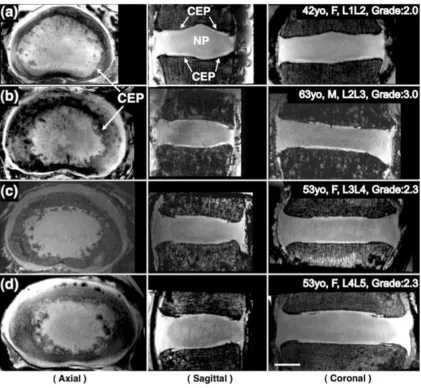
acquired at 7T. Three-plane views reformatted from the same isotropic dataset of each specimen clearly demonstrate the CEP’s (arrows) clearly, which are located between the vertebral body and the NP. Axial views show that the shape and size of the CEP can vary considerably for different subjects and levels: (a) 47 years, female, L1L2; (b) 63 years, male, L2L3; (c) 53 years, female, L3L4; (d) 53 years, female, L4L5. Scale bar = 1 cm ... 29 Figure 10: MRI and histology images of the same specimen (63 years, male, L2L3, Grade
2.6). Axial (a) and coronal (b) FLASH MRI of the whole disc, showing approximate locations of biopsy punches used for histological analysis. (c) Representative
histology section of the CEP stained with Alcian blue (glycosaminoglycans) and picrosirius red (collagen) showing adjacent NP and vertebral bone. (d) Von Kossa staining of an undecalcified section, showing regions of bone distinct from CEP and minimal CEP calcification. (Scale bars in (a) and (b) = 1 cm and in (c) and (d) = 0.5 mm) ... 30 Figure 11: CEP thickness in specimens, as measured on mid-sagittal MRI slices: (a) at
different disc levels (b) at different anterior-posterior locations (C-center, A5, A10 = 5 and 10mm off the center towards anterior, P5, P10 = 5 and 10 mm off the center towards posterior). Letters on top of error bars indicate significance (p<0.005) between measured locations. ... 31 Figure 12: Representative parameter maps at 7T: (A) T1 healthy, (B) T1 degenerate, (C)
ix
Figure 13: Computed AF MRI signals and image contrast at 7T. (a) Normalized AF signal intensity according to Equation 6 over the full range of parameters TR and TE. (b) AF image contrast based on Equation 7 utilizing the maximum and
minimum AF signal intensities. (c,d) Computed AF max (dashed), AF min (dotted) MRI signals, and image contrast (solid) at optimal TE (34 ms) (c) and versus TE at optimal TR (3000 ms) (d). ... 44 Figure 14: Representative images for (A) Radial, (B) Perinuclear, and (C)
Circumferential tears. Left column shows raw TSE images and right shows 3D fusion volume rendering for each tear, respectively ... 46 Figure 15: Volume renderings of tears: (A-B) Radial and (C) Perinuclear/Radial –
coronal views; (D-E) Circumferential – axial and coronal views of the same
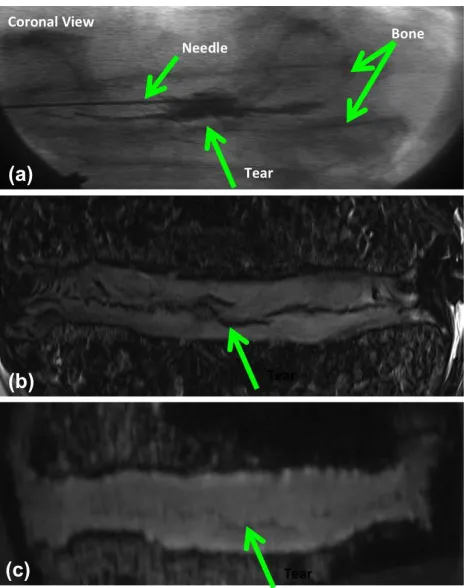
specimen. ... 47 Figure 16: Three matched images of a radial tear with different imaging: (a) fluoroscopic
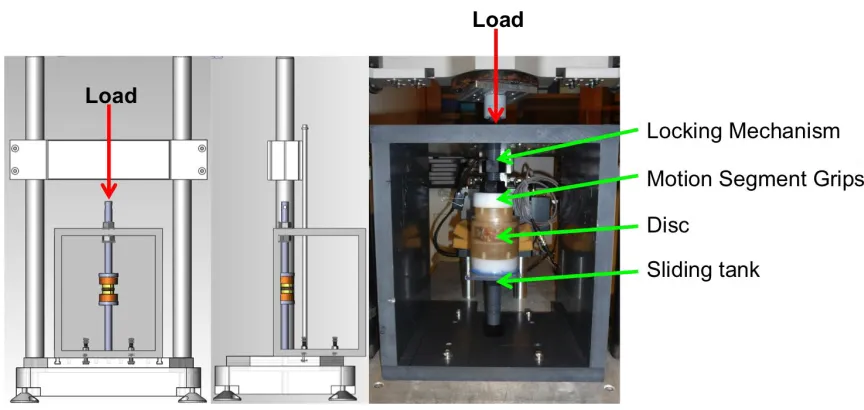
coronal view with radiographic dye, (b) T2 weighted TSE, and (c) T1 weighted FLASH ... 47 Figure 17: MRI loading frame integration with Instron 8874 ... 51 Figure 18: Effect of signal to noise ratio (SNR) on disc positioning within the MRI. Red
arrow indicates the direction of lost signal within the RF coil. Clinically relevant anatomic orientation (Left Side) results in decreased posterior AF lamellar
distinction (Orange Arrow). Lateral positioning of the disc (Right Side) enables the spine axis and B0 (Blue Circle: dot indicates spine axis and B0 direction) to be parallel, decreasing banding artifacts within the disc during image acquisition. ... 53 Figure 19: Integration of loading device with MRI and RF coil: (1) Placement of the
transmit piece of the coil in the direction of B0 on the MRI patient table, (2) loading frame slides over the transmit piece, and the (3) receive array slides directly over the disc’s location. ... 54 Figure 20: Representative mid-axial MR images with (A) and without (B) loading frame. Signal to noise ratio (SNR) was measured using a region selected within the agarose (Green) to represent signal, as these samples come from different lumbar levels (Noise – White). ... 55 Figure 21: Representative image depicting area and length measurements in the Coronal
and Sagittal plane to determine an average disc-height across the entire disc volume. ... 57 Figure 22: Representative (A) reference and (B) deformed labeled images. Labels cover
the SVB, IVB, AF lamellae, and defects. Arrows indicate differences between reference and deformed images. ... 62 Figure 23: Overlay of reference and reconstructed labels. Arrows indicate regions where
individual pixels are not aligned. ... 62 Figure 24: Reconstructed image displaying the effect of Gaussian (A) vs. B-spline (B)
regularization technique. Note the unnatural swirling pattern within the NP and vertebrae in the Gaussian regularization. ... 65 Figure 25: Segmentation of AAF (red) and PAF (blue) using ITK-SNAP. Each region
was defined based on visible lamellae within each IVD. ... 67 Figure 26: Representative plot on the effect of B-splines on AAF and PAF (A) Avg (B)
x
Figure 27: Representative (A) radial and (B) axial strain maps generated in ANTs. (C) Radial strains and (D) Axial strains measured in the AAF, PAF, and IVD in ANTs (intact white, nucleotomy checkered) and Vic2D (intact black, nucleotomy striped), == p ≤ 0.05 & — p ≤ 0.10... 70 Figure 1: (A) Loading frame interfaced with Instron (red arrow), showing locking
mechanism, segment grips, disc, and sliding tank (white arrows). (B) Loading frame integrated with RF coil (green arrows) in MRI. B0 = direction of magnetic field. .. 77 Figure 2: Images (A – C) are oriented to show coronal (left), axial (top-right), and sagittal
(bottom) planes. (A) Representative MRI data set. (B) The volume used for strain analysis (pink). (C) Annulus fibrosus regions of interest defined in the mid-axial plane: A=anterior (red), A-L=anterior-lateral (green), L=lateral (purple), P-L= posterior-lateral (yellow), P=posterior (aqua)... 79 Figure 3: Pictorial representation of the image registration process, resultant warp field,
and displacement map. The reference image is registered to the deformed image defining a warp field that prescribes how structures within the reference image are mapped to the deformed image. The deformation gradient tensor is applied to calculate the Lagrnagian strain tensor... 80 Figure 4: (A) Generation of lamellar structure labels using Sobel edge detection (red),
shown in three planes. A representative label is shown in green. (B-C) Five identified lamellar labels, shown in mid-axial view and as 3D projections,
respectively. Labels identified by white arrow. ... 82 Figure 5: Transformation of Cartesian coordinates to local disc coordinates using the
disc’s outer contour, scaled to intersect each voxel: (A) circumferential basis vectors defined by the contour’s tangent; (B) radial basis vectors defined by the contour’s normal. Note the complex vector directions imposed by the lamellar curvature. .... 85 Figure 6: Registration of a representative lamellar label (green), shown in coronal (left),
axial (top-right), and sagittal (bottom) views. Difference between original and registered label is small (red), demonstrating good registration. Scale bar = 1cm ... 88 Figure 7: Axial strains for all discs obtained by manual measurement and by image
registration, showing good agreement (r2=0.79, p<0.05). ... 89 Figure 8: Strain maps for 10% axial compression in a representative disc: (A) axial strain in coronal and sagittal views (left and right, respectively); (B) circumferential strain in axial view; (C) radial strain in axial view. Scale bar = 5 cm. ... 90 Figure 9: Mean (standard deviation) of AF regional strain at mid-disc height when loaded
to 15% compression for (A) axial, (B) circumferential, and (C) radial strain.
A=Anterior, A-L=Anterior-Lateral, L=Lateral, P=L=Posterior-Lateral, P=Posterior. Region locations are shown in Figure 2C. A solid line represents significance
p<0.05 and dashed line a trend 0.05<p<0.10. ... 91 Figure 35: Representative segmentation process for defining disc regions: (A) Automatic
NP (blue), inner AF (green), and outer AF (red), (B) Axial height division into superior, middle, and inferior disc regions, and (C) Subdivision into anterior: A, anterior-lateral: A-L, lateral: L, posterior-lateral: P-L, and posteriorL: P annulus within each axial height division. White scale bar = 1 cm. ... 107 Figure 36: Representative middle third disc height anterior outer annulus axial strain
xi
distribution. Mean strain values (solid black line) were reported for each region. One standard deviation (dashed black line) is shown for reference. ... 107 Figure 37: Reported regional (average ± standard deviation) mean strain values for
inferior (red) and superior (green) annulus fibrosus at 5%, 10%, and 15% axial compression for [A] – axial (Ezz), [B] – circumferential (E), [C] – radial (Err), and [D] – in-plane shear (Er). ... 110 Figure 38: Regional strain bar charts (mean ± standard deviation) comparing the inner
(left-hand side) and outer (right-hand side) attachment region (solid) vs. middle (dotted) AF regions under 15% axial compression for axial [A / B], circumferential [C / D], radial [E / F], and in-plane shear [G / H] at 15% axial compression.
Regions: anterior (A – red), anterior-lateral (A-L – green), lateral (L – blue),
posterior-lateral (P-L – orange), and posterior (P – turquoise) annulus. Significance: solid line p ≤ 0.05. Trend: dashed line 0.05 ≤ p ≤ 0.10. ... 113 Figure 39: Regional strain bar charts (mean ± standard deviation) comparing the
circumferential positions (A, A-L, L, P-L, and P) along the middle [left-hand side] and attachment region [right-hand side] disc height within the outer (solid) and inner (dashed) AF regions under 15% axial compression for axial [A / B], circumferential [C / D], radial [E / F], and in-plane shear [G / H] at 15% axial compression.
Regions: anterior (A – red), anterior-lateral (A-L – green), lateral (L – blue),
posterior-lateral (P-L – orange), and posterior (P – turquoise) annulus. Significance: solid line p ≤ 0.05. Trend: dashed line 0.05 ≤ p ≤ 0.10. ... 116 Figure 40: Regional strain bar charts (mean ± standard deviation) comparing the middle
[left-hand side] and attachment region [right-hand side] disc height outer (solid) and inner (dashed) AF regions under 15% axial compression for axial [A / B],
circumferential [C / D], radial [E / F], and in-plane shear [G / H] at 15% axial compression. Regions: anterior (A – red), anterior-lateral (A-L – green), lateral (L – blue), posterior-lateral (P-L – orange), and posterior (P – turquoise) annulus.
Significance: solid line p ≤ 0.05. Trend: dashed line 0.05 ≤ p ≤ 0.10. ... 118 Figure 41: Proof of concept balloon loading placement: (A) Unpressurized placement in
center of NP under fluoroscopic guidance, (B) Pressurized balloon, and (C) Securing of balloon. ... 135 Figure 42: Proof of concept balloon visualization comparing an intact bovine motion
1
CHAPTER 1
Introduction
The intervertebral disc (IVD) functions to permit motion of the spine while
distributing the multidirectional loads experienced during daily activities, including
tension, compression, torsion, and bending. Intervertebral disc degeneration widely
afflicts the aging population, often manifesting itself in low back pain. This progressive
and irreversible process causes deleterious changes to the disc’s structural integrity,
mechanical function, and nutritional pathways. The current surgical standard of care for
painful disc degeneration is limited to disc removal, followed by superior and inferior
vertebral body fusion or total disc replacement. Fusion results in a loss of motion and the
ability to distribute load. Total disc replacement attempts to preserve mobility, but does
not replicate the native disc load distribution characteristics. Quantification of internal
IVD mechanics can improve knowledge of the effect of degeneration on disc mechanical
function. This knowledge will provide crucial design criteria to better recapitulate healthy
disc structure and function, and thus improve treatment options.
Measuring disc internal mechanics is a complicated challenge; in situ boundary
condition replication is difficult with excised tissue testing samples. Motion segment
testing permits the study of overall disc stress and strain behavior, but it does not present
detail of the discs internal mechanics and interactions between its constituents. Prior
experimental studies have attempted to study the IVD internal deformations; however
they are limited to physical marker insertion or entire disc bisection, disrupting the discs
structural integrity. Physical markers may move separately from the surrounding tissue
and bisection depressurizes the NP, altering the AF mechanics. Magnetic resonance
2
non-invasive technique to visualize the disc’s substructures in two-dimensions (2D). This
technique has only been applied to measure 2D strain under single loads. However, the
IVD deforms in three-dimensions (3D). Single 2D images are not able to capture
out-of-plane deformations, which are typical of a loaded disc. Work within this dissertation will
develop techniques utilizing 3D MRI and image registration to allow intervertebral disc
structural visualization and the quantification of its deformations under load. The overall
objective of this dissertation is to measure the disc’s 3D internal deformations when
subjected to physiological loading, and more specifically, the effect of incremental axial
deformations on the regional annulus fibrosus (AF) mechanics.
Chapter 2 will provide background on the IVD and explain the structure,
composition, and mechanical function of healthy discs as well as the effects of
degeneration. Additionally, a thorough review of internal deformations within the IVD,
medical image analysis, and an introduction to Advanced Normalization Tools for image
registration will be presented.
Current MRI techniques for visualizing the detailed IVD structure have been
limited to single 2D images in one of the primary orthogonal planes: sagittal, coronal, or
transverse. Chapter 3 will develop a 3D MRI sequence to visualize and distinguish the
cartilaginous endplate (CEP). As the IVD degenerates, there is a loss of structural
integrity causing the CEP to become sclerotic. The imaging techniques developed in
Chapter 3 will then be applied to detecting and quantifying CEP thickness.
Chapter 4 will further visualize and distinguish the annulus fibrosus lamellae
within the IVD. A 3D MRI sequence will enable the ability to differentiate between
3
circumferential, perinuclear), rim lesions, and Schmorl’s nodes. The high-resolution 3D
images will then be applied to the clinically relevant problem to non-invasively
characterize and quantify annular deformities which are linked to low back pain and alter
disc mechanics. The ability to visualize AF lamellae in 3D will be applied to track
internal deformations within the disc under physiological loading in Chapters 7-8.
Chapter 5 describes an MRI compatible loading device designed to apply
incremental amounts of axial compression, maintain disc hydration, and integrate with a
curved RF coil. The developed loading frame will enable disc image acquisition in both a
reference and deformed state with the optimized sequence from Chapter 4.
Image registration is considered a promising soft tissue (e.g., pulmonary and
cardiovascular tissues, and ligament) strain analysis technique utilizing medical images.
Chapter 6 will establish the use of Advanced Normalization Tools (ANTs), an image
registration software for disc registration and optimize its parameters for 2D strain
analysis. The use of manual segmentation tools will enable registration accuracy
verification and strain measurements across user-defined regions. Registration strain
measurements before and after nucleotomy will be compared with previously published
texture correlation methods. Image registration optimization in 2D will be translated to
3D in chapters 7-8.
In Chapter 7, the high-resolution isotropic MR imaging sequence (Chapter 4),
MRI safe loading frame (Chapter 5), and optimized image registration parameters
(Chapter 6) will enable 3D internal deformation measurements in intact human discs.
Intervertebral disc substructures work together and distribute multi-directional loading in
4
strain distributions under physiological loading is limited. Experimental whole-disc
testing is limited to providing global disc load and deformation details, not yielding
internal mechanics information. The effect of incremental amounts of axial compression
on the regional strain variance will be reported along the mid-axial disc height.
Chapter 8 will expand upon the techniques developed in Chapters 3 – 6 to assess
the internal regional strain properties of the IVD. Regional strain analysis has been
limited to mid-axial, ex-vivo tissue testing, surface strain measurements, and
two-dimensional internal analysis. A complete 3D internal strain analysis will be performed
segmenting the disc into radial (i.e., inner and outer), circumferential (i.e., anterior,
lateral, and posterior) and axial (i.e., inferior, medial, and superior) components.
The developed capabilities to measure 3D internal strain within the disc, the
results from this dissertation, and proposed future studies involving the assessment of
degeneration, different loading schemes, and clinical treatments will be discussed in
5
CHAPTER 2
Background
2.1.
Clinical Significance
Intervertebral disc (IVD) degeneration is a progressive disease strongly linked to
low back pain (Frymoyer 1988, Andersson 1999, Adams 2004, Adams and Dolan 2005).
This ailment debilitates more than 5 million Americans and is the second most frequent
reason for physician visits (Deyo and Tsui-Wu 1987, Luo, Pietrobon et al. 2004). Its
estimated $100 billion societal cost in the United States (Katz 2006) mandates increased
knowledge of the effects of this disease. Current surgical treatment options for painful
disc degeneration is limited to disc removal, followed by either superior and inferior
vertebral body fusion or total disc replacement (Schizas, Kulik et al.). Fusion results in a
loss of motion and load distribution. Total disc replacement attempts to preserve mobility
but does not replicate the native disc load distribution characteristics (Costi, Freeman et
al.). Degeneration greatly affects the IVD and its constituents; it is associated with
mechanical damage, biological degradation, and a loss of nutritional pathways (Martin,
Boxell et al. 2002). Studies have shown that individuals, who undergo recurring
compressive and torsional motion, have a higher incidence of disc degeneration
compared to the general population (Kumar 2004, Hangai, Kaneoka et al. 2009). The
factors that cause disease progression, including interactions of mechanical,
compositional, structural, and cellular changes, are not well understood (Buckwalter and
Mow 2000). The primary function of the disc is mechanical; however the understanding
of disc internal deformations is limited to 2D work (O'Connell, Malhotra et al. ,
6
motivates the current study to examine the disc’s 3D internal mechanics, quantify the
effects of degeneration, and explore potential restorative techniques for AF mechanics.
2.2.
Intervertebral Disc Structure
The spine is a column-like structure that is made up of alternating vertebral bodies
(VB) that encapsulate the intervertebral discs (IVD) acellular soft-tissues. The IVD
sub-structures (Figure 1) comprise of the nucleus pulposus (NP), annulus fibrosus (AF), and
the cartilaginous endplates (CEP).
Figure 1: Representative lumbar spine image and the intervertebral disc sub-structures.
The NP is a hydrated, gel-like structure made up of water, proteoglycan, and type
II-collagen that primarily aids the IVD during compression (Pearce, Grimmer et al.
1987). The NP is circumferentially encapsulated by the AF, which is made up of highly
organized concentric lamellae. Each layer of lamellae has alternating fiber orientations
28°-43° above and below the transverse plane (Marchand and Ahmed 1990); with the
angle increasing from outer to inner AF. These fibers are made up of collagen bundles
that are embedded in a matrix of proteoglycans and non-fibrillar collagens. Along the
7
in type I collagen (Buckwalter 1995); resulting in less distinctive lamellae. Lamellae
thickness varies by location (anterior/posterior/lateral) within the disc and becomes
thicker towards the NP ranging from 140 – 520 μm (Marchand and Ahmed 1990). The
AF outer lamella fibers are attached to the vertebra, while the inner lamellas merge with
the CEP. The CEP is a very thin layer of hyaline-like cartilage, ranging from 450 – 800
μm positioned between the vertebral endplates and the NP (Roberts, Menage et al. 1989,
Marchand and Ahmed 1990, Roberts, Menage et al. 1993, Moore 2000, Urban and
Roberts 2003). It provides a mechanical barrier between the pressurized NP and the VB,
acting as a gateway for nutrient transport from blood vessels into the disc (Roberts,
Menage et al. 1993, Moore 2000, Urban and Roberts 2003). The structure and
composition of the disc is strongly linked to its mechanical function (Buckwalter and
Mow 2000).
2.3.
Disc Mechanical Function
The intervertebral discs sub-structures (nucleus pulposus – NP, annulus fibrosus –
AF, and cartilaginous endplate – CEP) function to distribute multi-directional loads,
which are applied to the disc during daily activities that relate to tension, compression,
torsion, and bending with stresses ranging from 0.1-2.3 MPa (Nachemson and Morris
1963, Wilke, Neef et al. 1999). The disc acts as a pressurized vessel, under load the NP
exhibits viscoelastic properties (Iatridis, Weidenbaum et al. 1996, Iatridis, Setton et al.
1997), where the pressurization of the NP transfers hoop stresses radially to the
anisotropic nonlinear AF. The alternating AF collagen fiber network permits resistance to
8
circumferential stress from the NP bulging under physiological loading. The proposed
work will focus on the internal strains seen during physiological compressive loads.
Motion-segment (bone-disc-bone) testing has been extensively performed in
compression analyzing both the static (Stokes, Laible et al. , Koeller, Funke et al. 1984,
Keller, Spengler et al. 1987, Cannella, Arthur et al. 2008) and dynamic (Adams and
Hutton 1983, Liu, Njus et al. 1983, Hansson, Keller et al. 1987, Race, Broom et al. 2000,
Riches, Dhillon et al. 2002, Johannessen, Vresilovic et al. 2004, van der Veen, van Dieen
et al. 2007, Korecki, MacLean et al. 2008, Wang, Wu et al. 2008) responses of the disc.
Disc height decreases under axial compression, resulting in an intradiscal pressure
increase. The reported disc’s compressive stiffness and modulus are 1.73 kN/mm and
3-10MPa (Nachemson, Schultz et al. 1979, Shea, Takeuchi et al. 1994, Beckstein, Sen et al.
2008) respectively. Under extended creep loading the NP transfers load to the annulus.
The thin posterior annulus sustains high strains (Stokes 1987, Heuer, Schmidt et al. 2008)
resulting in stress concentrations (Adams, McMillan et al. 1996, Edwards, Ordway et al.
2001). Radiographic measures have shown the endplate to bulge under increasing
amounts of load (Holmes, Hukins et al. 1993).
Torsional shear modulus ranges between 2-9 MPa (Abumi, Panjabi et al. 1990,
Elliott and Sarver 2004, Beckstein, Espinoza Orias et al. 2007) within the AF, where the
disc experiences 1-2° of torsion in-vivo (Adams and Hutton 1981). Both the facet joints
and annulus resist torsion (Shirazi-Adl 1994, Krismer, Haid et al. 1996) with the annulus
bearing upwards of 77% (Yingling and McGill 1999). Surface strain measurements have
shown the posterior lateral region to experience the greatest strain under torsion (Stokes
9
linked to degeneration by the derangement of the AF lamellae at low magnitudes (Farfan
1969, Farfan, Cossette et al. 1970) and to increased risk of herniation under combined
loading conditions (Drake, Aultman et al. 2005).
2.4.
Disc Degeneration
Degeneration of the IVD causes progressive changes to the disc’s structural
integrity (Figure 2), mechanical function, and loss of nutritional pathways; the
interactions of these changes are not well understood. During IVD degeneration the
proteoglycans breakdown, resulting in a pressure loss and the ability to maintain
hydration within the NP. This pressure and hydration loss subsequently causes a
decrease in compressive stiffness (Buckwalter 1995, Nguyen, Johannessen et al.
2008). These changes in biochemical composition as a result of degeneration lead to
a loss in fixed charge density (Urban and McMullin 1985, Urban and McMullin
1988). Consequently, the AF bears most of the loads within the IVD (Tsantrizos, Ito
et al. 2005), leading to inward bulging of the AF (Brinckmann and Grootenboer
1991), disorganization, and thickening. Thickening increases collagen cross-linking
(Pokharna and Phillips 1998), which can lead to annular tears (Thompson, Pearce et
al. 1990, Adams 2004) and ultimately disc herniation. The inner AF undergoes an
increase in collagen content with type II collagen fibrils becoming type I.
(Weidenbaum and Iatridis 2006). This change in fibril type makes the distinction
between NP and AF less apparent. Additionally, the CEP becomes sclerotic and loses
vascular contact, which in turn causes decreased permeability, nutritional loss, and
10
Roberts, Urban et al. 1996, Grignon, Grignon et al. 2000, Bibby, Jones et al. 2001,
Martin, Boxell et al. 2002, Adams and Roughley 2006, Accadbled, Laffosse et al.
2008, Raj 2008). These compositional changes of the IVD cause height loss, shifting
the load towards the facets (Yang and King 1984) and placing high stresses on the
AF leading to tears (Vernon-Roberts, Fazzalari et al. 1997, Lawrence, Greene et al.
2006).
Figure 2: Magnetic resonance images illustrating different stages of human lumbar degeneration. (A) A healthy disc exhibiting distinct AF lamellae and central NP region. (B) A disc exhibiting early stages of degeneration, including moderate height reduction, decreased NP signal intensity and inward bulging of AF lamellae (*). (C) A disc
exhibiting advanced stages of degeneration, including severely reduced height, large fissures (*) and generalized structural deterioration.(Smith, Nerurkar et al. 2011)
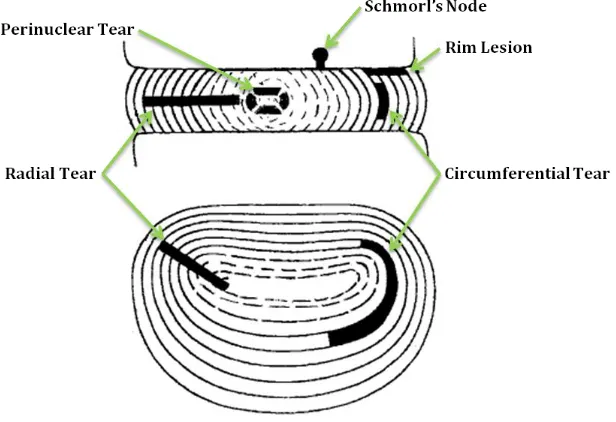
Annular defects have been categorized into classic tear categories: radial,
circumferential, perinuclear (Osti, Vernon-Roberts et al. 1992, Vernon-Roberts,
Moore et al. 2007) and other defects such as rim lesions and Schmorl’s nodes (Figure
3). Radial tears typically initiate at the NP and radiate outward, occurring primarily
11
increased age (Osti, Vernon-Roberts et al. 1992, Vernon-Roberts, Fazzalari et al.
1997). Circumferential tears are the separation of lamellae and occur equally in the
anterior and posterior AF, often concentrated in the outer regions (Osti,
Vernon-Roberts et al. 1992, Vernon-Vernon-Roberts, Fazzalari et al. 1997). Perinuclear tears are the
separation of the NP from the AF and result in a cleft (Vernon-Roberts, Moore et al.
2007).
In cadaveric studies, morphological/histological sections and discograms
(fluid contrast injected into the NP) have been used to quantify AF tears.
Morphological sections are limited because they only view one disc slice, while tears
occur in a complex 3D pattern (Vernon-Roberts, Fazzalari et al. 1997, Videman and
Nurminen 2004).
Figure 3: Representative annular and intervertebral disc defects. (Vernon-Roberts, Moore et al. 2007)
Discogram studies detect the presence of radial tears, but not their size or structure,
12
Kakitsubata, Theodorou et al. 2003, Videman and Nurminen 2004). The risk of a
radial AF tears has been shown to be 60% in early adulthood and 100% by
retirement age through an extensive discogram study of 157 cadaver spines. The
risk of a full AF tear is 10% for 20 to 49 year olds and 35% for 50 to 59 year olds
(Videman and Nurminen 2004). A comprehensive recent study using multiple
histological sections of L4-L5 quantified the incidence concentric tears to be ~100%
between ages 10 and 80 years (Vernon-Roberts, Moore et al. 2007). The incidence of
perinuclear tears was also high at ~90% across all ages. Posterior radial tears
increase from 70% incidence in those 10-30 years to 85% within the 51-89 year
group (Vernon-Roberts, Moore et al. 2007). Rim lesions occur at the junction of the
AF and vertebral endplate and are related to trauma, rather than degeneration. Rim
lesion data shows 30% incidence at age 30 and 90% at age 80 (Vernon-Roberts,
Moore et al. 2007). Schmorl’s nodes are herniations of the disc into the VB (Resnick
and Niwayama 1978). Reported frequency in the literature is varied (Hilton, Ball et
al. 1976, Hansson and Roos 1983, Hamanishi, Kawabata et al. 1994, Stabler, Bellan
13
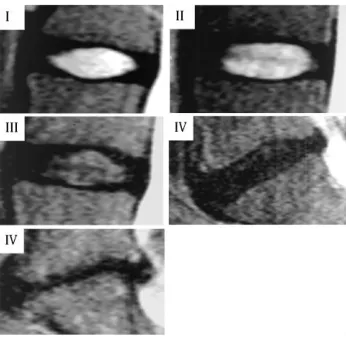
Figure 4: Pfirmann grading scale displaying degenerative changes visualized in MR (Pfirrmann, Metzdorf et al. 2001).
The degenerative IVD structural and compositional changes can be visualized
with MR imaging. Images illustrate a decrease in signal intensity, disc height narrowing,
and osteophytes on the vertebral bodies (Pfirrmann, Metzdorf et al. 2001). Pfirrmann et
al. established a qualitative graded scale (Figure 4) of increasing degeneration, where
non-degenerate discs are grades I-II, moderately degenerate are grades III-IV, and
severely degenerate grade V (Pfirrmann, Metzdorf et al. 2001).
Figure 5: T2 correlations to T1ρ and Pfirrmann from Elliot Lab lumbar spine database collected over several years for a multitude of studies
Since degeneration is a continuous process, quantitative MR mapping techniques
14
proteoglycan content (Blumenkrantz, Zuo et al. , Borthakur, Maurer et al. , Marinelli,
Haughton et al. , Takashima, Takebayashi et al. , Welsch, Trattnig et al. , Zuo, Joseph et
al. , Blumenkrantz, Li et al. 2006, Johannessen, Auerbach et al. 2006, Perry, Haughton et
al. 2006, Watanabe, Benneker et al. 2007, Nguyen, Johannessen et al. 2008, Marinelli,
Haughton et al. 2009). T2 mapping will be used within this study because it is more
repeatable and is correlated to both Pfirrmann grade and T1ρ score (Figure 5)
(Blumenkrantz, Zuo et al.).
2.5.
Internal Deformations
Internal deformations of IVD strains have been measured through various optical
and radiographic techniques (Seroussi, Krag et al. 1989, Meakin and Hukins 2000,
Kusaka, Nakajima et al. 2001, Meakin, Redpath et al. 2001, Tsantrizos, Ito et al. 2005,
Ho, Kelly et al. 2006, Costi, Stokes et al. 2007). Physical markers were inserted to track
displacements within the disc. Markers included metal beads (Seroussi, Krag et al. 1989),
thin wires (Tsantrizos, Ito et al. 2005, Costi, Stokes et al. 2007), or nylon rods (Kusaka,
Nakajima et al. 2001). These markers offered limited accuracy since they were able move
separately from the structure of the disc. This limitation was improved by the use of
Alcian blue stain dots to track the displacements of a sagittaly bisected disc against
transparent Plexiglas (Meakin and Hukins 2000, Meakin, Redpath et al. 2001, Ho, Kelly
et al. 2006); however, bisection depressurizes the disc. The recent application of the
commercial texture correlation software Vic2D (Correlated Solutions Inc: Columbia, SC)
15
in 2D within the sagittal and coronal plane of the disc (O'Connell, Malhotra et al. ,
O'Connell, Vresilovic et al. , O'Connell, Johannessen et al. 2007).
O’Connell et al. utilized a turbo spin echo (TSE) with TR/TE = 3000/113 ms
respectively, producing T2-weighted 2D mid-sagittal/coronal MR images with in-plane
resolution of 234 μm/pixel and 3mm slice thickness on a 3T clinical MRI scanner
(O'Connell, Johannessen et al. 2007). Spin-echo based sequences have been widely used
for MR imaging of the intervertebral disc (Haughton 2004) because they are less
susceptible to inhomogeneity’s in the magnetic field. T2-weighting an image with a long
echo time (TE) and long repetition time (TR) provides brighter signal for high water
content soft tissues and darker for fat predominant tissues. Texture correlation strain
measurements (resolution of 1/20th pixel = 11.7μm) were validated against displacement
measurements across the entire disc and also against finite element studies (O'Connell,
Johannessen et al. 2007). Under axial compression it was found that compressive and
radially tensile strains increased with degeneration (O'Connell, Vresilovic et al.). The
posterior AF experienced the highest regional strain and did not correlate with
degeneration, indicating that the posterior region undergoes high loads throughout life
(O'Connell, Vresilovic et al.). The use of MRI to measure internal deformations permits
the study of clinical treatments such as nucleotomy, which increases compressive AF
strains while decreasing radial strain (O'Connell, Malhotra et al.). Despite significant
technical improvements, these studies are limited to 2D strain measurements for a 3D
structure. It is difficult to limit out of plane motion; the 3D techniques developed in this
thesis will mitigate these limitations. Texture correlation has been shown to produce
16
MR images (Gilchrist, Xia et al. 2004). Recognition of such limitations has directed the
implementation of image registration to perform strain analysis on medical images
(Phatak, Sun et al. 2007). This process produces comparable results to texture correlation
(Hardisty, Akens et al. , Villemure, Cloutier et al. 2007). A non-rigid image registration
method was employed by Reiter et al. to calculate mid-sagittal strain after creep loading
(Reiter, Fathallah et al. 2012). Displacement encoded MRI, an image tagging method that
enables direct displacement measurements from MR data, was used by Chan and Neu to
calculate strain across the entire disc under cyclic loading (Chan and Neu 2013). These
studies utilized MR phantoms (Chan and Neu 2013) or computer generated deformations
(Reiter, Fathallah et al. 2012) to verify strain measurements. However, experimental
specific verification can provide a better sense of what is actually occurring within the
disc (ground truth). Image registration and the application of overlap statistics with
segmentations will provide strain analysis of the entire disc and accurate disc-specific
reportable strain resolution in Chapter 6-8.
2.6.
Medical Image Analysis and Registration Applications
Quantitative image analysis including texture correlation, digital volume
correlation and image registration (Liang, Zhu et al. , O'Connell, Malhotra et al. ,
O'Connell, Vresilovic et al. , Tustison, Cook et al. , Weiss, Rabbitt et al. 1998, Bay,
Smith et al. 1999, Bay 2001, Veress, Weiss et al. 2002, Tustison, Davila-Roman et al.
2003, Veress, Gullberg et al. 2005, Tustison and Amini 2006, Chandrashekara,
Mohiaddin et al. 2007, Liu and Morgan 2007, O'Connell, Johannessen et al. 2007,
17
extensively used to measure strain from various biomedical imaging modalities. Texture
correlation is a pattern-matching algorithm that compares random patterns of pixel
intensities between two images, calculating displacements between individual pixels in
corresponding images. Digital volume correlation is an adjunct to digital image
correlation, a form of texture correlation utilizing 3D images to track microstructural
feature movement within specimens (Bay, Smith et al. 1999, Bay 2001, Liu and Morgan
2007). Image registration is the process of finding a transformation (warp field) which
can map points from a reference image (original) to a different image (deformed) (Ng and
Ibanez 2004), this technique has been widely applied to medical images.
Image registration permits various imaging modalities, including X-Ray, CT, and
MRI which can be spatially aligned to correlate data (Maintz and Viergever 1998). The
wide applicability of image registration enables physicians to quantitatively detect subtle
changes between images, facilitate identification and localization of brain lesions for
surgical guidance (Ng and Ibanez 2004), assess treatment effectiveness pre- and post-
intervention and tumor/disease development (Maintz and Viergever 1998, Ng and Ibanez
2004), hippocampus disease valuation via template building for population studies
(Avants, Yushkevich et al.), and measuring ligament, pulmonary, and cardiovascular
tissue mechanics (Liang, Zhu et al. , Tustison, Cook et al. , Weiss, Rabbitt et al. 1998,
Veress, Weiss et al. 2002, Tustison, Davila-Roman et al. 2003, Veress, Gullberg et al.
2005, Tustison and Amini 2006, Chandrashekara, Mohiaddin et al. 2007, Phatak, Sun et
al. 2007, Phatak, Maas et al. 2009, Tustison, Avants et al. 2009). Parameter selection is a
critical process when performing image registration in a new tissue, in Chapter 6-7 these
18
2.7.
Advanced Normalization Tools Image Registration Parameters
Registrations are performed using either features or image intensity. Features
include specific points and landmarks or binary structures within the native anatomy,
which can be segmented as curves, surfaces, or volumes. Image intensity refers to the
image grayscale patterns. Landmark- and segmentation- based registration methods align
images, minimizing the distance between features. Intensity-based registrations minimize
a cost function that measures the similarity of the intensity between corresponding
images (Ng and Ibanez 2004). Advanced Normalization Tools (ANTs) is a
multi-resolution approach encompassing landmark-, segmentation-, and intensity- based
registration techniques.
The registration process is guided by 3 main parametric variables: transformation
model, regularization technique, and the similarity metric to define the resultant warp
field (Figure 6). The transformation model determines how one image is mapped into or
aligned with another image. Multiple transformation models exist to account for varying
degrees of differentiation between the images registered. During registration, ANTs has
the ability to account for rigid translation and rotation to align one image with another.
Deformable or non-rigid models (Diffeomorphic or Elastic) are more flexible, modeling
and deforming the image as a continuum (e.g. elastic material, viscous fluid, etc.) (Avants
and Gee 2004). During registration, the transformation model deforms the images on an
overlaid grid or warp field. Generally, points that fall along gridlines are matched directly
to points in the second image, and thus the grayscale intensity is known. The
regularization technique interpolates the pixel intensity of points mapped between
19
Gonner et al. 1999, Tustison, Avants et al. 2009) interpolators, which use Gaussian
distributions and basis functions respectively, to assign intensity values. The choice of
regularization as well as its measures (e.g. size of variance and number of splines) affects
the smoothness of the mapping. Similarity metrics are statistical measures used to
quantify the resemblance between the pixel intensity patterns in both images. Different
statistical measures should be used if pixel intensities and patterns are consistent or vary
across images. The metric choice is thus dependent on whether one or multiple imaging
modalities are used. ANTs offers several similarity metrics and is capable of both mono-
and multi- modality registrations. Mean squared difference (MSQ) and fast cross
correlation (CC) are ideal for mono-modality registrations, which are employed in this
work.
20
CHAPTER 3
Cartilaginous Endplate Geometry
3.1.
Introduction
The intervertebral disc has three distinct anatomical regions: the central nucleus
pulposus (NP), the surrounding annulus fibrosus (AF), and centrally positioned
cartilaginous endplates (CEP). These CEPs are distinct from the adjacent vertebral
endplates, which are composed of cortical bone (Francois, Bywaters et al. 1985, Roberts,
Menage et al. 1989, Raj 2008). The CEP is an approximately 600 μm thick layer of
hyaline cartilage positioned between the vertebral endplate and NP (Roberts, Menage et
al. 1989). It functions both as a mechanical barrier between the pressurized NP and the
vertebral bone, as well as a gateway for nutrient transport into the disc from adjacent
blood vessels (Crock and Goldwasser 1984, Roberts, Menage et al. 1993, Moore 2000,
Urban and Roberts 2003).
Intervertebral disc degeneration causes the CEP to become sclerotic, lose vascular
contact, and exhibit decreased permeability (Nachemson, Lewin et al. 1970, Bernick and
Cailliet 1982, Roberts, Urban et al. 1996, Grignon, Grignon et al. 2000, Bibby, Jones et
al. 2001, Benneker, Heini et al. 2005, Accadbled, Laffosse et al. 2008). This process is
considered to contribute to degeneration by reducing diffusion of nutrients to cells of the
NP (Ariga, Miyamoto et al. 2001, Martin, Boxell et al. 2002, Adams and Roughley 2006,
Raj 2008).
The literature is replete with cadaveric studies using histology or gross sections
depicting CEP thickness (Roberts, Menage et al. 1993, Vernon-Roberts, Fazzalari et al.
1997, Videman and Nurminen 2004, Bae, Statum et al. 2013). However, even multiple
21
accurate quantitative techniques for characterization of the 3D human CEP. Magnetic
resonance imaging (MRI) is a non-invasive, non-ionizing imaging modality well known
for its superior soft tissue contrast, making it ideal for disc applications including
anatomy, composition, and stage of degeneration through a number techniques (e.g., T1ρ-
and T2-weighted images) (Lyons, Eisenstein et al. 1981, Pfirrmann, Metzdorf et al. 2001,
Antoniou, Mwale et al. 2006, Johannessen, Auerbach et al. 2006). Application of MRI to
the study of the intervertebral disc has to date focused predominantly on the composition
of the NP and AF. Few studies have examined the CEP, therefore the objective of this
chapter is to develop MRI techniques to visualize and quantify the CEPs geometric.
In-order to visualize the thin CEP and accurately measure is thickness, a sufficiently high
22
3.2.
Materials and Methods
3.2.1. Intervertebral disc MRI parameter measurement
In this chapter, a T1weighted 3D FLASH (fast low-angle shot) sequence was
chosen for CEP imaging. In the FLASH sequence, transverse magnetization is spoiled
and the steady-state longitudinal magnetization depends on T1 and the flip angle. Flip
angle is the angle at which the net magnetization is rotated relative to the primary
magnetic field (B0) by application of an excitation pulse. The sequences parameters
repetition time (TR) and flip angle thus determine the T1 contrast in the FLASH
sequence and were optimized in this study using an analytical model. Repetition time
(TR) is the amount of time between successive pulses applied during image acquisition.
Optimized sequence parameters TR and flip angle will yield sufficient image contrast to
distinguish the CEP from its adjacent tissue.
The first step in MR image sequence optimization involves determining the MRI
tissue specific properties. To achieve a T1 weighted image, the T1 relaxation time must
be determined. T1 relaxation time (measured in milliseconds) known, as longitudinal
relaxation time is a measure of the time required for a tissues protons to realign with B0.
T1 values of NP, CEP, and AF lamellae were measured in a representative healthy and
degenerate cadaveric lumbar disc (Grade = 2.3/5) (Pfirrmann, Metzdorf et al. 2001) at 7T
magnetic field strength. T1 was measured using a fully relaxed (TR = 5100 ms) 2D spin
echo inversion recovery pulse sequence with ten inversion times (TI = 33 – 5000 ms). T1
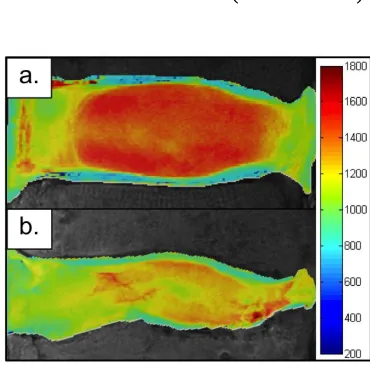
maps were generated (Figure 7) by fitting data on a pixel-by-pixel basis to its respective
23
Equation 1). Averaging 900 or more pixels within center of the NP, anterior and posterior
AF, and CEP determined representative T1 values of each disc substructure.
Equation 1:
Figure 7: Representative T1 parameter maps at 7T: (A) T1 healthy, (B) T1 degenerate
3.2.2. Optimization of CEP image contrast
In order to attain pulse sequence parameters with optimized contrast in the CEP,
MRI signal intensity and image contrast were simulated using an analytical MRI pulse
sequence equation prior to imaging. The T1 contrast of the FLASH sequence is a
function only of TR and flip angle in the limit of a short echo time (TE), and the
dependence of MRI signal intensity upon flip angle, TR, and T1 is given by Equation 2
where A is the equilibrium magnetization reduced by T2 relaxation and α is the flip angle
(Helms, Dathe et al. 2008, Dathe and Helms 2010). Echo time (TE) corresponds to the
time between RF pulse and the peak in signal. T2 relaxation time known, as transverse
relaxation is a measure of time required for a tissues protons to dissipate energy to their
surrounding nuclei perpendicular to B0.
24
This equation was used to analyze the signal dependence on flip angle and TR, the
primary adjustable imaging parameters in this application. Using the experimentally
determined mean T1 and I0 values for NP and CEP, normalized MRI signals (
Equation 2) for each substructure were plotted versus flip angle and TR. The image
contrast (signal difference) between NP and CEP (
Equation 3), normalized to maximize the signal intensity of CEP, was plotted versus flip
angle and TR for the full range of possible parameter values according to ex vivo MR
imaging
Equation 3:
3.2.3. Cartilaginous Endplate Imaging
Specimens for CEP imaging were prepared from 11 cadaveric human lumbar spines
(n = 17 discs, age: 57.7 ± 13.3). While for some subjects 2–3 levels were used from a
single spine, consistent with common practice in the literature (O'Connell, Vresilovic et
al. , Iatridis, Setton et al. 1997, Rodriguez, Slichter et al. 2011), these discs were assumed
to be independent samples and post hoc statistical analysis confirmed no subject
dependence on CEP height. Each whole spine was first scanned with a mid-sagittal T2-
weighted turbo spin echo imaging sequence for routine grading of degenerative state
(Pfirrmann, Metzdorf et al. 2001, Johannessen, Auerbach et al. 2006). The integer grade
from five individual examiners was averaged (Grade: 2.8 ± 0.7). Lumbar spines were
then dissected into bone-disc-bone segments with posterior elements removed and sealed
in airtight freezer bags to avoid dehydration during imaging. The sealed segments were
then embedded in 2 % agarose gel for immobilization and to reduce image distortion at
25
For protocol optimization, the flip angle and TR that provided the best optimal
NP-CEP contrast was selected using the analytical model simulation. All imaging was done
in a Siemens Magnetom 7T scanner (Siemens Medical Solutions, Erlangen, Germany)
using a 4-channel ankle coil (Insight MRI) (Wright, Lemdiasov et al. 2011). Due to the
thinness of the endplate, a voxel size of 200 μm3 was chosen. Imaging parameters were
TR = 9 ms, TE=3.7ms, flip angle=20°, (0.2 mm)3isotropic resolution, matrix = 320 x
320, and fat suppression. Scan time was 3 min per disc.
3.2.4. CEP Histology and endplate thickness quantification
Histological analysis was performed to confirm that the structure visualized using
MRI was indeed the CEP and to compare CEP thickness measurements with
measurements from site-matched MR images. Two adjacent 8 mm biopsy punches,
comprising vertebral bone, the CEP and the NP, were taken from a disc (63 years, male,
L2L3, Grade: 2.6), which had previously been imaged as described above, and an optical
image of the specimen was taken. These 200 μm3 isotropic MRI data and photograph
were later co-registered to confirm the location of the punches. Both punches were fixed
in buffered 10% formalin overnight. One punch was then decalcified overnight in formic
acid/EDTA. Twenty-micron sections were cut on a cryostat, and double stained with
Alcian blue and picrosirius red to demonstrate glycosaminoglycans and collagen,
respectively, and imaged using bright field microscopy. The other punch was sectioned in
a similar way, but without prior decalcification. These sections were then stained using
the von Kossa method to demonstrate calcium deposits and imaged using differential
26
To compare MRI-based CEP measurements with a histological standard, three 4
mm diameter CEP samples were punched within the inferior endplate for a single disc
(75 years, male, L2L3, Grade: 2.0), sectioned on a cryostat, and the CEP thickness
measured at three evenly spaced intervals across the plug. Virtual plugs were generated
from the MR data by co-registering with an optical image of the vertebral surface and
site-matched CEP thickness measurements were made.
Images were imported into OsiriX software and evaluated for CEP contrast in
comparison to the surrounding structures, for morphology three dimensions thickness.
MRI data had isotropic resolution and, therefore, could be viewed in arbitrary image
planes using multi-planar reformatting. The CEP thickness was measured for the superior
and inferior CEP along the mid-sagittal plane at five locations (center, 5 and 10 mm off
the center towards anterior and 5 and 10 mm off the center towards posterior). Average
thicknesses across specimens were measured by hand within OsiriX for each location and
each disc level.
The CEP thickness measurements were evaluated using a two-way ANOVA with
repeated measures, where the factors were disc level (L1L2, L2L3, L3L4, L4L5, L5S1)
and anterior-posterior disc location (center, 5 and 10 mm off the center towards anterior,
and 5 and 10 mm off the center towards posterior). Significance was set at p < 0.05. A
post hoc Bonferonni test was performed when significance was detected resulting in
27
3.3.
Results
Average T1 values (±standard deviation) from the T1 parameter map (Figure 7) of
each disc substructure obtained at 7T are presented for a representative healthy and
degenerate disc substructures in Table 1. These T1 values were used in Equation 2 and
Equation 3 to calculate signal intensity and determine optimal pulse sequence parameters
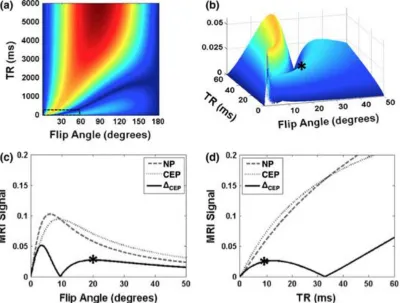
for NP-CEP image contrast (DCEP) (Figure 8). Figure 8a shows a contour plot of DCEP
covering the exhaustive range of flip angles (0–180°) and TR values (0–6,000 ms).
However, only a small region corresponding to short TR (dotted box in Figure 8a), where
scan time is reasonable for future in vivo applications, was considered in selecting the
optimal sequence parameters (Figure 8b), and the optimal flip angle and TR were
identified (asterisk in Figure 8b).
Grade Region T1
Healthy
AF 1270 ± 80
NP 1510 ± 50
CEP 775 ± 75
Degenerate
AF 1100 ± 43
NP 1300 ± 65
CEP 840 ± 32