Motor Coordination and Psychosocial Correlates in
a Normative Adolescent Sample
WHAT’S KNOWN ON THIS SUBJECT:Research has highlighted an important relationship between motor coordination and emotional functioning in children and adolescents. Few studies have provided support for this idea; research is therefore needed to further understand the relationship between the motor and emotional domains.
WHAT THIS STUDY ADDS: The results suggest that the relationship between motor coordination and emotional
functioning (anxious and depressive symptoms) in an adolescent sample may be understood in terms of a mechanism whereby motor coordination has an indirect impact on emotional functioning via self-perceptions.
abstract
OBJECTIVES: Previous research has revealed an important relation-ship between motor coordination difficulties and internalizing prob-lems such as anxiety and depressive symptoms. However, further research is needed to understand the potential mediating factors in this relationship. The aim of the current study was to examine whether the association between motor coordination and emotional functioning is mediated by self-perceptions in a normative sample of adolescents.
METHODS:Participants included 93 adolescents aged 12 to 16 years. The Movement Assessment Battery for Children–2 provided 2 indica-tors of motor coordination; the Mood and Feelings Questionnaire and Spence Children’s Anxiety Scale provided 2 indicators of emo-tional functioning; and the Self-Description Questionnaire–II provided 6 indicators for self-perceived competence.
RESULTS:Structural equation modeling revealed that motor coordina-tion affects emocoordina-tional funccoordina-tioning via self-percepcoordina-tions.
CONCLUSIONS: These results suggest that the relationship between motor coordination and emotional functioning in adolescents from a normative sample may be understood in terms of a mechanism by which motor coordination has an indirect impact on emotional outcomes through various self-perception domains. Thesefindings have important implications for increasing awareness and developing appropriate treatment programs for motor coordination and emotional difficulties.Pediatrics2012;129:e892–e900
AUTHORS:Daniela Rigoli, BPsych (Hons), Jan P. Piek, PhD, and Robert Kane, PhD
School of Psychology and Speech Pathology, Curtin Health Innovation Research Institute, Curtin University, Perth, Western Australia
KEY WORDS
adolescents, anxious symptoms, depressive symptoms, motor coordination, normative sample, self-perceptions
ABBREVIATIONS
ADHD—attention-deficit/hyperactivity disorder DCD—developmental coordination disorder
MABC-2—Movement Assessment Battery for Children–2 MFQ—Mood and Feelings Questionnaire
SCAS—Spence Children’s Anxiety Scale SDQ-II—The Self-Description Questionnaire–II SES—socioeconomic status
SWAN—Strengths and Weaknesses of ADHD Symptoms and Nor-mal Behavior Scale
VCI—Verbal Comprehension Index
WISC-IV—Wechsler Intelligence Scale for Children–IV www.pediatrics.org/cgi/doi/10.1542/peds.2011-1237 doi:10.1542/peds.2011-1237
Accepted for publication Nov 29, 2011
Address correspondence to Daniela Rigoli, BPsych (Hons), School of Psychology and Speech Pathology, Curtin University, GPO Box U1987, Perth 6845, Western Australia.
E-mail: [email protected]
PEDIATRICS (ISSN Numbers: Print, 0031-4005; Online, 1098-4275). Copyright © 2012 by the American Academy of Pediatrics
FINANCIAL DISCLOSURE:The authors have indicated they have nofinancial relationships relevant to this article to disclose.
FUNDING:No external funding.
Research has demonstrated an impor-tant link between movement difficulties such as developmental coordination dis-order (DCD)1and increased depressive2
and anxious symptoms.3Similarly, motor
coordination difficulties have been found in children with anxiety-related disorders.4 Although a common
neu-rodevelopmental cause is plausible in some cases, motor coordination deficits themselves may cause internalizing problems.5Given the psychosocial
im-plications (eg, academic underachieve-ment,6decreased participation in play,7
obesity problems8) and negative
self-perceptions associated with motor skill difficulties,3 it is not surprising
that anxiety and depression are possi-ble emotional outcomes. Few studies, however, have provided support for this hypothesis.9
The current study examined a mediat-ing model of the relationship between motor coordination, self- perceptions, and emotional functioning in an ado-lescent normative sample. It has been noted that correlational studies us-ing normative samples are important to provide a better understanding of relationships found in children with DCD.10For example, methodologic
prob-lems associated with the use of clinical samples include overestimating asso-ciations between domains. Further-more, research has also highlighted the value of a dimensional approach in research and practice given that it is often difficult to make clear boundaries between concepts such as develop-mental disorders.11
The study also aims to control for po-tentially confounding factors such as attention-deficit/hyperactivity disorder (ADHD) symptoms, verbal ability, socio-economic status (SES), age, and gen-der.12This is important given the poorer
emotional functioning found in individ-uals with combined ADHD and DCD.2
Sigurdsson et al13 found that
child-hood motor impairment was strongly
associated with persistent anxiety in male adolescents but not females. Fur-thermore, adolescents (both those with DCD and control groups) have reported significantly lower levels of social sup-port and self-worth, and higher levels of anxiety, than younger children,3
high-lighting the importance of further re-search in adolescent populations. A partial mediation model is proposed in which motor coordination has both a direct and indirect effect via self-perceptions on emotional functioning. Specifically, better motor coordination will have a positive, direct effect on emotional functioning; in addition, bet-ter motor coordination will have a posi-tive effect on self-perceptions, which in turn leads to better emotional func-tioning. The present correlational data cannot, of course, be used to establish cause-and-effect relationships. Our aim was to determine the degree to which the proposed causal model had the capacity to generate our correlational data.
METHODS
Participants
Recruitment occurred across 5 ran-domly selected secondary schools and through public advertisements. Ninety-three adolescents, 38 girls and 55 boys, aged 12 to 16 years (mean6SD: 14.26 1.1 years) participated in the study. Participants had a minimum Verbal Comprehension Index (VCI) of 70, as measured by using the Wechsler Intelli-gence Scale for Children–IV (WISC-IV). This criterion excluded any adoles-cent whose difficulties might be attrib-uted to general delayed development.14
In addition, none had a physical dis-ability, chronic illness, or a medical condition that affects development. SES scores were derived from the Australian Prestige Scale,15 which
uses a 7-point scale with 1 representing high prestige of occupation and 7 rep-resenting low prestige. The
occupa-tion rated as most prestigious out of mothers’and fathers’occupations was used as the SES score (mean 6SD: 3.7761.00; range: 1.8026.60).
Measures
Movement Assessment Battery for Children–2
The Movement Assessment Battery for Children–2 (MABC-2)16 is a
standard-ized test used for the identification and description of children with move-ment difficulties and is suitable for age bands 3 to 6, 7 to 10, and 11 to 16 years. Age-based standard scores are de-rived for manual dexterity, aiming and catching, and balance domains and for the total test score. A score be-tween the fifth and 15th percentile indicates a child is“at risk”of having a movement difficulty, and a total test score at or below the fifth percentile indicates significant movement diffi -culty. The age-standardized manual dexterity, aiming and catching, and balance component scores were used for this study.
The original MABC17is well established,
and preliminary evidence suggests fa-vorable psychometric properties for the recently revised MABC-2. The MABC-2 manual reports a reliability coefficient of 0.80 for the MABC-2 total test score and coefficients ranging from 0.73 to 0.84 for the individual component scores, as well as preliminary results demonstrating criterion-related and discriminative validity.16
Wechsler Intelligence Scale for Children–IV
The Wechsler Intelligence Scale for Children–IV (WISC-IV)18 assesses
and to exclude any adolescent whose difficulties might be attributed to gen-eral delayed development. The widely used WISC-IV has excellent internal con-sistency, test2retest reliability, crite-rion validity, and construct validity.18
Strengths and Weaknesses of ADHD Symptoms and Normal Behavior
The Strengths and Weaknesses of ADHD Symptoms and Normal Behavior (SWAN)19 is a parent-rated
question-naire based on the 18 ADHD symptoms listed in theDiagnostic and Statistical Manual of Mental Disorders, Fourth Edition. It involves observations based on the last month with reference to other children of the same age. Scores for each item range from “far below average” (scored as 3) to “far above average” (scored as 23). An overall SWAN score, calculated by averaging the total of the 18 items, was used in this study.
Polderman et al20found the SWAN
rat-ing scale to yield a normal distribution of scores, therefore making it a use-ful instrument for examining varia-tion of (hyper) activity and attenvaria-tion in the general population. Furthermore, Martin et al21found that the prevalence
rate of ADHD, as assessed by using the SWAN, was comparable to those reported in previous studies. Cron-bach’safor the current study was high (.97), which is often indicative of item redundancy, but in this case it may reflect the relatively large number of items contained in the scale.22
Mood and Feelings Questionnaire
The Mood and Feelings Questionnaire (MFQ)23was developed as a screening
tool to assess depression in children and adolescents aged 8 to 16 years. Items are derived from diagnostic cri-teria for depression and dysthymia specified within the Diagnostic and Statistical Manual of Mental Disorders, Revised Third Edition. The questionnaire
asks the child to rate depressive symp-toms in the past 2 weeks as“not true” (0),“sometimes true”(1), or“true”(2).
The MFQ has demonstrated high in-ternal consistency and test2retest reliability and has also shown to re-liably identify major depressive epi-sode and other mood disorders in youth with diverse demographic and clinical characteristics.24
Spence Children’s Anxiety Scale
The Spence Children’s Anxiety Scale (SCAS)25 assesses anxiety symptoms
in children and consists of 6 sub-scales: panic attack and agoraphobia, separation anxiety disorder, social phobia, physical injury fears, obsessive-compulsive disorder, and generalized anxiety disorder. Respondents are asked to indicate frequency with which each symptom occurs on a 4-point scale ranging from never (scored 0) to al-ways (scored 3). A total SCAS score, obtained by summing scores of the 38 anxiety symptom items, was used for the purposes of this study. The scale has shown high internal con-sistency for the total score and for each subscale, and strong psychomet-ric properties have been reported with adolescent samples aged up to 19 years.26
The Self-Description Questionnaire–II
The Self-Description Questionnaire–II (SDQ-II)27is a 102-item self-report scale
designed to measure multiple dimen-sions of self-concept for adolescents aged 12 to 18 years, including physical ability, physical appearance, same-gender and opposite-same-gender peer rela-tions, parent relarela-tions, mathematics, reading, school in general, and a global perception of self, as well as emotional stability and honesty/trustworthiness. The items are structured on a 6-point Likert scale ranging from“not like me at all”(1) to“it is very much like me”(6). The physical ability, physical appearance,
same-gender and opposite-gender peer relations, parent relations, school, and global self-concept subscale scores were used for the purposes of this study because these self-concept domains are commonly associated with motor difficulties.3,28,29 The subscale scores
represent the mean of each subscale’s total score.
The SDQ-II demonstrates good inter-nal consistency ranging from 0.83 to 0.91.27Byrne30stated that the SDQ-II is
the most validated self-concept mea-sure for use with adolescents.
Procedure
This study followed the National Health and Medical Research Council of Aus-tralia ethical guidelines and was granted approval from the Curtin University Human Research Ethics Committee and the participating schools’ representa-tive bodies. Written consent was pro-vided by interested adolescents and their parents; participants were then individually tested by a trained exam-iner. Duration of testing was 4.5 hours, which was broken into 2 sessions. Mea-sures were administered in a standard order. Adolescents completed the self-report MFQ and SCAS scales and parents completed the SWAN and a developmental history questionnaire. Sessions were conducted at the family home or Curtin University, according to family preference.
Data Analysis
Structural equation modeling, with maximum likelihood estimation, was used to determine the extent to which self-perceptions mediate the relation-ship between motor coordination and emotional functioning. The analysis was implemented by using LISREL version 8.54 (Scientific Software International Inc, Lincoln, IL).31
Our current sample size of 93 falls just short of this recommendation but should be sufficient to provide stable estimates of the path coefficients.
RESULTS
Descriptive Factors
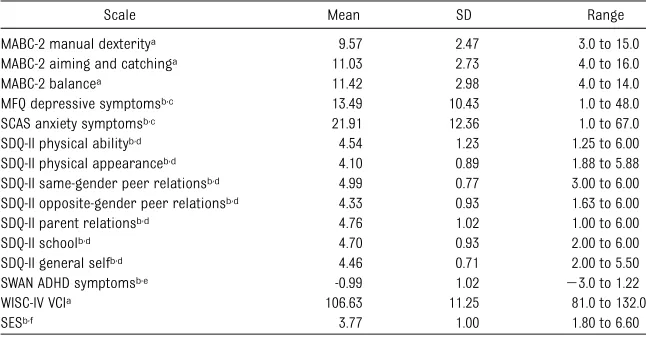
Means, SDs, and ranges for the varia-bles measuring motor coordination, self-perceptions, and emotional func-tioning are presented in Table 1.
Five adolescents performed at or below thefifth percentile on the MABC-2 and 2 scored between the sixth and 15th percentile (regarded as at risk). The prevalence of significant movement difficulty (ie, at or below thefifth per-centile) was 5.4%, which is comparable to previous estimates of 6%.1Ten
ado-lescents scored at or above the MFQ cutoff point of 29 (recommended by Daviss et al24). In terms of anxiety
symptoms as measured by the SCAS, 7 adolescents were subclinical (1 SD above the mean) and 5 demonstrated clinical (1.5 SDs above the mean) levels.33
One adolescent considered at-risk on the MABC-2 scored in the subclinical range on the SCAS, and 2 adolescents scoring at the fifth percentile on the
MABC-2 scored in the clinical range for both the SCAS and MFQ.
Correlations
Potential control variables included, age, gender, SES, ADHD symptoms, and VCI. These variables did not signifi -cantly correlate with the outcome variables of anxiety and depressive symptoms and therefore were not in-cluded in the analysis.
Indicators driven by the same latent construct will necessarily correlate. For the self-perception construct, how-ever, the opposite-gender peer relations subscale did not correlate with the parent relations and school subscales and was therefore not included in the model as an indicator of this construct. Similarly, the MABC-2 manual dexterity and aiming and catching subscales were not significantly correlated, al-though both correlated with balance. Because indicators of the same con-struct must be correlated, this pattern of correlations suggests 2 potential measurement models: 1 in which motor coordination is measured by manual dexterity and balance, and another in which motor coordination is measured by aiming and catching and balance.
An important underlying premise for mediation states that the independent variable (motor coordination) must be correlated with both the mediator (self-perceptions) and the outcome variable (emotional functioning).34
Be-cause manual dexterity was not cor-related with the outcome measures, including this as an indicator of motor coordination would immediately com-promise the mediator model. We there-fore opted for a measurement in which motor coordination is measured by using the aiming and catching and balance subscales.
LISREL Analysis
In the current study, the 10 structural equation modeling indicators were not multivariate normal. It was therefore decided to use the Spearman correla-tion as an index of associacorrela-tion among the indicators.35The Spearman
corre-lations are reported in Table 2.
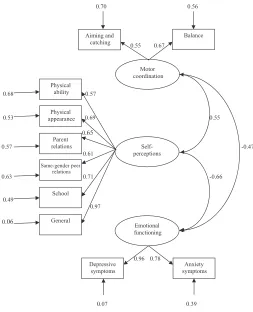
The parameter estimates for the mea-surement model (ie, the confirmatory factor model without the structural pathways among the latent variables) are given in Fig 1. Fit indices providing an indication of the overall fit of the measurement model are reported in Table 3. The fit statistics suggest an acceptable fit to the data. The x2/df ratio was,3, the comparative fit in-dex was .0.90, and the standardized root mean square residual was,0.10.36
Although the root square mean square error of approximation is above the desired cutoff, Tabachnick and Fidell37
note that this index may be less pref-erable with smaller samples due to the tendency to overreject the true model. Overall, the results indicate an accept-ablefit for the measurement model.
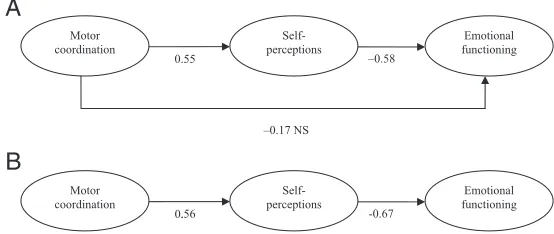
The saturated structural model is depicted with its path coefficients in Fig 2A. The path from motor coordi-nation to emotional functioning was not significant (when controlling for self-perceptions). The hypothesis that TABLE 1 Means, SDs, and Range of Scores (N= 93)
Scale Mean SD Range
MABC-2 manual dexteritya 9.57 2.47 3.0 to 15.0
MABC-2 aiming and catchinga 11.03 2.73 4.0 to 16.0
MABC-2 balancea 11.42 2.98 4.0 to 14.0
MFQ depressive symptomsb,c 13.49 10.43 1.0 to 48.0
SCAS anxiety symptomsb,c 21.91 12.36 1.0 to 67.0
SDQ-II physical abilityb,d 4.54 1.23 1.25 to 6.00
SDQ-II physical appearanceb,d 4.10 0.89 1.88 to 5.88
SDQ-II same-gender peer relationsb,d 4.99 0.77 3.00 to 6.00
SDQ-II opposite-gender peer relationsb,d 4.33 0.93 1.63 to 6.00
SDQ-II parent relationsb,d 4.76 1.02 1.00 to 6.00
SDQ-II schoolb,d 4.70 0.93 2.00 to 6.00
SDQ-II general selfb,d 4.46 0.71 2.00 to 5.50
SWAN ADHD symptomsb,e -0.99 1.02 23.0 to 1.22
WISC-IV VCIa 106.63 11.25 81.0 to 132.0
SESb,f 3.77 1.00 1.80 to 6.60
aStandard score. bRaw score.
cTotal scores are calculated by summing the item scores.
dScores are calculated by averaging the total of the SDQ-II subscale items. eScores are calculated by averaging the total of the 18 ADHD items.
motor coordination would have a di-rect impact on emotional functioning in this model was therefore not sup-ported. All other hypotheses were supported. Specifically, the path from motor coordination to self-perceptions was significant, as was the path from self-perceptions to emotional function-ing, indicating that motor coordination has an indirect effect on emotional functioning through self-perceptions.
Fit indices providing an indication of the overallfit of the saturated model can be found in Table 3. Using the cut-offs identified earlier when testing the measurement model, thefit statistics for the saturated model suggest an acceptablefit to the data. Once again, the root square mean square error of approximation is above the desired cutoff, but as we noted earlier, this in-dex has a tendency to overreject the true model when the sample size is small.
The test of the saturated model sug-gested that, when self-perception is controlled, the magnitude of the path coefficient for the direct pathway from motor skills to emotional functioning is trivial. This pathway was therefore dropped from the model. The fit of the resulting mediator model was ac-ceptable (Table 3). Furthermore, thefit of the mediator model was not sig-nificantly different from thefit of the saturated model (x2difference: 21.21;
P= .271). The more parsimonious me-diator model was therefore selected. The mediator model is depicted with its path coefficients in Fig 2B. LISREL estimated the indirect effect of motor coordination on emotional functioning to be 20.37. The mediator model ex-plained 45.14% of the variance in emotional functioning.
DISCUSSION
The current results revealed that in a normative sample of adolescents, motor coordination did not have a
TABLE 2 Spearman ’ s Corr elation Matrix for the K ey V ariables ( N = 93) Scale MABC-2 Manua l Dexter ity MA BC-2 Aim ing and Catching MA BC-2 Bala nce MFQ Depr essiv e Sym ptoms SCAS Anxi ety Sym ptoms SDQ-II Physic al Ability SDQ-II Physic al App ear ance SDQ-II Same-Gende r P eer Relation s
SDQ-II Par
direct impact on emotional functioning; rather, it affected emotional functioning through self-perceived competence in various domains. Few studies have attempted to understand the mecha-nisms through which motor coordina-tion may be related to internalizing domains3,38; therefore, the current
study is important in adding to exist-ing research.
One study found that child and ado-lescent twins with DCD demonstrated
significantly higher levels of depressive symptoms compared with their mono-zygotic co-twins without DCD, suggest-ing that thefindings may be attributed to the effects of unique environmental factors.2Cairney et al5name the
envi-ronmental stress hypothesis as a plau-sible explanation for the relationship between motor coordination and in-ternalizing problems. Specifically, as children with coordination difficulties are exposed to the cascade of negative
psychosocial consequences,39 this in
turn leads to negative self-appraisals, which in turn, may lead to anxiety and/or depression.5Consequently,
neg-ative self-perceptions may play a cru-cial role in understanding the nature of the relationship between coordina-tion deficits and emotional difficulties. The current study provides support for this idea. First, the current study sup-ports previous research linking self-perceived competence with emotional outcomes such as depression and anx-iety.40,41 Furthermore, the results also
support previous findings on DCD,3,28
as significant positive correlations were found for the MABC-2 motor compo-nents and SDQ-II self-perceived physical ability, physical appearance, general school, and same-gender peer relations subscales.
Few longitudinal studies have identi-fied the relationship between early motor difficulties and later anxiety and depressive symptoms at school-age and adolescence.13,42,43Shaffer et al43
found that the relationship between motor development at 7 years of age and later anxiety difficulties at age 17 years remained even when there was no evidence of anxiety at the early age. Consequently, it is plausible that the relationship may be better explained through environmental rather than bio-logical factors. The current study pro-vides evidence that the relationship between motor skills and internalizing symptoms in adolescents may be un-derstood in terms of a mechanism whereby motor coordination has an indirect impact on emotional function-ing via self-perceptions. However, it is important to note that given the cross-sectional nature of the current study, possible biological factors underly-ing the relationship cannot be ruled out. For example, cerebellar dysfunction has been associated with both motor coordination44 and emotional
regula-tion.45In fact, suggestion of a possible
FIGURE 1
The measurement model with correlations, factor loadings, and measurement errors.
TABLE 3 Summary of Relevant Model Fit Indices for the Measurement Model and the Structural Models of the Relationship Between Motor Coordination, Self-Perceptions, and Emotional Functioning
Model x2/df Comparative Fit Index
Standardized Root Mean Square
Residual
Root Mean Square Error of Approximation
Measurement model 95.58/32 = 2.99 0.92 0.087 0.15 (90% CI: 0.110–0.180) Structural model
Saturated 86.84/32 = 2.71 0.92 0.087 0.15 (90% CI: 0.120–0.180) Mediator 88.05/33 = 2.58 0.92 0.089 0.15 (90% CI: 0.110–0.180)
x2
common neurologic cause stems from research demonstrating a specific link between balance problems and anxiety disorders in children.46 Interestingly,
aiming and catching and balance were the only MABC-2 components related to the construct of emotional functioning, which may partly support previous lit-erature linking anxiety and balance problems.46
The manual dexterity subscale, a mea-sure of fine motor ability, failed to demonstrate significant correlations with the outcome measures of depres-sive and anxious symptoms. It is pos-sible that some individuals may have improved aspects of their motor skills (eg, fine motor) as a result of inter-vention in childhood or acquired some skills from prolonged practice.47
Con-sequently, these areas may not have a significant impact on emotional func-tioning in adolescence.
Kirby et al47noted how at older ages,
individuals may have learned coping mechanisms such as adapting or avoiding situations or specific tasks.
The tendency of individuals with motor coordination difficulties to avoid par-ticipating in sporting domains that of-ten require gross motor skills, such as ball throwing,48may have an important
role in understanding the relationships found in this study, particularly given the associated risk for social isolation and the increased need for belonging-ness during adolescence. Research has also highlighted the positive im-pact of sports participation on the emotional well-being of adolescents.49
Furthermore, it has been noted that in Western society, sporting competence and the ability to play games with friends are highly regarded,39 which
may also be important when consid-ering the relationship between gross motor ability and emotional function-ing in the current study.
CONCLUSIONS
The results of this study suggest that the relationship between motor co-ordination and emotional functioning in an adolescent sample may be best
understood in terms of a mediational association, although this cross-sectional study cannot imply causal-ity. Furthermore, although the current study aimed to control for possible confounding factors such as ADHD symptoms and verbal ability, other as-sociated problems (such as language difficulties50,51) may also have a role
in the relationship between motor co-ordination and emotional outcomes. The current findings, however, high-light the importance of assessing emo-tional outcomes in individuals who present with motor difficulties. Simi-larly, assessment of motor coordination in those referred for emotional prob-lems is important given research show-ing a high rate of motor problems in children (particularly, boys) diagnosed with an anxiety disorder.4 In addition,
it may be important to assess the indi-vidual’s self-perceived competencies. For example, if an adolescent also presents with self-perceived difficulties in the peer domain, a treatment plan aimed to promote social competency may also work to reduce or avoid pos-sible emotional difficulties. Future re-search is needed to further elucidate the nature of the relationship between motor coordination deficits and emo-tional outcomes.
ACKNOWLEDGMENTS
We are very grateful to the parents and adolescents who were willing to partic-ipate in this study. We also thank Sean Piek, Linda Pannekoek, and Eva Kuhry for their assistance with data entry.
REFERENCES
1. American Psychiatric Association.
Diag-nostic and Statistical Manual of Mental Disorders, Fourth Edition. Washington, DCAmerican Psychiatric Association; 2000
2. Piek JP, Rigoli D, Pearsall-Jones JG, et al. Depressive symptomatology in child and ado-lescent twins with attention-deficit hyperactivity
disorder and/or developmental coordina-tion disorder.Twin Res Hum Genet. 2007;10 (4):587–596
3. Skinner RA, Piek JP. Psychosocial implica-tions of poor motor coordination in chil-dren and adolescents.Hum Mov Sci. 2001; 20(1-2):73–94
4. Ekornås B, Lundervold AJ, Tjus T, Heimann M. Anxiety disorders in 8-11-year-old children: motor skill performance and self-perception of competence.Scand J Psychol. 2010;51(3): 271–277
5. Cairney J, Veldhuizen S, Szatmari P. Motor co-ordination and emotional-behavioral problems
–0.58
–0.17 NS
FIGURE 2
in children. Curr Opin Psychiatry. 2010;23 (4):324–329
6. Alloway TP. Working memory, reading, and mathematical skills in children with
de-velopmental coordination disorder. J Exp
Child Psychol. 2007;96(1):20–36
7. Smyth MM, Anderson HI. Coping with clumsiness in the school playground: so-cial and physical play in children with co-ordination impairments.Br J Dev Psychol. 2000;18(3):389–413
8. Cairney J, Hay JA, Faught BE, et al. Developmental coordination disorder and overweight and obesity in children aged 9-14y. Int J Obes (Lond). 2005;29(4):369– 372
9. Pearsall-Jones JG, Piek JP, Rigoli D, Martin NC, Levy F. Motor disorder and anxious and depressive symptomatology: a monozygotic co-twin control approach.Res Dev Disabil. 2011;32(4):1245–1252
10. Roebers CM, Kauer M. Motor and cognitive control in a normative sample of 7-year-olds.Dev Sci. 2009;12(1):175–181
11. Hattori J, Ogino T, Abiru K, Nakano K, Oka M, Ohtsuka Y. Are pervasive developmental disorders and attention-deficit/hyperactivity disorder distinct disorders?Brain Dev. 2006; 28(6):371–374
12. Lingam R, Golding J, Jongmans MJ, Hunt LP, Ellis M, Emond A. The association between developmental coordination disorder and other developmental traits.Pediatrics. 2010; 126(5). Available at: www.pediatrics.org/cgi/ content/full/126/5/e1109
13. Sigurdsson E, Van Os J, Fombonne E. Are impaired childhood motor skills a risk fac-tor for adolescent anxiety? Results from the 1958 U.K. birth cohort and the National Child Development Study.Am J Psychiatry. 2002; 159(6):1044–1046
14. Gueze RH, Jongmans MJ, Schoemaker MM, Smits-Engelsman BC. Clinical and research diagnostic criteria for developmental co-ordination disorder: a review and discus-sion.Hum Mov Sci. 2001;20(1-2):7–47
15. Daniel A.Australian Studies: Power, Privilege and Prestige: Occupations in Australia. Melbourne, Australia: Longman Cheshire; 1983
16. Henderson SE, Sugden DA, Barnett A. Move-ment AssessMove-ment Battery for Children. 2nd ed. London, United Kingdom: Psychological Corporation; 2007
17. Henderson SE, Sugden DA. Movement
As-sessment Battery for Children. London, United Kingdom: The Psychological Corpo-ration; 1992
18. Wechsler D.Wechsler Intelligence Scale for Children. 4th ed. San Antonio, TX: The Psy-chological Corporation; 2003
19. Swanson JM, Schuck S, Mann M, et al. Categorical and dimensional definitions and evaluations of symptoms of ADHD: the SNAP and SWAN Rating Scales. Available at: http:// adhd.net. Accessed December 15, 2005
20. Polderman TJ, Derks EM, Hudziak JJ, Verhulst FC, Posthuma D, Boomsma DI. Across the continuum of attention skills: a twin study of the SWAN ADHD rating scale. J Child Psychol Psychiatry. 2007;48 (11):1080–1087
21. Martin NC, Piek JP, Hay D. DCD and ADHD: a genetic study of their shared aetiology.
Hum Mov Sci. 2006;25(1):110–124
22. Streiner DL, Norman GR. Health
Measure-ment Scales: A Practical Guide to Their Development and Use. New York, NY: Oxford University Press; 1989
23. Costello EJ, Angold A. Scales to assess child and adolescent depression: check-lists, screens, and nets.J Am Acad Child Adolesc Psychiatry. 1988;27(6):726–737
24. Daviss WB, Birmaher B, Melhem NA, Axelson DA, Michaels SM, Brent DA. Criterion val-idity of the Mood and Feelings Question-naire for depressive episodes in clinic and non-clinic subjects.J Child Psychol Psychi-atry. 2006;47(9):927–934
25. Spence SH. Structure of anxiety symptoms among children: a confirmatory factor-analytic study.J Abnorm Psychol. 1997;106(2):280– 297
26. Muris P, Schmidt H, Merckelbach H. Corre-lations among two self-report questionnaires for measuring DSM-defined anxiety disorder symptoms in children: the screen for child anxiety related emotional disorders and the Spence Children’s Anxiety Scale.Pers Individ Dif. 2000;28(2):333–346
27. Marsh HW. Self-Description Questionnaire
II: Manual. Sydney, Australia: University of Western Sydney, SELF Research Centre; 1992
28. Piek JP, Baynam GB, Barrett NC. The
re-lationship betweenfine and gross motor
ability, self-perceptions and self-worth in
children and adolescents. Hum Mov Sci.
2006;25(1):65–75
29. Poulsen AA, Ziviani JM, Cuskelly M. General self-concept and life satisfaction for boys with differing levels of physical coordina-tion: the role of goal orientations and lei-sure participation.Hum Mov Sci. 2006;25(6): 839–860
30. Byrne BM.Measuring Self-Concept Across
the Life Span: Issues and Instrumentation. Washington, DC: American Psychological As-sociation; 1996
31. Jöreskog KG, Sörbom D. LISREL 8.7 for
Windows [computer software]. Lincoln, IL: Scientific Software International Inc; 2004
32. Hair TF, Black WC, Babin BJ, et al. Multi-variate Data Analysis. 6th ed. Upper Saddle River, NJ: Pearson Prentice Hall; 2006
33. Spence SH. Spence Children’s Anxiety Scale. Available at: www.scaswebsite.com/. Accessed January 5, 2011
34. Baron RM, Kenny DA. The moderator-mediator variable distinction in social psy-chological research: conceptual, strategic, and statistical considerations. J Pers Soc Psychol. 1986;51(6):1173–1182
35. Pugesek BH, Grace JB. Utility of path mod-elling for ecological and evolutionary stud-ies.Funct Ecol. 1998;12(5):853–856
36. Kline RB.Principles and Practice of Struc-tural Equation Modeling. New York, NY: Guilford Press; 1998
37. Tabachnick BG, Fidell LS.Using Multivariate Statistics. 4th ed. Needham Heights, MA: Allyn and Bacon; 2001
38. Francis M, Piek J. The effects of perceived social support and self-worth on depressive symptomatology in children with and with-out developmental coordination disorder (DCD). In: Proceedings of the 38th APS Annual Conference, The Australian Psychological Society; Melbourne, Australia; October 2–5, 2003:70–74
39. Schoemaker MKalverboer A. Social and af-fective problems of children who are clumsy: how early do they begin?Adapt Phys Activ Q. 1994;11(2):130–140
40. Cole DA, Martin JM, Powers B. A
competency-based model of child depres-sion: a longitudinal study of peer, parent, teacher, and self-evaluations. J Child Psy-chol Psychiatry. 1997;38(5):505–514
41. Smári J, Pétursdóttir G, Porsteinsdóttir V. So-cial anxiety and depression in adolescents in relation to perceived competence and situa-tional appraisal.J Adolesc. 2001;24(2):199–207
42. Piek JP, Barrett NC, Smith LM, Rigoli D, Gasson N. Do motor skills in infancy and early childhood predict anxious and de-pressive symptomatology at school age?
Hum Mov Sci. 2010;29(5):777–786
43. Shaffer D, Schonfeld I, O’Connor PA, et al. Neurological soft signs. Their relationship to psychiatric disorder and intelligence in
childhood and adolescence.Arch Gen
Psy-chiatry. 1985;42(4):342–351
44. Diamond A. Close interrelation of motor development and cognitive development and of the cerebellum and prefrontal cor-tex.Child Dev. 2000;71(1):44–56
45. Schutter DJ, van Honk J. The cerebellum in emotion regulation: a repetitive transcranial
magnetic stimulation study. Cerebellum.
2009;8(1):28–34
anxious children.Behav Brain Funct. 2009; 5:42–50
47. Kirby A, Edwards L, Sugden D. Emerging adulthood in developmental co-ordination disorder: parent and young adult per-spectives.Res Dev Disabil. 2011;32(4):1351– 1360
48. Cairney J, Hay JA, Faught BE, Wade TJ,
Corna L, Flouris A. Developmental
coordination disorder, generalized
self-efficacy toward physical activity, and
participation in organized and free play activities. J Pediatr. 2005;147(4):515– 520
49. Donaldson SJ, Ronan KR. The effects of sports participation on young adolescents’ emotional well-being.Adolescence. 2006;41 (162):369–389
50. Archibald LM, Alloway TP. Comparing lan-guage profiles: children with specific lan-guage impairment and developmental
coordination disorder. Int J Lang Commun
Disord. 2008;43(2):165–180
51. Jerome AC, Fujiki M, Brinton B, James SL. Self-esteem in children with specific
lan-guage impairment. J Speech Lang Hear
DOI: 10.1542/peds.2011-1237 originally published online March 26, 2012;
2012;129;e892
Pediatrics
Services
Updated Information &
http://pediatrics.aappublications.org/content/129/4/e892
including high resolution figures, can be found at:
References
http://pediatrics.aappublications.org/content/129/4/e892#BIBL
This article cites 36 articles, 1 of which you can access for free at:
Subspecialty Collections
dicine_sub
http://www.aappublications.org/cgi/collection/adolescent_health:me Adolescent Health/Medicine
following collection(s):
This article, along with others on similar topics, appears in the
Permissions & Licensing
http://www.aappublications.org/site/misc/Permissions.xhtml
in its entirety can be found online at:
Information about reproducing this article in parts (figures, tables) or
Reprints
http://www.aappublications.org/site/misc/reprints.xhtml
DOI: 10.1542/peds.2011-1237 originally published online March 26, 2012;
2012;129;e892
Pediatrics
Daniela Rigoli, Jan P. Piek and Robert Kane
Sample
Motor Coordination and Psychosocial Correlates in a Normative Adolescent
http://pediatrics.aappublications.org/content/129/4/e892
located on the World Wide Web at:
The online version of this article, along with updated information and services, is
by the American Academy of Pediatrics. All rights reserved. Print ISSN: 1073-0397.