TROPANE ALKALOIDS: AN OVERVIEW
aR. De Simone, L. Margarucci, V. De Feo*
Dipartimento di Scienze Farmaceutiche, Università degli Studi di Salerno, Via Ponte Don Melillo, 84084 Fisciano (Salerno)
Summary
Tropane alkaloids are a group of secondary metabolites containing a 8-azabicyclo[3.2.1]octane nucleus skeleton as a key structural element. They have hallucinogenic features and are active on Central Nervous System. Some of them, such as atropine and scopolamine, are used in medicine as antimuscarinic drugs. Tropane alkaloids are abundant above all in Solanaceae and Erythroxylaceae, where they are the most important alkaloids, but they were extracted also from other families of higher plants, e.g. Proteaceae, Euphorbiaceae, Rhizophoraceae, Convolvulaceae, Cruciferae and Moraceae. All these secondary metabolites, containing the tropane core as main structure, have as a common biosynthetic origin the amino acid L-ornitine. This compound, after several biosynthetic steps, is converted in hygrine, from which α-tropine, β-tropine, ecgonine and cuscohygrine origin and constitute the bases for the biosynthesis of all the tropane alkaloids known. The diffuse presence of tropane alkaloids among higher plants, can support the idea that they can be considered as a chemical link among different families of plants.
Keyword: Chemotaxonomy, Tropane Alkaloids, Atropine, Scopolamine.
*Address for Correspondence: Prof. Vincenzo De Feo
Dipartimento di Scienze Farmaceutiche, Università degli Studi di Salerno,
Via Ponte Don Melillo, 84084 Fisciano (Salerno), Italy
Phone: +39 089 969751; fax +39 089 969602 E mail: [email protected]
a This paper represents the final examination paper of the course of “Botanical identification of vegetal
Introduction
Chemotaxonomy, or chemosystematics, is the attempt to classify plants according to the differences in their biochemical features. Recently, it becomes more evidently the importance of a chemosystematic approach in chemical and/or pharmacological studies on biologically active plants.
One of the most fascinating field of research is constituted by plants containing compounds active on Central Nervous System and, among them by plants containing alkaloids. In this paper we attempt to consider a link between tropane alkaloids pharmacological activity and their distribution in different families of higher plants.
All tropane alkaloids contain the 8-azabicyclo[3.2.1]octane nucleus skeleton as key structural element (Fig.1).
Figure 1. 8-azabicyclo [3,2,1]octane nucleus.
Since tropane alkaloids have a quite simple chemical structure and are easy to be extract, they have been identified not only in Solanaceae and Erythroxylaceae, where they are the most abundant alkaloids, but also in other families, e. g. Proteaceae, Euphorbiaceae, Rhizophoraceae, Convolvulaceae, Cruciferae and Moraceae (1).
Plants containing tropane alkaloids have been medicinally used for centuries for their different pharmacological activities. Among the most important alkaloids, while cocaine (1) acts as an anaesthetic and a sympathomimetic, classical tropane alkaloids, as atropine (2) and scopolamine (3), are parasympatholytic; in fact, they act as competitive antagonists, by blocking the action of acetylcholine at parasympathetic sites in smooth muscle, secretory glands and CNS. For this reason, they are classified as antimuscarinic drugs. But it is also important to remind the hallucinogenic characteristics of some tropane alkaloids extract above all from the Solanaceus genera Brugmansia and
Datura. In fact, in most native American cultures, along with medicinal plants, these plants play a central role in therapeutic rites based on “magical plants”, which are seen as intermediaries between the human world and that of supernatural forces (2).
N O O
O
H
H HO
3
N O O HO
2
N O O O
O
1
Figure 2. Cocaine (1); (+/-)-hyoscyamine or atropine (2); hyoscine or scopolamine (3).
In this paper we present an overview on the chemotaxonomy of plant families containing tropane alkaloids and on their biological activities.
N
R
R
1Results
Solanaceae
Solanaceae is the family where tropane alkaloids are really abundant. This family is usually divided by botanists in different subfamilies and tribes, characterized by chemical differences in their composition. (1).
In the subfamily Solanoideae, the tribe Datureae, and specifically Datura and Brugmansia genera, contains the greatest range of tropane alkaloids. Tha aerial parts of Datura genus contain above all hyoscyamine (2) but also scopolamine (3), littorine (4) and the base 6β-(2-methylbutanoyloxy)tropan-3α-ol (5), while the roots yeald valtropine, a tropane alkaloid common in Duboisia species (3).
Recently, polyhydroxylated tropane alkaloids have been reported in Datura species: in the leaves of
Datura wrightii Regel and in tubers of Solanum spp., calystegine A3 (1β,2α,3β-trihydroxynortropane) (6) and calystegine B2 (1β,2α,3β,4α-tetrahydroxynortropane) (7) have been found, while calystegines C1 (1β,2β,3β,4β,6β-pentahydroxynortropane) (8) and C2 (1β,2α,3β,4α,6β-pentahydroxynortropane) (9) have been isolated from Duboisia leichhardtii F. Muell. (3).
The aerial parts of some species belonging to Brugmansia genus contain scopolamine (3) and/or hyoscyamine (2) as principal alkaloids, with smaller amounts of derivatives of these bases (10), while the roots contain in addition a large number of esters formed from dihydroxytropane and teloidine (10) (9).
N HO HO
OH
4
N
HO O
OH
N O
OH O
5 10
Figure 3. Littorine (4); 6β-(2-methylbutanoyloxy)tropan-3α-ol (5); teloidine (10).
The genus Solandra, (tribe Solandreae) contains atropine (2) and/or hyoscyamine (3) and their nor-derivatives as principal alkaloids (4).
Atropa belladonna L. (tribe Solaneae) contains hyoscyamine (2) as the principal alkaloid but also scopolamine (3), apoatropine (11), hyoscyamine (2) and scopolamine N-oxides (5). Leaves of A. belladonna and of Hyosciamus spp. contain also a few quantity of calystegines A3 (6), B1 (12) and B2 (7). Hyoscyamine (2) and tigloidine (13) have been found in some species of the minor genera Latua
N
O
O
11
N
O
O
H
13
N
O
O
H
15
Figure 4. Apoatropine (11); tigloidine (13); tigloyloxytropane (15).
The large genus Solanum does not contains the usual tropane alkaloids (11): calystegine A3 (6) has been found along with calystegine B2 (7) in the leaves of some Solanum species, including S.
tuberosum L., S. dulcamara L., S. melongena L. and in herbarium fragments of S. kwebense N. E. Br. ex C. H. Wright from Southern Africa (12).
In conclusion, calystegines are located in A. belladonna (all parts but mainly upper leaves),
Mandragora officinarum L. (likewise, mainly spring leaves), Scopolia carniolica Jacq. (spring leaves and flowers), Hyoscyamus niger L. (traces in all plant parts) and Solanum tuberosum L. (sprouts only). Specifically, Hyoscyamus niger L. contains also an alkaloid with a bridgehead aminogroup, calystegine N1 (23) (13).
For many centuries Mandragora roots have been considered very important as folk medicines. The former Mandragora officinalis Mill. comprises two distinct species, M. autumnalis Bertol. and M. vernalis Bertol., which contain hyoscyamine (2), scopolamine (3), cuscohygrine (18), apoatropine (11), 3α-tigloyloxytropane (15) and 3,6-ditigloyloxytropane. The roots contain small quantities of cuscohygrine (18), pseudotropine (24), tropine (17) and hyoscyamine (2). Withania somnifera Dunal likewise contains cuscohygrine (18) and 3α-tigloyloxytropane (15), but also tropine (17) and pseudotropine (24) (14). The main base from the roots of Cyphomandra betacea Cav. is N,N′-bis-(4-dimethylaminobutyl)-hexamide. Other bases included tropinone (25), cuscohygrine (18), hyoscyamine (2), tigloidine (13), tropine (17) and pseudotropine (24) (5).
14
N
O
16 17
N
O N
18 24
NH
O
N
O
25
N
OH
N
OH
N-oxides were found in Scopolia spp. and Hyoscyamus spp. (tribe Hyoscyameae) (6) which, along with
Physochlaina spp. and Przewalskia spp., contain hyoscyamine (2) as the major alkaloid with some scopolamine (3) derivatives (5, 6).
To the subfamily Cestroideae belong the tribes Anthocercideae, Nicandreae, and Salpiglossidae.
The tribe Anthocercideae includes seven genera, Duboisia, Anthocercis, Cyphanthera, Anthotroche,
Symonanthus, Grammosolen and Crenidium.
Among Duboisia genus, Duboisia myoporoides L. Br. contains scopolamine (3) (15), the dominant alkaloid in a variety collected North of Gosford, NSW Australia, or hyoscyamine (2), the major alkaloid in a variety South of Gosford. In a region known as Acacia Plateau near Killarney, Queensland, Australia, a third variety was discovered in which nicotine (26) and anabasine (27) are the dominant alkaloids (16). Duboisia leichhardtii F. Muell and D. myoporoides R. Br. contain hyoscyamine (2) and scopolamine (3) as the most important tropane alkaloid (17), but from the first one was isolated calystegine C2 (9), too. In Duboisia arenitensis Craven the alkaloid content is less than the other species and the most important are scopolamine (3) and hyoscyamine (2).
Anthocercis spp. contain either hyoscyamine (2) or scopolamine (3) as predominant alkaloids, frequently accompanied by their respective apo- and nor-derivatives. Among this genus, Anthocercis littorea Endl. contains mainly littorine (4) and meteloidine (28) (18) but also some mono- and ditigloyl esters of teloidine (10) (19); Anthocercis viscosa R. Br. and A. fasciculata F. Muell. contain hyoscyamine (2) (18); Cyphanthera anthocercidea Haegi (=Anthocercis frondosa) yelds scopolamine (3) and hyoscyamine (2), but chiefly nicotine (26) (20).
Among Cyphanthera genus, Cyphanthera albicans Miers (=Anthocercis albicans) affords butyryl esters of tropine and 6β-hydroxytropine. The alkaloids of Cyphanthera odgersii Haegi and
Cyphanthera tasmanica Miers were found to be consistent with other known Cyphanthera species (11). Three species belonging to Anthotroche genus, A. myoporoides C. A. Gardner, A. pannosa Endl. and A. walcottii F. Muell., contain hyoscyamine (2), norhyoscyamine (29), apoatropine (11) and scopolamine (3) (20).
Among Symonanthus genus (two species), the roots of Symonanthus aromaticus Haegi contain mono- and ditigloyl esters like Datura species and both aerial parts and roots have scopolamine (3) and its derivative aposcopolamine (30), as the main alkaloids (11).
N
O O H
OH
OH
27
H N O
O HO
28 N
N H
26
N
O O
O
H
H
29
N OH
33
N O
N O
O
O O
O
O O
O O
N O
O
35 N
N
30
Figure 6. Nicotine (26);anabasine (27); meteloidine(28);
The genus Grammosolen (two species) appears most closely related chemically to Cyphanthera and
Anthotroche (11).
The genus Crenidium has a single species, C. spinescens Haegi, where hyoscyamine (2) is the predominant alkaloid, but are present also anabasine (27) with ursolic acid (31). Anthocercis ilicifolia
Hook possesses a similar alkaloid spectrum to that of A. littorea Endl. Anthocercis genistoides Miers shows meteloidine (28) as the major alkaloid (11).
Esters of tropic acid (32) are not found in the tribe Nicandrae. However, tropine (17) was isolated from the roots of Nicandra species (21).
Schizanthus pinnatus Ruiz (tribe Salpiglossidae) contains tropane-derivate as schizanthines A and B which are 6β-senecioyloxytropan-3β-ol esters of dibasic mesaconic acid (A is a diester of 6-senecioyloxytropine, B is a mixed ester of 6-senecioyloxytropine and ethanol) (22). The root alkaloids of S. hookeri Lodd. are tropine (17), a pair of diastereoisomeric hygrolines (33) and the alkaloids 3α-senecioyloxytropan-6β-ol and 6β-angeloyloxytropan-3α-ol (22). Schizanthus litoralis Phil. contains hydroxytropane esters, hygrolines (33), the tropane diester of itaconic acid (34) and the alkaloids senecioyloxy-tropan-3α-methylmesaconate, cinnamoyloxytropan-3α-methylmesaconate, 6β-senecioyl-oxytropan-3α-ol, cis- and trans-N-(4-hydroxyphenyl)-ferulamides (23) but also 3α-senecioyloxytropan-6β-ol, (−)-hygroline and (+)-pseudohygroline, which had already been reported present in S. pinnatus Ruiz (24). Schizanthines C, D, E, and a trimeric tropane alkaloid occur in S. grahamii Borrer ex Baker (25). Grahamine (35) contains a cyclobutane ring substituted by three carboxyl groups and is formed from cinnamoyltropine and mesaconic acid (36).
HO
O OH
H H
H
31 32
HO OH
O
O
34
H HO
O
O OH
36
COOH OH
Figure 7. Ursolic acid (31); tropic acid (32); itaconic acid (34); mesaconic acid (36).
Erythroxylaceae
The genus Erythroxylum contains about 200 species. Erythroxylum argentinum O. E. Schulz, E. cataractarum Spruce ex Peyr, E. cumanense Kunth, E. glaucum O. E. Schulz, E. mamacoca Mart. and
Tropacocaine (37) is extracted from E. ulei O. E. Schulz (section Leptogramme), E. mamacoca Mart. and E. argentinum O. E. Schulz (section Archerythroxylon), but not in the sections Marcrocalyx and
Rhabdophyllum (11). Dihydrocuscohygrine and cuscohygrine (18) are also found in the cultivated cocaine producing species, E. coca Lam. and E. novogranatense Morris, and its variety truxillense. Cocaine (1) and the cis and trans isomers of cinnamoyl cocaine (38) is contained in E. coca Lam. and
E. novogranatense Morris var. truxillense (26). A series (α, β, γ, δ, ε) of dimeric methylecgonine (methyl ester of ecgonine, the basic moiety of cocaine) esters of truxillic acid (1,3-diphenylcyclo-butane-2,4-dicarboxylic acids, dimers of cinnamic acid) was identified in Bolivian coca leaf and α-truxilline (39) and β-α-truxilline were the most abundant (27). A new alkaloid, 1-hydroxytropacocaine, was discovered in E. novogranatense Morris var. novogranatense and var. truxillense (28). The base 6β-benzoyloxytropan-3α-ol occurs in both E. cumanense Kunth and E. glaucum O. E. Schulz (both section Archerythroxylum). Trimethoxybenzoyl esters are found in the roots of E. cumanense Kunth.
Erythroxylum macrocarpum O. E. Schulz and E. sideroxyloides Lam. of the section Packylobus contain a similar range of alkaloids consisting mainly of benzoyl esters of tropan-3α-ol, tropan-3β-ol and tropan-3α,6β-diol together with their nor-derivatives. Three alkaloids have been found, 3α-benzoyloxytropan-6β-ol (from E. sideroxyloides Lam.), 3α-benzoyloxynortropane and 3β-benzoyloxynortropan-6β-ol (both species) (29). The root barks of E. pervillei Baill. and E. hypericifolium Lam. contain the bases 3α-(3-hyroxyphenylacetoxy)-tropane, (+)-3α-phenylacetoxytropan-6β-ol, 6β-acetoxy-3α-phenylacetoxytro-pane, 3α-phenylacetoxytropan-6β,7β-diol, 3α-phenylacetoxynortropane and 3α-phenylacetoxytropane (29). Important to be noted are also the alkaloids 3α-cinnamoyloxytropan-6β-ol isolated as the (+) base from leaves of Knightia spp. (30). This is the first pseudotropane ester to be found in Erythroxylum hypericifolium Lam. The benzoyl analogue is widely distributed in Erythroxylum spp. The alkaloids 3α-cinnamoyloxytropane, 3α,6β-dicinnamoyloxytropane (analogous to the dibenzoyl ester found in E. cuneatum Kurz (31)), 3-cinnamoyloxytropan-6-ol (stereochemistry not established), 6β-acetoxy-3α-cinnamoyloxytropane and 6-phenylacetoxytropan-3-ol are found in Crossostylis spp. (32), together with cinnamate tropane dimers and esters of truxillic acid (33). These were identified as 3,3′-truxilloyloxy-6′-acetoxyditropane, 3,3′-truxilloyl-6hydroxy-6′-acetoxyditropane and 3,3′-truxilloyloxy-6′-hydroxyditropane. As in root bark, in the stem bark of E. hypericifolium Lam. predominate esters of phenylacetic acid: 3α-phenylacetoxynortropan-6β-ol, the main alkaloid, 6β-acetoxy-3α-benzoyloxytropane, 3-acetoxy-6-phenylacetoxytropane and hygrine (16) (34). Erythroxylum zambesiacum N. Robson (section
Melanocladus) likewise has a complex mixture of root bark alkaloids. The most important are trimethyoxybenzoyloxy)-nortropane, trimethoxybenzoyloxy)-tropan-6β-ol, 3α-(3,4,5-trimethoxybenzoyloxy)-nortropan-6β-ol, 6β-benzoyloxytropan-3α,7β-diol, 6β-benzoyloxy-3α-(3,4,5-trimethoxycinnamoyloxy)-tropan-7β-ol, and 7β-acetoxy-6β-benzoyloxy-3α-(3,4,5-trimethoxy-cinnamoyloxy)-tropane. Other minor bases identified include 3α-(3,4,5-trimethoxybenzoyloxy)-tropane, 3α-(3,4,5-trimethoxycinnamoyloxy)-3α-(3,4,5-trimethoxybenzoyloxy)-tropane, 3α-phenylacetoxytropan-6β-ol, 3α-(3,4,5-trime-thoxybenzoyloxy)tropan-6β,7β-diol, 6β-benzoyloxytropan-3α-ol, and 6β-benzoyloxy-3α-(3,4,5-trime-thoxycinnaomoyloxy)tropane (35). The main alkaloid of E. zambesiacum N. Robson is 3α-(3′,4′,5′-trimethoxybenzoyl)-oxytropane, followed by three new alkaloids characterized as 6β-benzoyloxytropan-3-one, 6-isovaleryloxytropan-3-ol and 3-(2-methyl butyryloxy)-6,7-diol (36). Other dimeric tropane alkaloids, although in very low yield (ca 0.003%), have been isolated from E. moonii
2-Hydroxy-3-phenyl-propionic acid, closely related to tropic acid and a component of the solanaceous alkaloid littorine (4), is a further link (besides meteloidine (28)) with the family Solanceae (39).
Erythroxylum zeylanicum O. E. Schulz contains three tropane alkaloids: erythrozeylanines A [1R,3R,5S,6R-6-acetoxy-3-(3',4',5'-trimethoxybenzoyloxy)-tropane], B [cis-3β -(cinnamoyloxy)-tropane], and C [cis-6β-acetoxy-3α-(cinnamoyloxy)-tropane], and others already found in other
Erythroxylum species (40).
Calystegines were identified in the genus Erythroxylum, too. Erythroxylum novogranatense Morris var.
novogranatense contained 0.2% total calystegines in dry leaves. Forty-six Erythroxylum herbarium species, consisting mostly of leaf tissue, were analysed for calystegines, and 38 were found positive. Calystegines A3 (6) and B2 (7) were the major calystegines in most species. The simultaneous occurrence of calystegines, cocaine (1), other alkaloids of a 3α-hydroxy- or 3β-hydroxytropane structure and nicotine (26), supports the concept of common biosynthetic steps of these alkaloids in
Erythroxylum (41).Finally, recently, pervilleine A (42), a novel tropane alkaloid, was extracted from
Erythroxylum pervillei Baill. (42).
N
O O
38
N
O O O
O
39
N
O
N O
O
O O
Ph Ph O
O O
N HN
O O
Ph Ph
O O
OCOR
40: R= C2H5
41: R= CH3
N
O O HO
O O H3CO
H3CO H3CO
OCH3
OCH3
OCH3
42 37
Figure 8. Tropacocaine (37); cinnamoyl-cocaine (38); α-truxilline (39); mooniine A (40); mooniine B (41); pervilleine A (42).
Proteaceae
D-strobiline (48) is the main alkaloid of K. strobilina R. Br., together with 3α-cinnamoyloxytropan-6β-ol, 3α-acetoxy-2α-acetoxybenzyltropane (acetylknightionl) (49), 3α-acetoxy-2α-benzyltropan-6β-ol (knightoline) (50), 6β-benzoyloxytropan-3α-ol (51), 2α-hydroxybenzyl-3α-acetoxytropane (knightinol) (52), dihydrostrobiline (53) (33), strobamine B (54), chalcostrobamine (55), strobolamine (56), knightalbinol (57) and knightolamine (58) (30). Agastachys odorata R. Br. contains 6β-acetoxy-3α-tigloyloxytropane and 3α-(p-hydroxybenzoyloxy)-trop-6-ene, the first naturally occurring tropene base (45).
N O
O R1 R2 R3
N O
O R1 R2
N
R1 R2 R3
R4
N
R1 R2
43: R1 CH3 R2 H
44: R1 CH3 R2 CH3
47: R1 H R2 CH3
48: R1 H R2 H
46: R1 COPh R2 COPh R3 H R4 H
49: R1 CH(OAc)Ph R2 OAc R3 H R4 H
50: R1 CH2Ph R2 OAc R3 OH R4 H
51: R1 H R2 OH R3 PhCO R4 H
52 R1 CH(OH)Ph R2 OAc R3 H R4 H
57: R1 CH(OH)Ph R2 OH R3 H R4 AcO
58: R1 CH(OH)Ph R2 OCOPh R3 H R4 OH
55: R1 COCH=CHPh R2 OH
53: R1 H R2 H R3 H 54: R1 H R2 Ph R3 H 56: R1 H R2 Ph R3 OH
N
O
45
Figure 9. Bellendine (43); darlingine (44); ferruginine (45); ferrugine (46); isobellendine (47); strobiline (48); acetylknightinol (49); knightoline (50); 6β-benzoyloxytropan-3α-ol (51);
knightinol (52); dihydrostrobiline (53); strobamine (54); chalcostrobamine (55); strobolamine (56); knightalbinol (57); knightolamine(58).
Euphorbiaceae
In this family, tropane alkaloids are isolated just from Peripentadenia mearsii (C.T.White) L. S. Sm. They are tropacocaine (37) (3β-benzoyloxytropane), 3α-acetoxy-6β-hydroxytropane and 2α-benzoyloxy-3β-hydroxytropane (48).
Rhizophoraceae
Brugine (59) has been also found in Crossostylis spp. (C. biflora Forst., C. multiflora Brongn. & Gris and C. sebertii Brongn. & Gris) along with tropine (17), 3α-benzoyl-oxytropane and two esters of tropine, tropine cinnamate (60) and ferulate (61) (32). Of Crossostylis species, C. Sebertii (Pancher) Pierre Arbuste contains the tropane alkaloids tropan-3α-yl cinnamate and tropan-3α-yl benzoate; C. multiflora Brongn. & Gris contains tropan-3α-yl-ferulate, 3α-tropanol and brugine (59) and C. biflora
J. R. Forst. & G. Forst. contains hygrine (16) and tropanone (50).
N
OR
59: R=
60: R=
61: R=
O
S
S
O
OH
O
OCH
3Figure 10. Brugine (59); tropine cinnamate (60); tropine ferulate (61).
Convolvulaceae
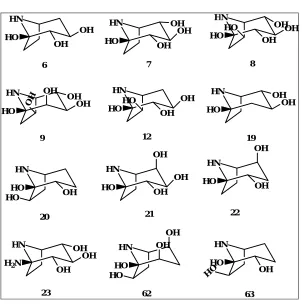
HN HO HN HO HN HO HN HO HN HO OH OH OH OH HO OH OH OH OH OH HO HN HO OH OH OH HN HO HN HO HN HO HN HO HN HO OH OH OH OH OH OH OH OH HO OH HO OHOH OH HN
H2N
OH OH OH 23 12 21 9 6 19 20 62 22 7 8 63 OH O H
Figure 11. Calystegines: A3 (6); B2 (7); C1 (8); C2 (9); B1 (12);
A5 (19); B3 (20); B4 (21); A7(22); N1 (23); B5 (62); A6 (63).
Convolvine (64) and convolamine (65), a nortropan-3α-yl veratrate and its N-methyl derivate, respectively, have been isolated from Convolvulus lineatus L. and C. pseudocantabricus Schrenk, together with closely related alkaloids having a veratroyl or a vanilloyl moiety as the acyl component. Convolvine (64) and convolamine (65) were extracted also from C. krauseanus Regel & Schmalh and
C. subhirsutus L. Moreover, C. krauseanus Regel & Schmalh and C. subhirsutus L. contain a series of tropine esters with methoxy substituted benzoic acids of tropane alkaloids which include convolvine veratroyloxynortropane), convolidine vanilloyloxynortropane) (53,54), confoline (3α-veratroyl-N-formylnortropine) (55) and convolamine-N-oxide (56). Recently, from the aerial part of C. subhirsutus L. has been extracted a new tropane alkaloid, the confolidine ((±)3a-vanillyl-N-formylnortropane), too. Evolvulus sericeus Sw. likewise contains convoline, convolamine (65) and convolidine. From E. elliptilimba Merr. & Chun and E. hainanesis Merr., Erycibe species, erycibelline (2β,7β-dihydroxynortropane) (66) and baogongten C (67) have been isolated (57). Baotongten A, (2β-hydroxy-6β-acetoxynortropane) and baogongten B have been isolated from Erycibe obtusifolia Benth. The roots of Convolvulus arvensis L. and transformed root cultures of Calystegia sepium R. Br. contain calystegine (calystegin) B1 (1β,2α,3β,6α-tetrahydroxynortropane) (12), calystegine B2 (1β,2α,3β,4α-tetrahydroxynortropane) (7) and calystegine A3 (1β,2α,3β-trihydroxynortropane) (6) (58). From roots of C. sepium R. Br. also calystegines A1, A2 and A4 (59) hae been isolated. The roots of C. siculus L. contain consiculine (68), a tropan-3α-ol esters, and merresectine B (69), while roots of C. sabatius Viv.
ssp. mauritanicus contain consiculine (68) and consabatine (2’-deoxyconsiculine) (70). Finally from roots of Convolvulus sabatius Viv. ssp. sabatius are extracted 3α-[1,4-dihydroxy-3-(3-methyl-but-2-enyl)-cyclohex-2-enecarboxy]tropane (4’-dihydroconsabatine) (71) (60).
From Merremia Dissecta Hallier F. and M. guerichii A. Meeuse were isolated four novel 3α-acyloxytropanes, merresectines A–D: 3α-(4-methoxybenzoyloxy)-nortropane (merresectine A) (73), 3α-kurameroyloxytropane (merresectine B) (69), 3α-nervogenoyloxytropane (merresectine C) (74) and 3α-[4-(β-D-glucopyranosyloxy)-3-methoxy-5-(3-methyl-2-butenyl)benzoyloxy]tropane (β-D-glucoside of merresectine D (75) (76). Moreover, the novel 3α,6β-di-(4-methoxybenzoyloxy)-tropane (merredissine) (77) has been isolated from M. dissecta Hallier F. The 4-β-D-glucoside (78) of merresectine E (79) has been identified in six Merremia species(60).
N
O O
X R HO
68 R= OH X= O 70 R= H X= O 71 R=H X= H, OH
N
O O
OR
69 R= β-D-Glucosio 74 R= H
HN
OH
66 OH
HN
OH
HO
67 N
O R
O
OCH3
OCH3
64 R= CH3 65 R= H
H N
O O
OCH3 73
H N
O O
OCH3
77 O
O H3CO
N
O O
R1 OR2
75 R1= OCH3 R2= H
76 R1= OCH3 R2= β-D-Glucosio 78 R1= H R2= β-D-Glucosio 79 R1= H R2= H
N
O
OCH3 OH
72
Figure 12. Convolvine (64); convolamine (65); erycibelline (66); baogongten C (67); consiculine (68); merresectine B (69); consabatine (70); 4’-dihydroconsabatine (71); concneorine (72);
merresectine A (73); merresectine C (74); merresectine D (75); merresectine D β-D-glucoside (76); merredissine (77); merresectine E β-D-glucoside (78); merresectine E (79).
Crucifereae
Brassicaceae or Cruciferae contain a novel group of hydroxylated nortropane alkaloids, some calystegines, above all calystegine A and the 3-hydroxybenzoate ester of tropine and cochlearine (80). The last one is the first tropane alkaloid identified in Cochlearia officinalis L. and Cochlearia arctica
N
O O
HO
80
Figure 13. Cochlearine (80).
In most genus Cochlearia tropine (17), the alcohol moiety of cochlearine (80) and pseudotropine (24) were found in minor concentration.
Calystegines were found in high concentrations in Cochlearia officinalis L. tissues. However, it contains calystegine A5 (19) as the major compound, while calystegines A3 (6) and B2 (7) dominate in
Solanaceae, calystegines B1 (12) and B2 (7) in Convolvulaceae and calystegines A3 (6) and B2 (7) in
Erythroxylaceae (60).
Moraceae
Among this family, Morus alba L. is important to be remembered for its contents of tropan alkaloids. Specifically, from its root bark the penthydroxylated nortropane calystegine C1 (8) (61), was isolated, while fruits contain calystegines A8 and A9 (62).
Pharmacology of Tropane Alkaloids
Cocaine (1), first isolated from the leaves of Peruvian Erythroxylum coca Lam. in 1860, shows local anaesthetic properties, stimulates the Central Nervous System and improves physical endurance. In fact, it is both a stimulant of the Central Nervous System and an appetite suppressant. Specifically, it is a dopamine reuptake inhibitor. It gives a feeling to what has been described as a euphoric sense of happiness and increased energy. It is most often used recreationally for this effect. Because of the way it affects the mesolimbic reward pathway, cocaine (1) is addictive. Nevertheless, cocaine (1) is still used in medicine as a topical anesthetic, even in children, specifically in eye, nose and throat surgery (63).
It is also useful in treating first degree of heart block, second degree of heart block Mobitz Type 1 and third degree heart block, too, with a high Purkinje or AV-nodal escape rhythm. Moreover, this comound acting on Parasympathetic Nervous System, inhibits salivary, sweat and mucus gland. This can be useful in treating hyperhydrosis and can prevent the death rattle of dying patients. Finally, by blocking the action of acetylcholine at muscarinic receptors, atropine also serves as an antidote for poisoning by organophosphate insecticides and nerve gases (64). Finally, hyoscyamine, the laevogyrate isomer of atropine (2), is used to provide symptomatic relief to various gastrointestinal disorders including spasm, peptic ulcers, irritable bowel syndrome, pancreatitis, colic and cystitis. It is also been used to control some of the symptoms of Parkinson’s disease as well as for the control of respiratory secretions in end of life care (65).
Scopolamine (3), also known as hyoscine, is used in medicine (in form of scopolamine hydrobromide,) for its depressant activity on the Central Nervous System, though it can cause delirium in the presence of pain, midrysis and cycloplegia. Combined with morphine, it produces amnesia and a tranquilized state known as twilight sleep. It is used in ophthalmogy to deliberately cause cycloplegia and mydriasis for diagnostic purposes and in the treatment of iridocyclitis. In otholaryngology, it has been used to dry the upper airway prior to use medical instrumentation on the airway. Scopolamine (3) is also an antiemetic, an antivertigo and an antispasmodic and can be used in the pre-anestetic sedation, as an antiarrhithmic during anesthesia and for the prevention of motion sickness. Some times ago it was also used in obstetrics, but now it is considered dangerous in this field (66).In October 2006 researchers at US National Institute of Mental Health found that scopolamine (3) reduces symptoms of depression within a few days and the improvement lasted for at least a week after switching to a placebo (67).
Nicotine (26) effects on the cardiovascular system are mediated by sympathetic neural stimulation associated with an increase in the levels of circulating catecholamines. Nicotine (26) causes sympathetic stimulation through central and peripheral mechanisms. Central Nervous System mediated mechanisms include activation of peripheral chemoreceptors, particularly the carotid chemoreceptor, and direct effects on the brain stem and spinal cord. Peripheral mechanisms include release of catecholamines from the adrenal glands and vascular nerve endings (68). These effects of nicotine (26) result in an acute increase in heart rate and blood pressure when it is delivered via cigarette smoking, chewing gum, nasal spray or intravenous infusion. Nicotine (26) differentially affects blood flow to different organs, causing vasoconstriction in some vascular beds (eg. skin) and vasodilatation in others (eg. skeletal muscle). Cutaneous vasoconstriction results in a decrease in the fingertip temperature (69). Nicotine (26) induces vasoconstriction in coronary arteries, as evidenced by a lack of increased blood flow in response to increased oxygen demand and by direct observation, specifically in atherosclerotic arteries. Coronary vasoconstriction appears to be mediated by catecholamines and can be abolished by the α-adrenergic blocker phentolamine (70).
Calystegines (Fig.11) are selective glycosidase inhibitors and could be applied as pharmaceutical compounds for diabetic patients (71).
Tigloidine (13) seems to be a substitute for atropine (2) (72), so it could be a potential anti-Parkinson agent (73); moreover, it could be used in the symptomatic treatment of spastic paraplegia (74) and in extrapyramidal syndromes (Huntington's chorea) (75).
Finally, because of its structural similarity with the well known (-)-hyoscyamine and (-)-cocaine (1), pervilleine A (42) shows cholinergic and adrenergic activities (77). Moreover, recent studies attest that pervilleine A (42) is an inhibitor of P-glycoprotein, a protein of drug efflux associated with a poor response to cancer chemotherapy, and should be further evaluated for clinical utility (42).
Discussion
Looking at the chemical structure of the tropane alkaloids, it is possible to note that all compounds are caracterized by the presence of the tropanic core and it has been proposed a possible common biosynthetic pathway, starting from the amino acid L-ornitine. After several biosynthetic steps, this compound is converted to hygrine, from which α-tropine, β-tropine, ecgonine and cuscohygrine origin (Fig. 14) and act as the bases for the biosynthesis of all the tropane alkaloids known.
N
O
SCoA
N
O NH2
NH2 COOH
L-ornitine
N-metil-pirrolinio
Hygrine
N
N N
OH
OH
O
N
OH COOH
α-tropine
β-tropine
scopine
ecgonine
N O
Cuscohygrine
N
OH
Figure 14. Biosynthesis of tropane alkaloids from L-ornitine.
Conclusion
Now, in fact, Solanaceae and Convolvulaceae are considered “sisters” because of their morphology and their plastidial DNA (79-84). In a similar way, Euphorbiaceae and Rhizophoraceae are now considered members of Malpighiales (83-86).
In addiction, the recent botanic classification considers Brassicaceae (Brassicales), Moraceae (Rosales) and Malpighiales members of the same larger group Roside (Fig.15) (78). This is to support, again, that biosynthesis of similar secondary metabolites can be related to a common phylogenetic origin.
Angiosperme Tricolpate
Roside
Asteride
Solanales Brassicales
Malpighiales
Rosales
Euphorbiaceae
Rhizophoraceae
Solanaceae
Convolvulaceae Moraceae
Brassicaceae
Figure 15. Simple cladogramme of the families of higher plant containing tropane alkaloids.
References
1. Griffin W.J. & Lin G.D. Chemotaxonomy and geographical distribution of tropane alkaloids.
Phytochemistry. 2000; 53: 623-637.
2. De Feo, V. The ritual use of Brugmansia species in traditional Andean medicine in Northern Peru. Economic Botany. 2004; 58.
3. Nash R.J., Rothschild M., Porter E.A., Watson A., Waigh R. & Waterman P.G. Calystegines in
Solanum and Datura species and the death's-head hawk-moth (Acherontia atropus).
Phytochemistry. 1993; 34(5): 1281-3.
4. Evans W.C., Ghani A. & Woolley V.A. Distribution of littorine and other alkaloids in the roots of Datura species. Phytochemistry. 1972; 11: 470.
5. Evans, W.C. & Ramsey K.P.A. Alkaloids of the Solananceae tribe Anthocercideae. J. Pharm. Pharmacol. 1979; 31: 9P.
6. Phillipson J.D. & Handa S.S. Hyoscyamine N-oxide in Atropa belladonna. Phytochemistry
7. Phillipson J.D., Handa S.S. & El-Dabbas S.W. N-oxides of morphine, codeine and thebaine and their occurrence in Papaver species. Phytochemistry (Elsevier). 1976; 15(8): 1297-301.
8. Sahai M. & Ray A.B. Secotropane alkaloids of Physalis peruviana. Journal of Organic Chemistry. 1980; 45: 3265.
9. Kubwabo C., Rollman B. & Tillequin B. Analysis of alkaloids from Physalis peruviana by capillary GC, capillary GC-MS, and GC-FTIR. Planta Medica. 1993; 59: 161.
10.Asano N., Kato A., Miyauchi M., Kizu H., Tomimori T., Matsui K., Nash R.J. & Molyneux R.J. Specific galactosidase inhibitors, N-methylcalystegines. Structure/activity relationships of calystegines from Lycium chinense. European Journal of Biochemistry. 1997; 248: 296.
11.El-Imam Y.M.A., Evans W.C. & Plowman T. Alkaloids of the genus Erythroxylum. Part 4. Alkaloids of some South American Erythroxylum species. Phytochemistry (Elsevier). 1985; 24(10): 2285-9.
12.Evans W.C. Tropane alkaloids of the Solanaceae. Linnean Soc. Symp. 1979; 7: 241-54.
13.Jackson B.P. & Berry M.I. Hydroxytropane tiglates in the roots of Mandragora species.
Phytochemistry. 1973; 12: 1165.
14.Khanna K.L., Schwarting A.E., Rother A. & Bobbitt, J.M. Occurrence of tropine and pseudotropine in Withania somnifera. Lloydia. 1961; 23: 179-81.
15.Hill K.L., Bottomley W. & Mortimer P.I. Variation in the main alkaloids of Duboisia
myoporoides and Duboisia leichhardtii. IV. Interspecific hybrids. Australian Journal of Applied Sciences. 1954; 5: 258.
16.Mortimer P.I. & Wilkinson S. The occurrence of nicotine, anabasine, and isopelletierine in
Duboisia myoporoides. Journal of the Chemical Society. 1957; 3967-70.
17.Hills K. Loftus, Bottomley W., & Mortimer P. I. Variation in the main alkaloids of Duboisia myoporoides and Duboisia leichhardtii. III. Duboisia leichhardtii. Australian Journal of
Applied Science. 1954; 5: 276-82.
18.Cannon J.R., Joshi K.R., Meehan G.V. & Williams J. Tropane alkaloids from three western
Australian Anthocercis species. Australian Journal of Chemistry. 1969; 22(1): 221-7.
19.Evans W.C. & Treagust P.G. Alkaloids of Datura pruinosa. Phytochemistry (Elsevier). 1973; 12(8): 2077-8.
20.Evans W.C. & Ramsey K.P.A. Tropane alkaloids from Anthocercis and Anthotroche.
Phytochemistry (Elsevier). 1981; 20(3): 497-9.
21.Romeike A. Presence of tropinone in Nicandra roots. Naturwissenschaften.1966; 53(3): 82. 22.San Martin A.S., Rovirosa J., Gambaro V. & Castillo M. Tropane alkaloids from Schizanthus
hookeri. Phytochemistry (Elsevier). 1980; 19(9): 2007-8.
23.Muñoz O., Piovano M., Garbarino J., Hellwing V. & Breitmaier E. Tropane alkaloids from
Schizanthus litoralis.Phytochemistry. 1996; 43(3): 709-713.
24.Gambaro V., Labbe C. & Castillo M. Angeloyl-, tigloyl-, and senecioyloxytropane alkaloids from Schizanthus hookerii. Phytochemistry (Elsevier). 1983; 22(8): 1838-9.
25.San Martin A. S., Labbe C., Muñoz O., Castillo M., Reina M., De la Fuente B. & Gonzalez A. Tropane alkaloids from Schizanthus grahamii. Phytochemistry. 1987; 26(3): 819-22.
26.Rivier L. Analysis of alkaloids in leaves of cultivated Erythroxylum and characterization of alkaline substances used during coca chewing. Journal of Ethnopharmacology 1981; 3(2-3): 313-35.
28.Moore J.M., Hayes P.A., Cooper D.A., Casale J.F. & Lydon J. 1-Hydroxytropacocaine: an abundant alkaloid of Erythroxylum novogranatense var. novogranatense and var. truxillense.
Phytochemistry. 1994; 36(2): 357-60.
29.Al-Said M.S., Evans W.C. & Grout R.J. Alkaloids of the genus Erythroxylum. Part 5. E.
hypericifolium Lam. root-bark. Journal of the Chemical Society. 1986; 6: 957-9.
30.Lounasmaa M., Pusset J. & Sevenet T. The New Caledonian plants. Part 57. 2-Benzyl pseudotropanes and dihydropyranotropanes, alkaloids of Knightia strobilina. Phytochemistry
(Elsevier). 1980; 19(5): 953-5.
31.El-Imam Y.M.A., Evans W.C., Grout R.J. Alkaloids of the genus Erythroxylum. Part 8. Alkaloids of Erythroxylum cuneatum, E. ecarinatum and E. australe. Phytochemistry. (1988), 27(7), 2181-4.
32.Gnecco Medina D.H., Pusset J., Pusset M. & Husson H.P. Tropane alkaloids from Crossostylis
sp.Journal of Natural Products. 1983; 46(3): 398-400.
33.Al-Said M.S., Evans W.C. & Grout R.J. Alkaloids of the genus Erythroxylum. Part 10. Alkaloids of Erythroxylum hypericifolium leaves. Phytochemistry. 1989; 28(11): 3211-15.
34.Al-Said M.S., Evans W.C. & Grout R.J. Alkaloids of the genus Erythroxylum. Part 9. Alkaloids of Erythroxylum hypericifolium stem bark. Phytochemistry. 1989; 28(2): 671-3.
35.El-Imam Y.M.A., Evans W.C., Grout R.J. & Ramsey K.P.A. Alkaloids of the genus
Erythroxylum. Part 7. Alkaloids of Erythroxylum zambesiacum root-bark. Phytochemistry.
1987; 26(8): 2385-9.
36.Christen P., Roberts M.F., Phillipson J.D. & Evans W.C. Alkaloids of the genus Erythroxylum. Part 11. Alkaloids of Erythroxylum zambesiacum stem-bark. Phytochemistry.1993; 34(4): 1147-51.
37.Rahman A.U., Khattak K.F., Nighat F., Shabbir M., Hemalal K.D. & Tillekeratne L.M. Dimeric tropane alkaloids from Erythroxylum moonii. Phytochemistry. 1998; 48(2): 377-383.
38.Evans W.C. & Ramsey K.P.A. Alkaloids of the Solananceae tribe Anthocercideae.
Phytochemistry (Elsevier). 1983; 22(10): 2219-25.
39.Griffin W.J. A phytochemical investigation of Erythroxylon australe F. Muell. Australian Journal of Chemistry. 1978; 31(5): 1161-5.
40.Bringmann G., Günther C., Mühlbachera J., Lalith M.D., Gunathilake P. & Wickramasinghe A. Tropane alkaloids from Erythroxylum zeylanicum O.E. Schulz (Erythroxylaceae).
Phytochemistry. 2000; 53(3): 409-416.
41.Brock A., Bieri S., Christen P. & Dräger B. Calystegines in wild and cultivated Erythroxylum species. Phytochemistry. 2005; 66(11): 1231-40.
42.Mi Q., Cui B., Silva G.L., Lantvit D., Lim E., Chai H., You M., Hollingshead M.G., Mayo J. G., Kinghorn A.D. & Pezzuto J.M. Pervilleine A, a novel tropane alkaloid that reverses the multidrug-resistance phenotype. Cancer Research. 2001; 61(10): 4030-4037.
43.Bick I.R.C., Bremer J.B. & Gillard J.W. Methyl(p-hydroxybenzoyl)acetate and an alkaloid, bellendine, from Bellendena montana. Phytochemistry (Elsevier). 1971; 10(2): 475-7.
44.Ralph I., Bick C., Gillard J.W. & Leow H.M. Alkaloids of Darlingia darlingiana. Australian Journal of Chemistry. 1979; 32(11): 2523-36.
45.Ralph I., Bick C., Gillard J.W. & Leow H.M. Alkaloids of Darlingia ferruginea. Australian Journal of Chemistry. (1979), 32(11), 2537-43.
46.Bick I.R.C., Gillard J.W. & Huck-Meng L. Alkaloids of Bellendena montana. Australian Journal of Chemistry. 1979; 32(8): 1827-40.
47.Lounasmaa M., Wovkulich P.M. & Wenkert E. Carbon-13 nuclear magnetic resonance spectroscopy of naturally occurring substances. XXXVI. Structures of some Knightia
48.Johns S.R., Lamberton J.A. & Sioumis A.A. New tropane alkaloids, (+)-(3R, 6R)-3α-acetoxy-6β -hydroxytropane and (+)-2α-benzoyloxy-3β-hydroxynortropane, from Peripentadenia mearsii (Euphorbiaceae). Australian Journal of Chemistry. 1971; 24(11): 2399-403.
49.Loder J.W. & Russel G.B. Tropine 1,2-dithiolane-3-carboxylate, a new alkaloid from
Bruguiera sexangula.Tetrahedron Letters. 1966; 51: 6327-9.
50.Gnecco Medina D.H., Pusset M., Pusset J. & Husson H.P. Tropane alkaloids from Crossostylis sp. Journal of Natural Products. 1983; 46(3): 398-400.
51.Schimming T., Jenett-Siems K., Mann P., Tofern-Reblin B., Milson J., Johnson R.J., Deroin T., Austin D.F. & Eich E. Calystegines as chemotaxonomic markers in the Convolvulaceae.
Phytochemistry (Elsevier). 2005; 66(4): 469-480.
52.Asano N., Kato A., Kizu H., Matsui K., Watson A.A. & Nash R.J. Calystegine B4, a novel trehalase inhibitor from Scopolia japonica. Carbohydrate Research. 1996; 293(2): 195-204. 53.Aripova S.F., Malikov V.M. & Yunusov S. Yu. Convolidine-new alkaloid from Convolvulus
krauseanus.Khimiya Prirodnykh Soedinenii. 1977; 2: 290-1.
54.Aripova S.F., Sharova E.G. & Yunusov S. Yu. Convoline-a new alkaloid from Convolvulus
krauseanus.Khimiya Prirodnykh Soedinenii. 1983; 6: 749-51.
55.Sharova E.G., Aripova S.F. & Yunusov S. Yu. Alkaloids of Convolvulus subhirsutus. Khimiya Prirodnykh Soedinenii. 1980; 5: 672-6.
56.Aripova S.F. N-Oxide of convolamine from Convolvulus krauseanus. Khimiya Prirodnykh Soedinenii. 1985; 2: 275.
57.Lu Y., Yao T. & Chen Z. Studies on the constituents of Erycibe elliptilimba. Yao xue xue bao = Acta pharmaceutica Sinica. 1986; 21(11): 829-35.
58.Goldmann A., Milat M.L., Ducrot P.H., Lallemand J., Maille A., Charpin I. & Tepfer D.T. Tropane derivatives from Calystegia sepium. Phytochemistry. 1990; 29(7): 2125-7.
59.Brock A., Herzfeld T., Paschke R., Koch M. & Dräger B. Brassicaceae contain nortropane
alkaloids. Phytochemistry (Elsevier). 2006; 67(18): 2050-2057.
60.Jenett-Siems K., Weigl R., Böhm A., Mann P., Tofern-Reblin B., Ghomian A., Kaloga M., Siems K., Witte L., Hilker M., Müller F. & Eich E. Chemotaxonomy of the pantropical genus
Merremia (Convolvulaceae) based on the distribution of tropane alkaloids. Phytochemistry
(Elsevier). 2005; 66(12): 1448-1464.
61.Asano N., Oseki K., Tomioka E., Kizu H. & Matsui K. N-Containing sugars from Morus alba and their glycosidase inhibitory activities. Carbohydrate Research. 1994; 259(2): 243-55. 62.Kusano G., Orihara S., Tsukamoto D., Shibano M., Coskun M., Guvenc A. & Erdurak C.S. Five
new nortropane alkaloids and six new amino acids from the fruit of Morus alba Linne growing in Turkey. Chemical & Pharmaceutical Bulletin. 2002; 50(2): 185-192.
63.Cabral G.A. Drugs of abuse, immune modulation, and AIDS. J Neuroimmune Pharmacol. 2006; 1(3): 280-95.
64.Kaluski E., Blatt A., Leitman M., Krakover R., Vered Z. & Cotter G. Atropine-facilitated electrical cardioversion of persistent atrial fibrillation. ACC Current Journal Review. 2004; 2: 13-55.
65.Orhan I., Naz Q., Kartal M., Tosun F., Sener B. & Choudhary M.I. In vitro anticholinesterase
activity of various alkaloids. Naturforsch. 2007; 62(9-10): 684-8.
66.Furey M.L. & Drevets W.C. Antidepressant efficacy of the antimuscarinic drug scopolamine: a randomized, placebo-controlled clinical trial. Archives of General Psychiatry. 2006; 63(10): 1121-1129.
69.Gourlay S.G. & Benowitz N.L. Arteriovenous differences in plasma concentration of nicotine and catecholamines and related cardiovascular effects after smoking, nicotine nasal spray, and intravenous nicotine. Clin. Pharmacol. Ther. 1997; 62: 453-63.
70.Kaijser L. & Berglund B. Effect of nicotine on coronary blood-flow in man. Clin. Physiol. 1985; 5: 541-52
71.Chemistry and biology of calystegines. Natural Product Reports. 2004. Institute of Pharmaceutical Biology, Faculty of Pharmacy, Martin-Luther-University Halle-Wittenberg, Germany.
72.Trautner E.M. & Noack C.H. Tigloidine as a substitute for atropine in the treatment of Parkinsonism. Med. J. Aust. 1951; 1(21): 751-4.
73.Sanghvi I., Bindler E. & Gershon S. Pharmacology of a potential anti-Parkinson agent: tigloidine. Eur. J. Pharmacol. 1968; 4(3): 246-53.
74.O'Rourke F.J., Gershon S., Trautner E.M. & Shaw F.H. The use of tigloidine in the symptomatic treatment of spastic paraplegia. Med. J. Aust. 1960; 47(1): 73-7.
75.Trautner E.M. & Gershon S. The effect of tigloidine on extrapyramidal syndromes (Huntington's chorea). Australas Ann Med. 1958; 7(4): 286-91.
76.Quevauviller A., Foussard-Blanpin O. & Coignard D. An alkaloid of Phyllanthus discoides (Euphorbiaceae) phyllalbine, a central and peripheral sympathomimetic. Therapie. 1965; 20(4): 1033-41.
77.Chin Y.W., Kinghorn A.D. & Patil P.N. Evaluation of the cholinergic and adrenergic effects of two tropane alkaloids from Erythroxylum pervillei. Phytother Res. 2007; 21(10): 1002-5.
78.Judd W.J., Campbell C.S., Kellogg E.A. & Stevens P.F. Plant systematics. A phylogenetic approach. Sinauer Associates, Inc. Publishers. Sunderland, Massachusetts U.S.A.
79.Downie S.R. & Palmer J.D. Restriction site mapping of chloroplast DNA inverted repeat: a molecular phylogeny of the Asteride. Ann. Missouri Bot. Gard. 1992; 79: 266-238.
80.Olmstead R.G., Michaels H.J., Scott K.M. & Palmer J.D. Monophyly on the Asteridae and identification fron DNA sequences of rbcL. Ann. Missouri Bot. Gard. 1992; 79: 249-265.
81.Olmstead R.G., Bremer B., Scott K.M. & Palmer J.D. A parsimony analysis of the Asteridae sensu lato based on rbcL sequences. Ann. Missouri Bot. Gard. 1993; 80: 700-722.
82.Taktajan A. Diversity and classification of flowering plants. Columbia University Press, New York. 1997.
83.Thorne R.F. Classification and geography of the flowering plants. Bot. Rev. 1992; 58: 225-348. 84.Cronquist A. An integrated system of classification of flowering plants. Columbia University
Press, New York. 1981.
85.Chase M.W., Duvall M.R., Hills H.G., Conran J.G., Cox A.V., Eguiarte L.E., Hartwell J., Fay M.F., Caddick L.R., Cameron K.M. & Hoot S. Molecular systematics of Lilianae. In Monocotyledons: systematics and evolution. Royal Botanic Gardens, Kew. 1995; 109-137.