
NCAEAS2322 | NCAEAS | ACET | January-February-2017 [(3)2: 93-97 ]
National Conference on Advances in Engineering and Applied Science (NCAEAS) 16th February 2017
In association with
I
nternational
Journal
of
Scientific
Research in
Science and
Technology
Solar AC Generator
Prof. Akil Ahmed
1, Afreen Khan
2, Gunwanti Shende
3, Nighar Sheikh
4, Murtuza Johar
5, Ritisha
Jaiswal
6, Shubham Sawarkar
7, Tabish Khan
8*1Assistant Professor, Electrical Department, Anjuman College of Engineering and Technology, Nagpur, Maharashtra, India *2,3,4,5,6,7,8Student Electrical Department, Anjuman College of Engineering and Technology, Nagpur, Maharashtra, India
ABSTRACT
Conventional energy sources have been depleting at a very alarming rate and they are limited and the consumption has been increasing with every passing day. Solar energy has moved out fast to have a major role to play as a renewable energy resource. Solar panels have been used to harness the solar power and this power is required to be stored in the battery. This dc power is then required to be converted to ac power to be used in homes and industry. This method turns out to be expensive and suffers from losses. In this work we present a new scheme wherein we are able to generate ac power without using the inverter. This technique also avoids the battery resulting in cost reduction. By adopting this technique, we can remove power losses due to an inverter. Another very good aspect of this technique is that we get a very pure sine wave of better efficiency than that of an AC inverter. We can generate the sine wave of any frequency by just controlling the speed of motor used in this technique. So it is a very simple technique with great effects.
Keywords: Research Solar, Inverter, Alternating Current, Renewable Energy
I.
INTRODUCTION
Solar energy can be harnessed in many ways. One way is to convert it by using solar cells or with concentrated solar power (CSP), in which we the sunlight is allowed to fall on the water so as to boil it and this boiled water is then used to produce electricity.
In this work we present the use of solar cells in such a way that they can directly produce alternating current. This eliminates the use of inverter and battery and the alternating current can be directly used. It is also possible to control the frequency of the sine wave by controlling the system and this system is able to produce a satisfactory sine wave.
A. Problem Statement
B. Purpose
The energy requirement has been escalating with every passing day and the conventional fuels are depleting fast. More so the conventional energy sources have contributed to various type of pollution. The hydroelectric power is a god source to generate power but requires huge amount of water. The nuclear energy is a good option but is very costly and requires a high maintenance. The solar energy comes as good ecofriendly option. The solar energy can be easily converted to electricity using solar cells or panels A photovoltaic cell is made up of a semiconductor material like silicon. It absorbs the sunlight and produces electricity. Electron can only flow in a one direction through a solar cell because the terminals (positive and negative) of the solar cell are static. That’s why solar cell can only produce direct current (DC). Now direct current has its own issues as it is difficult to send out in large distance, so it has limited uses [4]. So we use alternating current. Furthermore, the majority electrical devices can only use alternating current (AC).
C. Benefits
The proposed system comes as a practical, cheap, and environmental friendly unit for commercial as well as domestic use. It can be efficiently put to use for commercial as well as domestic usage and has the capacity to replace the existing power plants and can be placed at almost any place like a playground, school or in any residential or in any urban surroundings [4]. Large scale solar AC electricity generator arrays can easily be placed in any remote place.
II.
TECHNIQUE TO BE EMPLOYED
The system has been divided in to two parts a) Generation of AC
b) Solar tracking
Generation of AC
It contains the components to generate the alternating current
The major components used are • Lasani Wood Sheet
• Solar cell
• Variable Power supply • DC motor
A. Lasani Wood sheet
We used Lasani wood sheet for the base and upper rotating disk in the project. Lasani wood sheet has been selected due to following reasons such as
Safety
This wood sheet is impact-resistant [10]and does not shatter in case of impact.
Weight
This would turn out to be a bit heavy then other material but has high stability.
Rigidity
Lasani wood sheet used is a very rigid material [10]. So we don’t expect much elasticity in it.
Surface Hardness
The surface hardness is very even.
B. Electrical Properties
This wood is a good insulator with a high surface resistivity and suffers from very negligible effect due to its exposure to sunlight.
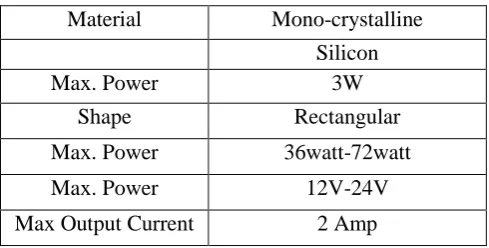
Small Solar Panel mono-crystalline 12pcs Solar cell pairs are connected in anti-parallel to make alternating current [11].
Table 1. Specification of small Solar Panel monocrystalline
Material Mono-crystalline
Silicon
Max. Power 3W
Shape Rectangular
Max. Power 36watt-72watt
Max. Power 12V-24V
Max Output Current 2 Amp
C. Variable Power Supply
Table 2. Specification of variable power supply DC gear motor
Max. Power 36watt-72watt Max. Power 12V-24V Max Output Current 2 Amp
D. DC Gear Motor
The motor houses a gear assembly where the small gear is coupled with a large gear in such a way that when small gear rotates the large gear also rotates, eventually rotating the disk.
III. METHODS AND MATERIAL
A. Solar Cells Arrangement
The arrangement has been done such that the solar cells have been placed in a circular form such that each pair of anti-parallel connected photovoltaic cells of each photovoltaic cell pair progressively and alternately get exposed and shaded producing the amplitude and polarity so as to generate alternating current.
Figure: 1 Arrangement of Solar cells
B. Designing
To arrange solar cells in a circular array perfectly we designed its drawing on AutoCAD. As the total numbers of solar cells are 12 so they must be kept at an angle of 30˚from each other. So we made an evenly spaced circular array.
Figure: 2 Auto Cad design of the rotating disc
C. Connections
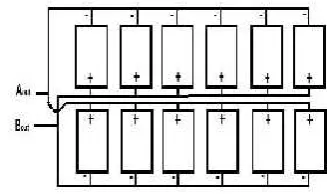
To generate an AC output, wave the solar cell pair is connected in anti-parallel. The negative terminal of the photovoltaic cell A is connected with positive terminal of the photovoltaic cell B, whereas the negative terminal of the solar cell B is connected to the positive terminal of the photovoltaic cell A. The solar cell pair should be connected as shown in the figure [4]. The AC output terminals are Aout and Bout. In the figure below, an array of solar cells is connected for AC sine wave. The solar cells on the upper side are represented by solar cells. A1, A2, A3, A4 and A5 are coupled to form the single AC output terminal Aout, while the remaining solar cells represented by solar cells B1, B2, B3, B4 and B5 are coupled so that they can form the single AC output terminal Bout hence forming a "photovoltaic cell pair". To increase the current and maintain the constant voltage, the solar cells shown are connected in parallel. In order to increase voltage and to maintain constant current, solar cells would be connected in series. Each solar cell pair of them has the first and second AC output (which can be seen in Fig. 4.4) is connected in anti-parallel to form a single AC output. So one output terminal would provide the single phase AC electricity.
.
D. Method For Directly Generating AC
The process of generating alternating current at an AC output of the photovoltaic cell pairs mechanically exposes and shades solar cell pairs that are connected in anti-parallel. We expose and shade the solar cells alternately and gradually of all solar cell pairs that are connected in anti-parallel to vary the amplitude and polarity to form AC.
E. Area With Respect To Angle
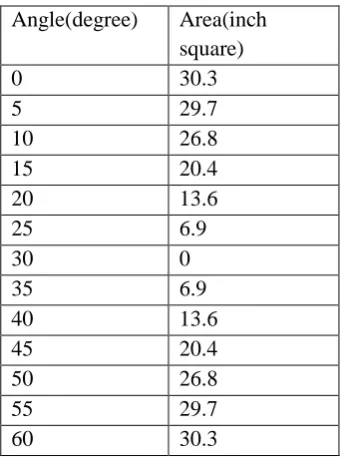
We calculated the area of uncovered solar cells with respect to angel of rotation of the disk in order to check out what are we giving as input to the solar cell.
Table 3. Angle v/s area in tabular form
Angle(degree) Area(inch square)
0 30.3
5 29.7
10 26.8
15 20.4
20 13.6
25 6.9
30 0
35 6.9
40 13.6
45 20.4
50 26.8
55 29.7
60 30.3
So we are giving a half rectified sine wave as an input to each cell and connecting them in anti-parallel form to a get AC unlike the other techniques in which they give a constant value as an input to the solar cell to get constant DC.
1) Base
We used wood sheet as base which is a non-conducting material. The solar cells are arranged in a circle on the surface of the base [4]. And the motor is at the center of base which is rotating the spinning disk. To support the upper disk some rollers are also fixed on the base.
Figure: 11 Smart Solar AC generator
2) Rotating Disc
A non-elastic disk having same or more diameters then the solar cell array which covers the whole solar cell array and it can expose and block the sun light. The disc should be of a lightweight material with no elasticity so it can easily rotate [4]. The disc has 6 holes. The size and shape of the holes is same as that of the photovoltaic cell array to control exposure of photovoltaic cell to the sunlight when the holes are placed over the solar cell. Rest of the sheet is used to completely cover a solar cell when the hole is not over the solar cell. The holes are located at about 60˚ from each other. The number of holes is 6 so that the number of coverings is half the number of photovoltaic cells. So, when the disc is placed on the frame above the photovoltaic cell array, half of the solar cell array area is exposed and half of the solar cell array area is covered [4]. When the disc rotates over the array of solar cells, it will slowly and constantly covers and exposes the array of photovoltaic cells by the cutouts and coverings.
Figure: 12 Rotating disc with arrangements of solar cell
3) DC Gear Motor
clockwise. Rotation of the disc causes the cut outs to alternately cover and expose the neighboring photovoltaic cells. The frequency of the signal depends on the speed of the rotating disk. Faster the photovoltaic cells are covered and exposed, the higher the frequency of AC electricity produced and vice versa [4]. Variable ower supply to drive motor. The variable power supply is used to supply the DC voltages to the DC motor hich will then rotate the disk to produce AC waveform
IV.RESULT AND DISCUSSION
A. Getting A Sine Wave
Mechanically exposing and covering the photovoltaic cell pairs gradually, alternating expose and cover the two anti-parallel solar cells. It results in a sinusoidal AC wave form. The resulting sine wave is periodic. The rate at which the exposing and shading is done determines the frequency of the sine wave.
B. Measurements of Output
We get the following output from a single ac solar generator. The resulting Sinusoidal wave form has peak voltage and frequency given in table shown below.
Table 4. Measurement of Solar AC generator
AC Voltage 30 volts DC Voltage 14 Volts
V.
CONCLUSION
Solar energy has emerged as a very popular alternate source of energy which is eco-friendly. The issue with the generation of electricity through solar cells is that they produce DC electricity thus requiring the need of an inverter to get the desired AC supply. This leads to escalation in the cost and leads to reduction in overall efficiency of the system. To counter this problem, we have been able to develop a mechanical setup which directly generates AC from the solar cells cell array which at a much lesser cost and with comparable efficiency.
But this system has its own limitations like the size of the solar cells and the sheet to be used and the spinning disk to be employed. The system efficiency can be
improved greatly by employing the tracking system. Reducing the weight and overcoming the frictional losses would also help in improving the efficiency. Similarly, by using some lighter sheets as compared to Lasani sheath the overall results can be improved.
VI. REFERENCES
[1]. Jason Oliver -“New AC Solar Generator Invention Could Revolutionize Solar Power Production”2010 [2]. Sanbo Pan and Xiafei Hao -“Power Management and Simulation of Renewable DC Power System” ICCEE 2010
[3]. U.S. Patent No. 4,075,034 issued to Butler on February 21 , 1978 (hereinafter, "Butler")
![Crystal structure of 26 (4 methylphenyl) 8,11,14,17 tetraoxa 28 azatetracyclo[22 3 1 02,7 018,23]hexacosa 2,4,6,18(23),19,21,24(1),25,27 nonaene](data:image/gif;base64,R0lGODlhAQABAIAAAP///wAAACH5BAEAAAAALAAAAAABAAEAAAICRAEAOw==)