Helgol~inder wiss. Meeresunters. 26, 382-395 (1974)
Influence of geomagnetism and salinity on the
directional choice of eels
F.-W. TESCH
BioIogiscbe Anstalt Helgoland (Zentrale); Hamburg 50, Federal Republic of Germany
KURZFASSUNG: Einfluf~ y o n Erdmagnetismus und Salzgehalt auf die Richtungswahl yon
AMen. 25 Blankaale yon Anguilla anguiIla und A. rostrata wurden in SIiB- und Meerwasser sowie unter ver~inderten Bedingungen des erdmagnetischen Feldes hinsichtlich ihrer Richtungs- einstellung untersucht. Hierzu dienten ein Rundbecken, ein Helmholtz-Spulen-Paar sowie eine photographische Registriereinrichtung. Die Aale bewegten sich in der Versuchsanlage wenig. Sie bevorzugten im Seewasser und unter natiirlichen Magnetfeldbedingungen, ~hnlich wie bei frii- heren Untersuchungen, eine nSrdliche oder siidliche Richtungseinstellung. Kompensierung der Nordkomponente (0 °) des Erdfeldes rief im Meerwasser bei Aalen aller drei Herkunf~sorte (Elbe, Hamburg und Brunsbiittel, Kiiste yon Rhode Island, USA) eine Bevorzugung 6stlicher Richtungen hervor. Umkehrung der magnetischen Nordkomponente auf geographisch Siid ver- ursachte keine Ver~inderung gegeniiber dem Verhalten im natiirlichen Feld. In alien neun Tests unter verschiedenen Magnetfeldbedingungen im S~it~wasser (beide Arten im natilrlichen Erdfeld, bei kompensierter Nordkomponente und bei auf geographisch S~id verlagerter Nordkompo- nente) lag die bevorzugte Richtung zwischen 93 ° und 184 ° (SO). In vier dieser F~ille stellten rich die Aale auch in entgegengesetzter Richtung ein. Es wird diskutiert, wodurch Unterschiede in der Richtungseinstellung zwischen Feld- und Laborversuchen zustande kommen konnten und wie welt magnetische oder elektrische Reize die Richtungswahl bedingen. Ein 5kologisches Bei- spiel aus dem Gebiet der Elbmiindung macht die verrnutlich kombinierte Wirkung yon Erd- magnetismus und Salzgehalt auf die Aalorientierung offenbar: das in Feldversuchen ermittelte Schwimmen in nSrdlicher Richtung wird erst beim Eintritt der Aale in Meerwasser geringer Salinit';it aktiviert.
I N T R O D U C T I O N
Directional choice of eels 383 Bt~ANOWl~ et al. (1971), VASlLYEV & GL~ISEI~ (1973) and VASlLYEV et al. (1973) observed in glass eels and older juvenile stages of A. anguiIla the ability to respond to changes in the magnetic field. The capability to "peroeive" the dkection of magnetic fields was reduced if strong artificial magnetic fields were induced. Other investiga- tions demonstrated that eels can perceive very weak electric fields. It was supposed that magneto-hydrodynamical effects which produce electrical fields could be involved (McCLEAW: et al. 1971, ROMM~L & McCLEAw 1973).
Using the method of photographing the directional choice of silver eel,s in a circu- lar tank (TEsc~ &LELEK 19736), it is also possible to exa,mine the directional behaviour under conditions of a changed geomagnetic field. The results presented here were ob- tained by this technique and include the use of Helmholtz coils for the generation of artificial magnetic fields. In this study, in addition to silver eels of A. anguilla from two different locations, individuals of A. rostrata caught d,uring their spawning migra- tion on the North American east coast were compared 'by exposures to a modified geo- magnetic field.
MATERIAL AND METHODS
Migratory European eels in the so-called silvery stage (body length 30-40 cm) were selectad from commercial catches in two locations of the River Elbe in Western Germany. Nine males were from fyke-net catches in Hamburg harbour on August 26 and 27, 1973. Examination of these eels took place from August 28 to September 5, 1973. Eleven males were caught at the end of October in the Elbe estuary in the same location [Brunsbiittel as described by TEscrt &Lt,;LzK (1973b) by a cutter with a framed gape net (a stow net)]. They were examined from November 6 to 11, 1973. Five female American eels (A. rostrata) in the silver stage and about 70 cm long were caught by commercial fishermen near Kingston, Rhode Island (USA). They were flown to Ham- burg at the end of October 1973 immediately a~er capture, and were examined on October 30 and from November 19 to 29, 1973.
The eels were maintained in fres~h water at 12 ° to 14 ° C. One set of experiments was conducted in fresh water (tap water); another set was performed in sea water transported to Hamburg from the Helgoland area. The salinity was > 30 °/oo.
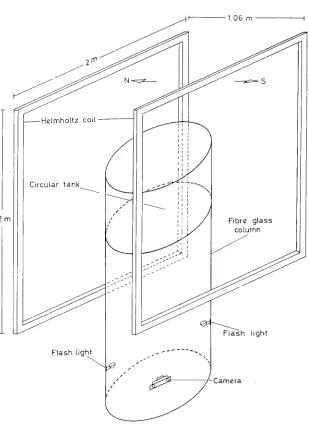
The plastic circular tank (1 m diameter, 50 cm ,height, water level 35-40 cm with a bottom of transparent plexiglas)and ~he recording camera, as well as all other experimental installation and procedure, were the same as described earlier (Tzscri & LELEK 1973b). Instead of a metal stand and a plastic cover, a fibreglass reinforced stand made of polyester tube wa~s installed ur~dernearh the circular tank to eliminate inter- ference with the magnetic field (Fig. 1). During observation periods the eels were kept in total darkness except when illuminated by photographic flash every 10 to 30 min- utes to photographically record their orientation.
384 F.-W. TESCH
Fig. i : Experimental arrangement of recording the directional choice. In the centre is the fibreglass reinforced polyester stand with the circular tank on top of it, on the leP¢ and right sides parts of the Helmholtz coils, on the le~ margin outside of the coils is a constant current
Directional choice of eels
-1,06 m
385
N -<=~"
~ S
m
"nhoLtz c o i l - - ~
Circular tank
/
r l ~ f i I
i i
'i
P E f ~
Fibre
glass
column
J
light
Flash Lig h.~....
/
~
-
CameraFig. 2: Coil arrangement around the circular tank and dimensions
386 F.-W. TESCH
1.7 A. If, at compensation of X to zero in the centre of the bottom of the circular tank, a value of 0.000 Gauss was measured, at some peripheral points of the tank X amounted to a value not higher than 0.005 Gauss.
Examination of the directional position of the eels took place with X compen- sated to zero, with X reversed from N o r t h to South, and with normal X relationships in the B A H laboratory as a control. Each test .lasted 17 to 22 ~aours ,(in two cases 4.5 or 12 hours) including the night period. As in earlier experiments (TEscH & LEL~K 1973b) day and night results were compared and no difference was found.
The mean angle (direction), the concentration, and the angular deviation were calculated. The statistical treatment of the results was performed as proposed by BAT- SCHELET (1965) : a Z 2 test to determine if a non-uniform circular distribution was present (see also TESCH & LELEK 1973a, b); the Rayleigh test for testing significance of preferred direction; a non-parametric two sample test (also a Z ~ test) for differences in angular deviation between samples. A difficulty arose since many of the circular di,stributions resulted in a bimodal distribution, as found earlier (T~scH & L~LEK 1973a). For this reason, in all cases in which a bimodal ~distri,bution wa.s foun.d, the calculation of the mean angle w.as performed by the method of "doubling the angle" (BATSC~tEL~T 1965). A bimodat calculation was conducted in each sample which exhibited no significance by unimodal treatment through the Rayteigh test. Smoothing of the circular distribu- tion rendered no better test results, but smoothed graphical illustration (Fig. 4 and 5) presents the differences more clearly. The procedure for smoothing the single direc- tional frequences (fm) was a follows: fm = fm - - 1 + 2 fm + f m + 1/4.
There is a possibility that, in these investigations, the single specimens tested to- gether could affect each other and bias the result (BATSCHELET, personal communica- tion). In a later experiment (TEscH unpublished) an examination of each single spe- cimen was performed. A comparison of specimens tested singly and together showed no difference in their directional choice.
RESULTS
; ; : . ~
: ::::: : :::::
::::::::::::::::::::::
I I h 7 ~ ... '
'/
/ , . < . , )
I S , I ' : ' : I ~ /
: l : t h l : l : l : i I ~;~l~): : : ~ , l ; : : l ;
" 7 7 - P ' 7 - F 7 "I~ 7 " I T - T 7--F=? ~ F T " F T ~ F T " 7 - - - - T T - T ' 7 - - K ' 7 T T - - F T 7 - 7 T " T - F ~ " °[-] - r - - 7 7
I : " ! . . . . I ' l ~ " ' 1 ' 1
preva~Hng organ~genic substrata, (~ Herpo/itha hTnax ~ I A ... s upper ~ ... zone i, untere Zone ~ ~ Acropopa varmb~ ~s tower zone 5tylophor~ pi~N/l,~ta, ~ 0 P~clflop#~ d~nae*Rhempfich~ prevamng m~neral sub~t?afa: enic substrata, #nbe.~ann/ecUnfergrund coral ~od~ of ~eel ~urf~ce ~nidenfihed svbs~ra~m ~ /{otallenfelsdeeR/f/obePf/#che ?ein#~rnigerSfrandfel~ ~ ÷ deepep ~eag o~co~al roc~ 5trandfels-Ron tomerat dichtertfora/lenschuff sandbedecktes Hong/ome?at Korallen~ru~ ~and covered conglomerate ~ co:al debt'~5 5eeb/lp[l#sfer, sand~tefugf ,,o,~,,~' ... " ... I~ o.oo.oo~o..°~"° °' ... .oo. .ooo 5ee~ras undAlgen: eelgrassandseaweed: ~-j-~ Turbinariaelatensi~ R ( one I~ ',o,, ... bd~ o,.,~o,."~'° °'~,o.,,. .... Enkeremorpha clafh#ala~ Hydroidea und A4adrepo?aria: Hydroidea and Madreporaria: L_L4~ Fawn, Favi~e~, Gonias/rea, ~ ~ Ptesiasffaa I~%~ e ~,,,,,,.,o ... CyphaMrea, L epfa~frea,
Alcyonaria: Alcyona¢ia
; .- Heteroreni~ fusce~cens EchinodeemafaEChinodermafa:: ~ Ha,o# ... ~ro Diadema~efosum
andereZeichen: other
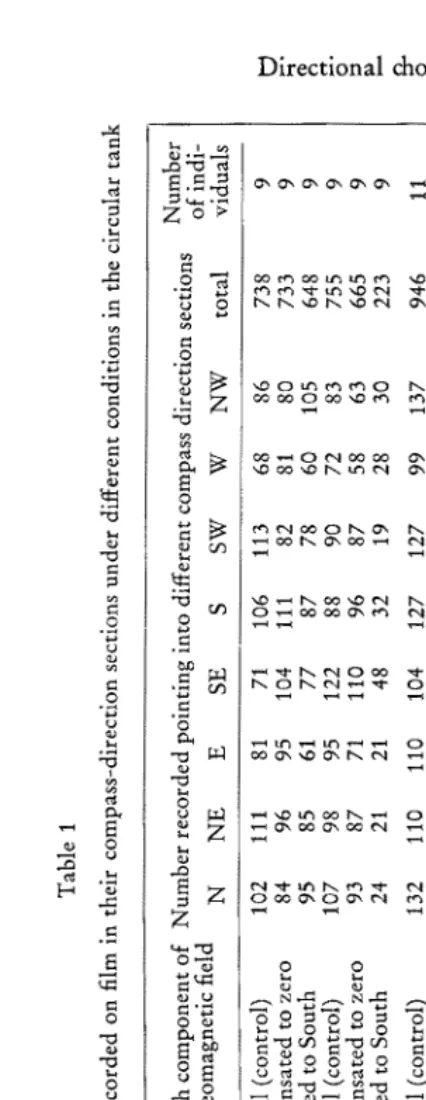
Table 1 Silver eels (Anguilla anguilla and A. rostrata) recorded on film in their compass-direction sections under different conditions in the circular tank Locality of capture Salinity during North component of Number recorded pointing into different compass direction sections
Number of
indi- observation the geomagnetic field N NE E SE S SW W NW total viduals Elbe near Hamburg sea water normal (control) 102 111 81 71 106 113 68 86 738 9 Elbe near Hamburg sea water compensated to zero 84 96 95 104 111 82 81 80 733 9 Elbe near Hamburg sea water reversed to South 95 85 61 77 87 78 60 105 648 9 Elbe near Hamburg fresh water normal (control) 107 98 95 122 88 90 72 83 755 9 Elbe near Hamburg fresh water compensated to zero 93 87 71 110 96 87 58 63 665 9 Elbe near Hamburg fresh water reversed to South 24 21 21 48 32 19 28 30 223 9 Elbe estuary sea water normal (control) 132 110 110 104 127 127 99 137 946 11 Elbe estuary sea water compensated to zero 96 100 72 104 71 81 84 80 688 11 Elbe estuary sea water reversed to South 99 82 62 86 85 118 72 75 679 11 Elbe estuary fresh water normal (control) 69 77 63 103 99 72 88 97 668 11 Elbe estuary fresh water compensated to zero 74 70 119 108 108 106 68 74 727 I1 Elbe estuary fresh water reversed to South 103 72 93 107 126 I15 78 78 772 11 Rhode Island, USA sea water normal (control) 45 54 49 43 68 60 40 51 410 3 Rhode Island, USA sea water compensated to zero 45 48 52 48 47 34 37 47 358 3 Rhode Island, USA sea water reversed to South 39 53 49 47 57 57 38 62 402 3 Rhode Island, USA fresh water normal (control) 22 35 43 37 34 21 18 15 225 5 Rhode Island, USA fresh water compensated to zero 60 43 47 67 44 46 36 45 388 3 Rhode Island, USA fresh water reversed to South 41 43 38 52 59 55 45 75 408 3
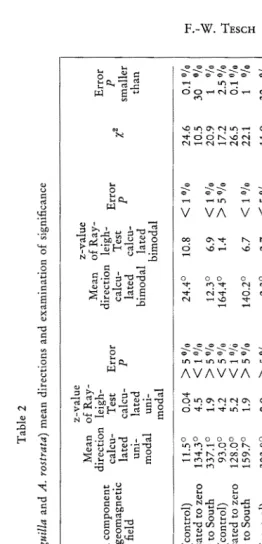
Table 2 Silver eels (Anguilla anguilla and A. rostrata) mean directions and examination of significance
t~ GO 00
Locality of capture Elbe near Hamburg Elbe near Hamburg Elbe near Hamburg Elbe near Hamburg Elbe near Hamburg Etbe near Hamburg Elbe estuary Elbe estuary Elbe estuary Elbe estuary Elbe estuary Elbe estuary Rhode Island, USA Rhode Island, USA Rhode Island, USA Rhode Island, USA Rhode Island, USA Rhode Island, USA z-value z-value Mean of Ray- Mean of Ray- direction ieigh- direction leigh- North component calcu- Test Error calcu- Test p Salinity during of the geomagnetic lated calcu- P lated calcu- Error observation field uni- lated bimodal lated modal uni- bimodal modal sea water normal (control) 11.5 ° 0.04 > 5 °/o 24.4 ° 10.8 < 1 °/o sea water compensated to zero 134.3 ° 4.5 < 1~/0 sea water reversed to South 337.1 ° 1.9 > 5 ~/o 12.3 ° 6.9 < 1 ~/o fresh water normal (control) 93.0 ° 4.2 < 5 °/0 164.4 ° 1.4 > 5 % fresh water compensated to zero 128.0 ° 5.2 < 1 :% fresh water reversed to South 159.7 ° 1.9 > 5 ~/o 140.2 ° 6.7 < 1 '°/o sea water normal (control) 303.8 ° 0.9 > 5 % 2.3 ° 2.7 < 5 °/o sea water compensated to zero 78.2 ° 15.9 < 1% sea water reversed to South 214.8 ° 1.7 > 5 °/o 19.0 ° 5.9 < t % fresh water normal (control) 209.2 ° 1.8 > 5 °/o 144.2 ° 4.3 < 5 °/o fresh water compensated to zero 149.4 ° 13.0 < 1% 115.1 ° 0.1 > 5 ~/o fresh water reversed to South 184.0 ° 7.1 < 1 °/o sea water normal (control) 182.4 ° 1.1 > 5 % 30.7 ° 2.4 > 5 % sea water compensated to zero 74.3 ° 2.0 > 5 ~/o 141.5 ° 0.5 > 5 °/4 sea water reversed to South 193.3 ° 0.3 > 5 ~/o 3.1 ° 0.2 > 5 ~/o fresh water normal (control) 109.3 ° I2.7 < 1 °/0 fresh water compensated to zero 356.2 ° 1.5 > 5 o/o 156.2 ° 2.5 > 5 °/o fresh water reversed to South 252.3 ° 2.7 > 5 °/o 150.2 ° 2.8 > 5 °/o Z ~
24.6 10.5 20.9 17.2 26.5 22.1 11.9 12.9 24.7 19.5 34.5 27.6 11.8 5.8 i0.5 26.5 14.5 20.1
Error
P
smaller than 0.1% 30
°/o
I
°/o
2.5
%
0.1% 1%
30 °/o 10 °/o 0.1 °/o 1 °/o 0.1 °/o 0.1 °/o 30 °/o 70 0/0 30 °/o 0.1 °/o 5 °/o 1 °/o
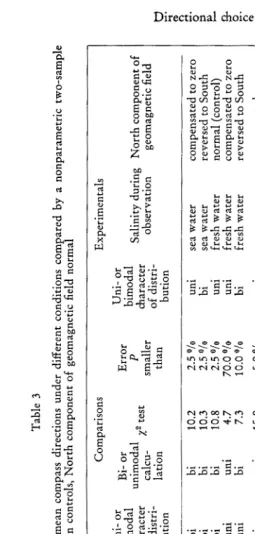
Table 3 Silver eels (Anguilla anguilla and A. rostrata) mean compass directions under different conditions compared by a nonparametric two-sample test (X2). In controls, North component of geomagnetic field normal Location of capture Elbe near Hamburg Elbe near Hamburg Elbe near Hamburg Elbe near Hamburg Elbe near Hamburg Elbe estuary Elbe estuary Elbe estuary Elbe estuary Elbe estuary Elbe estuary Elbe estuary Rhode Island, USA Rhode Island, USA Rhode Island, USA Rhode Island, USA Rhode Island, USA Controls Comparisons Uni- or Bi- or Error Uni- or Salinity during bimodal unimodal p bimodal character Z = test character observation calcu- smaller of distri- lation than of distri- bution bution
Experimentals Salinity
during North component of observation geomagnetic field sea water bi bi 10.2 2.5 % uni sea water bi bi 10.3 2.5 °/o bi sea water bi bi 10.8 2.5 % uni fresh water uni uni 4.7 70.0 % uni fresh water uni bi 7.3 I0.0 % bi sea water bi uni 15.8 5.0 % uni sea water bi uni I1.4 30.0 % bi sea water bi bi 4.4 30.0 ° bi sea water bi uni 17.3 2.5 % uni fresh water bi uni 28.0 0.1 ~/0 uni fresh water bi bi 8.0 5.0 °/0 uni fresh water bi uni 21.1 2.5 °/o uni sea water bi bi 3.7 30.0 % uni sea water bi uni 8.2 50.0 ~/o uni sea water bi bi 2.5 50.0 ~/0 - sea water bi bi 2.6 50.0 % uni sea water bi uni 18.6 1.0 % uni sea water compensated to zero sea water reversed to South fresh water normal (control) fresh water compensated to zero fresh water reversed to South sea water compensated to zero sea water reversed to South sea water reversed to South fresh water normal (control) fresh water compensated to zero fresh water reversed to South fresh water reversed to South sea water compensated to zero sea water compensated to zero sea water reversed to South fresh water normal (control) fresh water normal (control)
390 F.-W. TESCH
change from sea water to fresh water altered the ,directional choice from a northern or southern direction to an eastern or, to a lesser degree to a western direction.
The Rayleigh test irLdicated significance for all results obtained from A. anguilla,
except the controls of t~he Elbe estuary, if the highest values are always taken whether from unimodal or bimodal treatment (Table 2). Also the Z = test (test of fit) exhi/bited high significance for most values, or in two cases, slightly below the 90 °/0 level. The
W E
Experiments in sea water G~ograpNcal Norlh dir¢clion
~
t/
W E
.7
Experiments in fresh water 9eographical North direction
J 1 A
Place of AnguiUa anguNa Anguitla anguilIa Anguilla rostrata
capture: EIb¢ near Hamburg Elbe e s t u a r y Rhode Island, USA
, : - ~ Normal geomagnetism <~7C_ .-£> Hor{zonta[ North geomagnefism
compensated to zero < i ~ r l ~ > Horizontal geomagnetism reversed from North to South
Fig. 3: Mean directional preferences of Anguilla anguilla and Anguilla rostrata examined under different conditions of the geomagnetic field, in sea water and in fresh water and from differ-
ent locations
Rayleigh test values observed in A. rostrata are generally not significant. This is prob- ably due to the small samples and number of observations.
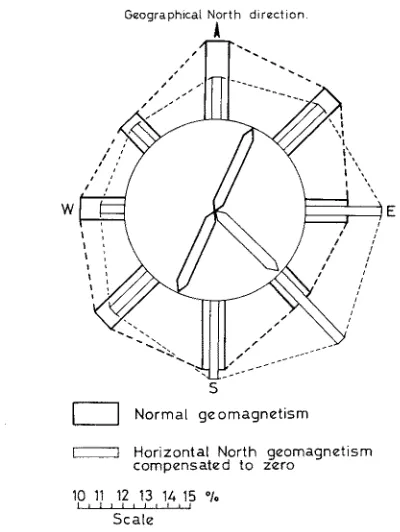
A comparison of the differences between experimental groups on the basis of the Z 2 test is presented in Table 3. In A. anguilla the striking differences between sea water and fresh water treated animals mentioned is accentuated by significant Z 2 values (both samples 2.5 % error). The same is true if the values for eels under com- pensated conditions and controls are compared (2,5 % and 5 % error).
Although on the basis of the comparatively small sample size of A. rostrata
Directional choice of eels 391 uncertain, a representation of the distribution graphically on the basis of a linear distribution seems to deliver clear results (Fig. 5). It becomes evident from the graph that eels in a compensated field exhibit a completely different (i. e. shifted b y 90 °)
Geographica{ North direction
1
/ / t I ',,
; / / ,I
i /
s
I ] Norma[ geomagnetism
I I Horizontal North geomagnetism
compensated to zero
lo 1~, 17,13,1~1s o/°
Scale
Fig. 4: Directional choice (in percent) of Anguilla anguilla, from the Elbe River at Hamburg examined in sea water, presented by a (smoothed) circular frequency distribution graph., with normal geomagnetic conditions (controls) and with North component of the horizontal geo-
magnetic field compensated to zero
~ 1 4 -
o
1 3 -
u
[ ~ 1 2 -
.o 11-
u
~ 1 0
. . . O . . . O . . . O, , , / / O . . . " - ~
•
y - /
"o
" \ \ ,
o
\ o / ~ . /
"',, ,
\ ' ~ o
• • N o r m a [ geomagnetism " " o . . . o " " •
o . . . o Horizontal North geomagnetism compensated to zero
0 - - - - o Horizontal geomagnetism reversed from North to South
I N'E I S ~ I -- , I ,
N E E S SW W NW
-14 -13
-12
-11
- 1 0
Fig. 5: Directional choice of Anguilla rostrata, examined in sea water, presented by a (smoothed) linear frequency distribution graph, with normal geomagnetic conditions (controls) with the
392 F.-W. TESCH
directional behaviour compared with controls. This is in agreement with the results on
A. anguilla
(Fig. 4).Although in a small experimental tar~k like the one used, effects such as ,generation of electric currents by means of the fish's movement through the geomagnetic field seem to be unlikely, some observations on change of position at intervals of 6 seconds indicated that movement is rare. Every 6 seconds a picture of the eels position was taken; thus nine comparisons of succeeding photos were possible. Out of 77 eel posi- tions 41 (53 °/0) exhibited no positional change; others revealed only slight changes.
D I S C U S S I O N
These investigations have shown that the directional position of silver .eels ob- viously depends on the geomagnetic field. This is evident i:rom the differences between the directional choice under a compensated horizontal North magnetism (X) and the
controls of
Anguilla anguilla
in sea water, as well as from similar changes of directionin all three samples of
Anguilla
sp. In fresh water the changes were not as clear as insea water but the directional choice of
A. anguilla
in fresh water was :significantlydifferent from that in sea water. The preferred direction in sea water was northerly and in fresh water easterly to southeasterly (in one case also in the opposite direction). Reversal of the N o r t h component of the geomagnetic field (X) to geographic South resulted in no consistent angular changes.
A directional preference of N o r t h or South, ,as in the controls, was also found
d,uring earlier investigations (TEscrI & LEL~K 1973)in
A. anguilla
examined in 1971under natural geomagnetic field. This was especially true for yellow (non-migratory) eels as well as for early stages of silver eels. Un~disturbed migratory eels in 1971 pre- ferred a northwesterly direction (321 °) with a hi~gh level of significance (Raytdgh test: z = 14.1 ; p < 1 % ) . The silver eels from the Elbe estuary in the present investigations were caught in 1973 at nearly the same place Ibut were not as undisturbed as the 1971 specimens: a~er capture they were transported and maintained in fresh water and they had to endure a longer delay before examination. This m a y be the reason for the circular distribution being more bimodal than in 197t. In addition, the number of measurements was not as great as 1971. The unimodal calcuiation of the mean direc- tion results in a northwesterly direction (303°; Rayleigh test: z = 0.9; no significance) as in I971.
The question now arises as to why, un, der the cor~dition of the N o r t h geomag- netism (X) compensated to zero, the circular distribution is not uniform. We stili always find an orientation to the east. This may be due to the fact that the horizontal magnetic field (H) also exhibits an easterly component (Y < - 0 . 0 1 Gauss), which a~er compensation of magnetic N o r t h supplies enough stimulation for further directional orientation. This would imply a very high sensitivity. Only compensation of Y to zero or reversal to the West can resolve this problem.
European robins
(Erithacus rubecula)
have been shown to be disoriented if placedDirectional choice of eels 393
horizontal component of the earth's field (X) but also the vertical component (V) was necessary for a directional orientation. Without V the robins had a bimodal ,directional choice. They appear to measure the inclination (J) of the geomagnetic field lines (WILTSCHKO 1972, WILTSCHKO & WILTSCHKO 1972). In eels a bimodal circular distribu- tion was found only if F was normal and it became unimodal if the horizontal field (H) was weakened by reduction of X. An answer to the question of whether V is important for the orientation of eels can only be given, if results of experimental reduction of V are at hand. From the results presented it seems likely that for eels the mechanism of utilizing magnetic fields is different from that in birds.
A ,directional preference along the magnetical meridian and in some cases in an East-West or West-East ,direction was also observed during periods of rest in gold-
fishes
(Carassius carassius auratus)
maintained in circular glass bowls (BrcKErt 1974).If the total geomagnetic field was compensated by a Helmholtz coil the fishes no lon- ger exhibited a special directional preference. A directional choice dependent on geo-
magnetism was also found in juvenile eels
(A. anguilla)
by a quite different technique:the labyrinth method (BRANOVER et al. 1971, VASILYEV et al. 1973). These as well as our own results imply that direct stimulation by magnetism is involved: the labyrinth examination, by the fact that strong magnetic fields rendered the eels incapable of orientation by means of magnetism; in the circular tank investigations, by the fact that only rare movement of the test animals in the tank was exhibited which indicates that hardly any induction and perception of electrical currents by the eels' movements through the earth magnetic field could occur. Electrical currents generated by water movement and their perception, as presumed by McCLEAVE e~: al. (1971), can de- finitely be excluded. TeSCH (1974) considers such a mechanism of orientation to be too complicated.
Ecologically very important is the influence of salinity on the directional ~behav- iour of the eels, as shown by examination either in pure fresh water or in pure sea water. The degree of salinity is obviously of minor importance. The earlier investiga- tions have shown that brackish water (one part sea water, two parts fresh water) in- duces a North or South preference of the silver eels (TEscH & LELE~ 1973b). The impor- tance of salinity on the behaviour of juvenile eels under the influence of magnetic fields is also demonstrated ;by experiments of VASILYEV & GL~ISER (1973). They found that increased salinity also augmented the effectiveness of the magnetical field. The authors attribute these results to the increase in .hydrodynamical effects by augmen- tation of salinity (see discussion above).
394 F.-W. TrscH
(TEscrt 1971). Probably, with a critical low salinity a change in orientation and be- haviour of the elvers at this location occurs. From an ecological point of view, the salinity acts as releaser in the silver eel which produces activity and a swimming in the direction of magnetical lines, i.e. in the Elbe estuary and in the North Sea, northward, as .demonstrated by results of telemetric ultrasonic tracking (TEscH 1972, 1974) and conventional tagging and recapture (LOHMANN & MANN 1958).
SUMMARY
1. A modified arrangement has been used for the photographic recording of the
directional choice of silver eels (Anguilla anguilla and A. rostrata) in a circular tank
and under the magnetic action of a Helmholtz coil.
2. The ~movement of the eels in the experimental tank was very restricted as obvious by photographs taken every 6 seconds.
3. Nine male specimens from the Elbe River near Hamburg, 11 male specimens from the Elbe estuary and 3 to 5 female specimes from Rhode Island (USA) were exam- ined for 17 to 22 rhours, either in sea water or in fresh water, and yielded 225 to 946 photographs for each examination.
4. In sea water, eels of all three samples changed their preferred direction from north or south to east, when the normal horizontal north (X) component of the geo- ,magnetic field was compensated to zero. The east component (Y) remained ( < - 0.01 Gauss) during all observations. In fresh water, eels also preferred more east-
erly directions in the compensated field, but to a lesser degree.
5. Reversal of the horizontal North component (X) of the magnetic earth field to the South caused no consistent change in eels examined in sea water compared with the controls. In fresh water a slight but consistent deviation to the right was observed.
6. Sea water and fresh water controls including A. rostrata showed a significant
directional difference; sea water specimens chose North or South; fresh water spe- cimens sel~ected East to Southeast.
7. Perhaps because of the very small sample of A. rostrata, differences in this species
and compared with A. anguilla were mostly not significant. ,But in all cases the
same tendencies as in the European eels have been observed.
8. The question of whether selection of swimming course is affected by the earth magnetic field itself or by magnetohydrodynamically produced electricity is dis- cussed. Mechanisms of orientation under the infl.uence of geomagnetism seem to be different from those observed in birds.
9. An ecological example &ore the Elbe estuary is given which demonstrates the combined action of geomagnetism and salinity on migratory orientation of silver eels. It is evident that the salinity necessary to release northward swimming is comparatively low; this was also obvious from the results of earlier laboratory investigations (TrscH & LzLr• 1973,b).
Acknowledgements. The author thanks Mrs. M: BAIITEI~ for technical assistance, Mr. W. DITT•ICtt ~or designing the Helmhohz coils, Mr. R. EDEL as well as Dr. H. E. WINN, Rhode
D i r e c t i o n a l choice of eels 395
the drawings and the photo. I am indebted also to Prof. E. BATSCrlEL~T, ZiJrich, for statistical advice, to Dr. J. D. McCLrAVr, Orono (Maine, USA), Dr. A. B. STASIfO, St. Andrews (Canada) and Dr. W. WILTSCH~O for critical reading the manuscript as well as Dr. A. LrLEK and Prof. Dr. F. W. M~RKrL (Frankfurt/M.) for helpful suggestions during the planning stage of the investigations. Part of this work was made possible by a grant of the Deutsche Forschungs- gemeinschaflc.
L I T E R A T U R E C I T E D
BATSCHEL~T, E., t965. Statistical methods of the analysis of problems in animal orientation and certain biological rhythms. Am. Inst. biol. Sci., Washington, D.C., 57 pp.
BECXER, G., 1974. Einfluf~ des Magnetfelds auf das Richtungsverhalten yon Goldfischen. Natur- wissenschafien 01,220-221.
B•ANOVER, G. G., VAsIrxrv, A. S., GLrISER, S. I. & TSmOBrR, A. B., 1971. A study of the behaviour of eel in artificial and natural magnetic fields and the analysis of their mechanism of reception. (Russ.) Vop. Ikhtiol. 11,720-727.
KO~L, H. & MANN, H , 1953. Beitr~ige zur Hydrochemie der Unteretbe. Ver~Sff. Inst. Meeres- forsch. Bremerh. 2, 236-268.
LOHMANN, M. & MANN, H., 1958. Wiederf~inge markierter Gelbaale vor der Kfiste D~ine- marks. Arch. FischWiss. 9, 200-202.
McCLEAVr, J. D., ROMMEL, S. A. & CATHCART, C. L., 1971. Weak electric and magnetic fields in fish orientation. Ann. N. Y. Acad. Sci. 188, 270-282.
ROMM~L, S. A. & McCL~AW, J. D., 1973. Sensitivity of American eels (Anguilla rostrata) and
Atlantic salmon (Salrno salar) to weak electric and magnetic fields. J. Fish. Res. Bd Can.
80, 657-663.
TESCH, F.-W., 1971. Aufenthalt der Glasaale (Anguilla anguilla) an der stidlichen Nordsee-
kiiste vor dem Eindringen in das Stii~wasser. Vie Milieu (Suppl.) 22, 381-392.
- - 1972. Versuche zur telemetrischen Verfolgung der Laichwanderung yon Aalen, Anguilla
anguilla, in der Nordsee. Helgol~inder wiss. Meeresunters. 23, 165-183.
- - 1974. Speed and direction of silver and yellow eels, Anguilla anguilla, released and tracked
in the open North Sea. Ber. dt. wiss. Komm. Meeresforsch. 23, 181-197.
- - & LEL~K, A., t973a. Directional behaviour of transplanted stationary and migratory form
of the eel, Anguilla anguilla, in a circular tank. Neth. J. Sea Res. 7, 46-52.
- - - - 1973b. An evaluation of the directional choice in the eel, in captivity. Arch. FischWiss. 24, 237-251.
VASILYrV, A. S. & GLEtS~R, S. I., 1973. Changes in activity of Anguilla anguilIa L. in magnetic
fields. (Russ.) Vop. IkhtioI. 18, 381-383.
- - - - So~owsmN, V. A., SOXOWSHINA, L. M. & KHODOR~OVSKY, V. A., 1973. Magneto- receptor reactions of hyaloid eel (Russ.). Biofizika 18, 132-137.
WILTSCHKO, W., 1968. r,3ber den Einflug statischer Magnetfelder auf die Zugorientierung der
Rotkehlchen (Erithacus rubecula). Z. Tierpsychol. 25, 537-558.
- - 1972. Einige Parameter des Magnetkompasses der Rotkehlchen (Erithacus rubecula). Verb.
dt. zool. Ges. 05, 281-285.
-- & WILTSCHKO, R., 1972. Magnetic compass of European robins. Science, N. Y. 17(5, 62-64.
Author's address: Dr. F.-W. TESCH
Biologische Anstalt Helgoland (Zentrale) 2 Hamburg 50
Palmaille 9