Open Access
Study protocol
Feasibility of a multidimensional home-based exercise programme
for the elderly with structured support given by the general
practitioner's surgery: Study protocol of a single arm trial preparing
an RCT [ISRCTN58562962]
Timo Hinrichs
1, Claudio Bucchi
1, Michael Brach*
2, Stefan Wilm
3,
Heinz G Endres
4, Ina Burghaus
4, Hans-Joachim Trampisch
4and Petra Platen
1Address: 1Department of Sports Medicine and Sports Nutrition, Ruhr-University Bochum, 44780 Bochum, Germany, 2Institute of Sport Science,
University of Münster, Horstmarer Landweg 62b, 48149 Münster, Germany, 3Institute of General Practice and Family Medicine, University Witten/
Herdecke, Alfred-Herrhausen-Straße 50, 58448 Witten, Germany and 4Department of Medical Informatics, Biometry and Epidemiology,
Ruhr-University Bochum, 44780 Bochum, Germany
Email: Timo Hinrichs - [email protected]; Claudio Bucchi - [email protected]; Michael Brach* - [email protected]; Stefan Wilm - [email protected]; Heinz G Endres - [email protected]; Ina Burghaus - [email protected];
Hans-Joachim Trampisch - [email protected]; Petra Platen - [email protected] * Corresponding author
Abstract
Background: Physical activity programmes can help to prevent functional decline in the elderly. Until now, such programmes use to target either on healthy community-dwelling seniors or on elderly living in special residences or care institutions. Sedentary or frail people, however, are difficult to reach when they live in their own homes. The general practitioner's (GP) practice offers a unique opportunity to acquire these people for participation in activity programmes. We conceptualised a multidimensional home-based exercise programme that shall be delivered to the target group through cooperation between GPs and exercise therapists. In order to prepare a randomised controlled trial (RCT), a feasibility study is being conducted.
Methods: The study is designed as a single arm interventional trial. We plan to recruit 90 patients aged 70 years and above through their GPs. The intervention lasts 12 weeks and consists of physical activity counselling, a home-exercise programme, and exercise consultations provided by an exercise therapist in the GP's practice and via telephone. The exercise programme consists of two main components: 1. a combination of home-exercises to improve strength, flexibility and balance, 2. walking for exercise to improve aerobic capacity. Primary outcome measures are: appraisal by GP, undesirable events, drop-outs, adherence. Secondary outcome measures are: effects (a. motor tests: timed-up-and-go, chair rising, grip strength, tandem stand, tandem walk, sit-and-reach; b. telephone interview: PRISCUS-Physical Activity Questionnaire, Short Form-8 Health Survey, three month recall of frequency of falls, Falls Efficacy Scale), appraisal by participant, exercise performance, focus group discussion. Data analyses will focus on: 1. decision-making concerning the conduction of a RCT, 2. estimation of the effects of the programme, detection of shortcomings and identification of subgroups with contrary results, 3. feedback to participants and to GPs. Published: 17 August 2009
BMC Geriatrics 2009, 9:37 doi:10.1186/1471-2318-9-37
Received: 10 July 2009 Accepted: 17 August 2009
This article is available from: http://www.biomedcentral.com/1471-2318/9/37
© 2009 Hinrichs et al; licensee BioMed Central Ltd.
Conclusion: A new cooperation between GPs and exercise therapists to approach community-dwelling seniors and to deliver a home-exercise programme is object of research with regard to feasibility and acceptance. In case of success, an RCT should examine the effects of the programme. A future implementation within primary medical care may take advantage from the flexibility of the programme.
Trial registration: Current Controlled Trials ISRCTN58562962.
Background
Home-based exercise for the elderly has been shown to be effective in keeping and increasing functional and health status, when carried out correctly. Low price and organisa-tional flexibility make it an alternative or a supplement to other forms of physical exercise and active lifestyle. With increasing age, the general practitioner's surgery often becomes a distinguished place of health care and social contacts. Our approach is to make use of this reputation and to set up cooperation between general practitioners and exercise therapists. Thus, elderly people should be invited to and guided through a state of the art home-based exercise programme. In order to prepare a ran-domised controlled trial (RCT, phase III, in accordance with [1]) on the new programme, a feasibility study (phase II) will be conducted. Provided satisfying results, the cooperation model could be implemented into every day primary medical care for the aged (phase IV). The fol-lowing sections describe the background and develop-ment of the programme, and the methods and measures of the feasibility study. Criteria for the RCT are given in section "Statistical analysis and decision-making on RCT preparation".
Physical activity and fitness in old age
In the face of demographic chance [2], preserving func-tional status, mobility and thus independence in old age is more and more challenging for the society. Some 80% of the population in Germany, aged 70 to 85 years, stated to suffer from two or more chronic diseases, 24% from five or more [3]. Without any question, physical activity on a regular basis contributes to healthy ageing. Positive influences both on chronic diseases such as diabetes or coronary heart disease, and on preservation of mobility and independence are well documented [4-6]. Results from Peel et al. [7] show a positive correlation between functional mobility (leg strength, balance, locomotion speed) and behavioural mobility (utilizing certain neigh-bourhoods and places inside and outside town). In order to obtain a standard value of life span postural balance, Era et al. [8] included 7979 Finnish subjects aged 30 years or older in a balance test battery on a force plate. Slight decreases in balance scores were already observable in middle-aged subjects (age 40 years and older) but became more pronounced after the age of 60 years. Reduced bal-ance has been identified as a risk factor for falls and is
related to decreased strength [9]. Hurley [10] reports a decrease in muscular strength of about 12–15% per dec-ade, starting with the fourth and fifth decade (up to the eighth decade) of life. The results of Jette and Branch [11] may describe another functional consequence of this reduction: only 72% of men and 34% of women in a sam-ple aged 75–84 years of age reported to being able to lift a weight over 10 lbs., comparable to a full shopping bag. Other aspects of physical fitness also show a clear relation-ship to everyday functioning: Maximum oxygen uptake, a measure of endurance capacity, decreases by 3 to 6% per decade during the third and fourth decade, and by more than 20% during the eighth decade of life [12]. Thus, the performance of some everyday activities seems to demand maximal effort from many old persons. Geraldes et al. [13] obtained a positive correlation between hip flexibil-ity and functional test scores (sit-to-stand, going-up-stairs, 6-minute-walk) in senior women. Kinematic analyses with young and old subjects identified restriction of shoulder flexion, knee extension and ankle plantar flexion as main age related and aggravating influences on every-day movements and activities, e.g. sit-to-stand, walk, arm operations [14]. Summing up, even highly aged and chronically sick persons may profit from physical exercise of endurance, strength, balance and flexibility [15-19]. Consequently, present guidelines of the American Heart Association (AHA) and the American College of Sports Medicine (ACSM) demand for multidimensional activity programmes, which should include a daily training of these four basic motor skills [5].
Multidimensional programmes for the elderly
func-tional abilities and quality of life seemed to be rather small. A possible selection bias causing the latter is dis-cussed, because sample baseline measurements were quite well (low functional restrictions, high quality of life). Mian et al. [18] studied the effect of training inter-ventions on locomotor function of the elderly. Inclusion criteria of this systematic review were met by 55 trials. In 36 (80%) out of 45 trials with a sedentary control group, at least one locomotor function improved in the experi-mental group relative to the control group. Most fre-quently used outcome measures were habitual walking speed (22 trials) and timed-up-and-go test (TUG, 16 tri-als). TUG scores improved significantly in 13 studies (by 5 to 28%). Only 10 trials (18%) were multidimensional, targeting at least on strength and endurance and balance, optionally on flexibility. Only one of them utilised home-based exercise. Another systematic review [21] focused on functional abilities of frail elderly and comprised 20 papers. These were based on a total of 23 different inter-ventions, which included strength exercise (9), tai chi (2) or combinations of strength training with endurance or flexibility or balance training (12). Mostly, elastic tapes, dumb bells and ankle weights were used for strength exer-cises. Three trials utilised special strength training machines. Merely two of the interventions were purely home-based. These were monitored by physiotherapists. The other interventions consisted of group exercise, car-ried out in training facilities. Five of them offered com-bined facility and home exercise. Paw et al. [21] noticed a broad variety of functional outcome measures. A majority of the interventions (14 out of 20) resulted in effects on at least one of the functional parameters. Yamauchi et al. [22] conducted an RCT on the effects of a multidimen-sional 12-week home-based exercise programme, which contained walking, stretching, and resistance exercises for 23 elderly people. Once a week, a group session was offered in the community centre. After 12 weeks all func-tional parameters (arm curl, chair stand, TUG, back scratch, sit-and-reach, 12-minute-walk) had improved sig-nificantly in relation to the control group (n = 17).
Home-based versus centre-based exercise
Obviously, there are some advantages of home-based exercise in opposition to group session exercise: Special facilities or costly devices are not necessary, and so is the transport – which might be most important with respect to the target group. Thus costs are low and the training can be conducted daily – just as demanded by ACSM and AHA. Under a public health perspective, the access to home-exercise programmes seems to be easier. Once implemented, a home-exercise programme should be capable to reach a broad audience. Ashworth et al. [23] conclude from their Cochrane Review, that especially on the long run, home-based exercise programmes show bet-ter adherence than centrally conducted programmes.
Inauspicious or distant locations may result in low adher-ence to a programme [24]. On the other hand, group exer-cise may enjoy popularity on the strength of social contacts, which generally are of very high importance for the target group. But yet there are no interventional trials comparing home-based single training versus centre-based group training and controlling all other variables, e.g. intensity, volume, and structure of exercise [18]. Therefore, a final statement or a general decision for either organisation of exercise is impossible at the moment. In order to maximise compliance to a home-based pro-gramme, exercises should be simple, combined with proper equipment and personal support: Henry et al. [25] found higher compliance for participation in a pro-gramme with two exercises compared to propro-grammes with five or eight exercises. Schoo et al. [26] failed to improve compliance or exercise performance of patients with osteoarthritis of the knee, when they handed them audio or video cassettes in addition to an oral instruction and a written exercise booklet for their home exercises. Compared with that, stakeholders in home-based exercise emphasise the importance of personal contact, given by oral instructions and phone support [27,28].
Approaching seniors at home and via general practitioners
Until now, activity programmes used to target on healthy, community-dwelling seniors or on elderly living in spe-cial residences or care institutions [[29], for an example]. Sedentary or frail people living in their own homes are dif-ficult to reach. About one half of seniors aged 85 years or above rarely leave their homes [30,31]. Interventional tri-als targeting on those "housebound" aged are scarce. Therefore, the surgery of the general practitioner (GP) seems to be an ideal starting point and junction for this target group: (a) the physician knows best about the eligi-bility of the individual, (b) there are chances to recruit patients for the programme and guide them through it, and (c) extra home visits could help to increase adher-ence. These aspects are discussed in the following sections.
Assessment of exercise eligibility
of Cardiology [33,34], and the U.S. Preventive Services Task Force [35] no longer dissuade from taking up light or moderate exercise without previous exercise tolerance testing. Only rarely acute cardiovascular incidents happen as a result of physical activity. Furthermore, they are not predictable: Neither screening questionnaires like rPAR-Q [36] nor exercise electrocardiograms (ECG) are valid diag-nostics to identify individuals, who are in danger of such incidents [37,38]. Both sorts of instruments yield high rates of false positives and false negatives, e.g. the sensitiv-ity of exercise ECG for future cardiovascular incidents (3– 12 years) is 40–62% [35,37].
Acquisition of participants
Generally, the trustful relation of patient and doctor plays an important role in patient compliance [39,40]. There-fore, GPs have chances to help their patients change their activity habits, and in particular to acquire them for par-ticipation in physical exercise programmes. Elley et al. [41] conducted a controlled trial with physicians advising their patients. This resulted in an increased physical activ-ity and health-related qualactiv-ity of life. Unfortunately, only few primary care physicians spend time on motivating their patients to reach for more physical activity or on dis-cussing its benefits [41,42]. This might be due to lack of time or to lack of specialised knowledge. A well-structured programme could yield support for both aspects.
Home visits
Home visits by trained personnel are one possible way to reach sedentary or frail elderly people in their homes. Tudor-Locke et al. [43] delivered an exercise intervention through existing home support infrastructures for old people. Home support workers instructed their clients on how they could exercise and provided ongoing encourage-ment on occasion of regular home visits. McMurdo and Johnstone [44] recruited participants for an interventional trial in sheltered housing complexes. For a period of 6 months, a physiotherapist visited them at home every 3 or 4 weeks and instructed them in home-based exercises. In a study of Campbell et al. [45], 622 potential participants were chosen from patient card files of 17 GPs surgeries and invited by the physicians. 233 could be randomised. The intervention consisted of four home visits within 2 months by a physiotherapist with instruction in a 30 minute three times a week exercise programme, and also in three walks a week. Following, there were regular phone calls over a period of 10 months, to stay in contact and to keep adherence.
Summary and consequences for programme development and trial methodology
Present guidelines for physical activity demand multidi-mensional programmes. It is a matter of research, how such programmes may in fact improve clinically relevant
parameters, everyday functions or quality of life for eld-erly people. So far, interventions used to target independ-ent seniors or residindepend-ents of care institutions. There are problems to recruit community-dwelling, but sedentary aged with restricted mobility. Approaching them via their GP seems promising. In this case, the physician plays a decisive role both in acquisition and assessment of poten-tial participants. A well-designed programme utilising this "surgery approach" should support the physician with structured information and personnel. An exercise thera-pist can provide this kind of support: he or she is able to take individual needs and constraints, but also principles of modern training into account [46]. Especially in older adults with multiple morbidities, the development of a tailored and safe exercise programme requires knowledge, time, individualised mentoring and a close cooperation between GP and exercise therapist. Considering health-related heterogeneity and restricted mobility, group exer-cise in central facilities seems suboptimal compared to home-based exercise. In summary, a home-based exercise programme, approaching and supporting community-dwelling but mobility-restricted seniors via their GP and an exercise therapist, is object of research with regard to feasibility and acceptance. In case of success, a ran-domised controlled trial should examine the effects of the programme. After positive evaluation, a future implemen-tation within primary medical care may take advantage from the flexibility and individuality of the programme.
Development of the exercise programme
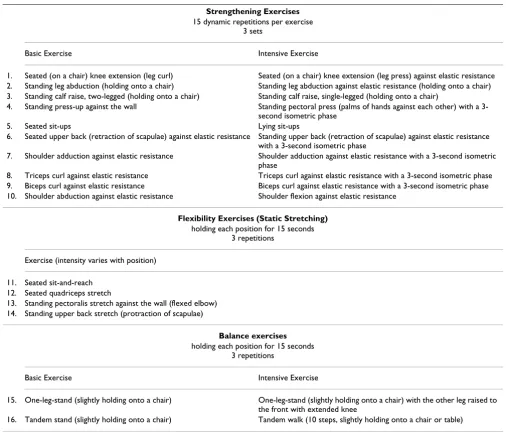
Cross-sectional and interventional studies have proven that functional abilities can be increased by physical train-ing even in very old people and in elderly patients with chronic diseases [15-19]. According to the current ACSM/ AHA recommendations on physical activity in older adults [5], a multidimensional exercise programme has been designed, that: 1. aims to improve aerobic capacity, strength, flexibility and balance; 2. can be individually adapted to the participant's functional abilities; and 3. allows combining preventive and therapeutic aspects of exercise. An activity plan, an activity log and a pedometer will be used to improve motivation for and adherence to the exercise programme. An overview of the home-based exercises is given in table 1.
Strengthening exercises
to strengthen the calf muscles (standing calf raise) can be performed two-legged ("basic") or single-legged ("inten-sive"). Some exercises are to be performed using an elastic resistance band. Elastic resistance band exercises have been demonstrated to be efficient in improving physical function in independently-living older adults [47] and in physically frail community-dwelling older persons [48]. Elastic resistance bands offer another possibility to adapt the level of difficulty to the participant's performance level as they are available in different colour-coded levels of resistance. Depending on the performance and the progress, participants can be instructed to increase inten-sity by advancing to the next resistance colour of the elas-tic band. The level of effort should be moderate (5 or 6 on
a 10-point scale, where no movement is 0, and maximal effort of a muscle group is 10). Participants should per-form 3 sets of 15 repetitions of every exercise. They are instructed to not hold their breath during the exercises in order to prevent exercise induced blood pressure eleva-tions.
Flexibility exercises
To maintain (or improve) the range of motion necessary for daily activities, the programme contains two upper body and two lower body flexibility exercises (static stretching). Participants are instructed to perform the exercises slowly, holding each position for 15 seconds. They are instructed to stretch to a point of moderate ten-Table 1: Overview of home-based exercises.
Strengthening Exercises
15 dynamic repetitions per exercise 3 sets
Basic Exercise Intensive Exercise
1. Seated (on a chair) knee extension (leg curl) Seated (on a chair) knee extension (leg press) against elastic resistance 2. Standing leg abduction (holding onto a chair) Standing leg abduction against elastic resistance (holding onto a chair) 3. Standing calf raise, two-legged (holding onto a chair) Standing calf raise, single-legged (holding onto a chair)
4. Standing press-up against the wall Standing pectoral press (palms of hands against each other) with a 3-second isometric phase
5. Seated sit-ups Lying sit-ups
6. Seated upper back (retraction of scapulae) against elastic resistance Standing upper back (retraction of scapulae) against elastic resistance with a 3-second isometric phase
7. Shoulder adduction against elastic resistance Shoulder adduction against elastic resistance with a 3-second isometric phase
8. Triceps curl against elastic resistance Triceps curl against elastic resistance with a 3-second isometric phase 9. Biceps curl against elastic resistance Biceps curl against elastic resistance with a 3-second isometric phase 10. Shoulder abduction against elastic resistance Shoulder flexion against elastic resistance
Flexibility Exercises (Static Stretching)
holding each position for 15 seconds 3 repetitions
Exercise (intensity varies with position)
11. Seated sit-and-reach 12. Seated quadriceps stretch
13. Standing pectoralis stretch against the wall (flexed elbow) 14. Standing upper back stretch (protraction of scapulae)
Balance exercises
holding each position for 15 seconds 3 repetitions
Basic Exercise Intensive Exercise
15. One-leg-stand (slightly holding onto a chair) One-leg-stand (slightly holding onto a chair) with the other leg raised to the front with extended knee
16. Tandem stand (slightly holding onto a chair) Tandem walk (10 steps, slightly holding onto a chair or table)
sion without pain in the joints or muscles, gradually increasing the range of motion. The flexibility exercises should be performed after the strengthening exercises.
Balance exercises
To reduce risk of injury from falls and to improve mobility [9], the programme comprises two balance exercises that can be performed in two different variations ("basic" or "intensive") depending on the participant's abilities. To perform these exercises safely it is important that partici-pants follow the safety instructions given by the exercise therapist (e.g., tandem walk along a stable table).
Walking
Home-based walking has been shown to be effective in improving cardiopulmonary function in community-dwelling elderly people [49]. To improve aerobic capacity, this study's participants are instructed to walk for exercise (around their homes) four times a week for 30 minutes. The level of effort should be moderate (5 or 6 on a 10-point scale, where sitting is 0 and all-out effort is 10). Depending on the physical activity habits and the abilities of the participant, it can be necessary to start with shorter walks of lower intensity. With the progress of the interven-tion, duration of the walks and intensity level can be increased in a stepwise manner.
Aims of the trial
From a methodological point of view, effects should be studied by randomised controlled trials. Before spending large resources for an RCT, the feasibility of the pro-gramme should be tested, and there should be some prob-ability that there will be an effect. Thus, the aims of the present study are:
1. On the individual level: to test the feasibility of the new physical activity programme according to the ACSM guidelines. The exercises were conceptualised and described in the previous subsection "Develop-ment of the exercise programme".
2. On the institutional level: to initiate and evaluate a cooperation between GPs and exercise specialists, for recruiting and supporting participants. The reasons for this procedure were given in the subsections "Approaching seniors at home and via general practi-tioners" and "Summary and consequences for pro-gramme development and trial methodology".
3. On the methodological level: to analyse the capabil-ity and functional effects of the programme including the special support scheme, and the adherence of the participants, thus gaining preliminary data for the preparation of a randomised controlled study. The decision criteria are laid down in subsection
"Statisti-cal analysis and decision-making on RCT prepara-tion".
Methods
Study overview: settings, targets, design and registration
The trial targets on community-dwelling patients, aged 70 years or above, who visit their GP's surgery. Beneath the practices, the participants' homes are also settings of the intervention, where the exercises are conducted and data are collected (diaries). For a time table and flow chart see figure 1 in subsection "Interventions". Using the frame-work of Campbell et al. [1], the present study belongs to phase II and is to prepare a phase III study. The trial is designed as a single arm interventional trial and is regis-tered at http://www.controlled-trials.com as ISRCTN58562962.
Recruitment of subjects and time schedule
Community-dwelling older adults will be recruited through GP surgeries. The recruitment period starts in April 2009 and ends in July 2009. The last participant is expected to finish the intervention in November 2009. In order to recruit a representative sample, all participants are recruited consecutively through (approximately 10) GP practices (motivated research practices associated to the Institute of General Practice and Family Medicine, University Witten/Herdecke) within predetermined time periods. All patients aged 70 years or above who are seen by the GP within his consultation hours (personal con-tact) within that time period are screened for eligibility. Exclusion for medical or other reasons (see exclusion cri-teria) is documented. If the physician considers a patient eligible for the study, the patient is informed about the study in detail by the physician and by an exercise thera-pist. The therapist spends the whole recruiting period in the practice to assist the GP and to document the recruit-ment process. After a participant has given written informed consent, appointments for the baseline assess-ment (telephone interview and motor tests in the practice, see secondary outcome measures) are made. The recruit-ing period for the respective physician ends with the recruitment of a predetermined number of patients. The recruitment period for the first participating practice ends with the recruitment of 12 patients. The number of partic-ipants to be recruited by the following practices depends on the number of patients that have already passed the baseline assessment in the previous practices. The target of this recruitment mode is that 90 subjects participate in the baseline assessment (on average 9 patients per practice if 10 practices participate in the study).
Inclusion criteria
Time table and flow chart of the trial
Figure 1
study. They have to be able to walk (with or without a walking aid) and to visit the practice of the GP for repeated consultations. Furthermore, participants have to be able to cooperate appropriately and to follow the instructions of the home-based exercise programme (according to their GP's judgement). Finally, all partici-pants have to provide written informed consent.
Exclusion criteria
Patients are excluded if the intervention doesn't fit into their schedule (e.g. because of a planned vacation). Patients are excluded for medical reasons if they suffer from untreated arterial hypertension or arterial hyperten-sion despite antihypertensive medication (GP's judge-ment), from chronic heart failure (New York Heart Association (NYHA) grade III–IV), from an acute psychi-atric disorder (e.g. depression), or from a severe consum-ing illness. Furthermore, patients are excluded, if they suffered a clinically relevant cardiovascular event (e.g. unstable angina pectoris, myocardial infarction, coronary angiography and/or angioplasty, cardiac surgery), a clini-cally relevant cerebrovascular event (e.g. stroke, recurrent TIA), any inpatient surgical procedure, or a deterioration of an insufficiently controlled diabetes mellitus (accord-ing to their GP's judgement) within the past 3 months, or if their HbA1c exceeds 10% (if available). Concurrent par-ticipation in another clinical trial is also an exclusion cri-terion.
Risk-benefit considerations
Unlike some physical activity trials that often exclude chronically diseased individuals this study only excludes individuals that are at high risk for adverse events. The GP, who knows the participant's medical history and his cur-rent health status, decides whether the patient is eligible for the programme. For the patients who are eligible for the study, the expected cardiovascular benefit of the pro-gramme exceeds the risk for adverse cardiovascular events. Cardiovascular risk is not the only risk associated with starting an exercise programme. An increase of physical activity and especially of walking outdoors may initially increase the risk of minor and major musculoskeletal injuries (including sprains, strains, joint pain, overuse injuries, falls and fractures) compared to a sedentary life-style. But in the long term, an increase in physical activity is considered to lead to a better mobility, to an improve-ment in gait performance and consecutively to a reduction of fall and injury risk. To reduce the risk of adverse events, the exercise programme is tailored to the abilities of the patient by an exercise therapist (in cooperation with the GP) who holds a university degree in sports science (bach-elor or higher).
Interventions
The intervention lasts 12 weeks and consists of physical activity counselling, the previously described home-based
exercise programme, and exercise consultations provided by an exercise therapist in the GP's practice and via tele-phone. The exercise programme starts immediately after the baseline assessment in the GP's practice (week 1) and ends with the final assessment in the practice (week 13, see figure 1).
Physical Activity Counselling and Exercise Consultation
The exercise therapist provides initial counselling on gen-eral aspects of physical activity (week 1), an introduction (theoretically and practically) into the exercise pro-gramme (week 1), a given number of additional personal consultations within the practice of the participant's GP (week 2, 4 and 6), and a given number of consultations on the telephone (week 3, 5, 7, 9 and 11). First of all, the par-ticipant receives standardised counselling by the exercise therapist pertaining to the benefits of physical activity (week 1). The conversation is aiming to improve knowl-edge and understanding of the preventive and therapeutic effects of physical activity on particular chronic condi-tions. The counselling also contains a systematic assess-ment of the actual physical activity status, a discussion of potential barriers, problem solving to overcome barriers (e.g. by creating an activity timetable), and the creation of individual physical activity goals. Secondly, based on the assessment of the actual physical activity habits and the functional abilities of the participant and based on the knowledge of the participant's chronic diseases (commu-nicated by the GP), the exercise therapist adapts the exer-cise programme to the participant's abilities and needs, integrating preventive and therapeutic aspects. Every par-ticipant is taught (theoretically and practically) to cor-rectly perform the selected exercises (week 1). A pictorial guidebook is provided to each participant to assist them in correct exercise performance. Within the following per-sonal consultations (week 2, 4, 6) with the exercise thera-pist, the participant gets the opportunity to discuss problems concerning the exercise programme. Exercises are controlled for correctness of performance. New exer-cises are taught. Choice and intensity of exerexer-cises is adapted to the participant's performance level. The con-sultations aim to provide encouragement and to improve knowledge and self-efficacy of the participants so that they are able to perform their activity programme inde-pendently. Support is reduced in a stepwise manner and personal consultations are replaced by telephone consul-tations (week 3, 5, 7, 9 and 11). If a patient misses a per-sonal consultation in the practice, the appointment is replaced by a telephone consultation. Every consultation follows a standardised protocol and is documented by the exercise therapist.
Home-based exercise programme
components that should be performed in alternating order:
1. a combination of home-exercises to improve strength, flexibility and balance on 3 days of the week,
2. walking to improve aerobic capacity on 4 days of the week.
Every participant is instructed and supervised by his per-sonal exercise therapist. The exercise programme usually starts with a selection of a few simple home-exercises and with short walks. Additional exercises are taught by and by (depending on the participant's progress) with the advancement of the intervention. The duration of the walks is also increased in a stepwise manner. Days of rest are accepted according to the patient's needs. In case a par-ticipant is able to perform all home-exercises, he performs ten strengthening exercises (moderate intensity 5–6/10), followed by four flexibility exercises and two balance exer-cises. The exercises are numbered and should always be performed in the same chronological order. To perform all home-exercises in a row it takes about 30 to 45 min-utes. In case of questions or problems concerning the exercise programme, patients have the opportunity to contact their GP or their exercise therapist.
Materials Pictorial guidebook
The pictorial guidebook includes a statement of the activ-ity goals and general information on the exercise pro-gramme (frequency, duration, intensity), instructions for use of the pedometer and the elastic resistance bands, safety instructions, instructions for clothing and warm-up, a detailed description of all home-exercises, and contact information of the exercise therapist (including the mobile phone number). The pictorial guidebook has been developed using older adults as models.
Workbook
Every participant receives the German Olympic Sports Federation workbook "Bewegungsangebote 70 plus" [Physical activity choices 70 plus] [50] that includes gen-eral information on the health benefits of physical activity and detailed information about physical activity pro-grammes for seniors in Germany.
Elastic resistance bands
Elastic resistance bands are provided to the participants in order to perform some of the home-exercises. The elastic resistance bands (Thera-Band® GmbH,
Dornburg-Frick-hofen, Germany) are available in eight different colour-coded levels of resistance. Two different levels of resist-ance, that are rather low within the available spectrum, have been chosen for this study: the yellow band ("thin") provides lower resistance; the red band ("medium")
pro-vides higher resistance. If necessary, additional resistance can be created by folding the band. Every participant gets a yellow and a red band, each of them measuring two metres.
Pedometer
As a motivational support and to receive immediate feed-back on their accumulated step count, every participant gets a pedometer (NL-800, New-Lifestyles Inc., Lee's Sum-mit, USA). The pedometer measures vertical acceleration to count steps. It has an internal memory chip and is capa-ble of storing up to 7 days of data, in 1-d epochs. The internal clock resets the step count at midnight. Step total is displayed on a screen. The pedometer should be worn close to the hip, attached to a belt, waistband or a hori-zontal pocket. Participants are instructed in the use of the pedometer and asked to begin recording daily pedometer counts (every evening).
Activity Log
Patients are instructed to record their daily activity. The activity log serves as a motivational support and as a help for the therapist to supervise (and adapt) the exercise pro-gramme. The following items are recorded by the patients every day: duration of walking for exercise, performance of home-exercises, total step count, comments (e.g. rea-sons for inactivity). The activity log also serves as an out-come measure.
Consultation protocol
Outcome measures, types of data and measurement techniques
We discriminate primary measures, which are essential to judge on the cancellation or conduction of the planned RCT, from secondary measures, which are all other data to be obtained.
Primary outcome measures
Appraisal by participating general practitioners
A structured interview will be held with partaking GPs. The main questions are: Would you once again participate in the trial? Why/why not? Do you have any ideas or pro-posals for programme improvements? In addition, age and sex of the physician and profile data of his or her prac-tice are documented (urban or rural area, medical field, single handed practitioner or group practice, quarterly number of patients seen below 900, between 900 and 1500, above 1500).
Documentation of any undesirable event during the intervention Any symptom or disease of any participant, which occurs during the intervention, is called an undesirable event. This definition is valid without reference to the fact, whether the intervention might be a cause or not. In case of an undesirable event, the participant promptly has to suspend exercise and to visit the surgery. The event has to be documented by a standardised report protocol, includ-ing the followinclud-ing judgements by the physician: medical/ non-medical; caused/not caused by exercise; subject may/ may not continue exercises.
Measures of drop-out
For each case of discontinued participation, the following reasons will be discriminated: medical reason (r1), change or misjudgement of inclusion or exclusion criteria (r2), subject's own decision (r3). After that, certain sets (groups) will be aggregated:
A – all participants who passed the baseline assessment
DOi – participants who drop out by reason ri
DO = DO1 ∪DO2 ∪DO3 – all participants who drop out
A* = A\(DO1 ∪ DO2) – adjusted set of participants (all participants not constrained to abort exercise by medical or trial criteria reasons)
DO* = A* ∩DO3 – adjusted drop out group (participants who discontinue on their own decision). Members of this group will be asked for a personal reason (voluntary and open question), and also be asked to participate in the final assessment.
The following parameters are of special interest:
|DO| – total number of participants who drop out after the initial assessment
|DOi| – number of participants who discontinue for rea-son Ri
|DO*|/|A*| – adjusted drop out rate
Measures of adherence
For the adjusted set of participants (A*), measures of adherence are calculated:
• Number of consultation dates with the exercise ther-apist attended (personal and telephone exercise con-sultations)
• Number of activity units (walks, home exercises) documented in the activity log. Depending on the data available, corresponding numbers will also be calcu-lated for DO*.
Secondary outcome measures
Effect measures (week 0/1 and week 13)
To measure effects of the intervention on functional skills, every day physical activity, general health, frequency of falls and fear of falling, the following measures will be used:
a. Motor tests (in standardised order): timed up and go, chair rising, grip strength, tandem stand, tandem walk, sit-and-reach;
b. Telephone interview: PRISCUS-Physical Activity Questionnaire (PRISCUS-PAQ), Short Form 8 Health Survey (SF-8™ 4-week recall version), three month recall of frequency of falls, Falls Efficacy Scale – Inter-national Version (FES-I).
assured by using two different ball sizes. For test of stand-ing balance, the subjects are asked to attempt to maintain their feet in the tandem position (heel of one foot directly in front of the other foot) for 10 seconds [56]. Three attempts are timed. For test of walking balance, the sub-jects are asked to attempt to walk heel of one foot directly in front of the other foot (tandem walk) for 8 steps. The number of performed steps is counted and documented (three attempts). A chair sit-and-reach test is used as a measure of hamstring flexibility [57]. The PRISCUS-PAQ has been developed to measure physical activity of the past 7 days in older adults (aged equal to or greater than 70 years) by telephone interview. General health will be assessed by the use of the Short Form 8 Health Survey (SF-8 4-week recall version). This instrument yields an (SF-8-part profile of functional health and well-being. Two SF-8 composites can be calculated: the SF-8 physical compo-nent score (PCS) and the SF-8 mental compocompo-nent score (MCS). These scores are linear combinations of the eight items based on their respective importance for physical functioning and mental functioning. Higher scores repre-sent better health status. The survey has demonstrated good reliability and validity [58]. Frequency of falls (three month recall) and fear of falling (Falls Efficacy Scale-Inter-national Version (FES-I) [59], will also be assessed by tel-ephone interview.
Appraisal by participant (week 13)
Participants who completed the intervention will be asked to rate the utility of the following programme actions and devices (on a scale from 1 to 6 modified from [27]: intro-duction into the exercise programme, personal and tele-phone exercise consultations, pictorial guidebook, activity log, pedometer and elastic resistance bands. Participants will also be asked to rate the length of the programme, the frequency of phone and personal exercise consultations, and the recommendation for extent and intensity of exer-cise. Finally, an open question on concrete proposals for programme improvements will be asked.
Evaluation of exercise performance by the exercise therapist (week 13)
To identify exercises that are more and exercises that are less suitable for a home-based exercise programme, the performance of the patients will be assessed at the end of the programme in terms of whether they are doing their exercises correctly. All participants who completed the intervention will be rated by their exercise therapist for correctness of performance of all exercises that have been practised within the course of the programme. A three grade scale [60] is used: grade 1 indicates that the exercise is done so well that the goal of treatment is reached; grade 2 indicates that the exercise is not carried out correctly and the goal is not reached, but that no negative impact is to be expected; grade 3 indicates that the exercise is per-formed incorrectly and the goal is not reached and that
there is reason to believe that the exercise might have harmful effects.
Focus group discussion with stakeholder representatives
As an additional qualitative measure, a focus group dis-cussion with stakeholder representatives (investigators, exercise therapists, GPs, practice team, participants, drop outs) will take place at the end of the study.
Statistical analysis and decision-making on RCT preparation
The main purposes for data analyses are the decision on a subsequent trial, the improvement of the programme and proper feedback to the participating individuals and phy-sicians.
Criteria to decide on preparation of an RCT
In order to decide for or against the conduction of a ran-domised controlled trial on the new programme, three cri-teria based on primary outcome measures (see previous subsection) were set up. If one of them is met, the plans for an RCT will be cancelled:
Criterion 1. In the subsequent appraisal interview, more than 50% of participating GPs answer "no", when asked if they once again would participate in the trial, and the reasons for this answer seem unchangea-ble.
Criterion 2. More than 30% of the participants have to stop exercises for medical reasons, which the physi-cian judges to be probably caused by the intervention.
Criterion 3. The adjusted drop out rate (see section "primary outcome measures – measures of drop-out") is above 60%, and no simple change of the criteria would clearly level down the adjusted drop out rate.
These three requirements will be analysed using binomial tests.
Data exploration
Additionally, explorative data analysis will be performed to estimate the effects of the programme, to detect short-comings and perhaps to identify certain subgroups with contrary results or special problems.
Individual feedback
Each participant will receive a structured feedback on his or her personal results. GPs will be handed out aggregated results.
Sample size
to conduct an RCT. We expect more than half of the patients to actually complete the exercise programme and therefore assume a drop out rate of 45%. Given these assumptions a sample size simulation for a binomial test results in 90 patients (power = 80%, alpha = 5%).
Ethical approval
The research carried out will be in compliance with the Helsinki Declaration. The protocol has been approved by the Ruhr-University of Bochum (Germany) Ethics Com-mittee on 10 February 2009 (Reg.-No. 3054-07).
Discussion
We conceptualised an activity programme for commu-nity-dwelling seniors, which
• on the individual level, contains multidimensional exercises according to accepted guidelines, and
• on the institutional level, establishes a cooperation between general practitioners and exercise therapists.
From the methodological point of view, clear criteria for the decision on the next step of development are given: A randomised controlled trial as phase III makes sense, if and only if phase II level of development was successful. Otherwise, the programme has to be changed fundamen-tally and phase II has to be passed through again. While the training effectiveness and patient eligibility are not expected to turn out as problems, another aspect may be crucial: The adherence of initially motivated participants. Both the design of the programme and the trial emphasise this aspect. The authors also were assured by a study of Armit and coworkers [61], which appeared after planning the trial: Inactive patients (50–70 years of age) from two GP practices were randomised into three groups, for behaviour change advice by the physician, or by the phy-sician in collaboration with an exercise scientist. The third group received collaborative advice and a pedometer. Self-reported physical activity time increased for all groups, but the most intense intervention (collaborative advice and pedometer) yielded the highest probability for the patients to meet physical activity guidelines. In summary, a home-based exercise programme, approaching and sup-porting community-dwelling but mobility-restricted sen-iors via their GP ("surgery approach") and an exercise therapist, is object of research with regard to feasibility and acceptance. In case of success, a randomised control-led trial should examine the effects of the programme. After positive evaluation, a future implementation within primary medical care may take advantage from the flexi-bility and individuality of the programme.
Competing interests
The authors declare that they have no competing interests.
Authors' contributions
PP, HJT and TH initiated the study and raised the research grant. TH and CB developed the multidimensional home-based exercise programme. All authors substantially con-tributed to conception and design of the study by giving relevant intellectual input on all aspects of the study within several detailed discussions and meetings. SW recruited the participating GPs. All authors contributed to the preparation of the manuscript. TH and MB finally wrote the manuscript. All authors revised the manuscript critically for important intellectual content. All authors approved the version to be published.
Acknowledgements
The present trial is conducted within subproject 4 of the research cooper-ation PRISCUS (Prerequisites for a new health care model for elderly peo-ple with multimorbidity) and is funded by the German Federal Ministry of Education and Research (01ET0720). The authors wish to thank Kurt Zim-mer, Ulrike Trampisch, Anna Moschny and Juliane Volke (Department of Sports Medicine and Sports Nutrition, Ruhr-University Bochum) for their valuable input on the research design.
References
1. Campbell M, Fitzpatrick R, Haines A, Kinmonth AL, Sandercock P, Spiegelhalter D, Tyrer P: Framework for design and evaluation of complex interventions to improve health. British Medical Journal 2000, 321(7262):694-696.
2. Demographischer Wandel in Deutschland. Heft 1 Bev-ölkerungs- und Haushaltsentwicklung im Bund und in den Ländern. Tech. rep., Statistische Ämter des Bundes und der Länder, Wiesbaden 2007.
3. Wurm S, Tesch-Römer C: Gesundheit, Hilfebedarf und Ver-sorgung [Health, medical requirements and medical care]. In Altwerden in Deutschland [Aging in Germany] Edited by: Tesch-Römer C, Engstler H, Wurm S. Wiesbaden: VS Verlag für Sozialwissenschaf-ten; 2006:329-383.
4. Fries JF: Physical activity, the compression of morbidity, and the health of the elderly. Journal of the Royal Society of Medicine 1996, 89(2):64-68.
5. Nelson ME, Rejeski WJ, Blair SN, Duncan PW, Judge JO, King AC, Macera CA, Castaneda-Sceppa C: Physical activity and public health in older adults: Recommendation from the American College of Sports Medicine and the American Heart Associ-ation. Circulation 2007, 116(9):1094-1105.
6. Sagiv M: The role of physical activity in the elderly as primary prevention. European Review of Aging and Physical Activity 2007, 4:59-60.
7. Peel C, Baker PS, Roth DL, Brown CJ, Bodner EV, Allman RM: Assessing mobility in older adults: The UAB Study of Aging Life-Space Assessment. Physical Therapy 2005, 85(10):1008-1019. 8. Era P, Sainio P, Koskinen S, Haavisto P, Vaara M, Aromaa A: Postural balance in a random sample of 7,979 subjects aged 30 years and over. Gerontology 2006, 52(4):204-213.
9. Granacher U, Zahner L, Gollhofer A: Strength, power, and pos-tural control in seniors: Considerations for functional adap-tations and for fall prevention. European Journal of Sport Science 2008, 8(6):325-340.
10. Hurley BF: Age, gender, and muscular strength. Journals of Ger-ontology – Series A Biological Sciences and Medical Sciences 1995, 50(SPEC. ISSUE):41-44.
11. Jette AM, Branch LG: The Framingham Disability Study: II. Physical disability among the aging. American Journal of Public Health 1981, 71(11):1211-1216.
12. Fleg JL, Morrell CH, Bos AG, Brant LJ, Talbot LA, Wright JG, Lakatta EG: Accelerated longitudinal decline of aerobic capacity in healthy older adults. Circulation 2005, 112(5):674-682.
hip joints and functional performance in active elderly women. Revista Brasileira de Fisioterapia 2008, 12(4):274-282. 14. Lee JH, Chun MH, Jang DH, Ahn JS, Yoo JY: A comparision of
young and old using three-dimensional motion analyses of gait, sit-to-stand and upper extremity performance. Aging Clinical and Experimental Research 2007, 19(19):451-456.
15. Hara T, Shimada T: Effects of exercise on the improvement of the physical functions of the elderly. Journal of Physical Therapy Science 2007, 19:15-26.
16. Hollmann W, Strüder HK, Tagarakis CVM, King G: Physical activity and the elderly. European Journal of Cardiovascular Prevention and Rehabilitation 2007, 14(6):730-739.
17. Landi F, Onder G, Carpenter I, Cesari M, Soldato M, Bernabei R: Physical activity prevented functional decline among frail community-living elderly subjects in an international obser-vational study. Journal of Clinical Epidemiology 2007, 60(5):518-524. 18. Mian OS, Baltzopoulos V, Minetti AE, Narici MV: The impact of physical training on locomotor function in older people. Sports Medicine 2007, 37(8):683-701.
19. Stanziano DC, Roos BA, Lai S, Perry AC, Signorile JE: The effects of an active-assisted stretching program on functional per-formance in elderly persons: A pilot study. Clinical Interventions in Aging 2009, 4:115-120.
20. Baker MK, Atlantis E, Singh MAF: Multi-modal exercise programs for older adults. Age and Ageing 2007, 36(4):375-381.
21. Paw MJMCA, Uffelen JGZV, Riphagen I, Mechelen WV: The func-tional effects of physical exercise training in frail older peo-ple: A systematic review. Sports Medicine 2008, 38(9):781-793. 22. Yamauchi T, Islam MM, Koizumi D, Rogers ME, Rogers NL,
Take-shima N: Effect of home-based well-rounded exercise in com-munity-dwelling older adults. Journal of Sports Science and Medicine 2005, 4(4):563-571.
23. Ashworth NL, Chad KE, Harrison EL, Reeder BA, Marshall SC: Home versus center based physical activity programs in older adults. Cochrane Database Syst Rev 2005:CD004017. 24. Martin JE, Dubbert PM: Exercise applications and promotion in
behavioral medicine: current status and future directions. Journal of Consulting and Clinical Psychology 1982, 50(6):1004-1017. 25. Henry KD, Rosemond C, Eckert LB: Effect of number of home
exercises on compliance and performance in adults over 65 years of age. Physical Therapy 1999, 79(3):270-277.
26. Schoo AMM, Morris ME, Bui QM: The effects of mode of exercise instruction on compliance with a home exercise program in older adults with osteoarthritis. Physiotherapy 2005, 91(2):79-86.
27. Gillis DE, Grossman MD, McLellan BY, King AC, Stewart AL: Partic-ipants' evaluations of components of a physical-activity-pro-motion program for seniors (CHAMPS II). Journal of Aging and Physical Activity 2002, 10(3):336-353.
28. King AC, Taylor CB, Haskell WL, Debusk RF: Strategies for increasing early adherence to and long-term maintenance of home-based exercise training in healthy middle-aged men and women. American Journal of Cardiology 1988, 61(8):628-632. 29. Oswald WD, Gunzelmann T, Ackermann A: Effects of a
multimo-dal activation program (SimA-P) in residents of nursing homes. European Review of Aging and Physical Activity 2007, 4:91-102. 30. Gilbert GH, Branch LG, Orav EJ: An operational definition of the
homebound. Health Services Research 1992, 26(6):787-800. 31. Lindesay J, Thompson C: Housebound elderly people:
Defini-tion, prevalence and characteristics. International journal of geri-atric psychiatry 1993, 8(3):231-237.
32. Cress ME, Buchner DM, Prohaska T, Rimmer J, Brown M, Macera C, DiPietro L, Chodzko-Zajko W: Best practices for physical activ-ity programs and behavior counseling in older adult popula-tions. Journal of Aging and Physical Activity 2005, 13:61-74.
33. Gibbons RJ, Balady GJ, Beasley JW, Bricker JT, Duvernoy WFC, Fro-clicher VF, Mark DB, Marwick TH, McCallister BD, Thompson PD, Jr WLW, Yanowitz FG, Ritchie JL, Gibbons RJ, Cheitlin MD, Eagle KA, Gardner TJ, Jr AG, Lewis RP, O'Rourke RA, Ryan TJ: ACC/AHA guidelines for exercise testing: Executive summary: A report of the American College of Cardiology/American Heart Association Task Force on Practice Guidelines (Committee on Exercise Testing). Circulation 1997, 96:345-354.
34. Gibbons RJ, Balady GJ, Bricker JT, Chaitman BR, Fletcher GF, Froeli-cher VF, Mark DB, McCallister BD, Mooss AN, O'Reilly MG, Winters WL, Gibbons RJ, Antman EM, Alpert JS, Faxon DP, Fuster V,
Gregora-tos G, Hiratzka LF, Jacobs AK, Russell RO, Smith SC: ACC/AHA 2002 guideline update for exercise testing: summary article: a report of the American College of Cardiology/American Heart Association Task Force on Practice Guidelines (Com-mittee to Update the 1997 Exercise Testing Guidelines). Cir-culation 2002, 106(14):1883-1892.
35. US Preventive Services Task Force: Screening for coronary heart disease: recommendation statement. Ann Intern Med 2004, 140(7):569-572.
36. Adams R: Revised Physical Activity Readiness Questionnaire. Canadian Family Physician 1999, 45:1004-1005.
37. Morey MC, Sullivan RJ Jr: Medical assessment for health advo-cacy and practical strategies for exercise initiation. American Journal of Preventive Medicine 2003, 25(3 Suppl 2):204-208. 38. Shephard RJ: Does insistence on medical clearance inhibit
adoption of physical activity in the elderly? Journal of Aging and Physical Activity 2000, 8(4):301-311.
39. Carter WB, Inui TS, Kukull WA, Haigh VH: Outcome-based doc-tor-patient interaction analysis: II. Identifying effective pro-vider and patient behavior. Medical Care 1982, 20(6):550-566. 40. Falvo D, Woehlke P, Deichmann J: Relationship of physician
behavior to patient compliance. Patient Couns Health Educ 1980, 2(4):185-188.
41. Elley CR, Kerse N, Arroll B, Robinson E: Effectiveness of counsel-ling patients on physical activity in general practice: Cluster randomised controlled trial. British Medical Journal 2003, 326(7393):793-796.
42. Balde A, Figueras J, Hawking DA, Miller JR: Physician advice to the elderly about physical activity. Journal of Aging and Physical Activity 2003, 11:90-97.
43. Tudor-Locke C, Myers AM, Jacob CS, Jones G, Lazowski DA, Eccle-stone NA: Development and formative evaluation of the cen-tre for activity and ageing's Home Support Exercise Program for frail older adults. Journal of Aging and Physical Activity 2000, 8:59-75.
44. McMurdo ME, Johnstone R: A randomized controlled trial of a home exercise programme for elderly people with poor mobility. Age Ageing 1995, 24(5):425-428.
45. Campbell AJ, Robertson MC, Gardner MM, Norton RN, Tilyard MW, Buchner DM: Randomised controlled trial of a general prac-tice programme of home based exercise to prevent falls in elderly women. British Medical Journal 1997, 315(7115):1065-1069.
46. Oddsson LIE, Boissy P, Melzer I: How to improve gait and bal-ance function in elderly individuals-complibal-ance with princi-ples of training. European Review of Aging and Physical Activity 2007, 4:15-23 [http://www.springerlink.com/content/153783p1921152uv/ ?p=b00cc7eb12c84a188f80f65097bc9714&pi=2].
47. Rogers ME, Sherwood HS, Rogers NL, Bohlken RM: Effects of dumbbell and elastic band training on physical function in older inner-city African-American women. Women Health 2002, 36(4):33-41.
48. Gill TM, Baker DI, Gottschalk M, Peduzzi PN, Allore H, Ness PHV: A prehabilitation program for the prevention of functional decline: effect on higher-level physical function. Arch Phys Med Rehabil 2004, 85(7):1043-1049.
49. Okamoto N, Nakatani T, Morita N, Saeki K, Kurumatani N: Home-based walking improves cardiopulmonary function and health-related QOL in community-dwelling adults. Int J Sports Med 2007, 28(12):1040-1045.
50. Wissen für die Praxis: Bewegungsangebote 70 plus. Tech. rep., Deutscher Olympischer Sportbund [compilation: Ute Blessing-Kapelke], Frankfurt, M 2007.
51. Podsiadlo D, Richardson S: The timed 'Up & Go': a test of basic functional mobility for frail elderly persons. Journal of the Amer-ican Geriatrics Society 1991, 39:142-148.
52. Mathias S, Nayak USL, Isaacs B: Balance in elderly patients: The 'get-up and go' test. Archives of Physical Medicine and Rehabilitation 1986, 67(6):387-389.
53. Shumway-Cook A, Brauer S, Woollacott M: Predicting the proba-bility for falls in community-dwelling older adults using the timed up and go test. Physical Therapy 2000, 80(9):896-903. 54. Seeman TE, Charpentier PA, Berkman LF, Tinetti ME, Guralnik JM,
Publish with BioMed Central and every scientist can read your work free of charge "BioMed Central will be the most significant development for disseminating the results of biomedical researc h in our lifetime."
Sir Paul Nurse, Cancer Research UK
Your research papers will be:
available free of charge to the entire biomedical community
peer reviewed and published immediately upon acceptance
cited in PubMed and archived on PubMed Central
yours — you keep the copyright
Submit your manuscript here:
http://www.biomedcentral.com/info/publishing_adv.asp
BioMedcentral MacArthur studies of successful aging. J Gerontol 1994,
49(3):M97-108.
55. Bassey EJ, Harries UJ: Normal values for handgrip strength in 920 men and women aged over 65 years, and longitudinal changes over 4 years in 620 survivors. Clinical Science 1993, 84(3):331-337.
56. Winograd CH, Lemsky CM, Nevitt MC, Nordstrom TM, Stewart AL, Miller CJ, Bloch DA: Development of a physical performance and mobility examination. J Am Geriatr Soc 1994, 42(7):743-749. 57. Jones CJ, Rikli RE, Max J, Noffal G: The reliability and validity of a chair sit-and-reach test as a measure of hamstring flexibil-ity in older adults. Res Q Exerc Sport 1998, 69(4):338-343. 58. Ware JE, Kosinski M, Dewey JE, Gandek B: How to score and interpret
single-item health status measures: A manual for users of the SF-8™ Lin-coln, Quality Metric; 2000.
59. Dias N, Kempen GIJM, Todd CJ, Beyer N, Freiberger E, Piot-Ziegler C, Yardley L, Hauer K: The German version of the Falls Efficacy Scale-International Version (FES-I). Zeitschrift für Gerontologie und Geriatrie 2006, 39(4):297-300.
60. Friedrich M, Cermak T, Maderbacher P: The effect of brochure use versus therapist teaching on patients performing thera-peutic exercise and on changes in impairment status. Phys Ther 1996, 76(10):1082-1088.
61. Armit CM, Brown WJ, Marshall AL, Ritchie CB, Trost SG, Green A, Bauman AE: Randomized trial of three strategies to promote physical activity in general practice. Preventive Medicine 2009, 48(2):156-163.
Pre-publication history
The pre-publication history for this paper can be accessed here: