AR
TICLE
© 2013 International Mycological Association
You are free to share - to copy, distribute and transmit the work, under the following conditions:
Attribution:
Non-commercial:
No derivative works:
For any reuse or distribution, you must make clear to others the license terms of this work, which can be found at http://creativecommons.org/licenses/by-nc-nd/3.0/legalcode. Any of the above conditions can be waived if you get permission from the copyright holder. Nothing in this license impairs or restricts the author’s moral rights.
INTRODUCTION
Astraeus is a member of Boletales, although the morphology
Geastrum (syn.
Geaster), such as (syn. G. coronatum),
and into which Astraeus was originally placed. Geastrum hygrometricum is the type of Astraeus by original designation, 4 #''$ " Geastrum species in gross morphology and hygroscopic physiology have led to some confusion with members of that genus from the earliest @/!/#$N' (1794) Lycoperdon recolligens, which was based on " G. recolligens (syn. G. coronilllum),
6 G. mammosum,
a further synonym of G. corollinum) and Astraeus, a notion ~#'J# <#'N$
« anglicum
; 6 x #'' report of an Astraeus, later called G. boltonii Willd. 1795
and from Swaines Moor 6_
6 > which Bolton’s record is based is rather poor, but and most probably represents G. rufescens, according to J. Palmer ## < #$K' ; published interpretations and associated distributional records of A. hygrometricus must be considered with caution.
? Astraeus has been
6 6 Although a common species, juvenile enclosed gasterothecia have been occasionally confused with entirely hypogeous
6 + #$JN young basidiomes resemble an undeveloped Scleroderma.
Dipterocarpaceae, Fagaceae, and Pinaceae are
G > angiosperms. Unfortunately, until recently little attention has been paid to the host association (Wilson et al. 2012). The species was previously thought to be cosmopolitan and quite common in warm temperate to subtropical and tropical 6 ; not found in arctic-alpine communities and is less frequent in boreal areas, although it ranges from low to montane regions in the Himalayas. In contrast to North America, it is evidently rare in South America. Perhaps this all-embracing
8 vulgare”
given to A. hygrometricus / #'PN @ what had been considered to be A. hygrometricus had a long history of edibility, and is regularly found on sale in > have shown that in Thailand only two species of Astraeus
are found: A. asiaticus (Phosri et al. 2007) and A. odoratus
(Phosri et al. 2004).
4 #''$ Geaster lilacinus from India ` #JK ; #$KJ6 the material and found the spore-size to fall in line with what was then considered to be the range for “hygrometricus Massee’s measurements of microscopic characters are notorious for being erroneous according to the late Derek ; x `
; ?6 A.
hygrometricus was common in India, citing material from
Astraeus
: hidden dimensions
Cherdchai Phosri1, María P. Martín2, and Roy Watling3
1"< + ; "| ~ _#| "?4 | ~ P'JJJ@
2 4^ ¤ ^x{¤x?/"/~ G 4NN'J#P4 " > ? I G rjb.csic.es
3/ 4 Nx;P*__
Abstract:The genusAstraeus6 @
@ molecular and morphological information and the classical literature, attempts to throw further light on these G 6 of this genus, necessitating the recognition of at least three new species. Potential nomenclatural problems are also outlined.
Article info:"INK;NJ#*>;IN*|NJ#*>~I*NJ#*
AR
TICLE
Dehra Dun, Mussories, and Saharanpur in Uttar Pradesh, and Simla, Dalhousie and the Kulu Hills in Punjab.
The fungus was the purported to have a wide distribution and broad host range correlated with slight differences in basidiospore morphology from one area to another that indicated to one of us (R.W.) that the picture presently accepted was too simple. The great range in the world 6 single species, A. hygrometricus, required re-investigation.
Astraeus pteridis from North America and A. koreanus from
Korea, however, have also been recognised but they appear rarely in the mycological literature.
@6A. hygrometricus started to be revealed
in some of our more recent studies (Phosri et al. 2007), but a wider ranging investigation was shown to be necessary to understand the full diversity of the fungi occurring under @ 6 specimens from a range of localities accross the world including Africa, South-East Asia, the New World, the Himalayas, as well as the classic areas of Europe. We also address issues surrounding the purported wide distribution of
A. hygrometricus, the number of actual species constituting
the genus, and their mycogeography. Some nomenclatorial problems are also considered, emanating from our study, and three new species are described.
MATERIAL AND METHODS
An in depth study of the genus based on cultured (Pibulsongkram Rajabhat University, Thailand) and herbarium /~ only be made by the use of molecular techniques carried, out by M. M., in parallel with a study of the classical literature by R. W.
Morphological study
Additional herbarium specimens under the name Astraeus
hygrometricus 6 ~et al.
NJJP #J 4 ^#$'' ~ et al. (2004, 2007) located in BCN, E, K, L, OSC, MA-Fungi, and the A. D. Parker Herbarium (Wisconsin, USA).
; 6 collection E00159977, (Southern Colorado, USA) collected
/ < x #'$$ 4 A.
hygrometricus, which we are able to include in the molecular
analyses (Table 1).
^
" |; 6 6 basidiomes. To avoid contamination by other fungi, tissues were taken from the inner part of the basidiome. DNA 6 @" K'" |; protocols in Phosri et al.NJJ$ @"#<L ITS4 (White et al #$$J> ` ! x #$$* cycling protocol described in Martín & Winka (2000). Aliquots 6 and reverse primers before sending to Macrogen (South Korea) for sequencing. When weak PCR products were > primers T7 and M13. Sequences obtained in this study are included in Table 1.
Consensus sequences where assembled using " ` / / ; ; 4 Prior to the alignment, sequences were compared with 4x+L`x Lx¤/
et al. 2011) using the BLASTn algorithm (Altschul etal. 1997). Multiple sequence alignment of the consensus sequences obtained in this study and homologous sequences from
4x+L`x Lx¤ ~et al.
Table 1. + ~ NJJÊ"4
as Astraeus hygrometricus (Pers.) Morgan.** Sequences obtained after cloning.
DNA isolation Code Voucher, Herbarium Country. Locality Collection Date Accession No.
A. hygrometricus
ASTRAE122 4¤#KK'4;?<| France. Provence, Avignon. N¤ #$'# `JJJN'
ASTRAE129 Isiloglu 2113 (E, MA-Fungi) @;ë/¼ 21 Nov. 2004 `JJJN$* ASTRAE131 '#P$4;?< Turkey. Ýzmir, Bayindir, Sariyurt village. NK|NJJ `JJJN$P
ASTRAE132 '*'*4;?< @; `` village.
11-May-07 `JJJN$K
A. morganii
ASTRAE134* C.F. Baker (E-00159977). Holotype USA. Colorado, La Plata co. N$4 #'$$ `JJJN$ `JJJN$? `JJJ*JNÊÊ
A. pteridis
ASTRAE124 MJ9732 (E) Portugal. Madeira, Valley of Nuns. 21 Jan. 1990 `JJJN''? `JJJN$JÊÊ
;"@;#N CORD2123 (E) ; ~ /î NJ¤#$$ `JJJN$#
ASTRAE127 CORD2123 (MA-Fungi) Argentina - `JJJN$N
A. telleriae
AR
TICLE
*AJ629403, ASTRAE86, USA (Holotype) AJ629398, ASTRAE73, USA
EU718087, MB05029, USA FJ710187, AWW220, USA AJ629402, ASTRAE85, USA AJ629399, ASTRAE74, USA
AB507399, ASWAN10, Japan AB507398, ASWAN7, Japan AJ629893, ASTRAEU98, China
AB507407, ASWAN9, Japan *AJ629900, ASTRAEU97, China AJ629894/AJ629899, ASTRAE96, Japan ASTRAE121, MJ4705 (GB), Spain AJ629408, ASTRAE72, Spain
*AJ629404, ASTRAE87, Greece (Holotype) *AJ629405, ASTRAE94, Japan .... Astraeussp.
AB507396, ASWAN17, Japan FJ810854, spPK1, Japan
AB507402, ASWAN21, Japan
AB507397, ASWAN18, Japan AB507401, ASWAN19, Japan *AJ629394, ASTRAE42, France
ASTRAE122, MJ1558 (E, MA-Fungi), France (Neotype) ASTRAE129, Isiloglu 2113 (E,MA-Fungi), Turkey ASTRAE131, Isiloglu 8149 (E. MA-Fungi), Turkey AJ629406, ASTRAE43, France
ASTRAE132, Isiloglu 8383 (E, MA-Fungi), Turkey AJ629395, ASTRAE44, Sri Lanka AJ629396, ASTRAE56, Thailand AJ629397, ASTRAE54, Thailand AJ629401, ASTRAE65, Thailand AJ629400, ASTRAE64, Thailand EU718089, Arora02121,Thailand AB507404, ASWAN29, Thailand
AJ629384, ASTRAE15, Laos AJ629381, ASTRAE9, Thailand AJ629383, ASTRAE13, Laos AJ629382, ASTRAE8, Thailand AJ629387, ASTRAE21,Thailand AJ629385, ASTRAE17, Laos AJ629386, ASTRAE19, Thailand AJ629389, ASTRAE23, Thailand AJ629388, ASTRAE22, Thailand AJ629875, ASTRAE59, Thailand AJ629877, ASTRAE62, Thailand AJ629878, ASTRAE66, Thailand AJ629411, ASTRAE71, Thailand
AJ629874, ASTRAE58, Thailand AJ629390/AJ629391, ASTRAE112, Thailand AJ629879, ASTRAE107, Thailand
AJ629880, ASTRAE10, Thailand
AB507400, ASWAN15, Thailand AB507405, ASWAN34, Thailand
AB507406, ASWAN35, Thailand AJ629882, ASTRAE12, Thailand
AJ629876, ASTRAE61, Thailand AJ629881, ASTRAE11, Thailand AJ629885, ASTRAE18,Thailand
AJ629883, ASTRAE14,Thailand AJ629884, ASTRAE16,Thailand *AJ629393, ASTRAE37, Canary Islands
FJ710188, PDD88503, no data EU784179, K(M) 81503, no data EU718088, Ashy3, no data
ASTRAE124c, MJ9732 (E), Madeira AJ629407, ASTRAE48, USA EU784178, K(M) 28837, no data
ASTRAE124a,MJ9732 (E), Madeira ASTRAE124b, MJ9732 (E), Madeira ASTRAE126, CORD 2123 (E), Argentina
ASTRAEU127, CORD 2123 (MA-Fungi), Argentina AJ629409, ASTRAE24, USA
AJ629410. ASTRAE25, USA
ASTRAE134, E00159977, USA (Neotype) ASTRAE134a, E00159977, USA ASTRAE134b, E00159977, USA ASTRAE134c, E00159977, USA ASTRAE134d, E00159977, USA ASTRAE134e, E00159977, USA ASTRAE134f, E00159977, USA *AJ629392, ASTRAE36, Mexico AJ629887, Pisolithusarhizus
AJ629886, Scleroderma verrucosum
5 changes
63/1.0
79/1.0
71/1.0 69/
1.0
91/1.0 99/1.0
75/1.0
100/1.0
100/1.0
82/0.7
95/1.0
83/1.0 82/1.0
A.
sm
i
t
hii
sp.
nov.
A. k
oreanus
Astraeussp. Fangfuketal. (2010)
A. hyg
rometr
i
cus
(
Pers.
)
Morgan
s.
Persoon
18
0
1
non
Morgan
A.
as
i
at
i
cus
A.
odoratus
A.
pter
i
d
i
s
A.
mor
g
an
ii
sp.
nov.
(
syn.
A. hyg
rometr
i
cus
(
Pers.
)
Morgan
s.
Morgan
)
/1.0/0.7
/0.6 /0.5
A.
te
ll
er
i
ae
sp.
nov.
I
II
III
1
2
3
4
5
6
7
8
9
AR
TICLE
(2007) and Fangfuk et al. (2010), were performed using Se-Al v. 2.0a11 Carbon (Rambaut 2002). The alignment was G ; ? |@ were included as outgroup: Pisolithus arhizus ;¤N$''
and Scleroderma verrucosum ;¤N$''
Phylogenetic analyses
The alignment was analysed under a heuristic search, using PAUP v. 4.0b10 (Swofford 2003), and under a Bayesian approach (Huelsenbeck et al. 2000, Larget & Simon #$$$ Å` 4x;" *J (Huelsenbeck & Ronquist 2001), as described in Telleria et al. (2010). The phylogenetic tree was viewed with FigTree #*#ILL L LL with Adobe Illustrator CS3 v. 11.0.2 (Adobe Systems).
RESULTS
Seventeen new sequences from Astraeus specimens were generated, including those obtained from E00159977 (see above). From the Madeira collection (ASTRAE 124, MJ9732 > sequences show three variable positions (two in ITS1 and @"N @L/<4 ~/ 6 > 6 @"# @"N `L; @L/
@@"|; '* '$# P' #J ? NK* ? 4 6 parsimony analysis yielded 100 most parsimonious trees with $/£J#NK£J*$J£J$N> consensus MP tree (not shown) and the 50 % majority rule Bayesian tree (Fig. 1) had a similar topology.
Astraeus species formed a monophyletic group with high
> x" 'N probability (PP) 1.0). At least three main lineages (I, II and III) and nine terminal clades were revealed and are described and related with spore size and morphology here (Fig. 2).
Lineage I consisted of #x"£'*>~~£#J Nx"£'N>~~£J/ # from Phosri et al. (2007) under the name A. pteridis and 46 _"; sequences from the Morgan specimens (E00159977, under
A. hygrometricus). The spore size ranged from 7.5–10.0
" £ $PP J' < N; / N x" £ 'N > ~~ £ J ## new sequences from Argentina and Madeira (3 clones), ;¤N$*$N/ ;¤N$PJ (specimen OSC49749 from Oregon) under A. pteridis
in Phosri et al NJJ> G K 12.5 μm, mean ± SD = 10.19 ± 1.24 (Fig. 2B). Sequence ;¤N$$J* / _ ~et al. 2007) was not included in the phylogenetic analyses because it was short PK N> ?N? ;¤N$$J* and nine sequences of this clade gave a value of 0.0000
(e.g. specimens from Argentina, Madeira) or 0.00215 (Canary Islands and Oregon).
Lineage II consisted of the strongly supported clade 3 (BS £$K>~~£#J Px"£#JJ>~~£#J SE Asian specimens, mainly from Thailand. Both clades were reported on previously (Phosri et al. 2007) and resulted in the need to recognize two new species, A. odoratus and A. asiaticus, respectively.
Lineage III included specimens from all around the ¤ ;¤N$PJK>~et al. 2007, JJ#K$'N @ ; I x"£$$>~~£#J
¤ < et al. 2010,
Japanese AstraeusN 'x"ÖKJ>~~£ J 6 ¤ / @ '
Pinus thunbergii>
to Stanek’s A. hygrometricus var. koreanus ~ï #$K' #$$ on the basis of the morphology of both the basidiome and of >G KK##K
mean ± SD£#J#K#P'<N/@
from A. koreanus, and clearly require formal recognition, in the future along the lines of host, one being associated with Fagaceae ;xKJ*$;xKJPJN <¤'#J'KP other Pinaceae, (AB507397, AB507401). Also, G 6 JJ#K$'N ;¤N$PJK> G J$J "£$NJ<N
Many isolates considered to be A. hygrometricus were / Kx"£$#>~~ £ #J 6 < @> G 'K#NK "£#JK ###<N/ x"£#>~~£#J " `>G K#NK "£$$####<N</ $x"£K> ~~ £ #J 6 _"; 4 >G K#NK "£#JK#NP<N`
DISCUSSION
| 6 a major issue is the identity of the original Astraeus
hygrometricus
Geastrum~#'J#
Paris. The well-supported group (clade 5) incorporating collections from France and Turkey, appears, based on distributional data, to represent Persoon’s fungus. _ 6 |; any collection made by Persoon.
AR
TICLE
_ ;¤N$$J* @ a rather different picture from the movement of the related
Pisolithus species around the world with their mycorrhizal
hosts, e.g. ; 6 Eucalyptus trees. in Africa (Phosri et al. 2012).
; 4 #''$ who demonstrated the differences between Geastrum
hygrometricum and true earth-stars, had to hand. He
correctly felt it necessary to erect a separate genus based on his interpretation of G. hygrometricum. Morgan introduced the generic name Astraeus to accommodate the single Geastrum hygrometricum. On the basis of what we have revealed about the genus, we suggest that he actually had a different species related to, but not the same as, A. pteridis. Interestingly, although Morgan described the genus in a paper from Cincinnatihe never collected or recorded the fungus from there. However,
Code is based on
the types of the names of the included species, whether or not the names were misapplied by the describing author. As
Astraeus ~
which must be that of, in this case Geastrum hygrometricum. Consequently, the generic name Astraeus European species G. hygrometricum (e.g. French specimens in clade 5).
In our proposed scheme, the type of Astraeus
hygrometricus must have lain in one of clades 1, 2 or 9.
Clades 1 and 2 encompass what has been called A. pteridis
" } #$P' G generally larger than those of A. hygrometricus of most authors. Lloyd (1901) described Geastrum hygrometricum
var. giganteum from California, and, almost at the same time, Shear (1902) described Scleroderma pteridis from material #'$$ _" `G{#$J+#$JN / } #$P' studying the type specimens of S. pteridis |x`made the new combination A. pteridis. Astraeus hygrometricus was }#$P' not only to the differences from what was then considered the true A. hygrometricus (i.e. Morgan’s fungus), but to the great variability of the species, probably also having taken into account observations on European material deposited in |x`@ 8#JJ 6 #'J$ >~{#$K'" most certainly not available to Morgan when he conducted his anatomical observations. Thus, we adopt the name
A. pteridis ~ | ;
species characterising clade 2 (such as collection OSC49749 ;¤N$PJ @ been found in the Canary Islands and Madeira, both Atlantic archipelagos, and Argentina, which has strong links with Lusitania. This distribution may indicate either a translocation 6 @ remaining closely allied clade 1 brings together the collection 4 46 @ / @6 @ unique features of specimens analysed from clade 1, clade 7
and clade 9 indicated that it is necessary to recognize three new species: Astraeus morganii, A. telleriae, and A. smithii,
respectively. On the other hand, additional studies are 6 India named as Geaster lilacinus, and included in Ahmad (1950) under A. hygrometricus, and material from Africa presently under study.
TAXONOMY
Astraeus
Morgan,
J. Cincinnati Nat. Hist. Soc.
11
: 20
#''$
Type species: Astraeus hygrometricus ~4 #''$
Astraeus hygrometricus
(Pers.) Morgan,
J. Cincinnati
Nat Hist. Soc.
11
INJ#''$
(Figs 2–3)
Basionym: Geastrumhygrometricum Pers., Syn. Meth. Fung.
1I#*K#'J#
Synonyms: Lycoperdon stellatus Scop., Fl. Carniol., edn 2: *#J
Geastrum stellatum (Scop.) Wettst., Verh. Zool.-bot. Ges.
Wien35IK#''K> Geaster stellatus
Astraeus stellatus (Scop.) E. Fisch., Nat. ; 1
(1**): 341 (1900).
Type: France: Provence: Avignon, Tarascon-sur-Rhone, ; < N ¤ #$'#
M. Jeppson MJ1558 (E – neotype designated here,
4x@#K$> 4;?< > @" |; 6?`JJJN'
Description: Basidiome 8
sometimes with a hint of a basal dome, fully enveloping when dry an inner peridium revealed when mature and moist, 20–25 mm diam before opening, splitting into 12–14 distinct N* **' > ? ? > concolorous, cracking deeply, when moist forming an ? > inner peridium 13–14 mm diam, a thin pale buff or pale clay-coloured sack when dry, darkening considerably when moist although retaining a pale, narrow zone around the irregular >rhizoids >capillitium very slightly ornamented with irregularly distributed low warts, hyaline PKK clearly branched formed of irregularly anastomosing hyphal elements. Spores minutely warted from low, small rounded prominences, globose, 10–12.5(–13.5) μm diameter, pale brown with larger ones generally paler and often with large central guttule.
Habitat: In dry sandy grassland.
AR
TICLE
'# * 4~3 #: France: East of
Orange and NE of Avignon, Mollans sur Ouveze, Aug. 1977, E. A. Ellis4#JP$$>@"|; ;¤N$PJ>` N*" 1997, B. W. Brown4KJ#>@"|; ;¤N$*$P – TurkeyI ;ë / ¼ Quercus forest, 21 Nov. 2004, M. Isiloglu 2113 4;?<> @" |; `JJJN$*>; `` Pinus brutia
and Quercus forest, 11 May 2007, M.Isiloglu '*'* 4;?<> @"|; `JJJN$K>ðGx "
Pinus brutia and QuercusNK|NJJM.Isiloglu8149
4;?<>@"|; `JJJN$P
Observations: The earliest name for this species, Lycoperdon stellatus, is not to be taken up for this species since Persoon #'J# Geastrum hygrometricum (Art. 13.1(d)).
Fig. 2. SEM image of basidiospore ornamentation. A.Astraeus morganii;¤N$*$N;"@;*B.A. pteridis;¤N$*$*;"@;*C.
A. koreanus ;¤N$$JJ;"@;$D.Astraeus ;¤N$PJK;"@;$PE.A. hygrometricus ;¤N$*$P;"@;PNF.A. telleriae
AR
TICLE
Astraeus morganii
Phosri, Watling & M.P. Martín,
sp.
nov.
4x 4x'J*$JK
(Figs 2–3)
EtymologyI | ; ~ 4 #'*ò#$J
Astraeus and how it fundamentally differed from the true
earthstars.
Diagnosis: This new species is closely related to A. pteridis,
but differs in the smaller basidiome, larger spores, and its unique ITS nrDNA sequence.
Type: USA: Colorado: La Plata Co., Hormosa, north of
N$ 4 #'$$C. F. Baker [Plants of Southern / #*> 4 ¹ ?JJ#K$$ > @" |; `JJJN$>
`JJJN$?`JJJ*JN
Description: Basidiome depressed-globose, outermost layer
and attached mycelium, deciduous, outer peridium splitting into 7–20 pointed rays, at least 5 or so narrower than the rest, 6 KJ outer peridium cartilaginus-gelatinous, hard and rigid when dry, 86 retaining hygroscopic qualities, stellate, remaining on the soil surface, spreading out in moist weather and bending inward > NJNK ? >
capillitium 4
Spores globose, minutely warted, brown, 7.5–10 μm diam.
HabitatI
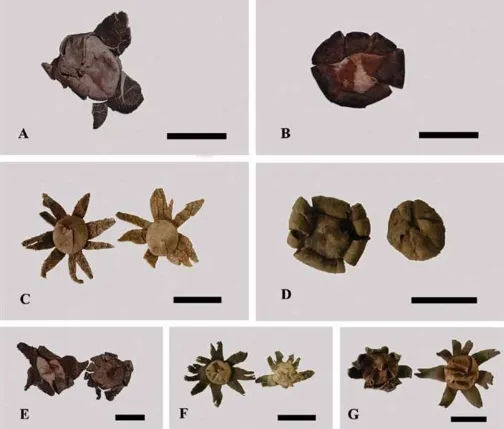
Fig. 3. Basidiomes. A. Astraeus morganii 4 #$KKJ> ;¤N$*$N ;"@;*B. A. pteridis ;¤N$*$* ;"@;*C. A. koreanus
AR
TICLE
Distribution: Central to Southern United States southwards
46
Observation: The above description represents Morgan’s
understanding of A. hygrometricus on which his new genus was based but this differs from what we believe to be Persoon’s original concept (see above). The holotype collection was purchased for E in 1900, and the collection was dated the same year as the publication of Astraeus. Morgan
Astraeus in Cincinnati, the state where
he published his new observations from, but he considered
A. hygrometricus, in parallel with many other classical and
post-classical mycologists, to be a very common fungus with a worldwide distribution. This is now patently untrue. It is recorded by Morgan for several sites in the US but without molecular data it is impossible to say which might be one of the three groupings now recognized there. His records include: California (Harkness), Florida (Calkins), Kansas
(Cragin), New England (Frost | 46 Wright), New
York (Peck), Pennsylvania (Schweinitz & Gentry), South Carolina (Aitken 6 P# " /
@6 Drummond), and Wisconsin (Brown & Trelease).
Unfortunately the material available from these collections, after several attempts, did not allow the reclamation of good DNA.
The type of 'a species described "G #'NN / Synops. Fungor.
Carol**J<? 6 /
! / #$N'
the A. hygrometricus consortium. The persistent basidiomes
>+#$J' from our observations above this cannot be assigned to
A. hygrometricus
6 |; morphological data and do molecular analyses.
'# * 4~3 #: Mexico: sine loc.,
10 Mar. 1991, W. C. Weightman4#$KKJ>@"|; ;¤N$*$N USA: Wisconsin: Adams County (Alan D. Parker < > @" |; ;¤N$P#J> Walworth County, Young Rd. Steinke, A. D. Parker, 15 Oct. 1995 ; ~ <>@"|; ;¤N$PJ$
Astraeus smithii
Watling, M.P. Martín & Phosri,
sp.
nov.
4x 4x'J*$J
(Figs 2–3)
EtymologyI| ;6 "#$JP
#$' ; ; 4 puffballs and their allies amongst his many other North American macromycete monographs.
Diagnosis: This species is characterised by the inner peridium ? almost blackish rhizoids, and its unique ITS nrDNA.
Type: USA: Michigan: Chippewa County, Upper Penninsula,
x ~ ?NK;#$KR. WatlingWat. 874/2023
?JJ#K$'N'>@"|; ;¤N$PJ*
Description: Basidiome 10–20(–30) mm, almost globose or
slightly ellipsoid, with dark almost blackish rhizoids some #K > ? 6 fugacious layer, which breaks up, although hard when dry, ? 6 > inner peridium a pale coloured, papery-thin sack, the surface ? > ? >capillitium buff to pale brown, encrusted, thick-walled, highly branched hyphal elements. Spores 7.5–12.5 μm, globose with a hyaline sheath overlying thickened warty layer composed of pegs.
Habitat: On soil surface margins of woodland, open areas.
Distribution: Central and Northern United States.
'#* 4~3 #: USA: Michigan: Luce
County, Upper Peninsula, Lake Superior, Crisp Point, on sandy soil in ?K;#$KR. Watling709/1137A?JJ#K$'N$> @"|; ;¤N$PJNWisconsin: Adams County, Castle Rock, 21 Sept. 2001, A. D. Parker; ~ >@" |; ;¤N$*$'> ~ / " ~ N$ " #$'$A. D. Parker ; ~ > @" |; ;¤N$*$$
Astraeus telleriae
M.P. Martín, Phosri & Watling,
sp.
nov.
4x 4x'J*$K'
(Figs 2–3)
Etymology: Named after Maria Teresa Telleria, Director of the ¤ ^x{?/"/#$$PNJJ
6" Flora
MycologicaIberica project.
Diagnosis: This new species differs from related species in
the very pubescent, even minutely woolly, inner layer of the outer peridium, and its unique ITS nrDNA sequence.
Type: Greece: D | #$J'M. Wilson 167
(E-JJ#K$'**>@"|; ;¤N$PJP
Description: Basidiome*KPN
#N >
pubescent s.l >
of outer peridium very pubescent even minutely woolly but > 6 ?>
capillitium buff to pale brown, some elements encrusted,
AR
TICLE
Habitat: On soil surface, margins of woodland (Pinus spp.
and Quercus spp.), open areas.
DistributionI4 "" `
'# * 4~3 #: Spain: Catalunya:
x 4 " ;4*J#$$'
M. JeppsonMJ4705`x>@"|; `JJJN'Madrid: Majadahonda, 23 Feb. 2002, P. P. Däniels & C. Phosri4;?<> @"|; ;¤N$PJ'
CONCLUSIONS
Our study indicates that the name Astraeus hygrometricus
has previously covered several separate species. Further, in addition to the three new species recognized here, more 6 4 required for a species originating in India, for which there may be a possible previous name available, and at least one noted from Japan. Much work is required on collections from Japan and North America, and more material is needed from South America where the collections may represent recent introductions. The names “Astraeus hygrometricus” and “A.
pteridis ; 4 et al. 2003),
so in any further study it would be essential to incorporate "6 E collected by A. Morrison in Western Australia shows great #K 6 KJºJK
With the integration of studies of type material deposited in herbaria, with molecular data from fresh collections of known provenance, a fuller attempt can be made to resolve 6; of the tree so far developed clearly demonstrate that Astraeus
hygrometricus, as previously circumscribed, to be not a
single species but made up of a multitude of cryptic species. The present study is a partial solution to this ever-increasing conundrum.
ACKNOWLEDGEMENTS
We thankthe herbaria BCN, K, L, MA-Fungi, OSC, and Alan D. Parker (Fungi of Wisconsin) for loan of specimens used in this and > molecular analyses of E-00159977 (our Morgan sample). Thanks are also due to Mikael Jeppson for providing us specimens of Astraeus
from his private herbarium, to Michael J. Richardson and Marian ` @ supported primarily by national projects from the Royal Thai ` | / @ Flora MycologicaIberica/`+NJJ?#N*N?/N?J#Lx" the Molecular Systematics Laboratory of the Real Jardín Botánico-CSIC, Madrid, was supported by SYNTHESYS ~ ILL L
REFERENCES
Ahmad S (1950) Studies in gasteromycetes. Sydowia4: 124–129. Altschul SF, Madden TL, Schäffer, AA, Zhang J, Zhang Z, Miller
+ ¤ #$$ ` x+;"@ ~"?x+;"@I generation of protein database search programs. Nucleic Acids Research25I**'$*PJN
x ¤ #''An History of Fungusses growing about Halifax. 4 I¤x ¸` + #$K#'NJBeschreibung der um Halifax wachsenden Pilze. Berlin: Reimer.]
/ / / ¤| #$N'The Gasteromycetes of the Eastern United States and Canada. Chapel Hill, NC: North Carolina University Press.
/ ;¤/#'PNIcones Fungorum hucusque cognitorum. Prague: ¤`/
/ ` ?4G | NJ##@ Nucleotide Sequence Database Collaboration. Nucleic Acids Research39I#K#'
6|;#'J$ ï] famille des Champignons. Journal de Botanique, Paris 2I*'#JK Fangfuk W, Petchang R, To-anun C, Fukuda M, Yamada A (2010)
¤ Astraeus, based on morphological and phylogenetic analyses. Mycoscience51: 291–299.
< 4 #'N$Systema Mycologicum. D * # ` I Ernst Mayritius.
` 4 x @ #$$* @" ? mycorrhizae and rusts. Molecular Ecologist 2:##*##' `G{`#$J4 ]Scleroderma Pers. emed
Fr. Darwinia16: 233–407.
Huelsenbeck JP, Rannala B, Masly JP (2000) Accommodating phylogenetic uncertainty in evolutionary studies. Science288: 2349–2350.
Huelsenbeck JP, Ronquist F (2001) MRBAYES: Bayesian inference of phylogenetic trees. Bioinformatics17: 754–455.
#$$Grundzüge eines natürlichen Systems der Pilze. ¤ I` <
Larget B, Simon DL (1999) Markov chain Monte Carlo algorithms for the Bayesian analysis of phylogenetic trees. Molecular Biology and Evolution16:750–759.
+/`#$J#Geaster hygrometricus var. giganteus. Mycological Notes1I'
+/`#$JN@Geastreae. Mycological Writings1: 1–44. + /` #$J' @ "G
MycologicalNotes30: 395–405.
4 ^ 4~ #$''; { y los gasteromicetes de Cataluña. Edicions especials de la Societat Catalana de Micologia2I#KJ'
4 ^ 4~ NJJJ ; 6 amplifying DNA from lichens. Lichenologist32I#'$#$ 4 ` #''$ |
Grevillea19I$P$'
May TW, Milne J, Shingles S, Jones JH (2003) Fungi of Australia.
Vol. 2B. Catalogue and Bibliography of Australian Fungi.
2. Basidiomycota p.p. & Myxomycota p.p. Canberra, ACT: Australian Biological Resources Study.
4 ;~ #''$ | ; < @Gasteromycetes
AR
TICLE
~ / #'J#Synopsis Methodica Fungorum. `I Dieterich.
Phosri C, Martín MP, Sihanonth P, Whalley AJS, Watling R (2007) Molecular study of the genus Astraeus. Mycological Research
111INKN'
Phosri C, Martín MP, Suwannasai N, Sihanonth P, Watling R (2012)
Pisolithus: a new species from Southeast Asia and a new combination. Mycotaxon120I#$KNJ'
Phosri C, Martín MP, Watling R, Jeppson M, Sihanonth P (2009) Molecular phylogeny and re-assessment of some Scleroderma
spp. (gasteromycetes). 3 = 66
"#I'*$#
Phosri C, Watling R, Martín MP, Whalley AJS (2004) The genus
Astraeus in Thailand. Mycotaxon89IPK*P*
~{;#$K'Gasteromycetes. [FloraCSR, Serie B.] Prague: Ceskoslovenke Akademie.
Rambaut A (2002) Se-Al. Sequence alignment editor. Version 2.0a11. 6I }_6
"G + #'NN " /
Schriften der naturforschenden Gesellschaft zu Leipzig1: 20– 131.
Shear CL (1902) Mycological notes and new species. Bulletin of the Torrey Botanical Club29: 451.
Swofford DL (2002) PAUP*: phylogenetic analysis using parsimony (*and other methods). Version 4. Sunderland, MA: Sinauer Associates.
Telleria MT, Dueñas M, Melo I, Hallenberg N, Martín MP (2010) A re-evaluation of Hypochnicium (Polyporales) based on morphological and molecular characters. Mycologia102I#PN #P*
@ x @ + " @ ¤ #$$J ; sequencing of fungal ribosomal RNA genes for phylogenetics. I 4; ` " ¤¤ @¤ PCR Protocols: a guide to methods and applications: 315–322. San Diego: Academic Press.
Wilson AW, Binder M, Hibbett DS (2012) Diversity and evolution of ectomycorrhizal host associations in the Sclerodermatineae
(Boletales, Basidiomycota). New Phytologist194: 1079–1095. Woodward TJ (1794) An essay towards a history of the British
stellated Lycoperdons. Transactions of the Linnean Society of London2I*NN