R E S E A R C H
Open Access
Artificial selection for male winners in the
Siamese fighting fish
Betta splendens
correlates with high female aggression
A. Ramos and D. Gonçalves
*Abstract
In Southeast Asia, males of the Siamese fighting fish Betta splendens have been selected across centuries for
paired-staged fights. During the selection process, matched for size males fight in a small tank until the contest is resolved. Breeders discard losing batches and reproduce winner batches with the aim of increasing fight performance. We assessed the results of this long-term selection process by comparing under standard laboratory conditions male and female aggressive behaviour of one strain selected for staged fights (“fighters”) and one strain of wild-types. The aggressive response of adult fish was tested against their mirror image or a size-matched conspecific. Fighter males were more aggressive than wild-type males for all measured
behaviours. Differences were not only quantitative but the pattern of fight display was also divergent. Fighter males had an overall higher swimming activity, performing frequent fast strikes in the direction of the intruder and displaying from a distance. Wild-type males were less active and exhibited aggressive displays mostly in close proximity to the stimuli. Females of the fighter strain, which are not used for fights, were also more aggressive than wild-type females. Aggressive behaviours were correlated across male and female fighter siblings, suggesting common genetic and physiological mechanisms to male and female aggression in this species. The study further shows that results were largely independent of the stimulus type, with the mirror test inducing similar and less variable responses than the live conspecific presentation. These results suggest that selection for male winners co-selected for high-frequency and metabolic demanding aggressive display in males and also enhanced female aggression, opening a wide range of testable hypothesis about
the ultimate and proximate mechanisms of male and female aggression in B. splendens.
Keywords: Aggression, Artificial selection, Domestication, Mirror test, Sexual conflict
Background
Artificial selection and experimental evolution are powerful tools for testing proximate and ultimate causes of behaviour. These manipulations may be carried out under controlled conditions in laboratory or natural settings or arise from unintended natural experiments. Domestication is a particularly interesting example as it usually combines adaptation to captive conditions and selective breeding for particular traits [1]. The compari-son between domesticated and wild-type strains was key
to Darwin’s theory of natural selection [2, 3] and since
then it has enriched our understanding of the general
mechanisms of behaviour and its evolutionary principles [4, 5]. Studying organisms that have been under strong artificial selection for particular behavioural traits may facilitate the identification of genetic and physiological mechanisms underlying the expression of that behaviour (e.g. [6]) and, because selection for one particular behav-iour usually co-selects for other traits, either behavbehav-ioural or morphological, uncover gene epistatic and pleiotropic effects [7].
Domestication is usually associated with selective breeding for tame behaviour but in a few species animals have been selected for high aggression either for cultural (e.g. fighting bulls, [8] fighting dogs, [9]) or research (e.g. fruit fly, [10]; mice, [11]) purposes. In most of these models, males are the target of selection because of their
© The Author(s). 2019Open AccessThis article is distributed under the terms of the Creative Commons Attribution 4.0 International License (http://creativecommons.org/licenses/by/4.0/), which permits unrestricted use, distribution, and reproduction in any medium, provided you give appropriate credit to the original author(s) and the source, provide a link to the Creative Commons license, and indicate if changes were made. The Creative Commons Public Domain Dedication waiver (http://creativecommons.org/publicdomain/zero/1.0/) applies to the data made available in this article, unless otherwise stated.
* Correspondence:[email protected]
inherently higher levels of aggression as compared to females. However, because males and females share the vast majority of the genome [12], the directional selec-tion for aggression in males may lead to increased aggression in females if female and male aggression are genetically correlated. The study of these systems may thus provide relevant information not only on the underlying genetic and physiological mechanisms of aggression but also on how sexual conflict may shape the evolution of aggressive behaviour [13,14].
The Siamese fighting fish Betta splendensis a
particu-larly interesting model to investigate proximate and ultimate behavioural questions. This species has been selected for body colour, fin patterns and behaviour, and the wide variety of currently available phenotypes makes it one of the most important species in the freshwater ornamental fish industry. Its aggressive behaviour has been well-characterized [15] and female-female aggres-sion occurs naturally [16]. Complex social modulation of aggressive displays has been documented, with both
audience [17–19] and eavesdropping [20, 21] effects
described. Of relevance, wild-type populations, presum-ably similar to the original populations that originated the domesticated varieties, can still be found in remote areas of Southeast Asia, allowing for comparative studies between the wild-type and domesticated strains.
Fighting strains ofB. splendenshave been under
selec-tion for more than six centuries [22, 23], originating
short-fin varieties known in Thailand as “Plakat Morh”.
During the selection process, matched for size males are paired in small tanks for staged fights. Fights can last several hours and after resolution fighters are discarded and the siblings of male winners are selected for breed-ing. Breeders try to improve the fighting lines by cross-breeding varieties that have specific morphologic and behavioural traits but the selection process is centred in the fight outcome and not on behavioural displays.
In a previous study, the male aggressive behaviour of
domesticated and wild-type B. splendenswas compared
using a combination of mirror and video playbacks tests and live conspecific presentations [24]. The authors showed that results were context dependent, with differ-ences in aggression between wild-type and short-finned domesticated varieties (results from a fighter and fancy short-finned variety where pooled together to increase sample size) detected during live conspecific trials but not when using mirror/video playback tests. Further, the same fighter and wild-type strains showed differences in male cortisol response to unfamiliar environments, with wild-types, but not fighters increasing cortisol levels [25]. Taken together, the results from these studies suggest that selection for winning has modified
aggres-sive behaviour and physiological responses in B.
splendens.
However, the possible impact of the selection process on females, who are not used in fights, remains to be investigated. Selection targeting males may have induced changes in female behavior and physiology via shared genetic mechanisms and possibly drive sexual conflict. A detailed characterization of the behavioural conse-quences of directional selection for male winners in both sexes is thus relevant to understand proximate and
ultimate mechanisms of aggression inB. splendens.
In this study, we compared the aggressive behaviour of a fighter and a wild-type strain to investigate: (1) the impact of selection for winners in male aggressive displays; (2) the possibility of correlated responses in the aggressive behaviour of females, which are not directly targeted by the selection process; (3) the possible variation in the aggressive response of males and females of both strains to two different types of aggression-elicit-ing stimulus, a mirror image and a size-matched conspecific.
Methods Study species
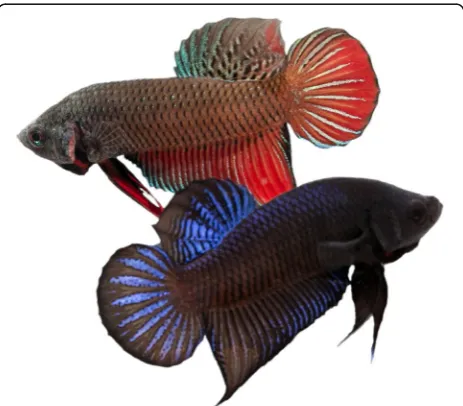
We compared the behaviour of a wild-type and a fighter
strain of B. splendens(Fig. 1). Species identity was
con-firmed for all F0 fish by sequencing the ITL1 and COI
genes following [26, 27] (data not shown). Wild-types
had been captured in Chiang Rai Province, Thailand, and were acquired from a local and authorized retailer. An initial mix-sex group of approximately 60 individuals was used to start a founding population in the lab. Ten pairs of F1 males and females from different families (different F0 parents) were mated to originate the F2
fish, with an approximately similar number of fish per family used in the experiments. Fighter fish were acquired from a reliable and authorized commercial retailer from Bangkok, Thailand. To start the fighter line, 12 sibling males from one breeder and 12 sibling females from another breeder were used (F0 fish), replicating a mating scheme commonly used by local breeders where sibling males of a winner are mated with sibling females from another winner. From the resulting F1, and simi-larly to the mating scheme for wild-types, males and females from different families were crossed to originate the F2 fish used in this study. Under laboratory condi-tions, the artificially selected traits associated with winning were probably under relaxed selection because there was no attempt to further select winners. The potential decrease in expression of the winning-related traits was minimized by limiting the initial genetic pool to two fighter families and by testing animals after only two generations. For breeding, a tank (50 W X 30D X 25H cm) without substrate or aeration, with shelters and aquatic plants for the female to hide, and with the water conditioned by adding one large indian almond leaf was used. The male was added to the tank and the female to a separate transparent box (10 X 10 X 10 cm) inside the larger tank. They were allowed to have only visual contact until the male built a bubble nest. The female was then carefully removed from the box with a hand net and released and spawning usually occurred within 24 h. After spawning, the female was removed from the tank and the male was allowed to provide parental care to the eggs and larvae for a period of 5 days. The male was then removed and if necessary the brood was divided into more similar tanks to achieve an approxi-mate raising density of 1 fish per 3 L. An external filter was added when fish were approximately 2 month old. We used 8 ± 1 months old males and females of both strains for all experiments. Standard length (cm) of fish used in the experiments were as follows (x̄± S.D., fighter males = 3.78 ± 0.02; fighter females = 3.54 ± 0.19; wild-type males = 3.42 ± 0.05; wild-wild-type females = 3.37 ± 0.18). At this stage, sex-ratio in the stock tanks was approxi-mately 1:1. Conditions in the stock and experimental tanks were similar, with temperature being kept at 28 ± 1 °C, the photoperiod set to 12:12 L:D and tank water supplied by a reverse osmosis system. Animals were fed once a day with a mixture of dry (tubifex worms and
pellets from different brands) and live (adult Artemia)
food.
Behavioural recordings
Prior to being tested, fish were isolated in individual tanks (28 W X 14D X 20H cm) for 1 week without any visual contact with other fish. Tank walls were lined on the outside with styrofoam plates, except the
wall through which observations were conducted. Animals were randomly assigned to one of three treatments: 1) mirror; 2) live conspecific and; 3) glass (control) test. There were no significant size differ-ences in standard length between treatments for fish of the same strain and sex (one-way ANOVA: fighter males, F2,46= 0.85, P= 0.432; fighter females, F2,46=
1.46, P= 0.244; wild-type males, F2,46= 0.79, P= 0.460;
wild-type females, F2,46= 0.42, P= 0.660). For the
mirror and control trials, a mirror or a same size transparent glass, respectively, were placed adjacent to one of the shorter walls of the test tank. For the live conspecific test, an individual tank containing a matched for size (standard length coefficient of vari-ation < 5%) conspecific of the same sex and strain was positioned to the top end of the tank of the focal animal. An opaque partition between the two tanks that did not allow the animals to see each other was removed to initiate the trial. The side of presentation (left or right) was randomized for all treatments. Fish used as models in the live conspecific test were also isolated for 1 week prior to being used and were not tested as focal animals. A subset of animals was also tested in a second control, an empty tank placed adjacent to one of the top ends of the test tank. Because no differences in behaviour of focal animals were recorded between this and the glass control (data not shown), it was decided to include only the latter in the analysis.
Trials had a duration of 15 min and were video re-corded at 60 cm from the test tank through an opening in an opaque partition using a Sony HDR-PJ670 Handycam. Mirror and conspecific trials began after the first aggressive display was recorded (usually within the first minute) and the control trials began immediately
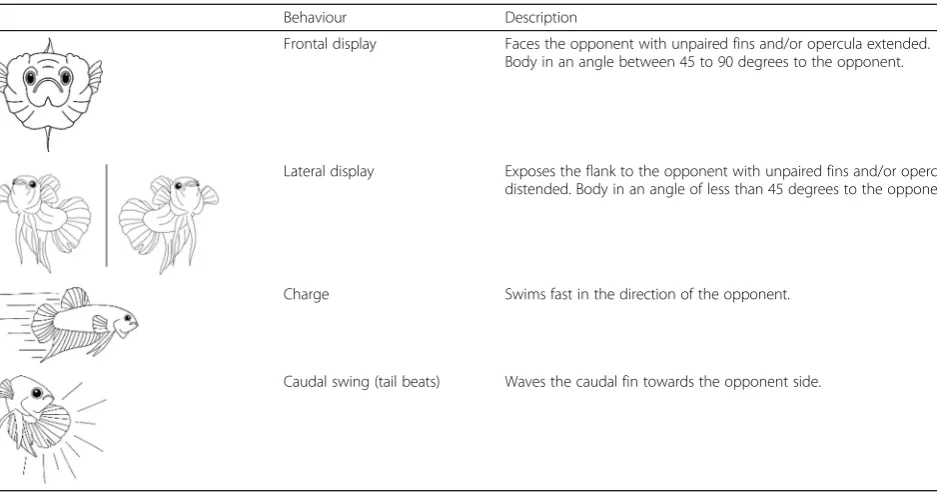
after the glass was placed. Behavioural displays (Table1)
were quantified from video using JWatcher V1.0 (Macquarie University and UCLA). For frontal and lat-eral displays, total duration was highly correlated with the frequency of the behaviour (Spearman correlation coefficient, frontal display, rs> 0.89, N= 184, P< 0.001;
lateral display, rs> 0.93, N= 184, P< 0.001) and it was
decided to use only the frequency of the behaviours for the analyses. Total travelled distance and time spent within one body distance to the stimuli was calcu-lated using UMA Tracker (http://ymnk13.github.io/ UMATracker/).
score was calculated as above and the correlation be-tween male and female aggressive behaviour computed. It was not possible to run the same analysis for the wild-type strain because a sufficient number of sibling pairs raised in separate tanks were not available.
Statistical analyses
Aggression-related variables (Table 1) were all
signifi-cantly correlated between each other (rs> 0.33, N= 111,
P< 0.001). To minimise the number of comparisons
between groups, an aggression score was first calculated as the average frequency of frontal and lateral displays, caudal swings and charges. Behavioural differences be-tween strains (wild-type and fighter), sex (male, female), treatment (control, mirror, glass) and the possible inter-action between these factors were tested with a three-way general linear model (glm). Only two levels of the factor treatment (mirror and conspecific) were used for analysis of the aggression score as aggressive behaviors were not displayed in the control (glass) treatment. Specific comparisons within or between levels of the fac-tors were tested with planned contrasts. The aggression score was squared root-transformed while the frequency of air breathing and the total distance travelled were log-transformed to comply with heteroscedasticity assump-tion. Effect sizes on glm analysis are reported by partial ETA squared (ηp2).
To test for possible differences in the variability of the aggressive response to the mirror and conspecific treat-ment, a Levene’s test on non-transformed values of the
aggression score was applied separately to each of the four experimental groups (i.e. fighter males, fighter females, wild-type males and wild-type females). These statistical analyses were performed with IBM SPSS Statistics version 25.
To test whether the overall behaviour of a group differed from the other groups the quadratic assignment procedure (QAP) correlation test was applied. In this procedure, a Pearson correlation matrix for the different behaviors is calculated for each group and compared with the matrix of the other groups. The QAP null-hy-pothesis indicates that there is no association between matrices and thus correlation matrices are considered different when theP-value is higher, not lower, than 0.05 ([27], for an example see [28]). QAP analysis were performed with the Ucinet for Windows software [29]. The Benjamini-Hochberg procedure [30] was applied to correct for the multiple Pearson correlation tests within groups.
Results
An overall analysis of the results shows that fighters had an aggression score three times higher than wild-types
(Table2, Fig.2). Differences in aggression between males
and females were of a similar magnitude, and higher in males.
These differences were relatively independent of stimulus type (mirror or conspecific) and, accordingly, total variance, as given by ηp2, was mostly explained by
strain and sex rather than treatment (Table2).
Table 1Description of the aggressive behaviours quantified. An aggression score was calculated as the average frequency of these displays
Behaviour Description
Frontal display Faces the opponent with unpaired fins and/or opercula extended. Body in an angle between 45 to 90 degrees to the opponent.
Lateral display Exposes the flank to the opponent with unpaired fins and/or opercula distended. Body in an angle of less than 45 degrees to the opponent.
Charge Swims fast in the direction of the opponent.
Males
Planned contrasts comparing only males confirmed that the aggression score was higher for fighter than wild-type males (P< 0.001, ηp2= 0.26; Fig. 2, see Additional file 1:
Figure S1 for individual aggression measures). The frequency of air breathing, a correlate of metabolic activity [31], was over three times higher in fighter than in wild-type males during mirror (P= 0.001,ηp2= 0.07) or
conspe-cific (P< 0.001, ηp2= 0.14) trials but not during control
trials (P= 0.252, ηp2= 0.01). Further, while fighters
increased air breathing frequency during conspecific (P< 0.001) or mirror (P= 0.001) trials, as compared to controls (ηp2= 0.13), wild-types did not (conspecific, P= 0.918;
mirror,P= 0.234);ηp2= 0.01). During the conspecific and
mirror trials, the frequency of air breathing was positively correlated with the aggression score and activity-related variables (Spearman correlation coefficient,rs> 0.37,N=
58, P< 0.004), except with the time spent close to the
stimuli (rs=−0.16,N= 57,P= 0.235). Fighter males spent
less time in close contact with the opponent (conspecific,
P= 0.055, ηp2= 0.02; mirror, P= 0.003, ηp2= 0.05),
approached more often the area close to the stimuli (con-specific,P< 0.001,ηp2= 0.07; mirror,P= 0.120,ηp2= 0.01)
and travelled longer distances (conspecific,P= 0.005,ηp2=
0.05; mirror,P= 0.014,ηp2= 0.03) than wild-types (Fig.2).
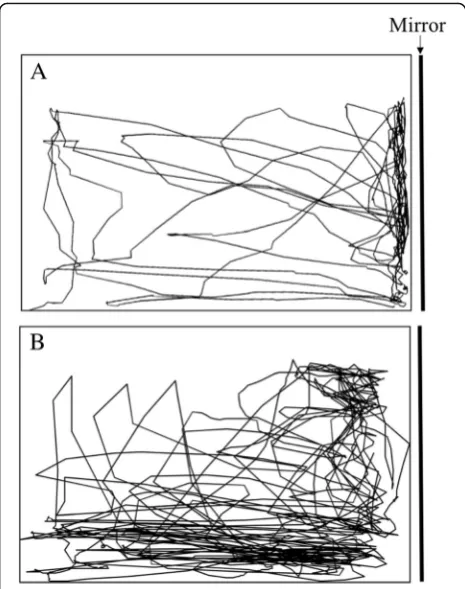
Again, these differences were only evident during aggres-sion-elicited trials but not during controls (P> 0.095). This was explained by the different approach of males of the two strains to the mirror/conspecific challenge. Typically, fighter males would swim back and forth, approaching or charging the stimuli very often but avoiding prolonged contact with the opponent and displaying from a distance
of a few cm (Fig.3). Wild-type males, on the other hand,
spent most of the trial time displaying within short dis-tance. In fact, while wild-type males increased the time
spent in close contact with the stimuli during the mirror (P= 0.015) and conspecific (P= 0.022) trials, as compared to controls (ηp2= 0.04), fighter males did not (P> 0.169,
ηp2= 0.01; Fig.2). This different pattern of fighting and
activity during aggression-eliciting trials for males of the two strains was confirmed by QAP correlation ana-lysis that revealed a different behavioural network
cor-relation pattern for the mirror (r= 0.09, P= 0.276) and
conspecific (r= 0.14,P= 0.222) treatment (Fig.4).
Females
Although females have not been directly selected for fighting, differences in aggressive behaviour between strains were similar to those observed for males. Fighter females were more aggressive than wild-type females (P= 0.001, ηp2= 0.10; Fig.2, see Additional file1: Figure
S1 for individual aggression measures). On the contrary, activity-related variables did not differ between females
of the two strains (frequency of air breathing,P= 0.462,
ηp2< 0.01; time spent close to opponent,P= 0.596,ηp2<
0.01; frequency of approaches to the area close to the stimuli, P= 0.102, ηp2= 0.02), with the exception of the
total distance travelled (P= 0.006, ηp2= 0.04), higher in
wild-type females (Fig.2).
Metabolic activity, as inferred by the frequency of air breathing, was positively correlated with the aggression score and all activity-related variables (rs> 0.29, N= 54, P< 0.036).
QAP correlation analysis suggested that differences in aggressive behaviour between females of the two strains were mostly quantitative rather than qualitative, as sup-ported by an overall behavioural network correlation
pattern similar in the conspecific treatment (r= 0.42,
P= 0.010) and marginally different for the mirror
treat-ment (r= 0.31,P= 0.070; Fig.4).
Table 2Three-way ANOVA results with factors sex (male and female), strain (fighter and wild-type) and treatment (conspecific, mirror and control) and interaction between the factors. For the aggression score, only two levels of the factor treatment
(conspecific and mirror were included as aggressive behaviours were absent during control trials. Values for the F-statistic and partial eta-squared (ηp2) are reported. *P< 0.05, **P< 0.01, ***P< 0.001
Variable Strain Sex Treatment Strain*Sex Strain*Treatment Sex*Treatment Sex*Strain*Treatment
Aggressive displays
Aggression score F ηp2
F1,104= 43.61*** 0.30
F1,104= 32.03*** 0.24
F1,104= 0.27 < 0.01
F1,104= 3.22 0.03
F1,104= 1.29 0.01
F1,104= 1.39 0.01
F1,104= 7.76** 0.07
Activity
# Air breathing F ηp2
F1,174= 13.10*** 0.07
F1,174= 15.17*** 0.08
F2,174= 4.80** 0.05
F1,174= 21.80*** 0.11
F2,174= 6.49** 0.07
F2,174= 6.96** 0.07
F2,174= 1.10 0.01
Time near F ηp2
F1,171= 4.44* 0.03
F1,171= 0.42 < 0.01
F2,171= 3.55* 0.04
F1,171= 1.84 0.01
F2,171= 6.06** 0.07
F2,171= 1.34 0.02
F2,171= 2.42 0.03
# Approach F ηp2
F1,174= 0.29 < 0.01
F1,174= 1.44 0.01
F2,174= 1.10 0.01
F1,174= 8.22** 0.05
F2,174= 6.11** 0.07
F2,174= 0.09 < 0.01
F2,174= 3.41* 0.04
Distance travelled F ηp2
F1,174= 0.23 < 0.01
F1,174= 5.38* 0.03
F2,174= 0.67 0.01
F1,174= 19.67*** 0.10
F2,174= 0.82 0.01
F2,174= 3.22* 0.04
Males vs females
Although females displayed frequent aggressive behav-iours towards the conspecific or mirror image, males were clearly more aggressive than females, both in the fighter (P< 0.001, ηp2= 0.21) and wild-type (P= 0.008,
ηp2= 0.07) strain (Fig.2, see Additional file1: Figure S1
for individual aggression measures).
Fighter males were also more active, approaching the stimuli more often (P= 0.004, ηp2= 0.05) and travelling
longer distances (P< 0.001,ηp2= 0.12), probably
contrib-uting to the higher frequency of air breathing (P< 0.001, ηp2= 0.18) in males than in females of this strain. Again,
these differences were only evident during aggression-eliciting trials and not during controls (P> 0.071). On
Wild-type Fighter 0 5 10 15 20 25 30 35 40 45 50 55 A g re ssi o n S co re
11 17 12
6 1 Wild-type Fighter 0 5 10 15 20 25 30 35 40 45 50 55 F re quenc y of ai r br eat hing
17 12 17 17 12 7 1 Wild-type Fighter 0 500 1000 1500 2000 D is tanc e t ra v elled (c m )
17 11 17 17 12 6 1 Wild-type Fighter 0 5 10 15 20 25 F req uenc y o f app roac he s
17 11 17 17 12 6 1 Wild-type Fighter 0 200 400 600 800 T im e near (s )
17 11 17 17 12 6 1 Wild-type Fighter 0 5 10 15 20 25 30 35 40 45 50 55 A g re ssi o n S co re
11 17 12
6 1 Wild-type Fighter 0 500 1000 1500 2000 D is tanc e t rav elle d (c m )
16 10 19 17 11 9 1 Wild-type Fighter 0 5 10 15 20 25 F req uenc y o f app roac he s
16 10 19 17 11 9 1 Wild-type Fighter 0 200 400 600 800 T im e near (s )
16 10 19 17 11 9 1 Wild-type Fighter 0 5 10 15 20 25 30 35 40 45 50 55 F re quenc y of ai r br eat hing
16 10 20 17 11 9 1 Conspecific Mirror Glass Males Females
the contrary, activity-related variables were generally similar for male and female wild-type (P> 0.141).
Differences between males and females in behaviour were confirmed by the QAP behavioural network correl-ation analyses which differed for the two strains and for
the two aggression-eliciting stimuli (fighter mirror, r=
0.29, P= 0.084; fighter conspecific, r= 0.14, P= 0.307;
wild-type mirror, r= 0.10, P= 0.315; wild-type
conspe-cific,r= 0.06,P= 0.327; Fig.4).
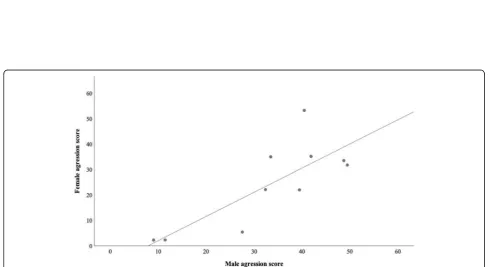
To further assess for a possible correlation between male and female aggression, 10 pairs of male and female fighter siblings from different families, raised in separate aquaria, were tested against their mirror image. The frequency of male and female aggressive behaviours were
all positively and significantly correlated (frontal
displays, rs= 0.82, P= 0.007; lateral displays, rs= 0.65,
P= 0.049; caudal swings, rs= 0.89, P= 0.001), with the
exception of the frequency of charges (rs= 0.55, P=
0.102), resulting in an overall significant correlation
be-tween male and female aggression scores (rs= 0.73,
P= 0.021; Fig.5).
Conspecific vs mirror
Behavioural differences found between males of the two strains were independent of the stimulus type. In fact,
planned contrasts confirmed that the response of fighter (P> 0.120) and wild-type (P> 0.168) males to the mirror and conspecific stimulus was comparable for the aggres-sion score and all activity-related behaviours. This gener-ally similar pattern of response to the mirror and conspecific challenge resulted in comparable behavioural network correlation patterns between treatments both for fighter (r= 0.77, P< 0.001) and wild-type (r= 0.66, P= 0.002) males (Fig.4).
For females, a different pattern was recorded for fighter and wild-type strains. Wild-type females presented a similar response to the two stimuli (P> 0.078), except for the time
near the stimulus, higher in the mirror treatment (P=
0.006, ηp2= 0.07). On the other hand fighter females were
more aggressive (P= 0.006, ηp2= 0.07) and active
(ap-proaches to the stimulus area, P= 0.033, ηp2= 0.03; total
distance travelled, P= 0.027, ηp2= 0.03) towards the
conspecific than towards their mirror image. These results were aligned with the QAP tests for the behavioural correl-ation networks as fighter females differed between the mirror and conspecific treatment (r= 0.24,P= 0.136), while wild-type females did not (r= 0.46,P= 0.010) (Fig.4).
In the conspecific test, the aggressive response of the focal fish may be expected to be more variable as compared with the mirror test because it depends on the dynamics of the interaction with another fish. This was only partially confirmed as the aggression score was more variable towards the conspecific than towards the mirror image only in fighter females (P= 0.015;P> 0.058 for the other groups).
Discussion
Domestication is a type of experimental evolution usually associated with intentional selective breeding and where control over the selection process is low [1]. Although such design is less powerful than careful artificial selection experiments performed under controlled conditions, data gathered from the comparison between wild-type and do-mesticated strains can be most informative for the under-standing of evolutionary processes, in particular because they often provide the only way to access long-term selec-tion processes that cannot be replicated in laboratory set-tings. That is the case of selection for male winners inB. splendensfor two reasons: first, breeders select the strains for reproduction from the outcome of paired-fights where fish can be injured or even die and, for ethical reasons, this selection process cannot be replicated for research purposes; second, selection for winners has been going on for centuries, limiting the possibility for a similar approach under controlled laboratory settings. The comparison of wild-type and fighter strains of this species thus allows a unique opportunity to test hypothesis on the proximate and ultimate mechanisms underlying aggression in fish. Fig. 3Representative 2D side-view tracks of a wild-type (a) and
Fig. 4Behavioural correlation networks for each of the aggression-eliciting groups. The diameter of circles represents the frequency of the behaviour, total distance travelled or time spent close to stimuli (normalized between 0 and 1). FD–frequency of frontal display; LD–frequency of lateral display; Ch–frequency of charge; CS–frequency of caudal swing; Ap–frequency of approach; AB–frequency of air breathing; TD–total distance travelled; TC–time spent close to stimuli. Distinct (≠) and similar (=) correlation network patterns among groups are indicated. Lines within groups represent Pearson’s correlation coefficients (r), with line thicknesses proportional torvalue and positive / negative correlations indicated by line colour (green / yellow, respectively). Asterisks indicate significant correlations after adjustment for multiple comparisons: *P< 0.05; **P< 0.01 and ***P< 0.001
Fig. 5Aggression scores for 10 pairs of male and female fighter siblings from different families. Spearman correlation coefficient:rs= 0.73,
The first prediction of our study was that selection for winning staged-fights would have enhanced aggressive
displays in male B. splendens. This prediction was fully
verified as differences were evident for all measured aggressive behaviours and for both aggression-eliciting contexts (mirror image and conspecific presentation). The results partially parallel a previous study in this species that had demonstrated enhanced aggression in a fighter strain as compared with a wild-type strain [24]. However, in that study differences were evident only during conspecific presentations (“mutual-viewing test”) and not when aggression was elicited by a combination of mirror images and video playbacks of conspecifics. Because the responses to mirror images and video play-backs, which need to be properly validated [32], were combined, a direct comparison with the results that we have obtained for the mirror test is not possible. Also, the same study compared differences between strains using aggression scores derived from a principal compo-nent analysis (PCA) and not individual behaviours, further limiting a direct comparison with our results. Still, the fact that both studies, which used different strains of wild-type and fighter animals, concluded for a higher aggressiveness of fighters, in line with our initial prediction, strongly suggest that differences between strains are the result of the selection process for winning and not of other uncontrolled factors. It should be highlighted that the selection criteria used by breeders is winning/losing and not the frequency/intensity of ag-gressive displays during the staged-paired fights. The fact that fighters exhibited a higher frequency of aggressive behaviours suggest that selection for winning co-selected for more frequent aggressive displays. One hypothesis is that males that display more frequently during fights will have a higher probability of winning, and indeed this has
been previously demonstrated forB. splendens[33].
In addition to quantitative differences in the frequency of aggressive behaviours, the approach of fighter and wild-type males to the aggression challenge was also strikingly different. Typically, wild-type males would stay for most of the trial displaying in close contact with the mirror image or live conspecific tank. Fighters, on the other hand, would repeatedly swim back and forth,
dart-ing into the opponent’s direction and displaying from a
distance. Accordingly, the pattern of the behavioural cor-relation network of wild-type and fighter males differed both for the mirror and conspecific treatment. The higher swimming activity and frequency of aggressive displays of fighter males was reflected in an increased frequency of surface air breathing, a correlate of oxygen consumption and metabolic activity [31]. These results may be understood in light of the selection process for winners. Staged fights take place in small, tall containers,
without any hiding places or escape routes (Fig. 6).
Observations from videos taken in fighting rings show that fish try to gain a position near the surface to block the opponent from breathing air (personal observations). Fights can last for several hours and fish that are able to inflict more damage to the opponent usually win the fight, with its siblings being selected for breeding. Thus, compared to wild-types, fighters seem to take a more cautious approach during fights, keeping a safe distance from the opponent and striking frequently with fast swims, probably because this strategy may be more efficient in the context of staged-fights as compared with the fights in the natural environment.
Second, we tested the hypothesis that female aggressive behaviour could have been affected by the selection process targeting males. Although female aggression is common in many species and plays a role in securing lim-ited resources [34], it is still unclear whether female and male aggression share the same proximate mechanisms or
if there are male and female-specific physiological modu-lators of aggression. Likewise, there is still no clear under-standing of whether female aggression is primarily the result of a correlated evolutionary response to selection acting on male aggression or of direct selection acting on females [35]. Studies on this topic offer contradictory evi-dence. For instance, selection for high male or female ag-gression in fruit flies [36] and mice [37,38] did not affect aggression levels in the other sex, thus suggesting that male and female aggression are not genetically correlated or that there were genetic compensation mechanisms [39]. On the contrary, exogenous androgen administration in fish [40] and birds [35] has been shown to enhance aggression both in males and females and comparative analyses demonstrate a covariation of testosterone in the
two sexes [35,41], suggesting shared mechanisms to male
and female aggression.
Fighter females, which are not used in staged-fights, were more aggressive than wild-type females. Differences were observed for aggressive displays and not for activ-ity-related measures and, unlike for males, seemed to be mostly quantitative rather than qualitative as the behav-ioural correlation networks of females of the two strains were similar for the conspecific test and marginally dif-ferent for the mirror trials. The higher aggression of fighter females may be the result of common genetic and physiological mechanisms to male and female aggression but other alternative explanations associated with the domestication process can be considered. For example, the increase in female aggression in fighters may represent an adaptation to captivity with more aggressive females being more successful. These fish are raised under mixed high-density groups and it is possible that more aggressive females have higher survival rates, better access to food and an overall better body condi-tion, being preferentially chosen by breeders to be paired with males for reproduction. Under this hypothesis, the high levels of female aggression in fighters could have resulted from an independent and unintended direc-tional selection process, targeting either common or independent physiological mechanisms to those of male aggression. However, this hypothesis would not explain the observed positive correlation between male and female aggression in fighter siblings. In fact, male and female aggressive behaviour from sibling pairs of differ-ent fighter families raised separately were correlated, supporting the hypothesis that the process of selection for male aggression has resulted in a correlated response in females. This claim is further supported by
anecdoti-cal evidence gathered from B. splendens breeders in
Thailand that report generally higher levels of aggression in females from more aggressive fighter strains (personal communication). As males and females share the vast majority of their genomes [12], it is reasonable to
hypothesise that directional selection for high male ag-gression has produced similar physiological and
pheno-typic changes in females. In B. splendens it was shown
that a fighter strain had a lower cortisol response to an unfamiliar context than a wild-type strain [25] and low cortisol levels have been associated with high-aggression in fish (e.g. [42]). It is thus possible that selection for male winners has reduced the activation of the stress-axis, explaining behavioural differences in male behav-iour across strains and the correlated female fighter response. Taken together, our results suggest shared
mechanisms to male and female aggression inB. splendens
and a correlated genetic response in females to selection targeting males. However, further studies on the genetic and physiological mechanisms of male and female aggres-sion and on the fitness consequences of high levels of
female aggressiveness in different strains of B. splendens
are needed.
The expression of female aggressive behaviour was significantly lower than in males not only in the fighter strain but also in wild-types. This suggests an overall higher aggressiveness of males in this species and may explain why males, and not females, were targeted for the selection process. Differences were not only quanti-tative but the behavioural correlation networks differed between males and females of both strains, and for both the mirror and conspecific trials, confirming sexual differences in the pattern of aggressive displays. These results are in contrast with a previous study with
com-mercial strains of B. splendens that described similar
levels of aggression for males and females, both during mirror and live conspecific fights [43]. This divergence may be a consequence of the different strains used in the two studies. Although not very clear, it seems that
the authors used long-tail B. splendens, selected for
ornamental purposes, and in these strains it is possible that intersexual differences in aggression are low, maybe because overall aggression has been reduced during the selection process.
A third objective of our study was to contribute to the ongoing debate about the use of mirror tests to study aggression. The mirror test has been used
exten-sively in studies of aggression, including inB. splendens
(e.g. [23,44]) but its choice is controversial for a
num-ber of reasons. First, some animals may be able to self-recognize in mirror images, a cognitive ability that was initially thought to be exclusive of humans but that has now been extended to many other mammalian and bird species [45] and even recently suggested for a fish species [46]. Second, the displays that are possible to be elicited with mirror images differ from those of live conspecifics. For example, antiparallel displays, where
fish engage in head-to-tail lateral exhibitions, or “
are not possible [47, 48]. Third, the behavioural [49], endocrine [50] and transcriptomic [51] response has been shown to differ between mirror and live conspe-cific interactions.
The behavioral reaction of males and females of both strains to the mirror image or to the conspecific presenta-tion were, in general, similar, paralleling previous results for fighting fish [52]. For males, the aggression score and activ-ity-related behaviours did not differ between the two types of stimuli. Similar results were found for wild-type females while the exception were fighter females, which displayed more actively towards the conspecific than the mirror, sug-gesting that the live intruder was a more salient stimulus than the mirror image. Results for fighter females parallel a previous study in zebrafish that showed a more salient brain transcriptomic response to a resolved live interaction than to a mirror interaction [53]. The more intense sponse of fighter females to the conspecific interaction re-sulted in differences in the behavioural correlation network pattern between treatments, which were absent in the other groups. The reason why differences in the response to the two treatments were detected in fighter females but not in the other groups, may relate to variation in the behaviour of live conspecifics. Unlike the mirror trials, where the image matches the intensity and behavioural patterns of the focal animal, the conspecific presentation is more variable, with the model fish displaying different behaviours to those of the focal fish. This view was partially supported by our results that showed an overall higher variability in the re-sponse to the conspecific than to the mirror stimulus in fighter females but not in the other groups. Thus, it is pos-sible that variation in the dynamics of the interaction with the live conspecific resulted in the observed differences in the response of fighter females to the two aggression-elicit-ing stimuli. Taken together, our results show that mirror presentations induced overall similar and less variable ag-gressive outputs to those of a live conspecific suggesting that the mirror test is as a useful tool for studies of aggres-sion inB. splendens.
Conclusions
The study highlights that long-term selection for male winners of staged fights ongoing in Southeast Asia with B. splendenshas enhanced and modified male aggressive displays but also female displays. The results strongly suggest that in this species male and female aggression share common genetic and physiological mechanisms, opening testable hypothesis about its evolutionary con-sequences, further facilitated by the recent sequencing of the species genome [54] and transcriptome [55]. The study further contributes to the ongoing discussion about the use of mirror-elicited aggression tests in animal behaviour, showing overall similar responses to a mirror image and to a live conspecific.
Additional file
Additional file 1: Figure S1.Frequency of frontal and lateral displays, caudal swings and charges for wild-type and fighter males (left) and females (right) during the conspecific and mirror trials. Numbers in columns indicateN. Means ± S.E. are shown. (DOCX 246 kb)
Abbreviations
B. splendens:Betta splendens; PCA: Principal component analysis
Acknowledgements
We are grateful to Alexandre Lebel for the fish drawings and to Pedro Vieira for help in the fish maintenance. The behavioural network diagrams were generated with a Perl script developed and generously shared by the lab of Rui Oliveira and Sara Cardoso provided further assistance with the design of those figures. We are also grateful to Dr. François-Xavier Dechaume-Moncharmont and one anonymous reviewer for their useful comments on the manuscript.
Authors’contributions
DG conceived and designed the experiments and data analysis plan, participated in the statistical analysis of the data and reviewed the final version of the manuscript. AR carried out the study, run the behavioural analysis, participated in the statistical analysis of the data and prepared the first draft of the manuscript. Both authors read and approved the final manuscript.
Funding
This work was supported by the Macao Science and Technology Development Fund, projects 093/2017/A2 and 011/2014/A1.
Availability of data and materials
All data is available upon request from the corresponding author.
Ethics approval
All methods adhered to the ASAB/ABS“Guidelines for the treatment of animals in behavioural research and teaching”(2012). The study followed the ethical guidelines enforced at the University of Saint Joseph and were approved by the Division of Animal Control and Inspection of the Civic and Municipal Affairs Bureau of Macao, license AL017/DICV/SIS/2016. No fish died in the context of these experiments and all animals were kept for further studies.
Competing interests
The authors declare that they have no competing interests.
Received: 29 March 2019 Accepted: 29 July 2019
References
1. Garland T, Rose MR, eds. Experimental evolution: concepts, methods, and applications of selection experiments. Berkeley: University of California Press; 2009.
2. Darwin C. The variation of animals and plants under domestication. 1st ed. London: John Murray; 1868.
3. Darwin C. On the origin of species by means of natural selection, or preservation of favoured races in the struggle for life. London: John Murray; 1859.
4. Trut L, Oskina I, Kharlamova A. Animal evolution during domestication: the domesticated fox as a model. Bioessays. 2009;31:349–60.
5. Zeder MA. Core questions in domestication research. Proc Natl Acad Sci U S A. 2015;112:3191–8.
6. Wang X, Pipes L, Trut LN, Herbeck Y, Vladimirova AV, Gulevich RG, et al. Genomic responses to selection for tame/aggressive behaviors in the silver fox (Vulpes vulpes). Proc Natl Acad Sci U S A. 2018;115:10398–403. 7. Wright D, Rubin C-J, Martinez Barrio A, Schütz K, Kerje S, Brändstörm H, et al.
The genetic architecture of domestication in the chicken: effects of pleiotropy and linkage. Mol Ecol. 2010;19:5140–56.
9. Mehrkam LR, Wynne CDL. Behavioral differences among breeds of domestic dogs (Canis lupus familiaris): current status of the science. Appl Anim Behav Sci. 2014;155:12–27.
10. Dierick HA, Greenspan RJ. Molecular analysis of flies selected for aggressive behavior. Nat Genet. 2006;38:1023–31.
11. Malki K, Pain O, Du Rietz E, Tosto MG, Paya-Cano J, Sandnabba KN, et al. Genes and gene networks implicated in aggression related behaviour. Neurogenetics. 2014;15:255–66.
12. Ellegren H, Parsch J. The evolution of sex-biased genes and sex-biased gene expression. Nat Rev Genet. 2007;8:689–98.
13. Rice WR. Sexually antagonistic genes: experimental evidence. Science. 1992; 256(5062):1436–9.
14. Wright AE, Fumagalli M, Cooney CR, Bloch NI, Vieira FG, Buechel SD, et al. Male-biased gene expression resolves sexual conflict through the evolution of sex-specific genetic architecture. Evol Lett. 2018;2:52–61.
15. Simpson MJA. The display of the Siamese fighting fish,Betta splendens. Anim Behav Monogr. 1968;1:i–73.
16. Braddock JC, Braddock ZI. Aggressive behavior among females of the Siamese fighting fish,Betta splendens. Physiol Zool. 1955;28:152–72. 17. Doutrelant C, Mcgregor PK, Oliveira RF. The effect of an audience on
intrasexual communication in male Siamese fighting fish,Betta splendens. Behav Ecol. 2001;12:283–6.
18. Dzieweczynski TL, Eklund AC, Rowland WJ. Male 11-ketotestosterone levels change as a result of being watched in Siamese fighting fish,Betta splendens. Gen Comp Endocrinol. 2006;147:184–9.
19. Matos RJ, Mcgregor PK. The effect of the sex of an audience on male-male displays of Siamese fighting fish (Betta splendens). Behaviour. 2002;139:1211–21. 20. Oliveira RF, Mcgregor PK, Latruffe C, et al. Know thine enemy: fighting fish
gather information from observing conspecific interactions. Proc R Soc London Ser B. 1998:1045–9.
21. McGregor PK, Peake TM, Lampe HM. Fighting fishBetta splendensextract relative information from apparent interactions: what happens when what you see is not what you get. Anim Behav. 2001;62:1059–65.
22. Smith HM. The freshwater fishes of Siam, or Thailand. New Jersey: T.F.H. Publications; 1945.
23. Clotfelter ED, Manning MG. Culture, Religion, and belief systems: fish fighting in Southeast Asia. Encycl. Human-animal relationships a glob. Explor. Our connect. With Anim. 2. Greenwood Press Westport; 2007:495–499. 24. Verbeek P, Iwamoto T, Murakami N. Differences in aggression between wild-type
and domesticated fighting fish are context dependent. Anim Behav. 2007;73:75–83. 25. Verbeek P, Iwamoto T, Murakami N. Variable stress-responsiveness in wild
type and domesticated fighting fish. Physiol Behav. 2008;93:83–8. 26. Kowasupat C, Panijpan B, Laosinchai P, Ruenwongsa P, Phongdara A, Wanna
W, et al. Biodiversity of theBetta smaragdina(Teleostei: Perciformes) in the northeast region of Thailand as determined by mitochondrial COI and nuclear ITS1 gene sequences. Meta Gene. 2014;2:83–95.
27. Panijpan B, Kowasupat C, Laosinchai P, Ruenwongsa P, Phongdara A, Senapin S, et al. Southeast Asian mouth-broodingBettafighting fish (Teleostei: Perciformes) species and their phylogenetic relationships based on mitochondrial COI and nuclear ITS1 DNA sequences and analyses. Meta Gene. 2014;2:862–79. 28. Borgatti SP, Everett MG, Johnson JC. Analyzing social networks. 2nd ed.
London: SAGE Publications Ltd; 2018.
29. Borgatti SP, Everett MG, Freeman LC. Ucinet for windows: software for social network analysis. Anal Technol. 2002;XV:12–5.
30. Benjamini Y, Hochberg Y. Controlling the false discovery rate: a practical and powerful approach to multiple testing. J R Stat Soc Ser B. 1995;57:289–300. 31. Alton LA, Portugal SJ, White CR. Balancing the competing requirements of
air-breathing and display behaviour during male-male interactions in Siamese fighting fishBetta splendens. Comp Biochem Physiol A Mol Integr Physiol. 2013;164:363–7. 32. Oliveira RF, Rosenthal GG, Schlupp I, Mcgregor PK, Cuthill IC, Endler JA, et al.
Considerations on the use of video playbacks as visual stimuli: the Lisbon workshop consensus. Acta Ethol. 2000;3:61–5.
33. Bronstein PM. Predictors of dominance in maleBetta splendens. J Comp Psychol. 1985;99:47–55.
34. Tobias JA, Montgomerie R, Lyon BE. The evolution of female ornaments and weaponry: social selection, sexual selection and ecological competition. Philos Trans R Soc B Biol Sci. 2012;367:2274–93. The Royal Society, Cited 2019 Jul 26.https://doi.org/10.1098/rstb.2011.0280.
35. Rosvall KA. Proximate perspectives on the evolution of female aggression: good for the gander, good for the goose? Philos Trans R Soc B Biol Sci. 2013;368:20130083. The Royal Society, Cited 2019 Jul 26.https://doi.org/10.1098/rstb.2013.0083.
36. Kravitz EA, Fernandez MP. Aggression in Drosophila. Behav Neurosci. 2015; 129:549–63 Cited 2018 Oct 30. Available from:http://www.ncbi.nlm.nih.gov/ pubmed/26348714.
37. Hyde JS, Ebert PD. Correlated response in selection for aggressiveness in female mice. I. Male aggressiveness. Behav Genet. 1976;6:421–7 Cited 2018 Oct 31. Available from:http://www.ncbi.nlm.nih.gov/pubmed/988820. 38. van Oortmerssen GA, Bakker TC. Artificial selection for short and long attack
latencies in wildMus musculusdomesticus. Behav Genet. 1981;11:115–26 Cited 2018 Oct 31. Available from:http://www.ncbi.nlm.nih.gov/pubmed/7196726. 39. Wright AE, Fumagalli M, Cooney CR, Bloch NI, Vieira FG, Buechel SD, et al. Male-biased gene expression resolves sexual conflict through the evolution of sex-specific genetic architecture. Evol Lett. 2018;2:52–61. Cited 2019 Jul 26. John Wiley & Sons, Ltd.https://doi.org/10.1002/evl3.39.
40. Oliveira RF, Gonçalves D. Hormones and social behaviour of teleost fish. Fish Behav. 2008:61–125.
41. Mank JE. The evolution of sexually selected traits and antagonistic androgen expression in Actinopterygiian fishes. Am Nat. 2007;169:142–9. 42. Øverli Ø, Kotzian S, Winberg S. Effects of cortisol on aggression and
locomotor activity in rainbow trout. Horm Behav. 2002;42:53–61. 43. Karino K, Someya C. The influence of sex, line, and fight experience on
aggressiveness of the Siamese fighting fish in intrasexual competition. Behav Processes. 2007;75(3):283–9.
44. Eisenreich BR, Szalda-Petree A. Behavioral effects of fluoxetine on aggression and associative learning in Siamese fighting fish (Betta splendens). Behav Processes. 2015;121:37–42.
45. Keenan JP, Gallup GGJ, Falk D. The face in the Mirror: the search for the origins of consciousness. London: HarperCollins Publishers; 2003. 46. Khoda M, Hotta T, Takeyama T, Awata S, Tanaka H, Asai J, et al. Cleaner
wrasse pass the mark test. What are the implications for consciousness and self-awareness testing in animals? PLoS Biol. 2018;27:2202–5.
47. Elwood RW, Stoilova V, McDonnell A, Earley RL, Arnott G. Do mirrors reflect reality in agonistic encounters? A test of mutual cooperation in displays. Anim Behav. 2014;97:63–7 Cited 2018 Oct 31. Academic Press. Available from:https://www.sciencedirect.com/science/article/pii/S0003347214003091. 48. Li C-Y, Curtis C, Earley RL. Nonreversing mirrors elicit behaviour that more
accurately predicts performance against live opponents. Anim Behav. 2018; 137:95–105 Cited 2018 Oct 31. Academic Press. Available from:https://www. sciencedirect.com/science/article/pii/S0003347218300241.
49. Balzarini V, Taborsky M, Wanner S, Koch F, Frommen JG. Mirror, mirror on the wall: the predictive value of mirror tests for measuring aggression in fish. Behav Ecol Sociobiol. 2014;68:871–8.
50. Oliveira RF, Carneiro LA, Canário AVM. Behavioural endocrinology: no hormonal response in tied fights. Nature. 2005;437:207–8.
51. Desjardins JK, Fernald RD. What do fish make of mirror images? Biol Lett. 2010;6:744–7. 52. Arnott G, Beattie E, Elwood RW. To breathe or fight? Siamese fighting fish differ
when facing a real opponent or mirror image. Behav Processes. 2016;129:11–7 Cited 2019 Jun 5. Available from:http://www.ncbi.nlm.nih.gov/pubmed/27234172. 53. Oliveira RF, Simões JM, Teles MC, Oliveira CR, Becker JD, Lopes JS.
Assessment of fight outcome is needed to activate socially driven transcriptional changes in the zebrafish brain. Proc Natl Acad Sci U S A. 2016;113:E654–61 Cited 2017 May 11. Available from:https://oliveiralab.files. wordpress.com/2016/01/2016_oliveira_etal.pdf.
54. Fan G, Chan J, Ma K, Yang B, Zhang H, Yang X, et al. Chromosome-level reference genome of the Siamese fighting fish Betta splendens, a model species for the study of aggression. Gigascience. 2018. Cited 2018 Oct 12. https://doi.org/10.1093/gigascience/giy087/5054042.
55. Yang W, Wang Y, Zhu C, Li G, Huang H, Chen H. De novo transcriptomic characterization ofBetta splendensfor identifying sex-biased genes potentially involved in aggressive behavior modulation and EST-SSR maker development. BioRxiv. 2018:355354 Cited 2018 Oct 31. Cold Spring Harbor Laboratory; Available from:https://www.biorxiv.org/content/early/2018/06/25/355354.
Publisher’s Note