O T T O K I N N E
Biologische Anstalt Helgoland, Zentrale, Harnburg-Ahona
KURZFASSUNG: Nichtgenefische Adaptation an Temperatur und Salzgehatt. Das Ph~nomen der Adaptation wird aus der Perspektive der Cikologie interpretiert und der Begriff ,,Adapta- tion" definiert als Neueinsteilung lebender Systeme im Anschlufl an Veriinderungen in den Intensit~itsmustern yon Umweltfaktoren, welche letztlich zu einer relativen Erh/Shung der Uberlebens-, Vermehrungs- oder Konkurrenzkapazitiit fiihrt und somit ob5ektiv megbare ,,potentielle Vorteile" im existenz~Skologischen Sinne beinhaltet. Nichtgenetische Adaptationen (Synonyma: Akklimatisation, Akklimatisierung) verm6gen erhebliche Ver~nderungen in der quantitativen Biologie des Stoffwechsels herbeizuf~ihren. Im zeitlichen Ablauf des Akklimati- sationsgeschehens werden drei Phasen unterschieden: Simuttanreaktion, Stabilisierung und neuer station~irer Zustand. Eine Simultanreaktion auf pl&zIiche Umweltveriinderungen spielt sich ab in Sekunden, Minuten oder Stunden. Der Vorgang der Stabilisierung dauert (bei mari- nen Wirbellosen und Fischen) gew~Shnlich Tage oder Wo&en, wobei ordinals mehr als die H~ilfte des ,,Endanpassungsvolumens" im alierersten Abschnitt der Stabilisierungsphase bew~iitigt wlrd. Die mit dem neuen station~ren Zustand verbundenen quantitativen Unterschiede gegen~iber der Ausgangssituation werden insbesondere am Beispiei der oberen und unteren Letalgrenzen und der Stoffwechselintensitiit erl~iutert. Nichtgenetische Adaptationen k6nnen sich aber auch auf an&re Funktionen erstrecken, wie etwa Bewegungsaktivitiit, Vermehrung oder Verhalten und auf strukturelle Bereiche (KSrpetdimensionen, Organ- und Zellarchitektur, Zellzahl pro Organ etc.). Eine eingehende Beurteilung der quantitativen Aspekte nichtgenetischer Adapta- tionen erfordert eine Differenzierung zwischen G e s a m t v o 1 u m e n (amount; percentage per- fection), S t a b i 1 i t ~ t und R a t e. Das Gesamtvolumen erreicht h~ufig Maximalwerte w~hrend der friihen Ontogenie und nimmt dana& mit zunehmendem Alter ab. ~hnliches gilt fiir die Stabilit~it: W~ihrend der friihen Ontogenie erworbene Akklimatisationen erweisen sich h~iufig als besonders stabil und k6nnen im Verlauf des spiiteren Indivldualdaseins sogar partiell irre- versibel sein. Die Akklimatisationsrate steigt gew6hnlich mit zunehmender Stoffwe&setinten- sifiit. Vermutlich vollzieht si& eine ni&tgenetische Adaptation gegeniiber e in era Faktor, etwa Salzgehalt, mit unterschiedlicher Geschwindigkeit und unters&iedlichem Nutzeffekt bei verschiedenen Intensitiitsmustern eines glei&zeitig einwirkenden zweiten oder dritten Faktors (Temperatur, Sauerstoffgehalt).
I N T R O D U C T I O N
434 O. KINNE
effects of environmental changes through a variety of adjustments both at the func- tional and structural level. Such adjustments tend to bring about an increased efficiency of performance and a greater fitness for continued existence under the new conditions; they often result in a higher degree of homeostasis in organisms exposed to environ- mental fluctuations.
The general concept of adaptation is a simple one, stating "that any living thing is somehow fitted to live where it does in fact live" (St~PSON et al. 1957, p. 13). However, the term " a d a p t a t i o n " is used in different ways and hence requires qualification. Adaptation is visualized here as an ecological phenomenon comprising adjustments of organisms to alterations in the intensity pattern of variables in their environment, which ultimately result in a relative increase in their capacity to survive, reproduce or compete under the new conditions. Such adjustments are "advantageous" in an objective sense and can be assessed quantitatively by measuring differences in performance of individuals with different environmental experiences. The net result of adaptation is compensation for adversive aspects of environmental circumstances, oi~en leading to an increase in stability or homeostasis and hence in organismic independence. This definition separates adaptation from the more general term " r e s p o rise", which refers to any reaction to an environmental stimulus whether it be adaptive or not. Another difference between adaptation and response is that the former requires more time to develop and involves more pronounced changes in the organism under stress. With ADOLrH (1956) one might catl an environmental circum- stance which induces adaptations, a "s t r e s s o r", and an increment of function which comprises the adaptive response to a stressor, an " a d a p t a t e ' . Criteria which may be used as indicators for adaptates are, for example, rates of survival, growth, meta- bolism, activity and reproduction, as wetl as the capacity for competition and differ- ences in structural organization. A detailed assessment of the adaptive value of an adaptate, however, is difficult. It requires an intimate knowledge of the ecology and phylogeny of the organism under consideration.
or hints as to the type of its past ecological niche. Only a few adequately documented cases of genetic adaptation to temperature and salinity have been published. They are mostly based on comparisons of populations from different latitudes or from waters with rather different salinities. Information obtained in such diverging complex environments is o~en difficult to evaluate. There is always the danger of interpreting a certain dissimilarity found as an adaptation to a single environmentaI factor without sufficient evidence at hand. Even in situations in which one factor, for exampie, tem- perature, appears to act as an "ecological master factor", its effects may be modified by other simultaneously effective environmental entities such as salinity, light, dis- solved organic substances, food or substratum, and the resulting adaptations may be composed of genetic as well as of non-genetic aspects. Proper distinction between non- genetic and genetic adaptations requires experimental cross-acclimations, tong-term breeding experiments and performance tests under different controlled conditions.
The present review- considers some non-genetic adaptations of aquatic inverte- brates and fishes to temperature and salinity. It represents in essence a physio-ecologi- cal approach; purely biochemical or biophysical aspects have been neglected. The examples chosen refer to adjustments of intact whole individuals rather than to those of removed organs, tissues or cells. Temperature and salinity are two of the most important environmental entities in marine- and bra&ish-water habitats. They charac- terize largely the basic physico-chemical properties of a given body of water and in numerous papers have been shown to be of great ecological significance.
As has already been pointed out, non-genetic adaptation may involve functional as well as structural adjustments. Most papers published up to this date deal with functional acclimations. With respect to temperature, functional acclimations have been subdivided into "capacity adaptations" and "resistance adaptations" (CHI~ISTO- I~HERSEN & PRECHT 1953, PI~ECHT et al. 1955, PRECI-IT 1964). Capacity adaptations involve changes in rates of metabolism and activity, the end points measured being, for example, O2-consumption, growth, heart rate or locomotory activity. Resistance adaptations involve shi~s in the upper or lower lethal limits, the end point measured usually being death (irreversible cessation of sufficient process-coordination or protein denaturation). In the time course of non-genetic adaptation, three phases may be distinguished, namely, immediate responses, stabilization, and the new steady state.
N O N - G E N E T I C A D A P T A T I O N TO TEMPERATURE
436 O. KINNE
status of our knowledge will therefore be documented here by referring to a few selected examples and previous reviews rather than by attempting an exhaustive treatment of literature.
Immediate responses to sudden changes in temperature
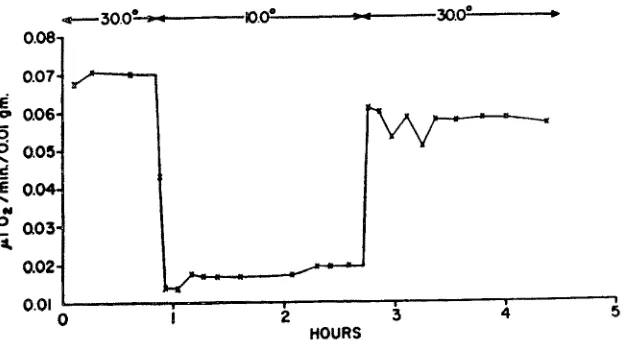
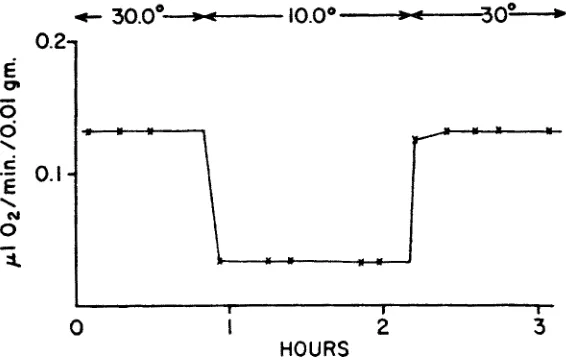
Sudden temperature rise or fall may cause three types of immediate responses: (1) shock-type responses, resulting in increased fluctuations in the response intensity, (2) fast direct adjustments to the new level without measurable intensity fluctuations, (3) gradual adjustments. Shock-type responses otien result in characteristic over- or undershoots of performance. Such over- or undershoots following sudden significant changes from one constant temperature to another have been observed in the turbella- rian Dugesia (BEHRE 1918), in various crustaceans, for example, in Cyclops strenuus (ScHERi3AIiOrF 1935), Neomysis integer, Hernirnysis larnornae, Diaptornus gracilis, Arternia saIina, developing eggs of Astacus paIIipes (GRAINGER 1956), Daphnia rnagna and Sirnocephalus vetulus (MHJERINC 1960). They have also been observed in fishes,
< - - . - . 3 0 . 0 % , ~ = I ) . 0 ° ~ : - - 3 0 0 °
0.08.
0.07"
m 0.06"
o~ 0,05-
E 0.O4.
a
o 0 0 3 .
"i
0.02-
1 / . - - - , -
0.01 " ' ''"~
o i ~ ~ ~ 5
HOURS
Fig. 1: Under- and overshoots of oxygen consumption following abrupt changes in ambient temperature in anaesthetized motionless brine shrimp Artemia salina. (After GRAINGER 1958)
of Astacus fluviatilis (Sc}tLIEPEI~ 1950). More studies are needed, particularly on the direct and the gradual type of adjustment, before we possess a sufficiently represen- tative picture. The main differences between the three types of immediate responses are presumably of a quantitative nature involving different speeds and intensities rather than qualitative modifications.
m
0 d
!:
e,t
0
: t 0 . 2 -
O.t
• e . - 3 0 . 0 " ~ I 0 . 0 " = : 3 0 ° =
0
i
HOURS
Fig. 2: Fast direct adjustment to abruptly d~anged water temperatures: carbon dioxide output in Arternia salina. (AEer GRAII'~GER 1958)
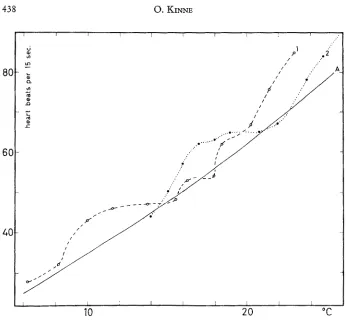
Sudden changes of rather constant temperatures may also occur under natural conditions, and the immediate responses referred to above may therefore be considered a typical first step in the acclimation process. A more normal situation, however, is gradually changing temperatures. They may cause fluctuations of rate functions around the steady state curve (obtained aiter completed acclimation to different constant temperatures) with the tendency of overshooting that curve under conditions of slowly rising temperatures and of undershooting it at slowly declining temperatures (Fig. 3). Immediate responses to changing temperatures oi~en express themselves at the behav- ioural level. Thus in the isopods Oniscus asellus and Cyl#ticus convexus, sudden changes in temperature (100 to 200 C) cause groups to scatter or scattered individuals to group (ALLEE 1931). The anostracan Eubranchipus serratus, when offered a choice of temper- atures ranging from 8 ° to 300 C, aggregated in the zone between 140 and 170 C (McGINN~S 191t). Similar preference responses have been reported for the parasitic carp louse Argulus foIiaceus (H~l~'rEl~ 1927) and other aquatic invertebrates. In Daph- nia longispina sudden temperature rise causes rapid downward movements, and sudden temperature fall, less rapid upward movements (Rose 1910). Various zoea-larvae and adult planktonic crustaceans exhibit sudden flight reactions upon contact with thermal discontinuity layers (SCHMID 1911, FI~P, DER 1957).
438 O. K I N N E
/ /
pl .2
I / .-"
u'~ ."
8 0 ~ , : -
~ . / f
; .
/ ..'
.C tic ..,
60
/:..
~" st
f / "
40 /
/ /
I I I ; I I I I J [
10 20 °C
Fig. 3: Typical immediate responses of frequency of heart beats to slowly rising temperatures in two 16 mm long Gammarus duebeni. A: Steady state curve. 1 : A male whi& had been kept at 6 ° to 7 o C for 14 days and subsequently was exposed to temperatures rising to 23.00 C within 31/2 hours. 2: A male whi& had been kept at 14 o C for 14 days and subsequently was exposed to temperatures rising to 26.1 o C within 2 hours. All points represent averages of
I0 counts. Salinity: 10%0. (After KINNE 1952; modified)
often accompanied by increased intensity fluctuations. They may have a positive survival value but do not seem to be necessarily an integrant part of the subsequent acclimation process in all cases.
The process of stabilization
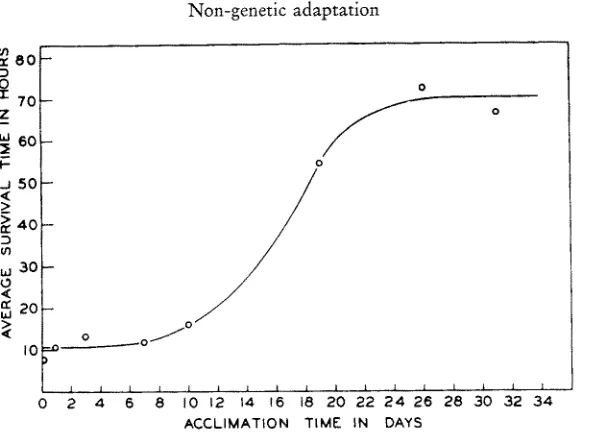
Stabilization begins with decreasing fluctuations of performance and ends with the attainment of the new steady state. The duration of the phase of stabilization may be quite different depending on the species tested and the parameter measured. Within a given species it depends on age (it tends to increase with age), metabolic rate (it tends to increase with decreasing metabolic rate), the life cycle stage (e. g., egg, larva, pupa, adult), and the degree and pattern of the temperature change. In American lobsters
Homarus arnericanus that were kept for varying periods at 23.0 ° C, thermal accli-
CO
8 0
-- 7 o
z_
,.L 6 0 }
T--
_1 5 0 <
m
uJ 3 0 0 <
~ 2o
I0
o
0 0 ~ 0 --_.0
Fig. 4: Time course of stabilization in the lobster Homarus americanus. Given is the gain in average survival time of groups of 6 to 10 lobsters previously kept at 14.50 C and transferred
0
into an acclimation temperature of 23.0 C for periods ranging from 1 to 31 days; survival time was then determined at 300 C. Thermal acclimation is practically complete aEer about
22 days. (A~er McL~se 1956)
Acmaea limatula low-level individuals transplanted to high-level localities exhibit a subsequent decrease in heart pumping rate; within 29 days heart rate finally becomes equal to that of the high-level individuals when measured at a given temperature. Half-acclimation time was about 6 days, and acclimation to cold was complete within 29 days (SEGAI~ 1956). In the shore crab Pachygrapsus crassipes respiratory acclimation to a temperature change of 7.50 C was found to require a half-time of about 6 days (RootleTs 1957). In the marine fish Girella nigricans about 50 per cent o£ the total resulting change of cold tolerance occurs in two days; complete acclimation, that is, constant cold tolerance is achieved in about 20 days (DouI)O~OFF 1942). In various other fishes metabolic acclimation takes about 4 to 5 days (PREcHT 1949); it takes only minutes or hours in micro-organisms (PREc~tT et al. 1955).
In most aquatic invertebrates and fishes tested so far, the process of stabilization lasts days or weeks. More than 50 per cent of the total resulting amount of acclimation seems frequently to be achieved within the very first portion of the stabilization period or immediately al°cer the latent period. Later the amount of non-genetic adaptation acquired per unit time decreases progressively.
The new stead), state of performance
440 O. KINNE
presented below, first at the functional level, with special reference to lethal temper- ature and metabolic rate, then at the structural level.
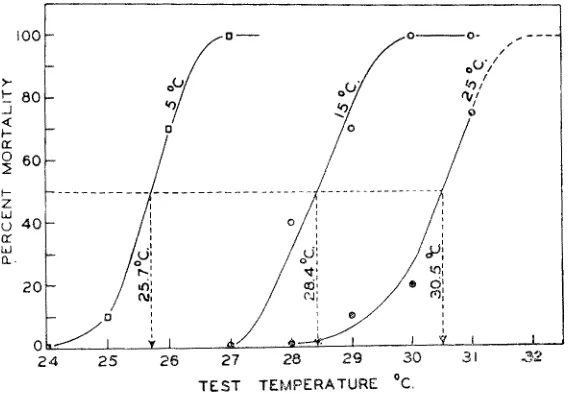
F u n c t i o n a l n o n - g e n e t i c a d a p t a t i o n to extreme cold and heat is well documented. Acclimation to subnormal temperatures generally tends to shit~ the lower lethal limit downward, and acclimation to supranormal temperatures tends to. shiflc the upper limit upward, Examples are the crustaceans Hornarus (Fig. 5), Streptoce- phalus (Moo1:e 1955) and Artemia (GRAINGER 1958); the green fish Girella nigricans had a lower lethal temperature of 13 o C aflcer acclimation to 28 o C and of 4.5 ° C a~er acclimation to 12°C (DouDoI:oFF 1942); for further examples consult LoEB & WASTENEYS (1912), HATHaWaY (1927), FI:Y et al. (1942, 1946), DOUDOROFF (I942,
iO0
/0--
./0
O- //~ ....
0
>- o k.~/ ~0 /
~_ 8 0 / o - / ~ ,
_J
t--- 0 0
Z i i
t.d I ~ t
U 4 0 - ~ o ' '
- /co.' / o va,, /
0 _ . o l , ,
/2!
/ ~i
/ ~,
2 0 ~ ,61 ~, ® o',
~- o ', I ' % 1 ',
o L l ~, I ,~ ,J v ... ~
2 4 2 5 2 6 2 7 2 8 2 9 3 0 31 ~'2
T E S T T E M P E R A T U R E °C.
Fig. 5: Effects oi: thermal acclimation on the lethal limits in Homarus americanus. Aider acclimation to 5 °, 15 o and 25 o C respectively, the lobsters were exposed to various test tem- peratures. The three curves are drawn through points representing per cent mortalities wltmn a period of 48 hours at a given test temperature. The temperature that would cause 50 per cent mortality is indicated by broken lines and arrows. Salinity: 30 %0. Ambient oxygen: 6.4 mg
O.2/1. (Aflcer McLErsE 1956)
been reported in several cases. Thus acclimation to extreme temperatures may result in concomitant increase in resistance to tow oxygen concentration, radiation and chemical poisoning.
The upper lethal temperature is a useful tool in assessing intra- and interspecific genetic differences in thermostability (FRY et al. 1942, FRY et al. I946, FRY 1947, 1957a, BRrTT 1956, McLEEsE 1956). It can also be used to assess the amount and speed of non-genetic adaptation to temperature. Experimental heat death - parti- cularly when measured as protein denaturation - oflcen appears, however, to be indi- cative of qualitative differences in basic properties such as primary protein structures rather than of subtle quantitative divergencies.
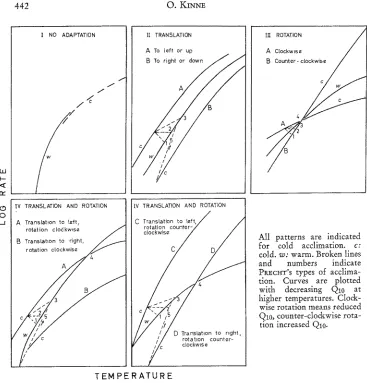
Non-genetic adaptation of metabolic rate to new levels of temperature has received much attention. All possible quantitative differences between the original level of performance and the new steady state that may follow a defined change in temperature have been considered and classified by PR~;CI~T (1949, 1955, 1958) and later in a modified version by PROSSER (I958). PRECH'r distinguishes five types: (1) over-compensation; (2) perfect or "ideal" compensation, resulting in constant rate functions after complete acclimation to different experimental temperatures; (3) partial compensation, the most frequent case; (4) no compensation; and (5) inverse compen- sation. PROSS~R distinguishes four basic patterns (Fig. 6): (I) little or no compen- sation, indicated by little or no change in the position of rate temperature curves (log rate plotted against temperature); (II) shi~ in position (translation) of rate curves without change in Q10; (III) change in Q10 (rotation) of rate curves without shiflc in position; (IV) translation combined with rotation. Little is known about what these different types and patterns imply in terms of the underlying physiological mechanisms. According to PROSSEr, & BROWN (1961) translation implies a change in activity (in the thermodynamic sense) of some enzyme system, and rotation implies a change in Q10 and hence in activation energy. Factors most likely to cause translation are alterations in enzyme concentration, relations among enzymes (in series or parallel) and in exter- nal factors other than temperature (salinity, pH, etc.). Factors most likely to cause rotation are alterations in enzymatic protein, in some co-factor and in enzymatic pathways.
Acclimation to changes in temperature expresses itself not only in alterations and shitts of lethal limits and metabolic rate. It may also affect the temperature preferen- dum (e. g. PITT et al. 1956, ZAHN 1962), intra- and interspecific competition, behav- lout, orientation as well as biological rhythms and quantitative changes in biologi- cally important substances. In wool handed crabs
Eriocheir sinensis
kept in fresh water, exposure to low temperatures of 10 to 30 C results in a marked decrease of free proline concentration in the intracellular pool of amino acids in muscles, relative to individuals kept at 150 C (DucH~TEAU & FLO~t~IN 1955). InDaphnia
supranormal temperatures - at constant O~ pressure - augment the amount of hemoglobin (FLoRKZN t960). In the fishesPlatypoecilus
andXiphophorus
temperature decrease from 280 to 220 C causes a significant rise in the level of amino acids (ANi)~RS et al. 1962).442 O. KINN~
W
b- <
o o _J
I NO ADAPTATION
/
/
./
I V TRANSLATION AND ROTATION f
A Translation to [eft,
rotation
clock/
t225 /
t[ TRANSLATION
A To teft or up B To right or d o w ~ . / ~ /
/ / t
tlI ROTATION /
A C[ockw B e /
B Counter- c l o c k w i s e ~
4
All patterns are indicated for cold acclimation, c:
cold. w: warm. Broken lines and numbers indicate PREcH'r's types of acclima- tion. Curves are plotted with decreasing Q10 at higher temperatures. Clo&- wise rotation means reduced Q10, counter-cIockwise rota- tion increased Q10-
T E M P E R A T U R E
Fig. 6: Patterns of acclimation of rate functions to different constant temperatures. (AEer PROSSEI~ 1958b; modified)
pigment per pigment cell or in number of chromatophores per unit area, or both (e. g. By.OWN 1934). In poeciliid fishes temperature decrease may accelerate and intensify the formation of pigment ceils. Thus a decrease from 28 ° to 22 ° C resulted within 8 days in an increase in the number of scale melanophores 50 times that of the controls (A~,rDEP.S et al. 1962). Changes in body size and shape, number, length and diameter of tentacles, cell dimensions, cell number per hydranth and size of nuclei and nemato- cysts due to acclimation to different constant temperatures have been demonstrated in the hydroid Cordylophora caspia (KINNE 1956a, 1958a). Structural adjustments of body size and shape are furthermore documented by the phenomenon of cyclomor- phosis in Cladocera (WrsE>,'BEt<G-LuND, e. g. 1900, OSTWALD 1904, WOLTEI<~CI% e. g. 1913, BRoo~:s 1946, 1947, 1957, LIEDER 1951) and Copepoda (M~cALEr 1955).
crest and spines, particularly if the parthenogenetic young developed at high temper- atures of at least 18 ° to 20 ° C. Such structural adjustments per se, however, may not have an adaptive value. They may largely represent incidental expressions of a func- tional acclimation to the over-all seasonal conditions, especially to high temperature and increased water turbulence. These two factors appear to affect relative growth of the different body parts through changes in metabolic rate (BRooKs 1957; see also HRBK4Hi 1959). In many invertebrates and fishes final body size tends to be larger in individuals exposed to slightly subnormal temperatures than in those living at normal or supranormal temperatures. In the desert pupfish
Cyprinodon macularius
body length at hatching is a function 'of incubation temperature(KINNE
1960, KINNE & KINN~ 1962). Temperature changes may furthermore affect the mode of reproduction (e. g. WrRNER 1962, 1963) and thereby cause structural alterations, which in some cases may be of adaptive value.N O N - G E N E T I C ADAPTATION TO SALINITY
Salinity is defined as the weight in grams (in vacuo) of the solids that can be obtained from 1 kilogram of sea water (likewise measured in vacuo) when all the carbonate has been converted to oxide, the bromine and iodine replaced by chlorine, all organic matter oxidized and the remainder dried at 480 ° C to constant weight (BARon,s 1959). From this definition it becomes immediately clear that the term "sall- nity" comprises a number of physical and chemical properties of a given body of water which may have diffel'ent biological consequences. Thus salinity may affect living systems in at least four different ways, namely through changes in (1) total concentration, (2) relative proportions of solutes, (3) coefficients of absorption and saturation of dissolved gases, and (4) density and viscosity (for further details see KINNE 1964b).
In the open oceans, total concentration and relative proportions of ions are rather constant; salinity averages about 35 °/00 and ranges from about 33 to 37 °/00. However, peripheral areas - such as the Baltic, Caspian and Red Seas, bays, lagoons, estuaries and other coastal waters - may display considerable deviations of both total osmo- concentration and ionic composition. It is in these areas that the capacity for non- genetic adaptation to salinity is of basic importance for the ecological success of the organism concerned.
The literature on non-genetic adaptation to salinity variations is scanty and refers almost exclusively to the effects of constant or average salinities. Next to nothing is known about acclimation to salinity fluctuations or to alterations in solute compo- sition although a few investigations on ionic requirements have been carried out, for example, on crustaceans, a fish and other animals (BERGt~R 1929), the cnidarians
Cordylophora caspia
(ROCH 1924, FULTON 1960, 1962) andHydra Iittoralis
(LooMIS
444 O. KINNE
organs for effective regulatiofi. Osmoregulators employ specialized regulatory organs such as gills, gut and excretory glands, which then presumably tend to represent the primary sites of functional or structural acclimation.
Immediate responses to sudden changes in salinity
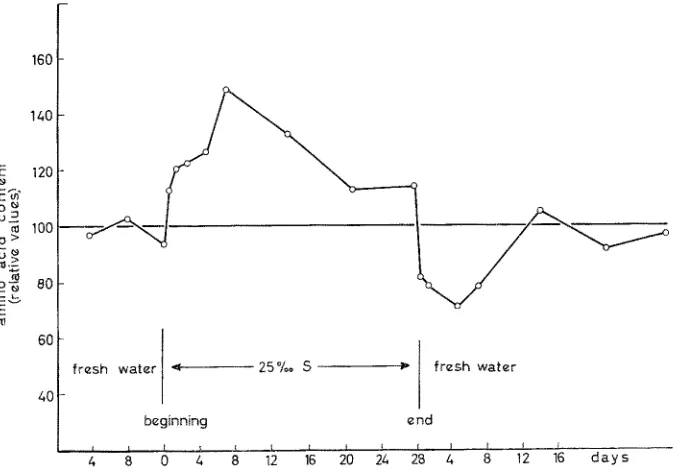
Immediate responses to sudden salinity rise or fali usually lead to over- or under- shoots in performance, resulting, for example, in marked and rapid fluctuations of acti- vity, metabolic rate, body volume and in water or salt content. They may also involve muscle contractions, e. g. in hydroids and molluscs, secretion of slime in molluscs and fishes as well as changes in the amino acid pool and in structural &aracteristics. T w o
160
140
120
o
o ~
1 0 0 1L1>
o ~ 80 . _ ~
E
60
fresh water "~ ... 25%° S ~ fresh w a t e r
40
beginning ¢nd
t I I
Fig. 7: Immediate responses to sudden salinity changes in the fish Platypoecilus maculatus. The content of free amino acids increases within a few hours after the rise in salinity and reaches a maximum after 7 days. At this time the process of stabilization begins and gradually leads toward a new steady level. Note over- and undershoot following beginning and end of salinity
increase. (After AND~RS et al. 1962; modified)
body itself begins to decrease in size and gradually to become more and more globular. Finally, what remains is withdrawn into the periderm tube and closed off by a septum. The initial phase of such a reduction may take only hours. The most obvious conse- quences are a decrease in surface area exposed to the adverse environment as well as a transformation of relatively active and sensitive tentacle and hydranth tissue in less active, but more resistant hydrocaulus tissue (KINN~ 1956a).
Immediate responses to adverse salinities may also involve active selection of a new micro-habitat, e. g., in the crabs Jasus (KRIJCSMAZV & KI<IlCSMAN 1954), Birgus (GRoss 1955) and Pachygrapsus (GRoss 1957b). In preference tests offering a choice between 50, 75, 100, 125 and 150 per cent sea water, Pachygrapsus crassipes exhibits locomotory responses, indicating a preference for 100 per cent sea water over all other salinities (GI<oss 1957b). The barnacle Balanus balanoides shows cirral and closure responses in sea water diluted below 40 to 50 per cent and in water of deviated ionic composition (BAr, N~s & BARN~S 1958).
The information available at present indicates that immediate responses to salinity begin seconds, minutes or hours afLer a significant salinity change. Immediate responses to salinity may increase the survival chances of the individual involved. It is unknown, however, whether they represent an integrant part of the process of non-genetic adap- tation in all cases.
The process of stabilization
Stabilization subsequent to a change in salinity has been studied in a number of cases. Mediterranean decapods living in a salinity of about 42%0 were transferred into water of 51 O/oo and 25 O/oo respectively. Upon transfer into 51%0 the stenosaline
Maja verrucosa became rapidly isosmotic; it collapsed and, if turned on its back,
failed to reassume the normal position. However, afLer about 1 hour, Maja began to recover and regain strength. Transfer into 25 %o led to slower changes of blood osmo- concentration (isosmosis reached a~er 24 to 32 hours), but also to progressively irre- versible damage: the crabs began to die 15 hours aider transfer. Eurysatine species like
Carcinus maenas and Eriphia spinifrons exhibited less extensive changes in blood
osmoconcentration (ScHwABE 1933). In Carcinus maenas transferred from dilute sea water with a A of - i . 4 0 C to water with a A of -0.63 ° C, blood A fell from -1.750 C to -1.30 C in 26 hours and then remained constant for at least 15 days (DurAL 1925).
Astacus astacus transferred from fresh water into blood isosmotic brackish water of
15 °/oo increased their blood osmoconcentration at first rapidly, then more slowly and
finally reached a new steady level a~er 12 days (H~RRMAI~N 1931, SCHXVAB~ 1933). Simultaneousl)~ O2-consumption decreased considerably and after 20 to 30 days reached a new steady level at 60 per cent of the original value. The stickleback Gasterosteus
leiurus loses water after transfer from fresh water into blood hyperosmotic brackish
446 O. KINNE
hyperosmotic brackish water leads to extensive osmotic withdrawal of water and respiratory difficulties resulting in irreversible damage. A slow rise of salinity over several days, however, allows for appropriate adjustments (MATReT 1939). The same final salinity may then be tolerated for weeks, months or even indefinitely. MA'rR~T acclimated Cyprinus carpio (A of internal medium: -0.5 o C) to brackish water of 18.6 °/00. During stabilization, osmoconcentration of blood and urine rose slowly (urine from A -0.07 ° C to a maximum of A -0.88 ° C), and the amount of urine excreted dropped considerably. Thus successful stabilization of a given individual depends not only on the degree of the salinity &ange but also on its time course; see also PaNTIN (1931) and PORA (1939). According to ScHtleWe, (1955) the mussel MytiIus edulis exhibits a higher metabolic rate in the Baltic Sea (15 °/oo) than in the North Sea (30 %o). If North Sea individuals are transferred into water from the Baltic, tissue O2-consumption increases 20 per cent within a few hours; further increase is slow so that the steady state consumption of Baltic Sea mussels is rea&ed only aider 4 to 7 weeks. Essentially the same time course of stabilization - this time with decreasing rates of metabolism - was observed after transfer of Baltic individuals into North Sea water. The speed of acclimation varies with temperature. It is higher in summer than in winter. In the mud crab Hernigrapsus oregonensis measurable acclimation to ap- proximately 51%o (150 per cent sea water) required more than 5 days, strong accli- mation, 22 days (GRoss 1963).
The new steady state of performance
The new steady state following a change from one salinity level to another has been studied with emphasis on lethal salinity limits, rates of metabolism and activity, and osmoregulative capacity. In general, acclimation to subnormal salinities tends to shif~ the lower lethal limit downward, and acclimation to supranormal salinities tends to shirk the upper lethal limit upward. Although there are many examples available from literature to illustrate this relationship, a quotation of McL~EsE's work (1956) on the lobster Hornarus arnericanus may suffice here.
SCHLIEWr. t958, p. 283/4), and various species of starfish Asterias (ScHLIrVer. 1929a, b, MeYEr. 1935, MALoeu~ 1938). Examples for type d are the wool handed crab Eriocheir sinensis (ScHxcABe 1933, Kr.OCH 1939), the fishes Sargus and Scorpaena (RAFFx I932a, b), Fundulus heteroclitus (MALo~Jr 1938) and AnguilIa anguilla (RAFrY 1933). In Metapenaeus monoceros increase of O~-consumption due to transfer into sub- or supranormal salinities is - aider prolonged exposure to the new salinity - followed by a gradual lowering of respiratory rate toward the original level (RAo 1958). In Arte- rnia salina the new steady metabolic rate is different in the two sexes. After complete acclimation to 35 %0 and to 140 %0 respectively, O~-consumption is proportional to the 0.662 power of dry weight in females (3.4 to 7.6 mm long) in both media
(GIL-
CHr.IsT 1956); males (3.3 to 7.3 mm long), however, show progressively increasing differences in the two media with increasing body length; their O2-consumption is proportional to the 0.883 power of dry weight in 35 0/00 but to the 0.624 power in 140°/00. The higher respiratory rate in 35%0 is presumably related to the larger surface area of the second male antennae in that salinity (GILcHr, ISV 1958). Complete acclimation of the freshwater living crayfish Astacus astacus to increased salinity results in a reduction of the osmotic gradient and a fall in urine output by half in 8 %0 and to negligible amounts in 15 to 200/00 (HERR~ANN 1931; see also SCHWA~E 1933). The break point of the blood-medium curve in Callinectes sapidus collected in dilute sea water occurs at lower salinity- values than it does in individuals collected in full strength sea water; but after acclimation of crabs from dilute sea water to full strength sea water, the break point shiPcs toward higher salinities (ANDEr.SON & P~oss~r. 1953). Individuals of Hernigrapsus oregonensis, which had been exposed for more than 20 days to about 51%0 salinity (150 per cent sea water), exhibited a greater capacity for osmoregulation in high salinities than individuals that were previously exposed to approximately 34 0/00 (100 per cent sea water). This acclimation occured both aiter sudden or gradual salinity increase (Gr.oss 1963).Salinity changes may not only affect the rate but also the e f f i c i e n c y of meta- bolic processes. In the fish Cyprinodon rnaeularius, for example, a given amount of food is being converted into different amounts of body substance depending on the salinity history of the individuals
(KINNE
1960, 1963b). Osmoregulation in sub- or supranormal salinities might be expected to use considerable amounts of energy (CRoGHAN 1961). Acclimations leading to an increase in efficiency of regulation would decrease the energy requirement for maintenance. It would by the same token decrease the food requirements and hence afford a significant competitive advantage.448 O. KINNE
by extra energy. They have been produced experimentally even in specimens with identical genotype. The most obvious net results of such acclimations are changes in surface area and in surface to volume ratios in hydranths and single cells, implying quantitative alterations in metabolic performance. In the euryplastic Pacific pink salmon
Oncorhynchus gorbuscha,
individuals raised in sea water have somewhat fewer kidney glomeruli than individuals raised in fresh water (FORD 1958). If exposed to diluted sea water, the Indian eurysaline £shEtroplus maculatus
decreases the diameter of its glomernli and shows structural changes in its kidney tubule. With acclimation to higher salinities,Etroplus
increases the thickness of the tunica propria of its gut wall and the number of goblet cells in the lining gut epithelium (Vn{ABHaD~ACHAt~I i961). Various similar studies demonstrate or suggest alterations of numbers of verte- brae and fin rays and of gill surface or gill structures with changes in salinity, which may be of adaptive value./' U / I~', __2o .
/ R \
\
\
,
t~, o/ \ \ ~ ', \ '. \ I ' TOLERANCE | ~ . ', I ~, ,~
/ \ ~ I ~ \ ~ \ I ~ Z O N E / ~ ~ I \ ~ - -
~o/ \ . % . / , , - - - ~ ~ - - , 4 ~ - ~ , , /
,,/7~
&
" / \
',
. . .
, V - ~ o/
/ /
~ / / / ;
30 28¢ / / / ; ,~/X
22 20 ~B ,/o ~ oT E M P E R A T U R E °C
Fig. 8: Diagram of the boundaries of lethal conditions for lobsters
(Homarus americanus)
in various combinations of temperature, salinity and oxygen. T, S, O: regions in which tempera-ture (T), Salinity (S) or Oxygen (O) alone act as a lethal factor. (After MCLEESE 1956)
DISCUSSION AND SUMMARY
2. Non-genetic adaptation may involve quantitative changes in lethal limits, activity, metabolism, reproduction and other functions as well as in body dimensions, archi- tecture of organs and cells, cell number per organ and in the quantity and activity of enzymes. It practically involves all levels of organismic function and structure. Non-genetic adaptation is not the result of a single process but represents a syn- drome. The capacity for non-genetic adaptation depends on the genetic ba&ground of the organism involved; it may be different in different ontogenetic stages, su& as egg, larva and adult, and may bear relations to metamorphosis and reproduction. There appears to be some evidence that non-genetic adaptations which have been acquired during the most sensitive phase of an individual's life cycle may be trans- ferred to the next generation as non-genetic transmission (e. g. P~oss~R 1958). 3. There is urgent need for carefully conducted long-term experiments. Much of our
present knowledge on non-genetic adaptation has been obtained from organisms kept under inadequate conditions; numerous experiments seem to have been con- ducted on si& or dying specimens. Even the small amount of information available at this time has therefore to be evaluated with some critical skepticism. Poor condi- tions and poor health are dangerous prerequisites for the analysis of such a complex and subtle process as is non-genetic adaptation.
450 O. KINNE
5. Most authors have considered non-genetic adaptations to a single environmental factor, namely either to temperature or salinity. Organisms, however, react to their total environment rather than to single entities. It is therefore of particular impor- tance to study the combined effects of two or more components of the environment. Very little is presently known about the combined effects of temperature and salinity on the process of non-genetic adaptation (e. g. D~I~N~L 1960, TODD & DEHN~I~ 1960, MAVUTANI 1962, ALDERDICE 1963, KINNE 1963b, 1964a, b). McLEEs~ (1956) analyzed the combined effects of temperature, salinity and oxygen on the survival rates of American lobsters (Fig. 8) (see also A~D~DmE 1963), and at the present Symposium, ROBERTS (1964) reported that the perfection of thermal acclimation of respiration in sunfish
Lepomis gibbosus
becomes a function of day length above temperatures of about 10 ° C.6. There appears to be some evidence that acclimation to one factor, say salinity, proceeds at different rates and at different efficiencies under different levels of other simultaneous acclimations, for example, to temperature or oxygen (KINN~ 1964a, b). Furthermore, inharmonious interrelations between one functional or structural adaptate relative to another may be a fundamental way of limiting the total resulting amount of non-genetic adaptation. The maximum amount of accli- mation to a given temperature is presumably only attainable at normal or near optimum salinities, and, conversely, maximum acclimation to salinity is presumably only possible under corresponding temperature conditions.
7. Very little is known about the process of de-adaptation. Does the process of de-acclimation display a similar or a different time course than the respective acclimation? Can de-acclimation from one factor, such as temperature, be initiated or hastened by applying a new stress, such as extreme salinity? De-acclimation may in;colve active changes and not just a cessation of a given non-genetic adaptation. Thus upon return from high altitude to sea level, erythropoiesis not only stops, but erythrocyte destruction is acceierated (M~I~INo 1950). Apparently, acclimation and de-acclimation are two opposed processes in competition, reaching equilibrium only under constant environmental conditions.
8. The information presented in this paper pertains to reactions of intact, whole individuals. Can we expect cells, tissues or organs removed from multl-cellular animals to preserve and display the full amount of a given non-genetic adaptation acquired in the intact organism? Presumably not, if a substantial part of that acclimation is based on adjustments in organismic integration. But even in other cases, removed cells or organs may o~en tend to lose part or all of the acclimation acquired due to damages caused by operation procedures. Another important question is whether or not there exists a relationship between the amount of accli- mation retained in isolated cells and (a) the level of organismic organization of the test organism (e. g. in the series plant, protozoan, crustacean, fish), or (b) the degree of disturbance caused by the removal of these cells.
different satinities results in considerable adjustments in the cells of tentacles, h y d r a n t h b o d y and "neck", while those of the hydrocaulus and stolons remain practically unaffected (KINNz 1958a), and in male rats, cold acclimation causes a remarkable increase in the amount of b r o w n fat, while other tissues do not seem to show sueh intensive modifications (SMiTU 1964).
A C K N O W L E D G M E N T S
It is a pleasure to acknowledge the use of the excellent library facilities of the Marine Biological Laboratory, Woods Hole, Massachusetts, USA. I would also like to thank Miss F. W. CRous~ for assistance in the preparation of this review, and the Bundesern~hrungs- ministerium, Bonn, for making this assistance financially possible.
LITERXI~t3RE C I T E D
ADOLPH, E. F., t956. General and specific characteristics of physiological adaptations. Am.
J. Physiol. 184, 18-28.
ALDERDICE, D. F., 1963. Some effects of simultaneous variation in salinity, temperature and dissolved oxygen on the resistance of young Coho salmon to a toxic substance. J. Fish. Res.
Bd. Canada 20, 525-550.
ALLEE, W. C., 1931. Animal aggregations. Univ. Chicago Press, Chicago, 431 pp.
AND~RS, F., VEsTal<, F., KLINKZ, K. & SCHUMAC~R, H., 1962. Genetische und biodaemische Untersuchungen tiber die Bedeutung der freien Aminosiiuren ftir die Tumorgenese bei Art- bzw. Gattungsbastarden lebendgeb~render Zahnkarpfen (Poeciliidae). Biol. ZbI. 81, 45-65. ANDERSON, J. D. & PROSSER, C. L , 1953. Osmoregulating capacity in populations occurring in
different salinities. Biol. Bull. mar. biol. Lab., Woods Hole 105, 369.
BAR>rZS, H., 1959. Apparatus and methods of oceanography. Part one: chemical. Intersci. Publ., Inc., New York, 341 pp.
-- & BARNrS, M., 1958. Note on the opening response of Balanus balanoides (L.) in relation
to salinity and certain inorganic ions. Ver6ff. Inst. Meeresforsch. Brernerhaven 5, 160-164. BaRitE, E. H., 1918. An experimental study of acclimation to temperature in Planaria doro-
tocephala. Biol. Bull. mar. biol. Lab., Woods Hole 35, 277-317.
B~LZHR~DEK, J., 1928. Le ralentissement des r6actions biotogiques par le froid est caus6 par une augmentation de Ia viscosit6 du protoplasma. Protoplasma 3, 317-326.
- - 1935. Temperature and living matter. Borntraeger, Berh Protoplasma-Monogr. 8, 277 pp. BELIA~V, G. M. & TSCHUClmOVA, M. N., 1952. Die physiologischen Unterschlede zwischen den MytiIi (Mytilus) der Barentssee und der Ostsee. (In Russian) Vortr. Akad. Wiss. UdSSR.
OkoI. 85, 233-236.
B~RGER, E., 1929. Unterschiedliche Wirkungen gleicher Ionen und Ionengemische auf verschie-
dene Tierartem Ein Beitrag zur Lehre vom Ionenantagonismus. Inaug.-Diss., Univ. KieI, 39 pp.
BORE1, H., 1936. Uber die Einwirkung des Salzgehaltes auf den Oe-Verbrauch des Echino- dermeneies. Z. Morph. OkoI. Tiere 30, 97-98.
BouxlN, H., 1931. Influence des variations rapides de Ia salinit4 sur la consommation d'oxyg~ne chez Mytilus edulls var. galloprovincialis (LM~.). Bull. Inst. oc~anogr. Monaco No. 569, 1-11.
BRETT, J. R., 1946. Rate of gain of heat-tolerance in goldfish (Carassius auratus). Univ. To- ronto Stud., Biol. Ser. No. 52, 9-28.
- - 1952. Temperature tolerance in young Pacific salmon, genus Oncorhynchus. J. Fish. Res.
Bd. Canada 9, 265-323.
452 O. KINNE
Bt~OEI~MA, M. M. M., 1941. Seasonal movements and the osmotic behaviour of the shrimp,
Crangon crangon L. Archs. n~erl. Zoot. 6, 1-100.
Bt~ooKs, J. L., 1946. Cyclomorphosis in Daphnia. I. An analysis of D. retrocurva and D.
galeata. Ecol. Monogr. 16, 409-447.
- - 1947. Turbulence as an environmental determinant of relative growth in Daphnia. Proc.
nat. Acad. ScL, Wash. 33, 141-148.
- - 1957. The species problem in freshwater animals. In: The species problem; edited by E. MAYR, Am. Ass. Advanc. Sci., Wash., D. C., 81-123.
Bi~owN, F. A., Jr., 1934. The chemical nature of the pigments and the transformations respon- sible for color changes in Palaemonetes. Biol. Bull mar. biol. Lab., Woods Hole 67, 365-380. Bu~I.OCK, T. H., 1955. Compensation for temperature in the metabolism and activity of poi-
kilotherms. Biol. Rev. 30, 311-342.
Cm~ISTOrrtrRSEN, J. & Pi~rcu'r, H., 1952a. Untersuchungen zum Problem der Hitzeresistenz. I. Versuche an Karauschen (Carassius vulgaris NILs.). Biol. ZbI. 71, 313-326.
- - 1952b. Untersu&ungen zum Problem der Hitzeresistenz. II. Versuche an Hefezellen. Biol.
ZbI. 71, 585-601.
- - 1953. Die Bedeutung des Wassergehaltes der Zelle fiir Temperaturanpassungen. Biol. Zbl. 7 2 , 104-119.
- - 1956. Uber die K~dIteresistenz yon Hefezelien. Biol. Zbt. 75, 612-624.
CgOCHAN, P. C., 1961. Competition and mechanisms of osmotic adaptation. Syrup. Soc. exp.
Biol. 15, 156-167.
D~HNE~, P. A., 1960. Effect of temperature and salinity on the oxygen consumption of two intertidal crabs. Bioi. Bull. mar. biol. Lab., Woods Hole 118, 215-249.
Dotmot~o;F, P., 1942. The resistance and acclimation of marine fishes to temperature changes. I. Experiments with Girella nigricans (AYRES). Biol. Bull. mar. biol. Lab., Woods Hole 83, 219-244.
- - 1945. The resistance and acclimation of marine fishes to temperature changes. II. Experi-
ments with Fundulus and Atherinops. Biol. Bull. mar. biol. Lab., Woods Hole 88, 194-206. Dlrcrt~T~AG G. & FLOR~IN, M., 1955. Influence de la temp6rature sur l'6tat stationnaire du pool des acides amin6s non prot~iques des muscles d'Eriocheir sinensis MILN~-EDwARI)S.
Archs int. Physiol. Biochim 63, 213-221.
DURAL, M., 1925. R6cherches physico-chimlques et physiologiques sur le milieu int&ieur des animaux aquatiques.Modifications sous l'inflnence du milieu ext~rienr. Annls Inst. oc~anogr.
Monaco 2, 233-403.
FLEMISTER, L. J. & FLEMISTER, S. C., 1951. Chloride ion regulation and oxygen consumption in the crab Ocypode albicans (BosQ). Biol. Bull. mar. biol. Lab., Woods Hole 101,259-273. FI~ORKIN, M., 1960. Ecology and metabolism. In: The physiology of Crustacea; edited by
T. H. WATERMAN, Acad. Pr., New York and London 1,395-410.
FO~TAINE, M. & RArFY, A., 1935. Sur la consommation d'oxyg~ne de la lamproie marine
(Petromyzon marinus L.). Influence de la satinit& Ass. fr. Avanc. Sci. 50, 330-333.
FortD, P., 1958. Studies on the development of the kidney of the Pacific pink salmon (On-
corhynchus gorbuscha WALBAUM). II. Variation in glomerular count of the kidney of the
Pacific pink salmon. Can. ]. ZooL 36, 45-48.
FRIED~mt~, H., 1937. Einige Beobachtungen tiber das Verhalten der AIderia modesta Lov. im Bra&wasser. Biol. Zbt. 57, 101-104.
FRY, F. E. J., 1947. Effects of the environment on animal activity. Univ. Toronto Stud., Biol. Ser., No. 55, 1-62.
- - 1957. The lethal temperature as a tool in taxonomy. Annls biol., Copenh. 33, 205-219. - - Be.t~r, J. R. & CLAWSON, G. H., 1942. Lethal limits of temperature for young goldfish.
Rev. canad. Biol. 1, 50-56.
- - Hat, T, J. S. & W~L~tt, K. F., 1946. Lethal temperature relations for a sample of young
spe&led trout, Salvelinus ~ontinalis. Univ. Toronto Stud., Biol. Ser., No. 54, %35.
FULTON, C., 1960. Culture of a colonial hydroid under controlled conditions. Science 132,
- - 1962. Environmental factors influencing the growth of Cordylophora. J. Exp. Zoot. 151, 61-78.
GiBson, M. B., 1954. Upper lethal temperature relations of the guppy, Lebistes reticulatus. Can. J. Zool. 32, 393.
GILCHRIST, B. M., 1956. The oxygen consumption of Artemia salina (L.) in different salinities.
Hydrobiologia 8, 54-65.
- - 1958. The oxygen consumption of Artemia salina (L.). Hydrobiologia 12, 27-37.
GRAINC~ER, J. N. R., 1956. Effects of changes of temperature on the respiration of certain Crustacea. Nature, Lond. 178, 930-931.
-- I958. First stages in the adaptation of poikilotherms to temperature change. In: Physio-
logical adaptation; edited by C. L. PROSSER, Am. Physiol. Soc., Wash., D.C., 79-91. GRoss, W. J., 1955. Aspects of osmotic regulation in crabs showing the terrestrial habit. Am.
Nat. 89, 205-222.
-- 1957a. An analysis of response to osmotic stress in selected decapod Crustacea. Biol. Bull.
mar. biol. Lab., Woods Hole 112, 43-62.
-- 1957b. A behavioral mechanism for osmotic regulation in a semiterrestrial crab. Biol. Bull.
mar. biol. Lab., Woods Hole 113, 268-274.
- - 1963. Acclimation to hypersaline water in a crab. Comp. Biochem. Physiol. 9, 181-188. GtmXLARD, F., 1925. De l'adaptation aux changements de salinit& Recherches biologiques et
physicochimiques sur l'epinoche (Gasterosteus teiurus CUR. & VAL.). Archs Phys. biol. 3,
79-187.
HARD~R, W., 1957. Verhalten yon Organismen gegeniJber Sprungschichten. Annls biol., Co-
penh. 33, 227-232.
HART, J. S., 1947. Lethal temperature relations of certain fish of the Toronto region. Trans.
roy. Soc. Can. 41, 57-71.
HATHAWAY, E. S., 1927. Quantitative study of the changes produced by acclimation on the tolerance of high temperatures by fishes and amphibians. Bull. Bur. Fish., Wash,, D.C. 43,
169-192.
HENSC~EL, J., I936. Wasserhaushalt und Osmoregulation yon Scholle und Flunder. Wiss.
Meeresunters. Abt. Kid 22, 89-121.
H~RRMaNN, F., 1931. Ctber den Wasserhaushalt des Fluf~krebses (Potamobius astacus L~Acrt).
Z. vergl. Physiol. 14, 479-524.
HERTeg, K., 1927. Reizphysiologische Untersuchungen an der Karpfenlaus (Argulus foliaceus
L.). Z. vergl. Physiol. 5, 283-370.
HRBk~EK, J., 1959. Circulation of water as a main factor influencing the development of hel- mets in Daphnia cucullata Sars. Hydrobiologia 13, 170-185.
KINNE, O,, 1952. Zur Biologie und Physiologie yon Gamrnarus duebeni LILLJ., V: Unter- suchungen tiber Blutkonzentration, Herzfrequenz und Atmung. Kieler Meeresforsch. 9,
134-150.
-- 1953. Zur Biologie und Physiologie yon Gammarus duebeni LILLJ., I. Z. wiss. Zool. 157,
427-491.
-- 1956. lFber den Einfluf~ des Salzgehaltes und der Temperatur auf Wachstum, Form und
Vermehrung bei dem Hydroidpolypen Cordylophora caspia (PaLLaS), Athecata, Clavidae.
Zool. Jb. (PhysioI.) 66, 565-638.
-- 1958a. Uber die Reaktion erbgleichen Coelenteratengewebes auf verschiedene Salzgehalts-
und Temperaturbedingungen. Zool. Jb. (Physiol.) 67, 407-486.
-- 1958b. Adaptation to salinity variations - some facts and problems. In: Physiological
adaptation; edited by C. L. P~oss~R, Am. Physiol. Soc., Wash., D. C., 92-106.
-- t960. Growth, food intake, and food conversion in a euryplast~c fish exposed to different
temperatures and satinities. Physiol. ZooI. 33, 288-317.
-- 1962. Irreversible nongenetic adaptation. Comp. Biochem. Physiol. 5, 265-282.
-- 1963a. The effects of temperature and salinity on marine and brackish water animals. I.
Temperature. Oceanogr. Mar. Biol. Ann. Rev. 1, 301-340.
454 O. K I N N E
fisches Cyprinodon macularius, Verdff. Inst. Meeresforsch. Bremerhaven, Sonderbd. Drittes Meeresbiol. Symposion, 49-66.
- - 1963c. Adaptation, a primary mechanism of evolution. In: Phylogeny and evolution of Crustacea; edited by H. B. WmTTINGTON & W. D. I. ROLF~, Mus. Comp. Zool., Special PubL, Cambridge, 27-50.
- - 1964a. Animals in aquatic environments: crustaceans. In: Handbook of physiology; Sec. 4, Am. Physiol. Soc., Wash., D. C., 669-682.
- - 1964b. The effects of temperature and salinity on marine and brackish water animals. II. Salinity and temperature-salinity combinations. Oceanogr. Mar.Biol. Ann. Rev. 2, 281-339.
- - & KINNE, E. M., 1962. Rates of development in embryos of a cyprinodont fish exposed to
different temperature-salinity-oxygen combinations. Can. J. Zool. 40, 231-253.
KRIJGSMAN, B. J. & KRIJS~MAN, N. E., 1954. Osmoreception in Jasus islandii. Z. vergl.
Physiol. 87, 78-81.
KROGH, A., 1939. Osmotic regulation in aquatic animals. Cambridge Univ. Press, London and New York, 242 pp.
Kr, OGER, G., 1962. Uber die Temperaturadaption des Bitterlings (Rhodeus amarus BLOCH). Z. wiss. Zoot. 167, 87-104.
LENHOFF, H. M. & BOVAIRD, J., 1960. The requirement of trace amounts of environmental sodium for the growth and development of Hydra. Expl. Cell. Res. 20, 384-394.
Lr~DER, U., 1951. Der Stand der Zyklomorphoseforschung. Naturwissenschaflen 38, 39-44. LoeB, J. & WAST~NeVS, H., 1912. On the adaptation of fish (Fundulus) to higher temperatures.
J. Exp. ZooI. 12, 543-557.
LOFTS, B., 1956. The effects of salinity changes on the respiratory rate of the prawn Palae-
rnonetes varians (LEACH). J. Exp. Biol. 33, 730-736.
LOOMIS, W. F., 1954. Environmental factors controlling growth in hydra. J. Exp. Zoot. 126, 223-234.
MALO~UF, N. S. R., 1938. Studies on the respiration (and osmoregulation) of animals. Z. vergI.
Physiol. 25, 1-42.
MARGALE~, R., 1955. Temperatura, dimensiones y evolucion. Pubis Inst. Biol. apI. (Barcelona)
1 9 , 13-94.
MARTRET, G., 1939. Variations de la concentration mol&ulaire et de la concentration en chlorures de l'urine des t616ost6ens st6nohalins en fonction des variations de salinit6 du milieu ext6rieur. Bull. Inst. oc~anogr, Monaco No. 774, 1-38.
MATUTANI, K., I960a. Studies on the temperature and salinity resistance of Tigriopus japoni-
cus. I. Changes in heat resistance in relation to acclimation temperatures of Tigriopus
]aponlcus reared at 200 C. Physiol. Ecol., Kyoto 9, 35-38.
- - 1960b. Studies on the temperature and salinity resistance of Tigriopus ]aponicus. II. Chan-
ges in heat resistance in relation to acclimation temperatures of Tigriopus ]aponicus reared at 4 different temperatures. Physiol. Ecol., Kyoto 9, 39-43.
- - 1961. Studies on the heat resistance of Tigriopus japonicus. PubI. Seto Mar. biol. Lab. 9, 379-411.
- - 1962. Studies on the temperature and salinity resistance of Tigriopus ]aponicus. IV. Heat
resistance in relation to salinity of Tigrlopus japonicus acclimated to dilute and concen- trated sea waters. Physiol. Ecol., Kyoto 10, 63-67.
MAYG E., 1960. Chairman's introduction to the symposium on adaptive evolution. Proc. int.
orn. Congr. i2. 1958, Hetslnki, 495-498.
McGINNIS, M. O., 1911. Reactions of Branchipus serratus to light, heat and gravity. J. Exp.
Zool. 10, 227-240.
McLEEsE, D. W., 1956. Effects of temperature, saIinity and oxygen on the survival of the American lobster. J. Fish. Res. Bd. Can. 18, 247-272.
M~IJERINC, M. P. D., 1960. Herzfrequenz und Herzschlagzahlen zwischen H~utung und Ei- ablage bei Cladoceren. Z. wiss. ZooI. 164, I27-142.
MEYER, H,, 1935. Die Atmung yon Asterias rubens und ihre Abh~inglgkeit yon verschiedenen Aul3enfaktoren. ZooI. Jb. (Physiol.) 55, 349-398.
MooR~, W. G., 1955. Observations on heat death in the fairy shrimp, Streptocephatus seati.
Proc. La. Acad. Sci. 18, 5-12.
OSTWALD, W., 1904. Experimentelle Untersuchungen tiber den Saisonpolymorphismus bei Daphnien. Arch. Entw. Mech. Org. 18, 415-451.
PAI~TIN, C. F. A., 1931. The adaptation of Gunda ulvae to salinity. III. The electrolyte ex- change. ]. Exp. Biol. 8, 82-94.
PITT, T. K., GATRSm~, E. T. & HEVBUi~N, R. L., 1936. Temperature selection of the carp (Cy- prinus carpio LINN.). Can. ]. Zool. a4, 555-557.
PORA, E., 1939. Sur l'adaptation d'un tel6ost&n dulgaquicole , Carassius carassius L., au milieu salin. BuI. Soc. Sci. Cluj. (Roumanie) O, 384-393.
PRECHT, H., 1.949. Die Temperaturabh~ngigkeit yon Lebensprozessen. Z. Naturf. 4b, 26-35.
-- t951. Der Einflug der Temperatur auf die Atmung und auf einige Fermente beim Aal (An-
guilla vulgaris L.). Biol. ZbI. 70, 71-85.
-- t955. Wechselwarme Tiere und Pflanzen. In: PRECHT, H., CHt~ISTOVHe~,SEN, J. & HENSeL,
H.: Temperatur und Leben; Springer Verlag, Berl., 1-177.
-- 1958. Concepts of the temperature adaptation of unchanging reaction systems of cold-
blooded animals. In: Physiological adaptation; edited by C. L. PRossel% Am. physiol. Soc., Wash., D. C., 50-78.
- - 1961. Temperamranpassungen bei wechselwarmen Tieren. Verh. dtsch. ZooI. Ges. 1960
(Zool. Anz. Suppl. 24), 38-60.
-- 1963. Anpassungen wechselwarmer Tiere zum Oberleben extremer Temperaturen. Naturw.
Rdschr. 16, 9-16.
- - 1964. l~ber die Resistenzadaptation wechselwarmer Tiere an extreme Temperaturen und ihre Ursachen. Helgol. Wiss. Meeresunters. 9, 392-411.
-- CHRISTOVt~E~S~N, J. & HENS~L, H., 1955. Temperatur und Leben. Springer Verlag, Berl.,
5t4 pp.
PROSSER, C. L., 1955. Physiological variation in animals. Biol. Rev. aO, 229-262.
-- 1958a. Physiological adaptation; edited by C. L. PROSSER, Am. physiol. Soc., Wash., D. C.,
185 pp.
-- 1958b. General summary: the nature of physiological adaptation. In: Physiological adapta-
tion; edited by C. L. PROSSER, Am. physiol. Soc., Wash., D. C., 167-180.
-- & BROWN, F. A., Jr., 1961. Comparative animal physiology. 2nd ed., W. B. Saunders Co.,
Philadelphia, 688 pp.
RAttY, A., 1932a. Variations de la consommation d'oxyg~ne dissous an cours de la mort de poissons marius st~nohalins passant de I'eau de mer ~t I'eau douce. C. r. hebd. Sdanc. Acad.
Sci., Paris 194, 1522-1524.
-- 1932b. Recherches physiologiques sur le m&anisme de la mort des poissons stdnohalins
soumis ~t des variations de salinit& Bull. Inst. oc&nogr. Monaco No. 602, 1-11.
-- 1933. Recherches sur le m&abolisme respiratoire des poikilothermes aquatiques. Annts Inst.
oc~anogr. Monaco 13, 259-393.
-- 1934. Influence des variations de sallnitd sur I'intensit~ respiratoire de la telphuse et de
I'&revisse. C. r. hebd. S~anc. Acad. Sci., Paris 198, 680-681.
RAO, K. P., 1958. Oxygen consumption as a function of size and salinity in Metapenaeus
monoceros F.aA3. from marine and bra&ish water environments. J. Exp. Biol. 35, 307-313.
REMANE, A. & SC~LI~I'ER, C., 1958. Die Biologie des Bra&wassers. In: Die Binuengewiisser; edited by A. Tm~NEMANN, Schweizerbart, Stuttgart 22, 348 pp.
ROBERTS, J. L., 1957. ThermaI accIimation of metabolism in the crab Pachygrapsus crassipes
RANDALL. II. Mechanisms and the influence of season and latitude. Physiol. ZoSI. 30,
242-255.
-- 1964. Metabolic responses of fresh-water sunfish to seasonal photoperiods and temperatures.
Helgol. Wiss. Meeresunters. 9, 459-473.
Rocrt, F., 1924. Experimentelle Unrersuchungen an Cordylophora caspia (PaLt,~.s) ( = lacustris
456 O. KINNE
yon den physikalisch-chemischen Bedingungen des umgebenden Mediums. Z. Morph. Okol.
Tiere 2, 350-426.
Rosa, M., 1910. Sur quelques tropismes. C. r. hebd. S~anc. Acad. Sci., Paris 150, 1543-1545. SCHE~At~OFF, A. P., 1935. Uber den Sauerstoffverbrauch yon einigen Planktoncrustaceen.
(Russian with German summary) Trud. limnol. Stanc. Kosino 19, 67-89.
SCttLIEV~, C., 1929a. 13ber die Einwirkung niederer Salzkonzentrationen auf marine Orga- nismen. Z. vergl. Physiol. 9, 478-514.
- - 1929b. Neue Versuche fiber die Osmoregulation wasserlebender Tiere. S. B. Ges. ges.
Naturw. Marburg 64, 143-156.
- - 1950. Temperaturbezogene Regulationen des Grundumsatzes bel wechselwarmen Tieren.
Biol. Zbl. 69, 216-226.
- - 1955. Uber die physiologischen Wirkungen des Brackwassers (nach Versuchen an der Mies-
muscheI Mytilus edulis). Kieler Meeres[orsch. 11, 22-33.
SCHMm, B., 1911. Ein Versuch fiber die W~irmeempfindlichkeit yon Zoea-Larven. Biol. ZbI. 31, 358.
SC~tWAB~, E., 1933. Uber die Osmoregulation verschiedener Krebse (Malacostracen). Z. vergL
Physiol. 19, 183-236.
S~GAL, E., 1956. Microgeographic variation as thermal acclimation in an intertidal mollusc.
Biol. Bull. mar. biol. Lab., Woods Hole 111, 129-152.
SHouv, C. S., 1932. Salinity of the medium and its effect on respiration in the sea anemone.
Ecology 8, 81-85.
SIMI, SON, G. G., 1958. Behavior and evolution. In: Behavior and evolution; edited by A. Ro~ & G. G. SiMPsoN, Yale Univ. Pr., New Haven, 507-535.
- - PITTENDRtCH, C. S. 8£ TIFFANY, L. H., 1957. Life. An introduction to biology. Harcourt, Brace & Co., iN'ew York, 845 pp.
SMITH, R. E., 1964. Brown fat in the rat: adaptive changes in cold. HelgoL Wiss. Meeresunters.
9 , 187-196.
STANIER, R. Y., DOUDOROFF, M. & AD~LBEt~G E. A., 1957. The microbial world. Prentice- Hall., Inc., Englewood Cliffs, N. J., 682 pp.
SUM~ER, F. B. & DOUDOgOFV, P., 1938. Some experiments upon temperature acclimatization and respiratory metabolism in fishes. Biol. Bull. mar. biol. Lab., Woods Hole 74, 403-429.
- - & LANt~AM, U. N., 1942. Studies of the respiratory metabolism of warm and cool spring
fishes. Biol. Bull. mar. biol. Lab., Woods Hole 82, 313-327.
- - & \V~LLS, N. A., 1935. Some relations between respiratory metaboIism in fishes and suscep-
tibility to certain anaesthetics and lethal agents. Biol. Bull. mar. biol. Lab., Woods Hole 69, 368-378.
TODD, M.-E. & DE~tNEL, P. A., 1960. The influence of temperature and salinity on heat tole- rance in two grapsoid crabs, Hemigrapsus nudus and Hemigrapsus oregonensis. Biol. Bull.
mar. biol. Lab., Woods Hole 118, 150-172.
TSUK~DA, H., 1960. Temperature adaptation in fishes. III. Temperature tolerance of the guppy,
Lebistes reticulatus, in relation to the rearing temperature before and after birth. Biol. J.
Nara Univ. 10, 11-14,
- - & KATAYAM& T., 1957. Temperature adaptation in fishes. I. The influences of rearing tem- perature on the temperature tolerance, growth rate and body form. Physiol. Ecol., Kyoto 7,
113-122.
VIRA~t.IADr, AC~tA~I, V., 1961. Structural changes in the gills, intestine and kidney of Etroplus
maeulatus (Teleostei) adapted to different salinities, Quart. J. Microscop. Sci. 102, 361-369.
Wz~s, N. A., 1935. Variations in the respiratory metabolism of the Pacific killifish, Eundulus
parvipinnis, due to size, season and continued constant temperature. Physiol. Zo61. 8,
318-336.
W ~ N ~ , B., 1962. Verbreitung und jahreszeitliches Auftreten yon Rathkea octopunetata (M. Sa~s) und BougainviIIia superciliaris (L. Ao~SSlZ) (Athecatae-Anthomedusae). Ein Beitrag zur kausalen marinen Tiergeographie. KieIer Meeresforsch. 18, 55-66.