REVIEW
Unveiling the hidden function of long
non-coding RNA by identifying its major
partner-protein
Yongfang Yang, Liwei Wen and Hongliang Zhu
*Abstract
Tens of thousands of long non-coding RNAs (lncRNAs) have been discovered in eukarya, but their functions are largely unknown. Fortunately, lncRNA–protein interactions may offer details of how lncRNAs play important roles in various biological processes, thus identifying proteins associated with lncRNA is critical. Here we review progress of molecular archetypes that lncRNAs execute as guides, scaffolds, or decoys for protein, focusing on advantages, shortcomings and applications of various conventional and emerging technologies to probe lncRNAs and protein interactions, including protein-centric biochemistry approaches such as nRIP and CLIP, and RNA-centric biochemistry approaches such as ChIRP, CHART and RAP. Overall, this review provides strategies for probing interactions between lncRNAs and protein.
Keywords: Long non-coding RNA, Function, Interaction, Protein, Biochemistry approaches
© 2015 Yang et al. This article is distributed under the terms of the Creative Commons Attribution 4.0 International License (http://creativecommons.org/licenses/by/4.0/), which permits unrestricted use, distribution, and reproduction in any medium, provided you give appropriate credit to the original author(s) and the source, provide a link to the Creative Commons license, and indicate if changes were made. The Creative Commons Public Domain Dedication waiver (http://creativecommons.org/ publicdomain/zero/1.0/) applies to the data made available in this article, unless otherwise stated.
Background
Recently, an explosion of microarray tiling and high-throughput deep sequencing analysis has led to the dis-covery of thousands of previously presumed non-coding transcripts [1, 2]. Global transcriptional analyses of the human genome have revealed that non-coding RNA far exceed the protein-coding mRNAs which account for only about two percent of the human genome [3]. Non-coding RNA include many small regulatory RNAs and tens of thousands of polyadenylated and nonpolyade-nylated lncRNAs which have been shown to be essential for many rapidly growing research areas [4]. Although only a few lncRNA have been documented to have important biological functions, increasing evidences sug-gest that the regulation of lncRNAs on target genes is complicated [5].
lncRNAs, through interactions with protein, DNA and RNA, regulate gene expression at multiple levels, includ-ing chromatin remodelinclud-ing and nuclear transcription,
pre-mRNA splicing and cytoplasmic mRNA translation [6]. Moreover, virtually all functional RNA molecules interact with protein complexes and protein is confirmed to be the first and principal partner of lncRNA [7]. Thus, understanding lncRNA functions can be accomplished by identification of lncRNA-bound proteomes. Substan-tial effort is being devoted to depicting RNA–protein interactions for gaining insight into molecular mecha-nisms, but lncRNA–protein interplay is poorly under-stood [8–10]. In this review, we highlight molecular modes and functions of lncRNA–protein interactions and summarize conventional and emerging techniques to probe these interactions, with hopes of illuminating hid-den lncRNA regulatory mechanisms.
Characteristics and function of lncRNA
LncRNA are a group of non-coding RNAs defined as being larger than 200 nucleotides in length, which dis-tinguish them from small RNAs such as microRNAs, small nucleolar RNAs (snoRNAs) and small interfering RNAs (siRNAs) [11]. According to the relative position of the coding gene, lncRNA exist in four groups: inter-genic, introninter-genic, overlap and antisense [12]. Compared with protein coding RNA, lncRNAs are typically shorter
Open Access
*Correspondence: [email protected]
Department of Food Biotechnology, College of Food Science
with fewer exons, less abundance, less coding potential and more restrictions to particular tissues or cells [13]. Moreover, lncRNAs sequences are less conserved than mRNA among related species. Recently, secondary struc-tures of lncRNAs have been shown to be conserved, hav-ing ‘repeat A’ region in lncRNA Xist (X inactive-specific transcript) and a ‘roX-boxes’ sequence motif comprised of two lncRNAs roX1 and roX2 [14, 15]. Research that lncRNAs have various important regulatory effect on tar-get gene expression contributing to epigenetic modifica-tion, transcription and post-transcriptional processing via specific interactions with proteins and other cellular factors [16–18].
LncRNAs mediate epigenetic changes by recruiting chromatin remodeling complexes to specific genomic loci [16]. For example, the lncRNA HOX antisense intergenic RNA (HOTAIR)which is initiated from the HOXC cluster interacts with ploycomb repressive com-plex 2 (PRC2) to silence transcription across 40 kb of the HOXC locus in trans by inducing a repressive chro-matin state [19]. lncRNAs, Xist, RepA and Kcnqot1 all recruit the polycomb complex to the target genome and they trimethylate lysine 27 residues (me3K27) of histone H3 to induce heterochromatin formation and repress gene expression [20, 21]. In addition, lncRNA also regulate target gene at transcriptional [18]. Proxi-mal promoters can be transcribed into long ncRNAs that recruit and integrate RNA binding proteins func-tion into the transcripfunc-tional process [22]. For example, an lncRNA induced by DNA damage and transcribed from the cyclin D1 gene promoter, recruits and inte-grates RNA binding protein TLS to silence cyclin D1
gene expression [22]. LncRNAs could act as co-factors to modulate transcription factor activity. LncRNA Evf-2 is transcribed from an enhancer and recruits transcription factor DlX2 to this same enhancer to induce expression of adjacent protein-coding genes [23]. Moreover, post-transcriptional regulation of lncR-NAs is being revealed. Normally, lncRlncR-NAs are involved in splicing regulation and translational control [17]. The lncRNA MALAT1 (metastasis-associated long adeno-carcinoma transcript 1) interacts with serine–arginine splicing factor to regulate its distribution in nuclear speckle domains and to modulate pre-mRNA alterna-tive splicing [24]. A neuron-specific antisense lncRNA, AS Uchl1, could specifically induce the translation of ubiquitin carboxyl-terminal esterase L1(Uchl1) under certain stress conditions through its complementa-rity with target mRNA [25]. LncRNA brain cytoplas-mic RNA 1 (BC1) blocks protein complex assembly to repress translation initiation in neurons and germ cells [26].
Molecular archetypes of the lncRNA–protein interaction
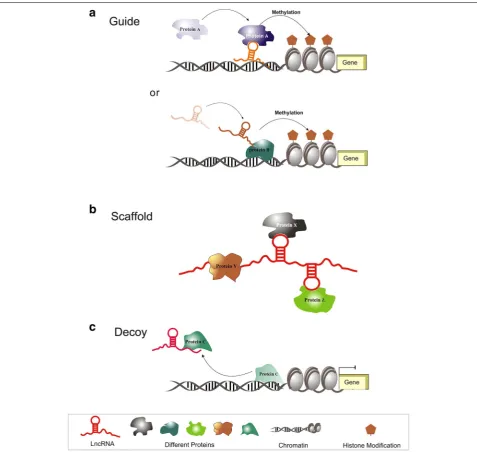
Recently, how lncRNAs control gene expression and molecular function archetypes of lncRNAs have been concerned. Wang’s group discussed four emerging arche-types of molecular functions that lncRNAs execute as signals, decoys, guides, and scaffolds via proteins, DNA and RNA interaction [27]. Here, we distill the myriad functions of lncRNA into three archetypes of molecular mechanisms to illustrate how lncRNAs directly interact-ing with proteins and serve as ‘guide’ to recruit protein complexes to target genes, serve as ‘scaffold’ to assem-ble proteins into RNPs, and serve as ‘decoy’ to seques-ter regulatory proteins away from target gene [28]. We then offer examples of each archetype’s lncRNA–protein interactions.
LncRNAs act as protein guides
First, lncRNA acts as guide to recruit proteins to chro-matin sites through RNA-DNA base pairing, to regu-late downstream gene expression (Fig. 1a). For example, lncRNA fetal-lethal non-coding developmental regula-tory RNA (Fendrr), which is specifically transcribed in nascent lateral plate mesoderm of the developing mouse embryo, guides PRC2 to target genes to increase PRC2 occupancy and trimethylate of H3K27me3, subsequently leading to attenuation of target gene expression [29]. Cold assisted intronic non-coding RNA (COLDAIR), a cold-induced lncRNA with a capped 5′ end lacking a 3′ poly A tail, is transcribed from the intron of the FLC
locus gene in Arabidopsis thaliana and recruits PRC2 to establish and maintain stable repressive chromatin of
LncRNAs scaffolds bring proteins together
lncRNA can be scaffolds to create discrete protein com-plexes: lncRNA–RNPs (Fig. 1b). HOTAIR could both bind to PRC2 and LSD1 to repress gene transcription and the catalytic methyl-transferase subunit EZH2 of PRC2 is confirmed to be recruited via a structural domain at the 5′-end of HOTAIR to impart repressive histone modifications. Meanwhile the 3′-end of HOTAIR asso-ciates with LSD1, inducing H3K4 demethylated modifi-cation [37]. Another nascent antisense lncRNA, ANRIL,
gene 1 (TUG1) and nuclear-enriched autosomal tran-script 2 (NEAT2)bind to methylated and unmethylated polycomb 2 protein (Pc2) respectively to mediate assem-bly of multiple corepressor or coactivator protein com-plexes [40], which switch non-histone protein methylated mark recognition to relocation of transcription units in the nuclear three-dimensional space, achieving coordi-nated gene expression regulation.
LncRNAs act as decoys to titrate away proteins
lncRNAs act as decoys to remove proteins away from target loci (Fig. 1c). The lncRNA p21 associated ncRNA DNA damage activated (PANDA) is a well-studied lncRNA that acts as a decoy for transcription factors. PANDA is located 5 kb upstream of the CDKN1A with a 5′-cap and a 3′-polyadenylated but non-spliced tail. PANDA binds to and sequestrates NF-YA transcription factor from target gene promoters to repress gene expres-sion [41]. Also, lncRNA could also be decoy of other pro-teins. LncRNA growth arrest-specific 5 (Gas5) has been identified to interact with glucocorticoid receptor (GR) to prevent binding to DNA response elements, thereby blocking glucocorticoid signal pathway [42]. The lncRNA metastasis-associated lung adenocarcinoma transcript 1 (MALAT1) binds to and sequesters several serine/argi-nine splicing factors to modulate their nuclear distribu-tion and phosphoryladistribu-tion states to ensure splicing factor regulation of alternative splicing of cellular pre-mRNAs at a precise time, place, and concentration [24].
Technologies to probe the lncRNA–protein interactions
AS the significance of lncRNA–protein interactions is bet-ter understood, their biochemistry attributes are being discovered and novel bioinformatics approaches are being developed to identify and predict proteins that interact with target lncRNA. Previously, most methods to study RNA–protein interactions are protein-centric, including native RNA immunoprecipitation (nRIP), cross-linking and immunoprecipitation (CLIP) [43, 44]. Recently, the discov-ery of numerous non-coding RNA has led to concern about RNA-centric approaches, such as the RNA pull-down assay, chromatin isolation by RNA purification (ChIRP), capture hybridization analysis of RNA targets (CHART), and RNA antisense purification (RAP) [45–48]. So other methods are being sought [49, 50], and here we depict detailed strategies for identifying lncRNA–protein interactions.
Protein‑centric approach to probing lncRNA–protein interactions
nRIP and nRIP‑seq
nRIP is used to detect the association of individ-ual proteins with specific RNA species in vivo. An
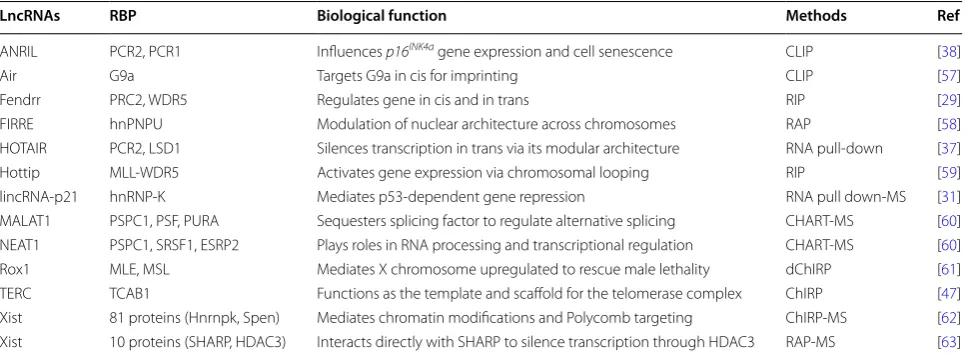
antibody-based technology, this can be used to immu-noprecipitate an RNA binding protein complex from a heterogeneous cellular homogenate in vivo. RNAs stably associated with the protein complex will immunoprecipi-tated together and associated RNAs including lncRNA and small RNA or even coding RNA can be measured with real-time PCR or be identified by RNA sequencing [51]. One important consideration prior to commencing RIP-based approaches designed to identify protein–RNA interactions is whether cross-linking is necessary. Native RIP is the method without crosslinking before cell lysis, which is a more appropriate for proteins that bind RNA directly. To reduce RNA recovery rates and identify the proteins that bind RNA indirectly, RIP assay is performed to crosslink cells with formaldehyde before cell lysis step [52]. nRIP is economical, requiring no specialized equip-ment and can be carried out under native conditions and thus allows identification of kinetically stable interactions [43]. However, the nRIP approach has limitations. First, differentiating direct from indirect interactions is diffi-cult and. the read length of associated RNA is too large for identifying the actual binding site. Finally, nRIP assays are commonly known to have variability (reproducibility of 60 % or more) [53]. Thus, multiple biological replicates for nRIP are required. Thus, RIP-based approaches have been used to identify many lncRNA–protein interactions (see Table 1). Zhao’s group discovered that Xist, Tsix, and RepA interacted with PRC2 by native RIP [14]. Recently, Fendrr was identified to bind to PCR2 complex and WDR5 protein by nRIP [29]. Previously, RNA isolated by native RIP was analyzed with microarray technolo-gies (RIP-ChIP) [54], but this is naturally limited by array design and coverage, so nRIP has recently been coupled with high-throughput sequencing (nRIP-seq) to capture the genome-wide RNA pools bound to target proteins [55]. Recent studies suggest that a genome-wide pool of thousands of PRC2-interacting RNAs including some characterized lncRNA, and many unannotated RNAs were identified in embryonic stem cells by nRNA-seq [56].
CLIP and CLIP‑seq
used to reveal that many intronic lncRNA directly bind to the PRC2 complex (see Table 1) [64]. For instance, Takashi’s group reported that lncRNA Air interacted with the H3K9 histone methyl-transferase G9a by CLIP [57], but their data suggest that the post-assay RNA quantity is small and the assay is tedious steps. Consequently, CLIP combined with high-throughput sequencing (HITS-CLIP or CLIP-seq) is used to identify many RBPs, such as Nova, Ago2, and TDP-43 [65–67]. The CLIP assay occasionally produces false–positive interactions and it determining the exact binding sites is not always straightforward [68]. Therefore, modified protocols have been developed to define cross-link-ing events, such as photoactivatable-ribonucleoside-enhanced CLIP (PAR-CLIP) and individual-nucleotide resolution CLIP (iCLIP) [69, 70]. With PAR-CLIP, cells are cultured in the presence of 4-SU (4-thiouridine) or 6-SG (6-thioguanosine), which are incorporated into RNA and induce strong cross-linking between RNAs and RBPs. Thus, this method can eliminate nonspecific targets and identify exact binding sites at a single nucle-otide resolution [71]. Disadvantage of PAR-CLIP is diffi-culties in the use of 4-SU and 6-SG in living animals due to the toxicity. Thus, the PAR-CLIP method has been successfully applied to RBPs, such as HuR, FMRP, and Ataxin-2 [72–74]. To identify RNA binding motifs and novel functions, iCLIP introduces an adapter at the 5′ end through the primer used for reverse transcription by cDNA circularization and subsequent linearization. Thus, both truncated and read-through cDNAs are cap-tured. Importantly, iCLIP also provides information about the cross-link site that permits precise mapping of RNA–protein contacts at a nucleotide resolution [70]. Rossbach’s group performed iCLIP combined with
deep-sequencing (iCLIP-Seq) to reveal global regula-tory roles of hnRPN L protein [75].
RNA‑centric approach to dissecting lncRNA–protein interactions
RNA pull‑down assay
RNA pull-down assay is a preliminary RNA-centric in vitro method that enabling identification and charac-terization of various proteins which interact with a given lncRNA of interest. First, lncRNA probes were synthe-sized and labeled with high affinity tags, such as biotin, then cell lysate was prepared from a in vitro sample. Next, the lncRNA probe was incubated with lysate or rebinant protein to form a specific lncRNA–protein com-plex. Subsequently, the protein complex was pulled down with streptavidin agarose or magnetic beads. Finally, the retrieved protein was identified with Western blot or mass spectrometry (MS) [45]. Rinn’s group used RNA pull-down to discover that HOTAIR was directly associ-ated with the PCR2 complex, which repressed transcrip-tion of the HOXD loci in trans [19].
ChIRP and ChIRP‑MS
Advances in RNA-centric biochemical purification offer new opportunities for systematically mapping lncRNA interactions with proteins and chromatin. The ChIRP method is based on using the biotinylated oligonu-cleotides complementary to the lncRNA of interest as a “handle” to pull down lncRNA-associated proteins and chromatin DNA. In brief, cultured cells are cross-linked, chromatin is extracted and sonicated, and then bioti-nylated tilling oligos that tile whole lncRNA were added and hybridized. Finally, the hybrids including target lncRNA, proteins and chromatin DNA were eluted with
Table 1 Summary of lncRNA analyzed by several biochemistry approaches
LncRNAs RBP Biological function Methods Ref
ANRIL PCR2, PCR1 Influences p16INK4a gene expression and cell senescence CLIP [38]
Air G9a Targets G9a in cis for imprinting CLIP [57]
Fendrr PRC2, WDR5 Regulates gene in cis and in trans RIP [29]
FIRRE hnPNPU Modulation of nuclear architecture across chromosomes RAP [58]
HOTAIR PCR2, LSD1 Silences transcription in trans via its modular architecture RNA pull-down [37]
Hottip MLL-WDR5 Activates gene expression via chromosomal looping RIP [59]
lincRNA-p21 hnRNP-K Mediates p53-dependent gene repression RNA pull down-MS [31]
MALAT1 PSPC1, PSF, PURA Sequesters splicing factor to regulate alternative splicing CHART-MS [60] NEAT1 PSPC1, SRSF1, ESRP2 Plays roles in RNA processing and transcriptional regulation CHART-MS [60]
Rox1 MLE, MSL Mediates X chromosome upregulated to rescue male lethality dChIRP [61]
TERC TCAB1 Functions as the template and scaffold for the telomerase complex ChIRP [47]
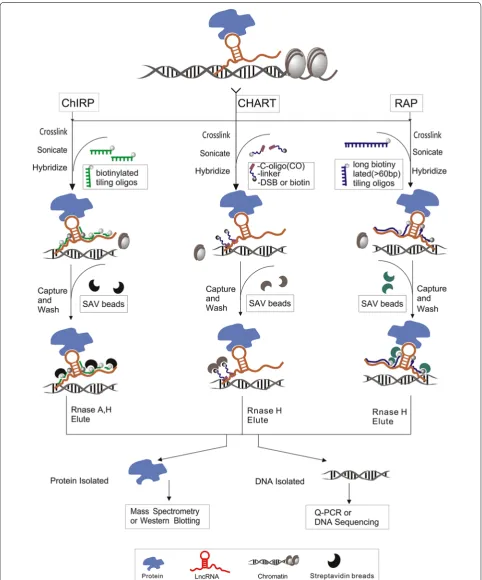
magnetic streptavidin beads and subjected to q-PCR or deep sequencing for DNA analysis, or to Western blot-ting or MS for protein analysis (Fig. 2) [46]. In addition, the recently developed ChIRP-seq method allows global and high-throughput discovery of genomic DNA associ-ated with lncRNA. Chu’s group used ChIRP-seq to reveal the precision genomic occupancy of roX2, TERC, and HOTAIR: three rather different lncRNAs in two species successfully (see Table 1) [47]. To dissect the lncRNA functional domains in situ, domain-specific chromatin isolation by RNA purification (dChIRP) has been devel-oped based on the ChIRP method and with dChIRP, biotinylated oligos are used as specific pools to recover specific domains of target RNA that improve the RNA genomic localization signal-to-noise ratio by >20-fold over traditional ChIRP [61]. dChIRP allowed lncRNA to be characterized at the domain level and revealed the lncRNA architecture and function with high precision and sensitivity [76]. Recently, Quinn’s group reported a ‘three-fingered hand’ topology of roX1 and that the three D domains of roX1 bind directly to the MSL protein complex to individually rescue male lethality by dChIRP [77].
MS based proteomics is a common tool for studying cellular interactions. Baltz and colleagues and Castello’s group used MS to identify hundreds of novel RBPs in human cells [78, 79]. Recently, to enable quantitation and accurate discovery of novel RNA–protein interactions from complexes assembled in vivo, Klass and colleagues used quantitative MS combined with RNase treatment of affinity-purified RNA–protein complexes to identify proteins that bind to RNA concurrently with an RBP of interest [80]. Kramer’s group developed an experimental and computational workflow method combining photo-induced cross-linking, high-resolution MS and auto-mated analysis of the resulting spectra for identification of RNA interactions with proteins [81]. This MS-based workflow based on MS can be applied to map any RNA– protein complex of interest. Recently, ChIRP-MS, an optimized ChIRP method for systematically discovering lncRNA-bound proteome in vivo proteomes by MS was developed to identify 81 endogenous proteins that asso-ciated with Xist in two waves to coordinate X chroma-tin spreading and silencing. Intereschroma-tingly, HrnpK protein participates in Xist-mediated gene silencing and chroma-tin modifications, but not Xist biogenesis or localization. Thus, the results suggested ChIRP-MS assay achieved high output and specificity regarding lncRNA–protein interactions in vivo [62].
CHART and CHART‑MS
Another hybridization-based purification strategy is CHART which is used to confirmed the genome-wide
localization of lncRNA in chromatin and isolate the pro-tein associated with the lncRNA of interest. CHART is more similar than different with ChIRP (Fig. 2), but one significant difference is the design criteria of the oligonu-cleotide probe. With ChIRP, short antisense DNA oligo-nucleotides tile across the entire target lncRNA without a priori knowledge of target RNA function domain cover all potential hybridization spots [47]. In contrast, probes of CHART are empirically determined after RNase H assay which determines the candidate hybridization region [82]. CHART is a useful method for biochemically defining DNA and proteins associated with lncRNAs. CHART-seq, which combines CHART and RNA-seq, was applied to discover hundreds of trans-genomic binding sites for NEAT1 and MALAT1 [60]. Moreo-ver, West’s group initially adapted the CHART assay to identify the full complement of proteins associated with RNAs in vivo with MS. CHART-MS was performed for two human lncRNAs, NEAT1 and MALAT1, to identify many nuclear speckle and para-speckle components and several new proteins not previously associated with them (see Table 1) [60].
RAP and RAP‑MS
LBR, SAF-A, RALY, HNRNPM, and PTBP1 (see Table 1). Also, they reported that the Xist interacts directly with SHARP to silence transcription through HDAC3 and that the recruitment of PCR2 by Xist depended on SHARP and HDAC3. These data is contrasted with previous work indicating that Xist directly interacted with PCR2 across the X chromosome [63]. Thus, the RAP-MS can be useful for investigating lncRNA regulation mechanism.
Bioinformatics approach to predicting lncRNA–protein interactions
Biochemical approaches to identify the lncRNA–protein complexes are constantly expanding along with computa-tional technologies. Compared with biochemical assays, the bioinformatics is more convenient and rapid for large-scale predictions of protein–lncRNA associations. Tartaglia’s group developed the algorithm, ‘fast predic-tions of RNA and protein interacpredic-tions and domains at the Center for Genomic Regulation, Barcelona, Catalo-nia’ (catRAPID), which evaluates interaction propensi-ties of polypeptide and nucleotide chains using their physicochemical properties [49]. catRAPID was used to predict RNA–protein interactions in neurodegenerative disorders, in which RNA-binding proteins apparently have a major role [83]. Recently, this method was used to predict protein interactions in the Xist regulatory net-work [84], and data show that catRAPID is powerful for predicting RNA–protein interactions from sequences. However, prediction of lncRNAs function is generally hampered by poor sequence homology and lack of inter-action data. Consequently, Lu and colleagues developed a new computational method, lncPro, to predict lncRNA– protein interactions. Compared to CatRAPID, lncPro is computational-friendly and does not lead to nonsensi-cal cross terms. Applying lncPro to all human proteins, this laboratory reported that long non-coding RNAs tend to interact with nuclear and RNA-binding proteins [50]. However, this technique is limited for finding the direct lncRNA–protein interaction s due to the volume of proteins. Recently, to gain insights into global rela-tionships between lncRNAs and their binding proteins, Shang and colleagues constructed an lncRNA–protein network (LPN) including 177 lncRNAs, 92 proteins and confirmed 683 relationships between them, based on experimentally determined functional interactions [85]. Therefore, bioinformatics approaches to predicting lncRNA–protein interactions may guide future experi-mental approaches and facilitate a deeper understanding of the role of lncRNAs.
Conclusions and perspectives
Given the multitude of non-coding transcripts discov-ered by second-generation deep sequencing, lncRNAs
arouse interest to biological and bio-medical research-ers. Recently, evidence has accumulated to support the idea that lncRNAs are critical to numerous biological processes, whereas the mechanisms by which lncRNA are poorly understood. Protein, an important partner for RNA in vivo, has been associated with molecular arche-types of lncRNA and we observed scaffolds, guides and decoys in these associations. However, some lncRNA interact with protein through more than one kind molec-ular mechanism. For example, HOTAIR is a scaffold for PCR2 and LSD1 as well as a guide to recruit PCR2 to target loci. Therefore molecular mechanisms behind lncRNA–protein interactions are complicated and rarely described. Study of lncRNAs interaction partners and the use of technologies to isolate and identify molecules associated with lncRNA are assisting researchers with the study of proteins and genomic DNA that directly and indirectly interplay with target lncRNAs. However, these interactions have not been studied across diverse species. As technologies improve, we may 1 day better under-stand evolution and functional mechanisms of lncRNAs.
Abbreviations
lncRNA: long non-coding RNA; RBP: RNA binding protein; RIP: RNA immuno-precipitation; PRC2: ploycomb repressive complex 2; HOTTIP: HOXA transcript at the distal tip; HOTAIR: HOX antisense intergenic RNA; BC1: brain cytoplasmic RNA 1; Fendrr: fetal-lethal non-coding developmental regulatory RNA; COL-DAIR: cold assisted intronic non-coding RNA; TUG1: taurine upregulated gene 1; NEAT2: nuclear-enriched autosomal transcript 2; Pc2: polycomb 2 protein; PANDA: p21 associated ncRNA DNA damage activated; Gas5: growth arrest-specific 5; MALAT1: metastasis-associated lung adenocarcinoma transcript 1; CLIP: cross-linking and immunoprecipitation; ChIRP: chromatin isolation by RNA purification; CHART: capture hybridization analysis of RNA targets; RAP: RNA antisense purification; PAR-CLIP: photoactivatable-ribonucleoside-enhanced CLIP; iCLIP: individual-nucleotide resolution CLIP; HITS-CLIP: high-throughput sequencing of CLIP; MS: mass spectrometry; LPN: lncRNA–protein network.
Authors’ contributions
HZ and YY planned the manuscript outline and wrote the draft. YY generated figures and tables. LW and HZ revised and edited the manuscript. All authors read and approved the final manuscript.
Acknowledgements
We thank Chen-Guang Zhou and Jing Shi for stimulating discussions and criti-cal review of the manuscript.
Competing interests
The authors declared that they have no competing interests.
Received: 18 June 2015 Accepted: 8 October 2015
References
1. Johnson JM, Edwards S, Shoemaker D, Schadt EE. Dark matter in the genome: evidence of widespread transcription detected by microarray tiling experiments. Trends Genet. 2005;21:93–102.
RNA-Seq reveals unannotated transcripts and isoform switching during cell differentiation. Nat Biotechnol. 2010;28:511–5.
3. Djebali S, Davis CA, Merkel A, Dobin A, Lassmann T, Mortazavi A, Tanzer A, Lagarde J, Lin W, Schlesinger F. Landscape of transcription in human cells. Nature. 2012;489:101–8.
4. Novikova IV, Hennelly SP, Sanbonmats KY. Sizing up long non-coding RNAs: do lncRNAs have secondary and tertiary structure? Bioarchitecture. 2012;2:189–99.
5. Wilusz JE, Sunwoo H, Spector DL. Long noncoding RNAs: functional surprises from the RNA world. Gene Dev. 2009;23:1494–504. 6. Yoon J, Abdelmohsen K, Gorospe M. Functional interactions among
microRNAs and long noncoding RNAs. Seminars in cell and developmen-tal biology. Elsevier; 2014. p. 9–14.
7. Chu C, Spitale RC, Chang HY. Technologies to probe functions and mechanisms of long noncoding RNAs. Nat Struct Mol Biol. 2015;22:29–35. 8. Rinn JL, Ule J. Oming in on RNA–protein interactions. Genome Biol.
2014;15:401.
9. Buenrostro JD, Araya CL, Chircus LM, Layton CJ, Chang HY, Snyder MP, Greenleaf WJ. Quantitative analysis of RNA–protein interactions on a mas-sively parallel array reveals biophysical and evolutionary landscapes. Nat Biotechnol. 2014;32:562–8.
10. Tome JM, Ozer A, Pagano JM, Gheba D, Schroth GP, Lis JT. Comprehensive analysis of RNA–protein interactions by high-throughput sequencing-RNA affinity profiling. Nat Methods. 2014;11:683–8.
11. Wang S, Tran E. Unexpected functions of lncRNAs in gene regulation. Commun Integr Biol. 2013; 6.
12. Zhu B, Yang Y, Li R, Fu D, Wen L, Luo Y, Zhu H. RNA sequencing and func-tional analysis implicate the regulatory role of long non-coding RNAs in tomato fruit ripening. J Exp Bot. 2015;66:4483–95.
13. Derrien T, Johnson R, Bussotti G, Tanzer A, Djebali S, Tilgner H, Guernec G, Martin D, Merkel A, Knowles DG. The GENCODE v7 catalog of human long noncoding RNAs: analysis of their gene structure, evolution, and expression. Genome Res. 2012;22:1775–89.
14. Zhao J, Sun BK, Erwin JA, Song J, Lee JT. Polycomb proteins targeted by a short repeat RNA to the mouse X chromosome. Science. 2008;322:750–6. 15. Ilik IA, Quinn JJ, Georgiev P, Tavares-Cadete F, Maticzka D, Toscano S,
Wan Y, Spitale RC, Luscombe N, Backofen R. Tandem stem-loops in roX RNAs act together to mediate X chromosome dosage compensation in
Drosophila. Mol Cell. 2013;51:156–73.
16. Lee JT. Epigenetic regulation by long noncoding RNAs. Science. 2012;338:1435–9.
17. Yoon J, Abdelmohsen K, Gorospe M. Posttranscriptional gene regulation by long noncoding RNA. J Mol Biol. 2013;425:3723–30.
18. Ponting CP, Oliver PL, Reik W. Evolution and functions of long noncoding RNAs. Cell. 2009;136:629–41.
19. Rinn JL, Kertesz M, Wang JK, Squazzo SL, Xu X, Brugmann SA, Goodnough LH, Helms JA, Farnham PJ, Segal E. Functional demarcation of active and silent chromatin domains in human HOX loci by noncoding RNAs. Cell. 2007;129:1311–23.
20. Terranova R, Yokobayashi S, Stadler MB, Otte AP, van Lohuizen M, Orkin SH, Peters AH. Polycomb group proteins Ezh2 and Rnf2 direct genomic contraction and imprinted repression in early mouse embryos. Dev Cell. 2008;15:668–79.
21. Pandey RR, Mondal T, Mohammad F, Enroth S, Redrup L, Komorowski J, Nagano T, Mancini-DiNardo D, Kanduri C. Kcnq1ot1 antisense noncod-ing RNA mediates lineage-specific transcriptional silencnoncod-ing through chromatin-level regulation. Mol Cell. 2008;32:232–46.
22. Wang X, Arai S, Song X, Reichart D, Du K, Pascual G, Tempst P, Rosenfeld MG, Glass CK, Kurokawa R. Induced ncRNAs allosterically modify RNA-binding proteins in cis to inhibit transcription. Nature. 2008;454:126–30. 23. Feng J, Bi C, Clark BS, Mady R, Shah P, Kohtz JD. The Evf-2 noncoding RNA
is transcribed from the Dlx-5/6 ultraconserved region and functions as a Dlx-2 transcriptional coactivator. Gene Dev. 2006;20:1470–84.
24. Tripathi V, Ellis JD, Shen Z, Song DY, Pan Q, Watt AT, Freier SM, Bennett CF, Sharma A, Bubulya PA. The nuclear-retained noncoding RNA MALAT1 regulates alternative splicing by modulating SR splicing factor phospho-rylation. Mol Cell. 2010;39:925–38.
25. Carrieri C, Cimatti L, Biagioli M, Beugnet A, Zucchelli S, Fedele S, Pesce E, Ferrer I, Collavin L, Santoro C. Long non-coding antisense RNA controls Uchl1 translation through an embedded SINEB2 repeat. Nature. 2012;491:454–7.
26. Lin D, Pestova TV, Hellen CU, Tiedge H. Translational control by a small RNA: dendritic BC1 RNA targets the eukaryotic initiation factor 4A heli-case mechanism. Mol Cell Biol. 2008;28:3008–19.
27. Wang KC, Chang HY. Molecular mechanisms of long noncoding RNAs. Mol Cell. 2011;43:904–14.
28. Rinn JL, Chang HY. Genome regulation by long noncoding RNAs. Annu Rev Biochem. 2012;81:145–66.
29. Grote P, Wittler L, Hendrix D, Koch F, Währisch S, Beisaw A, Macura K, Bläss G, Kellis M, Werber M. The tissue-specific lncRNA Fendrr is an essential regulator of heart and body wall development in the mouse. Dev Cell. 2013;24:206–14.
30. Heo JB, Sung S. Vernalization-mediated epigenetic silencing by a long intronic noncoding RNA. Science. 2011;331:76–9.
31. Huarte M, Guttman M, Feldser D, Garber M, Koziol MJ, Kenzelmann-Broz D, Khalil AM, Zuk O, Amit I, Rabani M. A large intergenic noncoding RNA induced by p53 mediates global gene repression in the p53 response. Cell. 2010;142:409–19.
32. Venter JC, Adams MD, Myers EW, Li PW, Mural RJ, Sutton GG, Smith HO, Yandell M, Evans CA, Holt RA. The sequence of the human genome. Sci-ence. 2001;291:1304–51.
33. Zappulla DC, Cech TR. RNA as a flexible scaffold for proteins: yeast telom-erase and beyond. Cold Spring Harbor symposia on quantitative biology. Cold Spring Harbor Laboratory Press; 2006. p. 217–24.
34. Cech TR. Life at the end of the chromosome: telomeres and telomerase. Angew Chem Int Ed. 2000;39:34–43.
35. Bilaud T, Brun C, Ancelin K, Koering CE, Laroche T, Gilson E. Telom-eric localization of TRF2, a novel human telobox protein. Nat Genet. 1997;17:236–9.
36. Jeon Y, Lee JT. YY1 tethers Xist RNA to the inactive X nucleation center. Cell. 2011;146:119–33.
37. Tsai M, Manor O, Wan Y, Mosammaparast N, Wang JK, Lan F, Shi Y, Segal E, Chang HY. Long noncoding RNA as modular scaffold of histone modifica-tion complexes. Science. 2010;329:689–93.
38. Wang H, Wang L, Erdjument-Bromage H, Vidal M, Tempst P, Jones RS, Zhang Y. Role of histone H2A ubiquitination in Polycomb silencing. Nature. 2004;431:873–8.
39. Maenner S, Müller M, Fröhlich J, Langer D, Becker PB. ATP-dependent roX RNA remodeling by the helicase maleless enables specific association of MSL proteins. Mol Cell. 2013;51:174–84.
40. Yang L, Lin C, Liu W, Zhang J, Ohgi KA, Grinstein JD, Dorrestein PC, Rosenfeld MG. ncRNA-and Pc2 methylation-dependent gene relocation between nuclear structures mediates gene activation programs. Cell. 2011;147:773–88.
41. Hung T, Wang Y, Lin MF, Koegel AK, Kotake Y, Grant GD, Horlings HM, Shah N, Umbricht C, Wang P. Extensive and coordinated transcrip-tion of noncoding RNAs within cell-cycle promoters. Nat Genet. 2011;43:621–9.
42. Kino T, Hurt DE, Ichijo T, Nader N, Chrousos GP. Noncoding RNA Gas5 is a growth arrest and starvation-associated repressor of the glucocorticoid receptor. Sci Signal. 2010;3:a8.
43. Gong C, Popp MW, Maquat LE. Biochemical analysis of long non-coding RNA-containing ribonucleoprotein complexes. Methods. 2012;58:88–93. 44. Darnell R. CLIP (cross-linking and immunoprecipitation)
identifica-tion of RNAs bound by a specific protein. Cold Spring Harb Protoc. 2012;2012:t72132.
45. Feng Y, Hu X, Zhang Y, Zhang D, Li C, Zhang L. Methods for the Study of Long Noncoding RNA in Cancer Cell Signaling. Cancer Cell Signaling. Springer; 2014. p. 115–43.
46. Chu C, Quinn J.Chang HY. Chromatin isolation by RNA purification (ChIRP). J Vis Exp. 2012;61. doi:10.3791/3912.
47. Chu C, Qu K, Zhong FL, Artandi SE, Chang HY. Genomic maps of long noncoding RNA occupancy reveal principles of RNA–chromatin interac-tions. Mol Cell. 2011;44:667–78.
48. Engreitz J, Lander ES, Guttman M. RNA antisense purification (RAP) for mapping rna interactions with chromatin. Nuclear bodies and noncoding RNAs. Springer; 2015. p. 183–97.
49. Bellucci M, Agostini F, Masin M, Tartaglia GG. Predicting protein associa-tions with long noncoding RNAs. Nat Methods. 2011;8:444–5. 50. Lu Q, Ren S, Lu M, Zhang Y, Zhu D, Zhang X, Li T. Computational
51. Selth LA, Close P, Svejstrup JQ. Studying RNA–protein interactions in vivo by RNA immunoprecipitation. Epigenetics protocols. Springer; 2011. p. 253–64.
52. Niranjanakumari S, Lasda E, Brazas R, Garcia-Blanco MA. Reversible cross-linking combined with immunoprecipitation to study RNA–protein interactions in vivo. Methods. 2002;26:182–90.
53. Khalil AM, Guttman M, Huarte M, Garber M, Raj A, Morales DR, Thomas K, Presser A, Bernstein BE, van Oudenaarden A. Many human large inter-genic noncoding RNAs associate with chromatin-modifying complexes and affect gene expression. Proc Natl Acad Sci. 2009;106:11667–72. 54. Keene JD, Komisarow JM, Friedersdorf MB. RIP-Chip: the isolation
and identification of mRNAs, microRNAs and protein components of ribonucleoprotein complexes from cell extracts. Nat Protoc Electron Ed. 2006;1:302.
55. Cloonan N, Forrest AR, Kolle G, Gardiner BB, Faulkner GJ, Brown MK, Taylor DF, Steptoe AL, Wani S, Bethel G. Stem cell transcriptome profiling via massive-scale mRNA sequencing. Nat Methods. 2008;5:613–9.
56. Zhao J, Ohsumi TK, Kung JT, Ogawa Y, Grau DJ, Sarma K, Song JJ, Kingston RE, Borowsky M, Lee JT. Genome-wide identification of polycomb-associ-ated RNAs by RIP-seq. Mol Cell. 2010;40:939–53.
57. Nagano T, Mitchell JA, Sanz LA, Pauler FM, Ferguson-Smith AC, Feil R, Fraser P. The Air noncoding RNA epigenetically silences transcription by targeting G9a to chromatin. Science. 2008;322:1717–20.
58. Hacisuleyman E, Goff LA, Trapnell C, Williams A, Henao-Mejia J, Sun L, McClanahan P, Hendrickson DG, Sauvageau M, Kelley DR. Topological organization of multichromosomal regions by the long intergenic non-coding RNA Firre. Nat Struct Mol Biol. 2014;21:198–206.
59. Wang KC, Yang YW, Liu B, Sanyal A, Corces-Zimmerman R, Chen Y, Lajoie BR, Protacio A, Flynn RA, Gupta RA. A long noncoding RNA maintains active chromatin to coordinate homeotic gene expression. Nature. 2011;472:120–4.
60. West JA, Davis CP, Sunwoo H, Simon MD, Sadreyev RI, Wang PI, Tolstoru-kov MY, Kingston RE. The long noncoding RNAs Neat1 and Malat1 bind active chromatin sites. Mol Cell. 2014;55:791–802.
61. Quinn JJ, Chang HY. In situ dissection of RNA functional subunits by domain-specific chromatin isolation by RNA purification (dChIRP). Nuclear bodies and noncoding RNAs. Springer; 2015. p. 199–213. 62. Chu C, Zhang QC, Da Rocha ST, Flynn RA, Bharadwaj M, Calabrese JM,
Magnuson T, Heard E, Chang HY. Systematic discovery of Xist RNA bind-ing proteins. Cell. 2015;161:404–16.
63. McHugh CA, Chen C, Chow A, Surka CF, Tran C. The Xist lncRNA interacts directly with SHARP to silence transcription through HDAC3. Nature. 2015;521:232–6.
64. Ule J, Jensen K, Mele A, Darnell RB. CLIP: a method for identifying pro-tein–RNA interaction sites in living cells. Methods. 2005;37:376–86. 65. Licatalosi DD, Mele A, Fak JJ, Ule J, Kayikci M, Chi SW, Clark TA, Schweitzer
AC, Blume JE, Wang X. HITS-CLIP yields genome-wide insights into brain alternative RNA processing. Nature. 2008;456:464–9.
66. Chi SW, Zang JB, Mele A, Darnell RB. Argonaute HITS-CLIP decodes micro-RNA–mRNA interaction maps. Nature. 2009;460:479–86.
67. Lagier-Tourenne C, Polymenidou M, Hutt KR, Vu AQ, Baughn M, Huelga SC, Clutario KM, Ling S, Liang TY, Mazur C. Divergent roles of ALS-linked proteins FUS/TLS and TDP-43 intersect in processing long pre-mRNAs. Nat Neurosci. 2012;15:1488–97.
68. Li Q, Uemura Y, Kawahara Y. Cross-linking and immunoprecipitation of nuclear RNA-binding proteins. nuclear bodies and noncoding RNAs. Springer; 2015. p. 247–63.
69. Hafner M, Landthaler M, Burger L, Khorshid M, Hausser J, Berninger P, Rothballer A, Ascano M, Jungkamp A, Munschauer M. Transcriptome-wide identification of RNA-binding protein and microRNA target sites by PAR-CLIP. Cell. 2010;141:129–41.
70. König J, Zarnack K, Rot G, Curk T, Kayikci M, Zupan B, Turner DJ, Luscombe NM, Ule J. iCLIP reveals the function of hnRNP particles in splicing at individual nucleotide resolution. Nat Struct Mol Biol. 2010;17:909–15. 71. Hafner M, Landthaler M, Burger L, Khorshid M, Hausser J, Berninger P,
Rothballer A, Ascano M, Jungkamp A, Munschauer M. PAR-CliP-a method
to identify transcriptome-wide the binding sites of RNA binding proteins. J Vis Exp. 2010;41. doi:10.3791/2034.
72. Ascano M, Mukherjee N, Bandaru P, Miller JB, Nusbaum JD, Corcoran DL, Langlois C, Munschauer M, Dewell S, Hafner M. FMRP targets distinct mRNA sequence elements to regulate protein expression. Nature. 2012;492:382–6.
73. Lebedeva S, Jens M, Theil K, Schwanhäusser B, Selbach M, Landthaler M, Rajewsky N. Transcriptome-wide analysis of regulatory interactions of the RNA-binding protein HuR. Mol Cell. 2011;43:340–52.
74. Yokoshi M, Li Q, Yamamoto M, Okada H, Suzuki Y, Kawahara Y. Direct bind-ing of Ataxin-2 to distinct elements in 3′ UTRs promotes mRNA stability and protein expression. Mol Cell. 2014;55:186–98.
75. Rossbach O, Hung L, Khrameeva E, Schreiner S, König J, Curk T, Zupan B, Ule J, Gelfand MS, Bindereif A. Crosslinking-immunoprecipitation (iCLIP) analysis reveals global regulatory roles of hnRNP L. RNA Biol. 2014;11:146–55.
76. Lau E. Non-coding RNA: zooming in on lncRNA functions. Nat Rev Genet. 2014;15:574–5.
77. Quinn JJ, Ilik IA, Qu K, Georgiev P, Chu C, Akhtar A, Chang HY. Revealing long noncoding RNA architecture and functions using domain-specific chromatin isolation by RNA purification. Nat Biotechnol. 2014;32:933–40. 78. Baltz AG, Munschauer M, Schwanhäusser B, Vasile A, Murakawa Y,
Schueler M, Youngs N, Penfold-Brown D, Drew K, Milek M. The mRNA-bound proteome and its global occupancy profile on protein-coding transcripts. Mol Cell. 2012;46:674–90.
79. Castello A, Fischer B, Eichelbaum K, Horos R, Beckmann BM, Strein C, Davey NE, Humphreys DT, Preiss T, Steinmetz LM. Insights into RNA biology from an atlas of mammalian mRNA-binding proteins. Cell. 2012;149:1393–406.
80. Klass DM, Scheibe M, Butter F, Hogan GJ, Mann M, Brown PO. Quantita-tive proteomic analysis reveals concurrent RNA–protein interactions and identifies new RNA-binding proteins in Saccharomyces cerevisiae. Genome Res. 2013;23:1028–38.
81. Kramer K, Sachsenberg T, Beckmann BM, Qamar S, Boon K, Hentze MW, Kohlbacher O, Urlaub H. Photo-cross-linking and high-resolution mass spectrometry for assignment of RNA-binding sites in RNA-binding pro-teins. Nat Methods. 2014;11:1064–70.
82. Simon MD, Wang CI, Kharchenko PV, West JA, Chapman BA, Alekseyenko AA, Borowsky ML, Kuroda MI, Kingston RE. The genomic binding sites of a noncoding RNA. Proc Natl Acad Sci. 2011;108:20497–502.
83. Cirillo D, Agostini F, Klus P, Marchese D, Rodriguez S, Bolognesi B, Tartaglia GG. Neurodegenerative diseases: quantitative predictions of protein–RNA interactions. RNA. 2013;19:129–40.
84. Agostini F, Cirillo D, Bolognesi B, Tartaglia GG. X-inactivation: quantitative predictions of protein interactions in the Xist network. Nucleic Acids Res. 2013;41:e31.
85. Shang D, Yang H, Xu Y, Yao Q, Zhou W, Shi X, Han J, Su F, Su B, Zhang C. A global view of network of lncRNAs and their binding proteins. Mol Biosyst. 2015;11:656–63.
Submit your next manuscript to BioMed Central and take full advantage of:
• Convenient online submission
• Thorough peer review
• No space constraints or color figure charges
• Immediate publication on acceptance
• Inclusion in PubMed, CAS, Scopus and Google Scholar
• Research which is freely available for redistribution