S T U D Y P R O T O C O L
Open Access
Efficacy to effectiveness transition of an
Educational Program to Increase Colorectal
Cancer Screening (EPICS): study protocol of a
cluster randomized controlled trial
Selina A Smith
1,2*and Daniel S Blumenthal
1,2Abstract
Background:African Americans have the highest incidence and mortality and are less likely than whites to have been screened for colorectal cancer (CRC). Many interventions have been shown to increase CRC screening in research settings, but few have been evaluated specifically for use in African-American communities in real world settings. This study aims to identify the most efficacious approach to disseminate an evidence-based intervention in promoting colorectal screening in African Americans and to identify the factors associated with its efficacy.
Methods/design:In this study, investigators will recruit 20 community coalitions and 7,200 African-Americans age 50 to 74 to test passive and active approaches to disseminating the Educational Program to Increase Colorectal Cancer Screening (EPICS); to measure the extent to which EPICS is accepted and the fidelity of implementation in various settings and to estimate the potential translatability and public health impact of EPICS. This four-arm cluster randomized trial compares the following implementation strategies: passive arms, (web access to facilitator training materials and toolkits without technical assistance (TA) and (web access, but with technical assistance (TA); active arms, (in-person access to facilitator training materials and toolkits without TA and (in-person access with TA). Primary outcome measures are the reach (the proportion of representative community coalitions and individuals participating) and efficacy (post-intervention changes in CRC screening rates). Secondary outcomes include adoption (percentage of community coalitions implementing the EPICS sessions) and implementation (quality and consistency of the intervention delivery). The extent to which community coalitions continue to implement EPICS post-implementation (maintenance) will also be measured. Cost-effectiveness analysis will be conducted.
Discussion:Implementing EPICS in partnership with community coalitions, we hypothesized, will result in more rapid adoption than traditional top-down approaches, and resulting changes in community CRC screening practices are more likely to be sustainable over time. With its national reach, this study has the potential to enhance our understanding of barriers and enablers to the uptake of educational programs aimed at eliminating cancer disparities.
Trial registration:http://www.ClinicalTrials.gov NCT01805622
Keywords:Dissemination, Implementation, Colorectal cancer screening, Health disparities, Community-based participatory research
* Correspondence:[email protected] 1
Department of Community Health and Preventive Medicine, Morehouse School of Medicine, Atlanta, GA, USA
2
Cancer Research Program, Morehouse School of Medicine, Atlanta, GA, USA
Background
Colorectal cancer (CRC) is the third most commonly diag-nosed cancer and the second leading cause of cancer death in the United States (US) [1]. The American Cancer Society (ACS) estimates that over 142,820 people will be diagnosed with CRC and over 50,830 people will die from this disease in 2013 [1]. The most frequently recommended screening tests for CRC include annual fecal occult blood testing (FOBT) or colonoscopy every ten years. Alternative screen-ing tests are sometimes used: sigmoidoscopy every five years (combined with annual FOBT), or double-contrast barium enema every five years. Fecal DNA and computed colonoscopy are available, but still considered investiga-tional by many third-party payers. Endoscopy is not only a mode of early detection (secondary prevention); it also serves as primary prevention when a precancerous polyp is removed. CRC screening is substantially underutilized in the US, with only about 55% of those for whom screening is recommended (persons 50 years and older) having been screened with the recommended frequency [2].
Factors associated with the use of CRC screening may be characterized as patient-related, physician-related, or system-related. Patient-related factors include having in-surance coverage, a source of medical care, and higher education and income. A number of knowledge, belief, and attitudinal factors also play an important role [3]. A screening recommendation from a physician is the only physician-related factor. System-related factors include electronic medical records, ancillary personnel who can provide follow-up and patient navigators [2]. African Americans have by far the highest CRC incidence and mor-tality rates of any racial/ethnic group. African American mortality is 50% higher than the second-highest group (white), and more than double that of the group with the lowest mortality (Asian/Pacific Islander) [4]. Likely related to the mortality disparity is the disparity in CRC screen-ing. Similar percentages of African Americans (23.8%) and whites (21.3%) age 50 years and older have had an FOBT within the last two years, but whites (64.0%) are substan-tially more likely to have had endoscopy (ever) than African Americans (58.6%) (2008 data) [5].
Given the high mortality rate, the substantial racial disparity and the reluctance of Americans (especially African Americans) to be screened, the dissemination of an evidence-based, low-cost intervention that would in-crease screening is highly significant.
In 2010, we published the results of the CRC Screen-ing Intervention Trial (CCSIT) [6] developed usScreen-ing community-based participatory research principles [7]. We partnered with and received input from a community coalition of advocates and agency staff. That coalition and the Community Coalition Board of the Morehouse Pre-vention Research Center (similar to a community advisory board) also participated in carrying out the project, and
the latter group assisted in interpreting and disseminat-ing results. This was a randomized controlled community intervention trial in which three hundred and sixty-nine African American men and women (aged ≥50) in the Atlanta, GA metropolitan area were randomized to par-ticipate in one of three interventions that had been chosen to address evidence gaps in the Guide to Community Pre-ventive Services [8]: one-on-one education, group educa-tion, and reducing out-of-pocket costs. We compared the three experimental cohorts to a control cohort. Following the interventions, there were significant increases in know-ledge about CRC in both educational cohorts but in nei-ther the reduced out-of-pocket cost nor the control cohort. By the six-month follow-up, 17.7% (11/6 of control group members reported having undergone screening, as com-pared to 33.9% (22/6 of the small group education (p = 0.039), 25.4% (17/6 of the one-on-one education (p = ns), and 22.2% (14/6 of the reduced out-of-pocket cost groups (p > 0.05).
The intervention included four one-hour sessions, each consisting of a small group led by a health educator or community health worker (facilitators). The presentations and discussion covered CRC mortality data, signs and symptoms, modifiable risk factors (e.g., dietary intake), screening tests, and treatment approaches.
Subsequent to CCSIT, we entered into a partnership with the local health department (Fulton County Depart-ment of Health and Wellness) and local Office on Aging to put EPICS into practice in the county’s 15 senior citi-zen centers. At the urging of the health department’s health educators, the number of sessions in the interven-tion was shortened to three. In the practice demonstrainterven-tion, 331 mostly African-American men and women 50 years and older who had never been screened for CRC, or who were not up-to-date, received the intervention. At three-month follow-up, 37.3% had been screened; another 33.8% stated that they had appointments for screening or in-tended to get an appointment [9]. It is unusual for an intervention to perform as well in practice (effectiveness) as in the research setting (efficacy). However, EPICS per-formed at least as well in practice as it did in the commu-nity intervention trial, even discounting participants who had not yet been screened, but stated that they intended to do so or had an appointment [9].
that will be used in the proposed project, including strat-egies for: engaging decision makers and stakeholders; developing, packaging, and enhancing the intervention toolkit; designing and improving facilitator training and certification; developing an implementation protocol; establishing quality assurance measures; and enhancing technical assistance for successful efficacy-to-effectiveness translation [10].
Goals and aims
The overall goals of this research are to identify the most efficacious approach to disseminating EPICS and to iden-tify the factors associated with its effectiveness.
Key aims are to:
1. Test passive and active approaches to disseminating EPICS.
2. Measure the extent to which EPICS is accepted by community coalitions and the fidelity of
implementation in various settings.
3. Estimate the potential for translation and the public health impact of EPICS.
Methods/design
Ethical approval and informed consent
The Institutional Review Board (IRB) of the Morehouse School of Medicine has approved our research plan. In-formed consent will be obtained for all study partici-pants: community coalition leaders, EPICS facilitators, and individual participants. The study is registered with ClinicalTrials.gov as NCT01805622.
Community coalitions
The community coalitions that will serve as clusters in the EPICS cRCT are part of the National Black Leader-ship Initiative on Cancer (NBLIC), a network that was founded in 1987 and have primarily engaged in commu-nity education efforts; this history has been described elsewhere [11]. The coalitions include individuals from academia, business, health care, non-profit organizations, and other community stakeholders. Twenty of the 33 NBLIC community coalitions will be randomized as clus-ters in the EPICS cRCT. In developing this project, we ex-ecuted Memoranda of Understanding (MOU) between the coalitions and Morehouse School of Medicine; recruited research sites and surveyed the community coalitions’ or-ganizational characteristics.
Trial design
This study is a four-arm, cluster randomized controlled trial (cRCT). Figure 1 depicts information from four stages of the EPICS cRCT (enrollment, intervention allocation, follow-up, and analysis) based on the recommended flow of parallel group randomized trials [12].
Randomization at the organizational (community co-alition) level has been chosen because this will minimize contamination that may occur if individual participants are randomized. In utilizing cluster randomization, we will focus on community coalitions as the cluster for all study arms, with individuals within their target settings as the secondary unit. We will ensure balance in all four study arms by ordering them into groups based on the total number participating. A computer program gener-ating random numbers between 1 and nwill be used to assign community coalitions to one of four conditions: web access (WA) to facilitator training materials and toolkits without technical assistance (TA); the same as 1, but with technical assistance (TA); in-person access (IP) to facilitator training materials and toolkits without TA; and in-person access to facilitator training materials and toolkits with TA. Our multilevel approach (e.g., cluster, setting, and individual) promotes widespread dissemin-ation [13]. Community coalitions will be allocated to one of the four arms and informed consent will be ob-tained from community coalition members and from in-dividual participants.
Toolkit
The EPICS toolkit is a package that includes facilitator training materials (manual, workshop agenda, and certifi-cates); implementation protocol; EPICS curriculum; indi-vidual/participant educational materials; and individual/ participant incentives. The toolkit was developed and pilot tested during the local and state practice demonstrations. Community coalitions randomized to passive dissemin-ation arms will access all toolkit components except par-ticipant incentives via the web. Those randomized to active dissemination will receive all toolkit components via person delivery. In the case of individual/participant in-centives, delivery will be via US Postal Service for commu-nity coalitions in all dissemination arms.
Programs (RTIPs) website (http://rtips.cancer.gov/rtips/ index.do) and conduct the training themselves, while those in active dissemination arms will be trained by EPICS developers. The facilitator training workshop
consists of three modules that address: principles knowledge (e.g., conceptual framework, intervention overview, and local/statewide demonstration projects); procedural knowledge (e.g., how to implement the Assessed for eligibility
(n=33 community coalitions)
Enrollment Excluded Non-responsive (n=10) Not meeting inclusion criteria (n=3)
20 community coalitions randomized as clusters
Allocated to web access without technical assistance (n=5 clusters; potential 1,800 participants) Received allocated intervention (n=5 clusters; potential 1,800 participants)
Did not receive allocated intervention (n=0 clusters; potential XX participants)
If not received allocated intervention, study group will give reasons
Allocated to in-person access with technical assistance (n=5 clusters; potential 1,800 participants) Received allocated intervention (n=5 clusters; potential 1,800 participants)
Did not receive allocated intervention (n=0 clusters; potential XX participants)
If not received allocated intervention, study group will give reasons Allocated to web access
with technical assistance (n=5 clusters; potential 1,800 participants) Received allocated intervention (n=5 clusters; potential 1,800 participants)
Did not receive allocated intervention (n=0 clusters; potential XX participants)
If not received allocated intervention, study group will give reasons
Allocated to in-person access without technical assistance (n=5 clusters; potential 1,800 participants) Received allocated intervention (n=5 clusters; potential 1,800 participants)
Did not receive allocated intervention (n=0 clusters; potential XX participants)
If not received allocated intervention, study group will give reasons
Lost to follow-up (n=0 clusters; n=0 participants in EPICS sessions; potential XX participants did not complete questionnaires
Discontinued intervention (n=0 clusters; potential XX participants) If
discontinued, study group will give reasons
Lost to follow-up (n=0 clusters; n=0 participants in EPICS sessions; potential XX participants did not complete questionnaires
Discontinued intervention (n=0 clusters; potential XX participants) If
discontinued, study group will give reasons
Lost to follow-up (n=0 clusters; n=0 participants in EPICS sessions; potential XX participants did not complete questionnaires
Discontinued intervention (n=0 clusters; potential XX participants) If
discontinued, study group will give reasons
Lost to follow-up (n=0 clusters; n=0 participants in EPICS sessions; potential XX participants did not complete questionnaires
Discontinued intervention (n=0 clusters; potential XX participants) If
discontinued, study group will give reasons
Analyzed (n=5 clusters; potential XX participants)
Excluded from analysis (n=0 clusters; potential XX participants) If excluded, study group will give reasons
Analyzed (n=5 clusters; potential XX participants)
Excluded from analysis (n=0 clusters; potential XX participants) If excluded, study group will give reasons
Analyzed (n=5 clusters; potential XX participants)
Excluded from analysis (n=0 clusters; potential XX participants) If excluded, study group will give reasons
Analyzed (n=5 clusters; potential XX participants)
Excluded from analysis (n=0 clusters; potential XX participants) If excluded, study group will give reasons
three EPICS sessions); and practical knowledge (e.g., how to market the programs and complete the EPICS assessments and measures).
2. Implementation Protocol: We also developed and tested a protocol similar to that used in the original CCSIT study and converted it into non-academic language. This 12-step protocol includes procedures to: recruit community partners; schedule sessions; market the program; recruit participants; prepare for the sessions; sort the toolkit; assign facilitators; deliver the sessions; identify‘completers’ (participants attending all three intervention sessions); monitor screening; submit reports; and get technical assistance.
3. EPICS Curriculum: Individual participants in all study arms will complete three small group educational sessions. These sessions, each
approximately one-hour in length, will be conducted the same day/time of the week for three consecutive weeks. This schedule will be formulated by NBLIC community coalitions in conversation with intervention settings at a time likely to solicit the greatest participation.
4. Individual/participant CRC educational materials include three session-specific brochures, CDC consumer education materials, including: Get Smart in Your Family Dinner; Get Smart as You Shop; and CRC Facts on Screening.
5. Individual/participant incentives such as a cookbook, water bottles, shopping bag, and similar items are distributed to individuals completing all three EPICS sessions.
Churches, clinical partners, and community sites
Three settings with congregants, patients or clients, aged 50 to 74 years, will participate in the study: churches, including Protestant and Catholic churches and other faith-based institutions; clinical cites, including health departments, community health centers, hospitals and similar healthcare providers; and community cites, includ-ing senior citizen centers, assisted livinclud-ing facilities, and community centers. NBLIC community coalitions, based on their relationship and history with these community institutions, will work closely with the leaders of these or-ganizations to assist in individual participant recruitment.
Individual participants
English-speaking, African Americans, 50 to 74 years of age, who are not current on CRC screening, are eligible for study participation. Individuals with a personal his-tory of CRC or inflammahis-tory bowel disease, blindness or severe hearing impairment; dementia; or other condition with life expectancy less than two years, are ineligible for participation.
Sample size calculation
We intend to enroll 7,200 individuals in this study, with 1,800 enrolled in each study arm. This sample size is based on 20 NBLIC community coalitions randomized to four study arms (WA, WA + TA, IP, IP + TA). There will also be three settings (church, clinic, and community site) per coalition. Each community coalition will have 30 groups of individuals completing three consecutive EPICS sessions, recruiting 15 individuals per setting with an expected 25% dropout rate; thus, we anticipate that 12 of these individuals will complete all three sessions. For the EPICS cRCT, there will be (30 groups of three sessions) × (12 individuals com-pleting all three sessions) × (20 NBLIC community coali-tions) = 7,200 individuals. Based on data from a previously published study, we calculated intracluster correlation coef-ficient (ICC) to equal 0.0911 (9.1%) [6]. The effective sam-ple size (ESS) was 5,645, which still has high power (>99%) with design effect of 1.2754.
Hypotheses
We propose three hypotheses to measure the impact of our effort:
Hypothesis one (H1): When compared to passive dissemination, active dissemination will result in greater participant enrollment.
Hypothesis two (H2): The intervention will be offered with equal fidelity in churches, clinics, and community sites.
Hypothesis three (H3): Knowledge of CRC screening and perceived risk of CRC will be positively correlated.
Power analysis
Blumenthal, Smith et al. [6]. These estimates include changes of 34.8 (71-36) and 15.5 (55.2-39) for a CRC perceived risk question, and 22.9 (92.9–70) and 13.1 (88.5–75.for a CRC screening question. Assuming that we observe similar changes in our study participants for active and passive arms, we will have greater than 99% power to detect differences in the proportions as being statistically significant.
Theoretical framework
We will use Rogers’Diffusion of Innovation Theory and Glasgow’s RE-AIM (Reach, Effectiveness, Adoption, Im-plementation, Maintenance) evaluation framework to guide the EPICS cRCT (Figure 2).
Based on Rogers’ theory, innovations that are simple, such as EPICS, are often adopted more rapidly and lead to a higher degree of sustainability. Diffusion of Innova-tions Theory addresses the process of adoption and up-take of interventions by a targeted audience. Three key components of this theory make it well-suited to facili-tate adoption of EPICS at the cluster and setting levels. Research suggests that the most effective communication strategy is face-to-face exchange [15]. We hypothesized that
social support theory, which uses informal communication channels, helped explain the success of EPICS.
We will continue to use informal communication chan-nels (as recommended by Rogers) to reach change agents and early adopters. Change agents are organizations con-nected to early adopters, organizations that will attempt EPICS before other organizations [15]. Rogers’theory will provide valuable insights into why EPICS is adopted by some NBLIC community coalitions and not by others. In the EPICS cRCT, this theory will:
1. Explain variance in adoption rates: All clusters will complete Barriers and Enablers to Uptake
Assessment (which include setting level-specific questions) to measure key attributes.
2. Explore the impact of facilitators on EPICS dissemination: We will compare key attributes and facilitator knowledge, attitudes and confidence (Pre and Post-Facilitator Training Knowledge, Attitudes and Confidence survey).
3. Evaluate fidelity of implementation to determine adherence to EPICS core elements.
4. Examine the relationship between adoption and outcomes: (e.g., cost-effectiveness analysis, CRC
Randomize
NBLIC Community Coalitions based on Passive or Active Strategies
Active Cohorts
Passive Cohorts
Disseminate
EPICS to NBLIC Community Coalitions based on
Diffusion of Innovation Theory
Evaluate
Implementation based on
RE-AIM Framework
Outcome Evaluation (Individual Level)
Reach
Effectiveness
Process Evaluation (Cluster & Setting Levels)
Adoption
Implementation
Impact Evaluation (Cluster & Setting Levels)
Maintenance
screening rates and number of individuals completing all three EPICS sessions).
5. Establish the role of TA: Comparing passive and active arms (providing reinforcement and positive feedback in Rogers’ confirmation stage).
RE-AIM is a framework developed by Glasgow et al. designed to evaluate interventions that change health behavior [16]. It has been applied to dissemination stud-ies of various behavioral modification interventions, in-cluding a smokeless tobacco intervention [17], diabetes self-management programs [18], smoking cessation [19], physical activity [20], and worksite health behavior inter-ventions [21], as well as interinter-ventions in churches [22] and schools [23]. The RE-AIM model is intended to re-focus priorities on public health issues and provide bal-anced emphasis on internal and external validity. Glasgow also concluded that simple and flexible interventions that can be implemented by non-researchers have the greatest potential for long-term maintenance.
RE-AIM is a good tool for evaluating the dissemin-ation of interventions like EPICS, which have the poten-tial to reach a large audience, can be broadly adopted, and can be implemented by different types of staff with-out a heavy investment of resources [16].
Primary outcome measures
The primary outcome for the EPICS cRCT focuses on the Reach and Effectiveness components of the RE-AIM (Reach, Effectiveness, Approach, Implementation, Maintenance) model. Reach refers to the proportion of representative eligible organizations, settings, and indi-viduals participating in the intervention. To determine EPICS Reach, we will examine two dimensions of this concept, estimated based on the following calculation [24]:
Number of participants in
Estimate of REACH
¼the target population who receive the three EPICS sessions100 Number of eligible participants in the target settings
In the RE-AIM framework, effectiveness is the impact of the intervention on desired outcomes. For the EPICS cRCT, CRC screening adherence will be based on baseline community CRC screening rates from the Centers for Dis-ease Control and Prevention’s (CDC) Behavioral Risk Factor Surveillance System (BRFSS), post intervention participant self-reported FOBT, flexible sigmoidoscopy and/or colonos-copy, and changes in facilitators’CRC knowledge, attitudes, and beliefs. Adherence to CRC screening on a total popula-tion basis is calculated as:
Number of participants
Adherence to CRC screening
¼adherent to CRC screening in the population Estimated target population by setting
In alignment with Glasgow’s RE-AIM definition, our es-timate of effectiveness will be determined using the fol-lowing formula [24]:
Number of participants in the sample of the target population
Estimate of Effectiveness
¼Number of participants in the target population who were reachedwho were Reached and adherent to CRC screening
To determine the effectiveness of this dissemination study, we will examine changes in CRC screening ad-herence rates, based on the pre-intervention and post-intervention in each NBLIC community coalition targeted community. Use of individual outcome measures in evalu-ating group-level interventions is valid and widely used with an appropriate analysis framework. Our analysis will be based on the principle of intention-to-treat and use the Generalized Estimating Equation (GEE) for modeling the CRC screening adherence in all African Americans, ages 50 to 74 years in the targeted communities pre-intervention and post-intervention. Specifically, the model for the ith community’s jthtime point’s kthparticipant’s adherence sta-tus Yijkwill take the form: logit Pr[Yijk= Adherent] =β0+β1 I{i = community}+β2I{j = Post-intervention}+β3I{i = communityI{j =
Post-intervention}+γTXwhere I{A}is an indicator variable for a set A,X is a vector of covariates to be adjusted for, and
β’s andγ(a vector communities, in the change in log odds of the CRC screening adherence from pre-intervention to post-intervention. Our statistical inference on β3 will be based on the asymptotic robust inference procedure of the GEE method. Special caution will be exercised in the inclu-sion of covariatesX into the model and the interpretation of the results, as our study design is a cluster randomized controlled trial.
Secondary outcome measures
to the extent to which various components of an inter-vention are delivered as intended in real-world settings.
The final RE-AIM dimension, maintenance, refers to the extent to which a program or policy becomes insti-tutionalized or part of the routine organizational practices and policies. At the individual level, measuring mainten-ance requires follow-up contact six-months or more post-intervention. Due to the timing of CRC screening recommendations (e.g., one to ten years), we will not meas-ure individual maintenance, but will focus at the change agent or cluster level, measuring long-term institutional effects. Organizational impact will be measured based on the following calculation, where fidelity is scored 1 to 4 according to the core elements listed in Table 1:
Estimate of Impact
¼%clusters adopting x%implementing x%institutionalizing EPICS fidelity to core elements
Adoption is the percent of NBLIC community coalitions approached for participation who did, in fact, participate. Adjustments for attrition will be made using intent-to-treat analysis.Implementation is the average percent and extent to which core elements are implemented as intended. In-stitutionalization is the extent to which NBLIC community coalitions continue to offer EPICS post-implementation.
Cost-effectiveness analysis
The active dissemination strategies used in this project are expected to be more effective in engaging the com-munity to implement EPICS with fidelity and thus more effective in increasing CRC screening rates. However, they will also be more expensive than the passive strategies of dissemination. Therefore, in a cost-effectiveness analysis we will determine whether the increased cost is worth the increased effectiveness. We will compare costs and out-comes of the WA, WA + TA, IP, IP + TA dissemination strategies. The cost-effectiveness analysis will be done from the perspective of a public health agency interested in dis-seminating EPICS (disseminator). It will thus include costs and benefits of disseminator, community coalitions, and settings. Effectiveness will be measured as described above by the increased adherence to CRC screening. Costs of the
dissemination strategies will be collected using the assess-ment tools described above, plus study records and time logs (for example for costs of web and IP training time of personnel and materials, marketing materials, TA per-sonnel time and expenses). From the NBLIC community coalitions we will collect data on costs incurred to engage community partners. Moreover, via periodic telephone in-terviews to assess the adherence to EPICS implementation protocol we will also collect information on costs related to recruiting participants and delivering the intervention. Costs of personnel time will be valued using age and gen-der specific wages as reported by the Bureau of Labor Sta-tistics. Costs and outcomes occurring in year two will be discounted using a 3% discount rate. Costs and outcomes of each dissemination strategy will be compared to first eliminate dominated strategies, i.e., those that are more costly than the next most effective ones. Among those that are not dominated we will calculate Incremental Cost Effectiveness Ratios (ICERs), i.e., the ratio of the costs of each strategy net of those of the next less effective one, by the effectiveness. ICERs will be com-pared to those of similar interventions to establish cost-effectiveness. In addition, we will obtain measures of efficiency for each strategy,i.e., cost per person screened, cost per community partner engaged, and other similar measures. In sensitivity analyses we will vary inputs of the analysis such as wages of personnel or number of partici-pants per education session, to provide a range of cost-effectiveness values under different assumptions.
Methods and statistical analysis
Statistical analysis will be completed based on the RE-AIM (Reach, Effectiveness, Adoption, Implementation, Main-tenance) framework based on methods as outlined below.
Reach
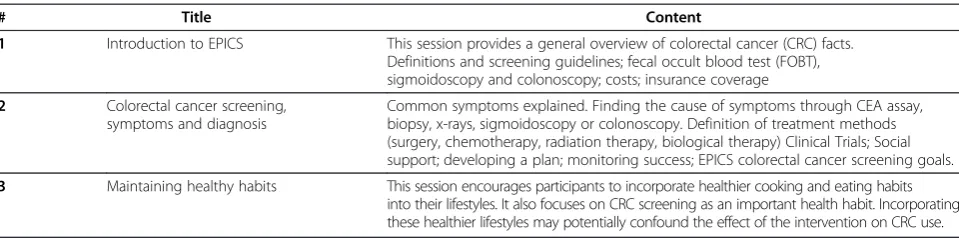
Methods determining EPICS’s reach included: establishing inclusion criteria and documenting exclusions, participa-tion rates, dropouts and representativeness; assessing size and characteristics of NBLIC community coalitions and church, clinical and community settings to determine barriers to participation (e.g., infrastructure, time, Table 1 EPICS sessions
# Title Content
1 Introduction to EPICS This session provides a general overview of colorectal cancer (CRC) facts. Definitions and screening guidelines; fecal occult blood test (FOBT), sigmoidoscopy and colonoscopy; costs; insurance coverage
2 Colorectal cancer screening,
symptoms and diagnosis
Common symptoms explained. Finding the cause of symptoms through CEA assay, biopsy, x-rays, sigmoidoscopy or colonoscopy. Definition of treatment methods (surgery, chemotherapy, radiation therapy, biological therapy) Clinical Trials; Social support; developing a plan; monitoring success; EPICS colorectal cancer screening goals.
priorities, etc.); assessing the proportion of eligible par-ticipants (African American, age 50 to 74, either gender) per setting consenting participation; documenting the number of community coalitions by characteristics; de-scription of settings (total number of eligible partici-pants); and estimating the number of eligible individuals and completers of EPICS sessions per setting. Propor-tion of eligible community coaliPropor-tions and settings aware of EPICS will be calculated and two-group t tests and chi-square tests to compare those aware versus not aware will be completed. Analysis of variance will compare the degree of change in EPICS awareness among leaders of community coalitions and settings and the increase in post intervention CRC screening knowledge scores will be determined using a pairedttest.
Effectiveness
To determine effectiveness, investigators will: compare CRC screening rates of passive and active dissemination ap-proaches by setting; examine baseline/post CRC screening rates (community coalition catchment area) and compare baseline/post CRC knowledge attitudes; and beliefs of facili-tators (training) and participants (EPICS sessions). Effect size will be computed by subtracting mean CRC screening rates in communities aware and not aware of EPICS di-vided by the pooled standard deviation of CRC screening rates. The proportion of community coalitions and settings aware of EPICS (effectiveness-organizational level) and that deliver it (adoption) will also be determined.
Adoption
In evaluating adoption, methods include: determining EPICS fit, cost, level of resources and expertise and simi-larity to current programs; estimating adoption rate (pro-portion of community coalitions trained that implement EPICS); and documenting reasons for not adopting EPICS (time, total membership or infrastructure, partnerships, program priorities). Descriptive statistics will be used to provide insight into organizational and individual reasons for (not) adopting EPICS. Differences between community coalitions adopting and not adopting EPICS and differ-ences between facilitator characteristics will be analyzed using independent samplettests and chi-square tests. Implementation
To evaluate EPICS implementation, the following methods will be employed: train and certify facilitators to deliver educational sessions; implement marketing strategies to enhance visibility; provide on-going technical assistance (TA) to organizations and settings; determine adherence to implementation protocol by passive and active dissemin-ation sites; estimate total number of completers; conduct one-and-one-half day training guided by three modules: principles, procedural and practical knowledge; distribute a
monthly newsletter, provide promotional flyers and posters to community coalitions and settings; conduct one-hour monthly teleconferences; assess the nature and quality of TA; measure level of fidelity to delivering sessions as devel-oped; and determine total number of individuals complet-ing the three educational intervention sessions. Descriptive statistics will determine differences in facilitator character-istics, knowledge, attitudes, and beliefs and level of satisfac-tion with training, the most effective marketing strategies, reasons for not implementing components, duration, and investment and differences facilitator demographic char-acteristics: education, gender, profession, insurance status, etc. Logistic regression analysis will evaluate variations in the effects of implementation barriers among community coalitions, settings and individual participants.
Maintenance
To evaluate the final construct in the RE-AIM framework, the following methods will be completed: determine per-cent of community coalitions indicating that EPICS will become standard practice; measure program feasibility, in-cluding cost, time, and human resources for program im-plementation; determine if EPICS facilitator training and curriculum is offered to additional settings; investigate the extent to which EPICS is integrated into community coali-tion planned activities; measure enablers and barriers to continued EPICS implementation and plans to continue or ‘intent’to offer; determine number of clusters and settings who had once offered EPICS but stopped; and determine the extent to which churches, clinical providers and com-munity sites continue EPICS sessions post-implementation. Logistic regression analysis will evaluate variations in the effects of implementation barriers among community coali-tions and settings. Descriptive statistics will determine set-ting by type and number compleset-ting facilitator training.
Trial timeframe
37–54) will be dedicated to assessing EPICS maintenance. The final six months (54–60) will be reserved for data ana-lysis, publications, and reporting.
Trial status
The EPICS cRCT completed its pilot phase February 28, 2013. The Implementation Phase will begin May 1, 2013.
Discussion
Implementing EPICS in partnership with community coa-litions, we hypothesized, will result in more rapid adoption than traditional top-down approaches, and that changes in community CRC screening practices are more likely to be sustainable over time. With its national reach, this study has the potential to enhance our understanding of barriers and enablers to the uptake of educational programs aimed at eliminating cancer health disparities.
Glasgowet al.at the National Institutes of Health (NIH) have stated: ‘there is a need for research testing ap-proaches to scaling up and sustaining effective interven-tions’ [25]. This project will help address that need and will focus on the five core values cited by Glasgowet al.: rigor and relevance, efficiency, collaboration, improved capacity, and cumulative knowledge. Regarding the first, the project will utilize the rigorous research methods re-quired of NIH-funded studies; but of equal importance, it will test dissemination in settings that are similar to those in communities across the country, where they often serve African Americans. The project is efficient in that it tests several settings simultaneously. It involves widespread col-laboration through its reliance on community coalitions that are comprised of healthcare professionals, business people, lay advocates, cancer survivors, and others. The project is building improved capacity in these coalitions; as a consequence, they will be prepared to participate in other cancer prevention studies in the future. The project is the product of cumulative knowledge developed through the original community intervention trial, the local practice demonstration, and the statewide initiative. These multiple iterations made possible the current study. The current study should be the last iteration; at its conclusion, EPICS will be positioned to become a part of standard health pro-motion practice.
Abbreviations
ACS:American Cancer Society; BRFSS: Behavioral Risk Factor Surveillance System; CCSIT: Colorectal Cancer Screening Trial; CDC: Centers for Disease Control and Prevention; CRC: Colorectal cancer; cRCT: Cluster randomized controlled trial; EPICS: Educational Program to Increase Colorectal Cancer Screening; DNA: Deoxyribonucleic acid; FOBT: Fecal occult blood test; GCC: Georgia Cancer Coalition; GEE: Generalized Estimating Equation; H1: Hypothesis one; H2: Hypothesis two; H3: Hypothesis three; ICER: Incremental Cost Effectiveness Ratios; IP: In-person; IRB: Institutional Review Board; MOU: Memorandum of Understanding; MSM: Morehouse School of Medicine; NBLIC: National Black Leadership Initiative on Cancer; NCI: National Cancer Institute; RCCG: Regional Cancer Coalitions of Georgia; RE-AIM: Reach, Effectiveness, Adoption, Implementation, Maintenance;
RTIPs: Research Tested Intervention Programs; TA: Technical assistance; WA: Web-access.
Competing interests
Both authors declare that they have no competing interests.
Authors’contributions
SAS and DSB, both principal investigators, conceived the study and acquired funding; SAS wrote the first draft of the manuscript. DSB refined the draft and completed the discussion section. Both authors advised on theoretical and methodological issues, providing ongoing critique and have approved the final version of the manuscript.
Acknowledgements
This work is funded by the National Cancer Institute (1R01CA166785-01 and 5U54CA118638-07). We wish to acknowledge the contributions of the Morehouse School of Medicine, EPICS Coordinating Center (Joyce Sheats, Larry Johnson, Ernest Alemah-Mensah and Rebecca Cabrera), Cancer Research Program (Wonsuk Yoo) and University of Alabama at Birmingham investigators (Michelle Martin, Maria Pisu and Robert Oster). We also acknowledge the contributions of the NBLIC Community Coalitions partnering with us to conduct this trial.
Received: 3 May 2013 Accepted: 1 August 2013 Published: 7 August 2013
References
1. American Cancer Society:Colorectal cancer.2013 [http://www.cancer.org/ cancer/colonandrectumcancer/index]
2. Guide to community preventive services.[http://www.thecommunityguide.org/] 3. CDC behavioral risk factor surveillance system prevalence and trends data.
[http://apps.nccd.cdc.gov/brfss/page.asp?cat=CCandyr=2009andstate=UB#CC] 4. NIH State-of-the-Science Conference:Enhancing use and quality of colorectal screening February 2–4, 2010.[http://consensus.nih.gov/2010/images/colorec tal/colorectal_panel_stmt.pdf.]
5. SEER fact sheets: colon and rectum.[http://seer.cancer.gov/statfacts/html/ colorect.html.]
6. Blumenthal DS, Smith SA, Majett C, Mensah E:Impact of three interventions on colorectal cancer screening rates among African Americans.Cancer2010,116:922–929.
7. Israel BA, Schulz AJ, Parker EA, Becker AB:Review of community-based research: assessing partnership approaches to improve.Public Health Ann Rev1998,19:173–202.
8. Guide to community preventive services.[http://www.thecommunityguide. org/cancer/screening/default.htm]
9. Smith SA, Blumenthal DS:Community health workers support community-based participatory research ethics: lessons learned along the research-to-practice-to-community continuum.J Health Care Poor Underserved2012,23(Suppl):77–88.
10. Smith SA, Johnson L, Wesley D, McCray G, Sheats J, Blumenthal DS: Translation to practice of an intervention to promote colorectal cancer screening among African Americans.Clin Transl Sci2012,5(5):412–415. 11. Sullivan LW, Jackson F, Sheats JQ, Smith SA:History of NBLIC.
Minority Health Today2000,2:1.
12. Moher D, Schykz K, Altman D:The CONSORT statement: revised recommendations for improving the quality of reports of parallel group randomized trials.BMC Med Res Methodol2001,1:2.
13. Glasgow RE, Marcus AC, Bull SS, Wilson KM:Disseminating effective cancer screening interventions.Cancer2004,101(5 Suppl):1239–1250.
14. Merriam SB, Caffarella RS:Learning in adulthood: a comprehensive guide.
San Francisco: Jossey-Bass; 1998.
15. Bero LA, Fgilli R, Grenshaw JM,et al:Closing the gap between research and practice: an overview of systematic reviews of interventions to promote the implementation of research findings.BJM1998, 317:465–468.
16. Rogers EM:Diffusion of innovations.New York: Free Press; 1995. 17. Graham ID, Tetroe J:KT theories research group some theoretical
underpinnings of knowledge translation.Acad Emerg Med2007, 14(11):936–941.
intervention across patient characteristics, healthcare settings, and intervention staff.Am J Manag Care2006,12(3):137–145.
19. Akers L, Gordon JS, Andrews JA, Barckley M, Lichtenstein E, Severson HH: Cost effectiveness of changing health professionals’behavior: training dental hygienists in brief interventions for smokeless tobacco cessation. Prev Med2006,43(6):482–487.
20. Kim AE, Towers A, Renaud J, Zhu J, Shea JA, Galvin R, Volpp KG:Application of the RE-AIM framework to evaluate the impact of a worksite-based financial incentive intervention for smoking cessation.J Occup Environ Med2012,54(5):610–614.
21. van Acker R, de Bourdeaudhuij I, de Cocker K, Klesges LM, Cardon G:The impact of disseminating the whole-community project’10,000 Steps’: a RE-AIM analysis.BMC Publ Health2011,11:3.
22. Ukoumunne OC, Gulliford MC, Chinn S, Sterne JA, Burney PG:Methods for evaluating area-wide and organization-based interventions in health and health care: a systematic review.Health Technol Assess1999,3:92. 23. Bopp M, Wilcox S, Laken M, Hooker SP, Saunders R, Parra-Medina D,et al:
Using the RE-AIM framework to evaluate a physical activity intervention in churches.Prev Chronic Dis2007,4:4.
24. Collard DC, Chinapaw MJ, Verhagen EA, van Mechelen W:Process evaluation of a school based physical activity related injury prevention programme using the RE-AIM framework.BMC Pediatr2010,10:86. 25. Glasgow RE, Klesges LM, Dzewaltowski DA, Estabrooks PA, Vogt TM:
Evaluating the impact of health promotion programs: using the RE-AIM framework to form summary measures for decision making involving complex issues.Health Educ Res2006,5:688–694.
doi:10.1186/1748-5908-8-86
Cite this article as:Smith and Blumenthal:Efficacy to effectiveness transition of an Educational Program to Increase Colorectal Cancer Screening (EPICS): study protocol of a cluster randomized controlled
trial.Implementation Science20138:86.
Submit your next manuscript to BioMed Central and take full advantage of:
• Convenient online submission
• Thorough peer review
• No space constraints or color figure charges
• Immediate publication on acceptance
• Inclusion in PubMed, CAS, Scopus and Google Scholar
• Research which is freely available for redistribution