R E S E A R C H
Open Access
Patient perceptions of foot disability in
Juvenile Idiopathic Arthritis: a comparison of
the juvenile arthritis foot disability index and
the Oxford ankle foot questionnaire for children
Jill Ferrari
1,2Abstract
Background:The Juvenile Arthritis Foot Disability Index (JAFI) and the Oxford Ankle Foot Questionnaire for Children (OxAFQ-C) are two region-specific paediatric outcome tools that measure the impact on well-being in children with foot pathology. The aim of this study was to establish the level of agreement between the JAFI and the OxAFQ-C in a group of children diagnosed with Juvenile Idiopathic Arthritis (JIA).
Methods:Children with JIA accessed the questionnaire via a website. The OxAFQ-C questionnaire and the JAFI questionnaire were combined into one document consisting of 42 statements with Likert-scale responses. A further question regarding duration of disease was added. On completion, the web-linked questionnaire was returned by e-mail.
Results:Thirty five participants were included. Individual domain and composite score analysis was undertaken. The JAFI participation domain was compared to the OxAFQ-C school domain and showed no significant difference between the median scores of each participant (z = -1.33,p= 0.181). The JAFI activity and the OxAFQ-C physical domains were compared and showed that a significant difference between the median scores existed (z = -4.29, p< 0.001). Agreement between the two PROMs was tested using Bland Altman Levels of Agreement based upon the percentage summed composite scores. Levels of agreement between the scores were considered to be poor based on the Bland Altman plot, despite a low mean difference in scores (mean difference = -3.88, SD of difference = 9.93, p= 0.027). Pearson correlation was undertaken to measure the relationship between the summed composite score and disease duration. No relationship was found (JAFI: r = -0.08,p= 0.672; OxAFQ-C: r = 0.037,p= 0.871).
Conclusions:This study has shown that despite some agreement between the individual domains, overall there is poor agreement between the OxAFQ-C and the JAFI percentage summed composite scores. The study is not able to determine if one score is superior to the other but both scores could be of value when used in this population.
Keywords:Juvenile idiopathic arthritis, Patient related outcome measures, Foot disability
Correspondence:[email protected]
1Department of Health, Sport & Bioscience, University of East London,
Stratford, London E15 4LZ, UK
2Department of Paediatric Rheumatology, Hospital for Sick Children, Great
Ormond Street, London WC1, UK
Background
The podiatrist is likely to encounter arthritic conditions that impact on the feet. Those practitioners treating paediatric foot problems on a regular basis will be famil-iar with Juvenile Idiopathic Arthritis (JIA) which has a prevalence of approximately 1 in 1000 children in the UK [1]. JIA is known to affect foot joints and other syn-ovial structures causing pain, changes in joint position and functional limitations [2, 3]. As with any arthropathy which affects the foot, it is helpful to determine the im-pact of the foot problems on the individual. Often, this is determined by simply asking the patient about the foot issues that are of importance to them and returning to these difficulties on follow up appointments, but be-ing a subjective process and influenced by many factors, this method is not ideal. With the development of out-come measures that have been shown to be valid, reli-able and sensitive to change, an objective measurement of the impact of the disease on the patient’s well-being is now possible. Validated patient reported outcome mea-sures (PROMs) provide quantifiable data as well as the potential to identify a meaningful change in the condi-tion of the patient. Such PROMs determine the patient’s perception of their foot problems across various aspects of their life. Understanding the patient’s perception al-lows the treatment to be patient-centred ensuring that the patient drives a goal-orientated approach to the management strategy. Utilising such validated PROMs also allows for ethical and rigorous clinical governance or research. Within podiatry, regional PROMs such as the Foot Function Index (FFI), Foot Health Status Ques-tionnaire (FHSQ) and the Manchester Oxford Foot Questionnaire (MOXFQ) are well known, but these are tools designed to be used with adult patients; children will need outcomes that relate specifically to their daily activities, such as attending school and being able to play. Only two paediatric outcome tools are available that are region-specific and thus measure the impact on well-being of foot pathology in children. One tool is spe-cific to JIA - the Juvenile Arthritis Foot Disability Index (JAFI); the other is a generic tool - the Oxford Ankle Foot Questionnaire for Children (OxAFQ-C). The JAFI was developed in Sweden and the item content was chosen by two physical therapists working in the field, and based on the Foot Function Index and the Sundbom Arthritis Foot Evaluation Index [4]. A sample of seven children and 7 adolescents and their parents reviewed the content of the questionnaire and adjustments were made. Following this, 15 children and adolescents were used in the testing of construct validity, sensitivity and specificity, ceiling and floor effects and reliability. The small sample size involved in the development of the questionnaire limits the robustness of the JAFI. Con-struct validity was tested by comparing each domain
with a different questionnaire. For example, the well-recognised and validated Child Health Assessment Questionnaire (CHAQ) was used to test construct valid-ity of the activvalid-ity domain. However, the other domains were tested against scales that were made up by the re-searchers and which thus were not previously validated, undermining the construct validity of the JAFI. Reliabil-ity was tested by the small JIA sample being tested a week apart. Reliability of each domain was good, with kappa scores > 0.88, however reliability of individual statements was moderate to poor with the authors consid-ering that the individual scores were impacted by emo-tional changes of the individual. No ceiling or floor effects were noted. The final questionnaire included 27 statements separated into three domains representing “Impairment”,
“Activity Limitation”and“Participant Restriction”. Each of the included statements are answered using a Likert scale graded from Never, Occasionally, Sometimes, Frequently, Always and scored from 0 to 4 respectively so that a high score represents marked impact. The median value for each domain is found and used to identify the impact for each separate area; a composite total score is not sug-gested. The authors note that the translation of the ques-tionnaire from the original Swedish language has not been validated and sensitivity to change has not been tested.
impact. The OxAFQ-C consists of 15 statements sepa-rated into “School and Play”, “Physical” and “ Emo-tional”domains. A median score is also determined for each domain but the data generated has also been summed for each domain and converted to a percent-age score giving mean data for each domain [6]. Again, computing a total composite score is not suggested and as with the JAFI, thresholds for severity have not been published. Minimal detectable change (MDC) has been calculated for the OxAFQ-C and the MDC(90) based upon the 90 % confidence intervals and the standard error of the mean suggested that a value of 6-8 percent-age points would indicate change beyond measurement error [6].
Although neither the JAFI nor the OxAFQ-C was de-veloped to be applied as a composite score, a similar adult score - the MOXFQ - has recently researched the use of its domain-based scores as a single composite score [7]. Preliminary research suggests that the single composite score does correlate with other measures of disease impact on well-being and that the benefit of the composite score is that, when used in research studies, it reduces the number of statistical comparisons needed to be performed (unlike testing the individual domains) which in term reduces the role of chance on the hypoth-esis testing, as well as giving an insight into the overall impact of the condition, with the single figure being eas-ier to interpret than the three individual domains [7].
Although the JAFI should be superior to the OxAFQ-C in children with JIA due to including statements within the questionnaire that focus on the subtleties of the disease, there are in fact only three disease-specific statements: presence of morning stiffness, pain in the morning and presence of joint swelling. Having 27 statements does mean that completion of the score is time-consuming in a clinical setting. Despite the rela-tively large number of statements, there is some sug-gestion that the JAFI may have a floor-effect, not being sufficiently sensitive to recognise very mild disease ac-tivity [2] although a more recent study did find that the JAFI identified mild-moderate impairment when mild disease activity was present [8]. The OxAFQ-C has evi-dence to support it as a robust tool to use in paediatric foot problems but whether it can capture the impact of JIA on the feet is not known.
The aim of this study was therefore to establish the level of agreement between the JAFI and the OxAFQ-C in a group of children diagnosed with JIA. This was undertaken using Bland Altman Levels of Agreement [9]. This study also reports the comparisons of medians between the scores for the best matched domains across the questionnaires, although it is recognised that there is no exact match for the domains. Association with dis-ease duration was also considered.
Methods
The Children’s Chronic Arthritis Association (CCAA) is a UK registered charity providing a national support net-work for children with JIA and their families. Permission was granted by the CCAA to access children with JIA via their website for this questionnaire-based study. Use of the OxAFQ-C requires permission from ISIS Out-comes at the University of Oxford, and this was granted. Following ethical approval from the University of East London’s School of Health, Sport and Bioscience ethics committee, recruitment of children with JIA was under-taken through the CCAA website. The study was adver-tised on the CCAA website inviting children and parents to participate. A web-link was provided on the CCAA site which linked to the study website, allowing access to study information and consent forms. Following submis-sion of consent forms and receipt of information to en-sure the inclusion criteria (aged 5-16 years old, diagnosis of JIA made by a paediatric rheumatologist and includ-ing all subgroups of the disease) were met, the partici-pants were directed to the questionnaire pages on the website, powered by SurveyMonkey Inc.
The OxAFQ-C questionnaire and the JAFI question-naire were combined into one document consisting of 42 questions. The name of each questionnaire was re-moved but a break was placed between questionnaires and the participants were invited to take a short rest be-tween the completions of each questionnaire if needed. A further question regarding duration of disease was added to the end of the questionnaire to provide add-itional information. The questionnaires are appropriate for children to complete alone but parents were asked to supervise the completion and assist as good language skills were required.
To prevent incomplete questionnaire submission, the facility on SurveyMonkey was utilised whereby only full completed questionnaires could be submitted. Com-pleted questionnaires were downloaded and returned via e-mail. All were anonymised prior to data extraction.
Data analysis Domain analysis
was partnered with the most similar domains in the OxAFQ-C and differences between the domain pairs were considered using Wilcoxon matched-pairs signed-ranks tests.
Composite ccore analysis
The data were also considered using the actual summed composite score and the percentage summed composite score. As the summed score for the JAFI is up to a max-imum of 108, and the summed score for the OxAFQ-C is up to 60, the data from each score was converted to a percentage score so that each questionnaire had the same unit value. The level of agreement between JAFI and OxAFQ-C scores was assessed using the method de-scribed by Bland and Altman considering the mean dif-ference and the 95 % levels of agreement calculated from the standard deviation (1.96*SD of mean differ-ence) [9]. Pearson’s correlation was also used to test for associations between the JAFI and OxAFQ-C percentage composite scores. The questionnaires use a Likert scale to generate the score which is not continuous data as re-quired in Pearson’s correlation, however when each question is totalled to form the actual or percentage summed composite score, the data becomes interval data and thus the assumptions of the Pearson’s correl-ation are met.
Normality testing determined that the actual summed composite scores and disease duration data were nor-mally distributed thus parametric testing of associations between questionnaires’actual summed composite score and duration of disease was tested using Pearson’s correlation.
Results
A total of 35 participants were entered into the study (age range 6 to 16 years). All were diagnosed with JIA, having had the disease for a mean of 4.7 years (range 1 to 11 years). The inclusion criteria was clear on the web-site and subjects self-assessed that they met these before submitting consent forms. The number of subjects being excluded after consent was not recorded.
Domain analysis
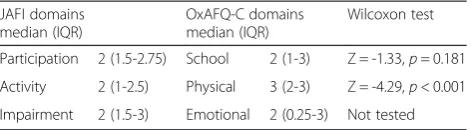
The median score (and interquartile range) is presented for each of the domains for each questionnaire (see Table 1). Although the JAFI domains and the OxAFQ-C domains were not entirely alike since questions across the domains were not identical, the scores for the JAFI participation domain versus the OxAFQ-C school do-main, and the JAFI activity domain versus the OxAFQ-C physical domain were considered to be addressing simi-lar themes and were compared directly using the Wil-coxon matched-pairs signed-ranks test. The impairment and emotional domains were not compared due to
marked differences in questions being included in each. The JAFI participation domain and the OxAFQ-C school domain had questions in common that related to school activities and analysis revealed no significant difference between the median scores of each partici-pant (z = -1.33, p= 0.181). The JAFI activity and OxAFQ-C physical domains had questions in common that related to difficulty in walking but analysis showed that a significant difference between the median scores existed (z = -4.29,p< 0.001).
Composite score analysis
The maximum value for the actual summed composite score for the JAFI (27 statements) is 108; for the OxAFQ-C (15 statements) the maximum value for the actual summed composite score is 60. For the 35 par-ticipants, the JAFI mean actual summed composite score was 52.74 (SD = 20.69) and the mean percentage summed composite score was 48.84 (SD = 19.15). For the OxAFQ-C the mean actual summed composite score was 31.63 (SD = 11.39) and the mean percentage summed composite score was 52.71 (SD = 18.99).
Agreement between the two scores was tested using Bland Altman Levels of Agreement based upon the per-centage summed composite scores. The Bland-Altman plot (Fig. 1) shows a wide spread of the data with several values close to or just beyond the upper and lower 95 % levels of agreement (ranging from -23.34 to 15.58 percent-age points). This identifies that the agreement between the scores was generally poor with agreement between the scores frequently varying despite the fact that the mean difference was small (mean difference = -3.88, SD of differ-ence = 9.93,p= 0.027).
A Pearson’s correlation was undertaken between the two percentage summed composite scores which showed a strong association (r = 0.86, p< 0.001) but this method of analysis does not show agreement between methods.
Duration
The Kolmogorov-Smirnov Test for normality con-firmed the normality of the distribution of the data for the JAFI and OxAFQ-C actual summed composite score and the duration of diagnosis data (KS = 0.104 (p= 0.201); KS = 0.11 (p= 0.202); KS = 0.15 (p= 0.304) respectively). The Pearson correlation was undertaken
Table 1Comparison of median scores across the domains between the two questionnaires
JAFI domains median (IQR)
OxAFQ-C domains median (IQR)
to measure the association between the summed total score and disease duration. No association was found (JAFI: r = -0.08,p= 0.672; OxAFQ-C: r = 0.037,p= 0.871). Fig. 2 demonstrates the lack of a relationship between JAFI score and disease duration.
Discussion
The results have shown that there were varying results when median domain scores were compared between the JAFI questionnaire and the OxAFQ-C questionnaire. When domains were compared that contained questions
relating to similar activities, no significant difference in domain scores were seen. This was shown for the JAFI participation domain and OxAFQ-C school domain. The author had expected to find some agreement as the JAFI was used in the development of the OxAFQ-C. However there is limited usefulness in comparing across the do-mains between the questionnaires as there are clear dif-ferences in the themes being probed by the statements. For example, the OxAFQ-C has emotional-themed ques-tions in the emotional domain that considers areas such as being“bothered” by the way the individual walked or how their foot / ankle looked. Such areas are not ad-dressed in the JAFI in a comparable domain as the two emotional-themed statements (being worried or sad about foot problems) are included in the activity limita-tion domain alongside 11 activity-based queslimita-tions. Thus the QxAFQ-C emotional domain was not analysed against a JAFI domain in this study. The JAFI activity domain and the OxAFQ-C physical domain were also compared and a significant difference in the median re-sults was found suggesting that the questions asked in each domain were investigating different areas impacting on well-being.
Considering the PROMs from a more general view whereby all the questions are considered without being confined to domains but in a composite score, the study showed that there was a lack of agreement between the questionnaires. Although neither of the questionnaires’ authors suggest the use of a composite score, the OxAFQ-C has been used as a composite score in one
Fig. 1Bland-Altman Plot for Levels of Agreement for the percentage summed composite scores showing mean difference (red line) and 95 % limits of agreement (blue outer lines). Bland-Altman Plot for Levels of Agreement for the percentage summed composite scores showing mean difference (red line) and 95 % limits of agreement (blue outer lines)
previous study [10]. A similar questionnaire, the MOXFQ, has also recently been used as a composite score and this has been recognised as being an acceptable method [7]. The lack of agreement identified between the composite scores of the JAFI and the OxAFQ-C in this study sug-gests that there are sufficient differences in the two scores such that they are either measuring differing aspects of the perception of well-being through asking different questions or they are identifying different levels of percep-tion. The Bland Altman Levels of Agreement calculation identified a mean difference in summed composite scores of close to four percentage points. The determination of the level of agreement is based primarily on clinical judge-ment. On initial consideration a mean difference of four percentage between scores would seem to be acceptable clinically. However the Bland Altman plot allows visualisa-tion of how each participant’s scores varied. The plot shows that many participants (14 out of 35) had scores that were more than ten percentage points apart which this author felt would be beyond the clinical acceptability. Although made arbitrarily, this decision was based upon the suggested value of 6-8 percentage points which was the value for meaningful change (MDC) in score for the OxAFQ-C [6]. Several participants had scores with differ-ences close to two standard deviations beyond the mean difference, which is the recommended level used to dem-onstrate disagreement by Bland and Altman and thus overall, the scores were judged to give differing results. The use of the total composite score has not been investi-gated in the OxAFQ-C or the JAFI and although a per-centage composite score is recommended for each individual domain in the OxAFQ-C, combining all three domains into a single score may mask some important outcomes within the individual domains and“smooth”the overall outcome of the score. Whether this would account for difference between the scores identified in this study is unclear.
The Pearson correlation (r = 0.86) shows that there is a strong association between the scores such that when the JAFI score increases then the OxAFQ-C also increases despite the fact that individual percentage summed com-posite scores are different. The existence of this associ-ation does add strength to the construct validity of each questionnaire which is typically tested by comparing dif-fering questionnaires that test a similar theme.
The data collected in this study is not sufficient to, and did not aim to, identify which questionnaire best re-flects the impact on well-being of foot problems in JIA. There have been concerns in past studies that the JAFI was not sufficiently sensitive to identify mild disease having a “floor effect” [2] but since then other studies have shown a strong relationship between disease activ-ity and the JAFI [8, 11]. The JAFI should probably be favoured for use in the JIA population by virtue of the
questions that are specific to this condition, such as morn-ing stiffness, mornmorn-ing pain and the presence of joint swell-ing which should identify when the typical JIA foot pathologies of synovitis, tendinitis and enthesitis are present. But that is not to say that the OxAFQ-C is not useful as it is quicker to complete and has a focus on emo-tions that may be of value in the teenage population where issues of image can become increasingly important.
When considering the lack of agreement between the scores, the difference in the descriptors may also have played a role in the outcome of this study. Both ques-tionnaires used the descriptors of “never” and “always” to define the end points of the Likert scale, with“ some-times”as the centre value. But the JAFI used descriptors of“occasionally”and “frequently” to complete the range whilst the OxAFQ-C used “rarely” and “very often”. These could have been interpreted differently by the par-ticipant and thus lead to the differing scores that have been identified.
A point worth noting regarding the use of the JAFI is that in the activity limitation domain, the meaning of the Likert descriptors is reversed for 11 of the 13 state-ments. This occurs as the statements change their dir-ection of impact. In the impairment domain the statements are phrased so that the use of the response
“always”(score = 4) relates to a poor response so for ex-ample “I have morning stiffness in my foot/feet” - a child with a high impact would likely answer “always”. The phrasing changes in the activity impairment domain such that the response of “always”would indicate a good response so for example the statement reads“I can always take part in PE” –if the child answers“always”this would be a good response yet it would still score 4 points. In this study, the scoring was reversed to be consistent with other answers with a high score equating to a greater impact for all statements. Dekker et al [11] also noted this discrep-ancy and recommended that these questions are adjusted to give consistency across the score.
as a monitoring tool so that any deterioration in outcome beyond the minimally important difference can be recog-nised and acted on quickly.
Further work on identifying a threshold of impact for the questionnaires would also be useful, perhaps to form a range for“normal” –feet with minimal biomechanical dysfunction and inactive joint disease - through to more severe levels of impact. This would be useful so that the feet considered most at risk from the inflammatory process (with or without biomechanical complications) can be identified and followed closely but also so that any medical professional within the multidisciplinary team can apply the PROM and determine when treat-ment is indicated and referral to a foot specialist is needed.
Disease duration did not correlate with either ques-tionnaire score. It had been expected that those partici-pants with longer disease duration might show a greater impact of the disease on their feet through their actual summed composite score. However no association was seen and this has also been found in another study [12]. Disease duration is not an indication of disease activity since despite being diagnosed for a long time, the disease may be mild or destructive, well controlled or poorly controlled and this seems to be more dependent on dis-ease subgroup [13] and access to care [14] than dur-ation, thus disease duration was too crude to identify correlations, between severity and the actual summed composite scores, on well-being.
This study was subject to some methodological limita-tions which might be improved in future studies. As JIA is a condition that can flare and remit and transient pain might occur with increased physical activity, the two questionnaires did need to be complete within a short time of each other. For pragmatic reasons, in this study the questionnaires were completed together but because the process of answering 42 statements may have been arduous, there was the potential that the final statements would not be answered accurately. Using software such as SurveyMonkey does allow observation of the length of time that participants take to complete the question-naires. For this study, the average time for completion of all statements was 6.7 min (SD = 1.4 mins) which was not as long as anticipated. For future studies it might be useful to format the questionnaires in differing orders for each of the participants to reduce the impact of less care being taken on the final statements. Neither of the questionnaires’ authors reports the need to answer the questions in a set order but it is noted that the emo-tional statements are at the end of each questionnaire, after the subject has focused on the limitations caused by the condition. This might be important to prepare the subject for the emotional statements and thus re-arranging the statements to equalise the potential for
rushing the final statements might be inappropriate. The impact of both fatigue in answering questions and the order of the questions in questionnaires is well recog-nised [15].
Questionnaires such as the JAFI and OxAFQ-C which require the participants to remember events occurring only in the last week, are subject to limitations such as telescoping whereby the participant remembers more dramatic events as being more recent than they actually were. They are also subject to selective recall (confirm-ation bias) when subjects remember events with confirm the ideas they have already formed. Although these are examples of limitations affecting this type of question-naire, they are not expected to alter the outcome of the study as they should apply to both questionnaires equally.
There was some small chance that the inclusion cri-teria for the study were open to abuse. Although only publicised on the CCAA website, this is an open site and it is possible that people other than those with JIA may have chosen to enter the study, or those with JIA, but outside of the inclusion criteria may have entered. Within this study, no exclusion was made for other con-ditions that might affect the feet such as talipes, tarsal coalition or neurological conditions. Having JIA does not prevent other foot conditions coexisting and there-fore, in order to have a sample representative of the nor-mal JIA population, it was decided not to exclude these conditions despite the fact the these conditions are likely to affect the score for each questionnaire.
Both questionnaires are designed for the children from the age of 5 years old to answer on their own. This study did allow the parents to assist the child and therefore the parents may have influenced the outcome of the questionnaires, however it has been recognised that par-ents are able to rate the consequences of the disease on their child [16]. The decision to allow parents to help was taken as it was felt that the questionnaires were quite complex for the younger children and it also reflected the situation in clinic where even older chil-dren would ask parents to help determine the most appropriate answer. The parental influence on both questionnaires would be expected to be equal and there-fore not to impact on the results of this study.
Conclusion
normal population distributions for JIA for both ques-tionnaires, and future research is needed to identify min-imal clinically important difference and thresholds to identify severity.
Competing interests
The author declares that they have no competing interests.
Acknowledgement
The author would like to acknowledge A. Azid, J. Barr, D. Creditor and G. Kozal who undertook the data collection as part fulfilment of their BSc Podiatry degree at the University of East London. The author would like to thank the Children’s Chronic Arthritis Association for access to their membership through their website.
Received: 16 April 2015 Accepted: 23 August 2015
References
1. McGann LJ, Wedderburn LR, Hasson N. Juvenile idiopathic arthritis. Arch Dis Child Educ Pract Ed. 2006;91(2):ep29–36.
2. Hendry G, Gardner-Medwin J, Watt GF, Woodburn J. A survey of foot problems in juvenile idiopathic arthritis. Musculoskeletal Care. 2008;6(4):221–32. 3. Powell M, Seid M, Szer IS. Efficacy of custom foot orthotics in improving
pain and functional status in children with juvenile idiopathic arthritis: a randomized trial. Rheumatol. 2005;32(5):943–50.
4. André M, Hagelberg S, Stenström CH. The juvenile arthritis foot disability index: development and evaluation of measurement properties. J Rheumatol. 2004;31(12):2488–93.
5. Morris C, Doll H, Wainwright A, Davies N, Theologis T, Fitzpatrick R. The Oxford ankle foot questionnaire for children: review of development and potential applications. Prosthet Orthot Int. 2010;34(3):238–44.
6. Morris C, Doll H, Davies N, Wainwright A, Theologis T, Willett K, et al. The Oxford Ankle Foot Questionnaire for children: responsiveness and longitudinal validity. Qual Life Res. 2009;18(10):1367–76. 7. Morley D, Jenkinson C, Doll H, Lavis G, Sharp R, Cooke P, et al. The
Manchester-Oxford Foot Questionnaire (MOXFQ): development and validation of a summary index score.Bone Joint Res. 2013; 3;2(4):66-9. 8. Hendry GJ, Watt GF, Brandon M, Friel L, Turner DE, Lorgelly PK, et al. The
effectiveness of a multidisciplinary foot care program for children and adolescents with juvenile idiopathic arthritis: an exploratory trial. J Rehabil Med. 2013;45(5):467–76.
9. Bland JM, Altman DG. Statistical methods for assessing agreement between methods of clinical measurement. The Lancet. 1986; 327(8476):307–310. 10. Evans AM, Rome K, Peet L. The foot posture index, ankle lunge test,
Beighton scale and the lower limb assessment score in healthy children: a reliability study. J Foot Ankle Res. 2012; 9;5(1):1.
11. Dekker M, Hoeksma AF, Dekker JHM, van Rossum MAJ, Dolman KM, Beckerman H, et al. Strong relationships between disease activity, foot-related impairments, activity limitations and participant restrictions in children with juvenile idiopathic arthritis. Clin Exp Rheumatol. 2010;28:905–11.
12. Minden K, Niewert M, Listing J, Biedermann T, Bollow M, Schontube M, et al. Long-term outcome in patients with juvenile idiopathic arthritis. Arthritis Rheum. 2002;49(9):2392–401.
13. Packham JC, Hall MA. Long‐term follow‐up of 246 adults with juvenile idiopathic arthritis: functional outcome. Paediatr Rheumatol. 2002;41(12):1428–35.
14. Foster H, Rapley T, May C. Juvenile Idiopathic Arthritis: improved outcomes requires improved access to care. Rheumatology (Oxford). 2010;49:401–3. 15. Krosnick JA, Presser S. Question and Questionnaire design. In: Marsden PV,
Wright JD editors. Handbook of Survey Research. 2nd edn. Emerald Publishing Company. West Yorkshire, England; 2010. p.263–313. 16. Duffy CM, Arsenault L, Watanabe Duffy K. Level of agreement between
parents and children in rating dysfunction in juvenile rheumatoid arthritis and juvenile spondyloarthropathy. J Rheum. 1992;19 Suppl 33:28–31.
Submit your next manuscript to BioMed Central and take full advantage of:
• Convenient online submission
• Thorough peer review
• No space constraints or color figure charges
• Immediate publication on acceptance
• Inclusion in PubMed, CAS, Scopus and Google Scholar
• Research which is freely available for redistribution