R E S E A R C H
Open Access
A new technique for testing distribution of
knowledge and to estimate sampling sufficiency
in ethnobiology studies
Thiago Antonio Sousa Araújo
1, Alyson Luiz Santos Almeida
1, Joabe Gomes Melo
1,
Maria Franco Trindade Medeiros
1, Marcelo Alves Ramos
1, Rafael Ricardo Vasconcelos Silva
1,
Cecília Fátima Castelo Branco Rangel Almeida
2and Ulysses Paulino Albuquerque
1*Abstract
Background:We propose a new quantitative measure that enables the researcher to make decisions and test hypotheses about the distribution of knowledge in a community and estimate the richness and sharing of information among informants. In our study, this measure has two levels of analysis: intracultural and intrafamily.
Methods:Using data collected in northeastern Brazil, we evaluated how these new estimators of richness and sharing behave for different categories of use.
Results:We observed trends in the distribution of the characteristics of informants. We were also able to evaluate how outliers interfere with these analyses and how other analyses may be conducted using these indices, such as determining the distance between the knowledge of a community and that of experts, as well as exhibiting the importance of these individuals’communal information of biological resources. One of the primary applications of these indices is to supply the researcher with an objective tool to evaluate the scope and behavior of the collected data.
Keywords:quantitative indices, selection of informants, outliers, intentional samplings
Introduction
Over the past several years, especially since the 1990s, many techniques for the quantitative analysis of tradi-tional botanical knowledge have been proposed. Perhaps some of the most popular techniques are the use value proposed by Phillips and Gentry [1,2] and the relative importance proposed by Bennett and Prance [3]. In gen-eral, these proposals are within the scope of a set of techniques (referred to as the “consensus of infor-mants”) aimed at assessing the relative importance of a given resource using the consensus of the informants’ responses. A set of techniques that is less popular but has long been the subject of discussion was proposed to assess the so-called“cultural importance”of a resource
(plants, for example); this set was labeled in its general-ity as “subjective allocation techniques” [4,5]. The sub-jective allocation techniques have been harshly criticized because the researcher must compute, according to his vision, priority scores in order to assign importance to a resource. Today, over 80 different techniques incorpo-rate computations that appear to have the same goals. Medeiros et al. [6] as certain that many new technical proposals do not actually introduce new features but serve only to inflate the literature; their creation is unnecessary, due to their redundancy. A general analysis shows that the vast majority of these indices are intended to assign importance to a given biological resource
We analyze the degree to which people from the same family nucleus or unit share knowledge about useful species as a proxy for this investigation. Numerous eth-nobotanical studies have proposed quantitative analyses based on the“Consensus of Informants”, i.e., the degree
* Correspondence: [email protected]
1Departamento de Biologia, Área Botânica, Laboratório de Etnobotânica
Aplicada, Universidade Federal Rural de Pernambuco, Rua Dom Manoel de Medeiros s/n, Dois Irmãos, Recife, Pernambuco 52171-030, Brazil Full list of author information is available at the end of the article
to which the informants of a community share informa-tion on the use of specific resources e.g., [7,8]. For example, when opting to collect information only from one family member or from a sampling of the commu-nity, logistical constraints may prevent that researcher from collecting the entirety of the family or commu-nity’s available information.
This can occur because there is a diversity of knowl-edge regarding biological resources see [8,9], and differ-ences in knowledge may be a consequence of the role and activities that each social actor plays in their com-munity or family, as well as the level of specialization needed to attain knowledge of certain features [8,10]. Sometimes, this makes it necessary to interview people at different positions in the social structure of a commu-nity until no new information is mentioned to the researcher [11]. Because the “knowledge can also be idiosyncratic, randomly distributed, shared within a sub-group, or contested by two or more different groups that‘know’different things” [12]. Hence,
1. People inside the same family nucleus or commu-nity may have considerably different knowledge of the richness of useful resources due to learning processes associated with their social position.
2. People inside the same family nucleus or commu-nity do not always communicate to other members about the use of a specific biological resource. Such communication will depend on several factors but is especially related to the uses of that resource (e.g., medi-cine, food, fuel and construction).
Depending on their research objectives and the finan-cial and time resources available to execute them, eth-nobiology studies can be oriented towards different types of informants. These informants may be chosen according to criteria such as age (e.g., children, adoles-cents and adults), gender, local recognition of expertise (i.e., people with increased knowledge about specific subjects) and generalist knowledge (i.e., people from the community or region who are not experts) and social roles (e.g., shamans and heads of families) when it is not possible or desirable to obtain the participation of the whole population. Commonly, researchers opt to con-duct interviews with heads of families (one for each family unit e.g., [13-16]) to optimize the efficiency of their fieldwork based on the assumption, which is often not clearly explained by the researchers, that these indi-viduals represent the knowledge of their family unit.
Modern ethnobiology studies face concerns of over sample sufficiency and, consequently, the representative-ness of collected information [17,18]. Numerous researchers have attempted to solve these issues by importing tools from other disciplines, such as rarefac-tion curves and species-area curves from ecology [19-22]. These efforts attempt to estimate whether the
sampling conducted in a study is sufficient to meet the representativeness criteria. Nevertheless, depending on how the authors use or interpret a specific procedure, the definition of the stability of a curve may be rendered arbitrary through subjective analysis. Peroni et al. [18] defend the use of ecological methods in ethnobotanical and ethnobiological investigations, stating that they enable “evaluation of sampling effort, comparability among sets of data obtained in different regions, the pos-sibility of objectively analyzing the distribution of ethno-botanical and ethnobiological knowledge, the possibility of applying ethnobotanical and ethnobiological studies for preservation programs, the possibility of integrating ethnobotanical and ethnobiological data and data of an ecological and biological character, and the possibility of evaluating biological and cultural standards“.
We propose a new quantitative measure that enables the researcher to make decisions and test hypotheses about the distribution of knowledge in a community and estimate the richness and sharing of information among informants. In our study, this measure has two levels of analysis: intracultural and intrafamily.
Although a broad range of quantitative indices are identified in the literature of ethnobiology, particularly indices that evaluate the consensus among informants regarding a biological resource, the creation of a new model was necessary due to the lack of simple techni-ques that can respond to issues raised in this study and the lack of indices that are able to evaluate the unique-ness of information. Our indices measure the consensus among people regarding their knowledge and its unique qualities. Two features make our approach distinctive; the first feature is the fact that the focus is placed on people and the knowledge that they possess. Another distinctive aspect is the sharing of information and the quality of uniqueness; indeed, uniqueness and the shar-ing of knowledge are rarely considered among the exist-ing indices.
Materials and methods Study area
and reproductive biology of native species [31,32]. Images of the study area are available at: https://picasa-web.google.com/etnobotanicaaplicada/
CaraoAltinhoPernambucoNordesteBrasil
vegetables supply daily family needs for food and health care. Moreover, individuals in the community use native and/or exotic plants for a number of purposes, including medicine, food, fuel, construction and fencing, foraging and veterinary medicine [24,29,32].
Ethnobotanical Inventory
The objectives of this study were explained to both of the legal representatives of the municipality (the mayor and the secretary of agriculture and food supply) and at a monthly event open to the community to achieve representativeness from the public. We used this event to explain the procedures and aims of the research. Additionally, we requested permission to visit their homes. We conducted data collection in each house of the community. In this study, we are referring to each home as a family unit. In each house, we interviewed at least two people (usually members of a couple). Two brothers living in different houses were considered to be members of distinct families. From this data set, we composed two samples for analysis. The first sample consisted of an analysis of intrafamily plant knowledge, i.e., we sought to understand how knowledge is shared within the same family unit. For the second sample, we reorganized the data in order to perform an intracul-tural analysis. Thus, our two data sets were the family unit (intrafamily) and the community (intracultural).
Only people who were 18 years old or older were included among our sample informants. This age group was chosen because these individuals could legally account for their actions and using underage partici-pants would require parental permission, which could make the study unfeasible. To access how discrepant data in a sample can influence the results, we performed our analyses considered the presence and absence of informants as outliers.
In addition, we analyzed the effect of outliers on data interpretation when their knowledge was compared to other community members. In this study, outliers are defined as informants with significant knowledge about a specific subject and/or category of resource use that distinguishes them from the group to which they belong.
With the support of community health agents, all dences were visited, and we explained the study to resi-dents to confirm their participation. Confirmation was attained by having them sign an informed consent form (ICF) [24] according to ruling 196/96 of the National Health Council. This research was authorized by the ethics in research committee from Universidade Federal de Pernambuco, under number 238/06.
The survey of ethnobotanical data was conducted in three consecutive stages. First, a survey regarding knowl-edge and/or uses of plants for medicinal, food, and/or
fuel purposes was conducted using the free-list techni-que [16]. Afterwards, a semi-structured interview was conducted [16] to record socioeconomic data. Finally, the guided tour technique was used [16] to enrich the list of cited plants and to collect vegetable material for incorporation into an herbarium. These plants were pre-served and identified through comparisons with material in existing herbariums, consultations with experts, and references in specialized literature. Exsiccates were deposited at the Professor Vasconcelos Sobrinho Her-barium (PEUFR) in the Biology department of Pernam-buco Federal Rural University.
Preparation of data
A binary matrix was constructed that contained the record of citation for each species (Si) known to each informant (Ii) for each category of use (medicinal, food, or fuel).”).
We focused only in three categories of use (medicinal, food, or fuel) because they are most common in the eth-nobotany literature. Based on these data, the knowledge richness and uniqueness index (KRI) and the knowledge sharing index (KSI) were calculated. A description of how these indices were calculated is provided below.
Mathematical Background
We used two quantitative measures, the knowledge rich-ness index (KRI) and the knowledge sharing index (KSI), to calculate how the richness of Nsknown species are
distributed and shared among Niinformants inside the
same family unit or throughout the community.
KRI measures the knowledge richness and uniqueness of a specific set of plants by a certain individual. The index tends to assume smaller values with a larger rich-ness and a higher number of exclusive plants cited by a determined informant. KRI values are inversely propor-tional. In other words, a lower KRI value corresponds to the greater knowledge of the informant.
The KRI assumes values starting from zero and repre-sents a distance measure that ranges from 0 to infinity. The more distant from zero the value presented by a determined informant, the smaller that the richness of a species known by that informant inside the family nucleus or group will be: 1/ = KRIJ2
i where: Ji= Ri/Rfi
Ri- Record of species (Si) cited by informant (Ii);
Rfi- Total record of species (Si) cited by the family or
community (fi).
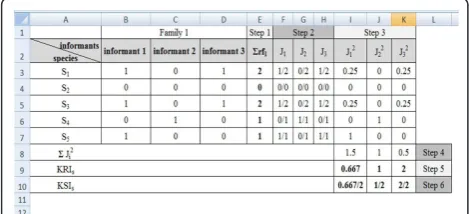
informant (Ii) (Figure 2). The steps in this process are as
follows:
1. The sum of records of use (or cited) was calculated for the species (Si) in the family unit or community (fi): Rfi (Figure 2 - step 1);
2. Ji was calculated as the ratio between the use of a
species (Si) recorded by the informant (Ii) and the sum
of records of use for the species (Si) in the family or
community (fi) (data obtained in step 1): Ji= Ri/Rfi
(Figure 2- step 2);
3. Ji2 was calculated for each species (Si) cited by the
informant (Ii) (Figure 2- step 3);
4. We carried out the sum of Ji2 values for all species
(Sn) cited by the informant (Ii): J2i (Figure 2 - step 4);
5. Finally, we calculated the KRI as follows: KRIs= 1/J2i
In this step, we note that the KRI is inversely propor-tional to the wealth of knowledge of the informant; in other words, the higher the Ji2 (wealth), the less the
value of the KRI informant. The second index, KSI, is based on the ratio between the richness index of the informant and the maximum richness index of the family unit or community. It aims to evaluate the homo-geneity of the knowledge.
The KSI is also a measure of distance, and the value may range from 0 to 1, with 1 being the value that expresses the lowest degree of sharing among a deter-mined informant (KRIi) and the other components of
the family unit or community (KRIMax) (Figure 2 - step
6).
KSI = KRIi/KRIMax.
Using the values for the KRI and KSI, the charting design (Figure 2) was developed to characterize the informants and sampling sufficiency. This chart illus-trates how informants are distributed according to the richness and uniqueness of their knowledge of a particu-lar cultural field. To this end, KRI and KSI values were transformed into log10, after which they were plotted in
a Cartesian plane where the values of the KRI log10
were on the ordinate axis (x), and the KSI log10values
were on the abscissa axis (y).
Data analysis
The normality of all scores obtained was checked with a Kolmogorov-Smirnov test. The Kruskal-Wallis non-parametric test [33] was used to compare the variance between each index’s values in the categories for both variables. This test was chosen because all of the data were not normal and because samples of different sizes needed to be compared. The samples had different sizes because the intrafamily analysis was composed only of residences in which more than one person cited plants within the same category of use. Conversely, in the intracultural analysis, individuals who cited at least one species in a particular category were considered, making the number of residences and informants different among each category of use.
The Spearman correlation coefficient [33] was used to test the relationships among the values of the indices, the total number of known species and the number of unique species cited. In this test, the indices were calcu-lated from the citations of specific plant use from parti-cipants who met our criteria of inclusion. Plants were considered unique in two areas: 1 - plants mentioned by a single person in the same household (intracultural analysis), 2 - plants mentioned only by one person in the community (intra-family analysis).
All statistical analyses were conducted with the BioE-stat 5.0 program [34] considering a significance level of 95%.
A principal component analysis (PCA) was conducted using the software MVSP 3.1 [35] to check the tenden-cies in group formation as a function of the index values used in the correlation tests.
Results
Intrafamily variance
A total of 101 people were interviewed in 55 residences; however, according to the criteria of inclusion, only 85 interviews were analyzed (32 men and 53 women) from 36 residences. Families that did not show any interest in participating in the research and residences that included only one person did not meet the criteria of inclusion.
In the category of food plants, 91 ethnospecies were cited, with an average of 11.5 ethnospecies reported per residence. The smallest number of plants cited was recorded for the fuel category, with 48 ethnospecies and an average of 9.25 ethnospecies reported per residence. The medicinal category had the largest number of cita-tions (159 ethnospecies), with an average citation of 27.2 ethnospecies per residence.
The smallest average KRI value was recorded for the medicinal category (x= 0.2848±0.55), suggesting that this category presents the greatest richness of knowledge among the informants of an individual residence. The food and fuel categories showed similar average KRI values (x= 0.8511±1.39 andx= 8285±1.611, respectively) and did not differ statistically from each other (p> 0.05); nevertheless, they were significantly different when com-pared to the medicinal category (p< 0.05) (Table 1).
Concerning the results for KSI, the medicinal category showed a smaller overlap among family members on average(x= 0.6644±0.370). However, no difference was observed among the categories because the food and fuel categories behaved in a similar man-ner,(x= 0.5769±0.421 andx= 0.6198±respectively)s0.377, (Table 1).
These results suggested that the knowledge in this community about species richness is heterogeneous. Moreover, on average, slightly more than half of the local knowledge was not shared among individuals from the same residential unit. This lack of sharing did not significantly vary based on the analyzed category of use, given that the average values of KSI are greater than 0.5. For this reason, to obtain a greater richness of ethnobo-tanical data from families in this community, it would be necessary to interview the largest possible number of family members. This conclusion becomes more evident when analyzing the medicinal category because this category presented a high richness and low sharing of species information among family members.
As expected, the correlation tests among the total number of cited plants and the KRI were inverse and very significant (p< 0.001), and the strongest relation-ship was found for the medicinal category (rs = -0.9186; p < 0.0001). The fuel category presented the weakest relationship, although it was significant (Table 2).
When comparing the KRI and KSI variables with the number of unique plants cited per residence, there was an increase in the value of the correlation coefficient among these variables, fluctuating between 7.69 and 20.9% for the KRI and between 8.3 and 35.2% for the KSI. These results show that the KRI and the KSI could
represent information regarding the richness of local knowledge and unique records of known plants. This trend became more evident when the fuel category was analyzed because when the relationship between the KSI and the number of unique plants was tested, it began to show a significant correlation that was not previously registered.
Although the fuel category exhibited a weaker correla-tion, there was a general increase in the power of this type of analysis when only the uniquely cited records were employed (Table 2).
Based on a multivariate analysis, it was possible to identify the formation of three groups (Figure 3). Group 1 comprised of 81% of local people, and group 2 con-sists of 11 people. We observed that the formation of these group tended to correlate with information from the food category, which showed high KRI and KSI values; i.e., these informants showed a low richness of knowledge and sharing with the members of their families. Group 3 consists of only three informants. We found that all of the KRI and KSI values of the fuel cate-gory were equal for these informants, meaning that all of these informants know of few plants suitable for use as fuel, and that this knowledge is not commonly shared among members of their family.
Table 1 Statistical analysis of the knowledge richness index (KRI) and knowledge sharing index (KSI) intracultural for the three categories of use in a rural community of northeastern Brazil
KRI KSI
Categories of use
Mean ± SD Mean ± SD Number of
people
Number of residences
Fuel 0.8285 ± 1.611 a* 0.6198 ± 0.377 a 71 31
Food 0.8511 ± 1.39 a** 0.5769 ± 0.421 a 77 32
Medicinal 0.2848 ± 0.55 b 0.6644 ± 0.370 a 85 36
* H = 32.8168;p< 0.0001; ** H = 28.5688;p< 0.0001
Values followed by the same letters in the same column do not show significant differences
Table 2 Correlation analysis between the knowledge richness index (KRI), the knowledge sharing index (KSI) and the number of plants cited (total and unique) per household (intracultural) for the three categories of use in a rural community in northeastern Brazil
KRI KSI
Categories of use Rs P Rs P
All plants
Fuel -0.3842 0.0003 -0.1788 0.1016
Food -0.6722 < 0.0001 -0.4206 < 0.0001
Medicinal -0.9186 < 0.0001 -0.6057 < 0.0001
Unique Plants
Fuel -0.4645 < 0.0001 -0.2370 0.0289
Food -0.7634 < 0.0001 -0.4924 < 0.0001
Intracultural variance
When analyzing food plants, 91 ethnospecies were cited, with an average of 5.8 ethnospecies reported per person. The smallest number of cited ethnospecies was recorded for the fuel category, with 48 ethnospecies and an aver-age of 4.77 citations. The medicinal category showed the highest number of citations (159 ethnospecies), with an average citation of 14.8 ethnospecies per person.
Under this new configuration, the scores of the indices assume much higher (KRI) or much lower (KSI) values because the record of use for a specific species (Si) for
each informant operates in the context of a much larger denominator. Given this assumption, the analysis should not only compare individuals’ inter- and intrafamily relationships but also compare the relationships to the entire community.
We noted that previously indicated relationships (family units) were maintained, though with less power. On average, the KRI scores recorded were different among the categories of use (p< 0.05). The fuel
cate-gory showed larger average values
(x= 256.184±sd513.855), followed by the food and
medicinal categories
x = 33.1315±sd 79.857; x = 33.1315±sd 79.857 (Table 3). Thus, the significance of the difference between the medicinal category and the other categories shows that knowledge of medicinal plants is much richer on average. The sharing of knowledge of medic-inal plants was also very expressive overall, a result that was indicated by the lowest average KSI value recorded among the categories of use.
These data show that more knowledge is shared within the community than within family groups, espe-cially in regards to the medical category. This finding suggests that obtaining the records of the plants used by the community would not require interviewing all of the community’s members, given that knowledge is shared. Thus, if the researcher’s target is the knowledge of the community, interviewing all family members (although interesting) would not be essential to documenting the community’s knowledge.
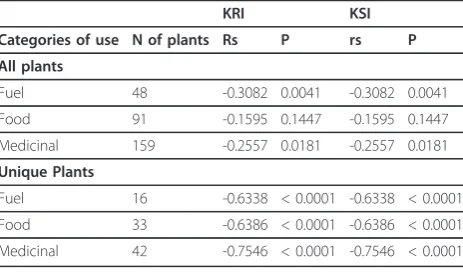
The relationships among the total number of plants cited and the values of the indices were much weaker. They were found to be significant for the fuel and med-icinal categories (Table 4). However, when comparing the KRI and KSI scores with the number of unique plants, the following increases were recorded: 105.64% for the fuel category, 195.11% for the medicinal cate-gory, and 300.37% for the food category.
A multivariate analysis revealed the presence of four groups among the community’s informants (Figure 4). Group 1 consists of 87.05% of the community. Group 2 consists of two people, and it was not possible to iden-tify a trend within this group because the data from these two informants (scores of KRI and KSI for all categories of use) were very different from each other. For groups 3 and 4, it was possible to determine that knowledge of the food category influenced the formation
Table 3 Statistical analysis of the knowledge richness index (KRI) and knowledge sharing index (KSI) Intrafamily for the three categories of use in a rural community in northeastern Brazil
KRI KSI
Categories of use Mean ± SD Mean ± SD N
Fuel 256.184 ± 513.855a* 0.102 ± 0.205ab 76
Food 243.8861 ± 632.706b** 0.0806 ± 0.209a# 81
Medicinal 33.1315 ± 79.857c*** 0.0742 ± 0.178b 85
*H = 5.456;p= 0.0195 **H = 29.208;p< 0.0001 ***H = 12.778;p= 0.0004;#
H = 4.773;p= 0.0289
Values followed by equal letters in the same column do not show significant differences
Table 4 Correlation analysis between the knowledge richness index (KRI) and knowledge sharing index (KSI) and the number of cited plants per informant
(intrafamily) for the three categories of use in a rural community in northeastern Brazil
KRI KSI
Categories of use N of plants Rs P rs P
All plants
Fuel 48 -0.3082 0.0041 -0.3082 0.0041
Food 91 -0.1595 0.1447 -0.1595 0.1447
Medicinal 159 -0.2557 0.0181 -0.2557 0.0181
Unique Plants
Fuel 16 -0.6338 < 0.0001 -0.6338 < 0.0001
Food 33 -0.6386 < 0.0001 -0.6386 < 0.0001
Medicinal 42 -0.7546 < 0.0001 -0.7546 < 0.0001
of the groups. The members of this group are united by their low level of knowledge and sharing of this type of plant compared with the rest of the community, espe-cially group 4, which showed lower values of KRI and KSI than group 3.
Characterization and analysis of sample sufficiency Two basic trends were observed with respect to the dis-tribution of the characteristics of informants. The first trend is present in the categories of fuel and food, in which most of the people aggregating and sharing char-acteristics related to the richness of their knowledge are observed on one side of the distribution. The other side of the distribution is characterized by people who could be removed from the analysis depending on the research objective (or who would not need to be interviewed) without causing significantly affecting the set of infor-mation that would be recorded, as they possess and share knowledge of few plants (Figure 5A and 5B).
The second trend is present in the medicinal category and supported by the formation of the two groups described above. Figure 5 illustrates the separation of a group of informants: the experts. These individuals are characterized by having the lowest scores in the indices, and there is a gap between them and the other infor-mants (Figure 5C).
Analysis of outliers
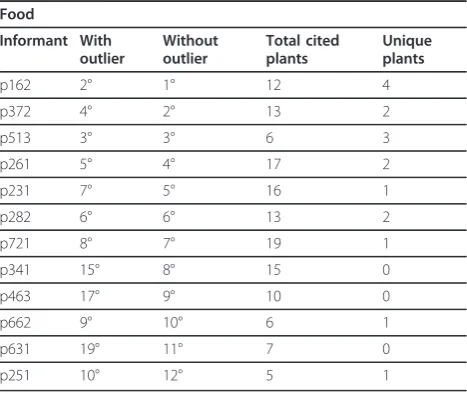
When the so-called “outliers”in the analysis were con-sidered, a change in the position of the informants was observed for the food category, although it was not very expressive. This trend related to informants p341, p463, and p631, all of whom had their positions improve with the removal of the outliers from the analyses. Appar-ently, the total richness of cited plants helps define the positioning of informants when the outliers are removed from the analyses (Table 5).
In contrast to the food category, there was no change in the first positions of the medicinal category. These changes start to become expressive from the tenth posi-tion onward, highlighting the informants p261 and p21, who move from position 24 and 17 in the presence of the outliers to position 10 and 11 when the outliers are removed. Similar to the food category, richness seems to be more critical their position in the absence of the out-liers than in their presence (Table 6).
Figure 4 Principal component analysis (PCA) among the informants of a rural community in northeastern Brazil, considering the KRI and KSI values for three categories of use (fuel, food and medicinal).
Figure 5Graphic representation of the expression (KRI; KSI) for the identification of groups and sample sufficiency of the three categories of use (A, B, and C).
Table 5 Comparison of the order of the first 12 positions of informants based on the presence and absence of outlier in calculating the KRI and KSI for the food category in a rural community in northeastern Brazil
Food
Informant With outlier
Without outlier
Total cited plants
Unique plants
p162 2° 1° 12 4
p372 4° 2° 13 2
p513 3° 3° 6 3
p261 5° 4° 17 2
p231 7° 5° 16 1
p282 6° 6° 13 2
p721 8° 7° 19 1
p341 15° 8° 15 0
p463 17° 9° 10 0
p662 9° 10° 6 1
p631 19° 11° 7 0
Discussion
The scores of the indices are good estimators of intra-and intracultural variation for the analyzed categories of use. Despite the focus of this analysis, there is nothing to prevent these indices from being tested and used as a sample unit for family groups. This unit would also con-sider other criteria and groupings implemented by the researcher (e.g., age range, gender and social function).
If the researcher intends to choose the group of infor-mants that may be the target of their approach, it is possible to obtain a list of priorities that may augment their study through the addition of data offered by these indices. This information might be useful, for example, in situations in which the researcher has a very limited period of time in which to conduct a study. Applying this framework would make it possible to focus the researcher’s efforts by identifying people who can contri-bute data relevant to the study’s objectives, particularly in regard to the amount, or exclusivity, of information that they can provide.
A number of ethnobiology studies are based on inten-tional samplings [4,24,36-38], and as Tongco [39] noted,
“methods in informant selection need to be actively dis-cussed. Purposive sampling is a practical and efficient tool when used properly and can be just as effective as, and even more efficient than, random sampling”. This approach, of course, depends on the objectives of the research being conducted. Our results show that the KRI and KSI values, as well as their charting designs, may assist in the intentional selection of informants.
Moreover, when information is retained by specific members of a community, it is advisable to use an
intentional sample [39], which will save time, especially when information is not equally distributed and some potential informants may even be excluded. This type of selection could be applied when the parameter being studied is not shared by all of the members of a com-munity [39].
Finally, we were able to evaluate how outliers interfere with these analyses and how other analyses may be con-ducted using these indices, such as determining the dis-tance between the knowledge of a community compared to that of experts, as well as showing the importance of these individuals in retaining information of biological resources. There is no doubt that the results of this study have several implications and interpretations. For example, people identified as outliers by indices may have their information evaluated from different points of view, even if these individuals show a low richness of information and sharing. Plants that were rarely men-tioned or shared may be: 1. introduced into the commu-nity’s knowledge repository or 2. abandoned. In either outcome, the recovery and enhancement of such infor-mation becomes valuable from a cultural and scientific point of view.
A relevant aspect of our proposal is the objective of providing a simple tool for accessing a sampling effort using a procedure that is similar to the methods tradi-tionally used in ecology. In our case, the researcher can continue to collect data while his sampling effort is eval-uated. Thus, our index allows us access to information about how unique or shared botanical knowledge arises among families, communities or other social groups.
Acknowledgements
The authors would like to thank the following people and organizations: the community of Carão for accepting our presence and helping us perform this study; the Mayor’s Office of the municipality of Altinho for their logistical support, especially the Secretary of Agriculture Sr. Miguel Andrade Júnior and the community health agents of Carão, Srs. Inaldo and Alexandre; and the CNPq ("Edital Universal”) and FACEPE for their financial support and grants to U.P. Albuquerque and T. A. S. Araújo, respectively. We would also like to thank the anonymous reviewers for careful their review and critique. This paper is the contribution P009 of the Rede de Investigação em Biodiversidade e Saberes Locais (REBISA-Network of Research in Biodiversity and Local Knowledge), with financial support from FACEPE (Foundation for Support of Science and Technology) to the project Nùcleo de Pesquisa em Ecologia, conservação e Potencial de Uso de Recursos Biológicos no Semiárido do Nordeste do Brasil (Center for Research in Ecology, Conservation and Potential Use of Biological Resources in the Semi-Arid Region of Northeastern Brazil-APQ-1264-2.05/10).
Author details 1
Departamento de Biologia, Área Botânica, Laboratório de Etnobotânica Aplicada, Universidade Federal Rural de Pernambuco, Rua Dom Manoel de Medeiros s/n, Dois Irmãos, Recife, Pernambuco 52171-030, Brazil.2Centro de Ensino Superior do Vale do São Francisco, Rua Cel. Trapiá, Centro, Belém, de São Francisco, Pernambuco 56440-000, Brazil.
Authors’contributions
TASA, ALSA and UPA have made substantial contributions to the conception and design analysis of the study and to the interpretation of the data. TASA,
Table 6 Comparison of the order of the first 12 positions of informants based on the presence and absence of outlier in calculating the KRI and KSI for the medicinal category in a rural community in northeastern Brazil
Medicinal
Informant With outlier
Without outlier
Total cited plants
Unique plants
p742 2° 1° 50 6
p631 3° 2° 37 3
p162 4° 3° 31 2
p721 5° 4° 34 2
p532 6° 5° 13 2
p512 7° 6° 31 2
p333 8° 7° 20 2
p231 9° 8° 32 1
p672 10° 9° 25 1
p261 24° 10° 19 0
p21 17° 11° 9 1
ALSA and JGM are responsible for the acquisition of the study data. All authors were involved in the drafting and revising of the manuscript and approved the final version.
Competing interests
The authors declare that they have no competing interests.
Received: 28 June 2011 Accepted: 15 March 2012 Published: 15 March 2012
References
1. Phillips O, Gentry AH:The useful plants of Tambopata, Peru: I. Statistical hypothesis test with a new quantitative technique.Economic Botany 1993,47:15-32.
2. Phillips O, Gentry AH:The useful plants of Tambopata, Peru: II. Statistical hypothesis test with a new quantitative technique.Economic Botany 1993,47:33-43.
3. Bennett BC, Prance GT:Introduced plants in the indigenous pharmacopeia of Northern South America.Economic Botany2000,
54:1:90-102.
4. Turner NJ:“The importance of rose": evaluating the cultural significance of plants in Thompson and Lillooet interior Salish.American
Anthropologist1988,90:272-290.
5. Stoffle RW, Halmo DB, Evans MJ, Olmsted JE:Calculating the cultural significance of American indian plants: Paiute and Shoshone ethnobotany at Yucca Mountain, Nevada.American Anthropologist1990,
92:416-432.
6. Medeiros MFT, Silva OS, Albuquerque UP:Quantification in ethnobotanical research: an overview of indices used from 1995 to 2009.Sitientibus. Série
Ciências Biológicas2011,11:211-230.
7. Hoffman B, Gallaher T:Importance indices in ethnobotany.Ethnobotany research & applications2007,5:201-218.
8. Ghimire S, McKey D, Aumeeruddy-Thomas Y:Heterogeneity in
ethnoecological knowledge and management of medicinal plants in the himalayas of nepal: implications for conservation.Ecology and Society 2004,9(3):6.
9. Silva FS, Ramos MA, Hanazaki N, Albuquerque UP:Dynamics of traditional knowledge of medicinal plants in a rural community in the Brazilian semi-arid region.Revista Brasileira de Farmacognosia2011,21(3):382-391. 10. Ghorbani A, Langenberger G, Feng L, Sauerborn J:Ethnobotanical study of
medicinal plants utilised by Hani ethnicity in Naban River Watershed National Nature Reserve, Yunnan, China.Journal of Ethnopharmacology 2011,134:651-667.
11. Caulkins DD:Identifying Culture as a Threshold of Shared Knowledge A Consensus Analysis Method.International Journal of Cross Cultural
Management2004,4:317-333.
12. Cunha LVFC, Albuquerque UP:Quantitative Ethnobotany in an Atlantic Forest Fragment of Northeastern Brazil- implication to conservation.
Environmental Monitoring and Assessment2006,114(1/3):1-25.
13. Albuquerque UP, Lucena RFP, Monteiro JM, Florentino ATN, Ramos MA, Almeida CFCBR:Evaluating two quantitative ethnobotanical techniques.
Ethnobotany Research Applications2006,4(1):51-60.
14. Albuquerque UP, Oliveira RF:Is the use-impact on native caatinga species in Brazil reduced by the high species richness of medicinal plants?
Journal of Ethnopharmacology2007,113:156-170.
15. Medeiros PM, Almeida ALS, Ramos MA, Albuquerque UP:A variation of checklist interview technique in the study of firewood plants.Functional
Ecosystems and Communities2008,2:45-50.
16. Albuquerque UP, Lucena RFP, Alencar NL:Métodos e técnicas para a coleta de dados etnobiológico.Métodos e técnicas na pesquisa
etnobiológica e etnoecológicaRecife: NUPEEA; 2010, 41-64, Organized by
Albuquerque UP, Lucena RFP, Cunha LVFC.
17. Peroni N:Coleta e análise de dados quantitativos em etnobiologia: introdução ao uso de métodos multivariados.InMétodos de Coleta e Análise de Dados em Etnobiologia, Etnoecologia e Disciplinas Correlatas. Edited by: Amorozo, MCMA, Ming LC, Silva SMP. Rio Claro: Unesp/CNPq; 2002:155-180.
18. Peroni N, Hanazaki N, Araujo H:Métodos ecológicos na investigação etnobotânica e etnobiológica: o uso de medidas de diversidade e
estimadores de riqueza.InMétodos e técnicas na pesquisa etnobiológica e
etnoecológica.Edited by: Albuquerque UP, Lucena RFP, Cunha LVFC. Recife:
NUPEEA; 2010:255-276.
19. Peroni N, Hanazaki N:Current and lost diversity of cultivated varieties, especially cassava, under swidden cultivation systems in the Brazilian Atlantic Forest.Agriculture, Ecosystems and Environment2002,92:171-183. 20. Hanazaki N, Tamashiro JY, Leitão-Filho HF, Begossi A:Diversity of plant
uses in two Caiçara communities from the Atlantic Forest Coast, Brazil.
Biodiversity and Conservation2000,9:597-615.
21. Williams VL, Witkowski ETF, Balkwill K:The use of incidence-based species richness estimators, species accumulation curves and similarity measures to appraise ethnobotanical inventories from South Africa.
Biodiversity and Conservation2006,16:2495-2513.
22. Williams VL, Witkowski ETF, Balkwill K:Application of diversity indices to appraise plant availability in the traditional medicinal markets of Johannesburg, South Africa.Biodiversity and Conservation2005,
14:2971-3001.
23. Sieber SS, Medeiros PM, Albuquerque UP:Local Perception of Environmental Change in a Semi-Arid Area of Northeast Brazil: a new approach for the use of participatory methods at the level of family units.Journal of Agricultural & Environmental Ethics2010,24(5):511-531. 24. Araújo TAS, Alencar NL, Amorim ELC, Albuquerque UP:A new approach to
study medicinal plants with tannins and flavonoids contents from the local knowledge.Journal of Ethnopharmacology2008,120:72-80. 25. Melo JG, Araújo TAS, Castro VTNAE, Cabral DLV, Rodrigues MD,
Nascimento S, Amorim ELC, Albuquerque UP:Antiproliferative Activity, Antioxidant Capacity and Tannin Content in Plants of Semi-Arid Northeastern Brazil.Molecules2010,15:8534-8542.
26. Nascimento VT, Moura NP, Vasconcelos MAS, Maciel MIS, Albuquerque UP:
Chemical characterization of native wild plants of dry seasonal forests of the semi-arid region of northeastern Brazil.Food Research International 2010,44(7):2112-2119.
27. Cruz MPG:Representações locais, uso e manejo de plantas alimentícias nativas da Caating.Universidade Federal de Pernambuco, Centro de ciências
Biológicas: Msc. Thesis2011.
28. Alencar NL, Araújo TAS, Amorim ELC, Albuquerque UP:The inclusion and selection of medicinal plants in traditional pharmacopoeias evidence in support of the diversification hypothesis.Economic Botany2010,64:68-79. 29. Soldati GT, Albuquerque UP:Impact assessment of the harvest of a
medicinal plant (Anadenanthera colubrin(Vell.) Brenan).International
Journal of Biodiversity Science, Ecosystem Services & Management2010,
6:106-118.
30. Santos LL, Ramos MA, Silva SI, Sales MF, Albuquerque UP:Caatinga Ethnobotany: Anthropogenic Landscape Modification and Useful Species in Brazil’s Semi-Arid Northeast.Economic Botany2009,63:363-374. 31. Lins Neto EMF, Peroni N, Albuquerque UP:Traditional Knowledge and
Management ofSpondias tuberosArruda (Umbu) (Anacardiaceae) an endemic species from the Semi-Arid Region of Northeast Brazil.
Economic Botany2010,64:11-21.
32. Almeida ALS, Albuquerque UP, Castro CC:Reproductive biology of
Spondias tuberosArruda (Anacardiaceae), a fructiferous endemic species in caatinga (dry forest), under distinct management conditions in Northeastern, Brazil.Journal of Arid Environments2011,75:330-337. 33. Zar JH:Bioestatistical analysisNew Jersey: Prentice-Hall; 1996.
34. Ayres M, Ayres MJ, Ayres DL, Santos AAS:BioEstat 5.0: aplicações estatísticas
nas áreas das ciências biológicas e médicasBrasília: Sociedade Civil
Mamirauá, CNPq; 2007.
35. Kovach WL:MVSP. A Multivariate Statistical Package for windows, ver. 3.1 Pentraeth, Wales: Kovach Computing services; 1999.
36. Walker M, Nunez J, Walkingstick M, Banack SA:Ethnobotanical investigation of the Acjachemen clapperstick from blue elderberry,
Sambucus mexican(Caprifoliaceae).Economic Botany2004,58:21-24. 37. Gazzaneo LRS, Lucena RFP, Albuquerque UP:Knowledge and use of medicinal plants by local specialists in an region of Atlantic Forest in the state of Pernambuco (Northeastern Brazil).Journal of Ethnobiology
and Ethnomedicine2005,1:9.
39. Tongco MDC:Purposive Sampling as a Tool for Informant Selection.
Ethnobotany Research & Applications2007,5:147-158.
doi:10.1186/1746-4269-8-11
Cite this article as:Sousa Araújoet al.:A new technique for testing distribution of knowledge and to estimate sampling sufficiency in ethnobiology studies.Journal of Ethnobiology and Ethnomedicine2012 8:11.
Submit your next manuscript to BioMed Central and take full advantage of:
• Convenient online submission
• Thorough peer review
• No space constraints or color figure charges
• Immediate publication on acceptance
• Inclusion in PubMed, CAS, Scopus and Google Scholar
• Research which is freely available for redistribution