S Y S T E M A T I C R E V I E W
Open Access
Psychometric properties of implementation
measures for public health and community
settings and mapping of constructs against
the Consolidated Framework for
Implementation Research: a systematic
review
Tara Clinton-McHarg
1,2, Sze Lin Yoong
1,2,3, Flora Tzelepis
1,2,3, Tim Regan
1,2, Alison Fielding
1, Eliza Skelton
1,
Melanie Kingsland
1,3, Jia Ying Ooi
1and Luke Wolfenden
1,2,3*Abstract
Background:
Recent reviews have synthesised the psychometric properties of measures developed to examine
implementation science constructs in healthcare and mental health settings. However, no reviews have focussed
primarily on the properties of measures developed to assess innovations in public health and community settings.
This review identified quantitative measures developed in public health and community settings, examined their
psychometric properties, and described how the domains of each measure align with the five domains and 37
constructs of the Consolidated Framework for Implementation Research (CFIR).
Methods:
MEDLINE, PsycINFO, EMBASE, and CINAHL were searched to identify publications describing the
development of measures to assess implementation science constructs in public health and community settings.
The psychometric properties of each measure were assessed against recommended criteria for validity (face/
content, construct, criterion), reliability (internal consistency, test-retest), responsiveness, acceptability, feasibility, and
revalidation and cross-cultural adaptation. Relevant domains were mapped against implementation constructs
defined by the CFIR.
(Continued on next page)
* Correspondence:[email protected] 1
School of Medicine and Public Health, The University of Newcastle, Callaghan, NSW 2308, Australia
2Hunter Medical Research Institute, New Lambton Heights, NSW 2305, Australia
Full list of author information is available at the end of the article
© The Author(s). 2016Open AccessThis article is distributed under the terms of the Creative Commons Attribution 4.0 International License (http://creativecommons.org/licenses/by/4.0/), which permits unrestricted use, distribution, and reproduction in any medium, provided you give appropriate credit to the original author(s) and the source, provide a link to the Creative Commons license, and indicate if changes were made. The Creative Commons Public Domain Dedication waiver (http://creativecommons.org/publicdomain/zero/1.0/) applies to the data made available in this article, unless otherwise stated.
Clinton-McHarget al. Implementation Science (2016) 11:148
(Continued from previous page)
Results:
Fifty-one measures met the inclusion criteria. The majority of these were developed in schools, universities,
or colleges and other workplaces or organisations. Overall, most measures did not adequately assess or report
psychometric properties. Forty-six percent of measures using exploratory factor analysis reported >50 % of
variance was explained by the final model; none of the measures assessed using confirmatory factor analysis
reported root mean square error of approximation (<0.06) or comparative fit index (>0.95). Fifty percent of
measures reported Cronbach
’
s alpha of <0.70 for at least one domain; 6 % adequately assessed test-retest reliability;
16 % of measures adequately assessed criterion validity (i.e. known-groups); 2 % adequately assessed convergent
validity (
r
> 0.40). Twenty-five percent of measures reported revalidation or cross-cultural validation. The CFIR
constructs most frequently assessed by the included measures were relative advantage, available resources,
knowledge and beliefs, complexity, implementation climate, and other personal resources (assessed by more than
ten measures). Five CFIR constructs were not addressed by any measure.
Conclusions:
This review highlights gaps in the range of implementation constructs that are assessed by existing
measures developed for use in public health and community settings. Moreover, measures with robust
psychometric properties are lacking. Without rigorous tools, the factors associated with the successful
implementation of innovations in these settings will remain unknown
Keywords:
Public health, Implementation research, Psychometric, Measure, Factor analysis
Background
In the field of implementation science, a considerable
number of theories and frameworks are being used to
better understand implementation processes and guide
the development of strategies to improve the
implemen-tation of health innovations [1
–
3]. Many of these
theor-ies and frameworks, however, have not been tested
empirically. As such, examining the utility of theories
and frameworks has been recognised as critical to
ad-vance the field of implementation science [4].
The assessment of implementation theories and
frame-works necessitates robust measures of their theoretical
constructs. Psychometric properties important for
mea-sures of implementation research have been proposed [5]
and include the following: reliability (internal consistency
and test-retest); validity (construct and criterion); broad
application (validated in different settings and cultures);
and sensitivity to change (responsiveness). Tools which
are acceptable, feasible, and display face and content
valid-ity are also particularly useful for researchers in real-world
settings [5]. Furthermore, the psychometric characteristics
of measures that assess a comprehensive range of
imple-mentation constructs have been highlighted as a particular
priority area of research [4].
A number of reviews of implementation measures exist
[6
–
13]. Such reviews indicate that the quality of existing
measures of implementation constructs is limited. A
re-view by Brennan and colleagues, for example, identified
41 instruments designed to assess factors hypothesised to
influence quality improvement in primary care [6]. The
re-view found that while most studies reported the internal
consistency of instruments, very few assessed the
con-struct validity of the measures using factor analysis [6].
Similarly, in a review of the psychometric properties of
research utilisation measures used in health care, Squires
and colleagues found that, of the 97 identified studies (60
unique measures), only 31 reported internal consistency
and only 3 reported test-retest reliability [13]. Twenty
per-cent of the included measures had not undergone any type
of validity testing, and no studies reported on measure
ac-ceptability [13].
There are a number of limitations of previous reviews.
Most do not provide comprehensive details of the
psy-chometric properties of included measures [7, 8, 12] or
address only a small number of constructs or outcomes
relevant to implementation science [8, 10]. Additionally,
the majority of these reviews primarily focus on
mea-sures developed for use in healthcare settings [6, 9, 11,
13]. Evidence from the field of psychometric research
has suggested that, even when administered to similar
population groups, changes in measure reliability and
validity can occur when a measure developed in one
set-ting is applied to another setset-ting with different
charac-teristics [14, 15].
Currently, a comprehensive review of measures of
im-plementation constructs is being conducted by the
Soci-ety for Implementation Research Collaboration (SIRC)
Instrument Review Project [16, 17]. The SIRC review
ad-dresses some of the limitations of past reviews by
extracting a range of psychometric properties from
iden-tified measures and assessing a more comprehensive
range of outcomes [18] and constructs relevant to
imple-mentation science [19]. The outcomes of interest in the
SIRC review are taken from Proctor and colleagues
’
Im-plementation Outcomes Framework (IOF) and focus on
the appropriateness, acceptability, feasibility, adoption,
penetration, cost, fidelity, and sustainability of the
inter-vention itself [18]. The constructs of interest for the
review are drawn from the Consolidated Framework for
Implementation Research (CFIR), which outlines factors
or conditions deemed important to support the
success-ful implementation of an intervention [19]. The
con-structs are grouped under five domains which describe
the following: (1) Intervention characteristics (details of
the intervention itself ); (2) Outer setting (factors of
in-fluence which are external to an organisation); (3) Inner
setting (internal characteristics of an organisation such
as culture and learning climate); (4) Characteristics of
individuals (actions and behaviours of individuals within
the organisation); and (5) Process (systems and pathways
within an organisation) [19].
To date, the SIRC review has uncovered 420
ments related to 34 of the CFIR constructs and 104
instru-ments related to Proctor and colleagues
’
IOF [16, 17]. At
present, the data are available for the measures relevant to
the inner setting domain of the CFIR and the IOF [20].
However, while comprehensive, the SIRC review only
per-tains to measures primarily applied to healthcare or
men-tal health care settings, where the individuals responsible
for implementing health-related interventions are most
likely to be healthcare professionals [16, 17]. In the field of
public health, the implementation of health-related
inter-ventions often occurs in clinical settings, with
non-healthcare professionals responsible for implementing
these changes. Therefore, there is a need to identify
mea-sures which have been developed specifically to measure
constructs important for the implementation of
health-related interventions in community settings, where the
primary role of the organisations and individuals is not
healthcare delivery.
To our knowledge, no previous reviews of measures of
implementation constructs have focussed on
instru-ments designed for use in a broad range of community
settings. Such measures are of particular interest to
pub-lic health researchers who are utilising implementation
theories or frameworks to support evidence-based
prac-tice in these settings. As such, the aim of this study was
to (1) systematically review the literature to identify
measures of implementation constructs which have been
developed in community settings; (2) describe each
mea-sure
’
s psychometric properties; and (3) describe how the
domains of each measure align with the five domains
and 37 constructs of the CFIR.
Methods
Scope of this review
The focus of this review was to identify, from
peer-reviewed literature, measures which have been
devel-oped for use in community-based (non-clinical settings),
and which measure constructs aligned to the CFIR.
These measures were then examined to determine their
psychometric properties and identify which of the CFIR
constructs they captured. In this review,
‘
measures
’
are
defined as surveys, questionnaires, instruments, tools, or
scales which contain individual items that are answered
or scored using predefined response options.
‘
Con-structs
’
are defined as the broad attributes or
character-istics which these items (usually grouped into domains)
are attempting to capture. The constructs of interest
were chosen to align with the CFIR, as this framework is
the most comprehensive and draws together numerous
theories which have been developed to guide the
plan-ning and evaluation of implementation research and
combines them into one uniform theory with
overarch-ing domains [19].
Design
A systematic search and review was conducted to address
the broad question of
‘
what psychometrically robust
mea-sures are currently available to assess implementation
re-search in public health and community settings
’
. A
comprehensive search of peer-reviewed publications was
conducted using four electronic databases and the quality
of identified measures was assessed using well-established,
pre-defined psychometric criteria.
Eligibility
Publications were included if they (1) were
peer-reviewed journal articles reporting original research
re-sults; (2) reported research from non-clinical settings;
(3) reported details regarding the development of a
measure; (4) described a measure which assessed at least
one of the 37 CFIR constructs; (5) described a measure
which was being applied to a specific innovation or
intervention; and (6) used statistical methods to assess
the measures
’
factor structure.
In this review, clinical settings included the following:
hospitals, general practices, allied health facilities such as
physiotherapy or dental practices, rehabilitation centres,
psychiatric facilities, and any other settings where the
de-livery of health or mental health care was the primary
focus. Non-clinical settings included schools, universities,
private businesses, childcare centres, correctional facilities,
and any other settings where the delivery of health or
mental health care was not the primary focus. Given that
an aim of the study was to map the domains of included
measures against constructs within the CFIR, it was
im-portant that measures displayed a minimum level of
con-struct validity via exploratory or confirmatory factor
analysis.
Duplicate abstracts were excluded from the review, as
were abstracts describing reviews, editorials,
commen-taries, protocols, conference abstracts, and dissertations.
Publications which reported on measures developed
using qualitative methods only were also ineligible.
Search strategy
A search of MEDLINE, PsycINFO, EMBASE, and
CINAHL databases was conducted to identify
publica-tions describing the development of measures to assess
factors relevant to the implementation of innovations.
These four databases were selected as they index
jour-nals from the field of implementation science and
pro-vide extensive coverage of research across a range of
public health and community settings, such as schools,
pharmacies, businesses, nursing homes, sporting clubs,
and childcare facilities.
Prior to the database searches being conducted, four
authors met to ensure that the chosen keywords
accur-ately captured the constructs of interest and that
key-words were combined using the correct Boolean
operators [21]. The core search terms comprised of
key-words that related to measurement, the psychometric
properties of instruments, the levels at which the
meas-urement could occur (e.g. organisational or individual)
and the goals of research implementation. These
key-words were as follows: [questionnaire or measure or
scale or tool] AND [psychometric or reliability or
valid-ity or acceptabilvalid-ity] AND [organisation* or institut* or
service or staff or personnel] AND [implement* or
change or adopt* or sustain*].
Similar to the strategy used in the SIRC review [16, 17],
the core search terms were combined with five more
key-word searches designed to capture the constructs within
each of the five CFIR domains: (1) Intervention
Character-istics [strength or quality or advantage or adapt* or
com-plex* or pack* or cost]; (2) Outer Setting [needs or barrier*
or facilitate* or resource* or network or external or peer or
compet* or poli* or regulation* or guideline* or incentive*];
(3) Inner Setting [structur* or communication or cultur* or
value* or climate or tension or risk* or reward* or goal* or
feedback or commitment or leadership or knowledge*]; (4)
Characteristics of Individuals [belief* or attitude* or
self-efficacy or skill* or identi* or trait* or ability* or motivat*];
or (5) Process [plan* or market or train or manager or team
or champion or execut* or evaluat*].
The keyword search terms were repeated for all four
databases. Keyword searches were limited to the English
language; however, no limit was placed on the year of
publication, as measurement tools often evolve over
many years. Medical Subject Headings (MeSH) were not
used in the literature search, as keyword searches have
been found to have higher sensitivity, being more
suc-cessful than subject searching in identifying relevant
publications [22].
Identification of eligible publications
One author coded all abstracts according to the
inclu-sion and excluinclu-sion criteria. A second author
cross-checked 10 % of the abstracts to confirm they had been
correctly classified. Full-text versions of publications
were obtained for included abstracts. To ensure that no
relevant tools had been missed, previous systematic
re-views [7, 8, 10] were also screened for relevant measures,
as were tools included on the SIRC Instrument Review
Project website [20]. Copies of publications for any
add-itional measures that met the inclusion criteria were
ob-tained. Full-text versions of all eligible publications were
then obtained and screened to identify the names and
acronyms of all relevant measures they described. The
reference lists of all eligible publications were also
screened for any additional measures, and Google
Scholar was used to conduct cited reference searches. A
final literature search was conducted by
‘
measure name
’
and
‘
author names
’
, using Google Scholar. This search
strategy ensured that as many publications as possible
were found that related to the psychometric
develop-ment and validation and revalidation and cross-cultural
adaptation of identified measures.
Extraction of data from eligible publications
The properties of each measure were extracted from all
full-text publications relating to the development of the
measure using data reported in the manuscript text,
ta-bles, or figures. Extracted data included: (1) the research
setting, sample, and characteristics of the intervention or
innovation being assessed; (2) psychometric properties
including face and content validity, construct and
criter-ion validity, internal consistency, test-retest reliability,
responsiveness, acceptability, and feasibility; and (3)
whether the measure had undergone a process of
reval-idation or cross-cultural adaptation.
The psychometric properties of each measure were
in-dependently assessed by two authors using the same
cri-teria described in previous systematic reviews [23, 24]
and according to the guidelines for the development and
use of tests, including the
Standards for Educational
and Psychological Testing
[5, 25, 26]. The
Standards
provides a frame of reference to ensure all relevant
is-sues are addressed when developing a measure and
al-lows the quality of measures to be evaluated by those
who wish to use them [25]. Following the assessment of
psychometric properties, two authors then
independ-ently coded each publication to determine which
meas-ure domains corresponded with which CFIR constructs.
When discrepancies emerged, a third author assisted in
reaching consensus.
Psychometric coding
Setting, sample, and characteristics of the innovation being
assessed
Details regarding the country and setting where the
measure was developed, characteristics of the innovation
or intervention being assessed, response rate, sample
size, and demographic characteristics of the sample
(gender and profession) who completed the measure
were described.
Face and content validity
An instrument is said to have face validity if both the
ad-ministrators and those who complete it agree that it
measures what it was designed to measure [27]. To have
content validity, the description of the measure
’
s
devel-opment needed to include: (1) the process by which
items were selected; (2) who assessed the measure
’
s
con-tent; and (3) what aspects of the measure were revised
[14, 28]. Information regarding any theories or
frame-works that the measure was developed to test, as well as
whether items were adapted from previously validated
measures, was also extracted.
Construct and criterion validity
A measure was classified as having good internal
struc-ture (construct validity) if exploratory factor analysis
(EFA) was performed with eigenvalues set at >1 [14, 29]
and >50 % of the variance was explained [30], or
con-firmatory factor analysis (CFA) was performed with a
root mean square error of approximation (RMSEA) of
<0.06 and a comparative fit index (CFI) of >0.95 [31, 32].
The number of items and domains in the measure
fol-lowing factor analysis was recorded. Additional
con-struct validity was determined by assessing whether the
measure had convergent validity (correlations (
r
) >0.40)
with similar instruments or divergent validity
(correla-tions (
r
) <0.30) with dissimilar instruments [33].
Criter-ion validity was determined by assessing whether the
measure was able to obtain different scores for
sub-populations with known differences (known-groups
val-idity) [34].
Internal consistency and test-retest reliability
To meet the criteria for internal consistency, correlations
for a measure
’
s subscales and total scale needed to have a
Cronbach
’
s alpha (
α
) of >0.70 or a Kuder-Richardson 20
(KR-20) of >0.70 for dichotomous response scales [28].
For test-retest reliability, the measure needed to have
undergone a repeated administration with the same
sam-ple within 2
–
14 days [35]. Agreement between scores
from the two administrations needed to be calculated,
with item, subscale, and total scale correlations having a
(1) Cohen
’
s kappa coefficient (
κ
) of >0.60 for nominal or
ordinal response scales [14]; (2) Pearson correlation
coeffi-cient (
r
) of >0.70 for interval response scales [14, 28]; or
an (3) Intraclass correlation coefficient (ICC) of >0.70 for
interval response scales [14, 28].
Responsiveness, acceptability, feasibility, revalidation, and
cross-cultural adaptation
A measure
’
s potential to detect change over time was
confirmed if it could show a moderate effect size (>0.5)
for a given change [14, 28, 36], and if it had minimal
floor and ceiling effects (less than 5 % of the sample
achieved the highest or lowest scores) [37]. To
deter-mine acceptability and feasibility (burden associated with
using the measure), data on the following were
ex-tracted: proportion of missing items, time needed to
complete, and time needed to interpret and score [28].
Data from publications reporting the revalidation of a
measure with additional samples, or in different
lan-guages or cultures, were also extracted [28].
CFIR coding
The domains of each included measure were assessed to
determine whether the factors they measured
corre-sponded with one or more of the 37 CFIR constructs
[19]. A brief summary of each of the CFIR constructs is
presented in Additional file 1. The mapping process was
domain-focused (i.e. mapping the overall measure
do-mains to constructs) rather than item-focused (i.e.
map-ping individual items to constructs) to ensure that the
overall construct was well captured. Within a measure,
only one domain needed to be judged by the reviewers
to address a CFIR construct. Therefore, it was possible
that a measure with five domains might only have one of
its domains mapped to a CFIR construct. Similarly, a
measure with three domains might have all contributing
to the same CFIR construct. In the latter scenario, the
construct was only counted once.
Analysis
Descriptive statistics (frequencies and proportions) were
used to report the number of domains from the included
measures which were mapped to each of the CFIR
con-structs and CFIR domains. Frequencies and proportions
were also used to describe the number of measures
which met various psychometric criteria.
Results
Identified measures of implementation constructs
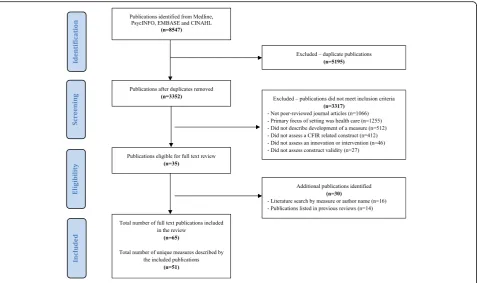
The initial searches of MEDLINE, PsycINFO, EMBASE,
and CINAHL identified 8547 potentially relevant
tions. Of these, 5195 were duplicates leaving 3352
publica-tion abstracts to be coded. Of these 3352 publicapublica-tions, 3317
did not meet the inclusion criteria (see Fig. 1 for PRISMA
diagram), leaving 35 eligible publications. The process of
identifying measures included in systematic reviews related
to the current review [7, 8, 10], and a secondary literature
search by measure or author name, lead to the inclusion of
an additional 30 publications. A total of 65 full-text
publica-tions were retained which described 51 unique measures.
Psychometric properties of measures
Setting, sample, and characteristics of the innovation being
assessed
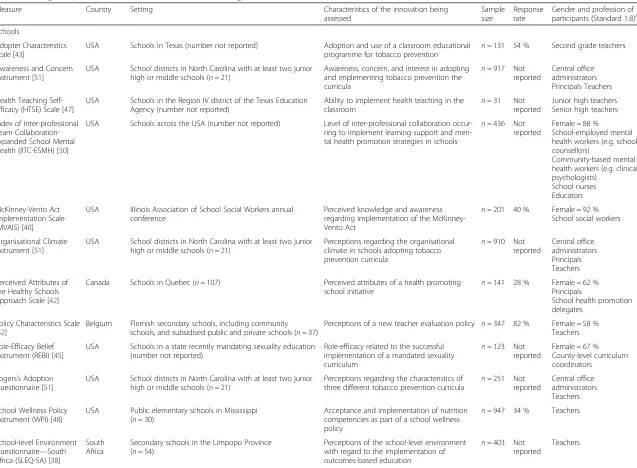
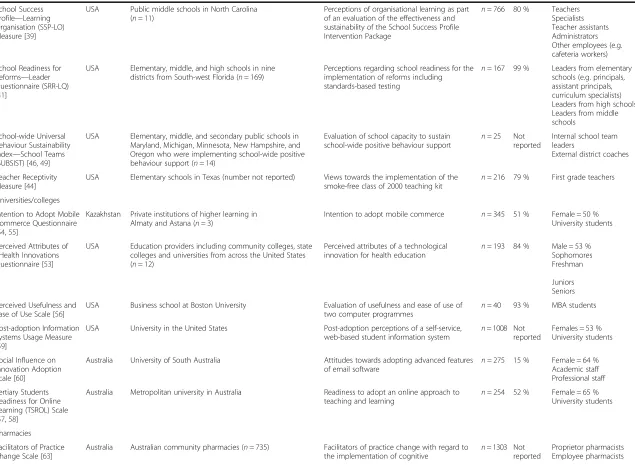
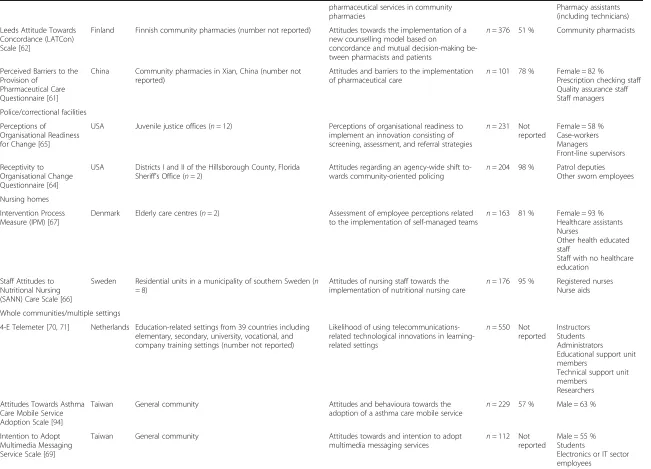
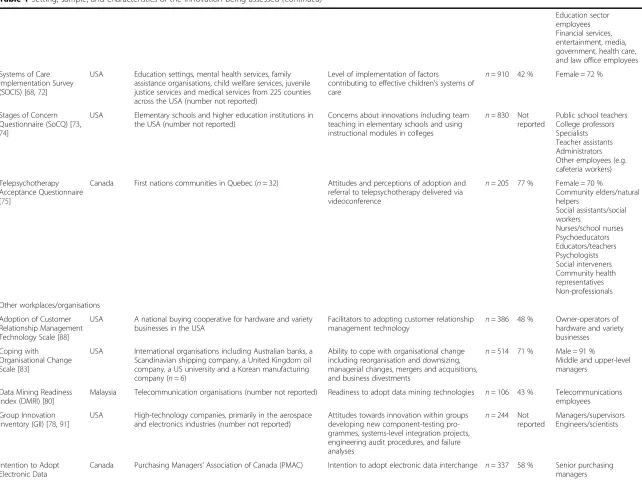
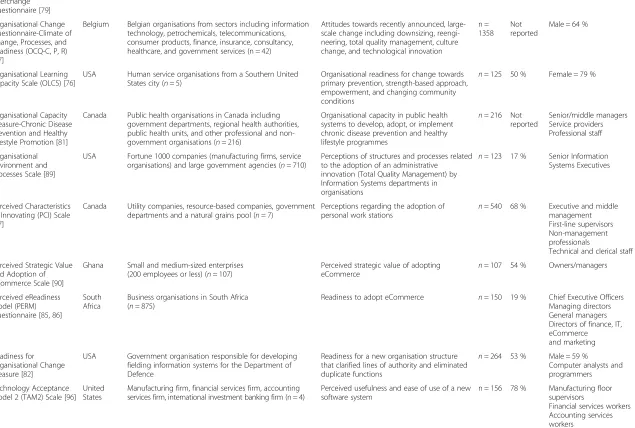
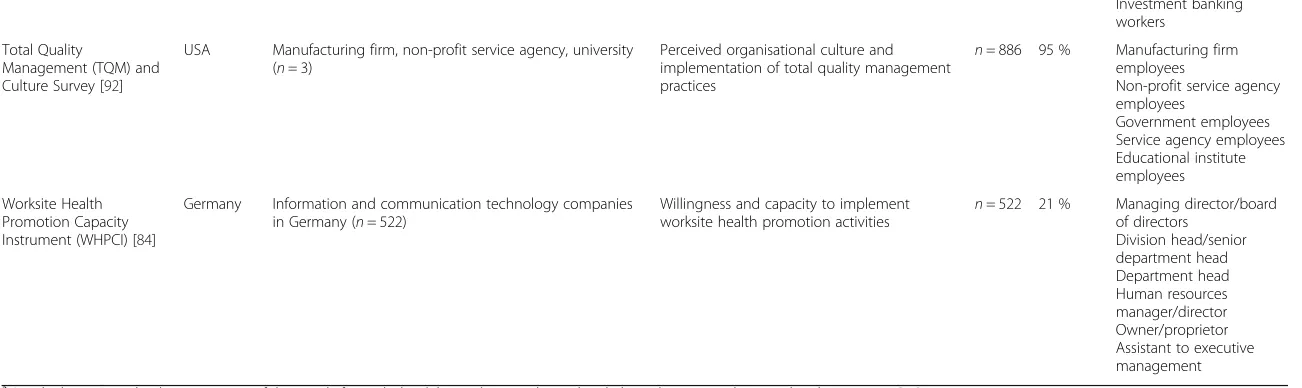
Table 1 outlines the details of the setting, sample, and
characteristics of the innovation being assessed by each
measure. The majority of measures were developed in
the USA (
n
= 28), with Canada and Australia also having
developed three or more measures each. Sixteen
mea-sures were developed for use in school settings [38
–
52],
six for use in universities or colleges [53
–
60], three for
use in pharmacies [61
–
63], two for use in police or
cor-rectional facilities [64, 65], two for use in nursing homes
[66, 67], six for use with whole communities or in
mul-tiple settings [68
–
75], and sixteen measures were
devel-oped for use in workplace settings or other organisations
(e.g. utility companies, IT service providers, human
ser-vices) [76
–
92]. A broad range of innovations or
inter-ventions
were
assessed,
with
technology-focussed
innovations featuring prominently. Sample sizes in each
study ranged from 31 to 1358, and response rates ranged
from 15 to 98 %. Sample characteristics (i.e. gender and
profession of participants) were inconsistently reported
across the studies.
Face and content validity
Almost all measures (
n
= 47) had undergone a process of
face and content validation. The development of 36
measures was guided by an existing theory or framework
(Additional file 2). No measures were specifically
de-signed to address all constructs considered important
for the implementation of innovations by the CFIR.
Twenty-six measures had adapted at least some of their
items from pre-existing instruments (Additional file 2).
Construct and criterion validity
The internal structure of 45 instruments was determined
via EFA (11 of these also used CFA [42, 49, 52, 54, 55,
59, 65, 67, 77, 78, 82, 91
–
93]), and six studies used CFA
alone [39, 40, 68, 72, 75, 83, 94] (Additional file 3). For
studies which conducted EFA, 46 % reported that >50 %
of the variance was explained by the final factor model.
None of the studies that used CFA alone reported
ac-ceptable RMSEA (<0.06) or CFI (>0.95). Across all
mea-sures, the number of items ranged from 9 to 149, and
the number of factors (domains) ranged from 1 to 20.
Eight measures were tested for criterion validity for
sub-populations with known differences. These measures
demonstrated capacity to distinguish between a number
of groups with known differences, including the amount
of teaching experience [47], familiarisation with
technol-ogy [59], age [58], and managers and non-managers [77].
Only two measures [41, 82] reported testing for
conver-gent/divergent validity against existing instruments,
al-though only one [82] met the required threshold of
having significant positive or negative correlations >0.40
or <0.30 with an external measure. In this instance, these
Fig. 1PRISMA flow diagram of the publication and measure inclusion processTable 1
Setting, sample, and characteristics of the innovation being assessed
Measure Country Setting Characteristics of the innovation being
assessed
Sample size
Response rate
Gender and profession of participants (Standard 1.8)a
Schools
Adopter Characteristics Scale [43]
USA Schools in Texas (number not reported) Adoption and use of a classroom educational programme for tobacco prevention n
= 131 54 % Second grade teachers
Awareness and Concern Instrument [51]
USA School districts in North Carolina with at least two junior high or middle schools (n= 21)
Awareness, concern, and interest in adopting and implementing tobacco prevention the curricula
n= 917 Not reported
Central office administrators Principals Teachers
Health Teaching Self-Efficacy (HTSE) Scale [47]
USA Schools in the Region IV district of the Texas Education Agency (number not reported)
Ability to implement health teaching in the classroom
n= 31 Not reported
Junior high teachers Senior high teachers
Index of Inter-professional Team Collaboration-Expanded School Mental Health (IITC-ESMH) [50]
USA Schools across the USA (number not reported) Level of inter-professional collaboration occur-ring to implement learning support and men-tal health promotion strategies in schools
n= 436 Not reported
Female = 88 %
School-employed mental health workers (e.g. school counsellors)
Community-based mental health workers (e.g. clinical psychologists)
School nurses Educators
McKinney-Vento Act Implementation Scale (MVAIS) [40]
USA Illinois Association of School Social Workers annual conference
Perceived knowledge and awareness regarding implementation of the McKinney-Vento Act
n= 201 40 % Female = 92 % School social workers
Organisational Climate Instrument [51]
USA School districts in North Carolina with at least two junior high or middle schools (n= 21)
Perceptions regarding the organisational climate in schools adopting tobacco prevention curricula
n= 910 Not reported
Central office administrators Principals Teachers
Perceived Attributes of the Healthy Schools Approach Scale [42]
Canada Schools in Quebec (n= 107) Perceived attributes of a health promoting school initiative
n= 141 28 % Female = 62 % Principals
School health promotion delegates
Policy Characteristics Scale [52]
Belgium Flemish secondary schools, including community schools, and subsidised public and private schools (n= 37)
Perceptions of a new teacher evaluation policy n= 347 82 % Female = 58 % Teachers
Role-Efficacy Belief Instrument (REBI) [45]
USA Schools in a state recently mandating sexuality education (number not reported)
Role-efficacy related to the successful implementation of a mandated sexuality curriculum
n= 123 Not reported
Female = 67 % County-level curriculum coordinators
Rogers’s Adoption Questionnaire [51]
USA School districts in North Carolina with at least two junior high or middle schools (n= 21)
Perceptions regarding the characteristics of three different tobacco prevention curricula
n= 251 Not reported
Central office administrators Teachers
School Wellness Policy Instrument (WPI) [48]
USA Public elementary schools in Mississippi (n= 30)
Acceptance and implementation of nutrition competencies as part of a school wellness policy
n= 947 34 % Teachers
School-level Environment Questionnaire—South Africa (SLEQ-SA) [38]
South Africa
Secondary schools in the Limpopo Province (n= 54)
Perceptions of the school-level environment with regard to the implementation of outcomes-based education
n= 403 Not reported
Teachers
Clinton-M
cHarg
et
al.
Implementa
tion
Science
(2016) 11:148
Page
7
of
Table 1
Setting, sample, and characteristics of the innovation being assessed
(Continued)
School Success Profile—Learning Organisation (SSP-LO) Measure [39]
USA Public middle schools in North Carolina (n= 11)
Perceptions of organisational learning as part of an evaluation of the effectiveness and sustainability of the School Success Profile Intervention Package
n= 766 80 % Teachers Specialists Teacher assistants Administrators Other employees (e.g. cafeteria workers)
School Readiness for Reforms—Leader Questionnaire (SRR-LQ) [41]
USA Elementary, middle, and high schools in nine districts from South-west Florida (n= 169)
Perceptions regarding school readiness for the implementation of reforms including standards-based testing
n= 167 99 % Leaders from elementary schools (e.g. principals, assistant principals, curriculum specialists) Leaders from high schools Leaders from middle schools
School-wide Universal Behaviour Sustainability Index—School Teams (SUBSIST) [46,49]
USA Elementary, middle, and secondary public schools in Maryland, Michigan, Minnesota, New Hampshire, and Oregon who were implementing school-wide positive behaviour support (n= 14)
Evaluation of school capacity to sustain
school-wide positive behaviour support n
= 25 Not reported
Internal school team leaders
External district coaches
Teacher Receptivity Measure [44]
USA Elementary schools in Texas (number not reported) Views towards the implementation of the smoke-free class of 2000 teaching kit
n= 216 79 % First grade teachers
Universities/colleges
Intention to Adopt Mobile Commerce Questionnaire [54,55]
Kazakhstan Private institutions of higher learning in Almaty and Astana (n= 3)
Intention to adopt mobile commerce n= 345 51 % Female = 50 % University students
Perceived Attributes of eHealth Innovations Questionnaire [53]
USA Education providers including community colleges, state colleges and universities from across the United States (n= 12)
Perceived attributes of a technological
innovation for health education n
= 193 84 % Male = 53 % Sophomores Freshman
Juniors Seniors
Perceived Usefulness and Ease of Use Scale [56]
USA Business school at Boston University Evaluation of usefulness and ease of use of two computer programmes
n= 40 93 % MBA students
Post-adoption Information Systems Usage Measure [59]
USA University in the United States Post-adoption perceptions of a self-service, web-based student information system n
= 1008 Not reported
Females = 53 % University students
Social Influence on Innovation Adoption Scale [60]
Australia University of South Australia Attitudes towards adopting advanced features
of email software n
= 275 15 % Female = 64 % Academic staff Professional staff
Tertiary Students Readiness for Online Learning (TSROL) Scale [57,58]
Australia Metropolitan university in Australia Readiness to adopt an online approach to
teaching and learning n
= 254 52 % Female = 65 % University students
Pharmacies
Facilitators of Practice Change Scale [63]
Australia Australian community pharmacies (n= 735) Facilitators of practice change with regard to the implementation of cognitive
n= 1303 Not reported
Proprietor pharmacists Employee pharmacists
Clinton-M
cHarg
et
al.
Implementa
tion
Science
(2016) 11:148
Page
8
of
Table 1
Setting, sample, and characteristics of the innovation being assessed
(Continued)
pharmaceutical services in community pharmacies
Pharmacy assistants (including technicians)
Leeds Attitude Towards Concordance (LATCon) Scale [62]
Finland Finnish community pharmacies (number not reported) Attitudes towards the implementation of a new counselling model based on
concordance and mutual decision-making be-tween pharmacists and patients
n= 376 51 % Community pharmacists
Perceived Barriers to the Provision of
Pharmaceutical Care Questionnaire [61]
China Community pharmacies in Xian, China (number not reported)
Attitudes and barriers to the implementation of pharmaceutical care
n= 101 78 % Female = 82 %
Prescription checking staff Quality assurance staff Staff managers
Police/correctional facilities
Perceptions of Organisational Readiness for Change [65]
USA Juvenile justice offices (n= 12) Perceptions of organisational readiness to implement an innovation consisting of screening, assessment, and referral strategies
n= 231 Not reported
Female = 58 % Case-workers Managers
Front-line supervisors
Receptivity to Organisational Change Questionnaire [64]
USA Districts I and II of the Hillsborough County, Florida Sheriff’s Office (n= 2)
Attitudes regarding an agency-wide shift to-wards community-oriented policing
n= 204 98 % Patrol deputies Other sworn employees
Nursing homes
Intervention Process Measure (IPM) [67]
Denmark Elderly care centres (n= 2) Assessment of employee perceptions related to the implementation of self-managed teams
n= 163 81 % Female = 93 % Healthcare assistants Nurses
Other health educated staff
Staff with no healthcare education
Staff Attitudes to Nutritional Nursing (SANN) Care Scale [66]
Sweden Residential units in a municipality of southern Sweden (n
= 8)
Attitudes of nursing staff towards the implementation of nutritional nursing care
n= 176 95 % Registered nurses Nurse aids
Whole communities/multiple settings
4-E Telemeter [70,71] Netherlands Education-related settings from 39 countries including elementary, secondary, university, vocational, and company training settings (number not reported)
Likelihood of using telecommunications-related technological innovations in learning-related settings
n= 550 Not reported
Instructors Students Administrators Educational support unit members
Technical support unit members
Researchers
Attitudes Towards Asthma Care Mobile Service Adoption Scale [94]
Taiwan General community Attitudes and behavioura towards the
adoption of a asthma care mobile service n
= 229 57 % Male = 63 %
Intention to Adopt Multimedia Messaging Service Scale [69]
Taiwan General community Attitudes towards and intention to adopt multimedia messaging services n
= 112 Not reported
Male = 55 % Students
Electronics or IT sector employees
Clinton-M
cHarg
et
al.
Implementa
tion
Science
(2016) 11:148
Page
9
of
Table 1
Setting, sample, and characteristics of the innovation being assessed
(Continued)
Education sector employees Financial services, entertainment, media, government, health care, and law office employees
Systems of Care Implementation Survey (SOCIS) [68,72]
USA Education settings, mental health services, family assistance organisations, child welfare services, juvenile justice services and medical services from 225 counties across the USA (number not reported)
Level of implementation of factors
contributing to effective children’s systems of care
n= 910 42 % Female = 72 %
Stages of Concern Questionnaire (SoCQ) [73,
74]
USA Elementary schools and higher education institutions in the USA (number not reported)
Concerns about innovations including team teaching in elementary schools and using instructional modules in colleges
n= 830 Not reported
Public school teachers College professors Specialists Teacher assistants Administrators Other employees (e.g. cafeteria workers)
Telepsychotherapy Acceptance Questionnaire [75]
Canada First nations communities in Quebec (n= 32) Attitudes and perceptions of adoption and referral to telepsychotherapy delivered via videoconference
n= 205 77 % Female = 70 %
Community elders/natural helpers
Social assistants/social workers
Nurses/school nurses Psychoeducators Educators/teachers Psychologists Social interveners Community health representatives Non-professionals
Other workplaces/organisations
Adoption of Customer Relationship Management Technology Scale [88]
USA A national buying cooperative for hardware and variety businesses in the USA
Facilitators to adopting customer relationship management technology
n= 386 48 % Owner-operators of hardware and variety businesses
Coping with Organisational Change Scale [83]
USA International organisations including Australian banks, a Scandinavian shipping company, a United Kingdom oil company, a US university and a Korean manufacturing company (n= 6)
Ability to cope with organisational change including reorganisation and downsizing, managerial changes, mergers and acquisitions, and business divestments
n= 514 71 % Male = 91 %
Middle and upper-level managers
Data Mining Readiness Index (DMRI) [80]
Malaysia Telecommunication organisations (number not reported) Readiness to adopt data mining technologies n= 106 43 % Telecommunications employees
Group Innovation Inventory (GII) [78,91]
USA High-technology companies, primarily in the aerospace and electronics industries (number not reported)
Attitudes towards innovation within groups developing new component-testing pro-grammes, systems-level integration projects, engineering audit procedures, and failure analyses
n= 244 Not reported
Managers/supervisors Engineers/scientists
Intention to Adopt Electronic Data
Canada Purchasing Managers’Association of Canada (PMAC) Intention to adopt electronic data interchange n= 337 58 % Senior purchasing managers
Clinton-M
cHarg
et
al.
Implementa
tion
Science
(2016) 11:148
Page
10
of
Table 1
Setting, sample, and characteristics of the innovation being assessed
(Continued)
Interchange Questionnaire [79]
Organisational Change Questionnaire-Climate of Change, Processes, and Readiness (OCQ-C, P, R) [77]
Belgium Belgian organisations from sectors including information technology, petrochemicals, telecommunications, consumer products, finance, insurance, consultancy, healthcare, and government services (n = 42)
Attitudes towards recently announced, large-scale change including downsizing, reengi-neering, total quality management, culture change, and technological innovation
n = 1358
Not reported
Male = 64 %
Organisational Learning Capacity Scale (OLCS) [76]
USA Human service organisations from a Southern United States city (n= 5)
Organisational readiness for change towards primary prevention, strength-based approach, empowerment, and changing community conditions
n= 125 50 % Female = 79 %
Organisational Capacity Measure-Chronic Disease Prevention and Healthy Lifestyle Promotion [81]
Canada Public health organisations in Canada including government departments, regional health authorities, public health units, and other professional and non-government organisations (n= 216)
Organisational capacity in public health systems to develop, adopt, or implement chronic disease prevention and healthy lifestyle programmes
n= 216 Not reported
Senior/middle managers Service providers Professional staff
Organisational Environment and Processes Scale [89]
USA Fortune 1000 companies (manufacturing firms, service organisations) and large government agencies (n= 710)
Perceptions of structures and processes related to the adoption of an administrative
innovation (Total Quality Management) by Information Systems departments in organisations
n= 123 17 % Senior Information Systems Executives
Perceived Characteristics of Innovating (PCI) Scale [87]
Canada Utility companies, resource-based companies, government departments and a natural grains pool (n= 7)
Perceptions regarding the adoption of
personal work stations n
= 540 68 % Executive and middle management First-line supervisors Non-management professionals
Technical and clerical staff
Perceived Strategic Value and Adoption of eCommerce Scale [90]
Ghana Small and medium-sized enterprises (200 employees or less) (n= 107)
Perceived strategic value of adopting eCommerce
n= 107 54 % Owners/managers
Perceived eReadiness Model (PERM) Questionnaire [85,86]
South Africa
Business organisations in South Africa (n= 875)
Readiness to adopt eCommerce n= 150 19 % Chief Executive Officers Managing directors General managers Directors of finance, IT, eCommerce
and marketing
Readiness for Organisational Change Measure [82]
USA Government organisation responsible for developing fielding information systems for the Department of Defence
Readiness for a new organisation structure that clarified lines of authority and eliminated duplicate functions
n= 264 53 % Male = 59 %
Computer analysts and programmers
Technology Acceptance Model 2 (TAM2) Scale [96]
United States
Manufacturing firm, financial services firm, accounting services firm, international investment banking firm (n = 4)
Perceived usefulness and ease of use of a new software system
n = 156 78 % Manufacturing floor supervisors
Financial services workers Accounting services workers
Clinton-M
cHarg
et
al.
Implementa
tion
Science
(2016) 11:148
Page
11
of
Table 1
Setting, sample, and characteristics of the innovation being assessed
(Continued)
Investment banking workers
Total Quality
Management (TQM) and Culture Survey [92]
USA Manufacturing firm, non-profit service agency, university (n= 3)
Perceived organisational culture and implementation of total quality management practices
n= 886 95 % Manufacturing firm employees
Non-profit service agency employees
Government employees Service agency employees Educational institute employees
Worksite Health Promotion Capacity Instrument (WHPCI) [84]
Germany Information and communication technology companies in Germany (n= 522)
Willingness and capacity to implement
worksite health promotion activities n
= 522 21 % Managing director/board of directors
Division head/senior department head Department head Human resources manager/director Owner/proprietor Assistant to executive management
a
Standard 1.8—Describe the composition of the sample from which validity evidence is obtained, including relevant sociodemographic characteristics [25]
Clinton-M
cHarg
et
al.
Implementa
tion
Science
(2016) 11:148
Page
12
of
Table 2
Summary of psychometric properties reported for each measure
Measure Face/content
validity
Construct validity
Criterion validity
Internal consistency
Test-retest reliability
Responsiveness Acceptability/ feasibility
Revalidation/cross-cultural
Schools
Adopter Characteristics Scale [43] – ✓ – ✓ – – – –
Awareness and Concern Instrument [51] ✓ ✓ – ✓ – – – –
Health Teaching Self-efficacy (HTSE) Scale [47] ✓ ✓ ✓ ✓ ✓ ✓ – –
Index of Inter-professional Team Collaboration-Expanded School Mental Health (IITC-ESMH) [50]
✓ ✓ – ✓ – – – –
McKinney-Vento Act Implementation Scale
(MVAIS) [40] ✓ ✓ – ✓ – – – ✓
Organisational Climate Instrument [51] ✓ ✓ – ✓ – – – –
Perceived Attributes of the Healthy Schools Approach Scale [42]
✓ ✓ – ✓ – – – –
Policy Characteristics Scale [52] ✓ ✓ – ✓ – – ✓ –
Role-Efficacy Belief Instrument (REBI) [45] ✓ ✓ – ✓ – – – –
Rogers’s Adoption Questionnaire [51] ✓ ✓ – ✓ – – – –
School Wellness Policy Instrument (WPI) [48] ✓ ✓ – ✓ – – – –
School-level Environment Questionnaire—South Africa
(SLEQ-SA) [38] ✓ ✓ ✓ ✓ – ✓ – ✓
School Success Profile-Learning Organisation Measure (SSP-LO) [39]
✓ ✓ – ✓ – – ✓ ✓
School Readiness for Reforms-Leader Questionnaire
(SRR-LQ) [41] ✓ ✓ – ✓ – – – –
School-wide Universal Behaviour Sustainability \Index-School Teams (SUBSIST) [49]
✓ ✓ – ✓ ✓ – – –
Teacher Receptivity Measure [44] ✓ ✓ – ✓ – – – –
Universities/colleges
Intention to Adopt Mobile Commerce Questionnaire
[54,55] ✓ ✓ – ✓ – – – ✓
Perceived Attributes of eHealth Innovations Questionnaire [53]
✓ ✓ – ✓ – – – –
Perceived Usefulness and Ease of Use Scale [56] ✓ ✓ – ✓ – – – ✓
Post-adoption Information Systems Usage
Measure [59] ✓ ✓ ✓ ✓ – – ✓ –
Social Influence on Innovation Adoption Scale [60] ✓ ✓ – ✓ – – – –
Tertiary Students Readiness for Online Learning (TSROL) Scale [57,58]
✓ ✓ ✓ ✓ – – – –
Pharmacies
Clinton-M
cHarg
et
al.
Implementa
tion
Science
(2016) 11:148
Page
13
of
Table 2
Summary of psychometric properties reported for each measure
(Continued)
Facilitators of Practice Change Scale [63] ✓ ✓ – ✓ – – ✓ –
Leeds Attitude Towards Concordance (LATCon) Scale (Pharmacists) [62]
✓ ✓ – ✓ – – – ✓
Perceived Barriers to the Provision of Pharmaceutical
Care Questionnaire [61] ✓ ✓ – ✓ – – – –
Police/correctional facilities
Perceptions of Organisational Readiness for Change [65]
– ✓ – ✓ – ✓ – –
Receptivity to Organisational Change Questionnaire
[64] – ✓ – ✓ – – ✓ –
Nursing homes
Intervention Process Measure (IPM) [67] ✓ ✓ – ✓ – ✓ ✓ –
Staff Attitudes to Nutritional Nursing Care (SANN) Scale [66]
✓ ✓ – ✓ – – – ✓
Whole communities/multiple settings
4-E Telemeter [70,71] ✓ ✓ ✓ – – – – –
Attitudes Towards Asthma Care Mobile Service
Adoption Scale [94] ✓ ✓ – ✓ – ✓ ✓ –
Intention to Adopt Multimedia Messaging Service Scale [69]
✓ ✓ – ✓ – ✓ ✓ –
Systems of Care Implementation Survey (SOCIS)
[68,72] ✓ ✓ ✓ ✓ – – – –
Stages of Concern Questionnaire (SoCQ) [73,74] ✓ ✓ – ✓ ✓ – ✓ ✓
Telepsychotherapy Acceptance Questionnaire [75] ✓ ✓ – ✓ – ✓ – –
Other workplaces/organisations
Adoption of Customer Relationship Management Technology Scale [88]
✓ ✓ – ✓ – – – –
Coping with Organisational Change Scale [83] ✓ ✓ – ✓ – – – –
Data Mining Readiness Index (DMRI) [80] ✓ ✓ – ✓ – – – –
Group Innovation Inventory (GII) [78,91] ✓ ✓ – ✓ – – – ✓
Intention to Adopt Electronic Data Interchange
Questionnaire [79] ✓ ✓ – ✓ – – – –
Organisational Change Questionnaire-Climate of Change, Processes, and Readiness (OCQ-C, P, R) [77]
✓ ✓ ✓ ✓ – – – ✓
Organisational Learning Capacity Scale (OLCS) [76] ✓ ✓ – ✓ – – – –
Organisational Capacity Measure-Chronic Disease
Prevention and Healthy Lifestyle Promotion [81] ✓ ✓ – ✓ – – – –
Organisational Environment and Processes Scale [89] – ✓ – ✓ – – – –
Clinton-M
cHarg
et
al.
Implementa
tion
Science
(2016) 11:148
Page
14
of
Table 2
Summary of psychometric properties reported for each measure
(Continued)
Perceived Characteristics of Innovating (PCI) Scale [87] ✓ ✓ ✓ ✓ – – – ✓
Perceived Strategic Value and Adoption of
eCommerce Scale [90] ✓ ✓ – ✓ – – – –
Perceived eReadiness Model (PERM) Questionnaire
[85,86] ✓ ✓ – ✓ – ✓ – ✓
Readiness for Organisational Change Measure [82] ✓ ✓ – ✓ – – – –
Technology Acceptance Model 2 (TAM2) Scale [96] ✓ ✓ – ✓ – – – ✓
Total Quality Management (TQM) and Culture
Survey [92] ✓ ✓ – ✓ – – – –
Worksite Health Promotion Capacity Instrument
(WHPCI) [84] ✓ ✓ – ✓ – – ✓ –
Clinton-M
cHarg
et
al.
Implementa
tion
Science
(2016) 11:148
Page
15
of
relationships were only reported for some individual
do-mains rather than the total score of the scale.
Internal consistency and test-retest reliability
Fifty of the 51 included measures reported on the
in-ternal consistency of either the total scale or the
indi-vidual domains (Additional file 4). The internal
consistency of both the total scale and the domains
was reported for four measures [40, 61, 66, 76], the
in-ternal consistency of the total scale only was reported
for five measures (all alpha
’
s >0.70) [47, 49, 51, 75, 83],
and the internal consistency for the scale domains
only was reported for the remaining 41 measures.
Twenty measures achieved a Cronbach
’
s alpha of
>0.70 for all of their domains [38, 40, 41, 48, 50
–
52,
54, 59, 60, 63, 76, 79, 81, 84, 85, 87, 89, 90, 95, 96],
in-dicating that more than 50 % of measures did not
meet the acceptable threshold for at least one domain.
Three measures were examined for test-retest
reliabil-ity [47, 73, 84]. The administration period was
accept-able (2
–
14 days) for all measures, and adequate
test-retest reliability (Pearson
’
s correlations >0.70) was
achieved for all measures, with the exception of one
domain (awareness,
r
= 0.65) in the Stages of Concern
Questionnaire [74].
Responsiveness, acceptability, feasibility, revalidation, and
cross-cultural adaptation
Seventeen measures reported acceptability and feasibility,
with five studies reporting the time that it took to complete
the measure (range 10
–
70 min;
M =
34.6 min) [39, 64, 73,
81, 90] and six studies reporting the proportion of missing
items observed following the measure administration
(range 1.5
–
5 %) [52, 59, 63, 67, 75, 84] (Additional file 5).
Seven studies examined responsiveness in relation to effect
sizes [38, 47, 67, 69, 75, 93, 97], and all but one reported an
effect size above the threshold criterion of 0.5 [67],
indicat-ing that these measures are capable of detectindicat-ing moderate
size change (Additional file 5). No studies reported floor or
ceiling effects. Thirteen measures were revalidated in new
settings and with different populations across a number of
additional studies [55, 77, 91, 96, 98
–
112].
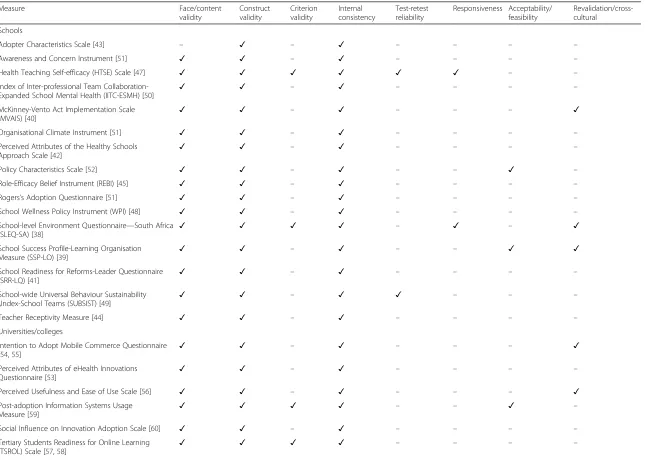
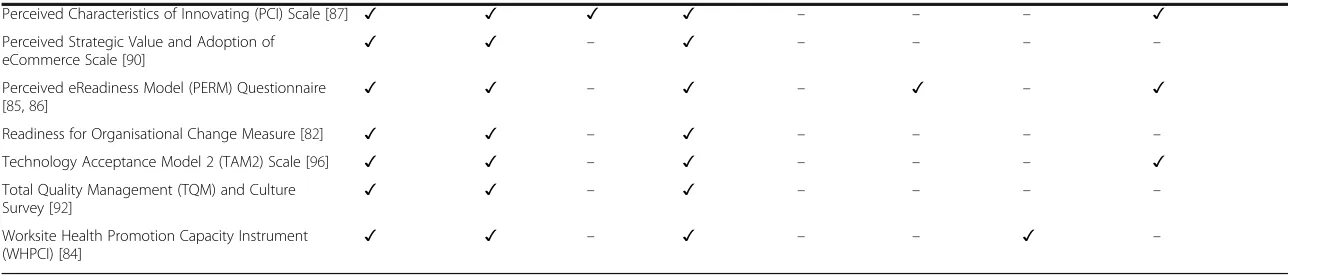
A summary of the psychometric criteria reported by
the included measures can be seen in Table 2.
Mapping of measure domains that align with the 37
constructs of the CFIR
The number of measure domains that mapped onto the
CFIR constructs ranged from 1 to 19. Relative advantage,
networks and communications, culture, implementation
climate, learning climate, readiness for implementation,
available resources, and reflecting and evaluating were
the constructs most frequently addressed by the
in-cluded measures. Five of the CFIR constructs were not
addressed by any measure (Additional file 6). These five
constructs were as follows: intervention source, tension
for change, engaging, opinion leaders, and champions.
Discussion
To our knowledge, this is the first systematic review to
de-scribe the psychometric properties of measures developed
to assess innovations and implementation constructs
spe-cifically in public health and community settings. Overall,
the psychometric properties of included measures were
typ-ically inadequately assessed or not reported. No single
measure reported on all key psychometric quality
indica-tors. The majority of studies assessed face, content,
con-struct validity, and internal consistency. However, criterion
validity (known-groups), test-retest reliability, and
accept-ability and feasibility were rarely reported. Only seven
mea-sures had responsiveness to change assessed. These
findings mirror those of previous reviews [7, 13] that found
that few measures demonstrated test-retest reliability,
ac-ceptability, or criterion validity.
When measures did report psychometric data, it was
typically below the widely accepted thresholds defined in
this review. Almost half of the measures that reported
undertaking EFA reported that their final factor model
ex-plained <50 % of the variance. Furthermore, none of the
measures that used CFA alone reported satisfactory
RMSEA (<.06) or CFI (>0.95). This suggests that a notable
proportion of available implementation measures
devel-oped and currently available for use in non-clinical
settings are not particularly robust or are prone to
misspe-cification of fit. That only eight of the 51 measures
ex-plored criterion validity using known-groups is also
concerning. The lack of attention to known-groups
valid-ity limits the confidence we can place in these measures
being able to detect how groups within community
set-tings (e.g. experienced teachers vs. new teachers) vary in
regards to implementation of innovation. This is
import-ant for identifying which aspects of an intervention or
innovation might need to be adjusted to ensure more
ro-bust implementation in the future.
Internal consistency was frequently reported but only
40 % of measures reported that all scale domains had a
Cronbach
’
s alpha >0.70, highlighting a need for further
refinement of scale items and revalidation. Only three
measures assessed test-retest reliability, another area
re-quiring much greater attention in future studies. Those
studies that did assess test-retest reliability performed
well, meeting the vast majority threshold criteria.
How-ever, the stability of these types of measures over time
remains unclear. Acceptability and feasibility data were
reported for just 33 % of the measures. Mean
comple-tion time for measures was almost 35 min. Although
shorter questionnaires have been shown to improve
re-sponse rates [113], it is unclear what the optimal survey
length is while still maintaining the survey validity. Rates
of missing data ranged from 1.5 to <5 %, which
accord-ing to Schafer [114] is acceptable given missaccord-ing data
rates of less than 5 % are likely to be inconsequential.
Only 25 % of measures had been revalidated or validated
in a different culture. This limits the generalisability of
the measures and poses a significant barrier to research
translation within potentially underserved communities
or cultures [115].
Without more comprehensive assessment of the
psycho-metric properties of these instruments, the ability to
ascer-tain the utility of theories or frameworks to support the
implementation of innovations in public health and
com-munity settings is limited. For example, understanding the
responsiveness of measures is essential for evaluating
im-plementation interventions and ensuring that changes in
constructs over time can be detected [116, 117]. Having
measures which are acceptable and feasible is also
import-ant to the conduct of rigorous research, particularly in
more pragmatic research studies [5, 18]. Low survey
sponse rates or high rates of attrition due to onerous
re-search methods can introduce bias and compromise study
internal and external validity [118, 119].
Alignment of measure domains with constructs of the
CFIR
While some of the CFIR constructs were addressed by
do-mains from multiple measures in this study, five constructs
were not assessed by any measure. These were intervention
source, tension for change, engaging, opinion leaders, and
champions. The development of psychometrically robust
measures which can assess these constructs in public health
and community settings may be a priority area of research
for the field.
The most frequently addressed constructs appeared to
fall within the
‘
inner setting
’
and
‘
characteristics of
individ-uals
’
domains, suggesting that the focus of measures to date
has been on understanding only the immediate
environ-ment where the innovation or intervention will be
imple-mented. It appeared that measures addressing
‘
outer
setting
’
or
‘
process
’
constructs were less frequently observed
than other domains. The development of future measures
should target these domains of the CFIR to ensure a greater
breadth and depth of understanding of all factors which
may influence the implementation of evidence into practice
in public health and community settings.
Comparison of the current review with the SIRC
Instrument Review Project
Despite the similarity in review methodologies utilised
by the current review and that undertaken by SIRC [16],
few measures have been reported by both reviews. This
is not surprising, as although the SIRC review captured
some measures developed in education or workplace
settings, other public health and community settings
were not addressed. Furthermore, the SIRC review used
a much broader inclusion criteria with regard to
mea-sures of CFIR constructs. For example, for the construct
of
‘
self-efficacy
’
, the SIRC review includes all measures of
efficacy, regardless of the context in which
self-efficacy is being examined. In contrast, the current
re-view only includes measures which assess self-efficacy in
the context of an individual
’
s perceived ability to
imple-ment the target innovation.
Despite these differences, the use of a common
frame-work (CFIR) for examining constructs captured by
dif-ferent
measures
in the
current
review
promotes
consistency and complements the findings of the SIRC
review.
Limitations
It is possible that not all existing implementation measures
in public health and community settings were captured by
this review. The keywords used to identify measures were
limited to
‘
questionnaire
’
,
‘
measure
,
’
‘
scale
’
, or
‘
tool
’
and other
possible terms such as
‘
instrument
’
and
‘
test
’
were not used.
These terms were excluded due to the likelihood of
identi-fying non-relevant publications related to clinical practice
(e.g. surgical instruments, immunologic tests). However, the
exclusion of these keywords may have meant that some
relevant publications were not identified during the
data-base search. Additionally, the review did not assess
mea-sures published in the grey literature and only studies
published in English were included. However, it is likely
that those measures which were identified represent the
best available evidence, given their publication in
peer-reviewed journals and indexing in four scientific databases.
The psychometric properties that were chosen to be
ex-tracted from publications about each measure may have
also limited the findings. For example, for studies that
uti-lised CFA, only data pertaining to the RMSEA and CFI
were recorded based on recommendations by Schmitt [32].
Included publications may have reported additional CFA
metrics (such as goodness of fit (GFI) or the normed fit
index (NI)); however, they were not included in this review.
Despite these limitations, the findings from this review
are likely to be of value to public health researchers who
are looking to identify measures with robust
psychomet-ric properties that can be used to assess implementation
constructs. There are, however, a small number of
con-structs for which no measure could be identified.
Devel-oping measures which can assess these five remaining
constructs will be an important consideration for future
research.
Conclusion
Existing measures of implementation constructs for use in
public health and community settings require additional
testing to enhance their reliability and validity. Further
re-search is also needed to revalidate these measures in
dif-ferent settings and populations. At present, no single
measure, or combination of measures, can be used to
as-sess all constructs of the CFIR in public health and
com-munity settings. The development of new measures which
can assess the broader range of implementation constructs
across all of the CFIR domains should continue to be a
priority for the field.
Additional files
Additional file 1:Summary of the CFIR domains and constructs used to support mapping of included measure domains [19]. (DOCX 32.8 kb)
Additional file 2:Face and content validity of each measure [25, 40–45, 47–97, 120–221]. (DOCX 44.7 kb)
Additional file 3:Construct and criterion validity of each measure [25, 40–92, 94, 96, 222–228]. (DOCX 48.4 kb)
Additional file 4:Internal consistency and test-retest reliability of each measure [25, 40–45, 47–92, 94, 96]. (DOCX 45.7 kb)
Additional file 5:Responsiveness, acceptability, feasibility, and cross-cultural adaptation for each measure [38–45, 47–92, 94, 96, 98–112]. (DOCX 42.1 kb)
Additional file 6:Mapping of measure domains against the 37 CFIR constructs [38–45, 47–92, 94, 96]. (DOCX 60 kb)
Abbreviations
CFA:confirmatory factor analysis; CFI: comparative fit index; CFIR: Consolidated Framework for Implementation Research (CFIR); CINAHL: Cumulative Index to Nursing and Allied Health Literature; EFA: exploratory factor analysis; EMBASE: Excerpta Medica database; GFI: goodness of fit; IOF: Implementation Outcomes Framework; MEDLINE: Medical Literature Analysis and Retrieval System Online; MeSH: Medical Subject Headings; NI: normed fit index; PRISMA: Preferred Reporting Items for Systematic Reviews and Meta-Analyses; RMSEA: root mean square error of approximation; SIRC: Society for Implementation Research Collaboration (SIRC)
Acknowledgements
The authors wish to acknowledge Ms. Tara Payling for the assistance with identifying the included publications.
Funding
The study was supported by an infrastructure funding from the University of Newcastle, Hunter Medical Research Institute, and Hunter New England Population Health.
Availability of data and materials
All data generated or analysed during this study are included in the published article and its supplementary information files.
Authors’contributions
LW, SY, and TCM developed the aims, the methodology, and the search terms. TCM, FT, TR, AF, ES, MK, and JYO contributed to the abstract and full-text screening and data extraction. TCM led the authorship of the manu-script. All other authors contributed to authorship and all approved the final manuscript.
Competing interests
The authors declare that they have no competing interests.
Consent for publication
Not applicable.
Ethics approval and consent to participate
Not applicable.
Author details
1School of Medicine and Public Health, The University of Newcastle, Callaghan, NSW 2308, Australia.2Hunter Medical Research Institute, New Lambton Heights, NSW 2305, Australia.3Hunter New England Population Health, Wallsend, NSW 2287, Australia.
Received: 14 March 2016 Accepted: 20 October 2016
References
1. Davies P, Walker A, Grimshaw J. A systematic review of the use of theory in the design of guideline dissemination and implementation strategies and interpretation of the results of rigorous evaluations. Implement Sci. 2010;5:14. 2. Nilsen P. Making sense of implementation theories, models and frameworks.
Implement Sci. 2015;10:53.
3. Tabak RG, Khoong EC, Chambers D, Brownson RC. Bridging research and practice: models for dissemination and implementation research. Am J Prev Med. 2012;43:337–50.
4. Martinez RG, Lewis CC, Weiner BJ. Instrumentation issues in implementation science. Implement Sci. 2014;9:118.
5. Rabin BA, Purcell P, Naveed S, Moser RP, Henton MD, Proctor EK, Brownson RC, Glasgow RE. Advancing the application, quality and harmonization of implementation science measures. Implement Sci. 2012;7:119. 6. Brennan SE, Bosch M, Buchan H, Green SE. Measuring organizational and
individual factors thought to influence the success of quality improvement in primary care: a systematic review of instruments. Implement Sci. 2012;7:121. 7. Chaudoir SR, Dugan AG, Barr CH. Measuring factors affecting
implementation of health innovations: a systematic review of structural, organizational, provider, patient, and innovation level measures. Implement Sci. 2013;8:22.
8. Chor KHB, Wisdom JP, Olin SCS, Hoagwood KE, Horwitz SM. Measures for predictors of innovation adoption. Adm Policy Ment Health. 2014;42:545–73. 9. Scott T, Mannion R, Davies H, Marshall M. The quantitative measurement of
organizational culture in health care: a review of the available instruments. Health Serv Res. 2003;38:923–45.
10. Weiner BJ, Amick H, Lee SYD. Conceptualization and measurement of organizational readiness for change: a review of the literature in health services research and other fields. Med Care Res Rev. 2008;65:379–436. 11. King T, Byers JF. A review of organizational culture instruments for nurse
executives. J Nurs Adm. 2007;37:21.
12. Emmons KM, Weiner B, Fernandez ME, Tu SP. Systems antecedents for dissemination and implementation: a review and analysis of measures. Health Educ Behav. 2012;39:87–105.
13. Squires JE, Estabrooks CA, Gustavsson P, Wallin L. Individual determinants of research utilization by nurses: a systematic review update. Implement Sci. 2011;6:1.
14. McDowell I. Measuring health: a guide to rating scales and questionnaires. New York: Oxford University Press; 2006.
15. Hersen M. Clinician’s handbook of adult behavioral assessment. Boston: Elsevier Academic Press; 2006.
16. Lewis CC, Fischer S, Weiner BJ, Stanick C, Kim M, Martinez RG. Outcomes for implementation science: an enhanced systematic review of instruments using evidence-based rating criteria. Implement Sci. 2015;10:155. 17. Lewis CC, Stanick CF, Martinez RG, Weiner BJ, Kim M, Barwick M, Comtois
KA. The Society for Implementation Research Collaboration Instrument Review Project: a methodology to promote rigorous evaluation. Implement Sci. 2015;10:2.
18. Proctor E, Silmere H, Raghavan R,