R E S E A R C H
Open Access
Integrating guideline development and
implementation: analysis of guideline
development manual instructions for generating
implementation advice
Anna R Gagliardi
1*and Melissa C Brouwers
2Abstract
Background:Guidelines are important tools that inform healthcare delivery based on best available research evidence. Guideline use is in part based on quality of the guidelines, which includes advice for implementation and has been shown to vary. Others hypothesized this is due to limited instructions in guideline development manuals. The purpose of this study was to examine manual instructions for implementation advice.
Methods:We used a directed and summative content analysis approach based on an established framework of guideline implementability. Six manuals identified by another research group were examined to enumerate implementability domains and elements.
Results:Manuals were similar in content but lacked sufficient detail in particular domains. Most frequently this was Accomodation, which includes information that would help guideline users anticipate and/or overcome
organizational and system level barriers. In more than one manual, information was also lacking for
Communicability, information that would educate patients or facilitate their involvement in shared decision making, and Applicability, or clinical parameters to help clinicians tailor recommendations for individual patients.
Discussion:Most manuals that direct guideline development lack complete information about incorporating implementation advice. These findings can be used by those who developed the manuals to consider expanding their content in these domains. It can also be used by guideline developers as they plan the content and
implementation of their guidelines so that the two are integrated. New approaches for guideline development and implementation may need to be developed. Use of guidelines might be improved if they included implementation advice, but this must be evaluated through ongoing research.
Keywords:Guideline development, Guideline implementation, Implementability
Background
Research, practice, and policy in the healthcare sector focus on improving the organization, delivery, and out-comes of care. Critical to achieving these objectives is the need for guidance based on currently available knowledge generated through research. This has led to an emphasis on evidence syntheses such as guidelines that are defined as‘systematically developed statements to assist practitioner and patient decisions about
appropriate healthcare for specific clinical circum-stances’[1,2]. While guidelines are important decision-making tools, along with expert clinical judgment and patient preference, their impact remains variable. Per-haps the most convincing evidence of this comes from a population-based assessment of performance on 439 recommendations for 30 conditions spanning prevent-ive, acute, and chronic services that found that only 55% of patients in the United States received recommended care [3]. Similar lack of adherence to practice guidelines continues to be identified worldwide across different conditions and settings of care [4-7].
* Correspondence:[email protected]
1University Health Network, 200 Elizabeth Street, Toronto, Ontario, Canada
Full list of author information is available at the end of the article
Numerous factors influence whether and how guide-lines are used. Some of these are extrinsic factors, such as: the nature of the newly recommended practice or technology itself; characteristics of healthcare providers; organizational capacity to collect, adapt, share, and apply evidence; and system-level environmental factors [8-10]. Because these manifest downstream of guideline devel-opment, single and combined interventions can be ap-plied to address these barriers and improve compliance with guideline recommendations, although their impact can be variable and inconsistent [11]. Other factors are intrinsic to guidelines and perhaps best addressed at the time of guideline development. For example, guidelines may be biased through conflict of interest, of variable methodological quality, poorly written and ambiguously presented, viewed as not applicable to individual patients or reducing clinician autonomy, and the volume of guidelines now available may be overwhelming, particu-larly given that recommendations for the same clinical indication may be inconsistent across different guide-lines [12-14].
To promote the development and use of high quality guidelines, the Appraisal of Guidelines Research and Evaluation (AGREE) instrument was developed by an international collaboration of guideline development experts [15]. A revised version, AGREE II, was recently issued [16]. It can be used to score guidelines based on their reported scope and purpose, stakeholder involve-ment, rigour of developinvolve-ment, clarity of presentation, edi-torial independence, and applicability. The Guideline Implementability Appraisal (GLIA) instrument is an-other tool that similarly considers the impact of guide-line recommendations on individuals and organizations, and whether measurable indicators are provided by which to evaluate implementation [17]. Still, many guidelines fail to comply with these recommended
stan-dards. Shaneyfelt et al. evaluated 279 guidelines
pub-lished from 1985 to June 1997 by 69 different developers, and found that mean overall adherence to standards for guideline format, methods, identification and summary of evidence, and formulation of recom-mendations was 43% [18]. When the AGREE instrument was used to evaluate 86 guidelines from 11 countries published between 1992 and 1999, they were found to vary considerably in whether and how they addressed each domain [19].
Turner et al. proposed that variability in manuals de-scribing guideline development methods may be causing the mismatch between standards for guideline quality and the actual quality of guidelines [20]. They identified and examined six prominent guideline development manuals and found strong concordance in recom-mended guideline development methods across all man-uals. However, the instructions varied in level of detail,
so the authors hypothesized that manuals may not pro-vide sufficient guidance on how to complete all steps of the guideline development process.
It is now well recognized that simply producing guide-lines does not itself lead to use, and that active imple-mentation is needed to encourage their uptake. The Knowledge to Action Cycle offers a framework for pro-moting the use of guidelines [21]. It recommends an it-erative process comprised of several steps, including adapting guidelines to local context, identifying barriers of guideline use, selecting and implementing tailored interventions to promote guideline use, monitoring guideline use, evaluating outcomes associated with guideline use, and sustaining guideline use. Regardless of
whether guideline developers are mandated and
resourced to implement the guidelines they produce, or whether it is the responsibility of other individuals or organizations to implement guidelines, detailed instruc-tions for guideline implementation are needed. Turner
et al. found that four of six manuals described instruc-tions for developing implementation advice that could be included in guidelines. However, the framework they used to examine manuals was based largely on the AGREE instrument, supplemented by a literature search for other key methods related to the development of guidelines. The framework consisted of 14 elements organized in four domains: preparing for guideline de-velopment, systematically reviewing the evidence, draft-ing the guideline, and reviewdraft-ing the guideline. Only one element pertained to implementation, and they only looked for presence or absence of any implementation information, and not the details of instructions for devel-oping implementation advice.
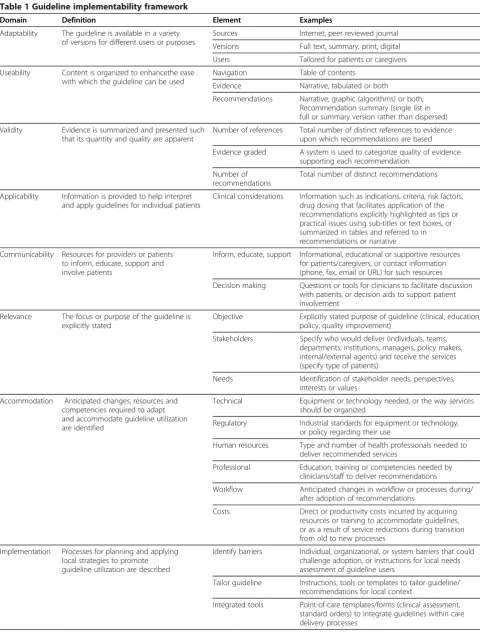
Table 1 Guideline implementability framework
Domain Definition Element Examples
Adaptability The guideline is available in a variety of versions for different users or purposes
Sources Internet, peer reviewed journal
Versions Full text, summary, print, digital
Users Tailored for patients or caregivers
Useability Content is organized to enhancethe ease with which the guideline can be used
Navigation Table of contents
Evidence Narrative, tabulated or both
Recommendations Narrative, graphic (algorithms) or both; Recommendation summary (single list in full or summary version rather than dispersed)
Validity Evidence is summarized and presented such that its quantity and quality are apparent
Number of references Total number of distinct references to evidence upon which recommendations are based
Evidence graded A system is used to categorize quality of evidence supporting each recommendation
Number of recommendations
Total number of distinct recommendations
Applicability Information is provided to help interpret and apply guidelines for individual patients
Clinical considerations Information such as indications, criteria, risk factors, drug dosing that facilitates application of the recommendations explicitly highlighted as tips or practical issues using sub-titles or text boxes, or summarized in tables and referred to in recommendations or narrative
Communicability Resources for providers or patients to inform, educate, support and involve patients
Inform, educate, support Informational, educational or supportive resources for patients/caregivers, or contact information (phone, fax, email or URL) for such resources
Decision making Questions or tools for clinicians to facilitate discussion with patients, or decision aids to support patient involvement
Relevance The focus or purpose of the guideline is explicitly stated
Objective Explicitly stated purpose of guideline (clinical, education, policy, quality improvement)
Stakeholders Specify who would deliver (individuals, teams, departments, institutions, managers, policy makers, internal/external agents) and receive the services (specify type of patients)
Needs Identification of stakeholder needs, perspectives, interests or values
Accommodation Anticipated changes, resources and competencies required to adapt and accommodate guideline utilization are identified
Technical Equipment or technology needed, or the way services should be organized
Regulatory Industrial standards for equipment or technology, or policy regarding their use
Human resources Type and number of health professionals needed to deliver recommended services
Professional Education, training or competencies needed by clinicians/staff to deliver recommendations
Workflow Anticipated changes in workflow or processes during/ after adoption of recommendations
Costs Direct or productivity costs incurred by acquiring resources or training to accommodate guidelines, or as a result of service reductions during transition from old to new processes
Implementation Processes for planning and applying local strategies to promote guideline utilization are described
Identify barriers Individual, organizational, or system barriers that could challenge adoption, or instructions for local needs assessment of guideline users
Tailor guideline Instructions, tools or templates to tailor guideline/ recommendations for local context
guideline development manuals lack instructions for developing such implementation advice. To confirm this and more thoroughly describe the nature of instructions for developing implementation advice in guideline devel-opment manuals, the purpose of this research was to
re-examine the manuals sampled by Turneret al. according
to our framework of implementability, which reflects guideline components shown by research to be asso-ciated with intent to, and actual use of guidelines. Use of a more detailed framework serves to pinpoint specific
implementation information that may be lacking,
thereby informing future updating of such manuals, or development of adjunct products.
Methods Approach
Content analysis describes ideas in written, verbal, or visual communication to generate, extend, or validate a framework or model [23]. It involves preparation (select unit of analysis, review data), analysis (code, group text by category), and reporting (describe analysis, findings). There are three types of content analysis (conventional, directed, summative) that vary by inductive or deductive nature [24]. This study adopted a directed approach by examining the content of guideline development man-uals based on domains and elements in the implement-ability framework, and a summative approach by synthesizing findings to compare the domains and ele-ments included in each manual (summative). As with any qualitative research, the findings of content analysis can be quantified, for example, by counting the number of times a word is used or an idea expressed, or expressed more qualitatively by identifying themes and the way they are expressed [24]. We described the pres-ence or abspres-ence of content reflecting implementability domains and elements quantitatively, and compared those findings across manuals.
Data collection
The unit of analysis is the guideline development man-ual. These were sampled by convenience. We examined
the same manuals identified by Turner et al. because
they used a comprehensive strategy to search for and identify the manuals, including the MEDLINE database,
various guideline web sites, web sites of known guideline developers, a general search of the Internet using Goo-gle, and consultation with members of an evidence-based healthcare email list. They included manuals published in English language, produced by international organizations responsible for guideline development, and supporting the development of evidence-based guide-lines, and excluded manuals issued by specialty societies for specific conditions.
Full-text manuals were retrieved from organization web sites, which were checked once again at the time of writing this manuscript to ensure the most recent ver-sions were analyzed. A data extraction form reflecting the implementability framework domains and elements was developed. It was used to extract information about the presence or absence of each element anywhere within the guideline development manuals, plus produ-cer, date of publication, number of pages, stated object-ive of the manual, implementation context (the stated purpose or setting of implementation), and how the im-plementation content was organized within the manual. Two individuals independently extracted data, and a third resolved differences and tabulated the data.
Data analysis
Tabulated findings were examined to describe general features of each manual, and enumerate the presence of implementation instructions reflecting elements from the implementability framework.
Results
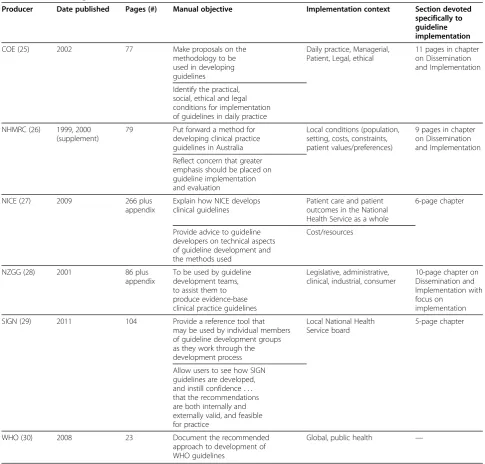
Manual features are summarized in Table 2. The six manuals were published between 1998 and 2011 by the Council of Europe (COE), National Health and Medical Research Council (NHMRC), National Institute for Health and Clinical Excellence (NICE), New Zealand Guidelines Group (NZGG), Scottish Intercollegiate Guideline Network (SIGN), and the World Health Organization (WHO) [25-30]. Their size ranged from 23 to 266 pages plus appendices. The stated objective of all manuals was similar: to inform guideline development. The stated implementation context was also similar across the six manuals, encompassing local patient care, regional management of services, and population-based
Table 1 Guideline implementability framework(Continued)
Promote utilization Possible mechanisms by which to promote guideline utilization
Evaluation Processes for evaluating guideline implementation and utilization are described
Implementation Methods for evaluating the implementation process
policy setting. Five of the six manuals contained a spe-cific chapter addressing implementation ranging from five to eleven pages [25-29], and one of the five offered a 104-page supplement specific to implementation [26].
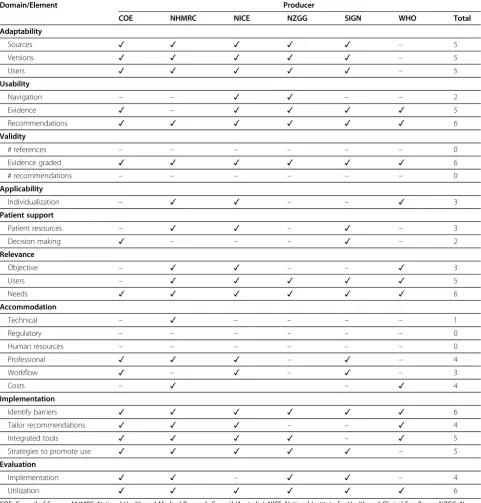
Implementability domains and elements addressed in manuals are enumerated in Table 3. Most manuals con-tained some representation of the majority of these domains and elements, though detail was minimal and did not lend itself to thematic analysis. COE included all domains but Applicability, but few elements within the
domains of Relevance and Accommodation [25].
NHMRC [26] included all domains in the main manual or implementation supplement but few elements in the domain of Accommodation, as did NICE [27]. NZGG did not include the domains of Applicability and Com-municability, and few elements in the domain of Accom-modation [28]. SIGN did not include the domain of Applicability, and few elements in the domains of Ac-commodation and Implementation [29]. WHO did not include the domains of Adaptability and Comunicability, Table 2 Features of guideline manuals
Producer Date published Pages (#) Manual objective Implementation context Section devoted
specifically to guideline implementation
COE (25) 2002 77 Make proposals on the
methodology to be used in developing guidelines
Daily practice, Managerial, Patient, Legal, ethical
11 pages in chapter on Dissemination and Implementation
Identify the practical, social, ethical and legal conditions for implementation of guidelines in daily practice
NHMRC (26) 1999, 2000 (supplement)
79 Put forward a method for developing clinical practice guidelines in Australia
Local conditions (population, setting, costs, constraints, patient values/preferences)
9 pages in chapter on Dissemination and Implementation
Reflect concern that greater emphasis should be placed on guideline implementation and evaluation
NICE (27) 2009 266 plus
appendix
Explain how NICE develops clinical guidelines
Patient care and patient outcomes in the National Health Service as a whole
6-page chapter
Provide advice to guideline developers on technical aspects of guideline development and the methods used
Cost/resources
NZGG (28) 2001 86 plus
appendix
To be used by guideline development teams, to assist them to produce evidence-base clinical practice guidelines
Legislative, administrative, clinical, industrial, consumer
10-page chapter on Dissemination and Implementation with focus on
implementation
SIGN (29) 2011 104 Provide a reference tool that
may be used by individual members of guideline development groups as they work through the development process
Local National Health Service board
5-page chapter
Allow users to see how SIGN guidelines are developed, and instill confidence. . . that the recommendations are both internally and externally valid, and feasible for practice
WHO (30) 2008 23 Document the recommended
approach to development of WHO guidelines
Global, public health —
few elements in the domain of Accommodation, and cursory mention of Implementation and Evaluation [30].
Discussion
We examined the content of the same guideline develop-ment manuals reviewed by Turneret al. [20] using a more comprehensive framework to assess the degree to which they offered instructions for developing implementation
advice. Our findings support the observation of Turner
et al. that the manuals were similar but lacked suffi-cient detail. We did not identify trends in manual purpose, implementation context, or content by type of guideline developer. Use of a more comprehensive frame-work reflecting the multiple steps of implementation revealed specific topics not addressed. Most frequently this was Accomodation, or information that would help Table 3 Domains of implementability addressed in guideline manuals
Domain/Element Producer
COE NHMRC NICE NZGG SIGN WHO Total
Adaptability
Sources ✓ ✓ ✓ ✓ ✓ – 5
Versions ✓ ✓ ✓ ✓ ✓ – 5
Users ✓ ✓ ✓ ✓ ✓ – 5
Usability
Navigation – – ✓ ✓ – – 2
Evidence ✓ – ✓ ✓ ✓ ✓ 5
Recommendations ✓ ✓ ✓ ✓ ✓ ✓ 6
Validity
# references – – – – – – 0
Evidence graded ✓ ✓ ✓ ✓ ✓ ✓ 6
# recommendations – – – – – – 0
Applicability
Individualization – ✓ ✓ – – ✓ 3
Patient support
Patient resources – ✓ ✓ – ✓ – 3
Decision making ✓ – – – ✓ – 2
Relevance
Objective – ✓ ✓ – – ✓ 3
Users – ✓ ✓ ✓ ✓ ✓ 5
Needs ✓ ✓ ✓ ✓ ✓ ✓ 6
Accommodation
Technical – ✓ – – – – 1
Regulatory – – – – – – 0
Human resources – – – – – – 0
Professional ✓ ✓ ✓ – ✓ – 4
Workflow ✓ – ✓ – ✓ – 3
Costs – ✓ – ✓ 4
Implementation
Identify barriers ✓ ✓ ✓ ✓ ✓ ✓ 6
Tailor recommendations ✓ ✓ ✓ – – ✓ 4
Integrated tools ✓ ✓ ✓ ✓ – ✓ 5
Strategies to promote use ✓ ✓ ✓ ✓ ✓ – 5
Evaluation
Implementation ✓ ✓ – ✓ ✓ – 4
Utilization ✓ ✓ ✓ ✓ ✓ ✓ 6
guideline users anticipate and/or overcome organizational-and system-level barriers. This may include: information about equipment or technology needed; industrial stan-dards; policies governing their use; type and number of health professionals needed to deliver services; education, training, or competencies needed by staff to deliver services; anticipated changes in workflow or processes during or after adoption of guideline recommendations. In more than one manual, Communicability information was lacking, or resources that physicians and/or patients could use for edu-cation or to facilitate shared decision making, as was Ap-plicability information, or clinical parameters to help physicians tailor guideline recommendations for individual patients.
While directions for creating Applicability information were absent in guideline development manuals, our pre-vious work found that 90% of guidelines we examined
did include clinical considerations by which to
individualize recommendations [22]. This is likely be-cause guidelines largely summarize data from clinical studies, and closely related to this is information such as diagnostic or risk criteria, pharmacologic dosing, indica-tions for treatment or referral, and management opindica-tions that often form the basis of Applicability content. The absence of Accomodation and Communicability infor-mation in guideline development manuals may not be surprising. Traditionally guidelines have often focused on questions relevant to clinicians, and when gaps in care emerged, the focus of quality improvement has been on changing clinician behaviour. Recognition of the need to consider a broader array of factors that in-fluence guideline use and impact, and the role of guide-lines as tools to direct quality improvement in this broader context is relatively recent [8-10,21]. Similarly, the role of patients in the patient-provider dyad, clinical decision making, and even guideline development is evolving [31]. In keeping with the fact that new para-digms are emerging, our previous work found that 50% of the guidelines we examined contained Communicabil-ity information, and less than 50% contained Accomoda-tion informaAccomoda-tion [22].
The guideline enterprise is challenged to keep up with these changes and modify the traditional guideline devel-opment and implementation strategy. This may require consideration of different knowledge sources and evi-dence, involvement of different types of experts in the guideline development and implementation process ei-ther in staged fashion or as multidisciplinary or interpro-fessional teams, and partnerships between those who synthesize and interpret clinical effectiveness data and those who plan and/or undertake implementation. We know that guideline implementation is complex, and many developers lack the mandate and/or resources to implement the guidelines they produce [32,33], so an
overarching question that must be addressed is who bears responsibility for implementing guidelines, what resources are required to support implementation as conceived in this emerging, broader paradigm, and who will provide those resources.
Interpretation of these findings may be confounded by several issues. Not all existing guideline manuals were examined. We instead relied on the comprehensive search strategy applied by another research team to identify our sample. They chose to examine six manuals that were produced by major international guideline de-velopment organizations, and of a general nature and therefore of broad relevance. We did search for and examine newer versions of those manuals if they were available. We also ran an updated search for other gen-eral guideline development manuals, and found only one published by the Canadian Medical Association [34]. For consistency and comparative purposes, we examined only the six manuals that were included in the previous study but brief review of the CMA manual revealed that it consists of 34 pages, of which one eleven-page chapter on implementation partially addresses Implementation and a three-page chapter partially addresses Evaluation. Instructions reflecting the remaining implementability domains and elements is lacking, therefore this manual too provides guideline developers with little instruction for preparing implementation advice.
implementation advice. These findings can be used by those who developed the manuals to consider expanding their content. It can also be used by guideline developers as they plan the content and implementation of their guidelines so that the two are integrated.
Another limitation—not necessarily of our study, but in the evidence on guideline development and imple-mentation—is the lack of criteria by which to assess the quality or actionability of instructions for developing guidelines or guideline implementation advice [35]. By using our more comprehensive implementability frame-work, we were able to comment on the completeness of the instructions. To judge the quality of the content of the instructions would require development of criteria, probably through expert consensus because little evi-dence is available, and then more detailed analysis of the content, both of which were beyond the resources avail-able for the study described here. In ongoing research, we are searching for and examining the format and con-tent of guidelines or adjunct products reflecting Accom-modation, Implementation, and Evaluation to create ideal templates for tools offering implementation advice that will be vetted by both guideline developers and users.
In conclusion, most manuals that direct guideline de-velopment lack complete information about incorporat-ing implementation advice for elements considered important by health professionals and associated with guideline use. These findings can be used by those who developed the manuals to consider expanding their con-tent in these domains. It can also be used by guideline developers as they plan the content and implementation of their guidelines so that the two are integrated. How-ever, to embrace the emerging expanded paradigm of
guideline development and implementation, new
approaches may need to be considered, including use of different knowledge sources and evidence, involvement of different types of experts, and partnerships between those who synthesize and interpret clinical effectiveness data and those who plan and/or undertake implementa-tion. Who bears responsibility for implementing
guide-lines, what resources are required to support
implementation, and who will provide those resources must also be considered. Use of guidelines might be improved if they included implementation advice, but this must be evaluated through ongoing research.
Competing interests
The authors declare that they have no competing interests.
Authors’contributions
ARG conceived the study and its design, acquired funding, and coordinated its conduct. MCB contributed to study design, and participated in data interpretation. All authors read and approved the final manuscript.
Acknowledgements
This study and the cost of this publication was funded by the Canadian Institutes of Health Research, which took no part in the study design or conduct, or decision to submit this manuscript for publication.
Author details
1University Health Network, 200 Elizabeth Street, Toronto, Ontario, Canada. 2
McMaster University, Juravinski Hospital Site, 711 Concession Street, Hamilton, Ontario, Canada.
Received: 29 January 2012 Accepted: 10 July 2012 Published: 23 July 2012
References
1. Grimshaw J, Eccles M, Thomas R, MacLennan G, Ramsay C, Fraser C, Vale L:
Toward evidence-based quality improvement. Evidence (and its limitations) of the effectiveness of guideline dissemination and implementation strategies 1966–1998.J Gen Intern Med2006,21(Suppl 2): S14–S20.
2. Browman GP, Levine MN, Mohide A, Hayward RSA, Pritchard KI, Gafni A, Laupacis A:The practice guidelines development cycle: A conceptual tool for practice guidelines development and implementation.J Clin Oncol1995,13(2):502–512.
3. McGlynn EA, Asch SM, Adams J, Keesey J, Hicks J, DeCristofaro A, Kerr EA:
The quality of health care delivered to adults in the United States.NEJM 2003,348(26):2635–2645.
4. FitzGerald JM, Boulet LP, McIvor RA, Zimmerman S, Chapman KR:Asthma control in Canada remains suboptimal: the Reality of Asthma Control (TRAC) study.Can Respir J2006,13(5):253–259.
5. Brown LC, Johnson JA, Majumdar SR, Tsuyuki RT, McAlister FA:Evidence of suboptimal management of cardiovascular risk in patients with type 2 diabetes mellitus and symptomatic atherosclerosis.CMAJ2004,171
(10):1189–1192.
6. Roberts VI, Esler CN, Harper WM:What impact have NICE guidelines had on the trends of hip arthroplasty since their publication?J Bone Joint Surg2007,89(7):864–867.
7. Milchak JL, Carter BL, James PA, Ardery G:Measuring adherence to practice guidelines for management of hypertension.Hypertension2004,
44:602–608.
8. Using Knowledge and Evidence in Health Care. InMultidisciplinary Perspectives. Edited by Louise L-C, Francois C. Toronto: University of Toronto; 2004. Press.
9. Francke AL, Smit MC, de Veer AJE, Mistiaen P:Factors influencing the implementation of clinical guidelines for health care professionals.BMC Med Inform Dec Mak2008,8:38.
10. Baiardini I, Braido F, Bonini M,et al:Why do doctors and patients not follow guidelines?Curr Opin Allergy Clin Immunol2009,9:228–233. 11. Grimshaw JM, Thomas RE, MacLennan G, Fraser C, Ramsay CR, Vale L,et al:
Effectiveness and efficiency of guideline dissemination and implementation strategies.Health Technol Assess2004,8(6):1–72. 12. Davis DA, Taylor-Vaisey A:Translating guidelines into practice: A
systematic review of theoretic concepts, practical experience and research evidence in the adoption of clinical practice guidelines.CMAJ 1997,157(4):408–416.
13. Grilli R, Magrini N, Penna A, Mura G, Liberati A:Practice guidelines developed by speciality societies: the need for critical appraisal.Lancet 2000,355:103–106.
14. Ward JE, Grieco V:Why we need guidelines for guidelines: a study of the quality of clinical practice guidelines in Australia.Med J Aust1996,
156:574–576.
15. Collaboration AGREE:Development and validation of an international appraisal instrument for assessing the quality of clinical practice guidelines.Qual Saf Health Care2003,12(1):18–23.
16. Brouwers M, Kho ME, Browman GP,et al:on behalf of the AGREE Next Steps Consortium. AGREE II: Advancing guideline development, reporting and evaluation in health care.CMAJ2010,182(18):E839–E842. 17. Shiffman RN, Dixon J, Brandt C, Essaihi A, Hsiao A, Michel G, O’Connell R:
18. Shaneyfelt TM, Mayo-Smith MF, Rothwangl J:Are guidelines following guidelines? The methodological quality of clinical practice guidelines in the peer-reviewed medical literature.JAMA1999,281(20):1900–1905. 19. Burgers JS, Cluzeau FA, Hanna SE, Hunt C, Grol R:Characteristics of
high-quality guidelines: evaluation of 86 clinical guidelines developed in ten European countries and Canada.Int J Technol Assess Health Care 2003,19(1):148–157.
20. Turner T, Misso M, Harris C, Green S:Development of evidence based clinical practice guidelines: comparing approaches.Implement Sci2008,
3:45.
21. Graham ID, Logan J, Harrison MB, Straus SE, Tetroe J, Caswell,et al:Lost in knowledge translation: time for a map?J Cont Ed Health Prof2006,
26:13–24.
22. Gagliardi AR, Brouwers MC, Palda VA, Lemieux-Charles L, Grimshaw JM:How can we improve guideline use? A conceptual framework of
implementability.Implement Sci2011,6:26.
23. Elo S, Kyngas H:The qualitative content analysis process.J Adv Nurs2008,
62(1):107–115.
24. Hsieh HF, Shannon SE:Three approaches to qualitative content analysis.
Qual Health Res2005,15(9):1277–1288.
25. Council of Europe:Developing a methodology for drawing up guidelines on best medical practice. 2002. http://www.leitlinien.de/mdb/edocs/pdf/ literatur/coe-rec-2001-13.pdf.
26. National Health and Medical Research Council:A guide to the development, evaluation and implementation of clinical practice guidelines. 1999. http:// www.nhmrc.gov.au/_files_nhmrc/publications/attachments/cp30.pdf and How to put the evidence into practice: implementation and dissemination strategies, 2000. http://www.nhmrc.gov.au/_files_nhmrc/publications/ attachments/cp71.pdf.
27. National Insitute for Health and Clinical Excellence:The guideline manual. 2009. http://www.nice.org.uk/media/5F2/44/
The_guidelines_manual_2009_-_All_chapters.pdf.
28. New Zealand Guidelines Group:Handbook for the preparation of explicit evidence-based clinical practice guidelines. 2001. http://old.nzgg.org.nz/ download/files/nzgg_guideline_handbook.pdf.
29. Scottish Intercollegiate Guidelines Network:A guideline developers’ handbook. 2011. http://www.sign.ac.uk/pdf/sign50.pdf.
30. World Health Organization:Guidelines for WHO guidelines.; 2008. http://www. searo.who.int/LinkFiles/RPC_Handbook_Guideline_Development.pdf. 31. Legare F, Boivin A, van der Weijden T,et al:Patient and public
involvement in clinical practice guidelines.Med Decis Making2011,31(6): E45–E74.
32. Kryworuchko J, Stacey D, Bai N, Graham ID:Twelve years of clinical practice guideline development, dissemination and evaluation in Canada (1994 to 2005).Imp Sci2009,4:49.
33. Lavis JN, Oxman AD, Moynihan R, Paulsen EJ:Evidence-informed health policy–interviews with the directors of organizations that support the use of research evidence.Implement Sci2008,3:55.
34. Davis D, Goldman J, Palda VA:Handbook on clinical practice guidelines. Canadian Medical Assocation; 2007. http://www.cma.ca/handbook.pdf. 35. Schunemann HJ, Fretheim A, Oxman AD:Improving the use of research
evidence in guideline development: Guidelines for guidelines.Health Research Policy and Systems2006,4:13.
doi:10.1186/1748-5908-7-67
Cite this article as:Gagliardi and Brouwers:Integrating guideline
development and implementation: analysis of guideline development manual instructions for generating implementation advice.
Implementation Science20127:67. Submit your next manuscript to BioMed Central
and take full advantage of:
• Convenient online submission • Thorough peer review
• No space constraints or color figure charges
• Immediate publication on acceptance
• Inclusion in PubMed, CAS, Scopus and Google Scholar
• Research which is freely available for redistribution