S H O R T R E P O R T
Open Access
WhatisKT wiki: a case study of a platform for
knowledge translation terms and definitions
—
descriptive analysis
Kathleen Ann McKibbon
1*†, Cynthia Lokker
1†, Arun Keepanasseril
1†, Heather Colquhoun
2†,
Robert Brian Haynes
1and Nancy L Wilczynski
1Abstract
Background:More than a hundred terms, often with unclear definitions and varying emphases, are used by health research and practice communities across the world who are interested in getting the best possible evidence applied (e.g., knowledge translation, implementation science, diffusion of innovations, and technology transfer). This makes finding published evidence difficult and can result in reduced, misinterpreted, or challenging interactions among professionals. Open dialogue and interaction among various professionals is needed to achieve
consolidation of vocabulary. We use case report methods to describe how we sought to build an online tool to present the range of terms and facilitate the dialogue process across groups and disciplines interested in harnessing research evidence for healthcare.
Methods:We used a wiki platform from Wikispaces to present the problem of terminology and make a case and opportunity for collaboration on usage. Wikis are web sites where communities of users can collaborate online to build content and discuss progress. We gathered terms related to getting research into practice, sought published definitions, and posted these on the wiki (WhatisKT http://whatiskt.wikispaces.com/). We built the wiki in mid-2008 and promoted it through various groups and publications. This report describes the content of the site, our promotion efforts, use of the site, and how the site was used for collaboration up to the end of 2011.
Results:The WhatisKT wiki site now includes more than 120 pages. Traffic to the site has increased substantially from an average of 200 monthly visits in 2008 to 1700 in 2011. Visitors from 143 countries viewed the wiki in 2011, compared with 12 countries in 2008. However, most use has been limited to short term accesses of about 40 seconds per visit, and discussion of consolidation and solidifying terminology is conspicuously absent.
Conclusions:Although considerable interest exists in the terms and definitions related to getting research into practice based on increasing numbers of accesses, use of the WhatisKT wiki site for anything beyond quick lookups was minimal. Additional efforts must be directed towards increasing the level of interaction among the members of the site to encourage collaboration on term use.
Keywords:Diffusion of innovations, Research, Knowledge translation, Implementation science
* Correspondence:[email protected] †Equal contributors
1Health Information Research Unit, Dept of Clinical Epidemiology and
Biostatistics, McMaster University, CRL Building, 1280 Main Street West, Hamilton, ON L8S 4K1, Canada
Full list of author information is available at the end of the article
Background
The concept of using research findings to improve knowledge and practice behavior is broad and rapidly evolving, with many names such as knowledge transla-tion (KT), disseminatransla-tion, uptake, and implementatransla-tion science. For this article, we have chosen to use the term KT. Regardless of what term is used, the concept gener-ally encompasses the processes aimed at converting sci-entific knowledge to socially beneficial actions, often through behavior change of various stakeholders and actions of decision and policy makers. The scope of KT includes ‘knowledge dissemination, communication, technology transfer, ethical context, knowledge manage-ment, knowledge utilization, two-way exchange between researchers and those who apply knowledge, implemen-tation research, technology assessment, synthesis of results within a global context, development of consen-sus guidelines and more’ [1]. The primary purpose of KT is to ‘address the gap between what is known from research and implementation of this knowledge by key stakeholders’ [2]. The specific design of these KT activ-ities is dependent on the type of research knowledge to be transmitted and the target audience.
The terminology in the field is wide ranging, often with unclear definitions and varying emphases on KT aspects and their importance. With more than 100 terms in use across a wide spectrum of disciplines, navigating through KT terminology can be challenging for researchers, practitioners, and administrators [3]. Al-though divergent definitions can enrich a new field by adding dimensions to a given term or concept, lack of accepted semantics may prevent or decrease the quality of interactions among professionals, especially when the interactions cross national and regional boundaries or disciplines. Unclear definitions and inconsistent use of terminology also make finding published evidence chal-lenging, leading to duplication of effort, knowledge gaps, and challenges in the production of knowledge summar-ies. The fledgling field of KT needs an open dialogue and exchange of ideas among stakeholders to under-stand and potentially consolidate its related vocabulary. Several online tools can facilitate this process.
One such tool is a wiki, designed to allow collabor-ation and consensus building by encouraging online dia-logue and allowing modification of text by a defined user group. The concept of wikis became popular after the launch of Wikipedia in 2001 [4]. Many groups have used wikis, including businesses [5], all levels of education (kindergarten to graduate school) [6], civil liberties unions [7], and medical groups [8]. Wikis have been used to prepare research publications [9], design re-search [10], build eRere-search Infrastructure [11], improve teaching and learning for nursing research teams [12], provide reminders to promote best practices in trauma
care [13], develop software and learning [14], enable professional development [15], and produce project management tools [16]. Wikis can be open to everyone with no restrictions on who can modify content, open to all for access but only allowing modification by mem-bers, or can be open only to a predefined community.
Blogs, discussion boards, and wikis have features that provide these collaborative traits. Blogs and discussion boards are more personal and provide static content that is often presented in chronological order. We chose to use a wiki, designed to allow collaboration and consen-sus building by encouraging online dialogue and allow-ing modification of text by a defined user group. Wikis excel when a community of users wants to build a shared repository of knowledge [17]. Wikis have advan-tages over other collaboration tools and methods. They allow creation and maintenance of documents in dy-namic and collaborative ways while keeping all versions of the documents (versioning) produced by multiple authors [14,18,19]. Wikis also allow incremental devel-opment of knowledge bases [20] and promote transpar-ency in knowledge creation [16]. Selected information can be placed online to facilitate discovery and discus-sion [21].
Wikis are extremely easy to use and edit, requiring lit-tle to no technical skill [18]. They are often inexpensive to start and do not need in-house computer support, de-sign experts, or trainers, making them cost and low-maintenance.
Collaborative innovation resulting from use of wikis has the potential to improve the quality of work and reports. KT researchers and practitioners could benefit from collaborative work to understand and build con-sensus, as well as to communicate the findings of KT re-search and evaluation. Therefore, we felt that use of a wiki for the broad, multinational network of KT researchers could facilitate resolution and understanding of our fields’terminology challenges. Other groups have used wikis for their vocabulary work. The US Environ-mental Protection Agency, through their Terminology Services group, uses internal wiki-based platforms for collaborative vocabulary building. They have developed a suite of tools to help users understand the Agency and make their information “findable” [22]. Researchers at Stanford Center for Biomedical Informatics Research have developed web-based tools that allow ontology building by a dispersed community [23]. Researchers at the US National Cancer Institute and the Kaiser Permanente Colorado Cancer Communication Research Center have built a wiki for their community of users based on outcome measures and vocabulary related to dissemination and implementation [24].
disseminate the wiki, how it has been used (2008–2011) and how successful we have been. This article is a case report of our experience and findings.
Methods
The WhatisKT wiki was created on the wikispaces plat-form. Wikispaces was selected because it offered easy edit-ing, reasonable rates, universal access not tied to an individual institution, and familiarity—it is one of the lar-gest of the wiki platforms. As of March 2011, Wikispaces had over 7.3 million registered users, more than 3.1 million all-time wikisites, and more than 105 million pages were viewed per month [9]. We use Google analytics to supple-ment the analytical data we receive from wikispaces.
User participation is the cornerstone of any wiki. The WhatisKT wiki offers several avenues for participation and collaboration to the users. We have incorporated design features keeping in mind the wide range of po-tential users of the wiki. For example, participants can join the WhatisKT wiki and then edit, review, comment, or add content. Members also have the option of joining an existing discussion or starting a new thread by post-ing in the discussion page.
Initial building of WhatisKT wiki
Our first goal in the project was to collect terms related to the practice and theory of KT and their definitions and post them on one site. We started with the list of KT terms provided by Graham and colleagues [2]. Using these terms, we sought definitions for each KT term sys-tematically by searching journals, books, and the Inter-net. Journals and books were searched using standard information retrieval methods and iterative cycling using newly-identified terms. In Google we used three search strings with each of our identified KT terms:
1.‘term,’e.g.,‘knowledge translation’
2. define:‘term,’e.g., define:‘knowledge translation’ 3.‘term’definition,e.g.,‘knowledge translation’
definition
We reviewed the links for the first 20 search results from each of the search strings for each term. If a defin-ition was found, the URL and the defindefin-ition were captured in a database. Any cited references in the definition or organizations that authored the definition also were col-lected, as was the date of last update for the website, if available. Duplicate definitions were tracked through their sources. We determined the discipline from which the definition came (e.g., psychology, education) and the spe-cific context of the definition, website (e.g., research train-ing), or both. Definitions came from a wide variety of disciplines, from nursing and medicine to sociology, mar-keting, and organizational behavior. We also contacted
authors, librarians, and content experts, and searched the relevant KT literature and technical reports. The process of searching and compiling terms and their definitions was iterative and completed over the course of six months, with periodic updating and addition of new terms. In late 2011, 107 terms are included on the wiki site. The terms are divided into‘KT terms’for core terms and‘other terms and concepts related to KT.’Core terms were those that had features of both the knowledge and moving that knowledge into practice or use. Other terms were those that were more peripheral, such as communi-cation, information, and evaluation.
Links to other KT-related sites and features
The home page also features links to such trusted sources of the high quality literature of KT as KT + (http://plus.mcmaster.ca/KT/Default.aspx) and other sites we felt would be potentially valuable to those inter-ested in the study or application of KT. WhatisKT peri-odically hosts polls and surveys on various aspects of KT, and provides access to the results of these polls. A user also has the option of receiving email notifications of updates for selected pages or for the entire wiki.
Proposed‘ideal’definitions framework
Because we were interested in providing a forum for communication around definitions and increased aware-ness of how individuals and groups are using KT terms, we started a process whereby we proposed a single def-inition that we felt could be embraced by KT researchers and users. We hoped that readers would dialogue using the wiki format to start the process of coming to a com-mon understanding of KT-related terms.
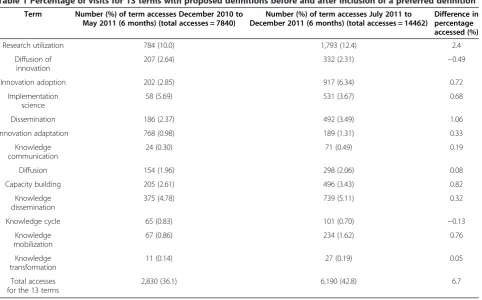
In spring 2011, we chose the terms that were viewed most frequently and selected 13 (Table 1). We used the broad and very commonly used definition of KT pro-vided by the Canadian Institutes for Health Research (CIHR) [1] to determine the concepts or issues that are components of KT. Authors McKibbon (KAM) and Keepanasseril (AK) ultimately identified 12 concepts within the CIHR definition [1] that were integral to KT: the knowledge to be transferred or translated; the need for that knowledge; the intervention for translation; how the information is to be applied; who is to receive the knowledge; who has the knowledge; what are important features of the context or setting; what skills are needed; what tools are needed to implement the knowledge; what are the barriers and facilitators to implementation; what are the outcomes and how are they measured; and how is the project going to be evaluated and monitored.
KT each definition covered. Although we acknowledge that few terms related to KT would include all of these components, the definitions for each of the 13 terms with the most concepts were further reviewed for clarity, comprehensiveness, reputation of source, and breadth of coverage. One preferred published definition for each of the 13 terms was selected based on consensus, taking into consideration inclusion of important concepts of KT and representing what the majority of the definitions for that term included. The selected definition was moved to the top of the list of definitions on the wiki page for that term and highlighted. We made note in the wiki that we were suggesting the use of that definition over the others. We asked our readers to comment on our choice, and if they did not agree, to make sugges-tions for a better selection of definition. To determine what our readers were reviewing and if they were com-menting on our definitions, we collected data on the de-gree to which these 13 terms were accessed.
Dissemination
In June 2008, we invited colleagues and fellow KT researchers to join the WhatisKT wiki as members through several emailings. These mailings went out to col-leagues of the authors and two mailing lists from KT Canada. We encouraged others to also mail out notice of our wiki. We urged the use of WhatisKT wiki in multiple
publications [3,25,26]. We notified directors of KT courses of the wiki, including four annual KT Canada Summer Institutes (2009–2012). We also presented sessions at con-ferences and workshops, and presented webinars introdu-cing the vocabulary challenges of KT and encouraging the use of the wiki for information and also consensus build-ing. The KT Canada KT Tools webpage links to WhatisKT (http://ktclearinghouse.ca/tools/uncategorized), as do other KT websites, such as Implementation Central (http://www. implementationcentral.com/index.html), KT + (http://plus. mcmaster.ca/kt/Default.aspx), and the Alberta Innovates Health Solutions. (http://www.aihealthsolutions.ca/rtna/ links.php).
Data analysis
Using data collected by wikispaces and Google analytics, we descriptively assessed usage and traffic trends for 2008 to the end of 2011. We also determined how the users came to the WhatisKT wiki by using internet sta-tistics sources and searching withGoogle and other search engines, such as Bing, Dogpile, and Altavista. Wiki traffic results are presented as monthly averages with the years broken down into six-month divisions for 2008 to 2011. Google analytics data are not available from June 29, 2010 to February 18, 2011 because of a lapse in our subscription.
Table 1 Percentage of visits for 13 terms with proposed definitions before and after inclusion of a preferred definition
Term Number (%) of term accesses December 2010 to May 2011 (6 months) (total accesses = 7840)
Number (%) of term accesses July 2011 to December 2011 (6 months) (total accesses = 14462)
Difference in percentage accessed (%)
Research utilization 784 (10.0) 1,793 (12.4) 2.4
Diffusion of innovation
207 (2.64) 332 (2.31) −0.49
Innovation adoption 202 (2.85) 917 (6.34) 0.72
Implementation science
58 (5.69) 531 (3.67) 0.68
Dissemination 186 (2.37) 492 (3.49) 1.06
Innovation adaptation 768 (0.98) 189 (1.31) 0.33
Knowledge communication
24 (0.30) 71 (0.49) 0.19
Diffusion 154 (1.96) 298 (2.06) 0.08
Capacity building 205 (2.61) 496 (3.43) 0.82
Knowledge dissemination
375 (4.78) 739 (5.11) 0.32
Knowledge cycle 65 (0.83) 101 (0.70) −0.13
Knowledge mobilization
67 (0.86) 234 (1.62) 0.76
Knowledge transformation
11 (0.14) 27 (0.19) 0.05
Total accesses for the 13 terms
Results
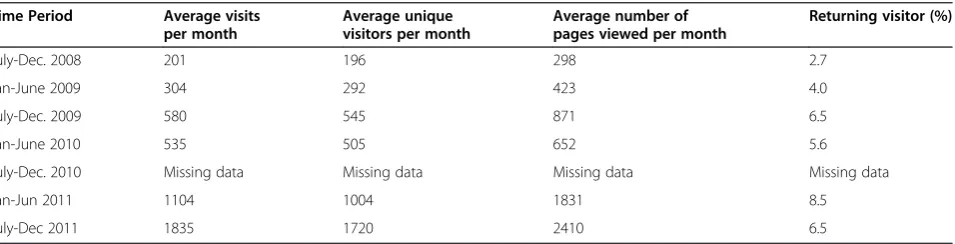
As of the end of 2011, the WhatisKT wiki has 107 pages, one for each KT term. Each term related to KT includes at least one published definition, with most having mul-tiple definitions. The number of visits to the wiki has increased substantially from 2008, when we had 200 unique visitors (unduplicated visitors, counted only once, in a specific timeframe) per month to more than 1,700 unique visitors per month in the last half of 2011 (Table 2). The percentage of returning visitors is low but has also been increasing from less than 3% in 2008 to 6.5% for all of 2011 (Table 2). With only 72 registered users, most use is from non-members.
We were hoping for interaction among users to in-clude commenting on terms and suggested definitions
—the main goal of the project. Several people suggested additional terms throughout the process. However, the most discouraging fact is that no one outside of our working group (up to 10 people at various times) used the WhatisKT wiki to comment on content, discuss pro-posed definitions, or to take part in other activities such as discussion groups.
The wiki garnered world-wide use with visitors from 12 countries in 2008 increasing to 143 countries in 2011. Table 3 lists the location of visitors who accessed the wiki from 2008 to 2011. Canada had the highest propor-tion of visitors for the first two years; the proporpropor-tion of US visitors has remained relatively unchanged since 2009, at approximately one-third of all visitors. All other countries showed substantial increases in use, especially the United Kingdom and India. Visitors from China began accessing the wiki in 2011. Australia and New Zealand had visitors in all years.
Average time spent by a visitor in the wiki was 16 sec-onds in the first half of 2009 and 57 secsec-onds in the cor-responding period in 2011 (Table 4). The bounce rate (percentage of users who only visit one webpage before leaving the site) ranged from 88% to 97% (Table 3).
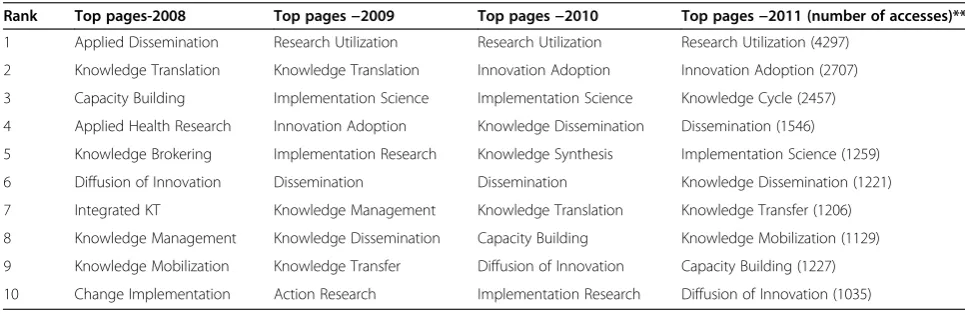
Table 5 lists the top 10 KT terms according to the number of times they were accessed during the four years of observation. Although the ranking of terms is
somewhat different across time periods, the terms accessed remained similar, especially for those accessed most frequently. We have included the number of accesses for 2011 to show the spread of number of visits. In 2011, ‘research utilization’ was viewed 4,030 times, while ‘diffusion of innovation’ was viewed 950 times. The least viewed terms for 2011 were‘routinization’(63 times),‘product adoption and utilization’(81 times), and
‘potentially better products’ (81 times). Eighteen other terms were viewed less than 100 times.
Table 1 shows the changes in the proportion of page views following changes in content. After implementing, the 13 enhanced definitions represented a greater pro-portion of the pages viewed after the terms were flagged as having a proposed definition than compared to before term flagging (P < 0.001for testing of proportions com-paring accesses in the six months before and six months after implementation of the definitions). ‘Research utilization’received the most page views both before and after the edits adding in the preferred definitions.
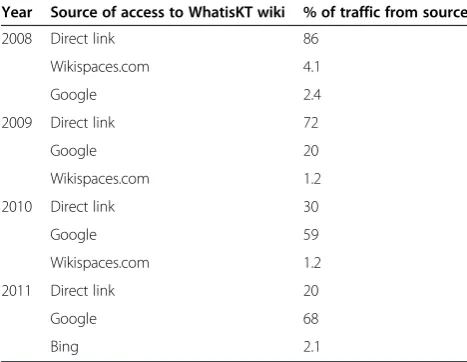
In 2008 and 2009, most visitors reached the site dir-ectly by typing or linking to the site URL in their browser address bar (86% and 72%, respectively). The rate of direct access has decreased and is now stabilized at approximately 30% (Table 6). Wikispaces, the hosting platform for the wiki, initially directed a few visitors, and this rate has steadily decreased. The proportion of people reaching the wiki through Google’s internet search engine has risen consistently over the years, from 2.4% in 2008 to 20% in 2009, 59% in 2010, and 67% in 2011. Google searches list WhatisKT as one of the first
Table 2 Average number of visitors per month to WhatisKT wiki for 6 month intervals
Time Period Average visits per month
Average unique visitors per month
Average number of pages viewed per month
Returning visitor (%)
July-Dec. 2008 201 196 298 2.7
Jan-June 2009 304 292 423 4.0
July-Dec. 2009 580 545 871 6.5
Jan-June 2010 535 505 652 5.6
July-Dec. 2010 Missing data Missing data Missing data Missing data
Jan-Jun 2011 1104 1004 1831 8.5
July-Dec 2011 1835 1720 2410 6.5
Table 3 Percentage of visitors to WhatisKT by country for 2008-2011
Year Canada US UK India Australia Others
2008 82.3 13.5 0.6 0.0 1.7 2.7
2009 43.2 34.7 7.6 0.7 1.4 7.0
2010 26.1 32.8 12.4 4.6 3.4 9
sites when Google is asked for ‘definitions’ or ‘define’ with any of the KT terms.
Discussion
The number of people using the WhatisKT wiki has steadily increased from 2008 to 2011, with average monthly visits increasing over 500% during this period. Similarly, the average number of monthly page views has increased by a factor of six, from 297 in 2008 to 1,948 in 2011. These numbers show the interest in static KT terminology information. The international nature of the visitors is notable. Overall, most visitors are from the United States, Canada, the United Kingdom, and Australia–probably because of the vibrant KT research and activity in those regions. Considerable and increas-ing interest is shown in the field from such countries as India and China, which are not traditionally considered centres of KT activity. This suggests that KT research and development is likely poised for global growth. Growth in interest is also shown by the fact that most people come to the wiki through Google. Our defini-tions pages appear near the top of Google search results lists, indicating that a number of other sites have created links to the wiki, thus signaling interest in KT terminology.
Our results related to collaboration and dialogue were discouraging. WhatisKT wiki members who were not part of the project development have not edited content or interacted with each other. This lack of editing and commenting could be because of such factors as per-ceived difficulty in editing and lack of specific guidance for the visitors on how best to contribute. The relative lack of participation (i.e., active editing) by the visitors is consistent with other web 2.0 applications: Contributors are only a very small portion of the total number of people who access the services for information [27]. According to Wikimedia's estimates, the larger Wikipe-dias (e.g., English, German, French) have 0.02% to 0.03% of visitors actively contributing to content [28,29]. In general, authorship attribution related to wikis is import-ant to only some contributors.
The WhatisKT wiki experience affords the following lessons for collaborative platforms: user registration is a barrier; user behavior can be observed but not explained by analysis of log tiles; and spurring collaboration using a platform such as a wiki requires further study and innovation. Registering as a member and editing or com-menting within a wiki are more difficult than contribut-ing to social media or commentcontribut-ing in an open forum. The exact nature and objectives of most of the visitors
Table 4 Average time spent on WhatisKT wiki and bounce rate for 6 month intervals
Time Period Average time per visit in seconds
Average number of pages per visit Average time per page in seconds Bounce rate* (%)
July-Dec. 2008 22 1.5 15 97
Jan-June 2009 16 1.4 11 96
July-Dec. 2009 37 1.5 16 94
Jan-June 2010 23 1.2 19 93
July-Dec. 2010 Missing data† Missing data† Missing data† Missing data†
Jan-June 2011 57 1.6 36 88
July-Dec. 2011 30 1.3 25 92
*“Bounce rate is the percentage of single-page visits or visits in which the person left the site from the entrance or landing page”. (http://www.google.com/ support/analytics/bin/answer.py?answer=81986).
†Google analytics data for this period was not recorded due to lapsed subscription.
Table 5 Ten most frequently viewed KT term pages by year for the WhatisKT wiki
Rank Top pages-2008 Top pages−2009 Top pages−2010 Top pages−2011 (number of accesses)**
1 Applied Dissemination Research Utilization Research Utilization Research Utilization (4297)
2 Knowledge Translation Knowledge Translation Innovation Adoption Innovation Adoption (2707)
3 Capacity Building Implementation Science Implementation Science Knowledge Cycle (2457)
4 Applied Health Research Innovation Adoption Knowledge Dissemination Dissemination (1546)
5 Knowledge Brokering Implementation Research Knowledge Synthesis Implementation Science (1259)
6 Diffusion of Innovation Dissemination Dissemination Knowledge Dissemination (1221)
7 Integrated KT Knowledge Management Knowledge Translation Knowledge Transfer (1206)
8 Knowledge Management Knowledge Dissemination Capacity Building Knowledge Mobilization (1129)
9 Knowledge Mobilization Knowledge Transfer Diffusion of Innovation Capacity Building (1227)
to the WhatisKT wiki are not yet known, but will be assessed in a 2013 survey of our members and users. These factors need to be ascertained to devise better strategies to foster collaboration using an online forum such as a wiki.
The average number of page views, time spent on site per visitor, and proportion of people who visited only one page can provide information about the online be-havior of visitors to a website but not necessarily why they visited or the effects of their visits. The average number of pages viewed by the visitors to the wiki has remained between one and two throughout the period of study. We did see an increase in the amount of time spent on the whole site and per page viewed. Combined with a high proportion of people who only visited one page (bounce rate) of above 90% and approximately 40 seconds per visit to the site, this likely indicates that most of the users visit the wiki for information regarding a specific term and leave thereafter. The increase in the proportion of pages viewed for the terms with a pro-posed definition could show evidence of strong interest in improving our use of KT terms. An alternative ex-planation is that the increased use is based on the added presence of a link from the home page to these sugges-tions for definisugges-tions. Further study is needed to deter-mine which explanation is warranted — both may be contributing to the very real increase in viewing.
We are planning a survey study to assess if visitors find the information useful. We hope that the wiki design and con-tent would promote cross navigation between pages, but we do not see evidence of the wiki being used in such a way. Im-proving navigation between pages may increase the average time per visit. We are also finding new terms to add to the wiki over time and still believe that a better understanding of how we use KT terms is needed. New interactive websites are available that offer easier commenting and contributing
facilities. We may need to modify our wiki, change our ap-proach to encouraging contribution, or move it to another platform if more user participation is to be assured. Inter-active websites have the advantage of ease of use, but they lack the meticulous versioning functionality of a wiki. Wikis were originally designed to be used ‘as a moderated list where anyone can be moderator and everything is archived’ [29]. Therefore, both versioning history and ease of use need to be considered in developing and maintaining collaborative knowledge platforms.
We are also planning to add content in relation to KT interventions—a list of interventions and the results of an international meeting to propose a simple framework for classifying KT interventions. This face-to-face meet-ing in Ottawa, sponsored by KT Canada on September 20–21, 2012, used the wiki as part of the planning. The meeting was designed to ‘strengthen KT interventions, and hence patient and population health, by clarifying terminology with the goal of improving evidence search-ing and synthesis, communication between research groups, disciplines, and countries and increasing the profile of KT in scientific and other arenas.’ Groups and individuals from many countries were invited. We plan to publish our recommendations and next steps. In addition, we will invite others to join our project through traditional publications, emails, and personal contact. The project will also include expansion and enhancement of the WhatisKT wiki to be more of a working tool for collaboration.
The outcome of using a wiki can be a‘function of both the features of technology and whether and how that technology is appropriated by groups that use it; neither can be divorced from the other’[30]. The 'wiki way' phil-osophy of sharing knowledge, inviting critique, present-ing multiple points of view and actively endeavorpresent-ing to influence and change others’ opinions must fit the cul-ture of the group [20]. We need to use our own KT knowledge to move WhatisKT into being a useful and used product. One way to increase participation may be to organize a formal link between the members, after which joint research and collaborative consultations can be facilitated. In fact, face-to-face group cohesion has been reported to make wikis work well [15,20]. Multiple techniques are needed for successful collaboration groups, and we can learn from the work of others [31]. Absence of a clear-cut social structure and incentive to collaborate have been suggested as possible reasons for a lack of engagement in collaborative technologies [30,31].
The ranking data showing which terms are accessed most often can be useful to determine where interest or confusion occurs in the domain. For example, because research utilization was the most often viewed term by a considerable margin, this might be a more acceptable umbrella term for cross discipline use.
Table 6 Top 3 access points that people used to access WhatisKT by year
Year Source of access to WhatisKT wiki % of traffic from source
2008 Direct link 86
Wikispaces.com 4.1
Google 2.4
2009 Direct link 72
Google 20
Wikispaces.com 1.2
2010 Direct link 30
Google 59
Wikispaces.com 1.2
2011 Direct link 20
Google 68
We have shown increases in the number of non-interactive visits and the global spread of WhatisKT; we now need to harness KT knowledge and move to other methods of collaboration on KT terminology.
Conclusion
People are interested in KT terms and definitions as shown by the large and consistent increase in the number of people who visit the WhatisKT wiki site. We also observed the movement of interest from initially Canada and then to Canada and the United States before expand-ing to many other countries, with large spikes in use from the United Kingdom and India. Although we sought to in-crease interaction with our site to enhance communica-tion about choice of KT definicommunica-tions, use was concentrated by those who sought KT definitions.
Abbreviations
KT: Knowledge translation.
Competing interests
The authors declare that they have no competing interests in the publication of this article.
Authors’contributions
RBH, KAM, NLW, HQ, and CL planned this project and provided input and guidance. KAM, CL, AK, HQ, and NLW planned and carried out the analyses and interpretation of the data. All authors approved of the final content of the paper.
Acknowledgements
Funding for this project was provided by the Canada Institutes of Health Research (FRN-86258). The authors thank Nicholas Hobson and Chris Cotoi for programming and technical support and Jeremy Grimshaw for suggestions regarding content.
Author details
1
Health Information Research Unit, Dept of Clinical Epidemiology and Biostatistics, McMaster University, CRL Building, 1280 Main Street West, Hamilton, ON L8S 4K1, Canada.2Centre for Practice-Changing Research (CPRC), Ottawa Hospital Research Institute. Ottawa Hospital–General Campus, 502 Smyth Road, Box 711, Ottawa, ON K1H 8L6, Canada.
Received: 9 March 2012 Accepted: 11 January 2013 Published: 24 January 2013
References
1. Knowledge Translation Strategies (2004–2009). http://www.cihr-irsc.gc.ca/e/ 26574.html#defining. Accessed March 8, 2012.
2. Graham ID, Logan J, Harrison MB, Straus SE, Tetroe J, Caswell W, Robinson N:Lost in knowledge translation: time for a map?J Contin Educ Health Prof2006,26:13–24.
3. McKibbon KA, Lokker C, Wilczynski NL, Ciliska D, Dobbins M, Davis DA, Haynes RB, Straus SE:A cross-sectional study of the number and frequency of terms used to refer to knowledge translation in a body of health literature in 2006: A Tower of Babel?Implement Sci2010,5:16. 4. History of wikis. http://en.wikipedia.org/wiki/History_of_wikis. Accessed
March 8, 2012.
5. Majchrzak A, Wagner C, Yates D:Corporate wiki users: results of a survey.
Pro-ceedings of the 2006 International Symposium on Wikis (WikiSym '06):
New York, NY, USA: Odense, Denmark. ACM; 2006:99–104. Conference chair D. Riehle.
6. Parker KR, Chao JT:Wiki as a teaching tool.Interdisciplinary J Knowledge and Learning Objects2007,3:57–72.
7. dKosopedia:About. http://www.dkosopedia.com/wiki/dKosopedia:About. Accessed March 8, 2012.
8. List of medical wikis. http://www.healthplusplus.com/wiki/ List_of_medical_wikis. Accessed March 8, 2012.
9. Von Hinten C, Hense A, Razum M:A Wiki for Collaboration and Publication in Research.Fourth IEEE International Conference on eScience; 7-12 December; Indianapolis, IN.Los Alamitos CA: Institute of Electrical and Electronic Engineering; 2008:790–794.
10. Salustri FA:A lightweight collaborative tool to support design research. In
Proceedings of International Conference on Engineering Design, ICED. Edited by Samuel A, Lewis W. Barton, A.C.T.: Engineers Australia: 15th Conference on Industrial Design and the Global Economy; 2005:3922–3934. 11. Higgs P, Cunningham S:Creative industries mapping: where have we
come from and where are we going?Creative Industries J2008,1:7–30.12. 12. Kardong-Edgren SE, Oermann MH, Ha Y, Tennant MN, Snelson C, Hallmark E,
Rogers N, Hurd D:Using a wiki in nursing education and research.IJNES
2009,6:6.
13. Archambault PM, Legare F, Lavoie A, Gagnon MP, Lapointe J, St-Jacques S, Poitras J, Aubin K, Croteau S, Pham-Dinh M:Study protocol Healthcare professionals’intentions to use wiki-based reminders to promote best practices in trauma care: a survey protocol.Implement Sci2010,5:45. 14. Phuwanartnurak AJ:Did you put it on the wiki? Information sharing
through wikis in interdisciplinary design collaboration. InProceedings of the 27th ACM International Conference on Design of Communication (SIGDOC '09). 5-7 October, Bloomington IN. Edited by Slattery WA. New York, NY, USA: ACM; 2009:273–280.
15. Varga-Atkins T, Dangerfield P, Brigden D:Developing professionalism through the use of wikis: a study with first-year undergraduate medical students.Med Teach2010,32:824–829.
16. Ebersbach A, Glaser M, Heigl R, Warta A:Wiki: Web Collaboration. New York: Springer; 2008.
17. Fichter D:The many forms of e-collaboration: Blogs, wikis, portals, groupware, discussion boards, and instant messaging.Online2005,
29:48–50.
18. Boulos M, Maramba I, Wheeler S:Wikis, blogs and podcasts: a new generation of Web-based tools for virtual collaborative clinical practice and education.BMC Med Educ2006,6:41.
19. Grudin J, Poole ES:Wikis at work: success factors and challenges for sustainability of enterprise Wikis,Proceedings of the 6th International Symposium on Wikis and Open Collaboration (WikiSym '10) 7-9 July. Gdansk Poland.New York, NY: ACM; 2010:5-1–5-8.
20. Watson K, Harper C:Supporting knowledge creation: Using wikis for group collaboration.Res Bull2008,3. http://net.educause.edu/ir/library/pdf/ ERB0803.pdf.
21. Anderson P, Blumenthal J, Bruell D, Rosenzweig M, Conte M, Song J:An online and social media training curricula to facilitate bench-to-bedside information transfer, Paper presented at: Positioning the Profession: The Tenth International Congress on Medical Librarianship. Brisbane, Australia (1–10): Aug–4 Sep 2009. University of Queensland, eSpace; 2011:1–11. 22. US Environmental Protection Agency:Terminology Services. http://ofmpub.
epa.gov/sor_internet/registry/termreg/home/overview/home.do Accessed October 5, 2012.
23. Tudorache T, Noy NF, Musen MA, Collaborative Protégé:Enabling community based authoring of ontologies. Semantic Web-ISWC Conference. 2008:17–32. http://www4.wiwiss.fu-berlin.de/bizer/pub/iswc2008pd/ iswc2008pd_submission_60.pdf Accessed October 5, 2012. 24. U.S. National Cancer Institute:Grid Enabled Measures (GEM) Database.
https://www.gem-beta.org/Public/wsoverview.aspx?wid=11&cat=8 Accessed October 24, 2012.
25. McKibbon KA, Lokker C, Wilczynski NL, Haynes RB, Ciliska D, Dobbins M, Davis DA, Straus SE:Search filters can find some but not all knowledge translation articles in MEDLINE: an analytic survey.J Clin Epidemiol2012,
65:651–659.
26. Lokker C, McKibbon KA, Wilczynski NL, Haynes RB, Ciliska D, Dobbins M, Davis DA, Straus SE:Finding knowledge translation articles in CINAHL.
Stud Health Technol Inform2010,160(Pt 2):1179–1183.
27. Tancer B:Who’s really participating in web 2.0.Time. Web article posted April 25, 2007. http://www.reuters.com/article/2007/04/18/us-web-participation-idUSN1743638820070418. Accessed October 26, 2012. 28. Glott R, Schmidt P, Ghosh R:Wikipedia survey - overview of results, United
29. Cummings R, Barton M:What was a Wiki, and why do I care? A short and usable history of Wikis, Wiki Writing: Collaborative Learning in the College Classroom.: digitalculturebooks; University of Michigan; 2008:1–16. 30. Kane GC, Fichman RG:The shoemaker's children: Using wikis for
information systems teaching, research, and publication.MIS Quarterly
2009,33:1–17.
31. Dixon BE, McGowan JJ, Cravens GD:Knowledge sharing using codification and collaboration technologies to improve health care: Lessons from the public sector.Know Manag Res Pract2009,7:249–259.
doi:10.1186/1748-5908-8-13
Cite this article as:McKibbonet al.:WhatisKT wiki: a case study of a
platform for knowledge translation terms and definitions—descriptive analysis.Implementation Science20138:13.
Submit your next manuscript to BioMed Central and take full advantage of:
• Convenient online submission
• Thorough peer review
• No space constraints or color figure charges
• Immediate publication on acceptance
• Inclusion in PubMed, CAS, Scopus and Google Scholar
• Research which is freely available for redistribution