R E S E A R C H
Open Access
Systematic analysis of somatic mutations
driving cancer: uncovering functional
protein regions in disease development
Bálint Mészáros
1*, András Zeke
2, Attila Reményi
2, István Simon
1and Zsuzsanna Dosztányi
3*Abstract
Background:Recent advances in sequencing technologies enable the large-scale identification of genes that are affected by various genetic alterations in cancer. However, understanding tumor development requires insights into how these changes cause altered protein function and impaired network regulation in general and/or in specific cancer types.
Results:In this work we present a novel method called iSiMPRe that identifies regions that are significantly
enriched in somatic mutations and short in-frame insertions or deletions (indels). Applying this unbiased method to the complete human proteome, by using data enriched through various cancer genome projects, we identified around 500 protein regions which could be linked to one or more of 27 distinct cancer types. These regions covered the majority of known cancer genes, surprisingly even tumor suppressors. Additionally, iSiMPRe also identified novel genes and regions that have not yet been associated with cancer.
Conclusions:While local somatic mutations correspond to only a subset of genetic variations that can lead to cancer, our systematic analyses revealed that they represent an accompanying feature of most cancer driver genes regardless of the primary mechanism by which they are perturbed during tumorigenesis. These results indicate that the accumulation of local somatic mutations can be used to pinpoint genes responsible for cancer formation and can also help to understand the effect of cancer mutations at the level of functional modules in a broad range of cancer driver genes.
Reviewers:This article was reviewed by Sándor Pongor, Michael Gromiha and Zoltán Gáspári.
Keywords:Cancer, Driver gene, Somatic mutation, Protein functional modules, Missense mutation, Insertion, Deletion
Background
Cancer genome projects use next generation sequencing technologies to identify somatic mutations–most often in exonic regions – that discriminate tumor cells from normal cells with the aim to understand the basis of the most common genetic disease [1–5]. The observed gen-etic alterations showed that the gengen-etic landscape of cancer is complex, affecting a much larger number and
varied types of genes than previously expected [1, 6]. There is also heterogeneity at the level of the underlying genetic mechanisms that lead to the variations. With ad-vanced technologies, cancer genome projects are able to produce a more complete catalog of the variations. These include single point mutations and short insertions or deletions that can have a localized effect on a single gene and larger structural aberrations such as copy num-ber alterations and genomic rearrangements that generally affect multiple genes. These data are cataloged in various databases, such as the COSMIC database, which now con-tains over millions of variations that are dominated by simple mutations [7, 8]. Most of the observed variations, however, correspond to randomly occurring passenger * Correspondence:[email protected];[email protected]
1
Institute of Enzymology, Research Centre for Natural Sciences, Hungarian Academy of Sciences, 2 Magyar Tudósok krt, Budapest H-1117, Hungary
3MTA-ELTE Lendület Bioinformatics Research Group, Department of
Biochemistry, Eötvös Loránd University, 11/c Pázmány Péter stny, Budapest H-1117, Hungary
Full list of author information is available at the end of the article
mutations. One of the key challenges in the interpretation of cancer genomics data is the identification of driver mu-tations that provide direct growth advantages in tumori-genesis, and distinguishing them from passenger mutations [3, 4].
Various computational approaches have been devel-oped to identify driver mutations and driver genes in which they reside. Most commonly, individual genes are identified based on the predicted functional impact or the reoccurrence of mutations [3, 9]. In these later ap-proaches, the number of mutations observed for each gene is compared to a background mutation rate. Ori-ginally, a uniform background mutation rate was used for the whole genome leading to many falsely identified driver genes. According to recent studies, however, the mutational background rate, which dictates the occur-rence of stochastic mutations can also vary at the level of individual genes and depends on genomic location, expression level and replication time [10, 11]. The more recent version of the MutSig algorithm incorporates this mutational heterogeneity by using a context dependent estimation of the background mutation rate [10]. This estimation is based on the observed synonymous and in-tronic mutations for each gene that can be effectively used in tumors with high mutation rates only.
While most efforts traditionally aim at the identifica-tion of cancer drivers at the level of genes, often more insight can be gained by taking into account that the position and nature of observed mutations can often be translated to changes of protein function and structure. A fundamental property of proteins is that they can be composed of multiple functional modules that can in-clude a combination of ordered domains and highly flexible intrinsically disordered regions [12, 13]. These specific regions can have independent functions and produce different phenotypic responses if disrupted. In accordance, it has already been observed that disease causing mutations are often clustered into specific re-gions of proteins, highlighting the role of specific func-tional modules in various diseases [14, 15].
The concept of identifying specific protein regions which contain a significant number of mutations has been already applied to identify cancer drivers. One method, OncoDriveClust [16] uses coding-silent tions as background, and detects regions where muta-tions are clustered compared to this background. However, because of its suboptimal background model, this method often misses even frequently mutated re-gions, like the DNA binding domain of p53. Using an al-ternative approach, the e-Driver [17] method relies on predefined functional regions such as known domains or predicted disordered segments. From these segments, the method selects those that show a bias in their muta-tional rate compared to other funcmuta-tional regions within
the same protein. Another type of approach incorporates information about the three-dimensional structure of proteins to evaluate the effect of mutations [18, 19]. Studying the effect of mutations at the level of specific regions gives us a better resolution and might serve as a better tool to understand the molecular principles of various diseases, including cancer [15, 18, 20]. A clear advantage of this approach is that a specific background of mutation frequencies can be calculated for each pro-tein. However, current methods have limitations either because of biases towards known structure or domain assignments or due to an inaccurate background model.
Here we present a novel method called iSiMPRe (iden-tification of significantly mutated protein regions) that is able to pinpoint proteins and protein regions that harbor a significant amount of cancer-related mutations in an unbiased manner. We consider mutations that carry pre-cise and localized information of the affected region of proteins, thus include only missense mutations and in-frame insertions and deletions. Significantly mutated re-gions are identified using a unified statistical model for all three mutation types. Using the annotations of muta-tions it is also possible to tie significantly mutated pro-tein regions to specific cancer types. We systematically analyzed the performance of iSiMPRe in identifying known cancer genes. We found that a surprisingly complete set of previously established cancer genes can be obtained by using the above mentioned limited set of genetic variations that directly affect protein regions. The main advantage of the new method is that it can pinpoint not only genes but also specific protein regions that are targeted by cancer mutations, even below the level of domains. The analysis of these regions helps to interpret the effect of cancer mutations at the level of functional regions.
Results
Significantly mutated protein regions are identified based on mutation pattern
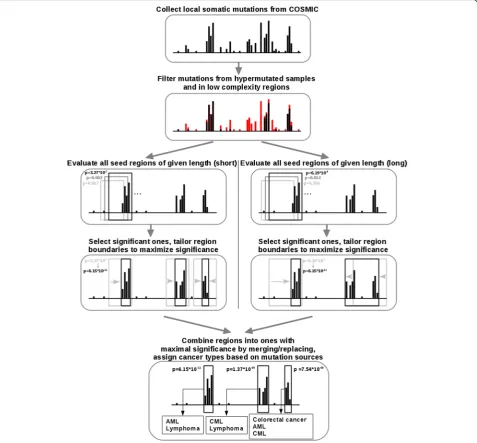
gene separately from the observed number of muta-tions, different background mutation rates apply for each gene, that can take into account that the back-ground mutation rate is different for individual genes [10]. In our analysis, we only considered exonic muta-tions that have a local effect, therefore only missense mutations and in-frame insertions and deletions are considered. The presented method is the first that is able to consider in-frame insertions and deletions as well as missense point mutations in a unified statistical framework. This sets it apart from two conceptually similar methods, eDriver [17] and OncoDriveClust [16], which do not consider in-frame insertions and dele-tions. The input of iSiMPRe is a set of cancer-related missense mutations and in-frame insertions and dele-tions. The background mutation rate is calculated sim-ply from these using only a few empirical parameters. This is in contrast to OncoDriveClust which estimates the background mutation rate from a set of silent sub-stitutions that has to be supplied as a separate set of in-put data. iSiMPRe is described in detail in Additional file 1 (iSiMPRe protocol) and in short in Fig. 1. In order to enable potential users to apply the method to up-dated versions of COSMIC datasets or other sources of cancer mutation data, the source code of iSiMPRe is available for download. In our experience, the identified significantly mutated regions change very little with up-dates of COSMIC datasets.
The large scale scanning of the COSMIC database yielded a total of 534 SiMPRes in 382 genes in the hu-man proteome. A complete list of identified regions to-gether with their significance levels, the number and type of mutations contained and respective cancer types is shown in Additional file 2. Highly significant mutated regions are usually found in well-established cancer genes such as BRAF and TP53. There are, however, only a limited number of high significance regions as most regions show a more moderate accumulation of muta-tions with medium to low significance (see Table 1). These results are in agreement with earlier observations that the mutational landscape of cancer is dominated by mutational hills with a few mutational mountains [1]. The length of the identified regions spans from 1 to 280 residues with an average of 20 residues. The identified regions on average cover 3.1 % of a protein’s sequence, with only a handful of regions exceeding 35 %. These data, indeed, indicate that cancer mutations are not dis-tributed evenly within proteins, but are clustered within certain localized regions.
Known cancer genes harbor significantly mutated regions We have tested the overlap between the identified SiMPRes and the cancer-related genes in the SCGD (see Methods), and separately on annotated tumor suppressors
and oncogenes. iSiMPRe can identify at least one SiMPRe in 74 % of the genes in SCGD (Fig. 2). The performance of the method is nearly perfect for oncogenes with at least one identified region (53 out of 54, accounting for 98 %) with only one exception, DNMT1. In this case, the avail-able mutational data is insufficient to yield high signifi-cance. Unlike its relative, DNMT3A, where mutations are highly enriched at a C-terminal region near the catalytic site, studies indicate that mutations of DNMT1 appear to be a rare event [21].
It is typically assumed that oncogenes harbor mainly missense mutations, while tumor suppressor genes are mainly affected by inactivating mutations, most often truncating nonsense or frameshift mutations [22]. As iSiMPRe considers only mutations that are traditionally linked to oncogenes and not to tumor suppressors, the recovery rate calculated on the latter group of genes is expected to be lower compared to oncogenes. In accord-ance with the hypothesis, a more moderate performaccord-ance was observed in this case. Nevertheless, the majority of tumor suppressor genes (50 out of 71, accounting for 70 %) were still identified as containing at least one re-gion with a significant accumulation of local somatic mutations. This is quite a striking result given that the contribution of missense mutations to tumor suppressor gene alterations is considered to be secondary to inacti-vating and truncating mutations [22].
iSiMPRe outperforms already existing methods with the same scope
Additionally to iSiMPRe, two recently developed methods OncoDriveClust [16] and eDriver [17] were also tested. These methods - similarly to our approach - aim to iden-tify regions where mutations are clustered in the amino acid sequence. The major difference between eDriver and iSiMPRe is that eDriver relies on regions with pre-defined boundaries based on domain annotations and disorder predictions, while iSiMPRe identifies regions that maximize mutational significance without relying on predefined regions. While the background model of eDriver is similar to the one used in our model, Onco-DriveClust uses different input data that includes frameshift and nonsense mutations together with mis-sense point mutations and compares it to the distribu-tion of silence mutadistribu-tions.
more challenging, especially for OncoDriveClust. In all three datasets, iSiMPRe achieves the best performance, followed by eDriver. The lower performance of concur-rent methods can be traced back to various factors. In the case of eDriver, averaging mutation numbers in larger predefined regions can sometimes mask signifi-cant regions, which can have a negative effect on correctly identifying cancer driving genes. Trivially, no
nonsense mutations cannot be compared to the local ef-fect of missense mutations and short indels.
In-frame indels are important for finding cancer genes The used version of the COSMIC database contains 404,903 missense mutations and 9977 in-frame tions and deletions. While the number of short inser-tions and deleinser-tions is only less than 2.5 % of that of all local somatic mutations, they still make significant con-tribution to the identification of significantly mutated re-gions and contribute to the increased performance of iSiMPRe. These types of genetic alterations are domin-ant in about 20 % of the found regions, meaning indels in these cases contribute more to the significance of the
region than missense mutations. In accordance, one-fifth of all regions are undetectable without taking indels into account. Omitting indels from the calculations would result in a decreased performance. Nevertheless, iSiMPRe would still outperform the other two methods (Fig. 2b–d). The incorporation of indel type mutations is especially important for the identification of tumor suppressors. Omitting indels does not have an impact on the recognition of oncogenes, but it does affect the results on both SCGD and tumor suppressors.
Some of the significantly mutated indel regions occur within genes with a well-established connection with can-cer development, such as KIT, BRAF or PTEN. The pro-teins encoded by these genes harbor multiple SiMPRes,
Fig. 2Comparison of the effectiveness and overlap between methods. Number of genes (a) identified by the different methods together with respective overlaps. The recovery rates of all three methods tested on the SCGD (b), oncogenes (c) and tumor suppressors (d)
Table 1Summary of identified SiMPRes. Regions are grouped according to their significance level (see Methods) and their dominant mutation type
Dominant mutation type
Missense mutations Insertions Deletions Total
Significance level High significance 68 5 10 83 (15.5 %)
Medium significance 77 0 13 90 (16.9 %)
Low significance 285 9 67 361 (67.6 %)
many of which are dominated by missense mutations, making the genes themselves identifiable using missense mutations alone. However, in certain cancer genes the pri-mary mechanism of genetic alteration is the accumulation of short insertions or deletions. Discarding indels in the region identification process would make it impossible to reliably identify such known cancer genes. Notable ex-amples include the interleukin-7 receptor subunit alpha (IL7R), which is known to be involved in the occurrence and development of various forms of acute leukemias and solid tumors [23]. Other examples include TSC2, where mutations have been linked to the development of hamartomas in multiple organs [24]; and ATAD5, the somatic mutations of which were identified in endomet-rial tumors [25].
Other types of genetic alterations are also often associated with local somatic mutations
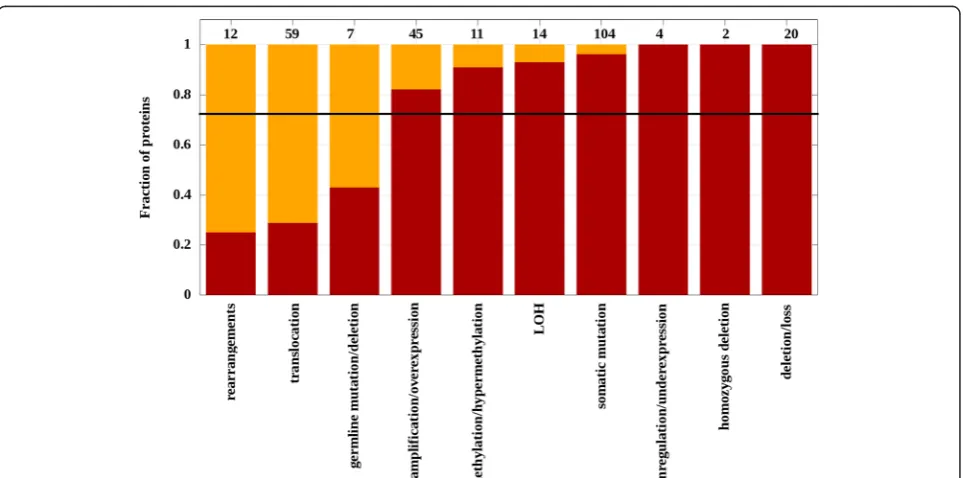
Known cancer genes are defined based on various dom-inant type of genetic alterations and do not necessarily contain an accumulation of local somatic mutations. In order to gain insights into how the dominant type of genetic alteration for a given gene influences the chance of iSiMPRe to find a significantly mutated region at the protein level, the performance was further analyzed on specific datasets. For this analysis the KEGG database was used that provides information about a broad set of genetic alterations associated with specific genes. Figure 3 shows the ratio of genes for each type of dominant
genetic alteration where SiMPRes were identified in the protein counterparts. Ten categories were analyzed in which somatic mutations represent only one of the cat-egories. The results indicate that chromosomal translo-cations and rearrangements represent a roughly independent modulation of the genome and genes pri-marily subject to such changes are largely devoid of sig-nificantly mutated regions. Also, relatively modest recovery rate was observed for genes altered domin-antly via germline mutations. In general, more than 80 % of the proteins dominantly altered by other mech-anisms also contain at least one significant region iden-tified by iSiMPRe in seven out of ten categories.
Significantly mutated regions can be specific to one cancer type or can be associated with a broad set of cancer types
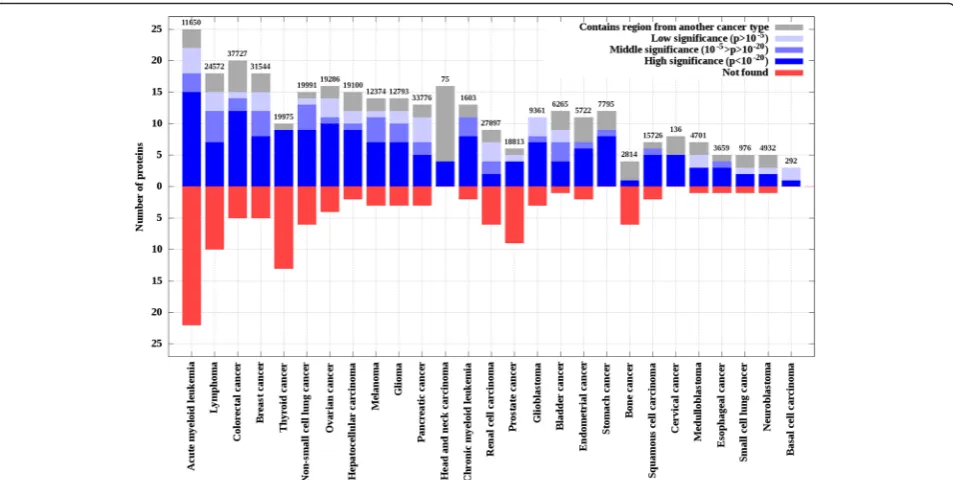
Based on the supplied annotations in the respective datasets, genes were linked to one or more of the 27 standardized cancer types (see Methods and Table 2). Taking advantage of this annotation, the performance of iSiMPRe could be evaluated for individual cancer types. Figure 4 indicates that the overlap between cancer genes and significantly mutated regions found by iSiMPRe is highly uneven across various cancer types. In certain cancer types, such as head and neck carcinomas, iSiMPRe is able to identify all known cancer genes, exhi-biting a perfect performance. In other cases the recovery rate is lower (such as the 40 % in the case of prostate
and bone cancer). However, iSiMPRe is able to recover 74 % of cancer genes on average with recovering at least one third of genes even in the poorest case. Although perfect performance can be seen in some cancer types with low numbers of COSMIC mutations (such as stom-ach cancer, head and neck carcinoma, basal cell carcinoma and cervical cancer); in general there is no obvious rela-tionship between the recovery rates and cancer types, sample number or the number of mutations.
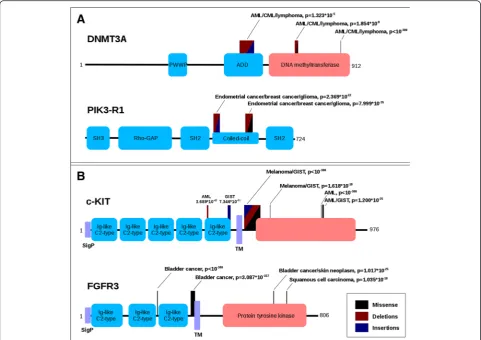
At the level of individual genes, cancer genes can be specific to one or a very limited number of (usually re-lated) forms of cancer or can be involved in multiple cancer types. In a number of cases, multiple regions showed a significant enrichment of local mutations within a single gene. In these cases two basic scenarios could emerge. In the first scenario, mutations from
various tissue samples are typically distributed in roughly the same way and their accumulation along the sequence outline the same functional regions. This general trend is demonstrated in Fig. 5a in the case of DNA methyltransferase 3A (DNMT3A) and for phos-phatidylinositol 3-kinase regulatory subunit alpha (PIK3-R1). In the case of DNMT3A, the dominant part of mutations come from various hematopoietic cancers, such as acute myeloid leukemia (AML), chronic mye-loid leukemia (CML) or lymphoma. These mutations cluster in three distinct regions: one region falls into the middle of the ADD (ATRX-DNMT3-DNMT3L) do-main, responsible for the interaction with the poly-comb repressive complex 2 (PRC2), and it roughly covers the PHD-type zinc finger; the second and the third regions both fall into the catalytic (DNA cytosine Table 2Twenty-seven main cancer types. Cancer types are shown with the corresponding tissue/organ of occurrence and number of local somatic mutations and originating samples in COSMIC
Tissue/organ Cancer types Number of local somatic
mutations in COSMIC
Number of samples Average number of mutations per sample
Bladder Bladder cancer 6 265 3 027 2.07
Blood Acute myeloid leukemia 11 650 5 857 1.99
Chronic myeloid leukemia 1 603 1 041 1.54
Lymphoma 24 572 6 944 3.54
Bone Bone cancer 2 814 706 3.99
Brain Glioblastoma 9 361 2 909 3.22
Neuroblastoma 4 932 619 7.97
Glioma 12 793 2 947 4.34
Medulloblastoma 4 701 728 6.46
Breast Breast cancer 31 544 4 404 7.16
Cervix Cervical cancer 136 132 1.03
Colorectal Colorectal cancer 37 727 25 806 1.46
Esophagus Esophageal cancer 3 659 433 8.45
Head and neck Thyroid cancer 19 975 13 908 1.44
Head and neck carcinoma 75 67 1.12
Kidney Renal cell carcinoma 27 897 1 750 15.94
Liver Hepatocellular carcinoma 19 100 2 091 9.13
Lung Small cell lung cancer 976 208 4.69
Non-small cell lung cancer 19 991 11 236 1.78
Ovary Ovarian cancer 19 286 2 936 6.57
Pancreas Pancreatic cancer 33 776 5 609 6.02
Prostate Prostate cancer 18 813 967 19.46
Skin Melanoma 12 374 7 923 1.56
Squamous cell carcinoma 15 726 3 459 4.55
Basal cell carcinoma 292 251 1.16
Stomach Stomach cancer 7 795 1 430 5.45
Uterus Endometrial cancer 5 722 1 627 3.52
methyltransferase) domain. In all three regions, the source of these mutations is fairly homogeneous with respect to the originating cancer types, even though the dominant mutation types differ for the three re-gions (deletions + insertions, deletions + missense and missense only, respectively). Similarly, the mutations in PI3K-R1 outline two distinct regions, covering the two terminal parts of the inter-SH2 coiled-coil region, which is responsible for the interaction with the catalytic subunit. Similarly to the DNMT3A case, the regions differ slightly in their dominant mutation types; however, in all regions the majority of the mutations come from the same, endo-metrial and breast cancer, samples.
Less frequently, a different scenario can also be ob-served, where a single gene is associated with different types of cancer depending on the location of the muta-tions. The most interesting examples involve certain tyro-sine kinase receptors. Figure 5b shows the domain structure and the significantly mutated regions encoun-tered in c-KIT and FGFR3. Both are single-pass transmem-brane proteins: in their extracellular region they contain multiple Ig-like domains, while their intracellular regions harbor a tyrosine kinase domain. The latter element is one of the most frequently mutated domains in various cancers (Table 3) and it also contains significantly mutated regions. However, other regions in these two proteins also exhibit an increased number of genetic variations that can involve mostly missense mutations, deletions, insertions or mixed
types of variations. Importantly, these specific regions are associated with different cancer types. In the case of KIT, the majority of known somatic mutations were sequenced in AML, melanoma and gastrointestinal stromal tumor (GIST) samples. The two regions found in the last Ig-like domain of the extracellular receptor part is linked to AML and GIST, respectively. The intracellular regions are either GIST, AML or melanoma specific, or a combination of two of the three cancer types, but interestingly KIT does not seem to harbor a ubiquitously mutated region. An-other uncommon cancer-type specific partition of muta-tions can be seen in the case of FGFR3, where both extracellular regions are linked exclusively to bladder can-cer while the intracellular regions are present in various forms of skin tumors as well.
Significantly mutated protein regions correspond to a diverse set of functional modules
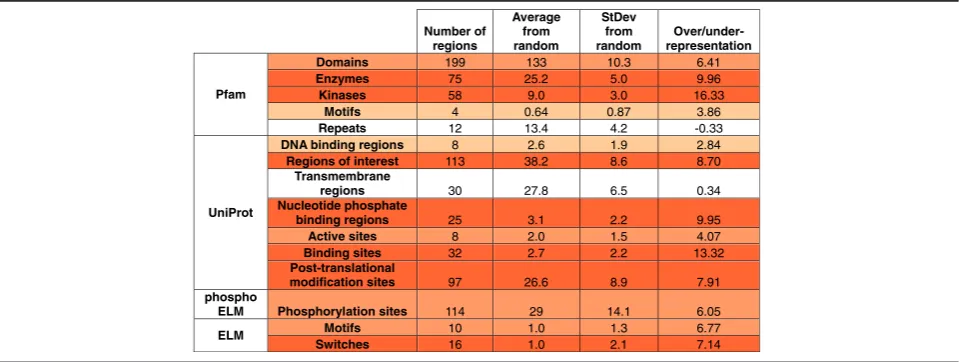
experimentally characterized protein region that can be of interest concerning protein function (such as inter-action sites, different regions of multifunctional enzymes or regions crucial for biological processes/sub-cellular localizations). UniProt annotations were complemented with annotations from the Pfam database [27] collecting evolutionarily conserved protein family information with associated functions and from the ELM database which provides information about linear motifs operating largely outside of globular domains [28]. The occurrence of SiMPRes in various types of annotations were tested for over and under-representation using a basic statis-tical model (see Methods).
In most cases the identified SiMPRes could be associ-ated with some structural or functional annotations. The mean overlaps and standard errors of randomized re-gions is shown in Table 3 together with the overlaps of real SiMPRes. The data in Table 3 shows that local
genetic alterations are significantly concentrated on the structured parts of proteins. This is in accordance with earlier findings [29]. Within structured domains, there is a clear tendency for enzymes, especially for kinases, con-firming earlier observations [30, 31]. The most com-monly mutated domain is the Tyrosine kinase domain observed in 20 different proteins, including such well-known cancer driver genes as ALK, EGFR or BRAF (see Additional file 3). Other domains mutated in multiple cases include the Serine/threonine-protein kinase domain (e.g. in Activin receptor type-1 or in Serine/threonine-protein kinase STK11) and the SH2 domains (e.g. in PIK3-R1 and STAT3). In theory, the easiest way to dis-rupt enzyme function would be the modulation of the active site via the introduction of mutations. However, data show that the number of active sites overlapping with SiMPRes is much lower than the number of tar-geted enzyme/kinase domains. Instead, iSiMPRe showed Fig. 5Proteins with multiple regions covering multiple cancer types. Symmetrically positioned boxes represent structural/functional protein units: grey–signal sequence,black–transmembrane region, various colors–domains (red= catalytic domains,blue= all other domains, with
a highly significant overlap with other types of functional regions, including nucleotide phosphate-, DNA- and other binding regions, as well as ‘regions of interest’. Protein binding regions were suggested to be the primary hot-spots for tumor suppressor proteins [15]. The high accu-mulation of mutations was not restricted to structured protein modules. The non-globular parts of proteins– es-pecially motifs, motif switches and post-translational modification sites–tended to coincide with a high accu-mulation of mutations as well [32, 33].
Discussion
The search for cancer driver genes continues
Cancer emerges due to genetic and epigenetic changes. With the dramatic expansion of catalogued mutations detected in diverse tumor samples and the advent of ex-ome sequencing screens, we have an overwhelming amount of data on our hands. Although this–in theory– should enable easier insights into tumorigenesis, it is still not a simple task to adequately distinguish between rele-vant, cancer-associated mutations and background genetic alterations without clinical significance. Therefore, one of the major focuses of cancer research is still the identifica-tion of genes that are responsible for cancer formaidentifica-tion, tumor progression and metastasis. However, the definition of these cancer genes is far from trivial. Usually a pre-requisite of a cancer driver gene is that its genetic alterations should have a positive contribution to the de-velopment of cancer. In practice, the decision of whether a gene fulfills these criteria or not can depend on the can-cer type and the number of samples already analyzed, as well as the type of genetic alterations analyzed. It was also suggested that significantly larger sample size is needed to
obtain a complete set of cancer driver genes [34]. The sub-jectivity of cancer drivers is transferred to the publicly available databases in which many such genes are col-lected. These datasets use different levels of evidence for the inclusion of a gene or gene product and they can also contain erroneously identified cancer genes, for example based on mouse models or paralog sequences. Since cur-rently there is no consensus on the list of cancer genes, we used four different sources to collect and combine manually assembled and curated sets of cancer genes (see Methods and the figure in Additional file 4).
The lack of consensus regarding cancer genes is evident from the limited overlap between the four included data-sets. The fact that only around 27 % of OMIM genes have support in other databases can be attributed to the fact that OMIM is primarily aimed at collecting germline af-fected genes that only partially overlap with somatically al-tered genes. Unexpectedly, even more limited overlap was observed in the case of COSMIC census database. For this dataset over half of the listed genes were absent from all other databases, as opposed to the 20 % and 4 % of the genes listed in KEGG and Driver genes, respectively. It could mean that the COSMIC census list includes novel cancer genes that are not present in other datasets as of yet, or it could also indicate lack of supportive evidence and possible biases of the inclusion system.
In addition to manually curated databases, various computational methods have also been developed to identify cancer driver genes [35, 36]. Most commonly used approaches seek to identify cancer driver genes ei-ther in the context of pathways and protein interaction networks [37] or by detecting signs of positive selection at the level of genes. Such methods can be based on the Table 3The occurrence of SiMPRes in known structural/functional protein sites/regions. Color codes represent over- and representation compared to random. Shades of red show increasing over-representation. The amount of over- and under-representation is given in standard deviation units calculated from 1000 randomly assigned regions.‘Regions of interest’marks experimentally characterized protein regions that can be of interest concerning protein function (such as interaction sites, different regions of multifunctional enzymes or regions crucial for biological processes/sub-cellular localizations)
Number of regions
Average from random
StDev from random
Over/under-representation
Pfam
Domains 199 133 10.3 6.41
Enzymes 75 25.2 5.0 9.96
Kinases 58 9.0 3.0 16.33
Motifs 4 0.64 0.87 3.86
Repeats 12 13.4 4.2 -0.33
UniProt
DNA binding regions 8 2.6 1.9 2.84 Regions of interest 113 38.2 8.6 8.70
Transmembrane
regions 30 27.8 6.5 0.34
Nucleotide phosphate
binding regions 25 3.1 2.2 9.95
Active sites 8 2.0 1.5 4.07
Binding sites 32 2.7 2.2 13.32
Post-translational
modification sites 97 26.6 8.9 7.91 phospho
ELM Phosphorylation sites 114 29 14.1 6.05
ELM Motifs 10 1.0 1.3 6.77
increased number of observed mutations compared to the background mutation rate [10]; a high rate of non-silent mutations compared to non-silent mutations [2]; or on the bias towards the accumulation of mutations with high functional impact [38]. However, the accumulation of mutations can highlight not only genes but also spe-cific functional regions at the protein level that are in-volved in disease development. Recent methods, such as OncoDriveClust [16] or e-Driver [17] identify putative cancer driver genes based on this concept, similarly to the iSiMPre method presented in this work. Clustering of mutations can also be observed in three-dimensional protein structures that often correspond to perturbed protein-protein interaction sites [18, 19]. Given the com-plexity and heterogeneity of the molecular basis of can-cer, the combination of different signals of positive selection can more reliably indicate mutational drivers [39]. Nevertheless, in our experience, the iSiMPre method is able to identify the majority of cancer driver genes based on the clustering of mutations and outforms methods with similar scope. The increased per-formance of iSiMPre can be attributed to several factors, including the cleaning of mutational data (e.g. eliminat-ing likely neutral polymorphisms and mutations occur-ring within tandem repeats that are more likely to accommodate neutral mutations as well as sequencing errors). Additional factor is the incorporation of all gen-etic variations with positional information, which in-clude short in-frame insertions and deletions while excluding frameshift and non-sense mutations. iSiMPre is based on an unbiased approach that does not rely on previous knowledge of structure or domain, which could be especially important to detect cancer driver muta-tions located in intrinsically disordered proteins for ex-ample (manuscript in preparation).
Based on the presented analysis, the local accumula-tion of somatic mutaaccumula-tions detected by iSiMPRe can also be used to pinpoint novel genes not yet (fully) repre-sented in the available databases. We found 7 genes that contained high significance mutated regions that were absent from SCGD. In these cases, the high significance of the enrichment of somatic mutations lends a very strong support that these proteins indeed correspond to true cancer drivers. These include the lymphoma gene IL7R, the K+ channel KCNJ5, a hyperaldosteronism-linked gene that is also known to be mutated in adrenal cancers [40], CD79B known to be involved in B-cell lymphomas [41], the breast cancer gene ESR1 [42], the cytokine receptor IL6ST known to be involved in a range of cancers, the known cancer gene RAC1 regulat-ing cell motility and RHOA also involved in various can-cers, eg. gastric carcinomas [43]. For these 7 genes that are unique to the COSMIC census dataset, iSiMPRe confirms their cancer driver statuses.
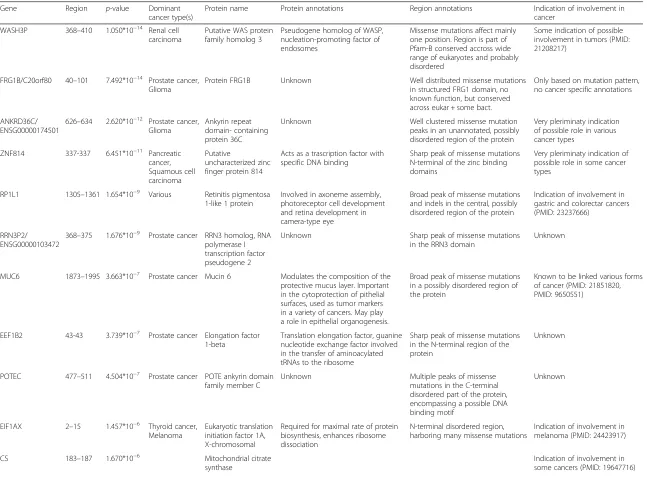
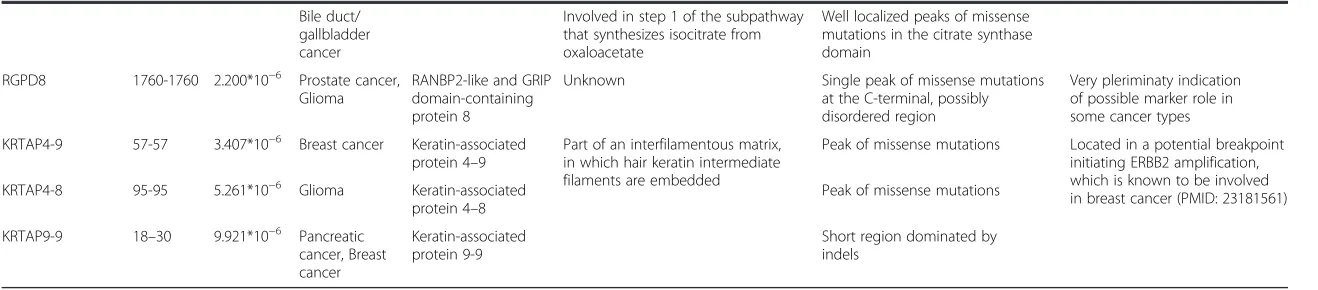
Moving towards lower significance levels, the list of novel cancer genes becomes more populated. Altogether, 23 novel genes are identified by iSiMPRe with medium significance level, 18 of which are included in only one dataset. In these cases, the presence of a reliable region and the inclusion in one cancer gene list is a very strong indication of being a true cancer gene. This notion is supported by genes such as the checkpoint kinase 2 (CHEK2) and tuberin, which have been described as tumor suppressors; or CSF3R which has been described as an oncogene [44]. The other 15 genes harboring medium significance regions are even less represented in cancer gene datasets as they are absent from all four studied databases. These genes are shown in Table 4. Al-though missing from the studied databases, there is at least some indication of the genes’ involvement in can-cer in the majority of cases. For RP1L1, recent results might offer a link between mutations in this gene and the development of gastric and colorectal cancers [45]. Similarly, mucin 6 is known to be linked to various forms of cancer [46, 47]. For other genes, their involve-ment in cancer is only hinted at in very preliminary studies (FRG1B) [25, 48, 49]. In addition, a link between WASH3P and cancer is supported by our findings; since mutations in a region indicate involvement in NSCLC and renal cell carcinoma.
WASH3P 368–410 1.050*10 Renal cell carcinoma
Putative WAS protein family homolog 3
Pseudogene homolog of WASP, nucleation-promoting factor of endosomes
Missense mutations affect mainly one position. Region is part of Pfam-B conserved accross wide range of eukaryotes and probably disordered
Some indication of possible involvement in tumors (PMID: 21208217)
FRG1B/C20orf80 40–101 7.492*10−14 Prostate cancer,
Glioma
Protein FRG1B Unknown Well distributed missense mutations
in structured FRG1 domain, no known function, but conserved across eukar + some bact.
Only based on mutation pattern, no cancer specific annotations
ANKRD36C/ ENSG00000174501
626–634 2.620*10−12 Prostate cancer, Glioma
Ankyrin repeat domain- containing protein 36C
Unknown Well clustered missense mutation
peaks in an unannotated, possibly disordered region of the protein
Very pleriminaty indication of possible role in various cancer types
ZNF814 337-337 6.451*10−11 Pancreatic cancer, Squamous cell carcinoma
Putative
uncharacterized zinc finger protein 814
Acts as a trascription factor with specific DNA binding
Sharp peak of missense mutations N-terminal of the zinc binding domains
Very pleriminaty indication of possible role in some cancer types
RP1L1 1305–1361 1.654*10−9 Various Retinitis pigmentosa
1-like 1 protein
Involved in axoneme assembly, photoreceptor cell development and retina development in camera-type eye
Broad peak of missense mutations and indels in the central, possibly disordered region of the protein
Indication of involvement in gastric and colorectar cancers (PMID: 23237666)
RRN3P2/ ENSG00000103472
368–375 1.676*10−9 Prostate cancer RRN3 homolog, RNA polymerase I transcription factor pseudogene 2
Unknown Sharp peak of missense mutations
in the RRN3 domain
Unknown
MUC6 1873–1995 3.663*10−7 Prostate cancer Mucin 6 Modulates the composition of the
protective mucus layer. Important in the cytoprotection of pithelial surfaces, used as tumor markers in a variety of cancers. May play a role in epithelial organogenesis.
Broad peak of missense mutations in a possibly disordered region of the protein
Known to be linked various forms of cancer (PMID: 21851820, PMID: 9650551)
EEF1B2 43-43 3.739*10−7 Prostate cancer Elongation factor 1-beta
Translation elongation factor, guanine nucleotide exchange factor involved in the transfer of aminoacylated tRNAs to the ribosome
Sharp peak of missense mutations in the N-terminal region of the protein
Unknown
POTEC 477–511 4.504*10−7 Prostate cancer POTE ankyrin domain
family member C
Unknown Multiple peaks of missense
mutations in the C-terminal disordered part of the protein, encompassing a possible DNA binding motif
Unknown
EIF1AX 2–15 1.457*10−6 Thyroid cancer,
Melanoma
Eukaryotic translation initiation factor 1A, X-chromosomal
Required for maximal rate of protein biosynthesis, enhances ribosome dissociation
N-terminal disordered region, harboring many missense mutations
Indication of involvement in melanoma (PMID: 24423917)
CS 183–187 1.670*10−6 Mitochondrial citrate
synthase
Indication of involvement in some cancers (PMID: 19647716)
al.
Biology
Direct
(2016) 11:23
Page
12
of
cancer oxaloacetate domain
RGPD8 1760-1760 2.200*10−6 Prostate cancer,
Glioma
RANBP2-like and GRIP domain-containing protein 8
Unknown Single peak of missense mutations
at the C-terminal, possibly disordered region
Very pleriminaty indication of possible marker role in some cancer types
KRTAP4-9 57-57 3.407*10−6 Breast cancer Keratin-associated
protein 4–9
Part of an interfilamentous matrix, in which hair keratin intermediate filaments are embedded
Peak of missense mutations Located in a potential breakpoint initiating ERBB2 amplification, which is known to be involved in breast cancer (PMID: 23181561) KRTAP4-8 95-95 5.261*10−6 Glioma Keratin-associated
protein 4–8
Peak of missense mutations
KRTAP9-9 18–30 9.921*10−6 Pancreatic
cancer, Breast cancer
Keratin-associated protein 9-9
Short region dominated by indels
al.
Biology
Direct
(2016) 11:23
Page
13
of
association between identified regions and functional protein regions, iSiMPRe may be useful to help in classi-fying mutations as drivers or passengers; simply based on their location inside or outside of a SiMPRe.
The fundamental differences between passenger and driver mutations can influence the set of preferential amino acid substitutions. In recent analyses, COSMIC mutations in the case of EGFR [51] and also for all genes [52] showed an uneven distribution of missense substitu-tions among cancer driver mutasubstitu-tions defined as reoccur-ring mutation compared to likely passenger mutations recorded only once in COSMIC. Partitioning driver and passenger mutations based on iSiMPRe showed good agreement with preferential distributions observed earl-ier (see Additional file 2), with the seven and 16 most frequent substitutions appearing in both lists for driver and passenger mutations respectively. These results also hint at the partitioning power of iSiMPRe between driver and passenger missense mutations.
The knowledge of significantly mutated regions involved in cancer can guide treatment and drug development choices
One of the main advantages of the method proposed in this work is that it is able to identify not only cancer driver genes but also specific regions that are involved in the disease. The importance of this more detailed view is apparent in cases where a single protein has multiple regions that are specifically mutated in different cancer types. An example for this behavior is exhibited in the case of cytokine receptors (Fig. 5b). In these cases vari-ous forms of cancer target different protein regions, which implies a tissue-specific biological selection for particular mutations. Unfortunately, little is known about the mechanistic differences of the same receptors in different tissues that would explain the selection for non-overlapping mutational hotspots. One possible ex-planation could be the homo- or heterodimerization of the same receptor with different partners in different tissues. Facultative receptor tyrosine kinase heterodi-merization is a common phenomenon and already doc-umented for several related proteins [53–55].
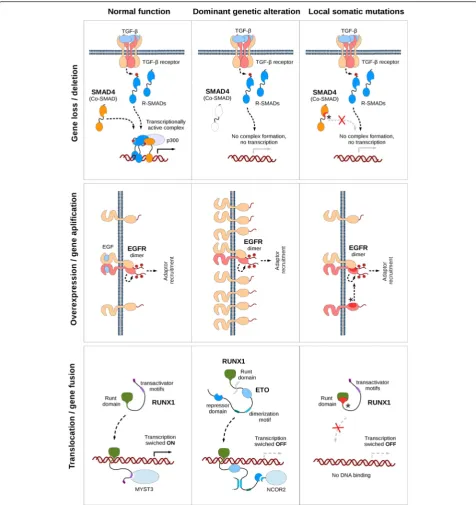
The current collections of genes that have been causatively linked to tumor formation are heteroge-neous concerning their dominant genetic alterations by which their structure/function may be modulated. An important question is how well genes containing SiMPRes (calculated from somatic missense mutations and short in-frame indels) represent all cancer genes. A surprising outcome of our analyses was that signifi-cantly mutated regions can be found in the majority of cancer genes, regardless of their dominant genetic al-terations (Figs. 3 and 4). The two main exceptions are chromosomal translocations and rearrangements,
which represent roughly independent modulations of the genome (Fig. 3). In many other cases, however, somatic mutations can have similar effects to other types of genetic alterations. (Note that the detailed ana-lysis of non-coding intergenic, promoter or intronic mutations was not done, yet the data published by other groups hints that the targets of these alterations might also be somewhat separate from those targeted by somatic mutations [56–58].)
The observed interchangeability of various genetic al-terations and the accumulation of somatic mutations is relatively straight-forward in the case where the domin-ant alterations diminish or abolish protein function (eg. deletion/loss, downregulation/underexpression and pro-moter hypermethylation). An example is provided by the SMAD4 gene (Fig. 6, top row). In this case the clustering of somatic mutations affects the C-terminal MH2 do-main that is essential for both homo- and hetero-oligomerization. Normally SMAD4 transmits signals in the TGF-beta pathway, which is a negative regulator of epithelial growth. The deletion of the SMAD4 gene or the abolishment of the protein function via somatic mu-tations leads to cancer through the breaking of a nega-tive regulatory pathway.
In the case of genetic alterations that enhance protein function, the interchangeability with missense mutations is slightly less evident. Overexpression/amplification typ-ically can happen in receptors containing intracellular kinase domains that are able to modulate various path-ways (such as ERK, JNK, Akt, etc.) via their downstream targets. Both amplification and their accumulated local somatic mutations force these proteins to be constitu-tively active independently from the binding of their extracellular ligands. For example in the case of EGFR (Fig. 6, middle row) the active form of the receptor is brought about by homo- or hetero-dimerization, which is normally achieved by the binding of EGF/TGFα (or other ligands). This dimerization can occur without lig-and binding when the protein is overexpressed; however, the same effect can also be brought about by the accu-mulation of local somatic mutations in the N-terminal part of the intracellular kinase domain.
(Fig. 6, bottom row). This gene encodes a transcription factor that consists of the runt domain that is respon-sible for the interaction with the DNA and a long, pre-sumably disordered transactivation region that binds to partner proteins. A common genetic alteration of RUNX1 is the fusion of the runt domain coding segment (first 5 exons) of the gene to the almost complete ETO
runt domain. The majority of these mutations were de-rived from AML samples indicating the possibility of these mutations mimicking the effect of the transloca-tion. The mutation hotspots in the runt domain coincide with three regions that are directly involved in DNA binding mostly affecting arginine/lysine residues that are necessary for the charge complementarity. This dimin-ishes the DNA binding capability of RUNX1 and inhibits the activation of its target genes, achieving the gene si-lencing effect of the gene fusion.
Conclusions
The observed somatic mutations collected across diverse tumor samples tend to cluster in functional protein re-gions that play a key role in tumorigenesis. This was exploited to construct an algorithm– iSiMPRe–which takes the list of the observed non-synomymous muta-tions and automatically identifies not only potential can-cer driver genes, but also specific regions that are involved in the disease development. iSiMPRe not only outperforms other available methods, but its success also shows that the limited range of mutations considered (somatic exonic mutations that have a local effect) is enough to identify the majority of known cancer genes with a wide variety of typical genetic alterations (somatic gene deletions, gene amplifications, over- or under-expression, etc.). This way, the accumulation of somatic mutations can also offer potential sites for drug develop-ment efforts even in cases which are generally altered by more complex genetic mechanisms. Furthermore, most tumor suppressors also show local enrichments of mis-sense mutations, just as proto-oncogens do. Neverthe-less, a subset of cancer driver genes cannot be identified solely based on their enrichment of local somatic muta-tions. These typically involve genes dominantly altered by chromosomal translocations or rearrangements, or a subset of tumor suppressor genes that are altered mostly by truncating mutations. The complete recovery of cancer driver genes therefore requires a combined approach [39].
In the future, iSiMPRe could be a useful tool to iden-tify genes and proteins where local biological selection affects their function in a selected way. This could not only be utilized to find (causatively) cancer-associated genes, but also to study their domains and other sub-molecular functional elements directly affected by muta-tions, even when no structural or functional annotation is available. Furthermore, apart from data supplied by cancer sequencing efforts, mutation data from any other illness targeted by systematic studies (Crohn’s disease [59], autoimmunogenic disorders [60], autisms [61] and others [62, 63]) can be used as input, thus iSiMPRe can be used to analyze the genetic background of rare her-editary diseases by linking phenotypic observations with protein function directly. The widely used approach of
considering whole genes/proteins is problematic as these are often pleitropic, while for regions pathological in-volvement is more direct. This way iSiMPRe can be dir-ectly used to gain invaluable insight into the patomechanisms of diseases as well.
Methods
COSMIC somatic mutations
Cancer related somatic mutations were collected from version 73 of the COSMIC database (http://cancer. sanger.ac.uk/cosmic/) [8]. The complete dataset con-tained 20,337 protein sequences with at least one an-notated mutation in the 73 version of the COSMIC database. All missense point mutations together with in-frame insertions and deletions were collected and checked against the protein sequences given in COS-MIC. Mutations that were sequenced in samples having over 100 mutations were discarded as hypermutated sam-ples, as these likely include a large fraction of passenger mutations. Furthermore, point mutations coinciding with positions of common single nucleotide polymorphisms were discarded using SNP data collected from the UCSC Genome Browser [64]. In order to filter out clonal vari-ants, samples having at least five mutations and sharing at least 50 % of the local variations (missense mutations and insertions and deletions) were filtered and only mutations coming from the most mutation-rich sample were con-sidered to avoid the inclusion of duplicated entries. Altogether, this resulted in the inclusion of 404,913 missense mutations and 9977 in-frame insertions and deletions. Correctly defined mutations were linked to one of the cancer types based on their given sites of oc-currence and histology according to the rules given in Additional file 2.
In the COSMIC database mutational data can be mapped to multiple isoforms. The isoform with the largest number of mutations often does not necessarily corres-pond to the canonic or the main isoform used in other da-tabases. In this work, the isoforms of the same gene were clustered together and the isoform with the the highest number of mutations was selected. For functional and structural annotations and crosslinks to other databases, COSMIC gene ID’s were also mapped to UniProt protein accession codes from the 2016/01 version of UniProt. The entries in each database and the identified regions were mapped to this main isoform, where possible.
Databases of known cancer related genes
In our study we surveyed four source databases that contained known cancer genes based on expert curation.
COSMIC census genes
census genes connected to cancer [65]. Somatically al-tered genes were collected and linked to one or more cancer types. This search yielded 824 gene-cancer type pairs.
Driver genes
A set of manually assembled cancer driver genes affected by somatic mutations was taken from [3]. This dataset also grouped genes as either tumor suppressors or onco-genes. The list included 54 oncogenes and 71 tumor suppressor genes.
KEGG disease genes
Genes connected to specific types of cancer were col-lected from the appropriate KEGG Disease pages [66]. For a wide variety of cancers, several genes are quoted together with their dominant type of genetic alterations. Genes are identified with HSA identifiers that are cross-linked with UniProt IDs. Based on this, genes were mapped to COSMIC sequences and the KEGG cancer types were assigned to one of the standardized cancer types providing a list of COSMIC genes with involve-ment in specific types of cancer. This search yielded 374 gene-cancer type pairs.
OMIM cancer genes
The Online Mendelian Inheritance in Man provides in-formation about genes with disease association–including cancer [67]. These genes were accessed via UniProt (http://www.uniprot.org/docs/mimtosp) and mapped to COSMIC gene IDs. The referenced OMIM pages were parsed and manually curated. Those pages that de-scribed one or more types of cancer were annotated with one or more of the 27 standardized cancer types (see Table 2). This yielded a set of 979 gene-cancer type pairs. In this case, genes affected by somatic or germ-line mutations could not be generally discriminated.
Somatic cancer gene dataset
The number of genes contained in the four datasets con-taining somatic cancer genes (OMIM, COSMIC census, Drivers and KEGG), together with the amount of over-lap between various datasets is shown in the figure in Additional file 4. The fairly limited overlap among the datasets clearly indicates the lack of consensus on can-cer genes. The total number of genes that are men-tioned in all four datasets is only 32, whereas there are 457 genes annotated as cancer-related that are present only in the OMIM database. In order to reduce the num-ber of falsely annotated genes, only those were considered in the evaluation which occurred in at least two databases of the four. This resulted in 260 cancer genes (referred to as the SCGD (Somatic Cancer Gene Dataset); for an ex-tensive list see table in Additional file 2).
Identification of significantly mutated protein regions A novel method was developed to identify significantly mutated protein regions. We refer this method as iSiMPRe (identification of significantly mutated protein regions) and the identified regions as ‘SiMPRe’s. iSiMPRe seeks to find regions that harbor a significantly enriched amount of somatic mutations compared to neutral local mutations which are assumed to be distrib-uted evenly throughout the sequence. To discard a large portion of possible sequencing artefacts, iSiMPRe first filters out mutations that fall into genomic regions with low sequence complexity measured by TRF [68]. Next, the method follows a hierarchical, stepwise algorithm at the determination of possible significant regions, de-scribed in detail in Additional file 1 and in short in Fig. 1. Each identified region has a p-value assigned that char-acterizes the significance of the given region based on all three types of mutations. Based on this totalp-value, re-gions are classified as high significance (if p< 10−20), medium significance (10−20<p< 10−05) or low signifi-cance (10−05<p< 10−02). Within that, however, the dom-inant mutation type (missense, insertion or deletion) is established for a region based on the relative contribu-tion of each mutacontribu-tion type to the total significance of the region. Here thep-values of the found regions were re-calculated with only considering one class of the three possible mutations types. The mutation type yielding the lowest p-value on its own was considered to be the dominant one. Furthermore, the resulting re-gions were assigned to one or more of the 27 cancer types based on the histology and site annotations of the mutations present in the region. These cancer types are shown in Table 2.
Comparison of iSiMPRe with oncodriveclust and edriver The performance of our method was compared to two methods with similar scope, OncoDriveClust [16] and e-Driver [17]. For both methods the programs were in-stalled and run locally with the default parameters. For the sake of direct comparison, all three methods were tested on the same set of mutations assembled from COSMIC.
Association of functional regions with SiMPRes
regions, regions of interest, transmembrane regions, nucleotide phosphate binding regions, active sites, binding sites and post-translational modification sites (from UniProt [26]), motifs, switches and phosphoryl-ation sites (from ELM [28] and phosphoELM [69]). The possible over- and under-representation of these functional protein regions in SiMPRes was also deter-mined and tested for statistical significance. For this, a random baseline was established. Each of the 534 found SiMPRe was moved to a randomly selected pro-tein in a way that the length and disorder content of the original and the new, random protein had to be the same within 10 % to avoid structural bias. Next, both real and randomly selected SiMPRes were assessed regarding their overlap with various func-tional protein units. The random region selection pro-cedure was repeated 1000 times and the average and the standard deviation of the overlap between ran-domized regions and functional protein regions was calculated. The over-representation of SiMPRe in func-tional regions compared to randomized regions is given in standard error (StdErr) units in Table 3. As values calcu-lated on random regions closely follow Gaussian distribu-tions, the threshold for p< 0.01 statistical significance in StdErr units is 2.326, therefore all color-coded over-representations are statistically significant.
Assessment of protein disorder
In the process of generating random regions, the dis-order content of proteins were assessed using IUPred [70, 71], ANCHOR [72, 73] and Pfam [27]. The output of IUPred was smoothed in a window of 31 residues. Po-sitions with a smoothed IUPred score over 0.5 or with an ANCHOR score over 0.5 were considered disordered, except for positions included in specific Pfam families which were annotated as domains.
Substitution rates
Substitution rates were calculated from missense muta-tions from the COSMIC database. Each type of missense mutation was considered only once for each position. First, all types of occurring missense mutations were collected separately for all positions. The number of substitutions changing the original amino acid of type i to type j is denoted byni-jand substitution percentages
are calculated as follows: Ri-j= (ni-j/N)*100, where N is
the total number of missense mutations. These substi-tution percentages were calculated separately for muta-tions inside and outside of SiMPRes and are shown in Additional file 2.
Availability
iSiMPRe is available for download from https://github. com/BalintMeszaros/iSiMPRe.
Reviewers’comments
The authors would like to thank the reviewers for the careful reading of our manuscript and their constructive comments. The manuscript was revised in light of their statements. After each of the reviewers’comments, the authors address each of the comments in detail.
Reviewer’s report 1: Sándor Pongor, International Centre for Genetic Engineering and Biotechnology (ICGEB), Italy
Reviewer comments
Reviewer summary One of the key problems in cancer genomics data is the identification of driver mutations distinction from from passengers mutations. There are a number of known algorithms for the purpose but current approaches are often limited by biases in struc-tural assignments as well as by the inaccuracy of the statistical background models. To stear clear of these problems the authors offer statistically-based method that considers statistically significant missense muta-tions, in-frame insertions and deletions in a unified stat-istical framework.
Reviewer recommendations to authors This is a piece of careful work and the results are convincing. One im-portant issue is how an method can be maintained as the databases change and new raw data become avail-able. the authors may want to add a few sentences how their method differs in this respect from other methods.
protocol) and in short in Fig.1. In order to enable poten-tial users to apply the method to updated versions of COS-MIC datasets or other sources of cancer mutation data, the source code of iSiMPRe is available for download. In our experience, the identified significantly mutated regions change very little with updates of COSMIC datasets.”
Minor issues
The authors may want to go through the English of text which is however clear and understandable in its present form.
Author’s response:We have made extra care to correct the English of the text.
Reviewer’s report 2: Michael Gromiha, Indian Institute of Technology Madras, India
Reviewer comments
Reviewer summary In this work, the authors presented a novel method for identifying regions that are signifi-cantly enriched in somatic mutations and indels. The analysis on human proteome showed the presence of about around 500 protein regions linked with 27 distinct cancer types. It also identified novel genes and regions that have not yet been associated with cancer. The area of research is interesting and potential applications to cancer research. The manuscript is well written and ana-lysis has been made in details.
Reviewer recommendations to authors Following points may be considered for improvements and discussions.
1. Recently, preferred amino acid mutations in cancer genes have been reported using COSMIC database with the location of mutations. A comparison of those results with the present work could be useful.
Author’s response: The substitution rates calculated for the missense mutations inside and outside SiMPRes have been contrasted with the mutation rates detailed in a recent study by Gomiha et al. (Exploring prefered amino acid mutations in cancer genes, applications to identify potential drug targets). Although the two studies use different definitions for driver and passenger muta-tions (being present in COSMIC multiple times vs being inside a significantly mutated region), the two distribu-tions of preferred amino acid changes show a striking similarity for both drivers and passengers mutations. The cited analysis found 26 driver amino acid substitu-tions (out of the possible 380) that represent over 1 % of total observed substitutions each. Out of these, the top 7 ones are present in our analysis as well, with 9 more appearing with over 1 % frequency. For the passenger mutations, Gromiha et al. described 29 mutations with over 1 % occurrence, out of which the top 16 (and an
additional 10) are present in our list of frequent substi-tutions as well. The results of the analysis have been in-cluded in the supplementary data and have been referred in the discussion section:“The fundamental dif-ferences between passenger and driver mutations can in-fluence the set of preferential amino acid substitutions. In recent analyses, COSMIC mutations in the case of EGFR and also for all genes showed an uneven distribu-tion of missense substitudistribu-tions among cancer driver muta-tions defined as reoccurring mutation compared to likely passenger mutations recorded only once in COSMIC. Partitioning driver and passenger mutations based on iSiMPRe showed good agreement with preferential distri-butions observed earlier (see Additional file 2), with the 7 and 16 most frequent substitutions appearing in both lists for driver and passenger mutations respectively. These results also hint at the partitioning power of iSiMPRe be-tween driver and passenger missense mutations.”
2. The preferred localized regions may be discussed in terms of secondary structures and solvent accessibility (either experimental or predicted).
Author’s response: While secondary structure and solvent accessibility properties can be informative for globular proteins, they cannot be directly applied to in-trinsically disordered proteins (IDPs). Since a significant portion of the mutated regions can correspond to IDPs, we believe that without partitioning our results based on available structural data and analyzing IDPs and struc-tured protein regions separately, the structural bias would make results difficult to interpret properly. We believe that this structure-based analysis would be really interesting but we also believe that this work is outside the scope of the present paper and will be presented in future publications.
3. COSMIC database provides the counts for the tants. The number of counts used to define somatic mu-tations may be mentioned.
Author’s response:These data were added to both the
‘In-frame indels are important for finding cancer genes’ section of Results and the Methods section.
Reviewer’s report 3: Zoltán Gáspári, Pázmány University, Budapest
Reviewer comments
into the role of missense mutations and indels in vari-ous proteins and their regions. They can form the basis of further studies on the possible roles of the proteins and functional regions identified in the study.
Reviewer recommendations to authors The field of identifying driver mutations is highly complex. Despite some commonly accepted paradigms there are divergent approaches based on different considerations for the identification of driver genes and/or mutations with bio-logical/therapeutic significance. Therefore, I think that the manuscript could benefit from a theoretical intro-duction about driver genes and their identification. In particular, it should be important to detail the premises on which the iSiMPRe method is expected to identify driver mutations more efficiently than other methods. This then can be referred in the subsection“The search for cancer driver genes continues” and provide the reader a firm background for the concept of the study. The conclusion section contains some hints, but I sug-gest that this should be described in a more detailed way in an earlier, suitable part of the paper.
Author’s response: A separate paragraph has been in-cluded in the Discussion section to better shed light on the various approaches are used to identify cancer drives genes and the advantages iSiMPRe approach of this work might have over other methods: “In addition to manually curated databases, various computational methods have also been developed to identify cancer driver genes. Most commonly used approaches seek to identify cancer driver genes either in the context of path-ways and protein interaction networks or by detecting signs of positive selection at the level of genes. Such methods can be based on the increased number of ob-served mutations compared to the background mutation rate; a high rate of non-silent mutations compared to si-lent mutations; or on the bias towards the accumulation of mutations with high functional impact. However, the accumulation of mutations can highlight not only genes but also specific functional regions at the protein level that are involved in disease development. Recent methods, such as OncoDriveClust or e-Driver identify pu-tative cancer driver genes based on this concept, similarly to the iSiMPre method presented in this work. Clustering of mutations can also be observed in three-dimensional protein structures that often correspond to perturbed protein-protein interaction sites. Given the complexity and heterogeneity of the molecular basis of cancer, the combination of different signals of positive selection can more reliably indicate mutational drivers. Nevertheless, in our experience, the iSiMPre method is able to identify the majority of cancer driver genes based on the cluster-ing of mutations and outperforms methods with similar scope. The increased performance of iSiMPre can be
attributed to several factors, including the cleaning of mutational data (e.g. eliminating likely neutral polymor-phisms and mutations occurring within tandem repeats that are more likely to accommodate neutral mutations as well as sequencing errors). Additional factor is the in-corporation of all genetic variations with positional infor-mation, which include short in-frame insertions and deletions while excluding frameshift and non-sense mu-tations. iSiMPre is based on an unbiased approach that does not rely on previous knowledge of structure or do-main, which could be especially important to detect can-cer driver mutations located in intrinsically disordered proteins for example (manuscript in preparation).”
Major recomenndations: In general, the study is well-documented, although there are some details in the methodology that, in my opinion, need to be clarified.
- How were disordered regions identified and how was the extent of disorder assessed for use in the randomization process?
Author’s response: This has been added to the Methods chapter in a separate section.
- Were the categories ‘Kinase’,‘Enzyme’,‘Domain’ used in a mutually exclusive way?
Author’s response: No, they are used in accordance with standard Pfam definitions, meaning that all kinases are a subset of enzymes which are in turn a subset of domains.
How exactly were the ‘regions of interest’ defined (which UniProt keywords were included here)?
Author’s response: UniProt contains a ‘regions of interest’ keyword, covering a broad range of functional protein regions. The appropriate section of Results was updated to reflect this.
Which version of UniProt was used?
Author’s response: 2016/01 version, this information has been added to the Methods section as well.
- In all studies using “artificial”thresholds, it could be important to justify the choice of these. Do the authors have data on how inclusion of hypermutated sequences containing more than 100 mutations affect their conclu-sions? How can the significance regions be justified?
noise. As the region between 100 and 150 seemed to make no difference, we opted to exclude those data as well and used the cutoff of 100 mutations/sample in all final analyses.
Questions/recommendations with respect to the re-sults: -The authors used the isoform with the most mu-tations. Could the validity of this approach checked at least for the top SiMPRes identified? Do the results ob-tained for the isoform chosen conform to those that could be obtained for the other isoforms, taking into account their specific role/localization etc.?
-Author’s response: We fully agree that it would be very interesting to study significantly mutated regions in an isoform specific way. However, the current policy of the COSMIC database does not make is possible, as mu-tations in COSMIC are usually mapped to only one of the isoforms which is often as not the same as the pri-mary isoform.
There is only limited information provided on affected domain types (“Within structured domains, there is a clear tendency for enzymes, especially for kinases, con-firming earlier observations”). As the data is at hand, could a more detailed analysis provide some further insights?
Author’s response: We now provide a more detailed table about various structural and functional annotations corresponding to SiMPRes and also added a sentence about the most commonly mutated domains:
“The most commonly mutated domain is the Tyrosine kinase domain observed in 20 different proteins, includ-ing such well-known cancer driver genes as ALK, EGFR or BRAF (see Additional file 3). Other domains mutated in multiple cases include the Serine/threonine-protein kinase domain (e.g. in Activin receptor type-1 or in Serine/threonine-protein kinase STK11) and the SH2 do-mains (e.g. in PIK3-R1 and STAT3).”
Minor questions/recommendations:
-Are there any selected cases where the authors can, with a detailed analysis of the literature, justify that most of the mutations themselves in a SiMPRe indeed signifi-cantly affect protein function? - It would be really inter-esting to analyze in detail one or two cases where different regions of the same protein are associated with different cancer types, but I understand if this is outside of the scope of the present study.
Author’s response:We discuss several examples in the manuscript in some detail, including DNMT3A, PIK3-R1, c-KIT and FGFR3, as well as SMAD4, EGFR and RUNX1 in the discussion. We would also like to emphasize that while most of highly significant mutated regions are well studied examples, for which we have relatively good understanding about the mechanism of the mutation, our understanding for many other cases is still limited. Therefore, we agree with the referee that
analyses of further examples are outside of the scope of the present study.
Minor issues
Kindly be more specific in statements like “Nevertheless the majority of tumor suppressor genes (50 out of 71,70 %)” as it is bit confusing to (seemingly?) compare numbers to percentages.
Author’s response:These sentences were rephrased to avoid confusion.
I personally would refrain from using terms like
“known oncogene”and would prefer“has been described as an oncogene”or similar.
Author’s response:These sentences were re-written to exclude these expressions.
In the sentence “The current collections of genes that have been casually linked to tumor formation” I guess the authors meant “causatively”? Please corrent “ geno-minc” here:“genominc regions with low sequence com-plexity measured by TRF [62]”
Author’s response:These were corrected.
In Table 4, please add all relevant references weher ap-plicable (e.g. I guess where “Some indication” has been described, there is some kind of reference).
Author’s response:The reference has been added. Please re-read Additional file 1 and correct typos/small grammatical errors.
Author’s response: We made extra effort to correct typos and small grammatical errors in the Additional file 1. I suggest to merge all additinal xls files into a single file with multiple tabs.
Author’s response: All additional tables were merged into a single file.
Additional files
Additional file 1:iSiMPRe protocol. (PDF 415 kb)
Additional file 2:All supplementary tables merged. 1: List of all identified SiMPRes. 2: All novel genes that contain identified low significance SiMPRes. 3: Substitution percentages calculated for mutations in and outside of SiMPRes. 4: Criteria for the classification of somatic mutations. 5: The elements of the SCGD dataset with support information. (XLS 285 kb)
Additional file 3:iSiMPRe mini-website. The mini-website shows all identified SiMPRes together with the found annotations from various source databases (Pfam, UniProt, ELM, etc.). (ZIP 37 kb)
Additional file 4:Cancer driver gene datasets. (PNG 131 kb)
Abbreviations