R E S E A R C H A R T I C L E
Open Access
Face yourself! - learning progress and
shame in different approaches of video
feedback: a comparative study
Anne Herrmann-Werner
1, Teresa Loda
1*, Rebecca Erschens
1, Priska Schneider
2, Florian Junne
1,
Conor Gilligan
3, Martin Teufel
4, Stephan Zipfel
1and Katharina E. Keifenheim
1Abstract
Background:Feedback is a crucial part of medical education and with on-going digitalisation, video feedback has been increasingly in use. Potentially shameful physician-patient-interactions might particularly benefit from it, allowing a meta-perspective view of ones own performance from a distance. We thus wanted to explore different approaches on how to deliver specifically video feedback by investigating the following hypotheses: 1. Is the physical presence of a person delivering the feedback more desired, and associated with improved learning outcomes compared to using a checklist? 2. Are different approaches of video feedback associated with different levels of shame in students with a simple checklist likely to be perceived as least and receiving feedback in front of a group of fellow students being perceived as most embarrassing?
Methods:Second-year medical students had to manage a consultation with a simulated patient. Students received structured video feedback according to one randomly assigned approach: checklist (CL), group (G), student tutor (ST), or teacher (T). Shame (ESS, TOSCA, subjective rating) and effectiveness (subjective ratings, remembered feedback points) were measured. T-tests for dependent samples and ANOVAs were used for statistical analysis. Results:n= 64 students could be included. Video feedback was in hindsight rated significantly less shameful than before. Subjectively, there was no significant difference between the four approaches regarding effectiveness or the potential to arise shame. Objective learning success showed CL to be significantly less effective than the other approaches; additionally, T showed a trend towards being more effective than G or ST.
Conclusions:There was no superior approach as such. But CL could be shown to be less effective than G, ST and T. Feelings of shame were higher before watching one’s video feedback than in hindsight. There was no significant difference regarding the different approaches. It does not seem to make any differences as to who is delivering the video feedback as long as it is a real person. This opens possibilities to adapt curricula to local standards,
preferences, and resource limitations. Further studies should investigate, whether the present results can be reproduced when also assessing external evaluation and long-term effects.
Keywords:Medical students, Video feedback, Shame, Communication skills
© The Author(s). 2019Open AccessThis article is distributed under the terms of the Creative Commons Attribution 4.0 International License (http://creativecommons.org/licenses/by/4.0/), which permits unrestricted use, distribution, and reproduction in any medium, provided you give appropriate credit to the original author(s) and the source, provide a link to the Creative Commons license, and indicate if changes were made. The Creative Commons Public Domain Dedication waiver (http://creativecommons.org/publicdomain/zero/1.0/) applies to the data made available in this article, unless otherwise stated.
* Correspondence:[email protected]
1Department of Psychosomatic medicine and Psychotherapy, University
Background
In medical education as well as later everyday profes-sional life, medical students are facing difficult physician-patient encounters for which they need to be trained appropriately. A crucial part of such teaching is feedback, which students receive in order to “mull over” what happened in the encounter and improve their skills [1–7]. With progressing digitalisation, video review is emerging for performance-based feedback and has been found to be particularly helpful for improving communi-cation skills [5, 8, 9]. Studies have shown that video re-view is far more effective than oral feedback by teacher or peer alone [10].
Unique to the video feedback method is the ability for learners to view themselves from a meta-perspective which enables them to evaluate their own learning pro-gress and clinical skills “from a distance” [11–14]. Fuk-kink and colleagues showed that through the use of video feedback, participants could improve verbal, non-verbal and paralingual aspects of their communica-tion in a professional context [15] –i.e. key interaction skills in the physician-patient encounter.
Despite evidence for its effectiveness, facing oneself in an already apprehensive and thus potentially stressful situation can be quite embarrassing for the targeted stu-dent [10, 16–19]. This level of embarrassment might be increased when the communication situation itself has potential for awkward moments or interactions as -amongst other situations– shown for asking about psy-chosocial aspects or taking a sexual history [20,21]. Em-barrassment or shame – as opposed to guilt, which focusses on wrong behaviour – is essentially a nega-tive evaluation of the complete self without any dis-tinction between the person and its behaviour [14,
22]. The feeling of shame is known to reduce motiv-ation and lead to subsequent avoidance of similar sit-uations, potentially hindering the learning process [14,
19, 23]. Regarding negative emotions towards video feedback in general, Paul and colleagues [17] reported that in their study most students scored high on anx-iety and resistance to videotaping beforehand, but both measures decreased after exposure to actual video feedback and with increasing practice. These findings have since been replicated, suggesting that students should be confronted with video feedback from early stages of their education on [11, 15, 24]. The same principles apply to self-evaluation and feed-back techniques in general [25]. In their commentary, William and Bynum (2015) even address the issue stating that the role of shame in feedback has so far gone unrecognised in research and that there is a lack of understanding about how to effectively communi-cate feedback and ensure that it is received in a con-structive manner [26].
At the University of Tuebingen, students are confronted from the very beginning with videotaped simulated physician-patient encounters thereby learning approaches like reflection, self-evaluation, peer-assessment, and
peer-feedback as guided by models such as the
Calgary-Cambridge Referenced Observation Guides and CanMeds (roles“Professional”and “Scholar”) [8,25,27– 29]. Within the variety of models on how to implement feedback into the medical curricula, different perspectives regarding who is best to deliver feedback to the students are offered. Quite often, an instructor or teacher is respon-sible for giving the feedback, for example in the form of formal debriefing after simulations or within communica-tion classes [15, 30]. However, with sometimes sparse re-sources, other ways are increasingly common; using student tutors for peer-assisted learning, or integrating feedback with a whole group of students [24, 31]. Some results suggest that students should best watch their vid-eos alone and not in small groups [24]. In contrast, other authors favour group videotape review to support reconsi-dering one’s own approach, getting to know different tech-niques and encouraging each other [31]. Sharp et al. reported that students preferred feedback from a simu-lated patient over a private review of the video [32]. How-ever, so far there is– to the best of our knowledge - no evidence about how to best implement video-feedback and, particularly, who is best placed to deliver it. Thus, the present study focussed on different video feedback ap-proaches and their potential to arise shame as well as se-cure learning success.
Methods
Aim, design and setting of the study
In the present comparative study at the Medical Faculty of University of Tuebingen different video feedback ap-proaches were investigated with regards to feeling of shame and potential learning success. We hypothesized the following:
1. The physical presence of a person delivering the feedback is more desired, and associated with improved learning outcomes compared to using a checklist.
2. Different approaches of video feedback will be asso-ciated with different levels of shame in students with a simple checklist likely to be perceived as least and re-ceiving feedback in front of a group of fellow students being perceived as most embarrassing.
Intervention
beginning of each module, the teacher introduced the theoretical background of each topic (psychosocial as-pects or sexual history taking) using standardized slides and clearly defined learning goals for the session. Then, one student took on the role of the physician and man-aged the patient encounter with a simulated patient (SP) in front of the group. The interview was videotaped. After the interview, the student watched the videotape for feedback either independently with a checklist of ex-pected behaviours (CL), with the whole group (G), with the teacher (T) or with a student tutor (ST). After all study-related measurements had been taken, simulated patients additionally provided their feedback as usually done in our communication classes. Assignment to one of the approaches was randomized. The randomization process was based on a random-number-approach [33], with each appointment being randomly assigned to one of the four approaches (CL, G, ST or T). Student tutors and teachers were trained with regards to suggested con-tent of feedback as well as the feedback process in a sim-ulated training session using a manual specifically developed for the study. Student tutors were medical students in their advanced medical training and had all gone through the course they were now tutoring as par-ticipants at earlier stages of their training. All teachers were experienced clinicians (medical doctors or clinical psychologists) regularly involved in teaching communi-cation classes.
Sample size
Based on experience with previous comparable interven-tions, sample size calculation with G*Power demanded a minimum of n= 12 students per group (power 0.8, sig-nificance level 0.05, effect size 0.5).
Feedback
Independent of the feedback approach (CL, G, ST or T), the feedback process followed the same pattern. Teachers, student tutors and the group had a checklist for their feedback that corresponded with the one used in the independent CL approach (see Additional files 1
and 2). It comprised two areas with three sub-topics each. The area “conversational techniques” (general feedback points) was uniform for psychosocial aspects (PA) and sexual history (SH) with its points “ introduc-tion”,“verbal communication”, and“non-verbal commu-nication”. The second area, was topic specific with issues concerning “profession”, “family”, and “well-being” for PA, and “sexual life quality”, “partnership quality”, and
“sexual dysfunctions” for SH. On the checklist, it was evaluated whether the student had addressed each point (binary list yes/no) and if so, with what strengths/weak-nesses (free comment) to guarantee standardisations as well as specific focusing which has been shown to be
beneficial for beginners [34]. In the CL group, the stu-dents had to fill in the checklist independently as they worked through the video. In the G approach, feedback points were divided upon the students who had watched the encounter so that each one gave feedback to only one point, whereas the teacher and student tutor gave feedback to all 6 topics in their respective approaches (ST, T). In the end, all students acting as physicians thus received feedback on all 6 checklist areas no matter through which source (CL, G, ST or T). The video could be stopped and rewound if needed, and also student tu-tors and teachers were actively encouraged to do so in order to highlight difficult or successful video sequences. In the G approach, the teacher was present in the room, moderating the discussion and following instructions if fellow students wanted a certain video section to be repeated.
Assessment
After having conducted the interview, but before the videotape review (T0), students were asked to fill in a questionnaire. It consisted of items regarding prefer-ences about the person to deliver feedback to them (teachers, fellow students, etc.), expected learning suc-cess, shame about the teaching’s content, and video feed-back in general. Additionally at T0, two standardized questionnaires for shame (Experiential Shame Scale (ESS) and the Test of Self-Conscious Affect (TOSCA-3)) were administered [35–37]. After having watched the videotape and having received feedback in one of the four possible feedback approaches (T1), students com-pleted the same questionnaire but without TOSCA-3, and with additional general questions about shameful-ness and their experience of their allocated feedback ap-proach. Figure1shows an overview on the study design.
Shame
Shame was – as described above – assessed with
general as well as in the particular feedback approach they had been randomised to, and regarding the content (PA/SH) on an 11-point Likert scale each (0 = “not at all”to 10 =“extremely”).
Learning success
Learning success was measured subjectively through self-assessment on an 11-point Likert scale from 0 =
“not at all”to 10 =“decidedly high”. To also gain a more objective measure of the effectiveness of the feedback process, it was assessed in absolute numbers (binary de-cision: yes/no) how many of the 6 feedback categories given were also perceived by the feedback recipient. Thus, at T1, participants wrote down all feedback points they could remember (blank sheet). There was only a minimal time delay between the actual video feedback and points remembered. Remembered feedback points were converted into absolute numbers, so the students could score up to 6 points.
Statistical analysis
Mean values, associated standard deviations, frequencies and percentages of relevant factors like age, gender and
approach and items like learning success were
calculated. All relevant data were normally distributed. T-tests for dependent samples were conducted to com-pare differences of the mean values (ESS, shame ques-tions). ANOVAS were used to test differences in shame (TOSCA) and learning success among the medical stu-dents and settings. The level of significance wasp< .05. Statistical analysis was performed using SPSS 24 (SPSS Incorporated, Chicago, IL).
Results
Participants
Sixty-six medical students (59.7% female, average age 22.67 ± 3.72 years) took part in the study. Half of them had to face a simulated patient (SP) with psychological comorbidities, i.e. assess psychosocial aspects; the other half had to take a sexual history of an SP. Statistically there were no significant differences between the two scenarios regarding the difficulty rating, so they were treated as one group for further analyses. Two sets of data had to be excluded because the information about the approach (CL, G, ST or T) was missing. Of the remaining 64, n= 15 students were randomized to the CL approach,n= 16 to G,n= 17 to ST, and n = 16 to T. There were no significant differences between the four
Fig. 1Study design with participants included, T0= before receiving video feedback, T1= after receiving video feedback, CL = checklist, G = group,
groups with regards to age, gender, formal medical train-ing (e.g. nurse, paramedic) or prior experience with training in communication.
Feedback approach
At T0, students of all approaches would have preferred to be in the T group (40.3%). However, at T1most had a retrospective preference for ST (+ 6.0%) or G (+ 1.5%) with T still being the most popular approach in absolute numbers (p<. 001).
Shame
Subjective rating of shame showed the following results: At T0, there was no significant difference between the four approaches (see Table 1). Overall, students consid-ered it more shameful to watch themselves on a video-tape when asked at T0as compared to T1(T0: M = 4.54 ± 2.76; T1: M = 3.38 ± 2.75; p< .001). There was again no significant difference when comparing the four ap-proaches at T1(see Table1).
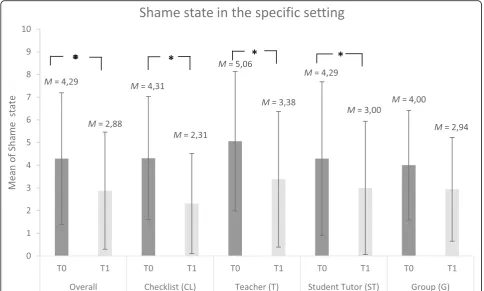
Similarly, students rated watching themselves on a videotape in the particular feedback approach they had been assigned to overall more shameful when asked at T0as compared to T1(T0: M = 4.29 ± 2.90; T1: M = 2.88 ± 2.58; p< .001). There were also significant effects in the approaches CL, ST and T (see Fig.2). Looking at the topic of the encounter, PA or SH, there was no signifi-cant difference between PA and SH with regards to the potential to generate shame, and both topics were rated relatively low in this regard (PA: M = 1.59 ± 1.88, SH: M = 2.48 ± 2.29, p> .05). There were no significant
differ-ences between the four feedback approaches on
TOSCA-3 or ESS (all p> 0.05, see Table 1) and results were well in line with previous studies [38,43]
Subjective learning success
Overall, students rated their learning success signifi-cantly higher after the video feedback than before (T0: M = 6.20 ± 1.93; T1: M = 7.20 ± 1.99; p< .01). At approach level, this stayed true for T (T0: M = 6.13 ± 1.82; T1: M = 7.31 ± 1.14; p< .05) and ST (T0: M = 6.06 ± 1.98; T1: M = 7.41 ± 1.97; p < .01). However, there was no significant difference when looking at the approaches CL or G.
Objective learning success (remembered feedback points) CL showed significantly lower results for remembered feedback points (M = 2.69 ± 1.65, p < .01). The three other approaches did not differ significantly (T: M = 4.20 ± 1.47; G: M = 3.94 ± 1.29; ST: M = 3.88 ± 1.75; scale 1–6), though there was a trend towards T as being most effective in conveying retained messages (F (3.56) = 2.556; p= .064). However, there were no significant cor-relations between shame scores and the ability to re-member feedback points (feedback points x ESS before training: r = .002, p> .05; feedback points x ESS after training: r =−.036, p > .05; feedback points x TOSCA proneness to shame: r = .037, p > .05).
Discussion
In summary, our first hypothesis could be supported as feedback approaches with a real person present were preferred and led to better learning outcomes. The CL approach, which does not enable students to discuss their performance with a peer, student tutor or teacher after watching the video scenario, was significantly less effective than the other approaches. This is in keeping with findings from past studies showing that students preferred feedback from a third party over a private re-view of their video [32]. Also, Sargeant and colleagues demonstrated that for improvement, accurate external feedback is necessary [44]. The CL approach might have scored lowest in the remembered feedback points due to the inadequacy of its external nature. Students rated the teacher approach best for learning outcome, which was reinforced by the fact that this approach also scored highest in relation to remembered feedback points. The fact that the student tutor was a close second to teacher, is not surprising given the fact that peer-assisted learn-ing has been proven to be equally effective and at the same time highly valued by fellow students [45]. Further, the differences between the approaches with a person present did not differ significantly between each other, offering flexibility in the implementation of video
feed-back classes in the curriculum. Also, the
above-mentioned idea of letting simulated patients de-liver feedback to students [32], could be considered. Interestingly, preferences in our study were initially fo-cused on the teacher but after the session, students were
Table 1Rating of shame by several instruments
Questions Point of Time CL (M; SD) G (M; SD) ST (M; SD) T (M; SD) p
Subjective rating of shame T0 4.36 ± 2.65 3.87 ± 2.48 4.35 ± 3.16 5.69 ± 2.72 > .05
T1 3.00 ± 2.35 2.87 ± 2.42 3.18 ± 2.94 4.31 ± 2.77 > .05
ESS T0 35.93 ± 6.83 37.87 ± 7.73 37.59 ± 7.74 39.80 ± 7.41 > .05
T1 33.38 ± 8.57 32.38 ± 7.27 33.47 ± 8.31 33.00 ± 5.85 > .05
TOSCA: shame-proneness T0 44.80 ± 9.84 49.67 ± 9.64 45.06 ± 9.74 48.63 ± 6.98 > .05
more open towards student tutors or even the group. These preferences might be crucial when considering different approaches as positive feelings have been shown to help students see the bigger picture rather than focus on specific details [6].
Our second hypothesis, however, did not prove to be true. There were no significant differences between the four approaches with regards to students’ feeling of shame, so receiving feedback in front of the whole group of fellow students was not perceived to be worse than more private settings like with the teacher or a student tutor in the room alone or even completely without a person. This offers flexibility regarding the application of different feedback approaches, with group and peer led sessions likely to have benefits in terms of resourcing over individual teacher-led feedback.
In line with the above mentioned research [11, 17, 24],
students in the present study anticipated being
video-taped and receiving feedback as much more shame-ful prior to the experience than they reported afterwards. Video feedback thus seems to be viewed as a positive teaching tool, but may require appropriate student prepar-ation and reassurance before the event [16,46]. Debriefing after a shameful experience can help the person involved to achieve personal growth through critical reflection [20,
47, 48]. In the present study, a kind of “debriefing” took
place in all of the four approaches in some way– in the CL approach at least by going through the checklist again and thereby processing the encounter. This might explain the result that students’perceived level of shame did not differ between the four approaches.
Finally, it has been stated in previous studies that feed-back should always focus on the task rather than the person, to avoid generating shame [14]. The feedback given by any of the persons in our study (G, ST or T) was structured and task-focussed. This makes us believe that any experienced level of shame was not influenced by the feedback itself but by the general experience of being faced with oneself on a video [14]. The lack of dif-ference could thus be due to methodological reasons, namely the fact that the ratings of shame were in general quite low so that the exposure might not have been challenging enough to show differences between the ap-proaches. Or possibly, the exposure to video-feedback from the early stages of medical education, which is an important element of the Tuebingen curriculum, has lead to a certain habituation to the situation and thus generally reduced fear, shame and other negative emo-tions. Alternatively, students might not admit feelings of shame as it does not fit into their ideal of a physician.
There are several limitations to our study. Firstly, we
only looked at one faculty, which might limit
Fig. 2Shame to watch oneself on video in specific feedback setting (CL, G, ST, T) before (T0) and after (T1) receiving video-feedback. * indicates a
generalizability. Furthermore, learning success and per-ceived effectiveness have only been measured from the students’perspective (subjective rating and remembered feedback points). In further studies it would be interest-ing to focus on objective measurement of learninterest-ing in clinical examinations (OSCEs) or to match it with the perception of teachers, student tutors, and fellow stu-dents. However, studies have shown that external evalu-ation by members of the medical faculty also often lack consensus as different teachers were shown to be valuing very different aspects of the students’ performance [49,
50]. Further, there is evidence that when students rate overall instructions as effective, there is a correspond-ingly high perception of learning, as well as “actual learning”measured by course exams [51]. We are there-fore confident that the students’assessments are a valu-able measure for the purpose of this exploratory study. Finally, we only measured immediate learning success after a single feedback experience, so it could be inter-esting to look at long-term follow-up results or how
stu-dents perform when they have opportunities
tore-rehearse. Also, we cannot exclude that the differ-ences in measurement are due to individual backgrounds that lead to different interpretations of received feedback as described by Eva and colleagues [52].
Conclusions
Despite these limitations we believe that our study shows how a model of video feedback teaching could be implemented. It does not seem to make any differences as to who is delivering the video feedback as long as it is a real person. This opens possibilities to adapt curricula to local standards, preferences, and resource limitations. Further studies in this field need to particularly look at long-term effects and possibilities of external evaluation.
Additional files
Additional file 1:Title of data:: Feedback Checklist“Assessment of Psychosocial Aspects”. Description of data: Translated version of the original feedback checklist containing 6 main points - 3 general and 3 case-specific - as described in the methods section. (PDF 415 kb)
Additional file 2:Title of data:: Feedback Checklist“Taking a Sexual History”. Description of data: Translated version of the original feedback checklist containing 6 main points - 3 general and 3 case-specific - as described in the methods section. (PDF 415 kb)
Abbreviations
CL:Checklist; ESS: Experiential Shame Scale; G: Group; OSCE: Objective measurement of learning in clinical examinations; PA: Psychosocial aspects; SH: Sexual history; SP: Simulated patient; ST: Student tutor; T: Teacher; TOSCA: Test of Self-Conscious Affect
Acknowledgements
We would like to thank Lisa-Maria Wiesner, MSc Psych, for her assistance with the whole study. We also acknowledge support with financing publication fees by Deutsche Forschungsgemeinschaft and Open Access Publishing Fund of the University of Tuebingen. The study was further supported by
Tuebingen Medical Faculty’s programme for innovative teaching projects (PROFIL).
Funding
Not applicable.
Availability of data and materials
The datasets used and/or analysed during this study are available from the corresponding author on reasonable request.
Authors’contributions
AHW was responsible for the designed and conduction the study, as well as acquisition, analysis and interpretation of data. She drafted the first version of the manuscript. TL and RE were involved in data acquisition, analyses and interpretation and revised the manuscript critically. PS conducted the study, was responsible for the teaching and revised the manuscript critically. FJ, MT and SZ made substantial contributions to the study design and revised the manuscript critically. CG was involved in the study design, data
interpretation and revised the manuscript critically. KEK supervised the study design and conduction as well as data collection and interpretation and revised the manuscript critically. All authors approved the final version of the manuscript and agreed to be accountable for all aspects of the work.
Ethics approval and consent to participate
Ethical approval for the study had been given by the Ethics Committee of Tuebingen’s Medical Faculty. Students signed their consent to participate.
Consent for publication
Not applicable.
Competing interests
The authors declare that they have no competing interests.
Publisher’s Note
Springer Nature remains neutral with regard to jurisdictional claims in published maps and institutional affiliations.
Author details
1Department of Psychosomatic medicine and Psychotherapy, University
Hospital Tuebingen, Osianderstr. 5, D-72076 Tuebingen, Germany.
2Department of Child and Adolescent Psychiatry, Psychosomatics and
Psychotherapy, University Hospital Tuebingen, Osianderstr. 14-16, 72076 Tuebingen, Germany.3School of Medicine and Public Health, faculty of
Health and Medicine, University of Newcastle, Callaghan, NSW 2308, Australia.4Dep. of Psychosomatic Medicine and Psychotherapy, LVR Hospital
Essen, University of Duisburg-Essen, Virchowstr. 14, 45147 Essen, Germany.
Received: 30 August 2018 Accepted: 13 March 2019
References
1. Bowen JL, Irby DM. Assessing quality and costs of education in the ambulatory setting: a review of the literature. Academic medicine : journal of the Association of American Medical Colleges. 2002;77(7):621–80. 2. McIlwrick J, Nair B, Montgomery G."How am I doing?": many problems but
few solutions related to feedback delivery in undergraduate psychiatry education. Academic psychiatry : the journal of the American Association of Directors of Psychiatric Residency Training and the Association for Academic Psychiatry. 2006;30(2):130–5.
3. van de Ridder JM, Peters CM, Stokking KM, de Ru JA, Ten Cate OT. Framing of feedback impacts student's satisfaction, self-efficacy and performance. Adv. Health Sci. Edu. Theory Pract. 2015;20(3):803–16.
4. Sender Liberman A, Liberman M, Steinert Y, McLeod P, Meterissian S. Surgery residents and attending surgeons have different perceptions of feedback. Med. Teach. 2005;27(5):470–2.
5. Hammoud MM, Morgan HK, Edwards ME, Lyon JA, White C. Is video review of patient encounters an effective tool for medical student learning? A review of the literature. Adv. Med. Educ. Pract. 2012;3:19–30.
7. Van De Ridder JM, Stokking KM, McGaghie WC, Ten Cate OTJ. What is feedback in clinical education? Med Educ. 2008;42(2):189–97. 8. Kurtz S, Silverman J, Draper J. Choosing and using appropriate teaching
methods. In: Kurtz S, Silverman J, Draper J, editors. Teaching and Learning Communication Skills iin Medicine. Oxford, UK: Radcliffe Publishing; 2005. p. 77–103.
9. Roter DL, Larson S, Shinitzky H, Chernoff R, Serwint JR, Adamo G, Wissow L. Use of an innovative video feedback technique to enhance communication skills training. Med Educ. 2004;38(2):145–57.
10. Ozcakar N, Mevsim V, Guldal D, Gunvar T, Yildirim E, Sisli Z, Semin I. Is the use of videotape recording superior to verbal feedback alone in the teaching of clinical skills? BMC Public Health. 2009;9:474.
11. Smith PEM, Fuller GN, Kinnersley P, Brigley S, Elwyn G. Using simulated consultations to develop communications skills for neurology trainees*. Eur J Neurol. 2002;9(1):83–7.
12. Hargie OSC, Dickson D. Social skills in interpersonal communication. Hoboken, NJ: Wiley; 1983.
13. Hosford RE. Self-as-a-model: A cognitive social learning technique. Couns Psychol. 1981;9(1):45–62.
14. Bynum WE IV, Goodie JL. Shame, guilt, and the medical learner: ignored connections and why we should care. Med Educ. 2014;48(11):1045–54. 15. Fukkink RG, Trienekens N, Kramer LJC. Video feedback in education and
training: putting learning in the picture. Educ Psychol Rev. 2011;23(1):45–63. 16. Nilsen S, Baerheim A. Feedback on video recorded consultations in medical teaching: why students loathe and love it - a focus-group based qualitative study. BMC medical education. 2005;5:28.
17. Paul S, Dawson KP, Lanphear JH, Cheema MY. Video recording feedback: a feasible and effective approach to teaching history-taking and physical examination skills in undergraduate paediatric medicine. Med Educ. 1998; 32(3):332–6.
18. Jarrell A, Harley JM, Lajoie S, Naismith L. Examining the relationship between performance feedback and emotions in diagnostic reasoning: toward a predictive framework for emotional support. In: International conference on artificial intelligence in education, vol. 2015: Springer; 2015. p. 650–3.
19. Ryan T, Henderson M. Feeling feedback: students’emotional responses to educator feedback. Assess Eval High Educ. 2018;43(6):880–92.
20. Lindström UH, Hamberg K, Johansson EE. Medical students’experiences of shame in professional enculturation. Med Educ. 2011;45(10):1016–24. 21. Van Brakel WH. Measuring health-related stigma—a literature review.
Psychology, health & medicine. 2006;11(3):307–34.
22. Tangney JP. Moral affect: the good, the bad, and the ugly. J Pers Soc Psychol. 1991;61(4):598–607.
23. Weiner B. An attributional theory of achievement motivation and emotion. Psychol Rev. 1985;92(4):548–73.
24. Parish SJ, Weber CM, Steiner-Grossman P, Milan FB, Burton WB, Marantz PR. Teaching clinical skills through videotape review: a randomized trial of group versus individual reviews. Teaching and learning in medicine. 2006; 18(2):92–8.
25. Hulsman RVJ. Self-evaluation and peer-feedback of medical students’ communication skills using a web-based video annotation system. Exploring content and specificity. Patient Educ Couns. 2014;98(3):356–63. 26. Bynum WE IV. Filling the feedback gap: the unrecognised roles of shame
and guilt in the feedback cycle. Med Educ. 2015;49(7):644–7.
27. Kurtz SM, Silverman JD. The Calgary—Cambridge referenced observation guides: an aid to defining the curriculum and organizing the teaching in communication training programmes. Med Educ. 1996;30(2):83–9. 28. Frank JR. The CanMeds 2005 physician competency framework. Ottawa, ON:
Royal College of Physicians and Surgeons of Canada; 2005.
29. Ringsted C, Hansen TL, Davis D, Scherpbier A. Are some of the challenging aspects of the CanMEDS roles valid outside Canada? Med Educ. 2006;40(8): 807–15.
30. Keifenheim KE, Petzold ER, Junne F, Erschens RS, Speiser N, Herrmann-Werner A, Zipfel S, Teufel M. Peer-assisted history-taking groups: a subjective assessment of their impact upon medical Students' interview skills. GMS journal for medical education. 2017;34(3):Doc35.
31. Chou C, Lee K. Improving residents' interviewing skills by group videotape review. Academic medicine : journal of the Association of American Medical Colleges. 2002;77(7):744.
32. Sharp PC, Pearce KA, Konen JC, Knudson MP. Using standardized patient instructors to teach health promotion interviewing skills. Fam Med. 1996; 28(2):103–6.
33. Fraenkel JR, Wallen NE, Hyun HH. How to design and evaluate research in education, vol. 7. New York: McGraw-Hill; 1993.
34. Archer JC. State of the science in health professional education: effective feedback. Med Educ. 2010;44(1):101–8.
35. Turner JE. Researching state shame with the experiential shame scale. The J. Psychol. 2014;148(5):577–601.
36. Rusch N, Corrigan PW, Bohus M, Jacob GA, Brueck R, Lieb K. Measuring shame and guilt by self-report questionnaires: a validation study. Psychiatry Res. 2007;150(3):313–25.
37. Tangney JPWPE, Gramzow R. The Test of Self-Conscious Affect (TOSCA). Fairfax, VA: George Mason University; 1989.
38. Tangney JPDR, Wagner PE, Gramzow R. The Test of Self-Conscious Affect–3 (TOSCA-3). Fairfax, VA: George Mason University; 2000.
39. Tangney J, Dearing R. Emotions and social behavior. Shame and guilt. New York, NY, US: Guilford Press; 2002.https://doi.org/10.4135/9781412950664. 40. Turner J. An investigation of shame reactions, motivation, and achievement
in a difficult college course, vol. 59; 1998.
41. Rüsch N, Corrigan P, Bohus M, Jacob G, Brueck R, Lieb K. Measuring shame and guilt by self-report questionnaires: A validation study, vol. 150; 2007. 42. Turner J, Waugh R. Feelings of shame: capturing the emotion and
investigating concomitant experiences. In: Annual meeting of the American Psychological Association, vol. 2001. San Francisco; 2001.
43. Turner J. Researching State Shame With the Experiential Shame Scale, vol. 148; 2014.
44. Sargeant J, Armson H, Chesluk B, Dornan T, Eva K, Holmboe E, Lockyer J, Loney E, Mann K, van der Vleuten C. The processes and dimensions of informed self-assessment: a conceptual model. Academic medicine : journal of the Association of American Medical Colleges. 2010;85(7):1212–20. 45. Herrmann-Werner A, Gramer R, Erschens R, Nikendei C, Wosnik A, Griewatz
J, Zipfel S, Junne F. Peer-assisted learning (PAL) in undergraduate medical education: an overview. Zeitschrift fur Evidenz, Fortbildung und Qualitat im Gesundheitswesen. 2017;121:74–81.
46. Van Dalen J. Assessment practices undermine self-confidence. Med Educ. 2002;36(4):310–1.
47. Lazare A. Shame and humiliation in the medical encounter. Arch Intern Med. 1987;147(9):1653–8.
48. Hautz WE, Schröder T, Dannenberg KA, März M, Hölzer H, Ahlers O, Thomas A. Shame in medical education: a randomized study of the acquisition of intimate examination skills and its effect on subsequent performance. Teach. Learn. Med. 2017;29(2):196–206.
49. Buyck DLF. Teaching medical communication skills: a call for greater uniformity. Fam Med. 2002;34(5):337–43.
50. Yeates P, O’Neill P, Mann K, Eva K. Seeing the same thing differently. Adv Health Sci Educ. 2013;18(3):325–41.
51. Centra JA, Gaubatz NB. Student perceptions of learning and instructional effectiveness in college courses. Research Rep. 2000(9).