O R I G I N A L A R T I C L E
Open Access
Quantitative scenario design with Bayesian
model averaging: constructing consistent
scenarios for quantitative models
exemplified for energy economics
Monika Culka
Abstract
Background:Scenario design is currently not a standardised process. The formulation of storylines representing different dimensions (for example economic or societal developments) demands an investigation of assumption compatibility, coherence, and consistency. Scenario techniques that use expert opinion as the sole information source are particularly appropriate for personal decisions. Contexts where scenarios serve as decision support on a societal level—for example in political decision-making—benefit from unbiased, fact-depicting, multi-dimensional information that is available in statistical data.
Methods:The presented approach uses the well-established method of Bayesian model averaging for the formulation of consistent, transparent, and intuitively understandable quantitative scenario assumptions. These assumptions are used in quantitative models to produce outlooks and forecasts. Illustrated by the example of quantitative energy models used to investigate developments of the energy system by scenario technique, the approach contrasts with other scenario methods. Bayesian model averaging (BMA) is a method that allows for an evaluation of both system relation stability in terms of observable co-evolvement of phenomena in the past and of future system states of interest based on expert opinion where past evolvements serve as a point of reference. Results:The results are scenarios assessable with respect to (1) the consistency of scenario assumptions in terms of statistical confirmation, (2) the suitability of a quantitative model to represent the scenario, and (3) the statistical uncertainty of the scenario for a given quantitative model. A transparent scenario construction process results in traceable assumption documentation (an exemplary communication is provided in theAppendix). Perhaps, the most important novelty of the approach is the possibility of communicating to decision-makers the associated uncertainty in easily understandable terms. The distinction between provable possible assumptions (based on statistical evidence) and hypothetical assumptions is a novelty and significantly improves the aptitude of scenario study recipients to evaluate scenarios on their part.
Conclusions:BMA provides the possibility for decision-makers (and all recipients of outlooks based on scenario technique) to trace back results to assumptions and provide an evaluation of these assumptions in terms of statistical confirmation. As such, the approach adds to the currently limited methodological diversity in scenario construction techniques.
Keywords:Scenario technique, Uncertainty modelling, Assumption consistency, Empirical adequacy
Correspondence:[email protected]
NICA New Interdisciplinary Collaboration Association, 6330 Kufstein, Austria
Background
Formulating scenarios is a relevant part of future re-search. This paper aims to contribute to the currently limited toolbox of scenario construction methodologies. The Bayesian model averaging (BMA) technique is a well-established methodology today and, as I will argue, is an appropriate conceptual setting for consistent sce-nario construction for application cases where (some) cause-effect relations are uncertain and the mathemat-ical representation in models should account for that uncertainty. Exemplified for the case of energy model-ling in this paper, the idea of the BMA scenario tech-nique is that what is observed in the past (documented by statistical data) is a proven possible state of the world. A state of the world that observably (re-)occurred in the past is more probable and less uncertain than a state of the world that has not been observed before.
However, in many circumstances, investigating unpre-cedented situations is the very reason for creating sce-narios! BMA offers a way that uses “knowledge of the past” about parts of the world—say, the number of un-employed people documented in statistical data—to for-mulate expectations about these parts of the world (unemployment rate) in different states of accompanying phenomena. It is important to understand that the stat-istical method tries to find relations of phenomena expressed as statistical data, based on similarities or dif-ferences in the changes these phenomena undergo. It is the expected impact of an assumption on other assump-tions of the scenario, given the data record we consider. The technique is particularly suitable for scenarios that figure as assumptions for consequent processing in quantitative models, e.g. optimization models and simu-lation models.
In contrast to most scenario techniques, BMA does not primarily rely on expert judgement. I emphasise that judgement-based scenarios are suitable in different con-texts. In the case of energy scenarios, the need for tech-niques improving known difficulties associated with judgement-based scenario design demands empirical evi-dence as a further source of information. In the follow-ing discussion, I will present the BMA method for consistent scenario construction from a mainly concep-tual perspective. Constructing scenarios is generally best performed with a perspective on the specific application case and purpose of the scenario. This implies that the scenario construction process should rely on different methodologies, in particular, qualitative techniques, to avoid an overemphasis of statistics. At the same token, applying only qualitative judgement-based approaches risks neglecting evidence and promotes an apodictic ex-pert opinion. Choosing the appropriate methodologies in a scenario construction process remains the main task of scenario designers.
The following discussion is a conceptual discussion. In contrast to a technical presentation of a method, the focus lies here on arguing for Bayesian model averaging in the context of quantitative models. That means,for this paper, I explain how to make sense of BMA results in scenario construction, and not primarily how to derive a BMA ana-lysis. For an example of a BMA analysis, I would like to refer to [1]. A detailedmethodologicaldiscussion of BMA in terms of mathematical formulation and computation options is given in [2–9], to name just a few. Fragoso et al. [10] present a taxonomy of BMA literature by means of a meta-analysis of published works. While earlier works of mine could be viewed as Fragoso et al.’s usage category “joint estimation”, the present discussion would match the “joint prediction” category, which is justifiably a separate category.1
Though the exemplary application case is again energy-economic modelling, the inferences drawn from applying BMA for scenario design are novel.
The focus of the paper is to present BMA as a technique to compute scenarios. This is particularly suitable in con-texts where mathematical relations are approximations and the modelled entities’ behaviour is uncertain. In contrast, the modelling of parts of the world that obey laws of nature is often straightforward in mathematical terms. A model of a dropped ball is a precise mathematical relation for example. The results computed with such a model depict empirically well-confirmed system states for known param-eters (e.g. gravitational pull) and variables (e.g. weight of the ball). The computed model results are quite precise— ex-pectation for, say, the ball’s position at timet. It is insensible to repeat a ball throw over and over to gather statistical data when we know a mathematical relation describing the relations precisely, a mathematical function. But when it comes to scenarios depicting (also) human decision(s), for example, scenarios in social sciences, then we lack a precise mathematical formulation as humans can decide differently at any time. The behaviour of humans and the consequent “behaviour”of relevant variables depicted in statistical data (e.g. GDP, trade balance, demand) can only be approxi-mated. This is what BMA, as a statistical method, does. BMA approximates with a view on the statistically evident behaviour in the past. Judgement-based scenario techniques reflect the expert understanding of the phenomena’s behav-iour in the past.
discussion of consistent scenario construction extends to two cases: an existing energy model and the case of a scenario-adapted energy model in the “Consistent sce-nario construction for a given energy model and an adapted energy model”section. The BMA results are nu-merical assumptions necessary for quantitative energy models as an input as discussed in the section“Results: consistent numerical value estimation”. The following section consists of a critical discussion of the approach and its limits in detail. Based thereon, I draw conclusions and end with a brief summary. The Appendixis an ex-emplary communication of scenario assumptions.
The hope is that this paper helps to acknowledge that scenarios depicting a future world should also respect the world of the past and the present. Here, BMA would be one way to do so.
Energy (economic) modelling as particular context
The energy system of a country is interrelated with dif-ferent societal aspects forming “systems” on their part. Economic, social, environmental, and governmental pol-icies influence the design and desired changes of an en-ergy system. Stakeholders are present in all societal “categories”, for example, industry, public, government, or non-governmental organisations. An adequate design and adaptation of the energy system to the changing needs of a society are in the interest of all stakeholders. The priorities may, however, vary according to stake-holder objectives, planning, and societal duties.
Changes to an energy system cannot be experimentally tested, as compared to the design of a physical experi-ment. Implementing “new” policies is a delicate process that needs to balance economic feasibility, societal accept-ance, industrial attractiveness, and political rigour. In addition, international agreements, such as the security of supply agreements or environmental protection agree-ments, demand for strategies that are respectful in regard to both the accepted duties and their practicability.
Investigating potential consequences of policy mea-sures for different stakeholders of an energy system in terms of monetary, technical, environmental, and social burdens has become a major concern of quantitative en-ergy modelling for policy advice. Assisting the impact evaluation for policy advice is a central role of quantita-tive energy modelling [11, 12]. To account for different possibilities, scenarios are developed representing a set of numerical assumptions interpreted in a narrative way, the so-called storyline. What the term “scenario” refers to is not clearly defined in the literature.
Van Notten discusses 11 definitions and application ex-amples for scenarios [13]. Lindgren debates paradoxical situations and practical indications of the scenario tech-nique [14]. Van Notten and also Lindgren accord to the scenario technique qualities as intuitiveness, creativity,
associational thinking, causal relation assumptions, and other possibly non-standardised characteristics. The main objective of scenarios is to create a set of assumptions representing a state of the world of interest, used for the evaluation of future developments [15]. Önkal et al. have addressed the difference between method-based statistical forecasting and the scenario technique. According to them, scenario technique reflects plausible futures based on the reasoning of the scenario designer [16].
In quantitative modelling, possible future states of the energy system are limited to some definedinput scenarios, also called storylines or key assumptions, what implies a subjective and decisive pre-selection of futures scrutinised with an energy model. This is a delicate process that should involve expert knowledge, and rigorous attention must be paid to plausibility. Individually stipulated as-sumptions may, in concert with other individually plaus-ible assumptions, amount to implausibility due to reciprocal assumption impact. An energy model, designed to represent an existing energy system, is typically applied to investigate potential consequences for the target sys-tem, given things were as assumed in a scenario. However, due to the interrelated nature of the target system, experi-mental confirmation of scenario assumptions is limited, if not impossible. Therefore, the assumptions figuring in a scenario cannot solely be derived from intuitive scenario methodologies, if the energy model results should repre-sent a provable possible or even probable energy system state. I refer toenergy modelsas quantitative descriptions of an existing energy system, e.g. [17–19]. The literature on existing energy models is given for example in [20–22], or [12], where reviews and evaluations are published.
The method proposed for scenario construction ad-dresses the problem of scenario representation in energy models and evaluates the scenario assumptions for a given energy model in terms of their empirical adequacy. The empirical adequacy of an assumption is its propensity to represent possible states of the world as confirmed by stat-istical evidence.2In other words, I takeconsistentscenario construction to mean that numerical assumptions are consistent with statistically evident stable relations in the target system. The transparent documentation and com-munication of the assumptions’ statistical confirmation can help recipients find their own opinion of a scenario.
Energy model results are typically presented as energy scenario studies, for example [23]. A consistent scenario construction as an accompanying document is an uncer-tainty assessment, as presented in [24], as well as the consequent predictive density computations, the scenar-ios. The scenarios come thus automatically with an un-certainty estimation for the specific energy model and the specific scenarios computed with it.
scenario. Consistent scenario construction can assess sce-narios of a specific energy model in terms deemed rele-vant by Goodwin [25] p. 7: transparency (what are the relevant phenomena according to the data), the ease of judgement (how good are the relevant phenomena cap-tured in the energy model—both quantitative via posterior model probability (PMP) and qualitative via posterior in-clusion probability (PIP)), the versatility (the BMA can be applied to many quantitative models), the flexibility (pro-vided statistical data are available, and different phenom-ena can be included in the statistical analysis), and theoretical correctness (the mathematical core of the BMA is set, applying BMA means exercising that theory on the data). I will return to these criteria by Goodwin in the conclusion section and discuss the BMA methods’ ap-titude as a “formal strategy evaluation process within the scenario planning”.
The general characteristic of scenario construction that is specific to the energy modelling context is a tight connection of the scenario to the actual world. In other words, scenarios modelling potential energy futures are (partially) used as a replacement of experiments (which cannot be carried out) and serve asconcreteguidance in decision support. This places requirements on the employed scenario technique in terms of empirical ad-equacy, as the purpose of energy scenario studies is an evaluation of actual, possible, and plausible future op-tions, which decision-makers may have to consider.
Methods: quantitative and qualitative scenario construction
For clarity, I would like to start with a clarification of the terminology used. I take a phenomenon to be either a physically observable or an invisible socially emerged con-stellation of parts of reality that are naturally interrelated. Physically observable phenomena are quantifiable via measurements and/or observation records. Social phe-nomena are observable and quantifiable via an interroga-tion and/or observainterroga-tion record. An observation record,
also called empirical evidence, is in this case the statistical data. In fact, a phenomenon may exhibit different empir-ical evidence of itself. Statistempir-ical data have the advantage above personal observations that they are collected sys-tematically, according to a method, and data observed the
same aspectsof a phenomenon over time. This methodo-logical transparency of statistical data serves as common ground for different persons to speak about reality. How-ever, one must not think that statistical data describe or capture a phenomenon exhaustively or even just appropri-ately. They are merely a basis allowing different people to speak about the same aspects of the target system.
In this discussion, an energy model is a mathematical representation of an energy system with the aim to de-pict a real energy system simplified and idealised, but
nonetheless empirically adequate. The term energy system refers to the part of reality that is (1) physically existent in the world used to generate and deliver energy (e.g. electricity, heat); (2) economically associated with the processes of generating, transporting, and consum-ing energy; (3) socially related to the effects induced by energy consumption and access (e.g. fuel poverty); (4) related to environmental phenomena (e.g. change of gaseous composition of the atmosphere due to energy sector CO2emissions); and (5) part of individual human reality, i.e. a human is aware that the energy model and the scenarios represent a part of her reality. The energy system (ESS) is part of the world (WSS), and the world is part of the universe.
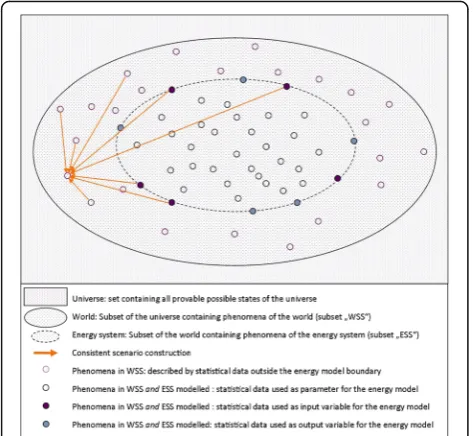
In Fig. 1, a subset illustrates being “part of” the larger reality, to which I refer to as thetarget system. The energy system is not naturally demarcated from any other system of the world, and the world is not naturally separated from any other system of the universe. The energy model de-picts parts of the energy system and all interrelated sys-tems of the world by stipulation, expressed in theenergy model design and energy model boundaries. Energy model boundaries are an artificial demarcation between naturally interrelated phenomena. The energy model design is basically the choice of input variables, parameters, and output variables representing the phenomena in WSS.
Statistical dataare quantitative, i.e. continuous or discrete or qualitative, i.e. categorical (nominal and ordinal) descriptions of phenomena in WSS according to the definition of the data collecting institution.3
I take atrue data generating processto be a process that causally influences the numerical appearance of statistical data. A true data generating process can be artificial, for example, if the data are created to test statistical methods, or natural, if known or unknown phenomena in WSS cause the data recorded. For example, let our data be the coordinates of a ball at a time. If the ball is thrown, the true data generating process is the force influencing the ball, which“changes”the coordinates’numbers—the data we collect. The relation in WSS of the phenomena can, for the ball example, be described by a mathematical for-mulation using laws of classical mechanics. Depending on the phenomena described by a statistical data point, the number of true data generating processes can vary and their causal status too. For example, the statistical numer-ical description of the phenomenon GDP is caused by, or correlated with, different phenomena in WSS as for ex-ample consumer satisfaction, trade balance, tax burdens, unemployment, etc. Statistical methods typically aim at identifying what phenomena are influential. The proposed BMA method does so, too.
methodologies, techniques, and quality standards have recently emerged. Research addressing the crucial role of scenario construction and the difficulty in classify-ing the diverse techniques has been undertaken, for example, by [27–29]. Scenario construction is the sys-tematic choice of numerical values for exogenous vari-ables (input varivari-ables) and parameters of an energy model as assumptions. Scenarios constructed to derive recommendations for decision support necessitate a balance between confirmed possibility and hypothet-ical assumption creation.
Unfortunately, in energy-economic modelling, the current practice of scenario construction is often opaque and unsystematic [30]. Sometimes, scenarios are defined, that is, agreed upon by modellers and sponsors. The consequently stipulated numerical values for assumptions translate the storyline. With opaque scenario construction, a “result design” for sponsors is also possible, what is in my view scien-tific misconduct. Evaluating the representation qual-ity of the agreed storyline in a specific energy model is rarely addressed. The proposed method does so by looking at the energy model input variables’ ability to represent the scenario. If the defined scenarios are not based on a systematic analysis of interrela-tions in the target system, the truth and legitimacy of the claim that energy model results represent a re-sponse of the energy system to the scenario cannot be evaluated. BMA scenarios for input variables allow for the construction and evaluation of consistent scenarios based on observable energy system rela-tions in the past using statistical data.
Methodologies and techniques reported in the literature are presented in Table1. The comparison of scenario tech-niques is based on the categorisation introduced by [31].
The following series of arguments addresses the ques-tion as to whether the proposed BMA technique is a sensible addition to the purely qualitative approaches of the scenario method. To do so, I highlight some aspects of opinion-based approaches which are implicit to them. I emphasise that these aspects are not erroneous in themselves. They may serve as an advantage in scenario design in some contexts. The basic claim I argue for is that scenario construction techniques which use opinion as a sole source of information fall short of empirical ad-equacy required for decision support and policy advice. Scenarios based on opinion
1. Lack a democratic perspective,
2. Lack the possibility to evaluate the scenario quality, 3. Suffer from detrimental psychological effects in the
context of decision support,
4. Cannot reflect the target system’s complexity due to limitations of human reasoning capacity.
I recall that the particular context of energy modelling uses scenarios as a basis for decision support, replacing experiments. In other words, scenarios computed with en-ergy models may lead to political decisions influencing real people in the real world. Scenario construction tech-niques which suffer extensively from the four points raised in this section bias the futures investigated, which could have far-reaching and society-relevant consequences.
Constructing scenarios for decision support with conse-quences surpassing the realm of personal experience of the scenario constructor places in a sense an obligation on the scenario to account for the interests of all people affected. If the information source of scenarios is an expert opinion, the constructed scenarios are necessarily and inevitably biased towards the personal situation of the expert(s). In a democ-racy, however, possible (probable, plausible, and consistent) futures presented to decision-makers ought to envision futures respectful of all stakeholders. Statistical data as an in-formation source, in a sense, encode stakeholder choices and implicitly reflect different interests, for instance, technology acceptance, economic commitment to changes, ecological concerns, institutional (personal, societal) priorities, etc. Many statistical data are available from trustworthy sources that collect data non-discriminatory, regularly, reliably, meth-odologically sound, and freely available.
Moreover, statistical data connect conceivable future scenarios to relevant constraints. Relating the thinkable to the feasible, and showing where changes are necessary to render scenarios feasible, can be achieved in a straightfor-ward manner based on statistical evidence. For example, the statistical information of average processing times for construction permits of electricity transportation facilities could constrain scenarios of generation capacity increase realistically. As a transparent assumption in a scenario, it is at the same time the action recommended to decision-makers; theassumptionthat processing times for construction permits are stipulated shorter (or equal, lon-ger) than statistically evident in the scenario can be com-municated in detail.4
Table 1Comparison of scenario design methodologies and techniques adapted from [31]
Methodological approach
Technique Keywords or a (very) brief description Source of information
Judgement Genius forecasting “Think the unthinkable”[55] Opinion
Visualisation Intuitive images are combined to scenarios that are in juxtaposition to analytical strategies, e.g. [56]
Opinion
Role playing A group judgement technique where individuals create a response to a hypothetical situation which is considered as a scenario. Playing the devil’s advocate is an example of scenario forming with focus on unprecedented or highly unlikely scenarios [57].
(Group) opinion
Coates and Jarratt For a given time frame and domain, four to six scenario themes regarding the most significant kinds of potential future developments based on judgement are formulated, cf. [58]
Opinion
Baseline scenario: the expected future
Trend extrapolation Measures existing trends and extrapolates effects into the future; both judgement and empirical analyses are possible. The Manoa technique defines three strong trends which are analysed w.r.t. their implications separately, and in conjunction using a cross-matrix, cf. [26]
Opinion or statistical data
Elaboration of fixed scenarios
Incasting Based on an (extreme) state of the world participants judge potential impacts in various respects as politics, economics, etc. Qualitative or quantitative for example life cycle assessment technique [59]
Opinion/data
SRI matrix (Stanford Research Institute matrix)
From a column-wise classification of fixed scenarios as for example worst case or expected future the dimensions (e.g. population, environment) are evaluated row-wise, cf. [60]
Opinion
Event sequences Probability trees and scenario trees
Different future conditions constitute individual paths which are assigned probabilities. Probability trees are used in risk management. A related technique is scenario trees where a reduction of probable paths to relevant paths is carried out, cf. [61]
Opinion
Intuitive scenario building Probability trees are evaluated to identify characteristics that are common to several branches. Summarising these branches is considered as a way to create coherent scenarios, e.g. sociovision [62]
Opinion
Divergence mapping A set of events, derived from brainstorming, is aligned in different time horizons forming the storyline of a scenario. The relation of earlier events to the later events is seen to be a plausible sequence, cf. [63]
Opinion
Backcasting Horizon mission methodology
Supposing a hypothetical situation (the scenario) was an actual situation, the ways and necessary components at present are analysed to achieve the scenario [31,64]
Opinion, state-of-the-art technology data
Impact of future technologies
Multiple future scenarios are the basis from which experts work backward and identify necessary (technological) breakthroughs, e.g. [65]
Opinion
Future mapping An expert elicitation technique where pre-defined events and pre-defined end-states are arranged to investigate interrelations and consequences, cf. [66]
Opinion
Dimensions of uncertainty
GBN (Global Business Network)
Based on two dimensions of uncertainty and polarities, four combinations are seen to constitute plausible futures, cf. [62]
Opinion
Morphological analysis and field anomaly relaxation
Multiple dimensions of uncertainty captured in columns are related to alternative events in rows. A scenario is created by the alignment of alternatives of each column, cf. [67]
Opinion
Cross-impact analysis
Interactive future simulation IFS
Based on a set of variables (descriptors) an assessment of their mutual relevance based on expert judgement is carried out. Consistent scenarios are constructed in the sense that variable combinations are computed that have been judged to be compatible. There are probabilistic versions of cross-impact analyses [37]
Opinion arranged by mathematical method
Modelling Trend impact analysis Based on a business-as-usual trend assumption, the impact of a potential event on that baseline scenario is evaluated in
distinguished impact sequences (first depart from trend continuation, maximum impact, and effect integration), cf. [68]
Opinion
collection are transparent and often follow a methodo-logically rigorous process. It seems legitimate to consider that scenarios based on statistical data are less susceptible to personal interests, personal experience, and group dy-namics. Psychological factors (as consensual attitudes or authority biases, in addition to cultural factors as pedigree, or gender prejudice, and environmental factors such as meeting facilities, meeting location, travel times and hous-ing, as well as economic factors such as remuneration, funding, or nepotism) are not observable in statistical data analyses. The unclear quality of expert elicitation and the reported psychological phenomena involved in the construction of opinion-based scenarios gain a dramatic momentum if we recall that these scenarios are presented as possible (sometimes even consistent) futures to decision-makers.
Using the technique of cross-impact analysis as an ex-ample for a judgement-based scenario construction tech-nique, I would like to discuss the fourth point. However, my criticisms apply to all techniques based on expert opinion. Consistent scenario construction is a relevant prerequisite for the legitimation of energy model results and one approach addressing this issue is cross-impact analysis [37,38], reviewed by [39]. Briefly described, the method presented in [37] defines the so-called descrip-torsfiguring as a representation of context assumptions for a scenario. Experts are elicited to stipulate the recip-rocal influence of the descriptors and via an algorithm compatible context assumption combinations are de-rived. Although cross-impact analysis (CIB) is preferable to an unsystematic assumption choice and numerical value stipulation, the method has some drawbacks.
First, the number of so-called descriptors is limited due to both practicability, cf. p359 [37], and reliance on experts. In contrast, due to the Monte Carlo simulation, the number of potentialinfluences(corresponding to de-scriptors) is not limited computationally using Bayesian model averaging. Expert knowledge is not required but can be included through prior choice.
Secondly, the CIB methodology defines consistency in a particular manner based on expert judgement. The de-scriptors are evaluated with respect to their reciprocal influence, one-on-one, as assumed by the expert interro-gated. The basic principle describing the consistency is the principle of compensation that says “two opposing influences on one state are to be judged as equally strong if their effects can compensate each other. If it is to be estimated that one of the influences predominates during a confrontation, this one shall be judged higher, i.e. be given a higher number.”p.340 [37].
Underlying the principle of compensation are three ar-guable assumptions (1) dominance is generally valid, (2) dominance can be extended, and (3) dominance is pair-wise invariable if additional descriptors are simultan-eously considered in a scenario.
Assumption 1 is a general statement for two descriptors that can be for example“+ 1”meaning“weakly promoting direct influence”,“−3”meaning“strongly restricting direct influence”, or “0” meaning “no direct influence”. The problem is that such an evaluation needs to be related ex-plicitly to another context (i.e. descriptor) and contexts may vary in different scenarios, and for different experts. For example, if an expert generally judges a descriptor as weakly promoting another descriptor, she (implicitly) pre-supposes conditions where the statement is valid, what I call that a state of the world. But the presupposed condi-tions are exactly those that are varied in different scenar-ios. In contrast, if we use statistical data and the BMA method, we evaluate the reciprocal influences of descrip-tors inmany different statesof the world, to be precise, all those states of the world, our data record contains. This is in fact what statistical analyses do, regarding the rate of change of a variable (i.e. descriptor, influence) relative to all other variables. I call the property of a descriptor to be influential in many different states of the worldstability. It is advantageous to formulate scenarios based on stable re-lations in the target system as these rere-lations are most likely to hold in scenarios too.
Table 1Comparison of scenario design methodologies and techniques adapted from [31](Continued)
Methodological approach
Technique Keywords or a (very) brief description Source of information
Sensitivity analyses Given a model, exogenous variables or model parameters are varied. The changes of model results given varying input/parameter assumptions are evaluated as“sensitivity”. Often the one-parameter-at-a-time technique is employed, a kind of ceteris paribus approach [69]
(Opinion and) statistical data
Dynamic scenarios From brainstormed scenario themes a system is mapped using causal models. The variables figuring in different causal models are combined in a meta-model mapping the whole domain. The meta-model is analysed for different uncertainties involved in the variables, cf. [70]
Opinion and statistical data
Bayesian model averaging (BMA)
Scenarios are constructed from statistical data records of phenomena most relevant for an input variable of a consequent quantitative model. Uncertainty is evaluated based on the explanatory power of influencing phenomena most relevant in the historical record, cf. [24]
Assumption 2 implies that dominance of descriptors can be extended to hypothetical states of the world. A hypothetical state of the world is a state with unprece-dented conditions. In contrast, a provable possible state of the world is a combination of occurrences in the world observed in the past. If the scenario construction is based on intuitive or hypothetically possible relations in the target system, we are confronted with two kinds of uncertainty: (a) assumption uncertainty and (b) rep-resentation uncertainty. Now, (a) is a natural uncer-tainty for every future scenario and, in fact, it is the very reason why we construct scenarios. Assumption uncertainty arises because we do not know what will happen in the future. So, if we assume a numerical value we stipulate an assumption for an input variable, we face assumption uncertainty as the value might prove to be different in due course. In contrast, (b) rep-resentation uncertainty means that the relations in the target system are, at least partially, flexible and un-known. Intuitive cause-effect relations or expert opin-ion on reciprocal relatopin-ions can be empirically adequate; however, the only way to evaluate the adequacy is to compare the assumed relation with actual target system behaviour in the past. This amounts to a statistical ana-lysis. The proposed method merely circumvents the introduction of additional uncertainty due to poor sys-tem relation representation and straightforwardly uses the stable relations that are statistically confirmed for the observation period in the target system. BMA for consistent scenario construction extends to hypothet-ical states of the world too but allows specifying that a scenariorepresentsa hypothetical state and allows for a clear communication as to why and to which extent the hypothetical scenario differs from the observations in the considered historical period.
Assumption 3 is, in a sense, a ceteris paribus assumption known to be an idealisation. It is related to assumption 1 but now I mean consistency within the same scenario. I would like to give a simple, intuitive counterexample to this assumption based on the interrelated nature of the energy system with social, environmental, and political systems. Consider the three descriptors: gross domestic product, world tensions, and oil price, taken from the example in [37]. The experts are supposed to judge the influence of the gross domestic product on the world tensions, and so forth, pairwise. But if an expert was asked to assess the relevance of the oil price on the world tensionsgivena high gross do-mestic product (a relaxed economic situation), it may be different than when this relation is assessed given a low gross domestic product (distressed economic situation). Whatever the expert’s subjective reasoning behind the sup-posed impact of one descriptor on another would be, it must not necessarily hold true when a third, a fourth, etc. descriptor enters the picture (and is variable).
However, for a human being, also for an expert, it is dif-ficult to assess the strength of relations between the de-scriptors when the number of dede-scriptors exceeds two or three. I suppose the cause for this is that human’s reason about correlation and reasoning is difficult when relations become multi-dimensional. In contrast, the statistical BMA model can (and does) take dozens, even hundreds, of potential combinations of descriptors (influences) into account and assesses their explanatory power with respect to all other descriptors in a model simultaneously. Thou-sands of such models are investigated in the MCMP sam-pler, which is not restricted by human capacity. And, perhaps most relevant, the explanatory power (equivalent to the “cross-impact judgements” of the experts) is not based on human reasoning, but on statistical confirmation. Consistency is hence defined as non-contradiction with empirically confirmed states of the system (i.e. with statis-tical fact) rather than an expertopinion.
In addition to being non-contradictory, the strength of evidential support in a relation (given the data used) can be analysedin principlein detail for any region, any time reso-lution, any historical period, and any type of statistical infor-mation by one person. In contrast, even if the group of
availableexperts has remarkably diverse backgrounds (what brings about other problems, e.g. language issues, incompat-ible implicit worldviews), this is for judgement-based scenar-ios in principle not possible. All experts employ human reasoning. I would like to remark that this is a fundamental difference to all techniques presented in Table1with infor-mation source opinion. To be clear, I do not say that experts err in principle their assessment of relations, even if a multi-dimensional scenario is constructed from their two-dimensional assessment. But we cannot assess the qual-ity of the“human black box”directly. Whatever the reason-ing behind the expert’s opinion of the assessed relation would be, it should be empirically adequate, and this ad-equacy needs to be evaluated. Using statistical data in the BMA method, we can obviate the risk of empirical inad-equacy due to human reasoning naturally involving psycho-logical effects and computational limitations.
numerical assumptions seems to not be based on a meth-odologically stringent interpretation procedure. In other words, the method invites interpretation opacity and uncer-tainty in the numerical value stipulation necessary for an energy model.5 Different modellers may interpret the impact of the descriptor oil price“quantified”as + 2 on the descriptor gross domestic product in completely different numerical value stipulations“fed in”the energy model. The CIB method in fact provides “sets of consistent assump-tions”for a number of descriptors forming the scenario it-self. To me, it is unclear if the interpretation of the scenario B1 (p. 343 [37]) consisting of moderate world tensions, medium borrowing industrial countries, strong cohesion of OPEC, an oil price of 35–50$, and 2–3% world GDP growth would be interpreted by different energy modellers numerically in the same way. If an oil price of 35$ is equally well confirmed as an oil price of 50$, the“rough”scenarios are possibly too general for energy models being highly sensitive to numerical assumption changes.
Secondly, how would “moderate world tensions”be nu-merically interpreted? Thirdly, if it was not included in the model numerically, how is the scenario-relevant context as-sumption (and its non-inclusion in the energy model) accounted for? The proposed BMA method for consistent scenario construction uses statistical data with explicit nu-merical assumptions for quantitative statistical data. For ex-ample, the descriptor GDP is notinterpretedbut simply is
the GDP in units, e.g. billion EUR [40]. The derived statis-tical data, as for example GDP per capita, inherit their meaning from the basic statistics and the transparently published computation procedure by statistic agencies. Vague scenario formulations as “high GDP” or “moderate world tensions” reflect the relative nature ofevery judge-ment. In the case of CIB, the judgement expresses the ex-pert’s opinion and the modeller’s interpretation stipulating the numerical value. In the case of BMA, the judgement ex-presses the statistical data used, e.g. the stipulated value lies in the third quartile of the data (in the highest 25%). If data are transformed [41] for BMA analyses, a systematic rever-sal to derive a numerical value for scenario assumptions is possible. In some contexts, categorical data or ordinate statistical data are available. They can be included in the scenario construction, but in contrast to semi-formal quantification, BMA is not limited to them. Their interpret-ation is straightforward from the statistical sources, for instance, defined indices6
or systematic data treatment as, e.g. seasonal adjustments.
The empirical assessment’s importance is particular to energy modelling and policy advice scenarios in general. The severe consequences of experimental trial-and-error strategies in terms of economic impacts on society de-mands for a scenario construction method that takes into account assumption compatibility and strength of evidential confirmation. As energy modelling is the best
“experiment” of the energy system we have, it is mean-ingful to make sure that the constructed scenarios relate to what was possible in the target system and to estimate how much deviation, we could say “novelty”, a scenario introduces compared to the states of the energy system as documented in statistical data. In this way, we esti-mate and give credit to the efforts we take in our pursuit of hypothetical system states we dream of in scenarios.
Expert knowledge is part of this process; however, evalu-ating therelationsof target system phenomena isnotan ad-equate scope for expert judgement, as speculations about relations are more adequately scrutinised with statistical methods. Ifin factone phenomenon in the target systems happens to systematically change in concert with other phenomena, statistical methods can point to that– what-ever the reasons for the simultaneous changes are. Experts can interpret changes and guess reasons for correlations if the true data generating processis unknown. But a guess remains a guess, even if performed by an expert. Pretending expertise on something one does not understand is not professionalism but unscientific conduct. And as we cannot directly evaluate expert understanding and the “ correct-ness” of reasoning as confirmed by evidence we might as well guess ourselves or directly consult evidence, as we do in statistical analyses.
If an expertknowsa true data generating process, expert judgement is valuable for scenario design. For example, if an expert knows of signed contracts to build a pipeline, she knows a reason for a change. In a scenario the phenomenon “infrastructure capacity” can be adjusted ac-cording to the expert’s opinion in due time of the scenario.
Scenario definition and uncertainty evaluation
The first step when creating BMA-scenarios is defining (i.e. choosing upon known) phenomena in the target system we want to make a scenario of for an energy model. I refer to such phenomena of interest as “scenario phenomenon”. Public invitations to tenders for modelling exercises often describe the scenario phenomena of interest in detail. For example“the impact of unconventional gas production on the electricity price of country X”could be a phenomenon of interest. But also phenomena, as for example “ implica-tions for the energy system of a legal threshold for CO2 emissions in country X”, could be subject of a scenario. Let me replace “country X” with “Nicastan”, an inexistent country, to improve legibility and intuitive understanding coupled with the generality of the presentation.
might be interested in tax burdens or security of supply scenarios, to name just a few. For a consistent scenario with BMA, the phenomena investigated are not limited in number and nature (social phenomena, environmen-tal phenomena, economic phenomena) provided statis-tical data are available. I return to that limitation in the “Discussion and limits of the approach”section.
We discern between modelled phenomena and context phenomena defined by the model boundaries of a spe-cific energy model. The consistent scenario construction is solely concerned with the aptitude of an energy model to represent the scenario given the energy model design. The relevant parts of an energy model for scenario rep-resentation are the input variables and sometimes pa-rameters. For the presented method of consistent scenario construction, we do not need any judgement of the energy model’s quality, as we only look at an energy model’s capacity to represent the scenario, and construct numerical assumptions consistent with statistical data and expert opinion. In other words, the consistent sce-nario construction as presented here is independent of consequent processing by an energy model, its mathem-atical formulation, and internal error propagation, what makes the method applicable to a large number of quan-titative modelling techniques. The “interface” of scenar-ios and energy models are typically input variables; therefore, the following example uses a typical input variable. Figure1 depicts a schematic illustration of sce-nario phenomena, statistical data, energy model repre-sentation of the energy system (ESS), and the target system (WSS), i.e. the“real”energy system.
The rectangle should be considered extending be-yond the graph as “the universe”; it is associated with all possible states of the universe, one at a time, ac-cording to the time increment we choose for the rec-ord. The solid ellipse depicts schematically “the world”; it is a subset of the universe associated with all possible states of the world. Dots in the WSS subset indicate existing phenomena. The dotted ellipse indi-cates “the energy system”; it is a subset of the world associated possible states of the energy system. The circles indicate statistical data depicting (a collection of ) phenomena in WSS as follows.Purple circles sche-matically depict phenomena of the world subset (WSS), explicitly outside the energy model boundaries.
Blue circles depict phenomena of WSSand the energy system subset (ESS); statistical data of these phenom-ena are accounted for in an energy model in the form of parameters. Solid purple circles depict phenomena of WSS and the energy system subset (ESS); statistical data of these phenomena are accounted for in an en-ergy model in the form of input variables. Solid blue circles depict phenomena of WSS and the energy sys-tem subset (ESS); statistical data of these phenomena are accounted for in an energy model in the form of
output variables. The arrows show the BMA descrip-tion of phenomena, to be read as“explains” in the dir-ection of the arrow tip (Fig.1).
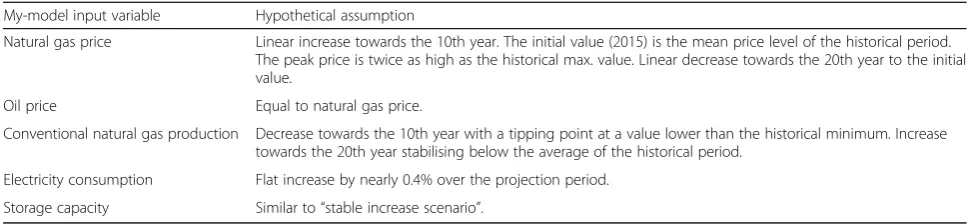
I created a fictitious scenario and elaborate the dif-ferent steps for the example. The storyline of the sce-nario is translated to numerical assumptions for input variables. Suppose the government of Nicastan is in-terested in a low-cost scenario for natural gas because in the real world, recent developments in unconven-tional gas production indicate a lasting period of low natural gas prices. We want to investigate the effects of such a low-cost period on the energy system in Nicastan with the fictitious energy model My-model.
Assessing the empirical adequacy of My-model is our aim, expressed as a lower bound of uncertainty that My-model is apt to represent this scenario. Find-ing the numerical assumptions, value that best de-scribes the scenario follows. Phenomena of interest in this example are different target system phenomena, including the unconventional gas production. The for-mulation of the scenario is captured in the input vari-able “natural gas price” of My-model. So, if the energy models’ assumption should reflect the bearing of unconventional gas production on natural gas prices in Nicastan, there should be statistical evidence for that. The strength of the supposed relation be-tween the energy model input variable (the price for natural gas) and the scenario-phenomenon of the target system (unconventional gas production) is assessed by statistical evidence.
Fig. 1Schematic illustration of the world, the energy system, and
It is, in a straightforward sense, evaluating whether the considered scenario can be described by the energy model at all (and how well), based on the energy model design. The input variable of My-model represents many phenomena; with BMA, we can find out how relevant the one phenomenon we are interested in (the uncon-ventional gas production) is. The uncertainty assessment estimates howrelevantthe relation ofscenario phenom-ena and energy model input variables is, based on obser-vations. For statistical data of phenomena outside the energy model boundary, it is a quantitative assessment of scenario uncertaintyas defined by Walker et al. [42]. This is a fundamental assessment because it concerns
the grounds of justification for any energy model result claiming to illustrate the scenario.
I would like to emphasise thathypotheticalenergy system state scenarios (i.e.notdesigned to represent energy system states observed in the past) are not in conflict with using statistical data for scenario construction. Both energy models and scenarios are designed to describepossible en-ergy system states. Statistical data are evidence for a system stateto bepossible. Equivalent to energy model calibration, consistent scenario construction uses the evidential basis to derive statements about the possibility of scenarios. This is of interest for scenarios describing unprecedented energy system states (hypothetical scenarios) because it provides an expectation based on what we know to be possible.
The statistical data are used to analyse relations in the target system of relevance for the scenario representa-tion in an energy model. To do so, classical statistical methods could be used. These methods have some dis-advantages, for example, biases in the choice of explana-tory variables by the scenario constructor. Using Baysian model averaging (BMA) [2, 3] allows for both expert opinion and statistical likelihood and reduces the risk of model misspecification.
The mathematical formulation representing a general relation between the influences (also called explanatory variables) and the dependent variable is chosen, where the input variable of the energy model (the natural gas price) figures as the dependent variable in the BMA model. Evi-dentially, production data of unconventional gas is consid-ered as an explanatory variable, but for an empirically adequate representation, statistical data of any kind which is suspected to be relevant can be included. Our aim is to find out what phenomena in the target system the input variable actually represents, according to statistical evi-dence. We employ BMA to evaluate the relevance of dif-ferent phenomena for the input variable, taking full advantage of the fact that BMA“sorts out”influences that cannot contribute to explaining the dependent variable. Defining the prior distribution also allows us to take into account the expert opinion on the number of explanatory variables expected to influence the dependent variable.
The BMA results are models containing different explana-tory variables. The models are ranked according to their explanatory power which is expressed as a posterior model probability (PMP). The relevance of individual ex-planatory variables is expressed as posterior inclusion probability (PIP). These two values per se already encode highly relevant information for scenario design. In a sense, they are the empirically confirmed counterpart to the ex-pert opinion of scenario design by cross-impact analysis. In contrast to the assumptions of cross-impact analysis, it is observable that the inclusion or exclusion of variables is not reciprocally balancing. Even for the simplest case of one explanatory and one dependent variable (comparable to CIB), we find that changing the role of the variables does not always lead to reciprocal balancing. The balan-cing is even less observable, given a growing number of explanatory variables. However, the CIB idea that influ-ences are “impacting” each other according to the rela-tions of phenomena in the target system is also captured in the BMA models. Unfortunately, the true data generat-ing process is often unknown, and in systems influenced by human decision, individual relations may be difficult to find in statistical data. What we seek to analyse is the strength of“stability” in the relations of influencing phe-nomena vis-à-vis the dependent variable.
and tedious construction of adequate software. For the ex-ample in [1], I used the R package BMS by Zeugner [43], which offers abundant possibilities of BMA specification and a complete set of standard features sufficient for a con-sistent scenario construction.
The BMA approach amounts to saying“It is by at least 93% uncertain that My-model can describe a low-cost natural gas period due to developments in unconven-tional gas. The scenario is introduced in My-model via the input variable “natural gas price”, but low natural gas prices are also explained by…”. In the following sec-tion, two options for consistent scenario construction are discussed: the consistent scenario construction and the representation quality assessment for (1) a given en-ergy model and (2) an adapted enen-ergy model. The latter generally allows for a better representation of scenarios, as the model is adapted to account for the most relevant phenomena influencing the scenario phenomenon.
Consistent scenario construction for a given energy model and an adapted energy model
Typically, a scenario is introduced to an energy model by input variable adjustment; in My-model, it was the natural gas price. Having gathered statistical data of all influences, we suspect to be related to the natural gas price and the scenario phenomenon“unconventional gas production”we have investigated the empirical adequacy of the scenario in the fictitious My-model. The BMA analysis delivers an indication of which phenomena are relevant for the input variable and how relevant these are relative to each other (and all phenomena we sus-pected being relevant).
We can improve the scenario representation quality of an energy model by changing the energy model design. In particular, we can decrease the energy models’ repre-sentation uncertainty of a scenario phenomenon by in-cluding the relevant input variables and/or parameters in the energy model. To do so empirically adequate, we need to find out which phenomena in the target system have influenced the scenario phenomenonin the past. If our intention is to create a consistent scenario, rather than justifying that our input variable assumption repre-sents a scenario, the consistent scenario construction method is suitable.
In consistent scenario construction for adapted energy models, we apply a different reasoning. In the target sys-tem, the emergence of a scenario phenomenon is often only possible if different related phenomena develop in a specific way. In other words, the scenario phenomenon, due to the interrelated nature of the target system, ne-cessitates other phenomena’s occurrence in a specific way. In the example, the scenario phenomenon of high unconventional gas production necessitates high natural gas prices; otherwise gas production is not profitable.
We denote the BMA variable representing the scenario phenomenon as the dependent variable and span the model space over all influences suspected to impact the phenomenon, including input variables and parameters of the energy model as explanatory variables. In that way, we investigate what potentially explains the sce-nario phenomenon’s emergence in the target system. If we consistently construct a scenario, our aim is to “present to the model” a world in which the scenario phenomenon is present in the way we are interested in (i.e.highunconventional gas production). To do so em-pirically adequate, we depict the scenario phenomenon “indirectly”, supposing its emergence is dependent on the influences to be in a certain way.
A phenomenon is“presented to the model”in a coherent and consistent way by an adequate choice of numerical values for input variables and the introduction of relevant input variables and parameters in the energy model, called energy model adaption. The more relevant input variables and parameters an energy model contain, the better our representation of the scenario would be. Again, we have BMA select for us which influences are systematically in-creasing or dein-creasing the observable value, but now, our dependent variable is the scenario phenomenon. All we have to do is be creative in our suspicions of what target system phenomena influence the scenario phenomenon and perform statistical data handling.
Including the data of energy model input variables as ex-planatory variables allows us to evaluate how well we can already represent the scenario phenomenon in the energy model. We can evaluate this quite precisely using the PIP of the influences that are energy model input variables relative to phenomena not modelled in the energy model. Also, we find what other influences in the target system are relevant for the emergence of the scenario phenomenon to efficiently
adapt the energy model with the objective to increase the empirical adequacy of scenario representation. Figure 2 is comparable to Fig.1 but depicts the different reasoning of consistent scenario construction in contrast to input variable justification (Fig.2).
Using the PMP of the best BMA model, it is possible to evaluate the probability that the phenomenon of our sce-nario can be described with the influences (let us assume a fictitious PMP of 16%). My-model does not contain all phenomena to describe the scenario with the highest probability. We can base our decision whether to adapt the model to better represent the scenario on that evalu-ation on the BMA results. Using the influences’ PIP, we quickly find which energy model adaptions are most rele-vant to increase the scenario representation quality. The energy model adaptions may concern both input variables and parameters, depending on the energy model design. If not all influences are used to construct a scenario, the lower bound of uncertainty needs to be adjusted to the PMP of the BMA model consisting of the influences that are used. This is a BMA model with higher uncertainty if it is not the best BMA model in terms of PMP. The sce-nario construction with all relevant influences is a sce-nario representation according to statistical evidence of the scenario phenomenon with least uncertainty for the proven possible states of the world (observed values).
Using the consistent scenario construction approach, we pay attention to the interrelated nature of the target system and design our energy model to represent the sce-nario phenomenon empirically adequate. This approach is also applicable for phenomena, as for example enactment of a law. This process may at first sight be self-sufficient in that it is a human decision governed by human sover-eignty, not grounded in statistically observable interaction with other target system phenomena. Upon second thought, we may find that the decision of actually enacting the law indeed necessitates a specific target system state. For example, the scenario of a law prohibiting the emissions of CO2 exceeding some defined quantity may necessitate a minimum quantity of CO2emissions, to be relevant at all. For human decision-governed scenarios, an investigation of most relevant influences on the decision improves the representation of a scenario.
Results: consistent numerical value estimation
With BMA, we can trulyconstructscenarios. Having iden-tified the most influential phenomena, we insert the stipu-lated values for the time period we want to project in the explanatory variable data record. I would like to remark that this is in the same instance a transparent assumption documentation. We use the BMA model of choice to com-pute the predictive density for the dependent variable based on the stipulated values for the influences. This means, expressed for readers of a scenario study,“the ad-justed input values of the energy model correspond statis-tically to an unconventional gas production of xy”.
The PMP of the BMA model determines the lower bound of uncertainty for the scenarios. In addition, we dispose of statistical criteria, for example, we can assess whether the predicted numerical value of the scenario phenomenon is within the double standard deviation or not. To be clear, the procedure is (1) stipulation of values for influences; we simply fill in the data record for the future period of the scenario. We can orientate on historical“highs and lows”, and include expert know-ledge, as mentioned before if the expert knows of signed contracts, the additional available capacity in the year of expected operation is entered as data. Next step (2) is computing the predictive densities for the scenario
Table 2Fictitious evaluation of scenario representation for My-model
BMA model-dependent variable Influences Relevance of influence (PIP) Influence modelled in My-model
Unconventional natural gas production Natural gas price 0.99 Yes
Oil price 0.85 Yes
Conventional natural gas production 0.84 No
Electricity consumption 0.62 Yes
LNG infrastructure investment 0.59 No
Gas storage capacity 0.45 Yes
Fig. 2Schematic illustration of the reasoning for consistent
phenomenon. Given the stipulated values, we compute
the numerical value of the scenario phenomenon. In doing so, we can explicitly explain both the numerical value of the scenario phenomenon (due to observed re-lations) and the representation quality of the scenario in the energy model, as captured in the input variable(s). Finally, (3) communicate a complete and transparent documentation of the scenario construction.
An exemplary communication for a scenario con-structed according to case (b) BMA scenario construc-tion for an adapted energy model is available in the Appendix.
Discussion and limits of the approach
In this section, I would like to discuss the limitations of the approach and address difficulties I experienced when carrying out the method. However, I may be unaware of some problems and limitations, so I do not claim this discussion to be exhaustive.
A practical limitation of the approach is its extensive use of statistical data. This naturally involves both access to statistical data and availability of statistical data in the first place. Today, many statistical data are freely avail-able from official sources, for instance, Eurostat or USA.gov, and often data can be bought. Researchers en-tertaining energy models are likely to already dispose of a significant amount of relevant data for calibration pur-poses. Efforts made to improve access to statistical data often prove to be advantageous in more respects than consistent scenario construction. It is my opinion that fi-nancial burdens for subscriptions, in particular for re-search collaborations or larger scientific institutions, are vindicated by the potential impact scenario studies can have, if used for decision support.
Data availability is different from data access. Unprece-dented phenomena may have no data record at all. In this case, it is indispensable to transparently communicate that the scenario is incommensurable to any known energy system state. The response of the energy system to a com-pletely unprecedented scenario phenomenon is highly un-certain as the assumption of well-established and long-standing observable relations to hold is uncertain. In less dramatic cases, some methods may be useful. The first method is indirect phenomenon description with dif-ferent influences data so that as many suspected data gen-erating processes as possible are included in the analysis. Phenomena described with statistical data of various sci-entific disciplines allow for a multi-dimensional descrip-tion of the phenomenon if researchers are not primarily focussed on their scientific discipline.
Another method applicable in some contexts is data scaling. Scaling isnot suitable for data known to depend on spatial or temporal relations in the system where they are collected, unless that system is the target system of
the scenario modelling. For example, data of energy effi-ciency improvements of a technology product are scal-able, because the data are regionally independent, i.e. the same technology product would have the same technical efficiency everywhere in the world. In contrast, data of consumer behaviour of a region are not suitable for scal-ing, because the data depend on regional aspects such as income, social system, political stability, or any cultural aspects of that region, to name just a few.
A third method is data generation. The applicability of data generation is dependent on the phenomena of interest. Consistent scenario construction provides a guideline to survey design, as we can find potentially relevant phenomena for the scenario by statistical evi-dence. Say, a city wants a scenario of residential CO2 emission reduction, but the data of the city is lacking. Based on a BMA analysis with data of a comparable city, we find what phenomena are statistically most relevant and hence what data are of primary interest in the city. A survey designed to generate the data for the scenario then contains questions regarding the influence with highest relevance in terms of PIP (e.g. primary heating fuel in the residential housing sector) and questions on statistically relevant data in terms of high PIP (e.g. heat-ing technology efficiency). Of course, other data sus-pected to be relevant, say as a particularity of the city, should also be generated. If data are partially available, the survey design should account for relevant influences additionally to or for in-depth surveys. Lastly, a method to increase the data availability is open source policy of anonymised data-managing enterprises or research insti-tutions. However, this is more a political question than a method a researcher can apply ad hoc. Nonetheless, it is important to mention it and engage in the discussion.
Some experts hold that some phenomena simplycannot
be represented statistically, and expert judgement is the only way to evaluate such phenomena. Human psycho-logical phenomena or socially arising phenomena are typ-ical examples showcased. I agree with sincere reservations. Take the example of Weimer-Jehle in [37]“world tensions”. An expert evaluating the impact of world tensions may sub-jectively have a clear idea of what is meant. However, differ-ent experts are likely to have differdiffer-ent interpretations of “world tensions”due to the vague definition that may lead to the incommensurability of expert opinions.
I contend that for many psychological or social phe-nomena, therearestatistical data with a precise definition ofwhatis evaluated by the statistic andhowthe data are generated. Using such data enables recipients of scenario studies and modellers to understand how a phenomenon is interpreted in a scenario. Statistical data, for example, national warfare expenditure [44] or arms trade data8
statistical representation of “world tensions”. In addition to the data for armed conflicts [46,47], corruption indices such as the Corruption Perceptions Index (CPI) by Trans-parency International [48] or the World Bank’s CPIA database [49] are available, to name just a few. Let us suppose we construct a scenario, and the influence“world tensions” were expressed in statistics. We could combine corruption data and warfare expenditures of relevant na-tions for the scenario. Let us say for an exemplary scenario in Nicastan, the country imports weapons from Germany. We could consult the United Nations register [50] and find out how many weapons were exported in the past years to Nicastan. Our scenario is constructed such that themeaningof“world tensions”corresponds, for example, to an increase of arms imports from Germany by four times the mean over the last years. We can even specify which weapons we include in our assumption and what scope our assumption has (e.g. “transfers between UN member states”). To me, this is a storyline understandable to recipients of scenario studies, and significantly less am-biguous than the CIB evaluation“strong”, “moderate”, or “weak”world tensions p. 339 [37]. For psychological and social phenomena, a large variety of data are available, for example, the World Values Survey“is a global network of social scientists studying changing values and their impact on social and political life” [51]. OECD social databases [52] document and allow access to social data, as well as the United Nations Statistics Division UNDATA databases [53], or research institutions hosting databases [54].
To reduce practical limitations computing “milestone years”and interpolating between those may sometimes be suitable. However, it is an advantage of a BMA consistent scenario construction that the scenario design can signifi-cantly differ from linear paths. This is possible because the computation of the corresponding numerical value of the scenario phenomenon (predictive density) takes stipulated numerical values for influences into account. Stipulated values of influences can represent any“shock”or atypical development, in consonance or individually, and the result of the best BMA model will represent the expected value of the scenario phenomenon based on the relations ob-served in the historical period considered. In this sense, intuitive scenario design has its place in BMA scenarios, as well as expert opinion.
I would like to emphasise that using statistical data for social and psychological phenomena does not mean that constructed scenarios are identical to past phenomena. Stipulating the numerical values of relevant influences al-lows for full creativity and exploration of hypothetical pos-sibilities. Using the BMA model to compute the predictive density means that interrelations and impacts in the past are the basis of expectations for the future. Evaluating the
bearingof an influences’hypothetical value on other phe-nomena isalwaysbased on system relation assumptions—
be it in the form of expert opinion or observation record. Statistical data are evidentially confirmed system relations (and provable possible) what renders scenario construction (1) consistent with what we observed, (2) intersubjective, (3) systematic, (4) understandable, and (5) comparable. I am aware that statistics can be manipulated and may not mirror the“true”state of the world. Nonetheless, I am con-vinced that they are a better record of fact than subjective observations. In any case, the data are clearly explicable in contrast to ambiguous classifications (“high”,“low”, etc.) ex-perts can commit to.
Today, scenario studies typically present storylines, but lack of (1) transparent documentation of scenario assump-tionsand implicit assumptions; (2) a (energy) model as-sessment of scenario adequacy, i.e. input variable aptitude to represent the scenario; and (3) scenario assumption evaluation (stipulation of numerical values). Omitting communication of that information averts scrutinising the representation quality of the scenario for a given (energy) model and the degree of confirmation for a scenario (proven possible or unprecedented hypothetical). In my view, providing that information is the (energy) scenario modeller’s assignment because a scenario study recipient has no means to retrieve that information from (energy) model results or a storyline narrative.
The BMA method allows for the inclusion of any stake-holder choices statistically evident. The behaviour of society members, consumers, the industry, or the government, is statistically recorded in a non-discriminatory way in a multi-tude of dimensions, for instance, periodicity in time, geo-graphic area, social and cultural categories, or economic benchmarks. The pedigree of these data, their collection, post-processing, financing, hosting, and availability are meth-odologically rigorous, transparent, and non-discriminative. Scenario construction by the BMA method does not oblige the scenario constructor to claim“expert knowledge”or have skills superior to any person capable of handling statistical data. Some programs suitable to carry out a BMA scenario construction are available without charges, for example, R statistical software package BMS [43]. The scenario constructor need not belong to some exclusive group of “experts”, where the quotes indicate the ambiguous status of such an appointment, as there are no transparent quality criteria for being an expert.
The opinionof a scenario constructor can be included by numerical value stipulation. Opinion is systematically and methodologically levelled in the light of statistical data. In other words, the advantage of BMA over judg-mental scenario construction techniques is theembedding
![Table 1 Comparison of scenario design methodologies and techniques adapted from [31]](https://thumb-us.123doks.com/thumbv2/123dok_us/327056.1525174/6.595.58.543.81.714/table-comparison-scenario-design-methodologies-techniques-adapted.webp)
![Table 1 Comparison of scenario design methodologies and techniques adapted from [31] (Continued)](https://thumb-us.123doks.com/thumbv2/123dok_us/327056.1525174/7.595.56.543.97.255/table-comparison-scenario-design-methodologies-techniques-adapted-continued.webp)