S H O R T R E P O R T
Open Access
Centenarians and diet: what they eat in the
Western part of Sicily
Sonya Vasto
1,3*, Claudia Rizzo
2,3and Calogero Caruso
2,3Abstract
This paper pays attention to the modifiable lifestyle factors such as diet and nutrition that might influence life extension and successful ageing. Previous data reported that in Sicily, the biggest Mediterranean island, there are some places where there is a high frequency of male centenarians with respect to the Italian average. The present data show that in Sicani Mountain zone there are more centenarians with respect to the Italian average. In fact, in five villages of Sicani Mountains, there were 19 people with an age range of 100–107 years old from a total population of 18,328 inhabitants. So, the centenarian number was 4.32-fold higher than the national average (10.37 vs. 2.4/10,000); the female/male ratio was 1.1:1 in the study area, while the national ratio is 4.54:1.
Unequivocally, their nutritional assessment showed a high adherence to the Mediterranean nutritional profile with low glycemic index food consumed. To reach successful ageing it is advisable to follow a diet with low quantity of saturated fat and high amount of fruits and vegetables rich in phytochemicals.
Keywords:Ageing, Centenarian, Longevity, Mediterranean diet
Introduction
The Mediterranean diet has been widely recommended for a healthy lifestyle since Ancel Keys first used the term in 1975 [1]. The essential concept is that this is not a set of changes to our usual diet dictated by scientific experi-ments, but a set of food habits and recipes traditionally enjoyed by the ordinary people of Mediterranean coun-tries, who have been found to have lower rates of coron-ary and other age-related chronic diseases, including cancer, than most developed countries [2,3].
In recent years, researchers have been extremely inter-ested in the clear advantage of the Mediterranean nutri-tional recommendation that exists and is used in the Mediterranean surrounding area. In fact, there is no sin-gle Mediterranean diet but several interpretations based on the Mediterranean country’s political, economic and cultural tradition [4].
Since 1990, increasing evidence suggests that these diets have a beneficial influence on several diseases such as cardiovascular diseases, metabolic syndromes, hence
showing protective effect on health and longevity [5-7]. Mediterranean diet is characterized by a high intake of monounsaturated fat, plant proteins, whole grains (fish is not always present), moderate intake of alcohol, and low consumption of red meat, refined grains, and sweets. Fur-ther, the consumption of large amount of olive oil and olives in meals dominates all the Mediterranean cuisine [8].
Historically, the beneficial properties of virgin olive oil were attributed to the high proportion of monounsatu-rated fatty acids (MUFAs), namely oleic acid, rather than to the phenolic fraction. Nevertheless, several seed oils, including sunflower, soybean, and rapeseed, rich in MUFA have been demonstrated to be ineffective in bene-ficially altering chronic disease risk factors. Therefore, it is likely that the polyphenols in olive oil may mediate these health benefits [8,9].
There are at least thirty-six structurally distinct pheno-lics that have been identified in virgin olive oil, but not all phenolic compounds and their concentration are present in every virgin olive oil. Such differences in the phenolic compound are dependent on several factors like the variety of the olive fruit, the region in which the olive fruit is grown, the agricultural techniques used, the ma-turity of the olive fruit at harvest, the extraction process and the storage method [10].
* Correspondence:[email protected]
1Department of Molecular and Biomolecular Sciences (STEMBIO), University of Palermo, Via Archifari 32, 90213, Palermo, Italy
3Immunohaemathology Unit, University Hospital, University of Palermo, Via del Vespro, 127, 90137, Palermo, Italy
Full list of author information is available at the end of the article
The Sicanian Mountains (or Sicani), bordered by Ficuzza wood in the North, Caltanissetta in the East, Salemi in the West and Agrigento to the South represent
a very peculiar area where there is a high frequency of centenarians with respect to the Italian average [11,12]. The goal of this study was to characterize the dietary
habits of centenarians residing around the Sicani moun-tains, in 5 villages, namely Giuliana, Bisacquino, Castro-novo, Chiusa Scalafani, and Prizzi.
Materials and Methods
19 centenarians (10 females and 9 males) living at home in the five municipalities of Bisacquino, Castronovo, Chiusa Scalafani, Giuliana and Prizzi in the Western part of Sicily, Italy, were identified for the present study. These villages are located above sea-level, on the South-Western edge of the Sicani Mountains. Subjects were individuated by general practitioners and their age checked in the birth registries. As a further control, in the interview, particular attention was paid to the con-cordance between reported age and personal chronolo-gies (age of marriage and of military service for men, age of first and last pregnancy for women, age of children, among others). The subjects underwent a physical exam-ination and a morning fasting blood venous sample was obtained for studying blood chemistry parameters. An-thropometric measures included height, weight, and the body mass index (BMI) [weight (kg)/height (m2)]. Fur-thermore, the Mini Nutritional Assessment (MNA), Basic Activities of Daily Living (ADL) and the Instru-mental Activities of Daily Living (IADL) were admini-strated. ADL and IADL were assessed by interviewing participants and their caregivers [13,14]. Physical items (meal taking, bowel and bladder continence, standing ability, extent of general activities, bathing and dressing abilities), sensory items (auditory acuity and eyesight) and cognitive abilities (comprehension and self-expression) were included in the ADL. Each item was classified into five categories of self-sufficiency: completely independent, independent but slow, independent with difficulty, par-tially dependent and completely dependent, using a point score from 12 to 1, respectively.
The study was approved by local University Hospital Ethics Committee; the purpose and procedures of the study were explained to the subjects, and informed and written consent was obtained from the participants or caregivers.
Results
Table 1 depicts the prevalence of centenarians in Italy and in the study area; we have identified 19 centenarian,
10 female and 9 males among a population of 18,327 inhabitants. In this area the centenarian number was 4.32-fold higher than the national average (10.37 vs. 2.4/ 10,000). It is noteworthy that the male centenarian num-ber was 11.51-fold higher than the national average (10.24 vs. 0.89/10,000). Female/male ratio was 1.1:1 in the study area, while the national ratio was 4.54:1.
All the centenarians live in a family home, mostly with their relatives. Individual ADL and IADL scores were in the category of moderately independent for both gen-ders. A good anamnesis on a single individual reported a poor auditory acuity and poor eyesight, while they were free from cardiac heart disease, severe cognitive impair-ment, severe physical impairimpair-ment, clinically evident can-cer or renal insufficiency.
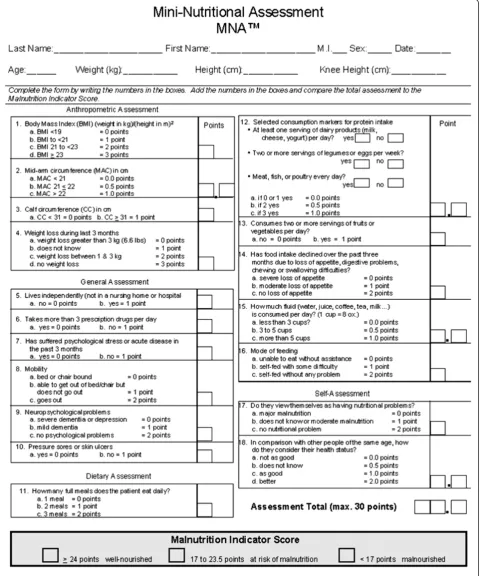
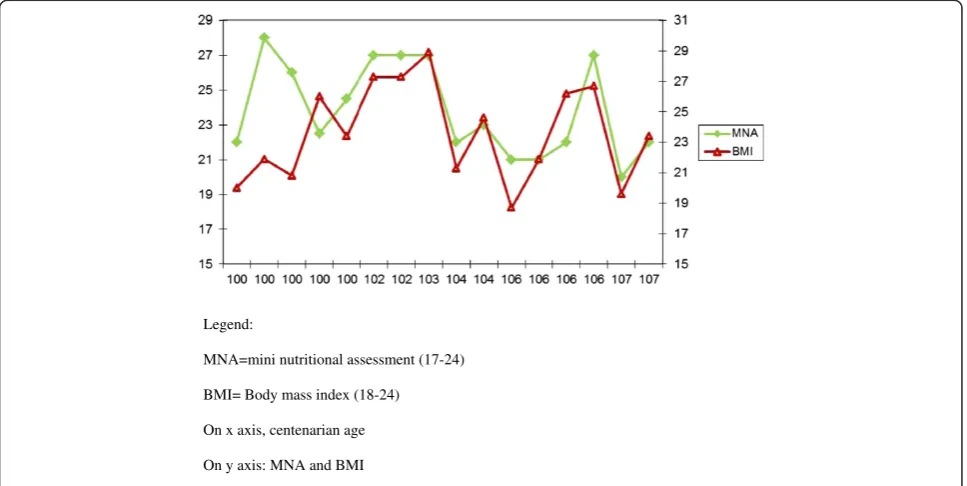
In Figure 1, MNA example administrated to healthy centenarian is shown [13], whereas Figure 2 reports a typical daily diet. Centenarians recruited in these area tended to be physically active, non-obese, small in stat-ure, with a regular BMI (23.6 ± 3.1), suggestive of some degree of calorie restriction with high intake of seasonal plant food and low meat intake. Their diet shows a low glycemic index because low of refined carbohydrate (no white bread, low amount of pasta, no sweeteners, sweet beverages, can food, frozen already prepared vegetables or dishes, cookies cakes or snacks). Furthermore, they have a good intake of olive and virgin olive oil from dif-ferent cultivar namely: Nocellara of Belice, Biancolilla, Giarraffa and Ogliarola that seems to have important anti-oxidant properties (unpublished data). In Figure 3, BMI and MNA are plotted together showing a perfect accordance between nutrition and body mass index.
Discussion
In Italy in 2010 the population aged one hundred years and over has 14 thousand units, hence the centenarian prevalence is 2.4/10.000. Currently there are almost five centenarian women for one man. However, in Italy there is a North to South gradient in the female/male ratio in centenarians [15]. To gain insight into the role of gender and environment, we have started a demographic study in Sicily showing that in mountain zones of Sicily there is a zone of male longevity with similar features to those found in Sardinia, in the so-called Blue Zone [11,12,16]. In both cases the municipalities concerned do not
Table 1 Distribution of Centenarian population in five villages of Sicani Mountains and in Italy
Total Population Males Females Total Centenarians Male Centenarians Female Centenarians
Sicani Mountains 18,328 8,793 9,535 19 9 10
(10.37) (10.24) (10.48)
Italy 60,626,442 29,413,274 31,213,168 14,473 2,612 11,861
(2.39) (0.89) (3.80)
include polluted areas and are small, with the lowest number of inhabitants. Therefore, longevity is more prevalent in men living in a small town, without pollu-tion, likely because of different working conditions, dif-ferent life style i.e. reduced smoking and alcohol abuse and Mediterranean diet. Accordingly, both these areas in Sicily and in Sardinia also share low mortality from can-cers and cardiovascular diseases [11,16-18].
One of the places in the Western part of Sicily, charac-terized by a high presence of oldest old people, is the area of “Monti Sicani”, between the provinces of Agrigento and Palermo [11,12]. “Monti Sicani” encompasses the area between the cities of Palermo and Agrigento from North to South and between the city of Caltanissetta and Trapani from West to East. The territory is characterized by a hilly area of clayey sandstone or pasture and a mountain area above 900 m, consists of pelagic limestone rocks of the Mesozoic. This area is characterized by olive tree agriculture, which tolerates a large range of soil con-ditions, preferring a neutral to alkaline soil type.
Looking at the national ratio of centenarian per inha-bitants in these area we have found more than a four-fold increase in centenarian, and regarding male female ratio of 1.1:1 times. Since Sicilian population genetics structure is very homogeneous and in Hardy-Weinberg equilibrium [19], the explanation for these data probably resides in the environmental characteristics of the study sample.
In this area, we have found a high number of cente-narians in good health, with a notable increase of male centenarians. Unequivocally, their nutritional assessment showed a high adherence to the Mediterranean nutri-tional profile with low glycemic index food consumed. According to the scores of ADL and IADL, centenarians of both gender demonstrated a good level of indepen-dency. They did not have any cardiac risk factors or major age related diseases (e.g. cardiac heart disease, se-vere cognitive impairment, sese-vere physical impairment,
Figure 2Example of daily menu.
Legend:
MNA=mini nutritional assessment (17-24)
BMI= Body mass index (18-24)
On x axis, centenarian age
On y axis: MNA and BMI
clinically evident cancer or renal insufficiency), although some had decreased auditory and visual acuity. Their life is characterized by social networking, acceptable physical activity and small amount of food divided among three meals, which contain a little amount of carbohydrate and meat and a lot of seasonal fruit and vegetables. In relation to biochemical parameters in centenarians, most biochem-ical parameters including cholesterol and triglycerides were within normal limits (data not shown) and better than those previously reported in a study of Sicilian elderly [20]. Furthermore, this reported modified Mediterranean-style show a low glycemic load.
The Glycemic index (GI) is defined as a kinetic param-eter that reflects the potency of food to raise blood glu-cose level and gluglu-cose clearance. The GI of a specific diet is calculated by averaging the GI values of the food items, statistically weighted by the carbohydrate contri-bution. Diets based on refined carbohydrate foods that are quickly digested, absorbed, and metabolized (i.e., high glycemic index diets) have been associated with increased risk of lifestyle diseases in particular with an increased risk of type 2 diabetes, because of postprandial hyperglycemia and hyperinsulinemia related to eating high-GI carbohydrates. Low GI is known to protect against heart disease in women, and cross-sectional stud-ies indicate low GI may reduce high-density-lipoprotein cholesterol and triacylglycerol levels in both sexes. More interesting, new observational studies have reported increased risks of coronary heart disease associated with higher intakes of carbohydrates from high glycemic index foods. Epidemiological evidence has emerged linking dietary glycemic index to visceral fat and inflammatory disease mortality [21-23]. Therefore, the Mediterranean diet is an anti-inflammatory diet [24]: it is puzzling that Italian centenarians are remarkably enriched in “good” genotypes involved in control of inflammation, confirm-ing that a good control of inflammatory responses (gen-etic and/or environmental) is advantageous for longevity [25,26].
play a major role in healthy ageing and nutrition has a significant influence. It has been estimated that the number of centenarians will approach 3.2 million world-wide by 2050 and that means an 18-fold increase with respect to the last century [27]. Consequently, under-standing the influence of dietary life-style in the process of healthy ageing is of paramount importance to devel-opment new strategies leading to healthy life extension. Finally, our results are consistent with data described in Dan Buettner’s book on the importance of the diets in 5 populations with high longevity [28]. To reach success-ful ageing it is advisable to follow a diet with low quan-tity of saturated fat and high amount of fruits and vegetable, rich in phytochemicals.
Competing interests
The authors declare that they have no competing interests.
Acknowledgements
C.R. is a PhD student of PhD course in Molecular Medicine directed by C.C. and this paper is submitted in partial fulfillment of requirement for herr PhD degree. This work was supported by grants from the Ministry of Education, University and Research ex60% to C.C.- The Authors are deeply indebted with Dr. Marchese for the access to centenarians living in the villages of Bisacquino, Chiusa Sclafani and Giuliana and Dr. Pizzolanti for the information on the centenarians living in Castronovo and Prizzi.
Author details
1Department of Molecular and Biomolecular Sciences (STEMBIO), University of Palermo, Via Archifari 32, 90213, Palermo, Italy.2Department of
Pathobiology and Medical and Forensic Biotechnologies (DIBIMEF), University of Palermo, Corso Tukory, 211, 90138, Palermo, Italy.3Immunohaemathology Unit, University Hospital, University of Palermo, Via del Vespro, 127, 90137, Palermo, Italy.
Authors’contributions
SV wrote the paper. All authors edited the paper and approved its final version.
Received: 13 April 2012 Accepted: 23 April 2012 Published: 23 April 2012
References
1. Keys A, Menotti A, Karvonen MJ, Aravanis C, Blackburn H, Buzina R, Djordjevic BS, Dontas AS, Fidanza F, Keys MH,et al:The diet and 15-year death rate in the seven countries study.Am J Epidemiol1986,124:903–915.
2. Fidanza F, Alberti A, Lanti M, Menotti A:Mediterranean diet score: correlation with 25-year mortality from coronary heart disease in the Seven Countries Study.Nutr Metab Cardiovasc Dis2004,14:254–258. 3. Sacks FM, Obarzanek E, Windhauser MM, Svetkey LP, Vollmer WM,
McCullough M, Karanja N, Lin PH, Steele P, Proschan MA,et al:Rationale and design of the Dietary Approaches to Stop Hypertension trial (DASH). A multicenter controlled-feeding study of dietary patterns to lower blood pressure.Ann Epidemiol1995,5:108–118.
4. Berry EM, Arnoni Y, Aviram M:The Middle Eastern and biblical origins of the Mediterranean diet.Public Health Nutr2011,14:2288–2295. 5. Tyrovolas S, Panagiotakos DB:The role of Mediterranean type of diet on
the development of cancer and cardiovascular disease, in the elderly: a systematic review.Maturitas2010,65:122–130.
6. Sofi F, Cesari F, Abbate R, Gensini GF, Casini A:Adherence to
Mediterranean diet and health status: meta-analysis.BMJ2008,337:a1344. 7. Fung TT, Hu FB, Wu K, Chiuve SE, Fuchs CS, Giovannucci E:The
Mediterranean and Dietary Approaches to Stop Hypertension (DASH) diets and colorectal cancer.Am J Clin Nutr2010,92:1429–1435. 8. Bulló M, Lamuela-Raventós R, Salas-Salvadó J:Mediterranean diet and
oxidation: nuts and olive oil as important sources of fat and antioxidants.Curr Top Med Chem2011,11:1797–1810. Overall, our data confirm our previous suggestion that
longevity concerns subjects, living in small town, without pollution, with different working conditions, lifestyles and close adherence to a Mediterranean diet. The reason why longevity has been observed particularly in small mu-nicipalities is not surprising. It is a well established, in fact, that individuals with greater access to social support and family network have better health and lower levels of mortality, particularly when adult daughters are present. Nevertheless, our data are collected in a relative small sample of subjects; accordingly, our data needed to be confirmed by larger population-based studies.
9. Aguilera CM, Mesa MD, Ramirez-Tortosa MC, Nestares MT, Ros E, Gil A: Sunflower oil does not protect against LDL oxidation as virgin olive oil does in patients with peripheral vascular disease.Clinical Nutrition2010, 23:673–681.
10. Cicerale S, Conlan XA, Sinclair AJ, Keast RS:Chemistry and health of olive oil phenolics.Crit Rev Food Sci Nutr2009,49:218–236.
11. Bürkle A, Caselli G, Franceschi C, Mariani E, Sansoni P, Santoni A, Vecchio G, Witkowski JM, Caruso C:Pathophysiology of ageing, longevity and age related diseases.Immun Ageing2007,4:4.
12. Vasto S, Scapagnini G, Rizzo C, Monastero R, Marchese A, Caruso C: Mediterranean diet and longevity: a survey in Sicani mountains population. Rejuvenation research. 2012,15:184–188.
13. Sancarlo D, D’Onofrio G, Franceschi M, Scarcelli C, Niro V, Addante F, Copetti M, Ferrucci L, Fontana L, Pilotto A:Prognostic Index (m-MPI) including the Mini Nutritional Assessment Short-Form (MNA-SF) for the prediction of one-year mortality in hospitalized elderly patients.J Nutr Health Aging 2011,15:169–173.
14. Lawton MP, Brody EM:Assessment of older people: self-maintaining and instrumental activities of daily living.Gerontologist1969,9:179–186. 15. www.stat.unipd.it/ricerca/fulltext?wp=388 (in Italian)
16. Poulain M, Pes GM, Grasland C, Carru C, Ferrucci L, Baggio G, Franceschi C, Deiana L:Identification of a geographic area characterized by extreme longevity in the Sardinia island: the AKEA study.Exp Gerontol2004, 39:1423–1429.
17. Caselli G, Lipsi RM:Survival differences among the oldest old in Sardinia: who, what, where, and why?DEMOGRAPHIC RESEARCH2006,14:267–294. 18. Marchese AG:La quarta età tra umanesimo letterario e Biomedicina. Palma
Editrice, Palermo: Indagine sulla longevità dei Monti Sicani; 2011 (in Italian). 19. Piazza A, Olivetti E, Griffo RM, Rendine S, Amoroso A, Barbanti M, Caruso C, Conighi C, Conte R, Favoino B,et al:The distribution of HLA antigens in Italy.Gene Geogr1989,3:141–164.
20. Lio D, Malaguarnera M, Maugeri D, Ferlito L, Bennati E, Scola L, Motta M, Caruso C:Laboratory parameters in centenarians of Italian ancestry.Exp Gerontol2008,43:119–122.
21. McGeoch SC, Holtrop G, Fyfe C, Lobley GE, Pearson DW, Abraham P, Megson IL, Macrury SM, Johnstone AM:Food intake and dietary glycaemic index in free-living adults with and without type 2 diabetes mellitus. Nutrients2011,3:683–693.
22. Brand-Miller J, Buyken AE:The glycemic index issue.Curr Opin Lipidol2012, 23:62–67.
23. Hare-Bruun H, Nielsen BM, Grau K, Oxlund AL, Heitmann BL:Should glycemic index and glycemic load be considered in dietary recommendations?Nutr Rev2008,66:569–590.
24. Lucas L, Russell A, Keast R:Molecular mechanisms of inflammation. Anti-inflammatory benefits of virgin olive oil and the phenolic compound oleocanthal.Curr Pharm Des2011,17:754–768.
25. Candore G, Caruso C, Colonna-Romano G:Inflammation, genetic background and longevity.Biogerontology2010,11:565–573. 26. Vasto S, Candore G, Balistreri CR, Caruso M, Colonna-Romano G, Grimaldi
MP, Listi F, Nuzzo D, Lio D, Caruso C:Inflammatory networks in ageing, age-related diseases and longevity.Mech Ageing Dev2007,128:83–91. 27. www.un.org/spanish/esa/population/wpp2000h.pdf
28. Buettner D:The Blue Zone: Lessons for living longer from the people who’ve lived the longest. Washington, DC: National Geographic Society; 2008.
doi:10.1186/1742-4933-9-10
Cite this article as:Vastoet al.:Centenarians and diet: what they eat in the Western part of Sicily.Immunity & Ageing20129:10.
Submit your next manuscript to BioMed Central and take full advantage of:
• Convenient online submission
• Thorough peer review
• No space constraints or color figure charges
• Immediate publication on acceptance
• Inclusion in PubMed, CAS, Scopus and Google Scholar
• Research which is freely available for redistribution