CORRESPONDING AUTHOR: Professor Erwin Loh, Chief Medical Officer, Monash Health, Monash University, Victoria, Australia. Email: [email protected]
Introduction
To provide safe and high quality patient care, health professionals must be appropriately credentialed and work within their defined scope of practice. The Department of Health in Victoria mandates credentialing and defining the scope of clinical practice for senior medical staff
(1). The process of credentialling of vocational trainees is also well developed and is driven by professional colleges.
Postgraduate medical training occurs in a workplace-based setting (2), using a problem-based learning paradigm (3, 4). But postgraduate medical training is also competency-based (5) © Medical Education Department, School of Medical Sciences, Universiti Sains Malaysia. All rights reserved.
ABSTRACT
Introduction: Develop and implement formal process for competency-based credentialing in frequently-performed clinical procedures for prevocational junior medical staff at a major tertiary public hospital. Method: This project was developed and implemented at Monash Health, a public healthcare service in the South-Eastern suburbs of Melbourne, Australia. Interns commencing at Monash Health were issued with a postgraduate year 1 (PGY1) competencies package and logbook for a suite of frequently-performed clinical procedures which was to be formally assessed and credentialed during the year. Evaluation involved a focus group discussion at mid-year and analysis of data obtained through a feedback form at the end of the year. Result: All 75 interns returned duly completed logbooks at the end of the year. The focus group discussion with 20% of interns revealed a generally positive attitude towards the process. The main barriers to undergoing formal assessment were supervisor availability and intern workload. Most interns (54% of respondents) did not think that formal assessment increased their confidence in performing the procedures. This group felt that they were already competent in some of the basic procedures as result of their medical school training and did not require formal assessment to be credentialed for them. Conclusion: Formal assessment of competence and credentialing of clinical procedures for interns ensure that junior doctors meet the standards of competence recognised by Monash Health before they are allowed to perform the procedures on patients. This outcome should lead to improved quality of care for patients in public hospitals that employ junior doctors.
Improving Safety and Quality: Competency Based Procedural Credentialing for
Interns
Anjali Dhulia1, Erwin Loh2
1Medical Services, Monash Health, 2Monash University, Victoria, Australia.
DOI:10.5959/eimj.v7i4.386 www.eduimed.com
ARTICLE INFO
Received : 24/07/2015 Accepted : 22/10/2015 Published : 15/12/2015
KEYWORD
and includes the training of clinical competencies (6-8). Medical education in general has moved to an outcomes-based model that focuses on such competencies (9). Indeed, clinical skills displayed by an effective doctor are a basis for the formation of core competencies for doctors (10, 11). Consequently,
the doctor’s CanMEDS framework of
postgraduate medical training, based on medical competencies, has been developed (12). These methods of competency-based learning have been used to teach clinical skills to junior medical staff (5).
Credentialing of prevocational junior medical staff is currently limited to verification of their medical board registration, qualifications and referee reports (1). These doctors come from different universities with diverse medical curricula and teaching models, and enter their intern year with varying levels of competence in procedural skills. During the course of their internship they are expected to perform certain procedures on patients. To ensure that interns perform procedures safely, health services should have a process to formally assess competence in frequently-performed procedures before they are allowed to perform them independently. Monash Health is a large metropolitan public healthcare and leading tertiary teaching health service located within the
South-Eastern suburbs of Melbourne in
Australia. We have developed and implemented a process for competency based credentialing of interns in a suite of frequently-performed procedures.
Method
Selection and identification of skills and
procedures: A multidisciplinary panel
comprising of clinicians (including both senior and junior medical staff), clinical educators and medical administrators from the health service, as well as university representatives, short-listed a suite of seven frequently-performed clinical procedures for which interns would be credentialed (Figure 1). These procedures were
selected from the Australian Curriculum
Framework for Junior Doctors (ACFJD)(13).
Development of logbooks and assessment of procedures: A logbook was assembled to assist in the assessment and credentialing process. The multidisciplinary panel developed assessment criteria based on evidence (14) and expert opinion. To be credentialed for each procedure, interns were first required to observe the supervisor performing the procedure once. Interns then had to satisfactorily perform the procedure twice under supervision, meeting all the required assessment criteria. Successful completion of the supervised attempts led to the intern being credentialed for the procedure and for the procedure to be formally included in their scope of clinical practice.
Project implementation: The project was
endorsed by the Monash Health Executive Management Team and sponsored by the Chief Medical Officer. Support was enlisted from heads of clinical departments and ongoing monitoring was provided by the Medical Education Unit. The project was introduced to interns at orientation where they were provided with instructions on the requirements for credentialing. The logbook was issued to each intern. Interns were advised that satisfactory completion of the requirements in the logbook was mandatory for successful completion of internship. Details and requirements of the project were reinforced several times at organised teaching sessions during the year. The aims of the project were also widely communicated to heads of clinical departments and supervisors. Supervisors were reminded of their responsibility for assessing and signing off logbooks.
Figure 1: Skills and procedures selected for assessment
Evaluation of the project: The project was evaluated by means of a focus group discussion held with interns at midyear and a feedback form
1. Mental state assessment
2. Surgical knots and simple wound suturing 3. Removal of sutures
4. Assessment of splints/plasters 5. Aseptic technique
completed at the end of the year. The focus group was organised by the Junior Medical Staff Advisory Committee, which is a representative body of junior medicals staff that provides advice to management about junior medical staff issues. The focus group was led by one of the interns.
A feedback form was included in the logbook which was collected at the end of the year with the logbook. The form had two multiple choice questions and three open ended questions. The multiple choice questions related to the usefulness of the logbook in increasing confidence levels in procedural skills and its user-friendliness. Open ended questions related to the main barriers to the process and other skills that should be included in the logbook.
Result
All 75 interns returned completed logbooks at the end of the year. Completion rate for five of the seven procedures was 100%. Several interns did not get an opportunity to complete the process for removal of sutures and assessment of splints and plasters, as these procedures are not common in a hospital setting.
Focus group feedback: The focus group
discussion revealed a generally positive attitude towards the process, indicating that the logbook, although tedious, had substantial benefit. The interns considered that keeping logbooks up-to-date was good preparation for future competency based training requirements, and recognised that this process encouraged safe medical practice. They acknowledged that it facilitated learning in line with the Australian Curriculum Framework for Junior Doctors.
The interns identified a major barrier being the availability of supervision during the surgery rotations due to registrars being in theatre at the time when the opportunities for performing the procedures arose. This situation was even more acute in rural rotations where there were a limited number of registrars and no full-time
consultants. Suggestions for increasing
acceptability included providing evidence of the
harm caused by the lack of skill in the procedures, giving credit for prior learning, and including procedures with a higher degree of difficulty like lumbar punctures, pleural taps, ascitic taps, arterial blood gas samplings, supra pubic catheterisations, and insertion of arterial and central venous lines.
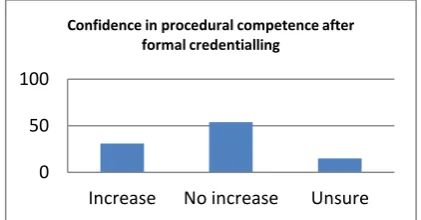
Figure 2: Level of confidence
Feedback form: 76% of interns completed the feedback form provided in the logbook. An analysis of these forms showed that 31% of respondents felt that the formal assessment of procedural skills improved their confidence level in performing those skills while 54% felt that the process had no effect on their level of confidence, as shown in Figure 2. Although 51% of interns found the logbook user-friendly, most felt that carrying it around all the time was difficult, and they did not always have it handy when an opportunity to perform a procedure presented. As a result, even though they performed the procedure under supervision, they could not get it formally signed off at the same time, and they found it difficult to remember to get it signed off at a later time.
The main barriers to the process were time and workload. Interns felt that they were too busy to organise formal assessment of the procedures with their supervisors. Supervisor time and availability, and engagement with the process, were also cited as barriers by some interns. Most interns who said that the logbooks were not useful felt that the skills being assessed were too basic. In addition, most interns felt that anyone who had completed a medical degree should already be deemed competent in such skills. Some stated they felt awkward when asking to be supervised for skills they felt that they should already be competent in. Additional skills that
0 50 100
Increase No increase Unsure
should be included in the logbook as suggested by the interns were lumbar puncture, nasogastric tube insertion, pleural tap, ascitic tap, chest drain insertion, joint aspiration, regional nerve block and arterial blood gas sampling.
Discussion
The prevocational years provide an opportunity for new doctors to consolidate the knowledge and experience acquired in medical school (15). Traditional apprenticeship models of medical training take the ‘see one, do one, teach one’ approach and rely on the trainee’s ability to accurately self-assess their own level of competence and seek appropriate supervision. However, studies show that individual medical student experience in procedural competencies varies considerably, and therefore interns demonstrate a range of competence levels. These studies also demonstrate that self assessment of performance bears little correlation with formally assessed competence in procedural skills (16-19). This issue can pose a risk to patient safety. While most interns might be competent in the basic skills listed in the Australian Curriculum
Framework for Junior Doctors at the
commencement of internship, a proportion of them would need formal training in those skills before they are confident to safely and competently perform them independently.
As such, health services need to ensure that anyone performing procedures on patients meet a minimum standard of competence. Therefore, assessment of competence in frequently-performed procedures is essential. All interns should be provided with the opportunity to access formal supervision for procedures until they achieve the required level of competence. The effectiveness of implementing procedural training programs has been demonstrated in several studies (17, 20, 21). Increased exposure
to procedures correlates with increased
confidence in procedural performance (18, 22, 23), in turn ensuring quality of treatment and patient safety.
The main aim of our procedural competency based credentialing project was to develop a
standardised process for objective assessment of individual interns in a suite of frequently-performed procedures. Interns were required to demonstrate competence in the shortlisted procedures and be formally credentialed in them before they could perform them independently. The process also provided interns with an opportunity to ask for supervision if they did not feel confident in performing a procedure.
The results of the project show that although 100% of interns completed the requirements of the logbook and underwent assessment, the acceptance of the process and its perceived usefulness was mixed. The main reason for 100% completion rate was that it was made clear from the start that the organisation mandated completion of logbooks as a prerequisite for internship completion. However, the data suggest that more than half the interns completed the logbook because it was mandatory and not because they felt that the process was useful.
Competency-based training, assessment and credentialing are still new concepts in the prevocational years. 54% of the interns did not think this process was useful and a majority felt that anyone out of medical school should be presumed to be competent in basic procedures. These interns felt that the organisation should trust them to seek supervision when required. As interns come from several different medical schools with different training curricula and
variable experience, recognition of prior
procedural learning is difficult. Our health service is now working with the university from which 70% of interns originate to vertically integrate procedural skills training. This will avoid duplication of effort and enable the health service to recognise medical school training in procedural skills in order to credential interns to perform those skills independently in the health service. However, the group of interns coming from other universities will still need to be assessed for competence in basic procedures to ensure they meet the standard required. Unless a
national undergraduate curriculum and
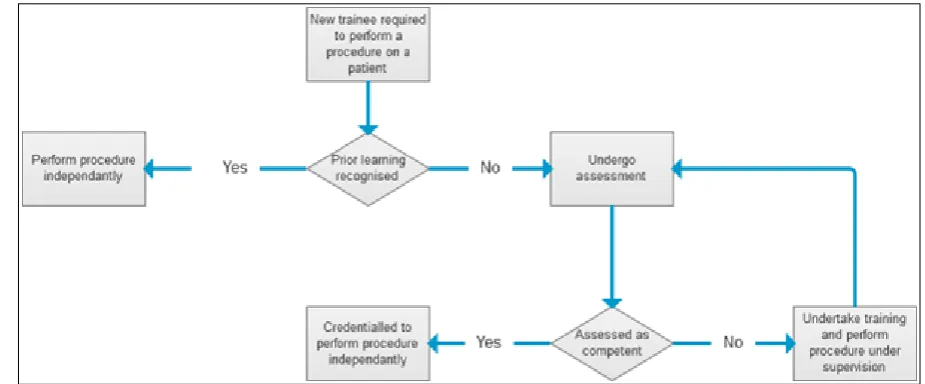
new medical graduates they employ. A framework for ensuring safe procedural practice
by junior medical staff is presented in Figure 3.
Figure 3: A framework for ensuring safe procedural practice by junior medical staff
In order to make this process acceptable and meaningful for the interns, health services need to ensure clear supervision structures are in place. Health services also need to engage supervisors and prevocational junior medical staff in the process. While the objectives of the project were communicated to all registrars and
consultants by email, newsletters and
memorandums, the frequent turnover of
registrars meant that not all registrars knew about the project. Theatre commitments of surgical registrars proved to be one of the major barriers to their availability. Use of nurse educators to assess competence in junior medical staff may be a strategy to overcome this barrier. An online package which the supervisor could sign off in their own time after having assessed the intern is another suggestion.
The procedures included in this project are basic skills that interns are required to perform frequently. The feedback from this project suggested that interns wanted competency-based training and assessment in relation to more difficult procedures that they have fewer opportunities to perform. Two of these procedures are being incorporated in a similar project for PGY2 doctors at Monash Health. These are lumbar puncture and nasogastric tube insertion. The process involves structured training involving online study material, an
online pre-test to assess required knowledge, followed by a formal assessment on a part-task trainer. Once these steps have been successfully completed, assessment on real patients will be carried out.
To the best of our knowledge this is the first publication of competency-based credentialing of prevocational junior medical staff. Our
experience has shown that appropriate
supervision structures, endorsement of the
process by the junior medical staff
representatives, and executive support, were the key success factors for the process. Further exploration of ways to increase acceptance for the process by junior medical staff is required. Vertical integration of procedural training which allows recognition of prior undergraduate training should be a focus of health services and the affiliated clinical schools.
Conclusion
Competency-based training may eventually
replace more traditional methods of
services are able to identify individuals who may need greater support and assistance. Health services can then assist in tailoring training to individual needs. Ultimately, an improvement in the quality and consistency of procedures performed by interns will improve quality of care and patient safety, resulting in reduced risk for the health service, the intern and the patient. The successful implementation of a procedural credentialing program for interns allows further opportunity to introduce structured organisation-wide credentialing of procedural competency for all prevocational and vocational junior medical staff.
Reference
1. Victorian Government Department of Human Services. Credentialling and defining the scope of clinical practice in Victorian health services - 2011 update. 2011 [cited 2015
Oct]; Available from:
https://www2.health.vic.gov.au/Api/download media/%7BA64DD34E-EFC0-434B-B1FE-40C6A263EFD3%7D.
2. Delva D. Workplace learning. Journal of Postgraduate Medicine. 2006;52(1):17. 3. Koh GCH, Khoo HE, Wong ML, Koh D. The
effects of problem-based learning during medical school on physician competency: a systematic review: CMAJ. Canadian Medical Association Journal. 2008;178(1):34.
4. Smits PBA, Verbeek JHAM, Buisonje CDd. Problem based learning in continuing medical education: A review of controlled evaluation studies. British Medical Journal. 2002;324(7330):153.
5. Batalden P, Leach D, Swing S, Dreyfus H, Dreyfus S. General Competencies and Accreditation in Graduate Medical Education. Health Affairs. 2002;21(5):103-11.
6. Leung W, Diwaker V. Competency based medical training: Review / Commentary. British Medical Journal. 2002;325(7366):693-6.
7. Busari J, Arnold A. Educating doctors in the clinical workplace: Unraveling the process of teaching and learning in the medical resident as teacher. Journal of Postgraduate Medicine. 2009;55(4):278-83.
8. Ruddlesdin J, Wentworth L, Bhat S, Baker P. Competency mapping in quality management of foundation training. Clinical Medicine. 2010;10(6):568-72.
9. Harden R. Developments in outcome-based education. Medical Teacher. 2002;24:117-20.
10. Epstein R, Hundert E. Defining and assessing professional competence. Journal of American Medical Association. 2002;287:226-35. 11. Aretz H. How good is the newly graduated
doctor and can we measure it? Medical Journal of Australia. 2003;178:147-8.
12. Frank J. The CanMEDS project: The Royal College of Physicians and Surgeons of Canada moves medical education into the 21st century. The Evolution of Specialty Medicine. Ottawa: The Royal College of Physicians and Surgeons of Canada2004.
13. CPMEC. Australian Curriculum Framework for Junior Doctors. Confederation of Postgraduate Medical Education Councils; 2009 [cited 2015 Oct]; Available from: http://curriculum.cpmec.org.au.
14. Dijksterhuis MG, Voorhuis M, Teunissen PW, Schuwirth LW, ten Cate OT, Braat DD, et al. Assessment of competence and progressive independence in postgraduate clinical training. Medical education. 2009 Dec;43(12):1156-65.
15. Marel GM, Lyon PM, Barnsley L, Hibbert E, Parise A. Clinical skills in early postgraduate medical trainees: patterns of acquisition of confidence and experience among junior doctors in a university teaching hospital. Medical education. 2000 Dec;34(12):1013-5. 16. Boots RJ, Egerton W, McKeering H, Winter
H. They just don't get enough! Variable intern experience in bedside procedural skills. Internal medicine journal. [Comparative Study]. 2009 Apr;39(4):222-7.
17. Liddell MJ, Davidson SK, Taub H, Whitecross LE. Evaluation of procedural skills training in an undergraduate curriculum. Medical education. [Controlled Clinical Trial]. 2002 Nov;36(11):1035-41.
18. Taylor DM. Undergraduate procedural skills training in Victoria: is it adequate? The Medical journal of Australia. 1997 Mar 3;166(5):251-4.
19. Barnsley L, Lyon PM, Ralston SJ, Hibbert EJ, Cunningham I, Gordon FC, et al. Clinical skills in junior medical officers: a comparison of self-reported confidence and observed competence. Medical education. [Research Support, Non-U.S. Gov't]. 2004 Apr;38(4):358-67.
20. Babl F, Priestley S, Krieser D, Miller J, Tully M, Spicer M, et al. Development and implementation of an education and credentialing programme to provide safe paediatric procedural sedation in emergency departments. Emergency medicine Australasia: EMA. [Research Support, Non-U.S. Gov't]. 2006 Oct-Dec;18(5-6):489-97. 21. Cherry RA, West CE, Hamilton MC, Rafferty
of central venous catheter associated blood stream infections following implementation of a resident oversight and credentialing policy. Patient safety in surgery. 2011 Jun 3;5(1):15. 22. Brazil E, Macnamara AF, O'Connor N,
Bodiwala GG. Accident and emergency medicine--still a useful 'apprenticeship'? European journal of emergency medicine :
official journal of the European Society for Emergency Medicine. 2002 Sep;9(3):244-7. 23. Coberly L, Goldenhar LM. Ready or not, here