INVESTIGATION OF SPEECH DISFLUENCIES
CLASSIFICATION ON DIFFERENT THRESHOLD
SELECTION TECHNIQUES USING ENERGY FEATURE
EXTRACTION
R. Hamzah1 and N.Jamil2
1,2Faculty of Computer and Mathematical Sciences, UiTM Shah Alam, Selangor, Malaysia
1[email protected], 2[email protected]
ABSTRACT
Filled pause and Elongation are the two types of speech disfluencies that need more suitable acoustical features to be classified correctly since they are always being misclassified. This work concentrates on developing an accurate and robust energy feature extraction for modelling filled pause and elongation by investigating different energy features using local maxima points of the speech energy. Method: In this paper, we extracted peak values from each frame of a voiced signal by implementing different thresholding techniques to classify filled pause and elongation. These energy features are evaluated by using statistical naïve Bayes classifier to see the contribution on the classification processes. Various samples of sustained syllables and filled pauses of spontaneous speech were extracted from Malaysian Parliamentary Debate Database of the year 2008. A naïve Bayes was used as a classifier. We performed F-measure evaluation to investigate the significant differences in mean of filled pause and elongation samples. Results: Results revealed that our proposed LM-E has increase the classification with up to 71% and 75% F-measure for elongation and filled pause. Conclusion: The best achieved accuracies in both filled pause and elongation classification were varied depending on the types of thresholding techniques applied during the local maxima of speech energy extraction. The most contributed thresholding technique is our proposed technique which is by using the adaptive height as the threshold that extracts the local maxima of the speech energy (LM-E).
Keywords: Filled pause and elongation, naïve Bayes, energy feature extraction, automatic speech recognition.
1. Introduction
eliminating normal words from recognition may modify the intended context of a speech and leads to inaccurate transcription. According to (Kaushik et al., 2010), filled pause and elongation causes transcription problem in ASR. Many ways were conducted to separate filled pause and elongation. The most common way is by extracting the acoustical features of the filled pause to be used in the classification. Various acoustical features were used to model filled pause such as energy, fundamental frequency, Mel-frequency cepstral coefficients and formant frequency. Among the well-established acoustical features, fundamental frequency is mostly used as can be found in (Gabrea et al., 2000, Goto et al., 1999, Audhkhasi et al., 2009 and Kaushik et al., 2010). Fundamental frequency is associated with energy as confirmed by (Rosenberg & Hirschberg, 2006) in his work where energy is used to classify pitch into accented or non-accented word. However, when the conventional energy extraction is used, the accurate modelling of filled pause and elongation cannot be achieved as seen in (Li et al., 2010). Therefore, this paper addresses the exploitation of speech energy as a feature to accurately model the filled pause and elongation. Energy was widely used in filled pause research (Garg & Wards, 2006, Li et al.,2008 and Stouten et al., 2006). The use of energy can be found in different language of filled pause studies such as Mandarin, European Portuguese and English. Since filled pause and elongation is language specific (Yusof et al., 2008), the performance of energy was reported differently. It was proven in (Stouten et al., 2006) that energy is unable to differentiate filled pause and elongation of European Portuguese language due to the equal pattern of energy stability. In contrast with (Li et al., 2008), the energy along with MFCC and F0 have shown promising classification performance for Mandarin filled pause. It is observable from those researches that the combination of suitable feature with energy can increase the classification process compared to energy alone.
Energy of the speech may be measured using several techniques such as log energy, sum of square energy and sum of absolute energy. Generally, all the above-mentioned techniques of calculating the sums of energy are measured on each short frame. These techniques are suitable and beneficial for speech involving normal words. However, sum of energy cannot sufficiently represent filled pause, especially when filled pause needs to be differentiated with elongation. According to (Stouten et al., 2006), the current means of representing energy is not able to separate filled pause and elongation in Portuguese language well due to their similar energy characteristics. The use of energy parameter is customary but not limited in endpoint detection only. It is also beneficial in consonant and vowel detection in (Izzad et al., 2013). However, sum of energy calculated from short time speech frame is unable to detect the energy variation from the consonant and vowel in the elongation. These researchers concluded that there are difficulties in differentiating filled pause and elongation into two separate classes. Therefore, further work is needed to investigate and select the suitable energy feature extraction technique for the abovementioned purpose. Rigorous energy feature selection research for representing filled pause and elongation remains hard to find. Therefore, this research aims to identify the most suitable energy characteristic of filled pause and elongation, and construct a classification model that is able to discriminate filled pause and elongation into their own separate classes.
.
2. Methodology
2.1 Dataset Development
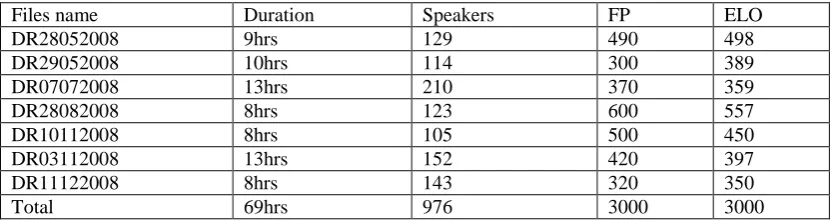
The raw data that is used in this research is taken from Malaysia Parliamentary Debate Database of the year 2008. The data collection process is started from the video file conversion to audio format by using video to audio converter freeware and named MPHD.wav. The video recording collection of MPHD comprises of 51 video files. Each video file contains a morning and an evening session that was conducted within eight to thirteen hours and is accompanied with text transcription. The analysis of video quality is done one by one to select the best perfect match between video and text transcription. Out of 51 video files, only 22 files are suitable for further processing. They are not corrupted, no missing sounds and matched perfectly with the transcriptions (text files). These 22 audio (.wav) files contains 1 074 072 words with approximately 214 814 sentences. Only seven audio (.wav) files are randomly chosen and exploited to extract the Malay filled pause and elongation. The quantitative information analysis of the randomly chosen files is tabulated in Table 1.
Table 1. Quantitative information of selected MPHD files
Files name Duration Speakers FP ELO
DR28052008 9hrs 129 490 498
DR29052008 10hrs 114 300 389
DR07072008 13hrs 210 370 359
DR28082008 8hrs 123 600 557
DR10112008 8hrs 105 500 450
DR03112008 13hrs 152 420 397
DR11122008 8hrs 143 320 350
Total 69hrs 976 3000 3000
Figure. 1. A complete sentence with only filled pause (Malay sentence id S169M9T04: Pesakit aaa, buah pinggang)
Figure. 2. A complete sentence with filled pause, normal words and elongation (Malay sentence id S53M5T03: di(ELO) aaa(FP) negara jiran)
2.2 Pre-processing
Pre-processing is one of the main part in ASR process (Deng et al., 2018). All the speech data that are used in this research are processed for the purpose of feature extraction. In the processing stage, several processes are undertaken inclusive of amplitude normalization, pre-emphasis, framing and windowing and voice activity detection. The pre-processing of speech is a vital stage in any speech processing research. Pre-processing is a crucial task in this research that involved speech vector normalization, framing windowing and voice activity detection. Each of the pre-processing process is discussed in the following subsections.
2.3.1 Amplitude Normalization
The raw speech data is a collection of speech uttered by different speakers thus the amplitude and energy vary. The variety of speaker’s speech energy can cause error or unstable classification rate if the feature vector is directly extracted. Therefore, the purpose of amplitude normalization is to ensure that the level of the energy is standardized or similarly calibrated. In this research, the z-score normalization technique is adopted. The speech amplitude variability is normalized to have zero mean and one standard deviation. Speakers’ volume variations need
Normal words
Filled pause
Time (seconds)
A
m
p
lit
u
d
e
Normal words
Elongation Filled pause Normal words
Time (seconds)
A
m
p
lit
u
d
to be normalized before the next process is taken so that the volume will not become a performance degradation factor.
The normalization steps are as follows:
i. The mean of the speech vector is computed
ii. The standard deviation of the speech vectors (x) is computed
iii. The mean and standard deviation calculated in step (i) and step (ii) are used to calculate the normalized speech vector as in Eq. (1)
) (
) ( )
(
x x x x z
(1)
where
x = speech vector
The normalization effect is evaluated by calculating the mean amplitudes of the speech samples (3000 FP and 3000 ELO). The mean amplitudes variance before and after the amplitude normalization are compared and shown in Table 2. From the result, it is clearly observed that the mean amplitude variance after the normalization is smaller compared to before speech vectors normalization. Smaller variance shows that the difference between normalized amplitude among the filled pauses and elongations is very minimal. As stated earlier, the amplitude normalization is important to ensure the energy of the speeches within the same range.
Table 2. Mean amplitude variance due to normalization
Before After
FP ELO FP ELO
3.8066e-06 3.7886e-06 2.1778e-3232 2.1587e-32
The output of normalized speech signal, z(x) is used as input to proceed with the pre-emphasis stage.
2.3.2 Pre-Emphasis
Generally, digitized speech waveforms comprise additive noise and have high spectral dynamic range. For example, a low energy can be found in high frequency spectrum of a speech as well as high energy in low frequency spectrum. Because of that reason, a process called as pre-emphasis is performed on the normalized speech to flatten the speech spectrum and to emphasize the high-frequency part of the speech signal that was repressed through the human sound production mechanism. For example, pronunciation of vowels existing in filled pause and elongations have high energy (Kitamaya et al., 2003) and may be pronounced at the lower frequency. Therefore, it needs to be boosted to attenuate the information from the higher frequency for better acoustical feature representation. The most extensively used pre-emphasis digital high-pass filter is defined as in Eq. (2).
) 1 ( ) ( )
(n z x A n
y (2)
where: ) (n
y = the value of output signal at discrete time step n )
(x
z = the value of normalized input signal at discrete time step n A = is a constant normally set between 0.9 to 1
set to 0.97. However, according to (Abbas et al., 2013), the typical value of pre-emphasis constant is 0.95. A low frequency signal is the one with slow time variation. The slow variation effect on low frequency signal concurrently produces adjacent samples of similar numerical value. From equation (2)(2), the subtraction process removed the part of the samples that did not change in relation to its adjacent samples to retain the high-frequency components. The output signal of the pre-emphasis process premx(n) is then past to the framing stage.
2.3.3 Framing
Speech signal is non-stationary and non-periodic in a longer duration. Its statistical properties are non-constant over time. However, practically, at a frame of 20ms~30ms, speech is considered stationary and quasi-periodic (Ganaphaty, 2012). Thus, the non-stationary properties of a speech signal need to be transformed as stationary using framing. Framing a speech signal is a process of blocking the speech signal into frames of N samples, with adjacent frames being separated by M samples i.e., the frame is shifted with M samples from the adjacent frame. The spectral features estimated from frame to frame will be smooth if the shifting is small. The shifting process is important to ensure overlapping of the speech frame. The absence of overlapping between adjacent frames will cause the speech signal to be entirely mislaid and will contain noisy components only.
The general equation for frame blocking is written in Eq. (3) by assuming that the speech frame length (lth) is represented as S and the entire speech signal is denoted as L.
( ) ( )
l l
X N S M N (3)
where.
l
X = frame of speech N = 0,1,…,N-1 sample l = 0,1,…L-1 frames
In this research, the frame size is set to 20ms (320 points) frames, which were overlapped at 10ms (160 points). A typical frame shift of 10ms of a short frame of 20ms is always chosen in speech processing research (Rosenberg & Hirschberg, 2006). The overlapping is important to ensure the smooth transition of estimated parameters between frames.
2.3.4 Windowing
Windowing is done to reduce the discontinuities of the speech signal at the edges of each frame by applying a tapered window to each frame. At each framed speech signal, a window is applied at the beginning and ending by using window function. For a window w(n), the windowed signal will be defined as in Eq. (4)(4).
), ( ). ( )
(n x n w n
y 0nN1 (4)
where,
w(n) = Hamming window x(n) = speech signal
) (n
y = windowing result of the signal
𝑤(𝑛) = {0.54 − 0.46cos(
2𝜋(𝑛 − 1) 𝑁 − 1 ) 0
, 0 ≤ 𝑛 ≤ 𝑁
(5)
2.4 Energy feature extraction
In general, the process of getting the representation of each speech sample’s energy is by using the standard method (Jalil et al., 2013) that is by calculating the sum of the energy of each short speech frame as in equation (6).
2 ] 1
) ( ) ( [
n
N n m
m n w n x n
E (6)
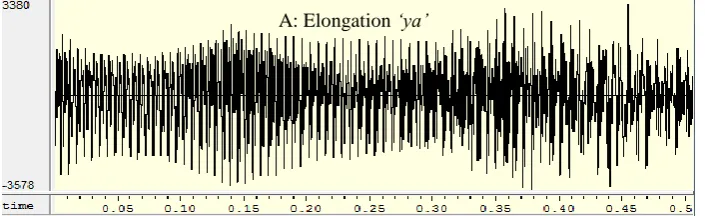
The next step is to calculate the standard deviation of the whole speech segment to measure energy’s stability. Energy standard deviation of the filled pause is expected to be small (Stouten et al., 2006) as they are presumed to be more stable. Energy example of filled pause and elongation is taken to demonstrate its function in representing elongation and filled pause as shown in Figure 3 and Figure 4. Hypothetically, the elongation (A) should produce higher STE while filled pause (B) lower due to the stability assumption of filled pause. However, both filled pause and elongation produced the opposite value of STE
STE Standard deviation of ELO: 10ms: 56, 20ms: 105, 40ms: 182
Figure. 3. Example of STE measurements on elongation
STE Standard deviation of FP: 10ms: 70, 20ms: 121, 40ms: 241
Time (seconds)
A
m
p
litu
d
e
Time (seconds)
A: Elongation ‘ya’
B: Filled pause
A
m
plit
u
d
Figure. 4. Example of STE measurements on filled pause
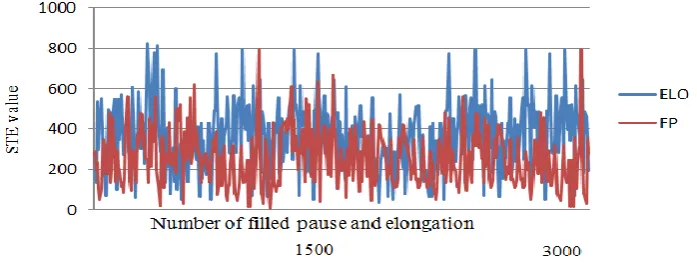
Figure. 5. STE value distribution for filled pause and elongation
In filled pause research, energy is an important feature. Several acoustical features that were previously tested in filled pause classification such as fundamental frequency and spectral envelope are correlated with energy (Rosenberg & Hirschberg, 2006). Generally, the energy of filled pause is stable and constant, as proven in (Garg & Ward, 2006). However, due to the transition between consonant and vowel in the elongation, the standard method of energy measurement is not able to represent this transition named as expressive intonation. Therefore, another way of exploiting the energy of the speech is by using the local information of the speech energy need to be investigated. This is further explored and discussed in the next subsection.
For each duration that are tested (i.e. 10ms, 20ms and 40ms), the standard deviation of the energy produced by elongation are denoted as 56, 105 and 182 which are lower compared to filled pause energy’s standard deviations (i.e. 70, 121, 241). The distribution of energy value of both filled pause and elongation is shown in Figure 5. From Figure 5, it is obviously seen that the energy representation (energy standard deviation) of filled pause and elongation is overlapping. It shows that the filled pause and elongation cannot be differentiated by using energy as the feature.
2.5 Proposed Speech Energy Extraction using Local Maxima
Speech energy is closely related to the amplitude of the speech (Izzad et al., 2013). Instead of calculating the total energy of each frame, in this research the energy stability of the speech is measured based on the amplitude transition from one frame to another. To measure the amplitude transition, this research proposed the manipulation of the local maxima points of the speech. We introduced adaptive local maxima threshold selection technique by directly comparing one peak points to another using adaptive threshold selection based on the height difference. The proposed energy extraction technique is Local Maxima of the Speech Energy (LM-E). The details steps of the proposed LM-E are as below:
Step1: Find the minimum peak pmof all the peaks in the speech Step2: Set the pmas the first threshold.
Step 3: Iterate the process to the next consecutive point in the speech pn
Step 4: Compare pmand pn
Step 5: If PmPn0and Pn0, then pnis assigned as the first local maxima LM E1.
If PmPn0then repeat step 3.
Step 6: Save the LMEninto a matrix for further process.
In this proposed method, different adjustable positive scalar number is tested as threshold to observe the most suitable parameter.
2.6 Classification
The classification stage is preceded after the energy feature vectors have been collected from the energy feature extraction stage. In this research a simple naïve Bayes classifier is used to evaluate the performance of extracted featured in representing the filled pause and elongation. The overall steps can be visualized as in Figure 6.
Classification
Figure. 6. Classification process The process of feature classification is described as follows:
i. The classifier learns the conditional probability from the training data of the attributes X (acoustical feature values) given the class label, C (FP or ELO).
ii. The classification is performed by applying Bayes rules to compute the probability of C given the particular feature of X.
iii. The class of the feature X is predicted by the highest posterior probability.
Let x be a specific feature with assigned values of
x
1, x
2, x
3…x
n and C is the class with assigned values of class variables of C1, C2, C3 …Cn. The Bayes classifier enables the computation of the posterior probability P C( ck|X x)for each possible classc
k
using Bayes theorem (Dougherty et al., 1995). The class label of the disfluency is determined by using Bayes theorem as in equation (7) (7).) | ( max
arg p Ci x
C (7)
where, I i i C p i C x p i C p i C x p x Ci p 1 ) ( ) | ( ) ( ) | ( ) |
( (8)
and,
Energy feature values Probability density estimation
Classification (Bayes Theorem)
( , )i ( | ) ( )i i
p x C p x C p C (9)
where,
c = class of the disfluencies
(c = FP for filled pause , c = ELO for elongation) x = acoustical feature
p(c) = prior probability p(x|c) = conditional probability p(c|x) = posterior probability
The prior probability of 0.5 for each class is set equally since the number of filled pause and elongation is distributed equivalently. To validate the classifier, a 10-folds cross validation is used. Cross validation (CV) is the most common and recently used (Elkan, 2012; Qin et. al, 2012). There are several techniques applied in CV such as leave one-out and fold-CV. In (Stouten et al., 2006), a total of 186 iterations is applied into leave one-out cross-validation in which each time of the experiment, 1 sequence of data is taken out as a test data while the rest is used for training. This process is repeated up to 186 times. However, this method is quite time consuming for a larger dataset. A large dataset that consists of 1076 samples has been applied with 10-fold CV in order to test the classifier’s performance (Elkan, 2012). The study found that their classifier’s performance is comparable with the previous work done by (Bouckaert, 2004). In (Murakami & Mizuguchi, 2010), two stage of classifiers validation is done. The first stage is conducted by using standard training and testing data partition with different data division ratios while the second stage uses cross-validation.
This research chooses cross validation method to test the accuracy of the model. In 10-CV technique, nine folds are used to train classifier, and the one-fold that is held out is then used to test the classifier. The process of dividing the data into 10-fold CV is as follows:
Input: Training setS, integer constant 𝑘 Procedure:
Partition 𝑆 into 𝑘 equal-sized subset 𝑆1… 𝑆𝑛
For i1 to ik Let
T
S
/
S
iRun learning algorithm (Bayes classifier) with
T
as training set Test the resulting classifier orS
i.In the 10-fold CV the total data of filled pause and elongation are divided into 10 equivalent folds. This process is executed 10 times with different fold used as testing during each iteration. Then, the evaluation of the classification is done based on several measurement techniques such as accuracy, F-Measure, precision and recall.
3. Results and Discussion
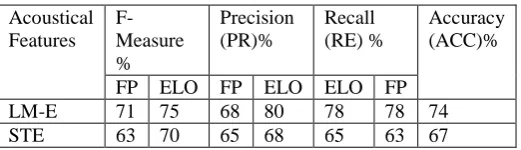
and elongation. All of the stated measurements between both STE and proposed LM-E are shown in Table 3.
Table 3. Evaluation results of STE and LM-E for FP and ELO Acoustical
Features F-Measure %
Precision (PR)%
Recall (RE) %
Accuracy (ACC)%
FP ELO FP ELO ELO FP LM-E 71 75 68 80 78 78 74
STE 63 70 65 68 65 63 67
From the results, it can be seen that the LM-E outperform the well-established STE. In overall, the accuracy of the energy feature increased from 67% to 74% which are about 7% increment when the technique of adaptive thresholding is introduced. Among them, LM-E scored higher recall and precision rate at > 68% for both filed pause and elongation compared to STE. The highest F-measure for filled pause is achieved by E at 71% followed by STE at 63%. LM-E scored higher F-measure at 75% for elongations followed by STLM-E at 70%. It shows that the proposed LM-E represents elongation better compared to STE.
The results of accuracy for each fold in the 10-fold CV for both LM-E and STE are shown in Fig 8. For the proposed LM-E, the accuracy differences between fold is considerably small which is only 3.69. This indicates LM-E is consistent in representing each filled pause and elongations. The lowest accuracy of the proposed LM-E is denoted at 68% as seen in the 7th fold. Most of the speech data of the 7th fold is from DR20080528 and DR20080828 datasets.
An example of misclassified ELO and FP are randomly taken from DR20080828 dataset. The LM-E standard deviation for both ELO (ELO07.wav and ELO06.wav) and FP (FP11.wav and FP107.wav) are 0.684, 0.378, 0.937 and 0.9828 respectively. It is obviously shown that the LM-E standard deviation for FP are lower compared to ELO which is supposedly to be small.
Figure. 8. 10-fold CV for LM-E and STE accuracy
In speech production, there is a transition between consonant to vowel causing the acoustic changes within the transition (Doellinger et al., 2011). According to (Doellinger et al., 2011) the transition between consonant to vowel is due to the interval between the release burst and the onset of laryngeal pulsing. The transition from consonant to vowel in Malay language
73 73 70 75 71 80
68 73 73
80
60 67 60 67 60 65
65 68 72
70
0 10 20 30 40 50 60 70 80 90
Accuracy of LM-E and STE for each fold of 10-fold CV
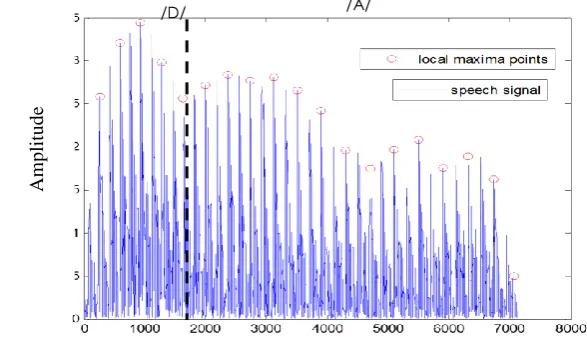
dataset produced a unique phenomenon named as expressive intonation in this research. The graphical representation of the consonant to vowel transition is shown in Figure 9. Since there is no significant transition between consonant to vowel in the elongations depicted in Figure 9, a lower standard deviation of LM-E is derived. Thus, the standard deviation does not meet the acoustical rules of LM-E for elongation; they are misclassified as filled pause.
Some of the elongation starts with voiced consonant (i.e. /ga/, /da/, and /ni/) unvoiced consonant (i.e. /pi/, /tu/, and /ke/). There are also elongations uttered with semivowel (i.e. /ya/, /wa/). It is observable that there is no significant amplitude transition between consonant to vowel in many of the elongations of the 7th fold; thus, causing lower LM-E standard deviation. The elongation that is in the form of semivowel is hardly to be correctly classified by LM-E. Most of the elongations cannot be correctly classified by using LM-E as the energy of the semivowel and the vowel of the filled pause do not differ significantly.
Figure. 9. Consonant to vowel transition in elongation /da/
According to (Espy, 1986), the similar acoustical pattern between semivowel and vowel causing the detection of semivowels is a challenging task. In summary, several causes of misclassification done by LM-E are:
I. A low volume of voice pronunciation by the speaker caused inaccurate representation of LM-E for filled pause.
II. Filled pause is uttered in an emotional state of mind such as angry, happy and doubt; producing expressive intonation in the filled pause utterances. Therefore, filled pause is misclassified as elongation as it possessed characteristic similar to elongation. III. Insignificant transition between consonant to vowel in elongation; causing a low
LME’s standard deviation.
As stated earlier, the LM-E is associated with the speech energy (STE). Therefore, this research compares the performance of these two speech energy characteristics in differentiating filled pause and elongation. Since the filled pause is unvaried pronunciation of phonemes, the energy is constant. The consistency of the energy is measured based on STE’s lower standard deviation (Stouten et la., 2006). In other words, the STE’s standard deviation for filled pause is lower compared to elongation. The LM-E which is an exploitation of the speech energy, however managed to differentiate the elongation better compared to STE.
Am
p
litu
d
e
4. Conclusion
This research concludes that the exploitation of the well-established STE has produced better classification accuracy for FP and ELO. In the future, the research is expected to produce a more robust energy feature or any acoustical feature that ae more suitable especially in overcoming the problem of semivowel detection in elongation. The research also suggests a more efficient algorithm can be constructed so that it can reduce the computation time.
Acknowledgement
This research is fully supported by FRGS grant,
600-IRMI/REI 5/3 (010/2018). The authors fully acknowledged Ministry of Higher Education (MOHE) and Universiti Teknologi MARA Malaysia for the approved fund which makes this important research viable and effective.
References
Abbas, E. I., & Refeis, A. A. (2013). Influence of Noisy Environment on the Speech Recognition Rate Based on the Altera FPGA. Engineering and Technology Journal, 31(13 Part (A) Engineering), 2513-2530.
Audhkhasi, K., Kandhway, K., Deshmukh, O. D., & Verma, A. (2009, April). Formant-based technique for automatic filled-pause detection in spontaneous spoken English. In 2009 IEEE International Conference on Acoustics, Speech and Signal Processing (pp. 4857-4860). IEEE.
Bertot, E. M., Beaujean, P. P., & Vendittis, D. (2014, July). Refining envelope analysis methods using wavelet de-noising to identify bearing faults. In European Conference of the Prognostics and Health Management Society.
Bouckaert, R. R. (2004, December). Naive bayes classifiers that perform well with continuous variables. In Australasian joint conference on artificial intelligence (pp. 1089-1094). Springer, Berlin, Heidelberg.
Deng, L., & O'Shaughnessy, D. (2018). Speech processing: a dynamic and optimization-oriented approach. CRC Press.
Doellinger, M., Burger, M., Hoppe, U., Bosco, E., & Eysholdt, U. (2011). Effects of consonant-vowel transitions in speech stimuli on cortical auditory evoked potentials in adults. The open neurology journal, 5, 37.
Dougherty, J., Kohavi, R., & Sahami, M. (1995). Supervised and unsupervised discretization of continuous features. In Machine Learning Proceedings 1995 (pp. 194-202). Morgan Kaufmann.
Espy-Wilson, C. (1986, April). A phonetically based semivowel recognition system. In ICASSP'86. IEEE International Conference on Acoustics, Speech, and Signal Processing(Vol. 11, pp. 2775-2778). IEEE.
Elkan, C. (2012). Evaluating classifiers. San Diego: University of California.
Gabrea, M., & O'Shaughnessy, D. (2000). Detection of filled pauses in spontaneous conversational speech. In Sixth International Conference on Spoken Language Processing.
Garg, G., & Ward, N. (2006). Detecting filled pauses in tutorial dialogs. Report of University of Texas at El Paso, El Paso.
Goto, M., Itou, K., & Hayamizu, S. (1999). A real-time filled pause detection system for spontaneous speech recognition. In Sixth European Conference on Speech Communication and Technology.
Izzad, M., Jamil, N., & Bakar, Z. A. (2013, January). Speech/non-speech detection in Malay language spontaneous speech. In 2013 International Conference on Computing, Management and Telecommunications (ComManTel) (pp. 219-224). IEEE.
Jalil, M., Butt, F. A., & Malik, A. (2013, May). Short-time energy, magnitude, zero crossing rate and autocorrelation measurement for discriminating voiced and unvoiced segments of speech signals. In 2013 The International Conference on Technological Advances in Electrical, Electronics and Computer Engineering (TAEECE) (pp. 208-212). IEEE.
Karpiński, M. (2013). Acoustic Features of Filled Pauses in Polish Task-Oriented Dialogues. Archives of Acoustics, 38(1), 63-73.
Kaushik, M., Trinkle, M., & Hashemi-Sakhtsari, A. (2010). Automatic detection and removal of disfluencies from spontaneous speech. In Proceedings of the Australasian International Conference on Speech Science and Technology (SST).
Kitayama, K., Goto, M., Itou, K., & Kobayashi, T. (2003). Speech starter: Noise-robust endpoint detection by using filled pauses. In Eighth European Conference on Speech Communication and Technology.
Li, Y. X., He, Q. H., & Li, T. (2008, May). A novel detection method of filled pause in mandarin spontaneous speech. In Seventh IEEE/ACIS International Conference on Computer and Information Science (icis 2008) (pp. 217-222). IEEE.
Li, Y. X., He, Q. H., Li, W., & Wang, Z. F. (2010, November). Two-level approach for detecting non-lexical audio events in spontaneous speech. In 2010 International Conference on Audio, Language and Image Processing (pp. 771-777). IEEE.
Meseguer, N. A. (2009). Speech analysis for automatic speech recognition. Norwegian University of Science and Technology, Department of Electronics and Telecommunications, 14-19.
Mohd Yusof, S. A., & Yaacob, S. (2008). Classification of Malaysian vowels using formant based features. Journal of ICT, 7, 27-40.
Murakami, Y., & Mizuguchi, K. (2010). Applying the Naïve Bayes classifier with kernel density estimation to the prediction of protein–protein interaction sites. Bioinformatics, 26(15), 1841-1848.
Ogata, J., Goto, M., & Itou, K. (2009, April). The use of acoustically detected filled and silent pauses in spontaneous speech recognition. In 2009 IEEE International Conference on Acoustics, Speech and Signal Processing (pp. 4305-4308). IEEE.
Qin, H., Ma X., Herawan, T., and Zain, J. M. (2012). “DFIS: A Novel Data Filling Approach for Incomplete Soft Set”, Journal of Applied Mathematics and Computer Science, 22 (4), 817-828.
Rosenberg, A., & Hirschberg, J. (2006). On the correlation between energy and pitch accent in read english speech. In Ninth International Conference on Spoken Language Processing.
Schwartzman, A., Gavrilov, Y., & Adler, R. J. (2011). Multiple testing of local maxima for detection of peaks in 1D. Annals of statistics, 39(6), 3290.
Stouten, F. (2008). Feature extraction and event detection for automatic speech recognition (Doctoral dissertation, Ghent University).
Stouten, F., & Martens, J. P. (2003). A feature-based filled pause detection system for Dutch. In
Automatic Speech Recognition and Understanding, 2003. ASRU'03. 2003 IEEE Workshop on (pp. 309-314). IEEE.
Stouten, F., Duchateau, J., Martens, J. P., & Wambacq, P. (2006). Coping with disfluencies in spontaneous speech recognition: Acoustic detection and linguistic context manipulation. Speech Communication, 48(11), 1590-1606.
Stouten, F., Duchateau, J., Martens, J. P., & Wambacq, P. (2006). Coping with disfluencies in spontaneous speech recognition: Acoustic detection and linguistic context manipulation. Speech Communication, 48(11), 1590-1606.
Veiga, A., Candeias, S., Lopes, C., & Perdigão, F. (2011, August). Characterization of Hesitations Using Acoustic Models. In ICPhS (pp. 2054-2057).
Verkhodanova, V., & Shapranov, V. (2014, October). Filled Pauses and Lengthenings Detection Based on the Acoustic Features for the Spontaneous Russian Speech. In International Conference on Speech and Computer (pp. 227-234). Springer, Cham.
Zapata, J., & Kirkedal, A. S. (2015). Assessing the Performance of Automatic Speech Recognition Systems When Used by Native and Non-Native Speakers of Three Major Languages in Dictation Workflows. In Proceedings of the 20th Nordic Conference of Computational Linguistics (NODALIDA 2015) (pp. 201-210).