Corresponding Author E-mail: [email protected]
1582 | Page International journal of Advanced Biological and Biomedical Research
Volume 2, Issue 4, 2014: 1582-1592
Effect of mechanical plucking height on tea green leaf yield and its quality
Seyed Babak Salvatian1*, Farshad Soheili-fard2, Koorosh Majd Salimi1
1
Tea Research Institute, Sheikh Zahed Street, Lahijan, Guilan, Iran
2
Department of Agricultural Machinery Engineering, Faculty of Agriculture, University of Tabriz, Tabriz, Iran
ABSTRACT
Tea is very important product in many countries due to huge consumption in the world and its valuable contains. The traditional harvesting method needs to be improved due to its effect on yield and quality. Mechanical plucking as a substitution to conventional method is spreading quickly and is necessary to be investigated for proper adoption. One of crucial factor has been noted to be the height of harvesting in this method, hence identifying the most appropriate height was aim of this study. The research was conducted in a research station of Fashalem located in the North part of Iran, Guilan province during last season. Treatments at four plucking height level of 5, 10 and 15 cm plus control (Plucking with secateurs) and their effects on tea hybrid bushes were considered. Regarding quality, parameters consisted revenue of total green leaf and the leaf standard, Tannin of green leaf and solid material contain in of green leaf were determined. Study was performed using randomized complete block design with three replications. The results indicated that plucking height of 5 centimeter, in total green leaf and standard leaf was significantly higher than other heights. Moreover 5 cm plucking height showed maximum amount of tannin and solid material compared to the other treatments. There. The effect of time was found to be significant for different parameters of quality.
Keywords:Tea, Height of Plucking, Green Leaf Yield.
1- INTRODUCTION
1583 | Page wage increase are among factors responsible for increasing the rates of harvesting costs that lead to a higher price cost of the green leaves and finally, the increased price of the produced dried tea. As a whole, this process impairs the competitiveness of the domestic quality teas in comparison to the imported ones. Since tea harvesting costs constitute a large amount of the green leaves production expenditure (Hudson 1998), in order to retrench the latter and to have an on time harvest and increase the interest / cost ratio, using a harvesting machine to replace the workforce on the condition of maintaining the harvested green leaves’ quality seems necessary (Satyanarayana, 1995). Also, with the small area of tea fields in Iran taken into account, applying a combination of mechanical and manual harvesting (Dalimoenthe 2004) to improve the yield and reduce the related costs is possible. In an experiment with the purpose of studying the effects of different manual harvest levels on the yield and quality of tea bushes, it was reported that harvesting from 5cm higher than the pruning level in better than other treatments with regard to the total yield of the green leaves and the standard ones and considering the bush extension level, 5 and 10cm levels are preferred over the controls (Hassanpour Asil, 2003).
A research was carried out in Kenya highlands showed that Machine harvesting almost doubled the yield and was at least 35 times faster than hand plucking. However, hand plucking resulted in better quality made tea. (Mwakha, 1990). An evaluated was carried out in India (UPASI Tea Research Institute) showed that A majority of estates surveyed (108 out of 140) used shear harvesting, with most of these integrating shear harvesting and hand plucking. A cost: benefit ratio of 1:34 was calculated for shear harvesting. (Satyanarayana, 1995). A research was carried out in India showed that Plucking with flat shears produced higher yields (3-year average) than with raised shears but the quality was greater with raised shears. ( Barbora et al.,1996). A research was carried out in Japan showed that during a period of new shoot growth for the first crop in 1992, new shoots were harvested at 1 cm intervals (1-15 cm) above the last skiffing surface. Weights of leaves and stems were heavier from the lower layers than from the upper layers. The total N concentration was higher for the upper layers. The free amino acid concentration was higher for the middle layers from an early harvest, but higher for the upper layers from a late harvest. The neutral detergent fiber concentration was higher for the lower layers. The results showed that at the higher plucking height, yield decreased but quality was enhanced (Nakano et al., 1996).
An evaluated was carried out in Kenya showed that Catching levels in green leaf, total the aflavins, brightness, the arubigins, color, flavor index and sensory evaluation decreased with coarseness of the plucking standard. The sum of Group I volatile flavor compounds (which impart inferior aroma) and C6 aldehydes and alcohols, in particular, increased with coarseness of the plucking standard. The sum of Group II volatile flavor compounds (which impart a sweet flowery aroma) did not follow a particular pattern, but flavor index decreased with coarseness of the plucking standards (Owuor et al., 1998).
A research was carried out in India showed that yield was highest with tipping 5 cm above the pruning mark (1247 kg made tea/ha). Yield decreased as the distance from the pruning mark increased (tipping 25
cm from the pruning mark resulted in 1053 kg made tea/ha).
1584 | Page India, and significant wage increases since 1990 combined with escalating costs for other inputs are having a negative impact on the profitability of tea. There is a need to increase the productivity of tea and the efficiency of pluckers. Factors affecting the plucking average, and which should be addressed when looking at ways to improve productivity, include: plucking interval; mechanical harvesting; lane plucking; plucker deployment; organization of pluckers; time of plucking; standard of plucking; length of pruning cycle; height of pruning; bush height; weighments; supervision; and human resource development ( Hudson, 1998 ).
An evaluated was carried out in Kenya showed that a higher plucking speed with the hand-held machine and hand plucking was obtained 8601 and 4360 kg green leaf/day, respectively. Shoots obtained by hand plucking were found to have better quality than the mechanically harvested ones. (Bore et al., 1998) An experiment was conducted in Elappara, Vandiperiyar, Kerala, India to investigate the effect of different harvesting methods on the incidence of grey blight (Pestalotia spp.) on tea. Grey blight incidence was lowest with hand plucking with breaking back (6.8%) and highest with continuous shearing (22.2-23.7%). (Sanjay et al., 2003)
A research was carried out in Indonesia and recommends the adoption of mechanized plucking during high cropping seasons and of intervening hand plucking during low cropping seasons. The potential of shears-pluckers and machine-pluckers versus that of hand plucking is emphasized. The advantages of mechanizing the harvesting operation and of combining hand and shears plucking are also mentioned (Dalimoenth, 2004). In this study, by evaluating these machines in the existing conditions of tea fields in Iran and determining the best height for the planted bushes to be harvested, maximum productivity in the harvest of green leaves while maintaining the dried tea quality can be achieved.
2- OBJECTIVES
Objectives of the study were: 1- To study the effect of four harvesting heights on quality factors of tea 2- To determine the most appropriate height for tea harvesting with the highest yield.
3- MATERIAL AND METHODS
This research has been conducted in Shahid Eftekhari Tea Research Station of Fashalam located in 12km of Rasht-Fouman road. The station was established in 1956 and its first productive bushes were planted between 1959 to 1964.Based on the latest survey, the total area of the used plots was 8.48 hectares. Station situated at 3725/N latitude, longitude 49 25/ W and altitude 3m above mean sea level. The research was done in the 4th plot with an area of 1593 m2.
1585 | Page To measure dry matter the green leaf sample is poured in a weighing capsule and put in a 103-105C AUTO. After reaching a fixed weight, it will be taken out of the AUTO and when cooled in a desiccator, the percentage of its dry matter is calculated by using the following equation:
Dry matter percentage =
eight Greenleafw
sample ghtwiththe
capsulewei ght
Capsulewei
100
In order to measure tannin 2g of the prepared sample (grinded dry green leaves) is poured in a 400CC Erlenmeyer flask having sandpaper cover and mixed with 200CC boiled distilled water. Then, the Erlenmeyer is connected to an inverted or vertical cooler. Later, it is boiled on an electric stove for 30 minutes. The mixture is immediately filtered and the accumulated residue on the filter paper (which is in a funnel) is washed for a few times with boiling distilled water. Then, 50CC CH3COOCu (copper acetate) (40g/l) is added to the filtered solution. After sedimentation, the solution is filtered while the sediment remains on the filter paper. The obtained sediment is leached with boiling distilled water. Following being dried at 600C, it is burned for 30 minutes. The conversion coefficient for Tannin is 65.305.
Tannin Percentage = conversioncoefficient mpleweight
Originalsa
g fterburnin entweighta
Se
dim
4- DATA AND RESULTS
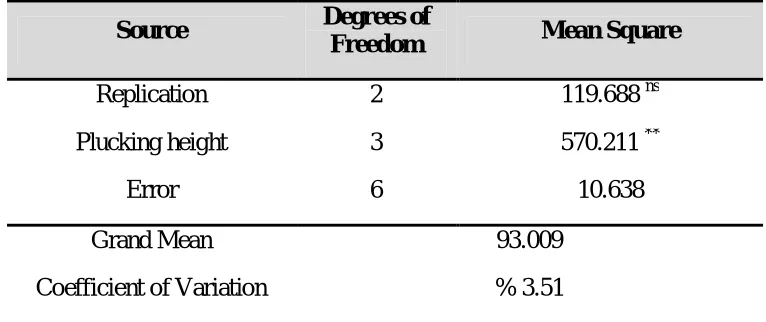
1586 | Page Table 1. The Variance Analysis of the normal data related to the yield characteristic carried out in
a RCBD using the Factorial method
Source Degrees of
Freedom Mean Square
Replication 2 119.688 ns
Plucking height 3 570.211 **
Error 6 10.638
Grand Mean 93.009
Coefficient of Variation % 3.51
*,**, ns Respectively significant at 5% , 1% and non significant
Significant differences were found between harvesting heights in producing dry matter at 5% level. Also, it was observed that there is a significant difference between harvesting times in producing dry matter at 5% level. Besides, difference of interactions between harvesting times and height levels probability is significant (Table 2). The statistical analysis indicated that differences between harvesting height and times are significant at 1% level. Moreover,
Table 2. The Variance Analysis of the normal data related to the solid material characteristic
carried out in a RCBD using the Factorial method
Source Degrees of
Freedom Mean Square
Replication 2 0.427 ns
Plucking height 3 5.599 *
Error 6 0.846
Time 1 9.563 **
Time * Plucking height 3 2.350 *
Error 8 0.444
Grand Mean 24.171
Coefficient of Variation % 2.76
1587 | Page The difference of interactions between harvesting times and height levels at 5% probability is significant (Table 3). The comparison of means plucking heights indicated that the lowest plucking height produced the highest tea yield among all plucking heights (Table 4).
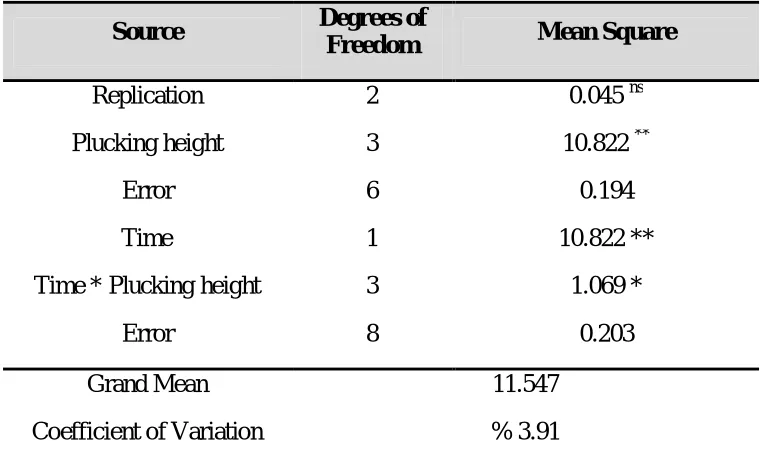
Table 3. The Variance Analysis of the normal data related to the Tanin characteristic carried out in a RCBD using the Factorial method
Source Degrees of
Freedom Mean Square
Replication 2 0.045 ns
Plucking height 3 10.822 **
Error 6 0.194
Time 1 10.822 **
Time * Plucking height 3 1.069 *
Error 8 0.203
Grand Mean 11.547
Coefficient of Variation % 3.91
* ,** , ns Respectively significant at 5% , 1% and non significant
Table 4. Comparison of harvesting height averages by using the Duncan method with 5%
probability of yielding characteristic
Ranked Order Mean
Plucking height ( Treatment )
A 109.9
T1
B 98.22
T4
C 84.57
T3
C 79.35
T2
1588 | Page The results of means comparison of harvesting times indicated in Table 5. Results showed that the highest dry matter percentage was obtained in summer. However, in a study that conducted in India it was found in spring and summer the Tanin and dry matter were increased (Sud and Badyal, 1989).
Table 5. Comparison of harvesting time averages by using the Duncan method with 5% probability of dry matter percentage characteristic
Ranked Order Mean
Time
A 25.178
D1
B 23.790
D2
D1 = Summer D2 = Autumn
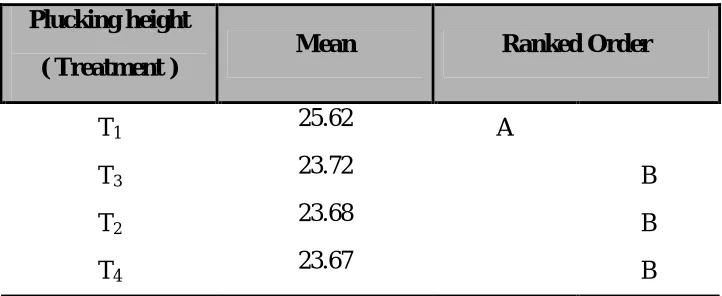
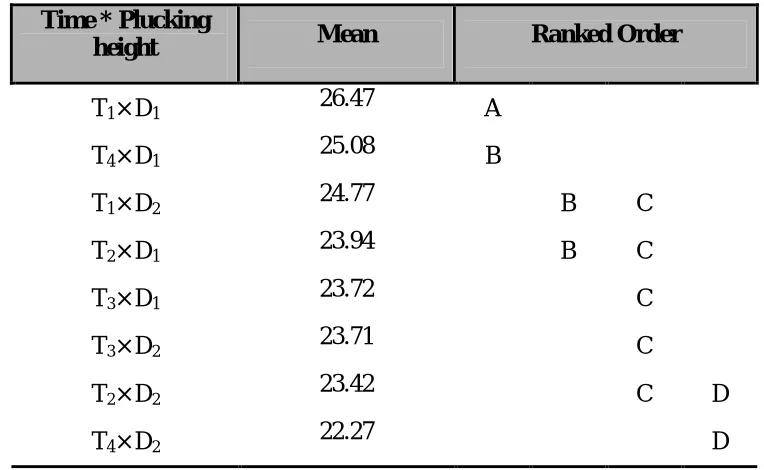
As observed in Table 6, the highest dry matter was obtained by treatment T1 (5 cm plucking height). Also, obtained results form a research in Japan showed that at the lower plucking height, quality was increased (Nakano et al., 1996). Meanwhile, details of comparison of interaction between factors of harvesting height and time on dry matter percentage were shown in Table 7.
Table 6. Comparison of harvesting height averages by using the Duncan method with 5% probability of dry matter percentage characteristic
Ranked Order Mean
Plucking height ( Treatment )
A 25.62
T1
B 23.72
T3
B 23.68
T2
B 23.67
T4
1589 | Page Table 7. Comparison of interaction between two factors (harvesting height and time) by using the
Duncan method with 5% probability of dry matter percentage characteristic
Ranked Order Mean
Time * Plucking height
A 26.47
T1× D1
B 25.08
T4× D1
C B
24.77 T1× D2
C B
23.94 T2× D1
C 23.72
T3× D1
C 23.71
T3× D2
D C
23.42 T2× D2
D 22.27
T4× D2
The result showed that the highest Tannin percentage was in summer (Table 8). Also, in 1989 some researchers found that in spring and summer Tannin and Dry matter were increase (Sud and Badyal, 1989).
Table 8. Comparison of harvesting time averages by using the Duncan method with 5% probability of tannin percentage characteristic
Ranked Order Mean
Time
A 12.067
D1
B 11.026
D2
1590 | Page Table 9. Comparison of harvesting height averages by using the Duncan method with 5%
probability of tannin percentage characteristic
Ranked Order Mean
Plucking height ( Treatment )
A 13.19
T1
B 12.04
T2
C 10.79
T4
C 10.17
T3
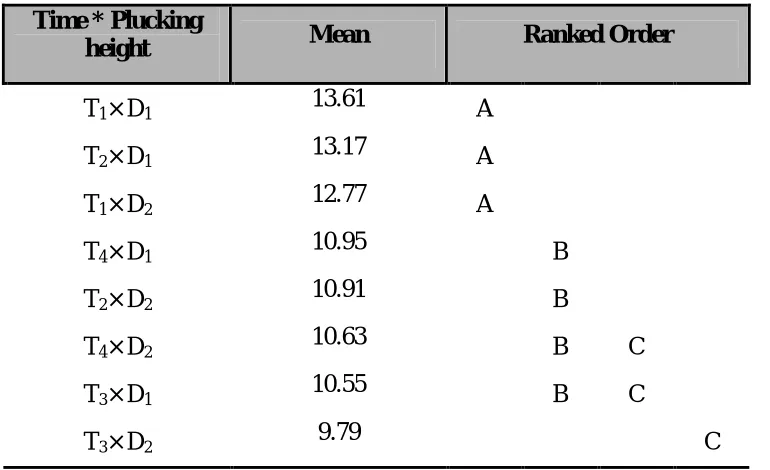
Table 10. Comparison of interaction between two factors (harvesting height and time) by using the Duncan method with 5% probability of tannin percentage characteristic
Ranked Order Mean
Time * Plucking height
A 13.61
T1× D1
A 13.17
T2× D1
A 12.77
T1× D2
B 10.95
T4× D1
B 10.91
T2× D2
C B
10.63 T4× D2
C B
10.55 T3× D1
C 9.79
T3× D2
1591 | Page The results showed that plucking height of 5 centimeter, in total green leaf and standard leaf was significantly higher than other heights. More over 5 cm plucking height showed maximum amount of tannin and solid material compared to the other treatments. There. The effect of time was found to be significant for different parameters of quality.
Although an increase in green leaf height increases the yield amount in a harvest round, in a low height harvest due to the increase of the number of harvest rounds during plucking, harvesting from a lower height shows a better yield. It should be mentioned that green leaves harvested from lower heights have better qualities for producing black tea.
Usually, the Tannin level in soft shoots, buds and the first and second leaves is higher than other parts of tea bushes. Hence, with an increase in the harvesting height the Tannin level in green leaves decreases. The results showed that harvesting from a lower height shows a better yield, in a similar experiment with the purpose of studying the effects of different manual harvest levels on the yield and quality of tea bushes, it was reported that harvesting from 5cm higher than the pruning level in better than other treatments with regard to the total yield of the green leaves and the standard ones and considering the bush extension level, 5 and 10cm levels are preferred over the controls. (Hassanpour Asil, 2003). Similarly in a research was carried out in Kenya showed that Machine harvesting almost doubled the yield (Mwakha, 1990). The results showed that harvesting in 5cm height shows a better Tannin and solid material characteristic in green leaves, similarly an experiment was conducted during 1989-90 in Kenya showed that for optimum yield, plucking speed and quality, medium plucking (2 leaves and a bud or about 5cm height ) at 10- to 11-day intervals is recommended ( Mwakha,1991). Again in a study was conducted at Srilanka showed that high plucking ( over 2 leaves and a bud or over 5cm height ) reduce the quality of green leaves and made tea (Sivapalan et al., 1986).
6- CONCLUSION
The results of study indicated that an increase in green leaf height increases the yield amount in a harvest round, in a low height harvest due to the increase of the number of harvest rounds during plucking, harvesting from a lower height shows a better yield. However, it should be mentioned that green leaves harvested from lower heights have better qualities for producing black tea.
Usually, the Tannin level in soft shoots, buds and the first and second leaves is higher than other parts of tea bushes. Hence, with an increase in the harvesting height the Tannin level in green leaves decreases.
REFRENCES
Barbora AC and Baruah DC (1996). Response of tea plant types to shear plucking. Two Bud. 43(2), 20-24.
Bore JK and Ng'etich, WK (2000). Mechanical harvesting of tea. Tea, Kenya. 21(1), 19–23.
Dalimoenthe SL (2004). Reducing the cost of tea plucking without loss of quality. International Journal of Tea Science, India. 3(3/4), 49-59.
1592 | Page Hudson JB (1998). Enhancing harvesting efficiency of pluckers. United Planters' Association of Southern India joint area scientific symposium-VII (JASS-VII), held at Chikmagalur, Karnataka, on 20-21 March 1998. Bulletin of UPASI Tea Scientific Department, India. 51, 31- 33.
Laing Y, Lu J, Zhang L, Wu Y (2002). Estimation of black tea quality by analysis of chemical compositions. FOOD CHEM. 80, 283-290.
Lakin A (1989). Food analysis Practical Handout. Reading University, UK.
Mwakha E (1990). Response of seedling tea to height and frequency of mechanical harvesting in Kenya highlands. Journal of Tea. 11, 8-12.
Mwakha E (1991). Response Clonal tea response to plucking standard and round length in the first year after recovery from pruning. Journal of Tea. 12, 89-96.
Nakano T, Morita A, Tani H and Suzuki N (1996). Stratiform analysis of growth, total nitrogen, free amino acid and neutral detergent fiber concentration of new shoots in mechanically-plucked tea (Camellia sinensis L.) bush. Japanese Journal of Crop Science, Japan. 65(4), 612-617.
Obanda M, Owour PO, Mangoka R, Kavoi MM (2004). Changes in thearubigins fractions and theaflavin levels due to variations in processing conditions and their influence on black tea liquor brighness and total color. Food Chem. 85(2), 163-173.
Owuor PO, and Obanda M (1998). The changes in black tea quality due to variations of plucking standard and fermentation time. Food Chem. 61(4), 435-441.
Ramaswamy R, Ramaswamy P and Ravichandran R (1998). The impact of mechanization of tea harvesting on the quality of south Indian CTC teas. Food Chem. 63(1), 61-64.
Sanjay R, Baby UI, Sasidhar R and Premkumar R (2003). Impact of harvesting methods on grey blight incidence. Newsletter UPASI Tea Research Foundation, India. 13, 14–26.
Satyanarayana N (1995). Techno-commercial aspects of shear harvesting in tea. Planters' Chronicle, India, August, PP. 361-362.
Sharma DK and Sharma KL and Mathew NM (1998). Standardization of tipping – plucking height for a light pruned section of china hybrid tea ( Camellia sinensis ( L/O, Kuntze)) grown in Himachal Pradesh hallayma, India, PP. 228–229.
Sharma VS (2004). Integration of agro-techniques for higher plucker productivity and lower harvesting costs. International Journal of Tea Science. 3(3/4), 39-48.
Sivapalan P and Kulasegaram S (1986). Hand Book on Tea. Tea Research Institute of Sri Lanka. Talawakele, Srilanka, 220 p.
Sud RG and Badyal J (1989). Varietal and seasonal variations chemical constituents of tea (Camellia sinensis (L.) O. kuntze) in Himachal Pradesh. S. L. J. Tea Sci. 58(1), 73-78.