2925 Int. J. Adv. Biol. Biom. Res, 2014; 2 (12), 2925-2933
*Corresponding Author: Mosayeb Baghaie, Ph. D student on Agricultural Extension & Education Tarbiat Modares University, Tehran, Iran ([email protected])
A R T I C L E I N F O A B S T R A C T
Article history:
Received: 05 Sep, 2014 Revised: 25 Oct, 2014 Accepted: 21 Nov, 2014 ePublished: 30 Dec, 2014
Key words:
Soil ethics Soil conservation Soil erosion
1.INTRODUCTION
Soil is one of the four elements and human being's first creation material. So that God in the Quran testifies that human being created by soil and breathed into him of His spirit and said to the angles to prostrate to him (AL-A'raf surah, verses 7-12). On the other hand, ground is as a mother of all creations and soil represents the effectiveness of nature that freely and generously placed on the human authority in all around the world.
This soil is one of the basic natural resources that guarantee the plants growth and provide more that 97 percent of nutrient requirement of the world (Aagheli and Sadeghi, 2004). Agricultural efficiency in each country has a close relationship with quality and depth of
soil in agriculture of that country. Dare to say each country that have more, rich and fertile soil resources and make the best and effective use of that, guarantee their own prosperity and security (Baghaei, 2012). Despite the critical importance of soil for human, now the issue of degradation and contamination of soil has affected on about one-third of earth's land surfaces and over the past few decades this valuable natural resource degrade by human and natural factors and it's contamination and erosion considered as a serious threaten for sustainable agriculture (Baghaei, 2012). Effective factors of degradation such as climate, soil, vegetation and topography are factors that naturally cause to degradation of soil that in which case all or some of them are out of human control. Also effective
IJABBR- 2014- eISSN: 2322-4827
International Journal of Advanced Biological and Biomedical Research
Journal homepage: www.ijabbr.com
Original Article
Analysis the Role of Ethic in Soil Conservation by Delphi Technique
Mosayeb Baghaie1*, Mohamad Chizari2
1Ph. D student on Agricultural Extension & Education Tarbiat Modares University, Tehran, Iran 2Full professor on Agricultural Extension & Education, Tarbiat Modares University, Tehran, Iran
Objective: The main purpose of this research is review of principles, concepts, problems
and solutions of soil ethic. Methods: In this research by descriptive method and Delphi
technique was used for identifying soil ethical concepts, soil ethical principles, problems and difficulties of soil ethics in Iran and al around the world and suggestions for improvement of soil ethics in Iran. The population of this research are consist of panel of faculty members of Agricultural Research Center of Isfahan and faculty members of Industrial and Payamenoor Universities of Isfahan and managers of agricultural education and extension of Agricultural Organization of Isfahan (n=35) and was studied
by census method. Results: According to results The most important soil ethical problem
abnormal or human factors that cause degradation and contamination are factors that mainly are as a result of human intervention in nature.
Also some concern has been expressed in published report of Asian Productivity Organization about soil degradation in Iran. Reported statistics shows that annual soil degradation in Iran are 15 -20 ton in hectare that are about three times more than average of degradation in Asia, two times more than average of degradation in Africa, fourteen times more than average of degradation in America and about sixteen times more than average of degradation in Europe. Statistics shows that amount of degradation in Iran from 1 billion tones in 1350 were reached to 2 billion tones in 2001. Also this amount in 2011 was reached to 4/5 billion tones (1and 6). On the other hand, over the past century about 2000 million hectare of soil has been destroyed of degradation. While under the best conditions of preparing fertile land for agriculture we need about 300 years.
Among different factors of degradation and
contamination of soil should not be ignored the important role of human as a catalyst of degradation. Human being with overuse and unbalance use of chemical materials cause increase in production costs and dependence on inputs and external energy and decrease in productivity and fertilization of soil, environmental pollution (underground and surface soil) and destroying effects on human health (16). Human's intervention in nature and soil destruction in Iran are so disturbing that in Draft of Soil Protection law have declared that more than half of the Iran area have critical condition because of its erosion (Khalkhili et al, 2011). Human being with greed, self-interest, lack of attention to the sustainable agriculture, uncontrolled use of chemicals and pesticides, the use of sewage and industrial waste and etc. has provided the soil erosion and pollution. Although some training in this regard presented to agricultural and industrial activists and promoted recommendations are presented but this training cannot prevent human's greediness and have not any effect on them. So having more attention to ethics beside new technologies, communications and information as the missing link in this process seems necessary.
Lack of ethics in agriculture will cause soil erosion phenomenon. Decline in the quantity and quality of crops, rangeland degradation, and loss of forest land productivity, destruction of wetlands, slope instability,
destructive floods and irreversible environmental
damage and finally diseconomy and social stability of societies are clear signs of soil erosion in nature productive units. Nevertheless, according to the ethics of soil conservation and prevention of waste it is necessary and In other words, ethics is an issue that must be considered in soil conservation.
Generally, ethics are as norms, values and ideals which help people to identify and describe that something is good or bad and applied ethics are as one of the main topics in the philosophy that seek to practice ethical
theories. Also agricultural ethics contains value
judgments that including production, processing and distribution of agricultural products (Thompson, 2001). Also in another definition, Agricultural ethics are discovery and development of transparent, uniform,
comprehensive and universal criteria that with
assistance of these criteria could be analyze the trueness and falseness of agricultural activities and policies. In summary it can be said that agricultural ethics (soil) is a branch of applied ethics that trying to do relevant legislation in order to obtain a criterion for determining that what actions are right and wrong.
Martin and associates assigned ethics as a choice and have defined it as Adherence to religious beliefs, adherence to the law, adherence to social and cultural norms and the commitment to personal thoughts . Also FAO agriculture use term "morality" for term "ethics" and know it as norms and values that lead peoples and their reactions to cooperation with other people and societies and their environment , in other word, they define ethics as a guidance for communicate with people, communities and the surrounding environment according to existing norms and values. Soil ethics is a sub cluster of applied ethics that is a branch normative ethics . A limited definition of applied ethic is: "application of general ethics theories in ethical issues with neutrality in these issues". In this definition applied ethics is a kind of normative ethics that with the implementation of ethical principles to resolve moral issues as more minor deals try to solve ethical issues (Beauchamp, 2003).
Applied ethics can scope the individual areas include ethics, family, personal relationships (e.g. friends) and relationships with others and social areas including science and technology, ethics, biology, biomedical, environmental, political, legal, sports and etc. (Fe'ely, 2012).
According to the definitions set forth in relation to the environment, water, soil and air that are tree main environmental components and according to the applied ethic, environment is one of the societal area of this kind of ethics, can conclude that soil ethics is sub cluster of applied ethics.
In summary soil could be a solution for conservation, effective productivity and preventing the loss of soil resources. Ethics with its strong power could make basic changes in beneficiaries. Therefore ethics issue especially in recent years is as a facilitator for soil conserving. Attention to ethic in soil conservation could be along with conservation software aspect beside its hardware and technical aspect. Observations shows that only technical effort cannot be effectively prevent soil erosion and destruction, so, many believes that the solution of environmental crisis should be found in change of human behavior and his way of life on the ground. For this
reason human beings should convinced that
(potheker, 2000). This is ethic. The main purpose of this research is review of principles, concepts, problems and solutions of soil ethic.
2. MATERIALS AND METHODS
In this research by descriptive method and Delphi technique was used for identifying soil ethical concepts, soil ethical principles, problems and difficulties of soil ethics in Iran and al around the world and suggestions for improvement of soil ethics in Iran. While most of studies, have tried to answer to the question about "what is it?" Delphi answers to the question "what could/ should be?" (Beauchamp, 2003). in this technique, one group of experts in their own professional area for developing society respond to one special or series of question. Delphi technique contains a series of surveys or questionnaire that with primary questionnaire next levels questionnaire also formed. In this technique, researchers normally use two or four steps and two or four kind of questionnaire that first and second steps are the same in all of them. The population of this research are consist of panel of faculty members of Agricultural Research Center of Isfahan and faculty members of Industrial and Payamenoor Universities of Isfahan and managers of agricultural education and extension of Agricultural Organization of Isfahan (n=35) and was studied by census method. This research conducted in two step and for each step a questionnaire was designed and was sent to the E-mails of studied population that suggestions was used for this purpose (2000- Dillman) first step's questionnaire had five open question that that was as follows:
First question) in your opinion what is the meaning of ethics in water and soil? Second question) what items are included in agricultural water and soil ethical principles? Third question) generally what are the most important shared ethical issues and difficulties in relation to the soil and water resources in all around the world? Forth question) what is the most important ethical issues and difficulties in relation to agricultural soil and water resources in Iran? Fifth question) with the above mentioned questions which suggestions can be proposed to solve water and soil problems in Iran?
In this step, 27 individual of 35 were ready to answer the research questions and answered to the first step's questionnaire (the questionnaire return rate was about %77). Individual's answers are given in the following table. According to the given answers about 70 index and item was determined. Of course because of similarity of many answers, answers are a combination of several people's answers. In second questionnaire, conducted
answers from first questionnaire were summarized and same answers deleted. Then in 35 format, items in Likert five-part spectrum domain (5=strongly agree, 4=agree, 3= neutral, 2=disagree, 1=strongly disagree) were sent
for 27 individuals of research population that
participated in the first step and by follow up study in three steps (in about four month) the 25 participates in research population were answered to the second step's questionnaire. In this step, studied statistic community assigns the amount of importance of each item with regarding their proposed scale. In this step, items were considered by researchers with standard deviation less than (SD<1) in community items and other items were deleted, the validity of each step's questionnaire was
approved by advisors and members of Isfahan
agricultural organization. Dalky (1969) states about questionnaires stability in this technique, he said while Delphi group had more than 13 expert, stability rate also become more than %80.
3. RESULTS
3.1.Responder's personal and professional
characteristics
Research findings show that about 76 percent (19 individual) of responders were male and rests of them were female. More than half of the responder's was PhD (56 percent), about 32 percent was MA and 12 percent was BA. The field of study of about half of the responders (48 percent) was soil science, about 25 percent of them was agriculture extension and education, 12 percent was water and soil sciences, 8 percent was rural development sciences and rest of them was about 8 percent that was from other fields of study. Age average was about 42. Employment history average was about 18 years. Also 36 percent of the responders were faculty members of Research Center, 24 percent of them were faculty members of Payamenoor University, 12 percent was faculty members of Isfahan Industrial University and 28 percent was managers of Isfahan agricultural extension.
3.2. First step-responder's comments about questionnaire's questions
Table 1.
The frequency response of the Delphi questions (n=25)
f First question
14 Values and issues of food and agriculture (Value for soil as a respected and live organisms)
23 Minimal use of chemical pesticides and minimal exploitation of resources, (How to use pesticides, technologies and utilization of soil and etc…).
9 Efficient use of land as sacred and precious gift
5 Respect to land as factors of production and food security,
14 Optimal use of agricultural land to achieve sustainable development,
7 Preventing erosion and indiscriminate use of soil
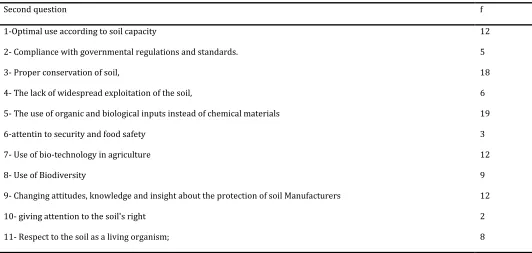
In table 2 that examine ethical principles, use of biological and organic materials and proper conservation
of soil and also optimal use due to soil capacity according to responder's comments are respectively ordering from first to third in ethical principles of soil
Table 2.
The frequency response of the Delphi questions (n=25)
f Second question
12 1-Optimal use according to soil capacity
5 2- Compliance with governmental regulations and standards.
18 3- Proper conservation of soil,
6 4- The lack of widespread exploitation of the soil,
19 5- The use of organic and biological inputs instead of chemical materials
3 6-attentin to security and food safety
12 7- Use of bio-technology in agriculture
9 8- Use of Biodiversity
12 9- Changing attitudes, knowledge and insight about the protection of soil Manufacturers
2 10- giving attention to the soil's right
8 11- Respect to the soil as a living organism;
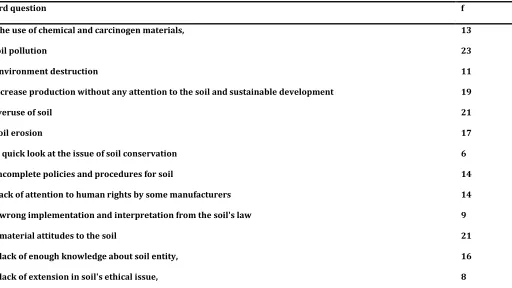
In third question, the most difficulties and problems of ethical issues of soil are; soil pollution, overuse of
Table 3.
The frequency response of the Delphi questions (n=25)
f Third question
13 1. The use of chemical and carcinogen materials,
23 2.soil pollution
11 3. environment destruction
19 4.increase production without any attention to the soil and sustainable development
21 5.overuse of soil
17 6. soil erosion
6 7. A quick look at the issue of soil conservation
14 8. Incomplete policies and procedures for soil
14 9. Lack of attention to human rights by some manufacturers
9 10. wrong implementation and interpretation from the soil's law
21 11. material attitudes to the soil
16 12. lack of enough knowledge about soil entity,
8 13. lack of extension in soil's ethical issue,
In table 4 give the most difficulties and problems of ethical issues of soil in Iran from responder's comments. The most important issues and factor are: overuse of
chemical materials in agriculture, material attitude and point of view to soil and soil erosion.
Table 4.
The response's frequency of the Delphi questions (n=25)
f Forth question
18 1.Soil erosion
6 2.Yeoman
11 3. Strict rules and strict administrative
12 4. Lack of attention to the nature of the soil
17 5. Misuse of soil and water
13 6. Lack of monitoring the implementation of existing laws,
3 7. Lack of attention to the rights of others,
20 9. Material attitudes to the soil,
16 10. Water and soil pollution by factories and etc…
24 11.The excessive use of chemical inputs in agriculture,
2 12.Non-compliance of plowing (e.g. slope),
2 13.Removing vegetation in deserts and mountains range
16 14.Lack of interest in organic and healthy products,
11 15.Increasing degradation of natural resources,
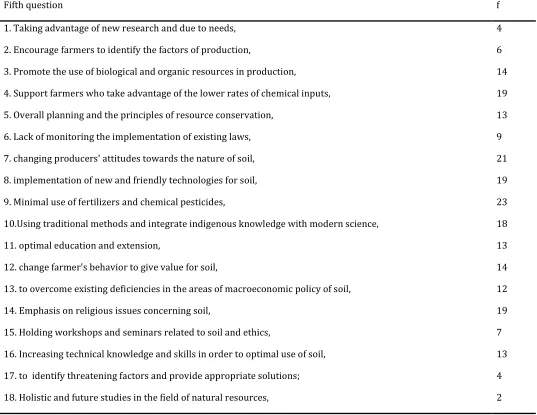
In table 5 shows the most important suggestions about soil ethic due to responder's comments. Some of them
are: minimal use of fertilizers and chemical pesticides, support farmers who take lower advantage of chemical inputs, implementation of new and friendly technologies for soil and etc.
Table 5.
The response's frequency of the Delphi questions (n=25)
f Fifth question
4 1. Taking advantage of new research and due to needs,
6 2. Encourage farmers to identify the factors of production,
14 3. Promote the use of biological and organic resources in production,
19 4. Support farmers who take advantage of the lower rates of chemical inputs,
13 5. Overall planning and the principles of resource conservation,
9 6. Lack of monitoring the implementation of existing laws,
21 7. changing producers' attitudes towards the nature of soil,
19 8. implementation of new and friendly technologies for soil,
23 9. Minimal use of fertilizers and chemical pesticides,
18 10.Using traditional methods and integrate indigenous knowledge with modern science,
13 11. optimal education and extension,
14 12. change farmer's behavior to give value for soil,
12 13. to overcome existing deficiencies in the areas of macroeconomic policy of soil,
19 14. Emphasis on religious issues concerning soil,
7 15. Holding workshops and seminars related to soil and ethics,
13 16. Increasing technical knowledge and skills in order to optimal use of soil,
4 17. to identify threatening factors and provide appropriate solutions;
3.3. Second step, prioritize opinions about soil ethics
In this step due to given answers of responders, responders comments about five raised questions in questionnaire format was designed and in cases that standard deviation was lower than one, Strong consensus (SD=1) emerged and items that their standard deviation
was more than one and experts panel had no strong consensus on them was deleted and finally 30 items remain. Panel members recognized the importance of 24 items of 30 items between high and very high levels. Importance of six strategies was found in an average level. Due to space limitation, just first tree priority of items in every question was mentioned in table 6.
Question Item m* SD priority Q u e s ti o n 1
Minimal use of chemical pesticides and minimal exploitation of resources, (How to use pesticides, technologies and utilization of soil and etc.),
4/63 0/351
1
Optimal use of agricultural land to achieve sustainable development, 4/41
0/41 2
Efficient use of land as sacred and precious gift, 4/38 0/245 3 Q u e s ti o n 2
Changing attitudes, knowledge and insight about the protection of soil Manufacturers,
4/69 0/51
1
The use of organic and biological inputs instead of chemical materials, 4/32
0/42 2
Optimal use according to soil capacity, 4/31 0/4 3 Q u e s ti o n 3 soil pollution, 4/68 0/61 1
overuse of soil, 4/62 0/58 2 environment destruction, 4/53 0/61 3 Q u e s ti o n 4
The excessive use of chemical inputs in agriculture, 4/86
0/101 1
Water and soil pollution by factories and etc. 4/86
0/11 2
Misuse of soil and water, 4/79 0/32 3 Q u e s ti o n 5
change farmer's behavior to give value for soil, 4/86
0/36 1
Increasing technical knowledge and skills in order to optimal use of soil, 4/81
0/4 2
Emphasis on religious issues concerning soil, 4/76
0/52 3
*5=strongly agree, 4=agree, 3=neutral, 2=disagree, 1=strongly disagree
4. DISCUSSION
According to the findings of Delphi this results were obtained.
First: definition and meaning of soil ethic in agriculture Due to results and findings of prioritize of answers, soil ethic can be defined as:
"Soil ethics means minimal use of chemical inputs in agricultural production, paying attention to sustainable development of agriculture and in other words, optimal use of one of the main sources of production that is soil as one of the God's Blessings. On the other hand soil ethics could be as give value to soil and respecting to
these two production elements and preventing
destruction and misuse of soil."
Second: soil ethical principals in agriculture The most important soil ethical principles are:
1. Changes in attitudes and knowledge of
producers in protecting soil resources,
2. Use of organic and biological inputs and paying
attention to the environment,
3. Optimal use and in accordance with the capacity
of the soil and the lack of exploitation of its abundant,
4. Respect for the soil and their rights in
production,
5. Implementation of environmental technologies
6. Observance of rules and instructions that
approved by the government and soil
conservation,
7. Paying attention to the safety of product's
materials for consumer's health.
Third: soil ethical problems and difficulties in agriculture in all around the world
The most important soil ethical problem in all around the world is soil and water pollution, other problems are:
1. Overuse of soil,
2. Environment destruction,
3. Increasing of production without any attention
to the development of sustainable agriculture,
4. Wrong and flawed policies about soil,
5. Material and economical attitudes in production
affairs,
6. Lack of attention to the extension of soil ethics,
7. Soil erosion,
8. Surface visibility Instead of thoughtfulness,
Forth: problems and difficulties of soil ethics in Iran' agriculture
The most important problem of soil ethics in Iran is overuse of chemical inputs in agriculture, Water and soil's pollution by factories and etc., misuse of soil and water, lack of attention to the production of healthy and organic products and etc.
Fifth: Suggestions for solving the soil ethical problems and difficulties in agriculture
According to the results, changing farmer's behaviors to give value for soil, increasing technical knowledge and producer's skills for optimal use of water and soil, emphasizing on religious issues about soil and etc. are the best suggestions for solving the soil problems.
SUGGESTIONS
Holding education and extension courses for agriculture activists (farmers, producers of agricultural inputs and experts and also private companies associated with agricultural activities should try to change farmer's behaviors and knowledge that will lead them to more sustainable behavior. On the other hand, the government protection of environmentally friendly plans and to encouraging farmers to use organic and biologic inputs will be efficient for soil ethics improvement. Some other suggestions are:
1. Using religion for convincing the importance of
soil as an efficient and holly element for human being.
2. Using local leaders and trustees for declaring the
importance of soil for others.
3. Supporting pioneer farmers for using
environmentally friendly agriculture.
REFERENCES
Baghaei Mosayeb, Chizari Mohammad, Baghbani Aarani
Abolfazl and Nahavand Saeed Fe'ely. A Practical Guide to
Promote Rangeland and Watershed, Tehran, Arghanoon Pub: 2012.
Khazaei, Zahra. Applied Ethics: Entity, Methods and
Challenges, Philosophic and Theological Studies,
pp:175-204,2006
Aabedi Sorestani, a.V shahvali, M.. The Role of Agricultural Extension in Promoting Environmental
Ethics Farmers. Ethical journal in Science and
Technology, fourth year, Num.1 and 2; pp 120-130, 2009
Aagheli Kohneshahri Lotfali and Sadeghi Hossein. The Estimation of Economic Impact of Soil Erosion. Economic Studies Journal, Num 15, pp 87-100, 2005
Azizi Khalkhili Taher, Bakhsh Jahromi Arman and Bijani Masoud. Farmer's behavior in Soil Conservation and Mass Media and Communication Media's Role, Science of agricultural education and extensional sciences of Iran, volume 7 Num 2, pp 51-61, 2010
Fe'eli Nahavand Saeed, Mirzaei Arezo, Baghaei Mosayeb and Bandarian Noshin. Factors Affecting on Knowledge of Farmer in Shahreza in Principles of Soil Sampling Area. Journal of education and extension of agricultural sciences, third year, Num 2, summer pp: 95-108, 2010
Planning and Economic Studies Institution.
Understanding the Current Situation and Resources: Fundamentals of Soil Comprehensive Bill. First volume, Ministry of Agriculture: 2010.
Apotheker, H. Is agriculture in need of ethics? Journal of Agricultural and Environmental Ethics, (12), p: 9-16. 2000
Beauchamp T. L. The Nature of applied Ethics: A Companion to applied Ethics , R. G. (Raymond Gillespie) Frey, Christopher Heath Wellman , ( New York, oxford,) pp. 1- 33. 2003
Bedau, H. A. Applied Ethics, the Encyclopedia of Ethics, ed. Becker, vol.1, pp.81-4, 2004
Britannica: p.s. Ethics, the new Encyclopedia Britannica,
Vol. 18, 15th ed, Encyclopedia Britannica, Inc., 1993, p:
492-521. 1993
Copp, D. the oxford handbook of Ethical Theory. Oxford university press, 2006.
Dallmeyer, D. G. Incorporating environmental ethics into
ecosystem-based management. 6th Marine Law
FAO. Land degradation in south Asia. Available in www.FAO.org , 2002
FAO. The Ethical Issues in Fishers. Pub in Rome, 2005.
Nesheim, N. Use management practices to protect ground
water from agricultural
pesticides.www.general.uwa.edu.au/u/dpannell/dpap99 01f.htm. 2003
Thompson, P. B. Food and agricultural biotechnology:
Incorporating ethical
considerations.www.agriculture.purdue.edu/agbiotech/