https://doi.org/10.5194/ms-10-363-2019
© Author(s) 2019. This work is distributed under the Creative Commons Attribution 4.0 License.
Analysis on the lateral vibration of drill string
by mass effect of drilling fluid
Chunxu Yang1,2, Ruihe Wang1, Laiju Han2, and Qilong Xue3
1School of Petroleum Engineering, China University of Petroleum, Qingdao, P. R. China 2Shengli Petroleum Engineering Co. Ltd, Drilling Technology Research Institute, Dongying, P. R. China
3School of Engineering and Technology, China University of Geosciences (Beijing), P. R. China
Correspondence:Qilong Xue ([email protected])
Received: 14 March 2019 – Revised: 12 June 2019 – Accepted: 28 June 2019 – Published: 17 July 2019
Abstract. It is well known that the influence of the internal and external drilling fluid on the lateral vibration characteristics of drillstring cannot be ignored. In this paper, experiment apparatus for simulating drillstring vibration was established. Hammering method is used to measure drillstring lateral natural vibration frequency when the internal and external drilling fluid is considered. The test results show that the drilling fluid can decrease the natural frequency of the drillstring. Based on the simulation model, considering the influence of the internal and external drilling fluid, an external drilling fluid additional mass coefficient is derived considering the dynamic pressure effect caused by external drilling fluid. Additional mass coefficient can get the result with high precision, which can meet the needs of the project. the simulation results are in good agreement with the test results, and the error is within 2 %. This work provides a useful attempt and lays the foundation for the dynamics of the drill string in the drilling fluid environment.
1 Introduction
It has been proved that drilling dynamics and its interactions with the surroundings is the essential reason of a lot of dan-gerous drilling accidents, such as the poor cementing quality induced by the deterioration of borehole quality and the fail-ure of drilling tools caused by strong vibration (Ritto et al., 2013; Bailey and Finnie, 1960). As the most common dy-namics phenomenon, severe vibrations of drillstring must be attached with great important to. Many dangerous problems related to drilling are caused by the drillstring dynamics and its interaction with the surrounding environment. As we all known that the drillstring failures is mainly due to the down-hole vibrations. They can decrease rate of penetration (ROP), interfere with MWD tools and even cause premature fatigue of the components. The drillstring is consisted of several drill pipes, drill collars, stabilizers and connections, both are un-der heavy dynamic loads with extreme complexity. If the ex-cited frequency of drillstring closes to the natural frequencies of its components, the energy will be absorbed. Once the res-onance appears and the energy boosts, the amplitude of string vibration will be increased, and the bending of string will be
intensified, by which the early fatigue of tools may be oc-curred, and the tools life will be reduced significantly. There are three typical modes of drillstring vibration, namely are the longitudinal vibration (also called axial vibration) mode, the transverse (also referred to lateral or bending) mode and the torsional (also known as stick-slip) mode. The destruc-tive nature of each type of vibration is different. It is well known that lateral vibration (Mitchell et al., 1985; Zamudio et al., 1987) is the main reason for drilling string failure as the study of drill string dynamics goes further. Many dan-gerous phenomena related to drilling are normally caused by the dynamics of the drillstring and its interactions with the surroundings.
side using liquid and solid coupling vibration theory, and the drilling fluid can be generalized to quality distribution, so it cannot be neglected. The bottom drillstring lateral vibration is very common during sidetracking, and the lowest resonate frequency depended on material property and drill fluid fea-tures. M. W. Dykstra (Sarpkaya, 1979) utilized infinite ele-ment method, in combination with BHA statics buckling and dynamics vibration analysis and simulation of Sperry-Sun. After conducted a lot of experiment, he pointed that mass un-balance affect drillstring lateral vibration very much, and the friction between drillstring and well bore is severe when the drillstring move near its instinct frequency. Furthermore, the effect of drilling fluid in annulus on drillstring lateral instinct frequency under the small annulus clearance circumstances, drillstring lateral vibration frequency and bending stress am-plitude increase with the decrease of annulus clearance.
Recently, many studies of the drillstring focused on the de-termination of natural frequencies (Chen and Géradin, 1995; Christoforou and Yigit, 1997), bending stress calculation (Graham et al., 1965; Plunkett, 1967), stability analysis (Vaz and Patel, 1995) and lateral displacement prediction (Yigit and Christoforou, 1998), etc. But the influence of the inter-nal and exterinter-nal drilling fluid on the lateral vibration char-acteristics of drillstring is less of research literature. Addi-tional mass force is on solid constructor caused mainly by the flow of surrounding liquid. The inertia mass which cause the additional mass force is called additional mass. Batche-lor obtained algorithm of calculating additional mass using potential theory and calculated additional mass coefficient of different regular shapes. Brebbia and Wrobel (1979) ap-plied boundary element method of solid mechanics to cal-culate velocity potential of flowing liquid, which make the algorithm easier. Sarpkaya (2004) developed that additional mass differed magnificently in different vibration amplitude after studied additional mass of cylinder vortex-induced vi-bration. Villaggo (1996) studied additional mass of infinite length cylinder with elastic deformation. However, no addi-tional mass coefficient theory equation was obtained in all above. In this paper, simulation experiment apparatus was established, through experiment and numerical calculation, mass effect of drilling fluid inside and outside on drillstring vibration property was simulated and analyzed, which pro-vide reference to the practical drillstring instinct vibration property.
2.1 Experiment apparatus
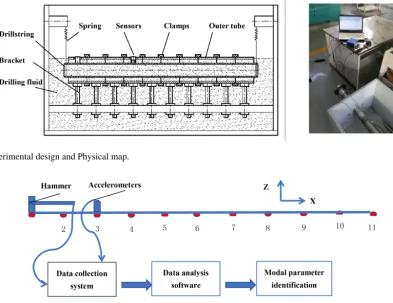
The Experiment apparatus designed as shown in Fig. 1, the experiment pipe (length 2 m) is suspended in the box by springs, and can be hinge supported in the box. The outside of the pipe is the housing, which is used to simulate the well-bore. There is a lid at each end of the pipe, so the drilling fluid can be only inside or outside of the pipe. Both ends are hinge supported when axial force is imposed. The height of the bolt can be adjusted in order to make sure that pipe is at the same axis with the box. The pipe is comprised of many sections which can be dismantled, and each section is connected and sealed by clamp with another. Each section of the outer tube (tubing diameter is 38 mm) corresponds to a measuring point position, two of the outer tubes are provided with holes to pass through the isolation tubes. Light isolation tube pastes through the hole in the test tube column, an isolation tube is placed in the acceleration sensor, another isolation tube for the hammer experiment. After the current position measur-ing point hammermeasur-ing test is finished, adjust the position of the outer tube with small holes to hammer test the next mea-suring point.
The data collection system is YMC9004 dynamic data col-lector. Dynamic data measurement and analysis software is YMC9800 modal analysis software, force hammer is IH-02, the hammer material is quartz, the sensor is 122A100 accel-erator sensor with the characteristic of light weight and high sensitivity.
Experiments using multi-tap, single-point response method, the drill pipe×direction is divided into 10 equal parts, 11 measuring points, as show in Fig. 2. In order to better match the simulation results, we select the 3rd click point as the response point. Due to the large difference in size between the y andzdirections and thex direction, it can be simplified as a bar, and only a few click points can be arranged in thexdirection sequentially.
2.2 Modal analysis theory
Figure 1.Experimental design and Physical map.
Figure 2.Measuring point arrangement and equipment connection.
strikes to eliminate the influence of square deviation and er-ror. Frequency response function is estimated as H1, during
the estimation, power window function was added to stim-ulation, and window function was added to response, and then the drillstring inherent property was obtained through simulation of parameter recognition. In this paper, Polymax method was applied to simulate parameter recognition.
For a system with output number ofNo, and input number Ni, when frequency response function is described in right
matrix distribution model, the frequency response function at lineO(O=1,2. . .N0) could be expressed as follows:
Ho(ω)=Bo(ω)A−1(ω) (1)
where, Ho(w)∈C1×Ni is the frequency response function, A(w)∈CNi×Niis denominator matrix,B
o(w)∈C1×Niis
nu-merator matrix, they are defined as follows:
A(ω)=
n X
r=0
Arr(ω) (2)
Bo(ω)=
n X
r=0
Bo,rr(ω) (3)
wherenis system degree,r(ω) is primary function,
coeffi-cient matrixAj∈CNi×Ni andBo,j∈CNi×Ni are parameters
to be evaluated, by combine all parameters together:
θ=
β1
.. .
βN
o
α
βo=
Bo,0 Bo,1 .. . Bo,n
α=
A0 A1 .. . An
o=1,2. . .No (4)
By multiplyingA(ω) on both sides of formula Eq. (1), lin-earization error can be expressed:
Eo(ωk)=Wo(ωk) Bo(ωk)−eH(ωk)A(ωk)
k=1,2. . .Nf (5) Wo(ωk) is invariant weighting function of each output, e
Ho(ωk) is frequency function measured, Nf is number of
spectral line included in the response function. For all out-putO=1,2, . . .N0, penalty function can be expressed as
fol-lows:
l(θ)=
No
X
o=1
Nf
X
k=1
=
Wo(ω2)[0(ω2) 1(ω2) · · · n(ω2)] .
. .
Wo(ωNf)[0(ωNf) 1(ωNf) · · · n(ωNf)]
εCNf×(n+1)
(8) Yo = −
Wo(ω1)[0(ω1) 1(ω1) · · · n(ω1)] ⊗eHo(ω1) Wo(ω2)[0(ω2) 1(ω2) · · · n(ω2)] ⊗eHo(ω2)
. . . Wo ωNf
[0 ωNf
1 ωNf
· · · n ωNf
] ⊗eHo(ω1)
CNf×Ni(n+10) (9)
In formula (9),⊗is Kronecker product. Normal equation can be obtained by multiplyingJHon both ends of formula (7),
Re JHJ
θ=
R1 0 · · · 0 S1
0 R2 · · · 0 S2 ..
. ... . .. · · · ...
0 0 · · · RNo SNo
ST1 ST2 · · · STN
o No P o=1 To β1 β2 .. .
βNo α
=0 (10)
where in
Ro=XHoXoR(n+1)×(n+1), So=XHoYoR(n+1)×Ni(n+1), To=YHoYoRNi(n+1)×Ni(n+1)
As the dimensionality of Re(JHJ) is very high, and system pole is related toα, so the solution ofαis sufficient. Through the topNolines of formula (10),
βo= −R−1o Soα(o=1,2. . .No) (11) Take formula (11) into the last line of formula (10), the re-duced standard equation can be obtained.
Mα=
No
X
o=1
To−SHoR−1o So
!
α=0 (12)
AcV=
0 INi · 0 0
0 0 · · · 0 0 . . . . . . . .. ... . . . 0 0 · · · 0 INi −AT
0 −A
T
1 · · · −A T
n−2 −A
T
n−1
V=V3 (14)
where, model contributing factor of pole at diagonal line of
3is corresponding to the last lineNiofV.
H(ω)=
Nm
X
r=1
8
rγrT j ω−λr
+ 8 ∗ rγrH j ω−λ∗
r
−LR
ω2 +UR (15)
Under the circumstance that pole λr and model
contribut-ing factor are known, formula (15) is converted to the linear equation of unknown8r, LR, UR. Therefore, the minimized
square law could be used.
3 Numerical method
3.1 Model description
The drillstring instinct vibration property was calculated based on finite element analysis software ABAQUS, the sim-ulated pipe model was constructed as shown in Fig. 3. The pipe is with homogeneity, small deformation, and flexible beam, and both ends are supported by springs. Taken the in-fluence of drilling fluid inside and outside into consideration, the mass is distributed on the pipe wall to form interior mass coefficient. According to the pressure effect of outside drill fluid on moving drill pipe, additional mass was reduced, and then exterior mass coefficient was obtained. Submerge con-dition was added to ABAQUS section characteristic, the drill fluid additional mass effect was considered through lateral additional mass coefficient.
3.2 Interior mass coefficient
Figure 3.Simplified model.
Assuming that the length of drillstring isL, and its mass is:
m1= π
4
d2−di2ρ1L (16)
The drill fluid inside drillstring is:
m2= π
4d
2
iρ2L (17)
Then the mass of drill sting with inside fluid:
m=m1+m2 (18)
Interior additional massCNis: CN=
m2 m1
(19)
Take formula (18) into formula (17),
m=m1(1+CN)=π
4
d2−di2ρ1L(1+CN) (20) Then the interior drill fluid additional mass will be obtained:
CN= d 2 iρ2 d2−d2 i
ρ1 (21)
In formula (16)–(21), CN is interior drill fluid additional mass coefficient, di is the inside diameter of drillstring, d
is outer diameter of drillstring,m1is drillstring mass,m2is interior drill fluid mass,ρ1is drillstring material density,ρ2
is drill fluid density.
3.3 Exterior mass coefficient
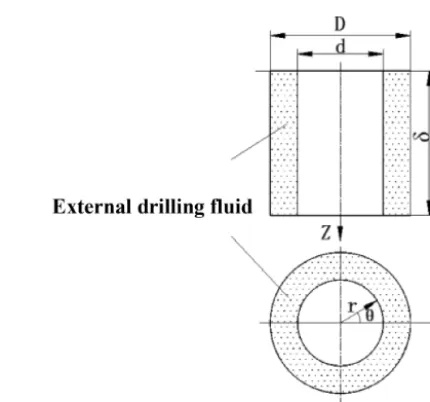
Assuming the outer diameter of the drillstring isd, the inner diameter of the borehole wall isD, set the axial direction of the drillstring isZdirection, and the model shown in Fig. 4 is established. Set the horizontal movement of the drillstring to make a harmonic vibration along theY direction, and the displacement of the drill string can be expressed as:
y=y(z)eiωt (22) Suppose that fluid media is homogeneous incompressible and perfect, velocity potential function of annulus drilling fluid is:
ϕ(r, z, θ, t)=ψ(r, θ, z)eiωt (23)
Figure 4.Movement Model of Drilling String in Annular Drilling Fluids.
where,y(z) is the vibration amplitude,ϕis velocity potential function,9 is amplitude function,ωis drillstring vibration frequency,tis timei=
√ −1.
Suppose drill string kinematic equation is y=y(z)eiωt,
y(z) is drill string vibration amplitude, ψ(r, θ, z) could be present asψ(r, θ, z)=R(r)2(θ)Z(z) according to variable separation principle, based on hydromechanics fundamental equation,
set d
2R Rdr2+
1
rR
dR
dr − m2
r2 = −
1
Z d2Z
dz2 = −µ (24)
1. Whenµ=0, get the following equation:
CM=
D2+d2 D2−d2·
2B1+B2δ
2(B1+B2z)
(25)
where,CMis exterior mass coefficient,δis unite
drill-string length,B1,B2is drillstring axial vibration
coeffi-cient.
2. Whenµ>0,
CM=H
√
µd 2
B
1−B2−B1e √
µδ+B
2e− √
µδ
√
µδ B1e √
µz+B2e−√µz ·
2
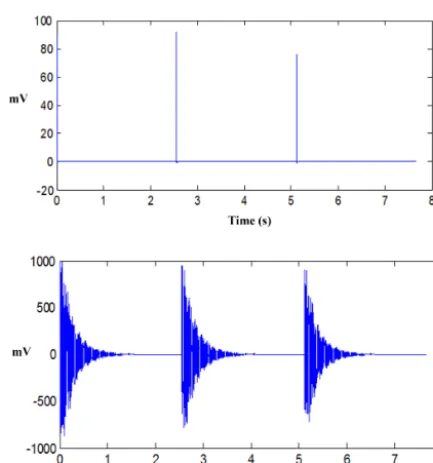
Figure 5.Acceleration Sensor Response of Hammer Test.
3. Whenµ<0,
CM=H
√
−µd
2
B1cos √
−µδ−B2sin √
−µδ−B1 √
−µδ
B1sin √
−µz+
B2cos √
−µz· 2 d (27)
4. Then, the following equation (Vaz and Patel, 1995) will be obtained:
CM=D 2+d2
D2−d2 (28)
4 Results
Taking the vibration frequency modal parameter of the ex-perimental drill string (38 mm diameter) in free state as an example, excitation and response signals as show in Fig. 5.
4.1 Frequency response estimation
Through the excitation and response signal frequency re-sponse function estimation, using H1 estimation, take 3 times average. Typical frequency response signals of mea-suring point 1 and 2 in the Fig. 2 are shown in Fig. 6.
4.2 Comparative analysis of measurement and simulation results
Analysis of experimental data for 38 mm diameter experi-mental drillstring vibration frequency in free state. And take the simulation through the finite element analysis software
Table 1.Free state natural frequency of drillstring.
Order Simulation Experimental frequency (Hz) frequency (Hz)
1 197.40 192.03
2 536.34 521.32
3 1030.00 1011.51
4 1658.60 1639.15
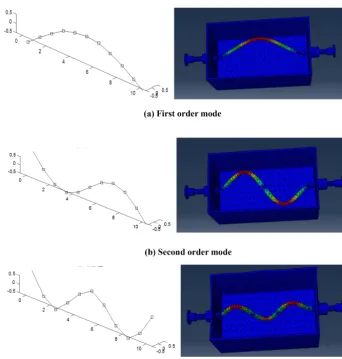
ABAQUS. The modal corresponding to the natural frequency of the corresponding step is obtained, and the simulation re-sults are in good agreement with the experimental rere-sults.
The experimental results show that the first few modes of the 38 mm OD cylindrical tube are shown in Fig. 7 (Left). The corresponding local mode shapes of the 38 mm cylindri-cal tube simulated by ABAQUS software are shown in Fig. 7 (Right).
The calculated value of the natural vibration frequency of the drill string under free state is compared with the exper-imental value in Table 1, It can be seen that experexper-imental values of the first 4 natural frequencies under the free state of the experimental column correspond well with the calcu-lated values and the relative errors are small (< 2 %), indicat-ing that the calculation method based on ABAQUS software and the experimental measurement procedures and process-ing software are reliable.
In order to study the effect of drilling fluid to drill string instinct frequency, simulation pipe with OD of 20, 27 and 29 mm, and length of 1.5 m was adopted to compute and cal-culate. Three conditions, interior filled with drill fluid, or/and submerged in the drill fluid were studied.
4.3 Influence of internal liquid on lateral vibration property
tak-Figure 7.Comparative Analysis of Measurement and Simulation Results.
Table 2.1st order natural frequency of drillstring when the interior is full of liquid.
Outer Simulation Experimental Relative Internal additive diameter frequency (Hz) frequency (Hz) error mass coefficient
20 mm 46.42 45.52 1.98 % 0.23
27 mm 63.43 62.62 1.30 % 0.20
29 mm 68.60 69.35 1.08 % 0.22
ing its mass effect into consideration. Experimental measure-ment and simulation results are shown in Table 2.
As can be seen in table 1, as the external diameter in-creases, the frequency increases. The simulation results are in good agreement with the test results, and the error is within 2 %.
4.4 Influence of outside drill fluid on lateral vibration property
Without consideration of interior drilling fluid, put a lid on both sides of the simulation pipe and then submerge it into a pipe which is filled with drilling fluid, the pipe OD is
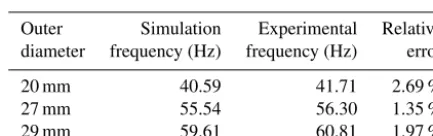
110 mm. The hammer strike test were conducted with OD of 20, 27, 29 mm, in order to analyze the instinct frequency. The drilling fluid additional coefficient can be computed accord-ing to formula (25), and import the coefficient into software ABAQUS, then the instinct pipe frequency can be computed. Experimental measurement and simulation results are shown in Table 3.
diameter frequency (Hz) frequency (Hz) error
20 mm 40.59 41.71 2.69 %
27 mm 55.54 56.30 1.35 %
29 mm 59.61 60.81 1.97 %
4.5 Influence of drill fluid outside and inside on lateral vibration property
Three pipes are filled with drilling fluid and then are sub-merged into pipe, which is filled with drilling fluid. The in-stinct frequency of each pipe can be analyzed through ham-mer strike experiment. Considering the influence of drilling fluid inside and outside, the drilling fluid additional coeffi-cient are added in the computation. The computation results are listed in Table 4.
In Table 3, both the instinct frequency value of experiment and that of computation are listed, and the difference between them is minor.
According to experiment above, taking the drilling fluid mass effect into consideration, the pipe instinct frequency re-duced dramatically. On basis of drilling fluid additional mass coefficient both inside and outside, with use of ABAQUS, it turns out that the difference between computation value and the experiment value is minor. Therefore, the mass effect pro-cessing method and the computation method is correct. The computation method can be used in engineering practice.
5 Discussion
During the process of drilling, the vibration of drillstring is a widespread phenomenon that has attracted the attention of so many scholars. In this paper, the mass effect of drilling fluid inside and outside on drillstring vibration property was sim-ulated and analyzed, which provide reference to the practical drillstring instinct vibration property. Hammering method is used to measure drillstring lateral natural vibration frequency when the internal and external drilling fluid is considered. The test results show that the drilling fluid can decrease the natural frequency of the drillstring. Based on the finite el-ement method, compared with experimental measurel-ement value, an additional mass coefficient is derived considering the internal drilling fluid. An external drilling fluid additional
mass coefficient is derived considering the dynamic pressure effect caused by external drilling fluid. Additional mass coef-ficient can get the result with high precision, which can meet the needs of the project.
The experiment apparatus was designed taken the influ-ence of drilling fluid inside and outside, an experiment algo-rithm of measuring influence of drilling fluid was proposed. By utilizing hammer strike to conduct model test on the pipe, and under applying Polymax model analyzing method, lat-eral vibration frequency under different conditions were ob-tained. Computing method with drilling fluid additional mass coefficient both inside and outside was proposed. With com-paring experiment results with simulation, the accuracy of mass effect handling method and computing method are ver-ified. This work proves the important role of drilling fluid in the vibration analysis of the drill string by provide simulation models and test methods. It also provides a useful attempt and lays the foundation for the dynamics of the drill string in the drilling fluid environment.
Data availability. The data used to support the findings of this study are included within the article. The data will be available upon request.
Author contributions. CY, RW, LH and QX analyzed the data and developed the model; QX, RW and CY performed the experi-ments; QX, RW and CY prepared the figures. QX, and CY wrote and edited the manuscript.
Acknowledgements. The author(s) disclosed receipt of the fol-lowing financial support for the research, authorship, and/or publi-cation of this article: This work was supported by Natural Science Foundation of China (51704264). Key tools and equipment for im-proving drilling efficiency in complex formations, National science and technology project (2016ZX05021-003).
Financial support. This research has been supported by the Nat-ural Science Foundation of China (grant no. 51704264) and Key tools and equipment for improving drilling efficiency in com-plex formations, National science and technology project (grant no. 2016ZX05021-003).
Review statement. This paper was edited by Guimin Chen and reviewed by two anonymous referees.
References
Brebbia, C. A. and Wrobel, L. C.: Boundary element method for fluid flow, Adv. Water Resour., 2, 83–89, https://doi.org/10.1016/0309-1708(79)90015-0, 1979.
Bailey, J. J. and Finnie, I.: An analytical study of drill-string vibration, J. Eng. Ind. Trans. ASME, 2, 122–128, https://doi.org/10.1115/1.3663017, 1960.
Chen, S. L. and Géradin, M.: An improved transfer matrix technique as applied to BHA lateral vibration analysis, J. Sound Vib., 185, 93–106, https://doi.org/10.1006/jsvi.1994.0365, 1995.
Christoforou, A. P. and Yigit, A. S.: Dynamic modeling of rotating drillstrings with borehole interactions, J. Sound Vib., 206, 243– 260, https://doi.org/10.1006/jsvi.1997.1091, 1997.
Graham, R. D., Frost, M. A., and Wilhoit, Jr. J. C.: Analysis of the motion of deep-water drill strings part 1: forced lateral motion, J. Engin. Ind., 87, 137–144, https://doi.org/10.1115/1.3670778, 1965.
Manolis, G. and Polyzos, D.: Recent advances in boundary element methods, Pentech Press, 71–80, https://doi.org/10.1007/978-1-4020-9710-2, 1978.
Mitchell, R. F. and Allen, M. B.: Lateral Vibration: The key to BHA failure analysis, World Oil, 4, 101–106, https://doi.org/10.1016/0165-1633(85)90018-8, 1985.
Plunkett, R.: Static bending stresses in catenaries and drill strings, J. Engin. Ind., 89, 31–36, https://doi.org/10.1115/1.3610004, 1967. Sarpkaya, T.: Vortex-induced oscillations (A Selective Review), J. Appl. Mech., 46, 241–258, https://doi.org/10.1115/1.3424537, 1979.
Sarpkaya, T.: A critical review of the intrinsic nature of vortex-induced vibrations vibrations, J. Fluid. Struct., 19, 389–447, https://doi.org/10.1016/j.jfluidstructs.2004.02.005, 2004. Temple, G. and Gillis, J.: An Introduction to Fluid Dynamics, Phys.
Today, 12, 36–38, https://doi.org/10.1063/1.3060769, 1959. Ritto, T. G. and Escalante, M. R., Sampaio, R., and
Ros-ales, M. B.: Drillstring horizontal dynamics with uncer-tainty on the frictional force, J. Sound Vib., 332, 145–153, https://doi.org/10.1016/j.jsv.2012.08.007, 2013.
Villaggio, P.: The added mass of a deformable cylinder mov-ing in a liquid, Continuum Mech. Therm., 8, 115–120, https://doi.org/10.1007/BF01184765, 1996.
Vaz, M. A. and Patel, M. H.: Analysis of drill strings in vertical and deviated holes using the Galerkin technique, Engin. Struct., 17, 437–442, https://doi.org/10.1016/0141-0296(95)00098-R, 1995. Wolf, S. F., Zacksenhouse, M., and Arian, A.: Field measure-ments of downhole drillstring vibrations, SPE Annual Technical Conference and Exhibition, https://doi.org/10.2118/14330-MS, 1985.
Xue, Q., Leung, H., Wang, R., Liu, B., Huang, L., and Guo, S.: The chaotic dynamics of drilling, Nonlinear Dynam., 83, 1–16, https://doi.org/10.1007/s11071-015-2461-y, 2016.
Xue, Q., Leung, H., Huang, L., Zhang, R., Liu, B., Wang, J., and Li, L.: Modeling of torsional oscillation of drillstring dynamics, Nonlinear Dynam., 96, 267–283, https://doi.org/10.1007/s11071-019-04789-x, 2019.
Yigit, A. S. and Christoforou, A. P.: Coupled torsional and bending vibrations of drillstrings subject to impact with friction, J. Sound Vib., 215, 167–181, https://doi.org/10.1006/jsvi.1998.1617, 1998.