R E S E A R C H
Open Access
Mutual kernelized correlation filters with
elastic net constraint for visual tracking
Haijun Wang
*and Shengyan Zhang
Abstract
In this paper, we propose a robust visual tracking method based on mutual kernelized correlation filters with elastic net constraint. First, two correlation filters are trained in a general framework jointly in a closed form, which are interrelated and interacted on each other. Second, elastic net constraint is imposed on each discriminative filter, which is able to filter some interfering features. Third, scale estimation and target re-detection scheme are adopted in our framework, which can deal with scale variation and
tracking failure effectively. Extensive experiments on some challenging tracking benchmarks demonstrate that our proposed method is able to obtain a competitive tracking performance against other state-of-the-art algorithms.
Keywords: Visual tracking, Mutual kernelized correlation filters, Elastic net constraint, Convolutional neural networks
1 Introduction
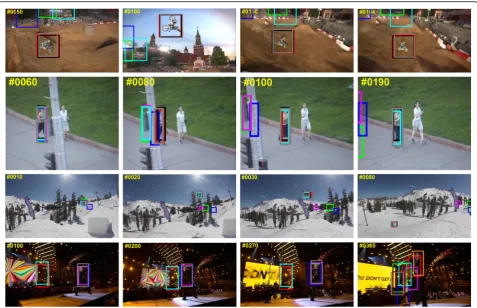
Visual tracking is a fundamental task in computer vi-sion with numerous applications, such as unmanned control systems, surveillance, assistant driving, and so on. Given the position of the tracked object in the first frame, the goal of visual tracking is to estimate the position of the tracked target in the subsequent frame precisely. Although great progress has been made in recent years [1, 2], designing a robust track-ing algorithm is still a challengtrack-ing problem due to negative factors such as background clutters, severe occlusion, motion blur, and illumination variation (see Fig. 1).
Generally speaking, visual tracking methods can be divided into two categories: generative methods [3–7]
and discriminative methods [8–13]. Generative
methods attempt to build a model to represent tracked target and find the region with the minimum reconstruction error from a great deal of candidates. For example, under the particle filter framework, Mei
et al. [14] developed a tracker method based on
sparse representation, called the ℓ1 method, which
re-constructs each candidate with dictionary template and trivial template. The sparse representation coeffi-cients of each candidate can be computed by solving
ℓ1minimization. Despite ℓ1 method demonstrated
im-pressive tracking performance, the tracking speed is very slow because of its huge computation load. In order to solve this problem, Bao et al. [15] proposed
a fast ℓ1 tracking method by using accelerated
prox-imal gradient approach. Xiao et al. [16] presented a
fast object tracking method by solving ℓ2 regularized
least square problem. Wang et al. [17] developed a
novel and fast visual tracking method via probability continuous outlier model. Different from the general method, discriminative algorithms regard visual track-ing as a binary classification problem which
distin-guishes the correct tracked object from the
background. For example, Babenko et al. [18] trained
an online discriminative classifier to separate the tracked object from the background by online mul-tiple instance learning. Zhang et al. [19] formulated visual tracking as a binary classification via a naive
© The Author(s). 2019Open AccessThis article is distributed under the terms of the Creative Commons Attribution 4.0 International License (http://creativecommons.org/licenses/by/4.0/), which permits unrestricted use, distribution, and reproduction in any medium, provided you give appropriate credit to the original author(s) and the source, provide a link to the Creative Commons license, and indicate if changes were made.
* Correspondence:[email protected]
Bayes classifier with an online update scheme in the compressed domain.
In recent years, visual tracking methods based on correlation filter [20–25] have attracted great atten-tion due to its real-time tracking speed and robust tracking performance. Under the framework of correl-ation filter, a discriminative classifier is trained with a great deal of dense sampling examples. These dense sampling examples are with circulant structure which allows the use of the fast Fourier transform (FFT).
Bolme et al. [26] first developed a minimum output
sum of squared error filter for real-time visual tracking. After that, a great deal of tracking methods based on correlation filter has been proposed to
improve tracking performance. Henriques et al. [27]
developed a high-speed tracker with kernelized correl-ation filters which can deal with multi-channel fea-tures. Danelljan et al. [28] presented a discriminative scale space tracker with a correlation filter based on a scale pyramid representation. In order to mitigate the
unwanted boundary effect which appeared in
traditional correlation-based trackers, Danelljan et al. [29] figured out spatially regularized discriminative
correlation filters (SRDCF) for visual tracking. Recent researches have shown that features from convolu-tional neural networks (CNN) can improve tracking performance greatly [30–33]. Zhang et al. [34] builded a simple two-layer convolutional network to learn robust representation for visual tracking without off-line training. Ma et al. [35] utilized three convolu-tional layers to learn robust target appearance for visual tracking. Wang et al. [36] exploited robust tar-get appearance representation from the top layer to lower layer for object tracking. Heng et al. [37] incor-porated recurrent neural network (RNN) into CNN to
improve tracking performance. He et al. [38]
inte-grated weighted convolution responses from 10 layers and achieved a very promising performance.
Although correlation filters based trackers have ob-tained superior tracking performance, many trackers utilized a single correlation filter and could not
achieve promising tracking results. Figure 2 gives the
precision plots and success plots of OPE by methods with a different number of correlation filters on OTB-2013. It is obvious that just simply merging two correlation filters is able to greatly improve tracking
performance in both precision and success rate. How-ever, there is still much room for improvement for methods using two correlation filters which are inde-pendent of each other.
Inspired by the above discussions, we develop a ro-bust visual tracking method via mutual kernelized correlation filters using features from convolutional neural networks (MKCN_CNN), where each tracker works on its own and tries to correct the other one. At the same time, an elastic net constraint is imposed on each filter, which can eliminate some distractive features. Finally, the proposed tracking framework can be solved in a closed-form fashion. Extensive experi-ments demonstrate that our method can achieve promising tracking performance competing with some other state-of-the-art trackers.
The rest of this paper is organized as follows.
Section 2 briefly summarizes the principle of visual
tracking based on kernelized correlation filter. Section
3 introduces the proposed tracking algorithm in
de-tails. The experimental results and corresponding
dis-cussions are described in Section 4, followed by the
conclusion in Section 5.
2 Visual tracking based on kernelized correlation filters
Henriques et al. [27] proposed a fast discriminative visual tracking method based on kernelized correlation filters (KCF). Given an× 1 vectorx= [x1,x2,…,xn]Tdenoting a
base image, a shifted version of x can be defined by
{Pux|u= 1} = [xn,x1,…,xn−1]T. Here, P is a permutation
matrix. So, the full shifted signals of x are given by
Fig. 3The flowchart of our proposed tracking framework
{Pux|u= 1, 2,…,n−1}. Then, the data matrixXis defined by all the cyclic shifted version ofxwhich can be made di-agonal by discrete Fourier transform (DFT).
X¼ FH diagð Þ^x F ð1Þ
Here, F means the DFT matrix, H stands for
trans-pose and complex-conjugate, ^x¼ℱðxÞ, which
com-putes the DFT of vector x. The goal of KCF is to
find a discriminative correlation classifier f(x) over
the data matrix X for separating the target object
from the surrounding environment. Given the training dataset and their corresponding labels (x1,y1), …, (xm,
ym), the discriminative correlation classifier f(x) can be obtained by the following equation,
min
w
X
i
fð Þxi −yi
ð Þ2þλk kw 2 ð2Þ
whereλ means the regularization parameter. xi stands
for the ith row element of the data matrix X. A
Gaussian function is adopted to model the label yi.
When xi is the centered target, yi is set to 1. For the
other cyclic shifted version of xi around the center
target, their labels smoothly decay to 0. The solution
w can be easily obtained by w= (XHX+λI)−1XHy. In order to get a powerful model, kernel trick is intro-duced into Eq. (2). The new model is rewritten as
min
α kKα−yk
2
2þαKα ð3Þ
whereKis an×nkernel matrix and one of its elements is Kij=k(xi,xj). Matrix K has a circulant structure and can be diagonalized as
K¼ FH diag k^ F ð4Þ
Here,k is the first row of matrixK. The solution αin the dual space can be given by
α¼ðKþλIÞ−1y ð5Þ
where I is an identity matrix. Just as the data matrix
X, kernel matrix K is also circulant. So, the solution
of Eq. (3) can be efficiently computed in the
fre-quency domain.
^
α¼ ^ ^y
Kxxþλ ð6Þ
In the next frame, a great deal of candidates, denoted as x', are extracted at the same position as the current frame. Actually, all these candidates’x'are obtained from
the cyclic shift of the base image x. The response of
these candidates can be computed from
f x0 ¼ℱ−1 ^k0∘α^t
ð7Þ
Here,ℱ−1stands for the inverse discrete Fourier
trans-form (IDFT). ^k0 means the kernel correlation of
candi-dates x' and base image x in the frequency domain. ∘
denotes element by element multiplication. The candi-date with the largest response is chosen as the final tar-get object in the next frame.
3 Methods
Though the KCF method has obtained promising tracking performance, only one discriminative classifier is used in this model, which makes the KCF method not able to deal with complex sciences. In order to overcome these prob-lems, inspired by ensemble tracking methods, we pro-posed mutual kernelized correlation filters with elastic net constraint for visual tracking. Extensive experiments show that our method can perform better than the state-of-the-art methods. The flowchstate-of-the-art of our proposed tracking framework is demonstrated in Fig.3.
3.1 Problem statement
In order to find the best target object from a great deal of candidates, we introduce a linear regressor model in the proposed method.
min
w ky−Xwk 2
2 ð8Þ
Here, X has the same definition as KCF.y means
re-gression label value of X. wrepresents the correspond-ing coefficient. In order to promote the performance of Eq. (8), just as least absolute shrinkage and selection op-erator (LASSO) model,ℓ1norm is adopted to regularize
the coefficientsw.
min
w ky−Xwk 2
2þτk kw 1 ð9Þ
where τ is a constant weight parameter. In Eq. (9),
some values of w are set to zero which can make
some occluded pixels excluded in this new model. So, the occluded pixels have less effect on the final decision of regression values. However, we find that the occluded pixels often assemble in one position
together. Eq. (9) cannot group these pixels with the
same features. So, in order to overcome the
limita-tions of the LASSO model, an elastic net
regularization [39] is introduced in Eq. (9).
min
w ky−Xwk 2
2þλk kw 2þτk kw 1 ð10Þ
Here, λ is a constant weight parameter. ‖w‖2 is used
are mapped to a high-dimensional feature space φ(x).
Then, in the dual space, the solution w is given by a
linear combination of mapped candidates.
w¼X i
αiφð Þxi ð11Þ
Equation (10) in the dual space can be described as
min
α ky−Kαk
2
2þλαTKαþτ αk k1 ð12Þ
whereKrepresents kernel matrix. The solution ofα
in-volves square norm and ℓ1 norm simultaneously. In
order to computeα efficiently, another variable βis in-troduced in Eq. (12).
min
α ky−Kαk
2
2þλαTKαþτ βk k1þμ αk −βk 2
2 ð13Þ
Here,μis a constant weight parameter.
3.2 Mutual kernelized correlation filters
In this part, we introduce mutual kernelized correlation filters based on Eq. (13). Then, the proposed mutual ker-nelized correlation filters will solve this following problem
Tðα1;α2Þ ¼ αmin
1;α2 ky−K1α1k
2
2þky−K2α2k22þλαT1K1α1
þλαT
2K2α2þτ β1 1þτ β2 1þμ α 1−β1 2 2
þμ α 2−β2 2
2þ2ρkK1α1−K2α2k 2 2
ð14Þ
The first two parts of Eq. (14) force each kernelized correlation filter model to have the minimum squared error with respect to the desired output regression label y. λαT1K1α1þλαT2K2α2 denote the elastic net
regularization on two models respectively. τkβk1þτ kβk2þμkα1−β1k
2
2þμkα2−β2k 2
2 are introduced to
ex-Table 2Tracking pipeline of MKCF_CNN method
clude the occluded pixels in the target object. 2ρ kK1α1−K2α2k22 is used to weight the influence of the
two kernelized correlation filter models.
It is obvious that Eq. (14) is convex with respect toα1, α2if β1, β2are fixed, and vice versa. So, we propose an
iterative algorithm to compute the solutionα1,α2. Thus,
four subproblems with respect toα1,α2,β1, β2are given
as follows
T1ð Þ ¼α1 minα
1 ky−K1α1k
2
2þλαT1K1α1þτ β1 1
þμ α 1−β1 2
2þ2ρkK1α1−K2α2k 2 2
ð15Þ
T2ð Þ ¼β1 minβ
1
τ βk k1þμ α 1−β1 2
2 ð16Þ
T3ð Þ ¼α2 min
α2 y−K
2α2
k k2
2þλαT2K2α2
þτ β2 1þμ α 2−β2 2 2
þ2ρkK1α1−K2α2k22 ð17Þ
T4ð Þ ¼β2 minβ
2
τ β2 1þμ α 2−β2 2
2 ð18Þ
Set the derivation ofT1with respect toα1to be zero;
Eq. (15) can be rewritten as follows: ∂T1
∂α1¼−2K1ðy−K1α1Þ þ2λK1α1þ4ρK1ðK1α1−K2α2Þ þ2μ αð 1−β1Þ
¼−2K1yþ2K1K1α1þ2λK1α1þ4ρK1K1α1−4ρK1K2α2þ2μα1−2μβ1
¼0
ð19Þ
Change the order of formula (19), we obtain
K1K1α1þλK1α1þ2ρK1K1α1þμα1¼K1yþ2ρK1K2α2þμβ1
⇒ðK1K1þλK1þ2ρK1K1þμIÞα1¼K1yþ2ρK1K2α2þμβ1 ð20Þ
Then, we obtain the solutionα1
α1¼ðK1K1þλK1þ2ρK1K1þμIÞ−1ðK1yþ2ρK1K2α2þμβ1Þ ð21Þ
Set the derivation ofT3with respect toα2to be zero; a
similar solutionα2is given as follows:
α2¼ðK2K2þλK2þ2ρK2K2þμIÞ−1ðK2yþ2ρK2K1α1þμβ2Þ ð22Þ
It is straightforward that Eqs. (16) and (18) are least squared byℓ1norm regularization. Thus, the solutionβ1
andβ2have closed form which can be easily achieved by
a soft shrinkage function
β1¼signð Þα1 max 0;j jα1− τ
2μ
ð23Þ
β2¼ signð Þα2 max 0;j jα2− τ
2μ
ð24Þ
By introducing Eqs. (4), (21) can be reformulated as follows:
α1¼ðK1K1þλK1þ2ρK1K1þμIÞ−1ðK1yþ2ρK1K2α2þμβ1Þ
¼ ð1þ2ρÞFH diag ^k1∘^k1
FþλFH diag ^k1 FþμI
−1
FH diag ^k1 Fyþ2ρFH diag ^k1∘^k2
Fα2þμβ1
¼FH diag 1
1þ2ρ
ð Þ^k1∘^k2þλ^k1þμ
!
diag ^k1 Fy
þ2ρFH diag 1 1þ2ρ
ð Þk^1∘^k2þλk^1þμ
!
diag ^k1∘^k2
Fα2
þμFH diag 1
1þ2ρ
ð Þ^k1∘^k2þλk^1þμ
! Fβ1
ð25Þ
Then, the DFT ofα1is found by
α1¼ diag
^ k1
1þ2ρ
ð Þ^k1∘k^1þλk^1þμ
! ^ yþ2ρ
diag ^k1∘^k2 1þ2ρ
ð Þ^k1∘^k1þλ^k1þμ
!
α2þμ
diag 1
1þ2ρ
ð Þ^k1∘^k1þλ^k1þμ
!
β1
¼^k1∘^yþ2ρk^1∘^k2∘α2þμβ1
1þ2ρ
ð Þk^1∘^k1þλ^k1þμ
ð26Þ
In the same way, the DFT ofα2is obtained from
^
α2¼
^
k2∘^yþ2ρ^k2∘k^1∘α1þμβ2
1þ2ρ
ð Þ^k2∘^k2þλk^2þμ
ð27Þ
Here,k2is the first row of matrixK2.
3.3 Model update
To update the proposed MKCF_CNN method for robust visual tracking, an incremental scheme is adopted to up-date the proposed model,
α1;t ¼ð1−ηÞα1;t−1þηα1;tα2;t ¼ð1−ηÞα2;t−1þηα2;t ð28Þ
where η is a constant parameter which controls the learning rate. The subscripttdenotes thetth frame. The incremental update strategy can deal with the abrupt change in successive frame.
3.4 Target detection
For kernel correlation filterK1, in thetth frame sequence, a great deal of circulant candidates, denoted asx01;t, are
ex-tracted around the base imagex1,t−1. The base imagex1,
t−1 locates at the position of the target at the (t−1)th
frame. The candidates x01;t have a circulant structure. Thus, the responses of these candidates are given by
response1¼ℱ −1 k^01∘α1;t
ð30Þ
In the same way, the responses of these candidates x02;t with respect to kernel correlation filterK2are obtained by
response2¼ℱ −1 k^02∘α2;t
ð31Þ
The maximum values of response1 and response2 are easily achieved by max(response1(:)) and max (response2(:)), respectively. if max(response1(:)) >
max(response2(:)), the final response is equal to max(-response1(:)). Otherwise, the final response is equal to max(response2(:)). The best position of the target is obtained according to the final response.
3.5 Convolutional neural network (CNN) features extracted from MatConvNet
Traditional features, such as histogram of oriented
gradient (HOG), SIFT, and CN, have achieved
promising tracking performance in the past decade. However, these handcrafted features are out-of-date
along with the rise of CNN features. In [40], the
properties of CNN-based representation have gained impressive results on image recognition and object detection. In [35], three convolutional layers, conv3−
4, conv4−4, conv5−4, utilizing VGG-19 model are
introduced to the field of visual tracking and demon-strate powerful representation ability. Inspired by [41],
we used the conv5−4 convolution layer and conv4−
4 convolution layer of VGG-19 to model the
appear-ance of the target. Features from conv5−4
convolu-tion layer with more semantic information can
discriminate the target from the dramatically changing
background. Features from conv4−4 convolution
layer with more spatial details can locate the position of target precisely.
3.6 Target recovery
We adopt the EdgeBox method [42] to re-detect the
target from the failures of tracking. A great deal of
object bounding box detection proposals Pd are
gen-erated by the EdgeBox method, and these proposals are evaluated under the framework of correlation fil-ter to decide the final tracking position. Given the position (xt−1,yt−1) of the target in the (t−1)th
frame, a set of bounding box proposals are extracted around the position of the target in the current
frame. The position of each bounding box proposal pi
is set to ðxi
t;yitÞ in the tth frame. The maximum
re-sponse score of each bounding box proposal pi is
given by r(pi), which is computed by Eq. (7) using the HOG feature. If the score of tracking results in the
tth frame is smaller than the threshold T0, it can be
believed that the tracker loses the target and the scheme of re-detection should be triggered. The
optimal bounding box proposal in the tth frame is
obtained by minimizing the following expression:
arg min i r p
i
t þαL pit;pt−1
s:t: r pit >1:5T0
ð32Þ
where Lðpi
t;pt−1Þ ¼ expð−21σ2kðxti;yitÞ−ðxt−1;yt−1Þk 2
Þ . The formula Lðpi
t;pt−1Þ is motion constraint between
two successive frames. α is a constant parameter which controls the balance between the response score and the motion constraint. σ means the diag-onal length of the initial target size.
3.7 Scale estimation
Scale estimation is very important for robust tracking.
Motivated by [42], we use the EdgeBox method to
deal with scale variation appeared in sequences. Given the size (wt−1,ht−1) of the target in the (t−1)th
frame, we use the EdgeBox method to conduct on
the multi-scale bounding box proposals Ps with the
size of swt−1×sht−1 in the current frame and reject
the proposals whose intersection over union (IoU) is lower than 0.6 or higher than 0.9. For each accepted scale proposal, we compute the response score under the framework of correlation filter. If the maximum response score {r(pi)|pi∈Ps} is smaller than response obtained in Section 3.4, we keep the size of the target in the (t−1)th frame. Otherwise, we update the size of the target by the following equation:
wt;ht
ð Þ ¼γwt;htþð1−γÞðwt−1;ht−1Þ ð33Þ
where ðwt;htÞis the size of the proposal with the
max-imum response score. γ is a constant parameter which
controls the update rate.
4 Results and discussion
In this section, we evaluate our proposed method on
three public datasets: OTB-2013 [43], TColor-128
[44], and DTB70 [45]. Matlab pseudo-codes and
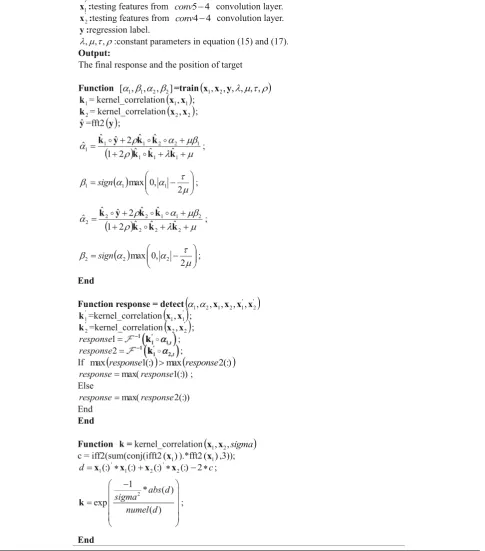
tracking pipeline of our MKCF_CNN method are given in Tables 1 and 2, separately. Extensive experi-ments demonstrate that our method is able to achieve a very appealing performance in terms of effectiveness and robustness.
4.1 Experimental setup
The proposed MKCF_CNN method is implemented in MATLAB on a PC equipped with an Intel Xeon CPU E5-2640 v4 with 128G RAM and a single NVIDIA GeForce GTX 1080Ti. We adopt the pretrained VGGNet-19 as our feature extractor and utilize matcovnet for fea-ture generation. We train two correlation filters utilizing outputs from the conv4−4 and conv5−4 layers. The lin-ear kernel is adopted in this paper. The parametersλ,τ,μ,
ρ in (14) are empirically set to 10−4, 10−5, 10−4, and 10−3 separately. We set the update rate η in (28) and (29) to 0.01 and the weight parameterγin (33) to 0.6. The track-ing failure thresholdT0is set to 0.2.
4.2 Evaluation metrics
We use two measurements, precision plots and suc-cess plots [46], to quantitatively assess the tracking results of our method. Precision plots illustrate the
percentage of frames in which the center location error is within a given threshold. The threshold is set to 20 pixels. The center location error means the Eu-clidean distance between the tracked location and the ground truth. The success plots are the percentage of
frames where the overlap rate S is larger than a fixed
threshold T1. The overlap rate S is defined as S
¼ AeraðBE∩BGÞ
AeraðBEUBGÞ. ∩ and ∪ are intersection and union
oper-ators, respectively. BE denotes the estimated bounding
box and BG is the ground-truth bounding box. T1 is
set to 0.5 in this paper.
To evaluate the tracking performance of our
method comprehensively, the challenging videos from OTB-2013 and TColor-128 are categorized with 11 attributes including background clutter (BC), deform-ation (DEF), fast motion (FM), in-plane rotdeform-ation (IPR), illumination variation (IV), low resolution (LR), motion blur (MB), occlusion (OCC), out-of-plane rotation (OPR), out of view (OV), and scale variation (SV).
4.3 Comparison of tracking performance on OTB-2013 OTB-2013 benchmark dataset contains 51 sequences with 11 challenging attributes. We compare our method with 9 state-of-the-art algorithms which
con-tain deep learning tracking methods (HCFT [35], HDT
[47], CNN-SVM [48], DeepSRDCF [49]) and correlation
filter tracking methods (MEEM [50], Staple [51],
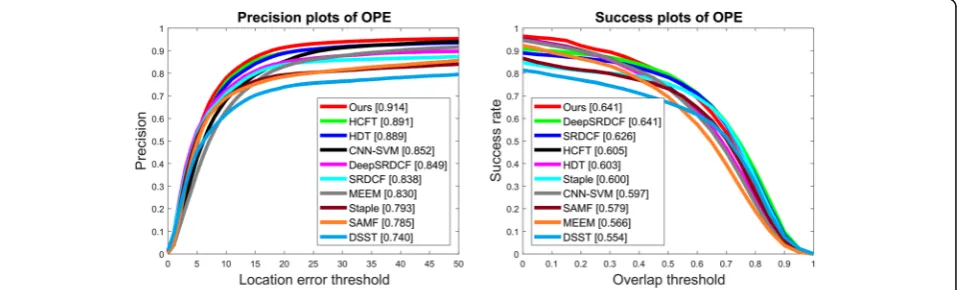
SAMF [52], DSST [28]). Figure 4 gives the precision plots and success plots of OPE of our proposed method against other state-of-the-state methods on OTB-2013.
According to Fig.4, our MKCF_CNN tracker outperforms
most of the other trackers, demonstrating the effectiveness Table 3The success rates of 8 trackers with 11 challenging attributes on TColor-128 dataset. The best, second best, and third best tracking results are represented in red, blue, and green, respectively
of MKCF_CNN. The proposed MKCF_CNN method achieves 2.3% performance gains in precision against HCFT, which is the most related tracking method with us. Meanwhile, MKCF_CNN and DeepSRDCF rank first on the success score.
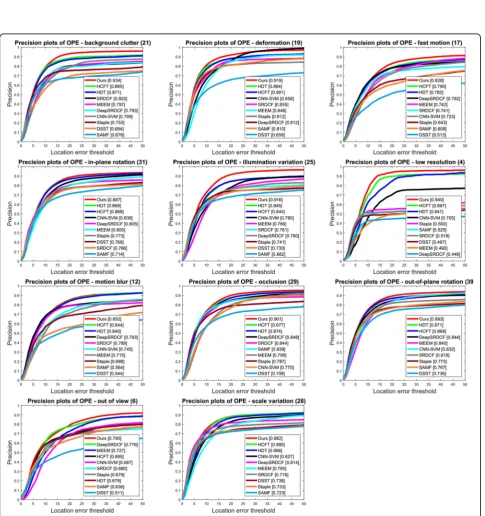
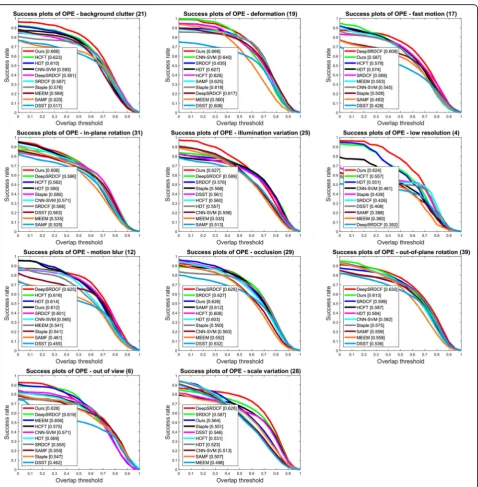
In order to comprehensively assess the tracking per-formance of our proposed MKCF_CNN tracker, we present tracking results under OPE regarding 11
attri-butes in Figs. 5 and 6. We can observe that on the
51 videos with all the 11 challenging attributes, our method ranks first among the 10 evaluated trackers on precision plots. On the videos with attributes such as background clutter, deformation, in-plane rotation,
illumination variation, low resolution, and out of view, MKCF_CNN ranks first among all the evaluated trackers on success plots. In the HCFT method, the
outputs of the conv3−4, conv4−4, and conv5−4
layers are used as the deep features. In the HDT method, the outputs of six convolutional layers
(10th–12th, 14th–16th) from VGGNet-19 are adopted
as feature maps. However, only two layers (conv4−4,
conv5−4) from VGGNet-19 are used in our proposed
method, and two mutual kernelized correlation filters are trained to interact each other through all the tracking process without definite parameters as HCFT
and definite initial parameters as HDT. From Figs. 5
Fig. 11Tracking results of nine trackers on sequences Soccer and Biker, in which the targets undergo fast motion. The tracking results of ASLA, IVT, CSK, SAMF, OAB, Struck, HCFT, COCF, and our tracker are shown by red, green, blue, black, magenta, cyan, gray, dark red, and orange rectangles, respectively
and 6, it is clear that our method performs better than those most relevant methods.
The tracking speed is very important for visual tracking. Correlation filter-based trackers obtained beyond real-time speed using handcrafted features. Except for DFT and inverse DFT, the computational complexity of trackers with a single correlation filter is O(nlogn). nis the dimensionality of the features. Thus, the whole com-putational load of single correlation filter-based trackers is
O(Mnlogn). M is the number of base trackers.M= 2 in
our method andM= 3 in HCFT. For trackers under the
correlation filter framework with deep features, the com-putational burden mainly comes from the features extrac-tion process. Thus, the tracking speed of our proposed
method is 1.3 fps, which is a little faster than HCFT with a speed of 1.1 fps.
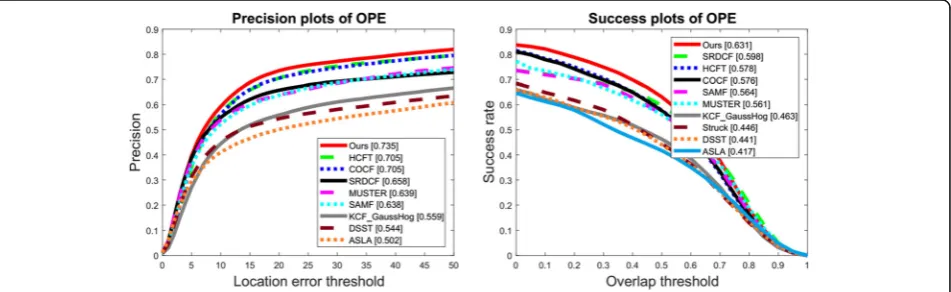
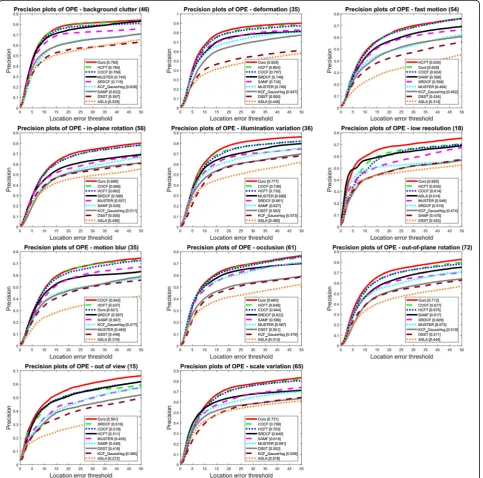
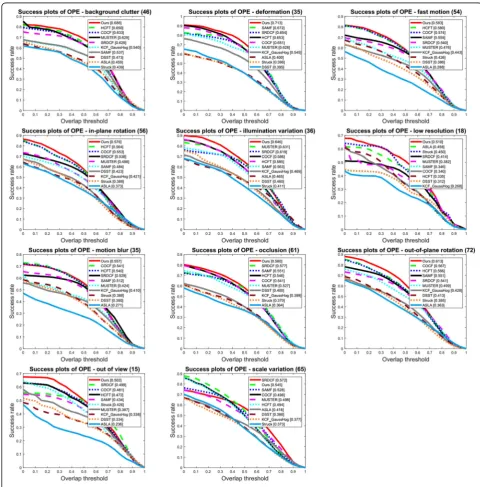
4.4 Comparison of tracking performance on TColor-128 The TColor-128 dataset consists of 128 challenging color videos and is designed to assess the tracking performance on color sequences. Similarly, we evaluated our proposed MKCF_CNN method with 9 state-of-the-art trackers, including HCFT [35], COCF [41], KCF_Gaus-sianHog [27], SRDCF [29], MUSTER [53], SAMF [52], DSST [28], Struck [54], and ASLA [55]. Figure 7 shows precision plots and success plots of OPE of our proposed method against other state-of-the-art methods on TColor-128. Figures 8 and 9 present precision plots and success
Fig. 13Tracking results of nine trackers on sequences Board and Torus, in which the targets undergo background clutter. The tracking results of ASLA, IVT, CSK, SAMF, OAB, Struck, HCFT, COCF and our tracker are shown by red, green, blue, black, magenta, cyan, gray, dark red and orange rectangles, respectively
plots of OPE with different attributes on TColor-128, re-spectively. It is obvious that our method is the best one among the ten trackers on dataset TColor-128, following HCFT method. Our method obtains a precision rate of 73.5% and a success rate of 63.1%. HCFT and COCF rank second and third, respectively. Although HCFT utilizes deep features from three layers, its performance is not bet-ter than our method. COCF uses the same outputs as our method from two layers of VGGNet-19, and it performs worse than our MKCF_CNN tracker. This is because the scale estimation and re-detection scheme are able to lo-cate the target precisely in our method. Figures 8 and 9 demonstrate the effectiveness of our method on TColor-128 with 11 challenging attributes. It can be seen that our
method performs best against 9 other methods. Table 3
gives the data comparison of success rates of 8 trackers. The experimental results show that our method achieves the best performance under all challenging attributes ex-cept for scale variation.
Figure10shows some tracking results of two sequences with severe occlusion. In the Lemming video, the toy Lemming is severely occluded by a triangular rule when it is moving (e.g., #320, #340). It is obvious that the pro-posed method, SAMF, Struck, and OAB are robust to se-vere occlusion and can track the Lemming target steadily. In the skating2 sequence, the target woman dancer has obvious appearance variation and is totally occluded by the man dancer occasionally when they are skating (e.g., #150, #250). We can observe that the proposed method, HCFT and COCF with deep features, are able to deal with the severe occlusion and appearance variation effectively.
Figure11demonstrates some screenshots of two videos with fast motion. In the Soccer sequence, the player target keeps jumping and undergoes fast motion, background clutter, and occlusion when celebrating the victory (e.g., #36, #76, #170). IVT, Struck, CSK, ASLA, and OAB lose the target completely because of the challenging interfer-ence factors. The target in the Biker sequinterfer-ence undergoes
Fig. 15Precision plots and success plots of OPE of our proposed method against other state-of-the-art methods on DTB
fast motion and scale variation because of fast riding (e.g., #10, #100, #200). It can be easily seen that our method performs well in the entire sequence and is able to deal with motion blur and scale variation effectively.
Figure 12 illustrates some sampled tracking results
of two sequences with appearance variation. The ap-pearance of the target in the Surfing sequence changes severely when the player is going surfing (e.g., #100, #125). From the tracking results, we can see that most of the trackers are able to locate the target coarsely. However, only our method has the ability to track the target more precisely. In the Bikeshow sequence, the biker cycles in the square with severe appearance variation and scale change (e.g., #20, #120, #361). The proposed method, HCFT and COCF utilizing deep features, handle appearance change better than the other methods with hand-crafted features.
Figure13demonstrates some tracking results of two se-quences with background clutter. The target in the Board sequence moves in the complex scenes with severe back-ground clutter (e.g., #160, #300, #400). It can be seen that our method can track the target successfully through the sequence. In the Torus sequence, the target moves in a cluttered room with slight appearance variation (e.g.,
#100, #200, #220). We can observe that trackers with handcrafted features can not deal with this situation and drift away to other objects.
Figure 14 shows some screenshots of tracking
re-sults in two sequences with illumination variation. In the Shaking video, a guitarist is playing on the stage with dim lights (e.g., #100, #200, #300). Although the target undergoes severe illumination variation, our method locates the target more precisely than other trackers. In the Singer2 sequence, the singer in dark clothes performing on the stage undergoes drastic il-lumination variation (e.g., #110, #210, #320). We can observe that HCFT and COCF with deep features move away from the target resulting in drastic illu-mination variation. Only our method is able to per-sistently track the target in the whole sequence.
4.5 Comparison of tracking performance on DTB
DTB dataset consists of 70 challenging videos cap-tured by a camera mounted on an unmanned aerial vehicle (UAV). All of the 70 challenging sequences in the DTB dataset were manually annotated with 11 challenging attributes, including motion blur (MB), scale variation (SV), similar objects around (SOA), as-pect ratio variation (ARV), background cluttered
(BC), occlusion (OCC), out-of-view (OV), deformation (DEF), out-of-plane rotation (OPR), fast camera mo-tion (FCM), and in-plane rotamo-tion (IPR). We compare our method with 9 representative trackers including
HCFT [35], HDT [47], COCF [41], MEEM [50],
SO-DLT [56], SRDCF [29], KCF [27], DAT [57], and
DSST [28]. Figure 15 shows the overall tracking
per-formance of OPE based on precision score and suc-cess score on DTB dataset. We can see that the
proposed tracker can achieve the best tracking per-formance against 9 other trackers.
4.6 Ablation study
4.6.1 Effect of mutual kernelized correlation filters
In order to demonstrate the effectiveness of mutual cor-relation filters, we investigate the tracking performance of our proposed method with mutual correlation filters
Fig. 18Average success rate of our proposed method with mutual kernelized correlation filters and our method without mutual kernelized correlation filters in terms of 11 challenging attributes on OTB-2013
and without mutual correlation filters on OTB-2013. Figure 16gives the precision plots and success plots of OPE by different settings. Our method with mutual cor-relation filters achieves a score of 0.914 in terms of pre-cision and the prepre-cision performance is improved by 0.9% compared with the method without mutual correl-ation filters. In success plots, owing to the interaction of mutual correlation filters, the tracking performance is
improved by 2.0%. Figures17 and 18show the tracking
results on OTB-2013 with 11 challenging attributes. It is obvious that our method with mutual correlation filters achieves better tracking performance in all the 11 attri-butes in both the average precision score and average suc-cess rate.
4.6.2 Effect of elastic net constraint
Figure 19 gives the tracking results on OTB-2013 by
our method with elastic net constraint and our method without elastic net constraint in terms of precision and success rate. We can observe that the proposed method with elastic net constraint achieves slightly better than method without elastic net
con-straint. Table 4 demonstrates the tracking results on
OTB-2013 with 11 challenging attributes. It is clear that our proposed method with elastic net constraint obtains better performance than method without
elastic net constraint in terms of IPR, OC, SV, OPR, and IV.
4.6.3 Effect of scale estimation
In this section, we investigate the tracking perform-ance with scale estimation scheme and without scale estimation scheme. Experimental results conducted on
OTB-2013 are demonstrated in Figs. 20 and 21. The
first picture in Fig. 20 shows the comparison of success plots of OPE on OTB-2013 and the second picture in Fig. 20gives the success plots of OPE in terms of scale variation. Figure21shows the average success rate of our proposed method with scale estimation scheme and our method without scale estimation scheme in terms of 11 challenging attributes on OTB-2013. It can be seen that the scale estimation mechanism is able to improve the tracking performance greatly.
4.6.4 Effect of re-detection module
In this section, we compare the tracking performance with re-detection module and without re-detection
module on OTB-2013. The first picture in Fig. 22
shows the comparison of success plots of OPE on
OTB-2013 and the second picture in Fig. 22 gives the
success plots of OPE in terms of occlusion. It is obvi-ous that the re-detection module is able to recover Table 4The success rates of our method with elastic net constraint and our method without elastic net constraint on OTB-2013. The best tracking results are represented in red. ENC denotes elastic net constraint
target in case of tracking failures. Table 5 gives the tracking results on OTB-2013 in terms of 11 challen-ging attributes. The best tracking results are shown in red. It is clear that our method with re-detection module achieves better tracking results in almost all the 11 attributes except for the LR and DE.
5 Summary and conclusion
In this paper, we propose a novel visual tracking method based on mutual kernelized correlation filters with elas-tic net constraint. The proposed algorithm is able to train two interactive discriminative classifiers to cope with the challenging environment and severe appearance variation. The elastic net constraint is imposed on the mutual kernelized correlation filters to group the similar
Fig. 21Average success rate of our proposed method with scale estimation scheme and our method without scale estimation scheme in terms of 11 challenging attributes on OTB-2013
features and to alleviate the impact of outliers. Scale adaption and re-detection scheme are applied in our method to promote tracking performance. Extensive ex-perimental results demonstrate that our proposed method is able to obtain appealing tracking performance by using the interacted kernelized correlation filters with elastic net constraint. Quantitative and qualitative results show the superiority of our method in terms of effective-ness and robusteffective-ness, compared with other tracking algorithms.
Abbreviations
BC:Background clutter; CN: Color name; CNN: Convolutional neural networks; DEF: Deformation; DFT: Discrete Fourier transform; ENC: Elastic net constraint; FFT: Fast Fourier transform; FM: Fast motion; HOG: Histogram of oriented gradient; IPR: In-plane rotation; IV: Illumination variation; KCF: Kernelized correlation filters; LASSO: Least absolute shrinkage and selection operator; MB: Motion blur; OCC: Occlusion; OPR: Out-of-plane rotation; OV: Low resolution; OV: Out of view; RD: Re-detection; RNN: Recurrent neural network; SIFT: Scale-invariant feature transform; SRDCF: Spatially regularized discriminative correlation filters; SV: Scale variation
Acknowledgements
The authors thank the editor and anonymous reviewers for their helpful comments and valuable suggestions.
Authors’contributions
HW proposed the study, conducted the experiments, and wrote the manuscript. SZ analyzed the data and revised the manuscript. Both authors read and approved the final manuscript.
Funding
This work was supported by A Project of Shandong Province Higher Educational Science and Technology Program under Grant No. J17KA088 and No. J16LN02, the Natural Science Foundation of Shandong Province under Grant No. ZR2015FL009 and No. ZR2019PF021, the Key Research and Development Program of Shandong Province under Grant No.
2016GGX101023, Scientific Research Fund of Binzhou University under Grant No. 2019ZD03 and Dual Service Projects of Binzhou University under Grant No. BZXYSFW201805.
Availability of data and materials
Data sharing not applicable to this article as no datasets were generated or analyzed during the current study.
Competing interests
The authors declare that they have no competing interests.
Received: 11 February 2019 Accepted: 11 July 2019
References
1. A. Li, M. Lin, Y. Wu, M. Yang, S. Yan, NUS-PRO: a new visual tracking challenge. IEEE Trans. Pattern Anal. Mach. Intell.38(2), 335–349 (2016)
2. P. Li, D. Wang, L. Wang, H. Lu, Deep visual tracking: review and experimental comparison. Pattern Recogn.76, 323–338 (2018) 3. S. Zhang, X. Lan, Y. Qi, C. Yuen, Robust visual tracking via basis matching,
IEEE Trans. Circuits Syst. Video Technol.27(3), 421–430 (2017) 4. S. Zhang, H. Zhou, F. Jiang, X. Li, Robust visual tracking using structurally
random projection and weighted least squares. IEEE Trans. Circuits Syst. Video Technol.25(11), 1749–1760 (2015)
5. D. Wang, H. Lu, M. Yang, Robust visual tracking via least soft-threshold square. IEEE Trans. Circuits Syst. Video Technol.26(9), 1709–1721 (2016) 6. L. Zhang, W. Wu, T. Chen, N. Strobel, D. Comaniciu, Robust object tracking
using semi-supervised appearance dictionary learning. Pattern Recogn. Lett.
62, 17–23 (2015)
7. W. Zhong, H. Lu, M. Yang, Robust object tracking via sparse collaborative appearance model. IEEE Trans. Image Process.23(5), 2356–2368 (2014) 8. Y. Song, C. Ma, L. Gong, J. Zhang, R. Lau, M. Yang, inProceedings of the IEEE
International Conference on Computer Vision. CREST: convolutional residual learning for visual tracking (2017), pp. 2555–2564
9. T. Zhang, C. Xu, M. Yang, inProceedings of the IEEE Conference on Computer Vision and Pattern Recognition. Multi-task correlation particle filter for robust object tracking (2017), pp. 4819–4827
10. W. Chen, K. Zhang, Q. Liu, Robust visual tracking via patch based kernel correlation filters with adaptive multiple feature ensemble. Neurocomput.
214, 607–617 (2016)
11. K. Zhang, X. Li, H. Song, Q. Liu, Visual tracking using spatio-temporally nonlocally regularized correlation filter. Pattern Recogn.83, 185–195 (2018) 12. K. Zhang, Q. Liu, J. Yang, M.-H. Yang, Visual tracking via boolean map
representations. Pattern Recogn.81, 47–160 (2018)
13. S. Yao, Z. Zhang, G. Wang, Y. Tang, L. Zhang, inProceedings of the European Conference on Computer Vision. Real-time visual tracking: promoting the robustness of correlation filter learning (2016), pp. 662–678
14. M. Xue, H. Ling, inProceedings of the IEEE International Conference on Computer Vision. Robust visual tracking usingℓ1minimization (2009), pp. 1436–1443
15. C. Bao, Y. Wu, H. Ling, H. Ji, inProceedings of the IEEE Conference on Computer Vision and Pattern Recognition. Real time robustℓ1tracker using
accelerated proximal gradient approach (2012), pp. 1830–1837 16. Z. Xiao, H. Lu, D. Wang, L2-RLS based object tracking. IEEE Trans. Circuits
Syst. Video Technol.24(8), 1301–1308 (2014)
17. D. Wang, H. Lu, Fast and robust object tracking via probability continuous outlier model. IEEE Trans. Image Process.24(12), 5166–5176 (2015) 18. B. Babenko, M. Yang, S. Belongie, inProceedings of the IEEE Conference on
Computer Vision and Pattern Recognition. Visual tracking with online multiple instance learning (2009), pp. 983–990
19. K. Zhang, L. Zhang, M. Yang, Fast compressive tracking. IEEE Trans. on Pattern Anal. Mach. Intell.36(10), 2002–2015 (2014)
20. K. Zhang, L. Zhang, Q. Liu, D. Zhang, M. Yang, inProceedings of the European Conference on Computer Vision. Fast visual tracking via dense spatio-temporal context learning (2014), pp. 127–141
21. M. Wang, Y. Liu, Z. Huang, inProceedings of the IEEE Conference on Computer Vision and Pattern Recognition. Large margin object tracking with circulant feature maps (2017), pp. 4021–4029
22. H. Fan, H. Ling, inProceedings of the IEEE International Conference on Computer Vision. Parallel tracking and verifying: a framework for real-time and high accuracy visual tracking (2017), pp. 5486–5494
23. F. Li, C. Tian, W. Zuo, L. Zhang, M. Yang, inProceedings of the IEEE Conference on Computer Vision and Pattern Recognition. Learning spatial-temporal regularized correlation filters for visual tracking (2018), pp. 4904–4913 24. W. Zuo, X. Wu, L. Lin, L. Zhang, M. Yang, Learning support correlation filters
for visual tracking. IEEE Trans. on Pattern Anal. Mach. Intell. DOI:https://doi. org/10.1109/TPAMI.2018.2829180
25. M. Danelljan, G. Hager, F. Khan, M. Felsberg, inProceedings of the IEEE Conference on Computer Vision and Pattern Recognition. Adaptive decontamination of the training set: a unified formulation for discriminative visual tracking (2016), pp. 1430–1438
26. D. Bolme, J. Beveridge, B. Draper, Y. Lui, inProceedings of the IEEE Conference on Computer Vision and Pattern Recognition. Visual object tracking using adaptive correlation filters (2010), pp. 2544–2550
27. J. Henriques, R. Caseiro, P. Martins, J. Batista, High-speed tracking with kernelized correlation filters. IEEE Trans. on Pattern Anal. Mach. Intell.37(3), 583–596 (2015)
28. M. Danelljan, G. Hager, F. Khan, M. Felsberg, Discriminative scale space tracking. IEEE Trans. on Pattern Anal. Mach. Intell.39(8), 1561–1575 (2017)
29. M. Danelljan, G. Hager, F. Khan, M. Felsberg, inProceedings of the IEEE International Conference on Computer Vision. Learning spatially regularized correlation filters for visual tracking (2015), pp. 4310–4318
30. L. Bertinetto, J. Valmadre, F. Henriques, A. Vedaldi, H. Philip, inProceedings of the European Conference on Computer Vision Workshops. Fully-convolutional siamese networks for object tracking (2016), pp. 850–865
31. N. Hyeonseob, B. Han, inProceedings of the IEEE Conference on Computer Vision and Pattern Recognition. Learning multi-domain convolutional neural networks for visual tracking (2016), pp. 4293–4302
32. Z. Chi, H. Li, H. Lu, M. Yang, Dual deep network for visual tracking. IEEE Trans. Image Process.26(4), 2005–2015 (2017)
33. S. Zhang, Y. Qi, F. Jiang, X. Lan, P. Yuen, H. Zhou, Point-to-set distance metric learning on deep representations for visual tracking. IEEE Trans. Intell. Transp. Sys.19(1), 187–198 (2018)
34. K. Zhang, Q. Liu, Y. Wu, M. Yang, Robust visual tracking via convolutional networks without training. IEEE Trans. Image Process.25(4), 1779–1792 (2016) 35. C. Ma, J. Huang, X. Yang, M. Yang, inProceedings of the IEEE International
Conference on Computer Vision. Hierarchical convolutional features for visual tracking (2015), pp. 3074–3082
36. L. Wang, W. Ouyang, X. Wang, H. Lu, inProceedings of the IEEE International Conference on Computer Vision. Visual tracking with fully convolutional networks (2015), pp. 3119–3127
37. F. Heng, H. Ling, inProceedings of the IEEE Conference on Computer Vision and Pattern Recognition. SANet: structure-aware network for visual tracking (2017), pp. 42–49 38. Z. He, Y. Fan, J. Zhuang, Y. Dong, H. Bai, inProceedings of the IEEE
International Conference on Computer Vision. Correlation filters with weighted convolution responses (2017), pp. 1992–2000
39. S. Yao, G. Wang, L. Zhang, Correlation filter learning toward peak strength for visual tracking. IEEE Trans. Cybern.48(4), 1290–1303 (2018)
40. K. Simonyan, A. Zisserman, Very deep convolutional networks for large-scale image recognition, arXiv:1409.1556(2015)
41. L. Zhang, P. Suganthan, Robust visual tracking via co-trained Kernelized correlation filters. Pattern Recogn.69, 82–93 (2017)
42. D. Huang, L. Luo, M. Wen, Z. Chen, C. Zhang, inProceedings of British Machine Vision Conference. Enable scale and aspect ratio adaptability in visual tracking with detection proposals (2015), pp. 185.1–185.12 43. Y. Wu, J. Lim, M. Yang, inProceedings of the IEEE Conference on Computer
Vision and Pattern Recognition. Online object tracking: a benchmark (2013), pp. 2411–2418
44. P. Liang, E. Blasch, H. Ling, Encoding color information for visual tracking: algorithms and benchmark. IEEE Trans. Image Process.24(12), 5630–5644 (2015) 45. S. Li, D. Yeung, inAAAI Conference on Artificial Intelligence. Visual object
tracking for unmanned aerial vehicles: a benchmark and new motion models (2017), pp. 4140–4146
46. Y. Wu, J. Lim, M. Yang, Object tracking benchmark. IEEE Trans. on Pattern Anal. Mach. Intell.37(9), 1834–1848 (2015)
47. Y. Qi, S. Zhang, L. Qin, H. Yao, Q. Huang, J. Lim, M. Yang, inProceedings of the IEEE Conference on Computer Vision and Pattern Recognition. Hedged deep tracking (2016), pp. 4303–4311
48. S. Hong, T. You, S. Kwak, B. Han, inProceedings of the 32nd International Conference on International Conference on Machine Learning. Online tracking by learning discriminative saliency map with convolutional neural network (2015), pp. 597–606
49. M. Danelljan, G. Hager, F. Khan, M. Felsberg, inProceedings of the IEEE International Conference on Computer Vision Workshop. Convolutional features for correlation filter based visual tracking (2015), pp. 621–629
50. J. Zhang, S. Ma, S. Sclaroff, inProceedings of the European Conference on Computer Vision. MEEM: robust tracking via multiple experts using entropy minimization (2014), pp. 188–203
51. B. Luca, V. Jack, G. Stuart, M. Ondrej, P. Torr, inProceedings of the IEEE Conference on Computer Vision and Pattern Recognition, 2016. Staple: complementary learners for real-time tracking (2016), pp. 1401–1409 52. Y. Li, J. Zhu, inProceedings of the European Conference on Computer Vision. A
scale adaptive kernel correlation filter tracker with feature integration (2014), pp. 254–265
53. Z. Hong, Z. Chen, C. Wang, M. Xue, D. Prokhorov, D. Tao, inProceedings of the IEEE Conference on Computer Vision and Pattern Recognition. Multi-store tracker (MUSTer): a cognitive psychology inspired approach to object tracking (2015), pp. 749–758
54. S. Hare, A. Saffari, H.S. Philip, inProceedings of the IEEE International Conference on Computer Vision. Struck: structured output tracking with kernels (2011), pp. 263–270
55. X. Jia, H. Lu, M. Yang, Visual tracking via coarse and fine structural local sparse appearance models. IEEE Trans. Image Process.25(10), 4555–4564 (2016)
56. N. Wang, S. Li, A. Gupta, D. Y. Yeung, Transferring rich feature hierarchies for robust visual tracking, arXiv:1501.04587(2015)
57. H. Possegger, T. Mauthner, H. Bischof, inProceedings of the IEEE Conference on Computer Vision and Pattern Recognition. In defense of color-based model-free tracking (2015), pp. 2113–2120
Publisher’s Note