1
Understanding Value of Social Media in Supply Chain
Management
Soumyadeb Chowdhury ([email protected]) Operations and Information Management Department
Aston Business School, Aston University
Oscar Rodriguez-Espindola ([email protected]) Operations and Information Management Department
Aston Business School, Aston University
Victoria Uren ([email protected])
Operations and Information Management Department Aston Business School, Aston University
Pavel Albores ([email protected])
Operations and Information Management Department Aston Business School, Aston University
Prasanta Dey ([email protected])
Operations and Information Management Department Aston Business School, Aston University
Abstract
The purpose of the paper is to extend the social media analytics frameworks reported in the existing literature to create value from the data captured from heterogenous social media and IoT sources in a global supply-chain. The paper will aid the practitioners to understand the importance of focussed analysis and the key requirements for this analysis by offering a guide to organisational needs. The framework and requirements proposed in the paper will aid managers to capture value from the data (i.e. gain key insights) and augment human decision-making.
Keywords: Social Media, Analytics framework, Value creation
Introduction
2
How to properly harness the benefits of social media in supply chain management, however, it is still a growing area. Information from a multitude of sources is collected and analysed to take advantage of it, but that can become a complex and time-consuming task because of the large volume, variety and velocity of the data, along with its unstructured state (Singh, Shukla, & Mishra, 2018). This is an important consideration because poor quality of data can render the data useless (Hazen, Boone, Ezell, & Jones-Farmer, 2014). This paper states that a different approach is required. Instead of only looking at the volume and the quality of the data, it is important to start looking at the question that the data is trying to answer.
Current analytics frameworks assume that value is created at the final stages, once analytics are applied to the information to find some trends/insights. This article presents a review of two case studies in supply chain management to identify the important elements that create value from the use of social media and redefine current analytics framework. From a more practical perspective, this paper is looking at the most beneficial approach to create value for decision-makers. The objective is to offer a conceptual framework that can be used by stakeholders to take advantage of social media for value creation.
The contribution of this paper is to change the current paradigm from a more “exploratory” analysis of social media data to a focused process introducing “value creation” as a stage defining and guiding the analysis. This shift can become beneficial to address several of the shortcomings identified in the literature about the use of social media in organisations. The paper is also providing a guide with the value creation requirements and organisational needs to exploit the benefits of social media.
Cases
Currently, the role adopted by the social media is increasing world-wide with the advances of cross-platform Web 2.0 applications and services (Palen, Starbird, Vieweg, & Hughes, 2010). To analyse the impact of social media in the supply chain and to identify the needs to exploit its potential impact, this research is looking at two different supply chains: retail and humanitarian. Both supply chains have similar components, but the objectives and strategy of each one of them exhibit significant differences, allowing the authors to identify the common elements to exploit social media in supply chain management.
Case study: Zara
Zara has been a very interesting case in operations for a long time because of the fast response and flexibility stemming from their practices (Kasra Ferdows, Machuca, & Lewis, 2015). The concept of fast fashion and the high level of vertical integration applied by this company has shown the value of staying at the forefront of operations and its impact on performance. Zara is part of the Inditex group, with more than 650 stores over 50 countries (K. Ferdows, Lewis, & Machuca, 2004) which has led them to achieve nearly 75% of sales of the whole group (Kasra Ferdows et al., 2015).
3
been able to introduce new items of clothing to its different stores in around two weeks, from design until delivery (Kasra Ferdows et al., 2015).
Zara has been able to thrive by leveraging new technologies to support its fast fashion approach. The high degree of control over the different links of the supply chain has allowed Zara to have better information sharing as part of their supply chain. Knowledge from the links directly in contact with the customer in the supply chain have allowed the company to be more responsive, using private systems to reduce delays, and enhance the quality and attractiveness of the garments.
With the development of Web 2.0, e-commerce has become a valuable channel to sell products and services. Zara has taken advantage of that opportunity to make their products available to consumers (Fondevila Gascón, Del Olmo Arriaga, & Bravo Nieto, 2012; Gamboa & Gonçalves, 2014) and leveraging from brand enhancement from electronic word of mouth (Correia Loureiro et al., 2019). Similarly, consumers are taking a more prominent role through new communication channels opened by Web 2.0. The introduction communication channels supporting many-to-many interactions have allowed consumers to participate and even collaborate with companies (Gamboa & Gonçalves, 2014). Therefore, several companies are using online platforms in which customers can take part to become closer to the company (Correia Loureiro et al., 2019) Social media has become a new battlefield for fashion companies because it has become essential to shape the reputation of the brand and achieve customer loyalty (Fondevila Gascón et al., 2012). Zara is the example of an organisation that has embraced social media, as it is one of the fashion companies with the highest number of fans on Facebook (Gamboa & Gonçalves, 2014), which allows them to enhance the engagement with consumers (Fondevila Gascón et al., 2012) and advertise new products and relevant updates about the brand (Correia Loureiro et al., 2019).
Zara’s engagement in social media involve constant interaction with customers and posting photos and videos with relevant content (Correia Loureiro et al., 2019), which has paid-off with an increased level of customer loyalty (Gamboa & Gonçalves, 2014) and improved advertising strategies, but it has also carried some challenges. For multinational organisations it is important to consider decentralisation, language, culture and campaign coordination across markets (Fondevila Gascón et al., 2012). The evolution of the content provided and aligning social media to the strategy of Zara is essential to continue enjoying the benefits of social media.
Occupy Sandy: Social media for disaster relief
U.S. Congresswoman Susan Brooks stated in 2013 the importance of social media and technology in disaster management, as well as the value of digital volunteers to enhance the potential of social media and increase situational awareness (Kirac & Milburn, 2018).
4
Social media has been heavily linked to disseminating information in disaster situations and to target search and rescue activities (Panagiotopoulos, Barnett, Bigdeli, & Sams, 2016), but the potential of these tools go beyond that. FEMA has recognised the value of social media have a two-way conversation with people and to look at them as resources (Tobias, 2011). This was experienced after Hurricane Sandy hit the US, because the occupy movement was able to set-up communication hubs to re-establish communication and use it to create an emergent supply chain.
Procurement was performed appealing at donations from citizens in two ways. Financial donations using Webpay (Webpay, 2012) were collected to finance response activities and projects, with a total tally of $1,361,337.19 (Occupy, 2013). On the other hand, in-kind donations were also encouraged through the use of Amazon’s wedding registry (Occupy, 2012) . In this alternative, an updated list of the most needed items in ravaged areas was posted online for donors to but the items directly and use Amazon retail services to deliver the items to one of the outposts from the movement (Feuer, 2012). The collection of in-kind relief was successful as well, as shown by the delivery of over 35,000 items in few weeks after the storm hit (Islam, Vate, Heggestuen, Nordenson, & Dolan, 2013). They used Sahara Eden to request assistance, to print waybills with items and delivery areas, and to track requests (Homeland_Security, 2013) Exploiting both supply channels represented operational challenges to manage the relief. The relief was delivered to Occupy Sandy distribution sites split between two churches in Brooklyn, which were the facilities used to deploy relief end volunteers to affected areas (Kavner, 2012). Coordination of these volunteers and relief can become problematic task, especially with numbers between 5,000 and 10,000 volunteers (Homeland_Security, 2013). The Occupy movement used communication systems to enable collaboration by matching human resources with the required activities (Kavner, 2012; Occupy, 2012). That way, a set of borrowed cars and trucks were used to move items and people from the distribution hubs to the affected areas (Feuer, 2012) with the purpose of providing further support to the victims and distribute the relief available.
The size of the occupy movement, however, was not enough to supply all the affected areas. The integration of different organisations and initiatives quickly became a priority to manage operations. That is the reason a link between formal and informal response efforts was essential. Geeks without Bounds became that link for Occupy Sandy, allowing them to coordinate with FEMA and other formal organisations to make operations more efficient (Homeland_Security, 2013). Additionally, they provided situational awareness through crowd mapping. They worked with Hurricane Hackers NYC to provide a map of the affected areas (Homeland_Security, 2013). Therefore, the Occupy movement was able to use public social media as an enabler to create an emergent organisation to provide support online and on the ground (Kavner, 2012). Overall, Occupy Sandy was able to leverage social media across different parts of the supply chain to support disaster affected areas. The collaboration among different links of the supply chain, the constant monitoring of physical and financial aid, the ability to match supply and demand to coordinate different stakeholders, and the use of crowdsourcing to enhance information during the event are some of the examples of the potential of social media in these situations.
Framework
supply-5
chain entities to understand the purpose of using the analytics for processing the big data captured from social media sources. The key challenge with the voluminous and heterogenous data collected from different sources are lack of focussed analysis (i.e. what do we want from the data) and trying to find a pattern (generate insights without knowing what exactly we are exploring). Thus, the proposed framework extends the existing social media analytics frameworks reported in the extant literature (Lee, 2018; Stieglitz et al., 2018; Holsapple et al., 2018; Chae, 2015)
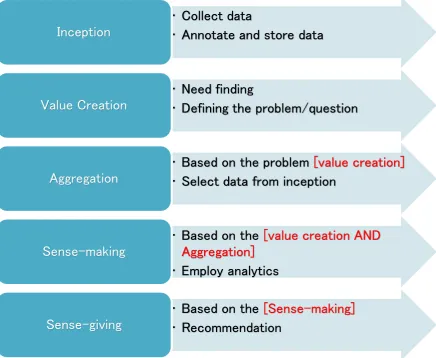
Figure 1: Analytics process to create and capture value from social media data
• Inception: The primary activities in this stage are collecting the data, followed by cleaning it (i.e. formatting with suitable annotations), then storing it in a structured-way for future use. The primary deliverable is not only a data repository but a report that can guide the next stage, where managers will identify the value of the stored data for purposeful use.
• Value Creation: This stage is essential to the outcome of the analytics and a component that has seldom been considered in the existing analytics frameworks. The main idea is for managers to use the inception report to understand what data is available from various social media sources and define the questions that they would like to pose to make the analysis focussed. The focussed analysis will aid in capturing value from the process and aid human-decision making.
•
Collect data
•
Annotate and store data
Inception
•
Need finding
•
Defining the problem/question
Value Creation
•
Based on the problem
[value creation]
•
Select data from inception
Aggregation
•
Based on the
[value creation AND
Aggregation]
•
Employ analytics
Sense-making
•
Based on the
[Sense-making]
•
Recommendation
6
• Aggregation: The relevant data from the inception stage will need to be integrated into a consistent format suitable for analysis (basic analytics and advanced analytics). The data selection will depend upon the problem (questions posed by the decision-makers), thus making the both the analysis and outcome focussed and purposeful (Govindan et al, 2018).
• Sense-making: The sense-making stage will employ algorithmic procedures depending upon the questions posed by the managers (in the value creation stage). This stage will include two deliverables: (1) a summarised snap-shot of the data which will help to gather suitable information from the data (which is likely to be voluminous and gathered from heterogeneous sources); (2) output of the analytics employed (such as predictive, prescriptive) using machine learning techniques (Fan and Gordon, 2014). The summary and output will help the managers to capture value from the data, i.e. gain suitable insights for the problem/question identified in the value creation stage, which in-turn will aid in formulating recommendations thus reducing the information and cognitive overload.
• Sense-giving: This final stage will present the information (summary and output of the analytics) in a visual form, which is intuitive and easy to understand using suitable pictorial representation (such as linked-graphs, trees, filters). The visual representation will help the mangers to have a high-level understanding of the output and offer further drill—down to understand the rationale behind the recommendations (for a recommender system), which ought to depend upon historical information (data bias), heuristics used in the analysed (factor weighing) and source as well as type of data (textual, numerical values, audio and videos). Overall, the proposed framework demonstrates the importance of value creation stage, which drives all the other stages in the analytics framework towards a focussed analysis. The outcome of the analysis will aid managers to understand the value of the data and have the potential to optimise business processes.
Organisation Needs
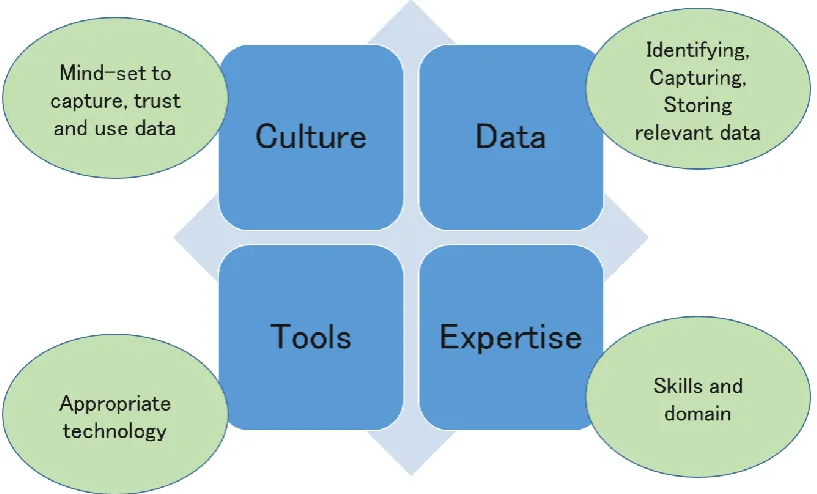
This section will discuss the key needs for an organisation to use the proposed framework for creating value and eventually capturing it through the analytics process. The key elements comprise of resources and activities that will aid organisations to build capabilities (such as technology, tools, skills) for successful deployment of the initiatives. The key elements (Figure 2) for consideration are as follows.
• Organisation culture: This represents the willingness and attitude of the business organisation (managers and team) to invest in contemporary initiatives (data-driven vale creation), appreciate the associated long-term and short-term risks, and evolve the process over time (i.e. remain agile to the advent of technology and novel data contribution platforms). The mindset of the organisation will determine the keenness to take risks, make changes and evolve to create and capture value using data-driven initiatives.
7
technical capabilities is pivotal for value creation and capture. It also requires managers to interpret and recognise the information presented in the sense-giving stage to make decisions.
• Identifying relevant data sources: This relates to identifying, capturing and storing real-time data obtained from social and physical sensors that will aid the organisation in creating value, which requires understanding of the data and business needs of the organisation. This element will require domain expertise (i.e. understanding the business needs to identify relevant sources) and knowledge about the analytics framework (not necessarily technical but conceptual).
• Relevant Tools: This represents the technological needs of the organisation to harvest relevant insights from the data, i.e. transform data into knowledge using suitable analytic tools, and infrastructure to support such techniques. It requires making decisions for purpose of the analytics to capture value, a strategy to identify and invest in the resources.
Figure 2: Needs of the organisation to employ the proposed analytics framework
Value creation process
8
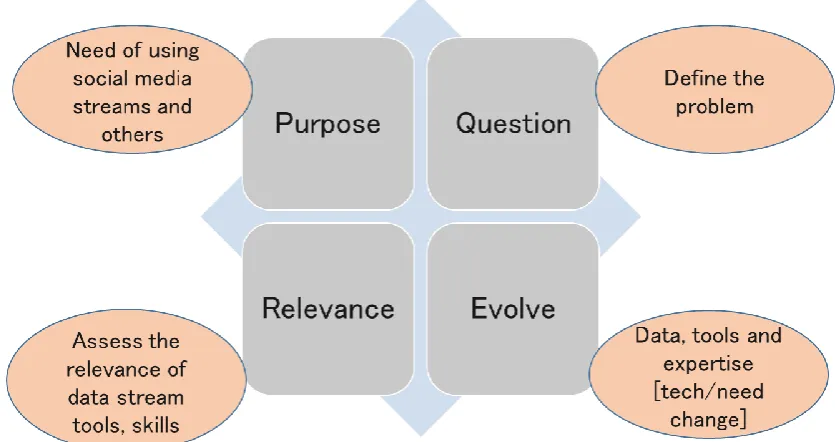
• Purpose: It is necessary for the organisations (key decision-makers) to use their domain knowledge, understanding of the business needs, and knowledge of the data sources to outline the purpose of the analytics, i.e. what is the question the automated process will aid in answering. This will streamline and eventually co-ordinate the business needs, data availability, analytics process and value creation (Sanders, 2016). The purpose will also determine which social media streams should be used depending on the nature of the query, quality and type of data available from the stream, and organisational trust in the data stream.
• Question: The question (i.e. definition of the problem) is a critical element to guide the aggregation and sense-making stages of the analytics framework (Shah et al., 2012). The relevance of the question should be critically assessed considering four key factors: (1) whether the question can be answered, or key insights can be gained by employing analytics; (2) whether the organisation has relevant access to the data streams that will aid in answering the question; (3) how answering the question/ gaining insights will add value to the business needs of the organisation; (4) whether the question is relevant to the contemporary needs of the organisation, i.e. relevance and alignment to business needs, objectives and existing strategy.
Figure 3: Key elements to consider in the value creation process
9
• Evolve: This is a critical consideration for the organisation to the evolving needs pertaining to technology turbulence and the supply-chain (at all levels – both upstream and downstream). The whole analytics process is evolutionary both in terms of value creation requirements and needs of the organisations. Organisations need to be agile to manage and respond to market movements and make changes dynamically, which will involve taking risks and strategically tackle the uncertainty. Therefore, organisations will be required to revisit their strategy and reflect on it, instead of sticking to a one-stop solution, which is unlikely to reap benefit over a period of time.
Conclusion
This paper demonstrates the need to include a value creation stage in the existing social media analytics framework, so that organisations can streamline the technological and business needs in a suitable manner, which will aid in reaping the benefits from social media data. In this context, organisation will need to adopt an agile strategy that will respond to changes in market as well as the technological turbulence in this digital era. The conceptual framework reported in this paper is yet to be validated in a practical business setting through a longitudinal study. In the future, we aim to conduct multiple case-studies with organisations (both small and large businesses) to validate the framework and identify the barriers stemming from the adoption of this framework. Nonetheless, the value-creation stage in social media framework is non-trivial because in a real-life business setting, organisations often delve into analytics (both social media and IoT data), without having substantial knowledge of the process and randomly searching for patterns in the hope of capturing some insights (which eventually becomes a barrier due to uncertainties stemming from an non-focussed analysis).
References
Chae, B. (2015). Insights from hashtag #supplychain and Twitter Analytics: Considering Twitter and Twitter data for supply chain practice and research. International Journal of Production Economics, 165, 247-259.
Correia Loureiro, S. M., Serra, J., & Guerreiro, J. (2019). How Fashion Brands Engage on Social Media: A Netnography Approach. Journal of Promotion Management, 1-12.
Fan, W. and Gordon, M.D. (2014). The power of social media analytics. Commun. Acm, 57(6), pp.74-81.
Ferdows, K., Lewis, M. A., & Machuca, J. A. D. (2004). Rapid-Fire Fulfillment, 104.
Ferdows, K., Machuca, J. A. D., & Lewis, M. (2015). Zara: The World's Largest Fashion Retailer. Feuer, A. (2012, November 9th). Occupy Sandy: A Movement Moves to Relief. New York Times. Retrieved from https://www.nytimes.com/2012/11/11/nyregion/where-fema-fell-short-occupy-sandy-was-there.html
Fondevila Gascón, J. F., Del Olmo Arriaga, J. L., & Bravo Nieto, V. (2012). Presencia y reputación digital en social media: comparativa en el sector de la moda. Fonseca: Journal of Communication, Iss 5, Pp 92-116 (2012)(5), 92.
Gamboa, A. M., & Gonçalves, H. M. (2014). Customer loyalty through social networks: Lessons from Zara on Facebook. Business Horizons, 57(6), 709-717.
Govindan, K., Cheng, T.C.E., Mishra, N. and Shukla, N. (2018). Big data analytics and application for logistics and supply chain management.
Hazen, B. T., Boone, C. A., Ezell, J. D., & Jones-Farmer, L. A. (2014). Data quality for data science, predictive analytics, and big data in supply chain management: An introduction to the problem and suggestions for research and applications. International Journal of Production Economics, 154, 72-80.
10
Holsapple, C.W., Hsiao, S.H. and Pakath, R. (2018). Business social media analytics: Characterization and conceptual framework. Decision Support Systems, 110, pp.32-45.
Hopkins, M. S., & Lavalle, S. (2010). 10 insights: a first look at the New Intelligent Enterprise survey. MIT Sloan Management Review(1), 22.
Islam, M. M., Vate, J. V., Heggestuen, J., Nordenson, A., & Dolan, K. (2013). Transforming in-kind giving in disaster response: A case for on-line donation registry with retailers. In (pp. 191): IEEE.
Kavner, L. (2012, 5 november). Occupy Sandy Emerges As Relief Organization For 21st Century,
Mastering Social Networks. The HuffPost. Retrieved from
https://www.huffingtonpost.co.uk/2012/11/05/occupy-sandy-relief-efforts_n_2079308.html?guccounter=1
Kirac, E., & Milburn, A. B. (2018). A general framework for assessing the value of social data for disaster response logistics planning. European Journal of Operational Research, 269(2), 486-500.
Lee, I. (2018). Social media analytics for enterprises: Typology, methods, and processes. Business Horizons, 61(2), pp.199-210.
Martínez, S., Errasti, A., & Rudberg, M. (2015). Adapting Zara’s ‘Pronto Moda’ to a value brand retailer. Production Planning & Control, 26(9), 723-737.
Occupy. (2012). Occupy Sandy's Wedding Registry Needs Your Support. Retrieved from http://occupywallst.org/article/occupy-sandy-wedding-registry/
Occupy. (2013). OS Income and expenditure. Retrieved from
https://docs.google.com/spreadsheets/d/1deBIKIJsuYCmtyONL0nHmG6PKiuAG4qSZeLFR4UASNY/p ub?single=true&gid=14&output=html&widget=true
Palen, L., Starbird, K., Vieweg, S., & Hughes, A. (2010). Twitter-based information distribution during the 2009 Red River Valley flood threat. Bulletin of the American Society for Information Science and Technology, 36(5), 13-17.
Panagiotopoulos, P., Barnett, J., Bigdeli, A. Z., & Sams, S. (2016). Social media in emergency management: Twitter as a tool for communicating risks to the public. Technological Forecasting and Social Change, 111, 86-96.
Sanders, N.R. (2016). How to use big data to drive your supply chain. California Management Review, 58(3), pp.26-48.
Shah, S., Horne, A. and Capellá, J. (2012). Good data won't guarantee good decisions. Harvard Business Review, 90(4).
Singh, A., Shukla, N., & Mishra, N. (2018). Social media data analytics to improve supply chain management in food industries. Transportation Research Part E: Logistics and Transportation Review, 114, 398-415.
Stieglitz, S., Mirbabaie, M., Ross, B. and Neuberger, C. (2018). Social media analytics–Challenges in topic discovery, data collection, and data preparation. International journal of information management, 39, pp.156-168.
Tobias, E. (2011). Using Twitter and other social media platforms to provide situational awareness during an incident. J Bus Contin Emer Plan, 5(3), 208-223.
Webpay. (2012). Occupy: Sandy Relief NYC. Retrieved from
https://www.wepay.com/donations/occupy-sandy-cleanup-volunteers
Yoo, E., Rand, W., Eftekhar, M., & Rabinovich, E. (2016). Evaluating information diffusion speed and its determinants in social media networks during humanitarian crises. Journal of Operations Management, 45, 123-133.