Structural Behavior of Durable Composite Sandwich Panels with
High Performance Expanded Polystyrene Concrete
Ji-Hyung Lee
1), Sung-Hoon Kang
1,2), Yu-Jin Ha
1), and Sung-Gul Hong
1),*
(Received September 25, 2017, Accepted February 6, 2018)
Abstract: Sandwich panels comprising prefabricated ultra-high performance concrete (UHPC) composites can be used as eco-friendly and multi-functional structural elements. To improve the structural and thermal performance of composite sandwich panels, combinations of UHPC and expanded polystyrene (EPS) beads were investigated. High-performance expanded polystyrene concrete (HPEPC) was tested with various EPS bulk ratios to determine the suitability of the mechanical properties for use as a high-strength lightweight aggregate concrete. As a core material in composite sandwich panels, the mechanical properties of HPEPC were compared with those of EPS mortar. The compressive strength of HPEPC is approximately eight times greater than that of EPS mortar, and the thermal conductivity of approximately a quarter that of EPS mortar. The structural behavior of composite sandwich panels was empirically analyzed using different combinations of cores, face sheets, and adhesive materials. In the flatwise and edgewise compression tests, sandwich panels with HPEPC cores had high peak strengths, irrespective of the type of face sheets, as opposed to the specimens with EPS mortar cores. In the four-point bending tests, the sandwich panels with HPEPC cores, or reinforced UHPC face sheets combined with adhesive mortar, exhibited higher peak strengths than the other specimens, and failed in a stable manner, without delamination.
Keywords:sandwich panel, structural lightweight aggregate concrete, high performance expanded polystyrene concrete (HPEPC), compression test, four-point bending test.
1. Introduction
Lightweight concrete can be applied in a number of ways, such as a reduction in self-weight of structures with smaller cross sections. The lightweight concrete developed could be a suitable material for high-rise buildings, with a number of advantages: cost saving due to extra insulation not being required, more flexibility for architects and structural engi-neers when designing buildings, sustainability due to rela-tively easy maintenance, and easier recycling (Yu et al. 2015).
One of the typical applications is as a core material in a composite sandwich structure. Sandwich structures can comprise various types of cores and skin materials to create an optimal design for a specific performance target. Com-posite sandwich structures are used widely in weight-sensi-tive structures where high flexural rigidity is required, because of the high-specific strength, stiffness, light weight,
high thermal insulation, and the capability to be formed into complex geometries (El Demerdash 2013). Typical com-posite sandwich panels comprise a relatively thin, stiff, and strong skin plate with a relatively thick and light core. To improve the structural performance of standard composite sandwich panels, numerous strengthening methods have been proposed and studied. One was the change of core materials or configurations to strengthen the elements. The contribution of core materials with high flexural strength and shear stiffness is significant.
Expanded polystyrene (EPS) was first used as an aggre-gate for concrete in 1957. It is the most well-known core material because of its low density and high thermal insu-lation capacity. As opposed to the limited resources of lightweight mineral aggregates, EPS aggregates are com-mercially available worldwide. Therefore, EPS concrete can be considered as an alternative lightweight aggregate con-crete (Short and Kinniburgh 1978; Babu and Babu 2003; Sadrmomtazi et al.2011). The composite sandwich panels evaluated in this study are constructed with an EPS concrete core, with face sheets on either side of the panel, as shown in Fig.1. Precast concrete sandwich panels are composed of two concrete wythes separated by a layer of rigid foam plastic insulation, typically (PCI Sandwich Wall Committee 1997). Compared with the typical sandwich panels, EPS concrete core in the EPS concrete sandwich panels can provide the dual function of transferring load and insulating structure in a single element, and enveloped face sheet acts
1)Department of Architecture and Architectural Engineering, Seoul National University, 1 Gwanak-ro, Gwanak-gu, Seoul 08826, Korea.
2)
Department of Civil and Environmental Engineering, National University of Singapore, 1 Engineering Drive 2, Singapore 117576, Singapore.
*Corresponding Author; E-mail: [email protected] CopyrightÓThe Author(s) 2018. This article is an open access publication
International Journal of Concrete Structures and Materials DOI 10.1186/s40069-018-0255-6
as a strengthening reinforcement of EPS concrete core. However, the compressive strength of EPS concrete is generally less than 10 MPa (Ravindrarajah and Tuck1994; Miled et al.2004; Babu et al.2006), which makes it difficult to use as a structural construction material. Additionally, mixture segregation of EPS beads and mortar during the manufacturing process easily leads to a deterioration in quality, and a degradation in durability.
In this study, high performance expanded polystyrene concrete (HPEPC) is proposed in place of EPS concrete. It was found that the rate of strength development of concrete increased with an increasing percentage of silica fume (Babu and Babu 2003; Sadrmomtazi et al. 2011). Therefore, the combination of EPS beads and ultra-high-performance concrete (UHPC) matrix is expected to be stronger than EPS concrete. An optimized core material and composite sand-wich system was proposed to produce an eco-friendly, lightweight system with highly resistant mechanical prop-erties and good thermal insulation. To investigate the mechanical properties of HPEPC, the compressive strength, flexural strength, modulus of elasticity, and Poisson’s ratio were measured, with varying percentages of EPS beads, to evaluate different densities. After determining the optimum mixture composition of HPEPC as a high-strength light-weight concrete, the mechanical and thermal properties of possible components in composite sandwich panels were investigated. Compressive and flexural behavior tests of the various composite sandwich panels, using developed light-weight concrete, were conducted to investigate the potential for applications as walls, slabs, and other components in high-rise buildings.
2. Development of High Performance
Expanded Polystyrene Concrete (HPEPC)
2.1 Experimental Program for HPEPC
EPS concrete is a lightweight, low-strength material with good energy-absorbing characteristics. However, due to the light weight of EPS beads, and their hydrophobic surfaces, EPS concrete is prone to segregation during casting, result-ing in poor workability and lower strength. Fine silica fume greatly improved the bond between the EPS beads and cement paste, and increased the compressive strength of EPS concrete (Cook 1972; Chen and Liu 2004). Fine silica powder is one of the main binders of UHPC, therefore the combination of UHPC and EPS aggregates is expected to perform better than normal concrete without silica fume.
Density is known to be an important parameter deter-mining numerous physical properties of EPS concrete, and it is determined primarily by the volume fraction of poly-styrene aggregates. The strength of EPS concrete increased with increasing concrete density and decreasing EPS volume fractions (Chen and Fang 2011). The thermal resistance of EPS concrete can also increase with an increase of EPS volume fractions, due to the decreased density (Schackow et al.2014; Real et al.2016). To evaluate optimized HPEPC as a core element in a sandwich panel, the mechanical properties of HPEPC, according to the replacement ratio of UHPC and EPS in a unit volume, were investigated. The tested range of the EPS volume fraction in this study ranged from 30 to 70%. The mix composition of UHPC and the material properties of EPS, used in this study, are presented in Tables1and 2, respectively.
The design compressive strength of the given mix com-position of UHPC is 180 MPa (Richard and Cheyrezy1995; Wille et al.2011; KCI2012). The Portland cement was Type I, as designated by ASTM C150. The silica fume used was made in Norway, and had a particle size distribution of 45–800lm. Typically the silica fume/cement ratio used for UHPC is 0.25 considering the optimum filling performance, enhancement of the lubrication effect, and the complete consumption of total hydration of the cement (Richard and Cheyrezy 1995). Filler, sized between cement and silica fume sizes, improves the compressive strength of concrete by increasing the poured density. A mean particle size of the filler in Table1 is 2.2lm and the filler, as an Australian product, composed ([99%) of SiO2components was used.
to be lighter and more thermally resistant, but the com-pressive strength is expected to decrease.
2.2 Test Results
The compressive strength tests were carried out in accor-dance with ASTM C109. On the seventh day, the strength of the cubic specimens (50950950 mm3) was measured using a universal testing machine. The specimens were subjected to displacement at a loading rate of 1 mm/min. The unit weight of the HPEPC was measured according to standard KS F 2462, that contains a method for determining the unit mass of structural lightweight concrete.
To determine the modulus of elasticity and Poisson’s ratio, cylindrical concrete specimens, 100 mm in diameter and 200 mm high, were tested according to ASTM C469 (2014). A compressometer was used to measure the modulus of elasticity. The mean strain was measured by two strain gauges, opposite each other halfway up the specimen, par-allel to the vertical axis. The specimens were tested, and maintained within the defined curing state, within 1 h after removal from the mold. The transverse strain was deter-mined by an unbonded extensometer, with an accuracy of 0.5lm, that measured changes in diameter at the mid-height of the specimen. A combined compressometer and exten-someter was used to obtain Poisson’s ratio.
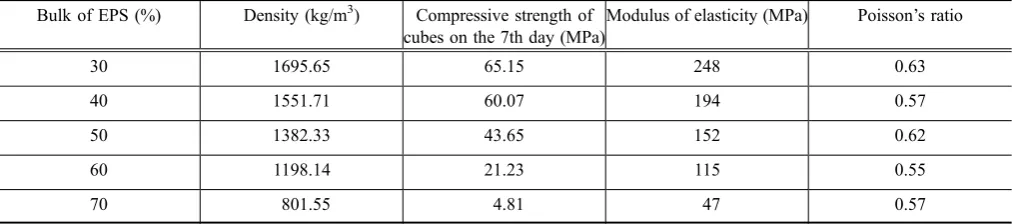
The test results are summarized in Table3. The com-pressive strength and density of UHPC measured on the 7th
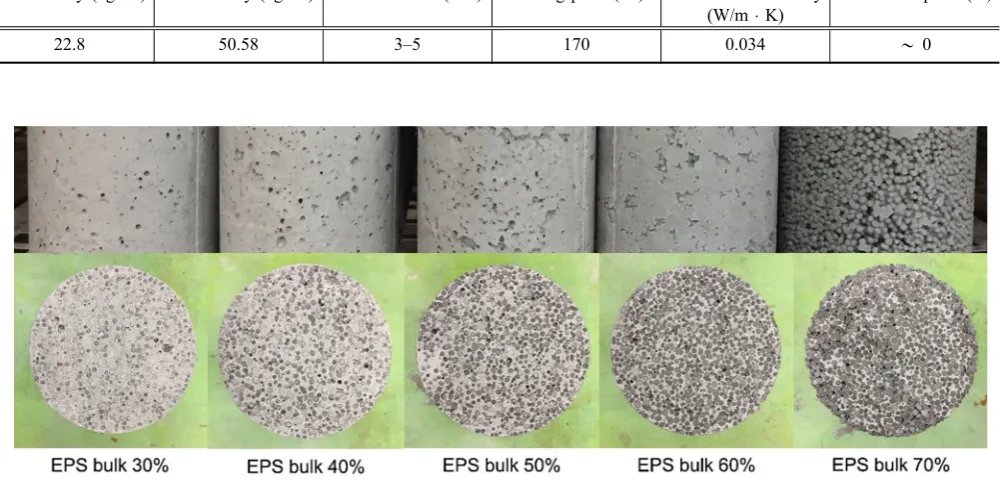
day were 196.83 MPa and 2311.07 kg/m3, respectively, for the same curing conditions as the other specimens. The density and compressive strength of HPEPC decreased with increasing EPS bulk ratios. The density of HPEPC decreased almost linearly with increase EPS bulk ratio till 60%, but the density of HPEPC with EPS bulk 70% decreased steeply. The massive pores in the specimens with EPS bulk 70% in Fig.2 supports these test results. The compressive strength of HPEPC decreases at a rate greater than the rate of increase of the EPS bulk ratio. Figure3a shows the normalized compressive strength and density, by material properties, of UHPC that contained no EPS. The modulus of elasticity shows tendencies similar to the compressive strength, but the Poisson’s ratio decreases negligibly compared to the other properties. Figure3b shows all the test results, except for the average values, that indicate that the standard variation of Poisson’s ratio increases with an increase in the EPS bulk ratio, despite the relatively constant average value, 0.6.
From the test results, HPEPC with a 40% EPS bulk ratio was chosen as a core material for the composite sandwich panels, taking into consideration the decreased rate of compressive strength, modulus of elasticity, and density as a function of the EPS bulk ratio.
This can be regarded as a high strength lightweight con-crete. According to fib Model Code 2010, it is recommended that lightweight aggregate concrete for structural applica-tions have a density in the range 800–2000 kg/m3, and high Fig. 2 Side and section views of HPEPC cylindrical specimens with different EPS bulk ratios.
Table 1 Mix composition of UHPC (without steel fiber).
Cement Silica fume Sand Filler Superplasticizer Water
1 0.25 1.1 0.35 0.025–0.04 0.185–0.225
Table 2 Material properties of EPS beads.
Bulk density (kg/m3) True density (kg/m3) Bead diameter (mm) Melting point (°C) Thermal conductivity
(W/mK)
Water absorption (%)
strength concrete is typically accepted to have a character-istic compressive strength greater than 50 MPa (Fib2012).
3. Experimental Investigation of Component
Materials in Composite Sandwich Panels
3.1 Test Program for Composite Sandwich Panels
As can be seen in Fig.1, composite sandwich panels comprise a prefabricated core and a prefabricated face sheet, with glue between them. To investigate the optimized composite sandwich panels using HPEPC cores, three types of face sheet materials, ultra-high-performance fiber-forced concrete (UHPFRC), UHPC with a glass fiber rein-forced polymer (GFRP) mesh, and GFRP were tested with both adhesive mortar and epoxy bond as a glue. Specimens with EPS mortar cores were also tested, for comparison with the specimens with HPEPC cores. EPS mortar in this study is distinguished by EPS concrete by no silica fume, no coarse aggregates. EPS mortar was composed by ready mixed cement mortar and EPS beads. The mechanical properties of EPS mortar was targeted for structural appli-cations. The test program is presented in Table4. The first letter of the specimen ID is the core material, and the second letter the face sheet material.
The test set-ups and dimensions of the specimens are shown in Fig.4. The thickness of the core and face plate are 55 and 5 mm, respectively, and the specimens are 65 mm thick. Results of flatwise compression tests can be used for the applications of the support zones under concentrated loads. To compare core compressive behavior only, speci-mens with two different cores, with GFRP face sheets, were tested. For applications of load bearing walls and slabs in high-rise buildings, specimens bonded by adhesive mortar were tested for edgewise compressive loading, as well as for flatwise flexural loading (Manalo et al. 2010). In addition, specimens with different face sheets, with their HPEPC cores bonded by epoxy, were tested to investigate delami-nation between cores and face sheets. Flexural behavior testing was planned for all composite sandwich panels, but the face sheet of the M-U2 specimen detached before the test was conducted, and the flexural test results of that specimen are not recorded.
3.2 Mechanical and Thermal Properties of Component Materials
3.2.1 Mechanical Properties of Component Materials
Mechanical properties of component materials, except for UHPC reinforced by GFRP mesh, are presented in Table5. The compressive strength of EPS mortar was measured on Fig. 3 Test results of HPEPC specimens depending on EPS bulk ratio;anormalized compressive strength and normalized density
andbmodulus of elasticity and Poisson’s ratio.
Table 3 Mechanical properties of HPEPC with different EPS bulk ratios.
Bulk of EPS (%) Density (kg/m3) Compressive strength of
cubes on the 7th day (MPa)
Modulus of elasticity (MPa) Poisson’s ratio
30 1695.65 65.15 248 0.63
40 1551.71 60.07 194 0.57
50 1382.33 43.65 152 0.62
60 1198.14 21.23 115 0.55
the twenty-eighth day after pouring. The mechanical prop-erties of HPEPC were written on the seventh day according to Table3. The compressive strength after the 90°C heat treatment for 48 h can be regarded as a result of fully hydration reaction (Fehling et al.2014), and the compressive strength after the heat treatment tends to maintain their strength regardless additional curing duration (Kang et al. 2017). For the same density and 40% EPS bulk ratio, the compressive strength of HPEPC was approximately eight times higher than that of EPS mortar. The compressive strength of UHPFRC, with a 2% steel fiber volume fraction, was greater than 190 MPa, for the same UHPC mix com-position and curing conditions as the HPEPC. The mix compositions are presented in Table1, and the most
commonly used steel fiber, with a diameter of 0.2 mm, 13 mm long, and 250 MPa tensile strength was used.
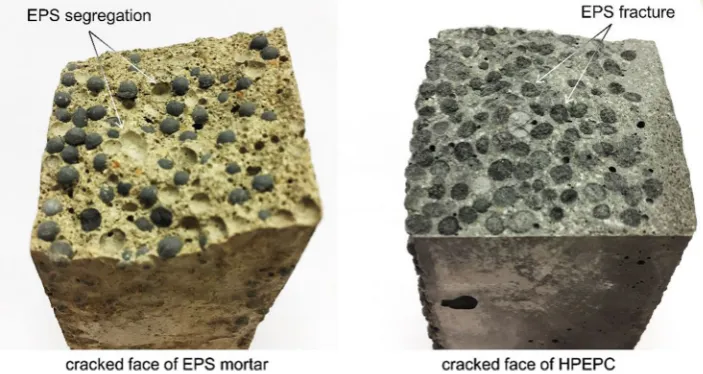
Three-point bending tests were conducted on the beam specimens to determine their flexural strength (160940940 mm3). Figure5shows the EPS mortar and HPEPC flexural test results. The crack face of the EPS mortar specimen shows that EPS beads had segregated from the mortar, which meant that cracks had generated along the EPS beads. On the other hand, the crack face of the HPEPC specimen shows that EPS beads were fractured, and that cracks had gone through the EPS beads. These crack faces are similar to typical crack faces of normal strength concrete and high strength concrete with coarse aggregates, respec-tively (Mohamed and Richard1999). The flexural strength Fig. 4 Test set-ups foraflatwise compression test,bedgewise compression test, andcfour-point bending test.
Table 5 Mechanical properties of component materials.
Target layer Component material Compressive strength
(MPa)
Density (kg/m3) Flexural strength (MPa)
Core EPS mortar 7.67 1485.51 3.05
HPEPC 60.07 1551.71 10.01
Face sheet UHPFRC 193.39 2476.03 32.07
Table 4 Overview of test program for composite sandwich panels.
Specimen ID Core material Face sheet material Adhesive material Compression test Four-point bending
test
Flatwise Edgewise
M-U1 EPS mortar UHPFRC Adhesive mortar – O O
M-U2 UHPC with GFPR
mesh
– O –
M-G GFRP plate O O O
U-U1 HPEPC UHPFRC – O O
U-U2 UHPC with GFPR
mesh
– O O
U-G GFRP plate O O O
U-U1-E UHPFRC Epoxy bond – – O
of UHPFRC is greater than 32 MPa, with considerable tensile strain, and the post-peak behavior shows outstanding ductility.
In addition to the tested components in Table5, UHPC with GFRP mesh and GFRP plates were applied as face sheets on composite sandwich panels (Fig.6). Fabric-type GFRP, as a GFRP mesh, was used to maximize the tensile strength by ensuring the smoothness of the shell and the convenience of installation (Fam and Sharaf2010; Correia et al. 2012). The mesh was affixed to the form prior to pouring, to ensure adhesion to the concrete. UHPC rein-forced by GFRP mesh was expected to be lighter and more ductile than UHPFRC (Shams et al.2014). The GFRP plates used in this study were manufactured from three different types of mats, laminated, and embedded in a polyester resin matrix: surface mats of 30 g/m2, chopped mats of 380 g/m2, and roving cloth mats of 570 g/m2. The face sheets were produced using a hand lay-up technique. Adhesive mortar and epoxy bond were used as adhesive materials. The adhesive strength of both materials, from technical data, is approximately 2.0–2.1 N/mm2after 28 days.
3.2.2 Thermal Properties of Component Materials The thermal properties focused on were thermal conduc-tivity (k), thermal resistance (R), and thermal transmittance (U). These term are defined in ASTM C168 (2017): thermal conductivity is the rate of steady state heat flow through a unit area of a material induced by a unit temperature gradient in a direction perpendicular to the unit area; thermal resis-tance is the quantity determined by the temperature differ-ence, at steady state, between two defined surfaces of a material that induces a unit heat flow through a unit area; and thermal transmittance is the heat transmission in unit time through a unit area of a material and the boundary air films, induced by unit temperature differences between the envi-ronments on each side. Thermal conductivity and resistance are indices of heat flow from surface to surface, but thermal transmittance is an index from environment to environment; therefore, the environmental temperatures of both sides must be well defined. Lower thermal conductivity, lower thermal transmittance, and higher thermal resistance ensure efficient thermal insulation performance of a sandwich panel.
The specimens were prepared in accordance with ISO 9869-1 (2014). All components used for the structural tests Fig. 5 Comparison of cracked face in EPS mortar and HPEPC specimens.
were made of panels sized 3009300920 mm3. Mea-surement periods were at least 72 h on the outside of the specimens, to comply with the ISO 9869 norm. For mea-surements where the inside structure varied, the measure-ment time was extended, considering the importance of constant conditions according to the ISO norm. The test results are presented in Table6.
The thermal conductivity of concrete depends primarily on its density and water content, and tends to increase with increasing density and water content (Holm and Bremner 2000). According to Holm and Bremner (2000), the thermal conductivity of structural lightweight aggregate concrete, with an average density of approximately 1850 kg/m3, typ-ically ranges from 0.58 to 0.86 W/(mK). In normal-weight concrete of approximately 2400 kg/m3density, the thermal conductivity can vary from 1.4 to 2.9 W/(mK). A typical thermal conductivity value for concrete with quartzite aggregate is 3.5 W/(mK) (Metha and Monteiro2006). The thermal conductivity of EPS concrete, with an EPS bulk ratio of 55–60%, was 0.50–0.56 W/(mK) at a density of approximately 1100 kg/m3 (Schackow et al. 2014). When comparing the typical values of lightweight concrete and EPS concrete, the thermal properties of EPS mortar in this study were found to be lower than anticipated. However, the HPEPC specimens exhibited outstanding thermal insulation performance. The U- and k-values of HPEPC are approxi-mately 3.34 times lower than those of EPS mortar, despite the similar density of the two specimens. For face sheet components, UHPC reinforced by GFRP mesh has a 1.43 times higher U-value, and lower R-value, than those of UHPFRC. It can be concluded that HPEPC exhibits better thermal resistance than typical structural lightweight con-crete, and the thermal resistance of UHPFRC is greater than that of normal concrete of similar density.
4. Structural Behavior of Composite
Sandwich Panels
4.1 Compressive Behavior of Flatwise and Edgewise Composite Sandwich Panels
The flatwise compression tests were conducted in accor-dance with ASTM C365 (2016). Compressive strength tests were performed on three sandwich specimens, 1009100965 mm3, for the EPS mortar core and the HPEPC core. The load was applied with a universal test
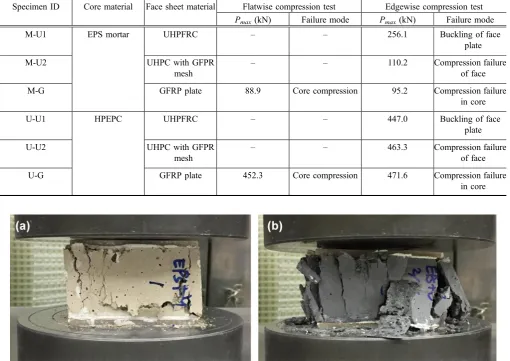
machine, with a 2000 kN capacity. The ultimate flatwise compressive strengths, based on the averaged test results, are 8.89 MPa for the M-G specimen, and 45.23 MPa for the U-G specimen (Table7). The failure modes of both speci-mens are core compression failure, as shown in Fig.7. When comparing the material properties of the core materials in Table5, the ultimate compressive strength of the M-G specimen is greater than the compressive strength of EPS mortar, but the ultimate compressive strength of the U-G specimen is significantly lower than that of the HPEPC specimen. The material compressive strength of HPEPC is approximately eight times greater than that of EPS mortar, but the flatwise compressive strength of the U-G specimen is approximately five times greater than that of the M-G specimen. This phenomenon might be interpreted by size effect and high strength effect. The compressive strength of EPS concrete decreases significantly with an increase in EPS bead size for the same concrete porosity (Miled et al. 2004, 2007; Le Roy et al. 2005; Babu et al. 2006) It is observed that the EPS beads size effect is very pronounced for low porosity concretes. In addition, for 6.3 mm EPS beads concrete, unlike 2.5 mm beads EPS concrete, the compressive strength can be affected by specimen size (Miled et al. 2007). HPEPC has much less porosity than general EPS concrete and the EPS bead size applied in this study was 3–5 mm, which can lead to the specimen size effect.
Edgewise compression tests determine the compressive properties of structural sandwich construction in a direction parallel to the sandwich facing plane. The tests, to evaluate the in-plane compressive behavior of the sandwich panels made of both core materials, were carried out in accordance with ASTM C364 on specimens with nominal dimensions of 2509250965 mm3. The loaded surfaces (2509 65 mm2) were levelled to avoid any non-uniform or trans-verse loading. The load was applied with the same testing machine used in the tests described above. The test results in Table7 show that the maximum strength of the specimens with EPS mortar core depends on the type of face sheets, but the maximum strengths of the specimens with HPEPC cores are greater, irrespective of the type of face sheets.
Failure mode is important in edgewise compression test results, and commonly observed failure modes of composite sandwich panels can be categorized as face sheet failure, comprising buckling or compression failure, or core failure, comprising compression or shear failure (ASTM C364 Table 6 Thermal properties of component materials.
Target layer Component material Density (kg/m3) k(W/(mK)) U(W/(m2K)) R(m2K/W)
Core EPS mortar 1384.07 1.649 32.987 0.030
HPEPC 1382.33 0.493 9.864 0.101
Face sheet UHPFRC 2311.07 0.837 16.743 0.060
UHPC with GFRP mesh
Fig. 7 Flatwise compression test results;aM-G specimen andbU-G specimen.
Fig. 8 Edgewise compression test results for the specimens with HPEPC core;aU-U1 specimen,bU-U2 specimen, andcU-G specimen.
Table 7 Flatwise and edgewise compression test results for composite sandwich panels.
Specimen ID Core material Face sheet material Flatwise compression test Edgewise compression test
Pmax(kN) Failure mode Pmax(kN) Failure mode
M-U1 EPS mortar UHPFRC – – 256.1 Buckling of face
plate
M-U2 UHPC with GFPR
mesh
– – 110.2 Compression failure
of face
M-G GFRP plate 88.9 Core compression 95.2 Compression failure
in core
U-U1 HPEPC UHPFRC – – 447.0 Buckling of face
plate
U-U2 UHPC with GFPR
mesh
– – 463.3 Compression failure
of face
U-G GFRP plate 452.3 Core compression 471.6 Compression failure
2016). In this study, it was observed that the specimens sheeted by GFRP plate experienced core failure, and the other specimens face sheet failure. In all specimens, initial cracking was observed in the core, and the M-G and U-G specimens suffered core failure, with severe delamination between the face sheets and cores. The other specimens behaved differently after core cracking, depending on the types of face sheets. The specimens sheeted with UHPFRC resisted additional compressive loading with less stiffness, but failed with face sheet buckling. The specimens sheeted by UHPC with GFRP mesh did not resist additional com-pressive loading, but ductile behavior was observed with constant compressive loading. The failure modes of the specimens with HPEPC cores, as shown in Fig.8, depend on the face sheets. The U-U1 specimen failed by UHPFRC buckling in a brittle way, and the U-U2 specimen failed by compressive failure in the face sheet. Shear failure in the HPEPC core was observed in U-G specimen.
4.2 Flexural Behavior During Four-Point Bending Tests on Composite Sandwich Panels
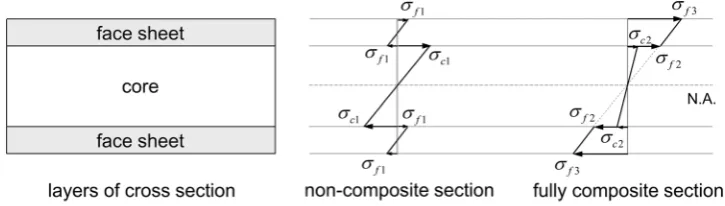
Flexural tests were conducted in a four-point bending configuration. The bond capacity between the face sheet and core plays an important role in the flexural capacity of a sandwich panel. The separation of the facing from the core in the adhesive bond zone is one of the most frequent failure modes for sandwich panels with concrete facings (Shams et al. 2014). Using externally bonded reinforcement as shown in Fig.1a, the bond between the adhesive and the concrete often fails once the tensile strength of the concrete has been exceeded. Following the local debonding of externally bonded reinforcement and the concrete, the results mostly induces a total failure of the bond between the externally bonded reinforcement (Zilch et al. 2014). The representative stress distribution depending on the bond capacity between the face sheet and core can be explained by non-composite section and fully composite section in Fig.9. For a non-composite sandwich panel, the three concrete wythes act independently, so that the distribution of loads is based on the relative flexural stiffness of each wythes. For a fully composite panel, the entire panel acts as a single unit in bending and the flexural design of fully composite panels can be considered as I-shaped section applying transformed section method (PCI Sandwich Wall Committee 1997). There are numerous techniques, for instance the shear con-nection between the outer face sheets, for ensuring linear
composite behavior in the cross sections (Benayoune et al. 2008; Shams et al. 2014). To consider the importance of bond behavior between prefabricated concrete, epoxy bond as an adhesive material was also tested for the U-U1 and U-G specimens.
Table 8 and Fig.10 shows the failure modes of the specimens. The flexural capacity of the specimens with EPS mortar cores, and the specimens with epoxy bonds, was significantly less than the flexural capacity of the specimens with HPEPC cores. The peak loads of the specimens with epoxy bonds was 0.3–0.6 times the peak loads of the specimens with the same components, but with different adhesive materials. Therefore, it can be concluded that the epoxy bond is not appropriate as an adhesive material in prefabricated concrete panels. Whether delam-ination was observed before the peak load is also indicated in Table8, as delamination induces not only a decrease in the flexural capacity, but also occasional brittle structural behavior. Both specimens sheeted with GFRP plate, and the specimens with epoxy bonding, were clearly delaminated before the peak load, as shown in Fig.10. For the speci-mens with a delamination, core cracking tends to govern the overall flexural capacity, which means that the maxi-mum stresses in the EPS core determines the peak load without externally bonded reinforcement’s role as shown a non-composite section in a Fig.9. On the other hand, the delamination in U-U2 specimen was observed after the peak load in a partial region, which induces ductile behavior till a total failure.
UHPFRC face resisted after the peak load, without delami-nation. The post-peak behavior of the U-U2 specimen is outstanding, ensuring conservative flexural loading, and the specimen failed by the yielding of the GFRP mesh in the face sheet.
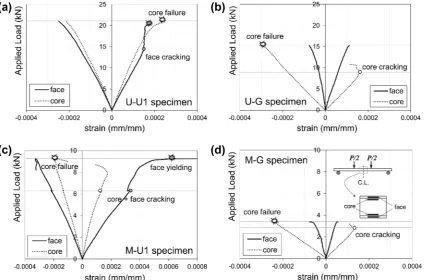
Measured strain values in Fig.12demonstrate the flexural behavior in detail. The specimens reinforced by UHPFRC
face sheets shows partially composite flexural behavior. For for U-U1 specimen and M-U1 specimen, the initial crack was observed in a core and face at the same time and the final failure was related to the face yielding or bending. On the other hand, the specimens reinforced by GFPR plates shows non-composite flexural behavior. The face sheets in U-G specimen and M-G specimen hardly resist flexural Fig. 10 Flexural test results of composite sandwich panels.
Fig. 11 Force–displacement relationship of flexural tests for composite sandwich panels;acomparison of test results for the specimens with UHPFRC plate andbcomparison of test results for the specimens with HPEPC core.
Table 8 Four-point bending test results for composite sandwich panels.
Specimen ID Core material Face sheet material Adhesive material Pmax(kN) Failure mode Delamination
M-U1 EPS mortar UHPFRC Adhesive mortar 9.3 Face plate yielding –
M-G GFRP plate 3.4 Core cracking Observed
U-U1 HPEPC UHPFRC 21.1 Core cracking with
plate bending
–
U-U2 UHPC with GFPR
mesh
14.5 Face plate yielding Partially observed
U-G GFRP plate 15.3 Core cracking Observed
U-U1-E UHPFRC Epoxy bond 6.2 Core cracking with
plate bending
Observed
loads, so that the initial crack was caused by tensile stress at the bottom of the core and the compressive stress in the top of the core induces the final failure. The provision in ACI 318-11 requires that reinforced flexural members need at least 1.2 times additional load beyond cracking to reach its flexural strength to prevent abrupt flexural failure developing immediately after cracking (ACI Committee 318 2011). U-U1 specimen and M-U1 specimen satisfy the statement, and U-G specimen also satisfies that in spite of almost single resistant behavior of HPEPC core.
5. Summary and Conclusions
To investigate the mechanical properties of HPEPC, the compressive strength, flexural strength, modulus of elastic-ity, and Poisson’s ratio were measured for various densities obtained by altering the amount of EPS beads. It was found that HPEPC with 40% EPS bulk ratio was suitable for high strength lightweight concrete. HPEPC exhibits better mechanical and thermal resistance than typical structural lightweight concrete. The HPEPC had compressive strength and thermal conductivity 8 and 0.25 times, respectively, those of EPS mortar. The lightweight and thermal insulation characteristics is suitable for HPEPC to be applied as core material in sandwich panels. To qualify the structural behavior in composite sandwich panel, flatwise and edge-wise compression tests, and four-point bending tests, were conducted on various composite sandwich panels. The HPEPC and EPS mortar were considered as core materials in
composite sandwich panels, and specimens sheeted by three types of faces, UHPFRC plate, UHPC plate reinforced by GFRP textile mesh, and GFRP plate were tested for each core material. The structural test results indicated that the sandwich panel with an HPEPC core and UHPFRC face sheet can be used for high-strength lightweight elements, and the sandwich panel with EPS mortar and UHPFRC face sheet can be used as structural lightweight concrete.
Acknowledgements
This research was supported by a Grant (13SCIPA02) from Smart Civil Infrastructure Research Program funded by Ministry of Land, Infrastructure and Transport (MOLIT) of Korean Government and Korea Agency for Infrastructure Technology Advancement (KAIA).
Open Access
This article is distributed under the terms of the Creative Commons Attribution 4.0 International License (http:// creativecommons.org/licenses/by/4.0/), which permits un restricted use, distribution, and reproduction in any medium, provided you give appropriate credit to the original author(s) and the source, provide a link to the Creative Commons license, and indicate if changes were made.
References
ACI Committee 318. (2011). Building code requirements for structural concrete (ACI 318 M-11) and commentary. USA: American Concrete Institute.
ASTM C168. (2017).Standard terminology relating to thermal insulation. West Conshohocken: American Society for Testing and Materials.
ASTM C364. (2016).Standard test method for edgewise com-pressive strength of sandwich constructions. West Con-shohocken: American Society for Testing and Materials. ASTM C365. (2016). Standard test method for flatwise
com-pressive properties of sandwich cores. West Con-shohocken: American Society for Testing and Materials. ASTM C469, C469M. (2014).Standard test method for static
modulus of elasticity and poisson’s ratio of concrete in compression. West Conshohocken: American Society for Testing and Materials.
Babu, K. G., & Babu, D. S. (2003). Behaviour of lightweight expanded polystyrene concrete containing silica fume. Cement and Concrete Research, 33,755–762.
Babu, D. S., Babu, K. G., & Tiong-Huan, W. (2006). Effect of polystyrene aggregate size on strength and moisture migration characteristics of lightweight concrete.Cement & Concrete Composites, 28(6), 520–527.
Benayoune, A., Abdul Samad, A. A., Trikha, D. N., Abang Ali, A. A., & Ellinna, S. H. M. (2008). Flexural behaviour of pre-cast concrete sandwich composite panel—Experimen-tal and theoretical investigations. Construction and Build-ing Materials, 22, 580–592.
Chen, B., & Fang, C. (2011). Mechanical properties of EPS lightweight concrete. Construction Materials, 164(4), 173–180.
Chen, B., & Liu, J. (2004). Properties of lightweight expanded polystyrene concrete reinforced with steel fiber. Cement and Concrete Research, 34,1259–1263.
Cook, D. J. (1972).Expanded polystyrene beads as lightweight aggregate for concrete. Sydney: University of New South Wales.
Correia, J. R., Garrido, M., Gonilha, J. A., Branco, F. A., & Reis, L. G. (2012). GFRP sandwich panels with PU foam and PP honeycomb cores for civil engineering structural applications. International Journal of Structural Integrity, 3(2), 127–147.
El Demerdash, I. M. (2013). Structural evaluation of sustain-able orthotropic three dimensional sandwich panel system. Irvine: University of California.
Fam, A., & Sharaf, T. (2010). Flexural performance of sandwich panels comprising polyurethane core and GFRP skins and ribs of various configurations. Composite Structures, 92, 2927–2935.
Fehling, E., Schmidt, M., Walraven, J., Leutbecher, T., & Frohlich, S. (2014). Ultra-high performance concrete UHPC: Fundamentals—Design—Examples. Germany: Ernst and Sohn.
Fib. (2012). Fib model code for concrete structures. Berlin: International Federation for Structural Concrete, Ernst & Sohn.
Holm, T. A., & Bremner, T. W. (2000).State-of-art report on high-strength, high-durability structural low-density con-crete for applications in severe marine environments. Washington, DC: Engineer Research and Development Center, U.S. Army Corps of Engineers.
ISO 9869-1. (2014). Thermal insulation: building elements. In situ measurement of thermal resistance and thermal transmittance. Part 1, Heat flow meter method. Geneva: International Organization for Standardization.
Kang, S., Lee, J., Hong, S., & Moon, J. (2017). Microstructural investigation of heat-treated ultra-high performance con-crete for optimum production. Materials (Basel), 10(9), 1106.
KCI. (2012). Design guidelines for ultra high performance concrete K-UHPC structure. Seoul: Korea Concrete Institute.
Le Roy, R., Parant, E., & Boulay, C. (2005). Taking into account the inclusion’s size in lightweight concrete com-pressive strength prediction. Cement and Concrete Research, 35(4), 770–775.
Manalo, A. C., Aracinthan, T., Karunasena, W., & Islam, M. M. (2010). Flexural behaviour of structural fibre composite sandwich beams in flatwise and edgewise positions. Com-posite Structures, 92,984–995.
Metha, K. P., & Monteiro, P. J. M. (2006). Concrete microstructure, properties and materials (3rd ed.). New York: University of California at Berkeley, McGraw-Hill. Miled, K., Roy, R. L., Sab, K., & Boulay, C. (2004).
Com-pressive behavior of an idealized EPS lightweight concrete: Size effects and failure mode. Mechanics of Materials, 36(11), 1031–1046.
Miled, K., Sab, K., & Le Roy, R. (2007). Particle size effect on EPS lightweight concrete compressive strength: Experi-mental investigation and modelling.Mechanics of Materi-als, 39(3), 222–240.
Mohamed, A. A., & Richard, N. W. (1999). Enhanced concrete model for shear friction of normal and high-strength con-crete.ACI Structural Journal, 96(3), 348–361.
PCI sandwich wall committee. (1997). State-of-the-art of pre-cast/prestressed sandwich wall panels.Journal of the Pre-cast/Prestressed Concrete Institute, 42(2), 1–60.
Ravindrarajah, R. S., & Tuck, A. J. (1994). Properties of hardened concrete containing treated expanded polystyrene beads.Cement & Concrete Composites, 16(4), 273–277. Real, S., Bogas, J. A., Gomes, M. G., & Ferrer, B. (2016).
Thermal conductivity of structural lightweight aggregate concrete. Magazine of Concrete Research, 68(15), 798–808.
Richard, P., & Cheyrezy, M. (1995). Composition of reactive powder concretes. Cement and Concrete Research, 25(7), 1501–1511.
Schackow, A., Effting, C., Folgueras, M. V., Guths, S., & Mendes, G. A. (2014). Mechanical and thermal properties of lightweight concretes with vermiculite and EPS using air-entraining agent.Construction and Building Materials, 57,190–197.
Shams, A., Horstmann, M., & Hegger, J. (2014). Experimental investigations on texile-reinforced concrete. Composite Structures, 118, 643–653.
Short, A., & Kinniburgh, W. (1978).Lightweight concrete(3rd ed.). London: Applied Science Publishers.
Wille, K., Naaman, A. E., & Parra-Montesinos, G. J. (2011). Ultra-high performance concrete with compressive strength exceeding 150 MPa: A simpler way.ACI Materials Jour-nal, 108(1), 46–54.
Yu, Q. L., Spiesz, P., & Brouwers, H. J. H. (2015). Ultra-lightweight concrete: Conceptual design and performance evaluation.Cement & Concrete Composites, 61,18–28. Zilch, K., Niedermeier, R., & Finckh, W. (2014).Strengthening