R E S E A R C H
Open Access
YGL138
(
t
), encoding a putative signal recognition
particle 54 kDa protein, is involved in chloroplast
development of rice
Fantao Zhang
1*, Xiangdong Luo
1, Biaolin Hu
2, Yong Wan
2and Jiankun Xie
1*Abstract
Background:Normal development of chloroplast is vitally important to plants, but its biological mechanism is still far from fully being understood, especially in rice.
Results:In this study, a novel yellow-green leaf mutant,ygl138, derived from Nipponbare (Oryza sativaL. ssp. japonica) treated by ethyl methanesulfonate (EMS), was isolated. The mutant exhibited a distinct yellow-green leaf phenotype throughout development, reduced chlorophyll level, and arrested chloroplast development. The phenotype of theygl138mutant was caused by a single nuclear gene, which was tentatively designed asYGL138(t). TheYGL138(t) locus was mapped to chromosome 11 and isolated into a confined region of 91.8 kb by map-based cloning. Sequencing analysis revealed that,Os11g05552, which was predicted to encode a signal recognition particle 54 kDa (SRP54) protein and act as a chloroplast precursor, had 18 bp nucleotides deletion in the coding region ofygl138and led to a frameshift. Furthermore, the identity ofOs11g05552was verified by transgenic complementation.
Conclusions:These results are very valuable for further study onYGL138(t) gene and illuminating the mechanism of SRP54 protein involving in chloroplast development of rice.
Keywords:Oryza sativaL, Yellow-green leaf mutant, Chloroplast development, SRP54 protein
Background
On our globe, up to 109 tons of chlorophyll is synthe-sized and degraded every year (Eckhardt et al. 2004). In higher plants, the content of chlorophyll in chloroplast is more than that of other pigments. Its significant change always results in the variation of leaf color, so chlorophyll deficient mutation is also called leaf-color mutation.
The mechanism of leaf-color mutation is very compli-cated. As an excellent material in such studies, leaf-color mutants have been paid more and more attentions re-cently (Jung et al. 2003; Zhang et al. 2006; Wu et al. 2007). During the past decade, large number of such mutants had been identified in higher plants, such as rice (Hu et al. 1981), soybean (Ghirardi and Melis 1988), wheat (Falbel et al. 1996), Arabidopsis (Carol et al.
1999), maize (Pasini et al. 2005), and barley (Liu et al. 2008). At the same time, there had been major advance-ments in understanding genetic mechanism of leaf-color mutation, with many related genes being identified. So far, genes for all 15 steps in the chlorophyll biosynthetic have been identified in Arabidopsis. Analysis of the complete genome of Arabidopsis indicated that it has 15 enzymes encoded by 27 genes for chlorophyll biosyn-thesis from glutamyl-tRNA to Chlb(Nagata et al. 2005). Rice is an important food crop and a model mono-cotyledonous plant. At least 70 leaf-color mutants have been identified in it (Kurata et al. 2005). However, its mechanism of leaf-color mutation is still far from fully being understood, and only a few related genes have been cloned up to now.OsCHLHencodes OsChlH sub-unit of magnesium chelatase, and its mutant lacks chlo-rophyll in the thylakoids (Jung et al. 2003; Goh et al. 2004). ygl1 encodes a chlorophyll synthase, and its mu-tant can reduce chlorophyll accumulation and delay chlo-roplast development (Wu et al. 2007). Chl1 and Chl9 * Correspondence:[email protected];[email protected]
1College of Life Sciences, Jiangxi Normal University, Nanchang 330022, China
Full list of author information is available at the end of the article
encode key enzymes for chlorophyll synthesis and chlo-roplast development. Ultrastructural analyses have re-vealed that the grana of Chl1 and Chl9 mutants are poorly stacked, resulting in the underdevelopment of chloroplasts (Zhang et al. 2006).OsCAO1andOsCAO2 encode Chlaoxygenase.OsCAO1is induced by light; in contrast, OsCAO2 mRNA expression level is higher under dark condition (Lee et al. 2005).OsDVR encodes a functional 8-vinyl reductase and can convert divinyl Chl a to monovinyl Chl a in rice, and its mutant ex-hibits a yellow-green leaf phenotype (Wang et al. 2010). OsPPR1encodes the PPR protein that might play an es-sential role in the chloroplast biogenesis, and its mutant shows typical phenotypes of chlorophyll-deficient mu-tant (Gothandam et al. 2005). OsHAP3 regulates the normal development of chloroplasts and chlorophyll biosynthesis, and its mutant shows pale green leaves (Miyoshi et al. 2003). RNRL1 and RNRS1 encode the subunits of ribonucleotide reductase that is required for chloroplast biogenesis during early leaf development, and their mutants exhibit chlorotic leaves in a growth stage-dependent manner under field condition (Yoo et al. 2009).
Here, we identified a novel yellow-green leaf mutant ygl138, which was controlled by a single nuclear gene in rice. We tentatively named it YGL138(t). Map-based cloning of the mutation resulted in the identification of the YGL138(t) gene. Os11g05552, which was predicted to encode a signal recognition particle 54 kDa (SRP54) protein and act as a chloroplast precursor, had 18 bp nu-cleotides deletion in the coding region ofygl138and led to a frameshift. The mutant phenotype was complemen-ted by transformation with the wild-type gene. Taken to-gether, this study reports the identification of a SRP54 protein involving in the chloroplast development of rice.
Results
Theygl138mutant has reduced chlorophyll accumulation
and arrested chloroplast development
The ygl138 mutant was derived from japonica rice cv Nipponbare treated by EMS, which exhibited a distinct yellow-green leaf phenotype throughout development (Figure 1). At the maturity, the tiller number, number of spikelets per panicle and seed setting rate reduced by 9.7%, 7.4%, and 9.6% respectively; but the plant height, panicle length, and 1000-grain weight were not af-fected remarkably compared with its wild-type parent (Table 1).
To characterize the yellow-green leaf phenotype of the ygl138 mutant, we measured its chlorophyll contents at the seedling stage. Compared with that of its wild-type parent, the content of Chl a, Chl b and total Chls de-creased significantly in the mutant, indicating that the mutant phenotype resulted from reduced chlorophyll
Figure 1Plant phenotypes of theygl138mutant and its wild-type parent.(A) Seedling stage. (B) Elongation stage. Theygl138
mutant exhibits yellow-green leaf phenotype throughout development.
Table 1 Comparison of major agronomic traits between
theygl138mutant and its wild-type parent
Agronomic traits WT ygl138 Compared with WT (%)
Plant height (cm) 106.3 ± 3.8 102.2 ± 2.3 −3.9
Tiller number 12.4 ± 1.5 11.2 ± 1.7 −9.7★
Panicle length (cm) 19.5 ± 0.9 19.1 ± 1.2 −2.1
No. of spikelets per panicle 115.9 ± 5.7 107.3 ± 4.8 −7.4★
Seed setting rate (%) 91.3 ± 1.3 82.5 ± 1.9 −9.6★
level. In addition, the ratio of Chla/bwas increased, due likely to the potential of Chl b synthesis in suffering a more severe decline than Chl a in the ygl138 mutant (Table 2).
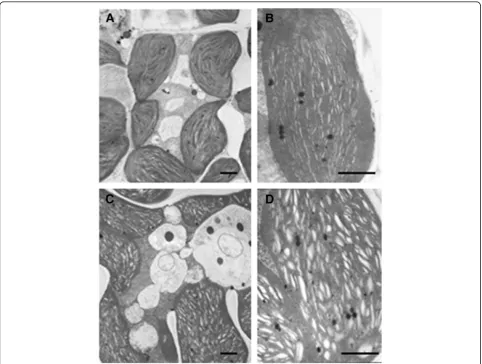
Next, transmission electron microscopic analysis was performed to determine if low chlorophyll content in the ygl138mutant leaves affects the chloroplast development and morphology. The results revealed that, the number
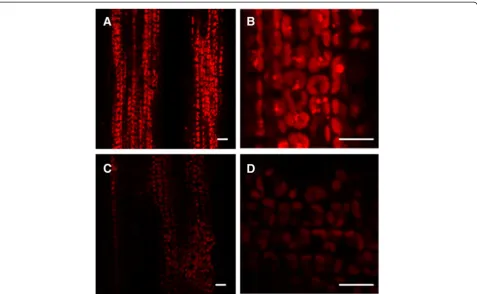
and size of chloroplasts per cell in the mutant were very similar to that of the wild-type parent (Figures 2A and C), whereas the shape of ygl138 mutant chloroplasts was ir-regular compared with the wild-type chloroplasts, a lot of cystic structures were observed in the chloroplasts of ygl138, the number of thylakoids inygl138was decreased, and the grana stacks in the mutant appeared less dense (Figures 2B and D). Furthermore, we used confocal mi-croscopy to view the mesophyll cells of the leaf tissues, and the results revealed that the chloroplasts of ygl138 mutant emitted a weaker chlorophyll fluorescence, com-pared with wild-type chloroplasts (Figure 3). These results indicated that the development of chloroplast was defec-tive in the mutant.
TheYGL138(t) gene was fine mapped to a confined region about 91.8 kb on chromosome 11
To decipher the inheritance behavior of ygl138 mutant, we developed an F2 population between ygl138 and Table 2 Comparison of chlorophyll contents in leaves
between the wild-type parent andygl138mutant at the seedling stage
Line Total Chl Chla Chlb Chla/b (mg/g FW) (mg/g FW) (mg/g FW) Ratio
WT 3.01 ± 0.17 2.48 ± 0.16 0.53 ± 0.09 4.68 ± 0.11
ygl138 1.78 ± 0.08 1.57 ± 0.11 0.21 ± 0.04 7.48 ± 0.24
Compared with WT −40.9%★★ −36.7%★★ −60.4%★★ 59.8%★★ ★★Significantly different atP= 0.01.
Figure 2Mesophyll cell structures of the mutantygl138and the wild-type parent.(A) Mesophyll cell of the wild-type parent. (B)
cultivar rice Minghui 63 and found that the F1 genera-tion exhibited normal green leaf phenotype. Among the 3246 F2 individuals, 2410 were wild-type phenotype plants and 836 were yellow-green leaf phenotype plants. The separate ratio was about 2.88:1, which accorded with 3:1 (χ2=1.0 <χ20.05, 1= 3.84). These results indicated that the yellow-green leaf phenotype ofygl138 was controlled by a single nuclear gene, which was tentatively designed as YGL138(t).
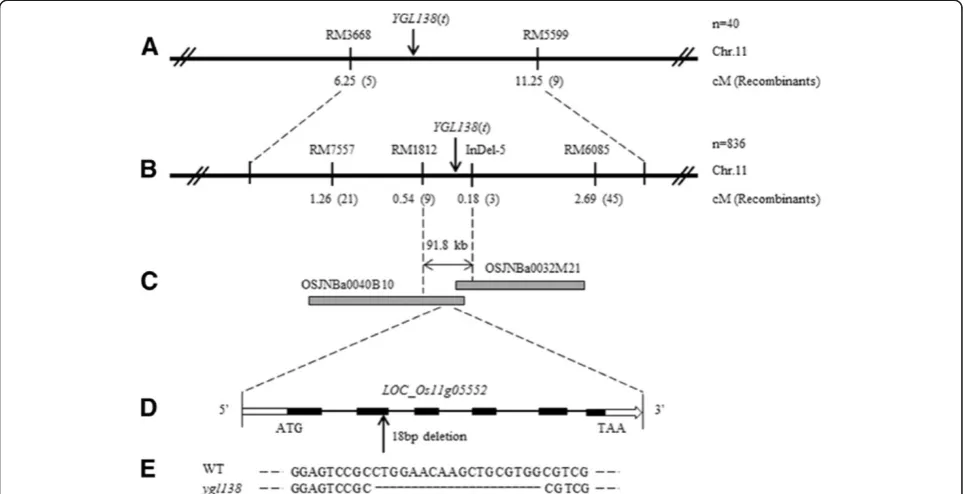
In order to map the YGL138(t) gene, map-based clo-ning was carried out by using F2 population obtained from the cross of ygl138 and Minghui 63. By screening 280 pairs of SSR markers scattered on rice chromosomes with proportional spacing, we found 105 pairs of mar-kers exhibited polymorphisms between the two parents, and then these markers were used for analyzing the link-age relationship with the YGL138(t) gene. The yellow-green leaf mutant DNA pool and wild-type phenotype DNA pool were used for linkage relationship analysis. Fi-nally, we detected that RM3668 and RM5599 on the short arm of chromosome 11 showed a linkage relation-ship with the YGL138(t) gene, and the YGL138(t) locus was primarily mapped between SSR markers RM3668 and RM5599 with genetic distances 6.25 cM and 11.25 cM, respectively (Figure 4A).
In the region between RM3668 and RM5599, 15 pairs of new SSR and InDel markers were developed for fine mapping. Four pairs of them exhibited polymorphism between two parents, and then were used for fine map-ping (Additional file 1: Table S1). Finally, theYGL138(t) gene was mapped between markers RM1812 and InDel-5 based on 836 F2 recessive individuals from ygl138/ Minghui 63. The genetic distances were 0.54 and 0.18 cM respectively, and the physical distance was about 91.8 kb (Figures 4B and C).
Candidate gene annotation and sequence analysis
Within the 91.8 kb interval, no gene involved in leaf-color mutation has been cloned yet, and 10 predicted open reading frames (ORFs) were found (Table 3). To identify the candidate gene ofYGL138(t), we sequenced the 10 ORFs in theygl138mutant and its wild-type par-ent, respectively. DNA sequencing results revealed that 18 bp nucleotides were deleted in the coding region of Os11g05552 in ygl138 mutant (Figures 4D and E), and no nucleotide mutation existed in the other ORFs. The 18 bp were deleted at nucleotides 246 to 263 in the ORF in theygl138mutant and caused a frameshift. Therefore, the Os11g05552 gene was considered as the candidate gene ofYGL138(t).
Figure 3Confocal laser scanning micrographs of mesophyll cells.(A, B) The wild-type parent. (C, D) Theygl138mutant. The chloroplasts of
BLAST search in the rice genome database revealed that YGL138(t) is a single-copy gene, and was predicted to encode a SRP54 protein and act as a chloroplast pre-cursor. Multiple amino acid sequence alignment showed that YGL138(t) has significant similarity to Zea mays uncharacterized protein and Sorghum bicolor hypothet-ical protein, with identity of 80% and 75%, respectively.
And its C-terminal region is poorly conserved from the homologues proteins of other species (Additional file 2: Figure S1). We subsequently analyzed the possible phy-logenetic relationships between YGL138(t) and its re-lated proteins from other species. The result indicated that rice YGL138(t) is more closely related to the homo-logues proteins of the monocotyledonous plants Zea mays and Sorghum bicolor than to those of other spe-cies (Figure 5).
Complementation analysis
To confirm the defect ofOs11g05552as causal mutation for ygl138, we performed a complementation analysis by transforming the wild-type gene (Os11g05552) into the ygl138 mutant. Detected by PCR amplification, we ob-tained 20 positive transgenic plants. In these transgenic plants, the yellow-green leaf trait of ygl138 was rescued (Figure 6). We measured their chlorophyll contents at the elongation stage, the results revealed that the levels of Chla, Chlband the ratio of Chla/bin the transgenic plants were all restored to the levels of wild-type plant (Table 4). Furthermore, the other major traits of the transgenic plants were all restored to the normal levels (Table 5). These results confirm that the nucleotide dele-tion in Os11g05552 was responsible for the ygl138 mu-tant phenotype, and Os11g05552 was identified as the YGL138(t) gene.
Figure 4Map-based cloning ofYGL138(t).(A) Primary mapping ofYGL138(t). TheYGL138(t) locus was primarily mapped between SSR markers RM3668 and RM5599 on the short arm of chromosome 11 with genetic distances 6.25 cM and 11.25 cM respectively. (B) Fine mapping ofYGL138
(t). TheYGL138(t) gene was fine mapped between markers RM1812 and InDel-5 with the physical distance of 91.8 kb. (C) BAC contigs spanning theYGL138(t) locus. (D) Structure ofOs11g05552. Black boxes indicate exons, white boxes indicate UTRs, and black lines indicate introns. (E) The mutation in theygl138mutant. 18 bp nucleotides were deleted in the coding region ofOs11g05552in the ygl138 mutant.
Table 3 Gene names and their putative functions in the target interval
Gene name Putative functions
Os11g05510 carbonic anhydrase family protein, putative
Os11g05520 bifunctional monodehydroascorbate reductase and carbonic anhydrasenectarin-3 precursor, putative, expressed
Os11g05530 expressed protein
Os11g05540 rhoGAP domain containing protein, expressed
Os11g05550 expressed protein
Os11g05552 signal recognition particle 54 kDa protein, chloroplast precursor, putative, expressed
Os11g05556 signal recognition particle 54 kDa protein, putative, expressed
Os11g05562 40S ribosomal protein S25, putative, expressed
Os11g05570 RNASEH2A−Putative ribonuclease H2 large subunit, expressed
YGL138(t) mRNA expression level is affected by the
YGL138(t) mutation
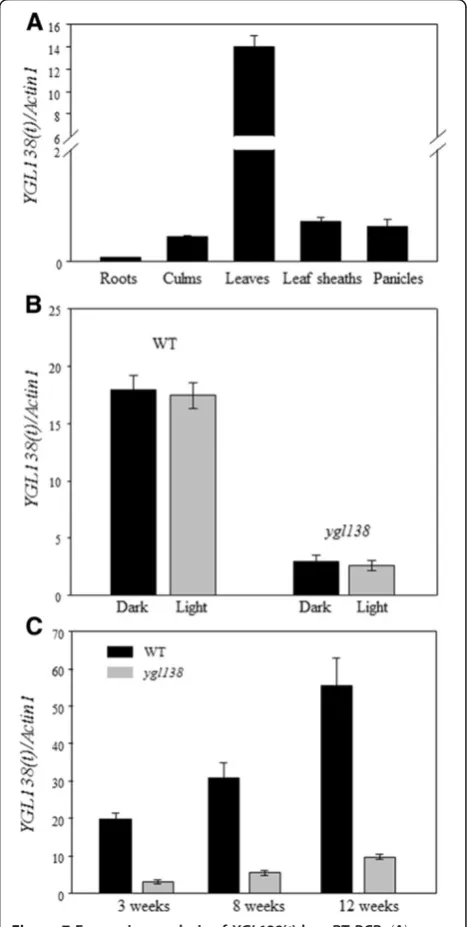
To investigate the YGL138(t) expression profile, total RNA was extracted from roots, culms, leaves, leaf sheaths, and panicles, and qRT-PCR analyses were performed. The results showed that YGL138(t) mRNA was expressed in all tissues tested, with relatively higher levels in leaves than in other organs (Figure 7A). We also examined the effect of light and dark growth conditions on the expression of YGL138(t). No change in transcript levels was observed whenygl138 or wild-type plants were grown under light or dark conditions (Figure 7B). Furthermore, the trans-cript levels of YGL138(t) were always significantly de-creased inygl138than that of wild-type parents from early to mature stages (Figure 7C). These results indicated that the mRNA expression ofYGL138(t) does not be affected by light intensity, and the mutation occurred in the coding
region of YGL138(t) could result in the variation of its mRNA expression.
Discussion
Nowadays, extensive attention has been paid to the leaf-color mutation, and certain achievements have been made by studying various organisms, but the mechanism of mu-tation and the responsible loci have not been fully under-stood at molecular level, especially in rice. Mutant analysis is a useful approach to illuminate the function of gene in complex biological processes of chloroplast development.
Recently, many reviews about Arabidopsis pigment defective mutants had been reported. immutans (im), variegated1 (var1) and variegated2 (var2) are the ty-pical leaf variegation mutants, and exhibit green- and white-sectored leaves (Yu et al. 2007; Aluru et al. 2006; Sakamoto et al. 2003). However, in this study, we identi-fied a novel yellow-green leaf mutantygl138 in rice, and defined it as a homogeneous paleness mutant.
By map-based cloning, theYGL138(t) gene was finally delimited in a 91.8 kb region on the short arm of chro-mosome 11. On the same chrochro-mosome, six genes: V9 (Satoh et al. 1984); tsc1 (Dong et al. 2001); OsPPR1 (Gothandam et al. 2005); Z1 (Zhang et al. 2008); Z2 (Chai et al. 2011) and yl11 (Liu et al. 2012), related to the leaf-color mutation have been mapped up to now,
Figure 5A phylogenetic tree representing alignment of YGL138(t) protein and its homologues proteins.The rooted neighbor-joining tree using percentage identities was constructed based on a multiple sequence alignment generated with the program Clustal X and MEGA 4. Scale represents percentage substitution per site. Accession numbers of the protein sequences were as follows:Oryza sativa[YGL138(t), RAPDB:
Os11g05552];Coccomyxasp. C-169 [GenBank: EIE18517];Nodularia spumigenaCCY9414 [GenBank: ZP_01629394];Actinomyces coleocanisDSM 15436 [GenBank: ZP_03925628];Arabidopsis thaliana[GenBank: NP_196014];Micromonas pusillaCCMP1545 [GenBank: XP_003056150];Sorghum bicolor[GenBank: XP_002442824];Zea mays[GenBank: NP_001142003].
Figure 6Complementation analysis of theygl138mutant.
Phenotype comparisons among wild-type,ygl138mutant and transgenic plants.
Table 4 Comparison of chlorophyll contents in leaves among the wild-type parent,ygl138mutant and the transgenic plant at the elongation stage
Line Total Chl Chla Chlb Chla/b
(mg/g FW) (mg/g FW) (mg/g FW) Ratio
WT 5.32 ± 0.23 4.18 ± 0.20 1.14 ± 0.05 3.67 ± 0.13
ygl138 2.30 ± 0.13 1.93 ± 0.14 0.37 ± 0.02 5.22 ± 0.30
but only OsPPR1 gene has been cloned. Among them, V9 and OsPPR1 mutants exhibit almost purely white at their young seedling stage, and leaves emerging at or after transplanting are pale green with white midrib (Satoh et al. 1984; Gothandam et al. 2005); tsc1 mu-tant is a thermo-sensitive seedling-color mumu-tant, and its thermo-sensitive decreases gradually with the increase of the seedling age (Dong et al. 2001);Z1and Z2mutants exhibit zebra leaves (Zhang et al. 2008; Chai et al. 2011); yl11 mutant is a typical chlorophyll deficient mutant, which has yellow leaves at whole growth stages (Liu et al. 2012). According to the previous reports, the six genes do not locate in the fine mapping region of YGL138(t), so we claim that YGL138(t) is a novel gene leading to leaf-color mutation in rice.
By sequencing, we found that, Os11g05552, which was predicted to encode a SRP54 protein and act as a chloro-plast precursor, had 18 bp nucleotides deletion in the coding region ofygl138and led to a frameshift. Further-more, the mutant phenotype ofygl138could be restored to the wild-type phenotype by transformation with the wild-type gene. Therefore, the gene Os11g05552 was identified as the YGL138(t) gene.
In higher plants, chloroplast is a complex organelle with a highly organized internal system, and the chloro-plast proteome comprises nuclear- and chloro-plastome-encoded proteins (Ferro et al. 2010). In order to function correctly, these proteins must be transported to their final destin-ation in the chloroplast (Richter et al. 2010). In this pro-gress, signal recognition particle (SRP) plays an essential role in binding to the signal sequence of the nascent poly-peptide emerging from the ribosome and directing the polypeptide toward the proper cellular compartment (Keenan et al. 2001; Halic et al. 2004).
In eukaryotes, the SRP contains six proteins (SRP9, SRP14, SRP19, SRP54, SRP68, SRP72) and a 300-nucleo-tide RNA (Zwieb et al. 2005). Among them, SRP54 is the only protein subunit conserved in all SRPs, and it is essential for signal sequence recognition and binding at the ribosome, and for the GTP-dependent interaction with the cognate receptor SR. This interaction deter-mines proper transport of the ribosome-nascent chain
complex to the protein-translocating channel in the membrane (Egea et al. 2008). SRP54 can also be involved in the co-translational transport of chloroplast-encoded thylakoid proteins, which is able to switch between the co- and post-translational means of interaction with its respective substrate proteins (Franklin and Hoffman 1993; Li et al. 1995; Schünemann 2004). Meanwhile, the conserved SRP54 protein associates with 70S ribosomes to function in the co-translational transport of the plastid-encoded thylakoid membrane protein D1 (Nilsson et al. Table 5 Comparison of major agronomic traits among the
ygl138mutant, its wild-type parent and the transgenic
plants
Agronomic traits WT ygl138 ygl138-C
Plant height (cm) 106.3 ± 3.8 102.2 ± 2.3 105.9 ± 2.4
Tiller number 12.4 ± 1.5 11.2 ± 1.7 12.5 ± 1.3
Panicle length (cm) 19.5 ± 0.9 19.1 ± 1.2 19.3 ± 0.6
No. of spikelets per panicle 115.9 ± 5.7 107.3 ± 4.8 114.8 ± 3.6
Seed setting rate (%) 91.3 ± 1.3 82.5 ± 1.9 90.8 ± 1.5
1000-grain weight (g) 23.3 ± 0.3 22.9 ± 0.4 23.1 ± 0.2
1999; Richter et al. 2010). From these reports we can see that SRP54 is a key component in SRP protein and plays prominent roles in chloroplast development.
SRP54 is a basic protein and has a three-domain struc-ture: an N-terminal helical bundle domain, a central GTPase domain and a C-terminal M domain (Marchler-Bauer et al. 2011). The N-terminal domain and the GTPase domain always associate together to consti-tute a structural and functional catalytic core, while the C-terminal M domain is responsible for the promiscuous recognition of the diverse signal sequences, and this do-main is generally less conversed between different SRP ho-mologues and also varies in length (Egea et al. 2008).
Mutant in SRP54 had been isolated in the model di-cotyledonous plant Arabidopsis.ffc1-2, which was gener-ated by EMS mutagenesis, always showed pale green leaves phenotype (Amin et al. 1999). This phenomenon was consistent with the reduction of chlorophyll levels in ffc1-2 mutant compared with its wild-type plants (Hutin et al. 2002). However, to our knowledge, no SRP54 has yet been identified in model monocotyledonous plant rice. In our study,Os11g05552, which was predicted to en-code a SRP54 protein and act as a chloroplast precursor, was identified as the novel geneYGL138(t) leading to leaf-color mutation in rice. We believe that further efforts on functional characterization of the YGL138(t) gene will contribute to understand the mechanism of SRP54 protein involving in chloroplast development in rice.
Conclusions
A novel rice yellow-green leaf mutant ygl138 was iso-lated in this study. The mutant exhibited a distinct yellow-green leaf phenotype throughout development. The phenotype of theygl138mutant was controlled by a single nuclear gene, which was tentatively designed as YGL138(t). The YGL138(t) locus was fine mapped to a 91.8 kb region. A SRP54 gene (Os11g05552) was con-firmed as the candidate gene by complementation ana-lysis. These results will not only provide basis for further research onYGL138(t) gene, but will also facilitate the il-lumination of the mechanism of SRP54 protein involving in chloroplast development of rice.
Methods
Plant materials
Theygl138mutant was derived from Nipponbare treated by ethyl methanesulfonate (EMS). To fine mapYGL138(t) gene, a large F2 population derived from the cross of ygl138 mutant and normal green leaf variety Minghui 63 (Oryza sativa L. ssp. indica) was constructed, and 836 recessive individuals with yellow-green leaf phenotype in the population were selected for fine mapping. All the plants were grown under natural condition in a paddy
field at the experimental station of Jiangxi Academy of Agricultural Sciences, Nanchang, China.
Chlorophyll content measurement
Chlorophylls were extracted from 0.2 g fresh leaves with 95% ethanol, and the chlorophyll contents were measured with UV-1700 UV-visible spectrophotome-ter (Shimadzu, http://www.shimadzu.com/) and calcu-lated according to the method of (Wellburn 1994).
Transmission electron microscopy analysis
Fresh leaf sections of ygl138 mutant and its wild-type parent Nipponbare were fixed in a solution of 3% glutar-aldehyde and further fixed with 1% OsO4. The tissues were dehydrated in a gradient acetone series and embed-ded in Epon812 medium prior to thin sectioning. The samples were stained with uranyl acetate and Reynolds’ lead citrate, and observed under a transmission electron microscope (H-600IV, Hitachi, http://www.hitachi.com/).
Confocal microscopy
Chlorophyll imaging was carried out using a confocal laser-scanning microscope (μRadiance; Bio-Rad Labora-tories Inc., Hercules, CA, USA). Chlorophyll was excited with the 568 nm line. Fluorescence images were col-lected through red channel.
Molecular marker development
Simple sequence repeats (SSR) markers were obtained from Gramene (http://www.gramene.org/microsat/) based on the SSR linkage map constructed by (McCouch et al. 2002). Insertion/Deletion (InDel) markers were developed according to DNA polymorphism of the mapped region between the japonica rice cv Nipponbare and theindica rice cv 9311 (http://www.ncbi.nlm.nih.gov/BLAST/). All InDel markers were designed by Primer 5.0 software.
Mapping and linkage map
Gene cloning and sequence analysis
The speculated candidate genes were amplified from ygl138mutant and its wild-type parent Nipponbare. Spe-cific primers were designed according to the genome sequence of Nipponbare. And the primers for gene clon-ing and sequence analysis of Os11g05552 were as fol-lows: P1 (F: 50-CCAGATAGTTTTGGGCCTGA-30 and R: 50-GCAGGCAATGCACAGAACTA-30); P2 (F: 50-GT CGGTGTACCAGTTTACTC-30 and R: 50-ACCAACGG GGAGGATAAGAG-30). Target DNA fragments were cut from the gel and purified by the DNA Gel Extrac-tion Kit (Tiangen, http://www.tiangen.com/), and then were sequenced at Shanghai Invitrogen Biotech. Co. Ltd. (Invitrogen, http://www.invitrogen.com/). Sequences data were assembled using ContigExpress, and then aligned using public programs Clustal X and Bioedit.
Vector construction and transformation
For complementation ofygl138 mutant, a 7179 bp geno-mic fragment consisting of a 2686 bp upstream sequence, the entireYGL138(t) coding region, and a 2284 bp down-stream region was acquired by splicing together three DNA fragments from PCR amplifications. The primers used were as follows: CP1 (F: 50-GGTACCGCTCATTGA TTGGCTCTT-30 and R: 50-GGTTTACGGGTTGCTGA TGT-30); CP2 (F: 50-GTGAGTGACCCTGCTCCTTT-30 and R: 50-ACGGCATTCTTGGTTATTTG-30); CP3 (F: 50 -GGCTTTATCAGGTCGGTGTA-30 and R: 50-TCTAG ATGAACTACAACGCTCACCAG-30). These three DNA fragments with overlapping sequences were individually inserted into the pMD18-T vector (Takara, http://www. takara.com.cn/) to produce the 7179 bp fragment. KpnI-and XbaI-recognizing sequences were added to the ends. The 7179 bp fragment was digested with KpnI and XbaI and inserted into the binary vector pCAMBIA2300 (CAMBIA, http://www.cambia.org/) to generate the re-sulting binary vector. The rere-sulting binary and empty pCAMBIA2300 vectors were introduced into the ygl138 mutants using the Agrobacterium tumefaciens-mediated transformation method (Liu et al. 2007).
RNA extraction and qRT-PCR
Total RNA was extracted using a TRIzol kit according to the manufacturer’s instructions (Invitrogen, http://www. invitrogen.com/). The RNA was pre-treated with DNase I and used for cDNA synthesis using an RT-PCR Kit (Promega, http://www.promega.com/). For qRT-PCR, SYBR Green I was added to the reaction system, and samples were run on a Chromo 4 real-time PCR detec-tion system according to the manufacturer’s instructions (Bio-Rad, http://www.bio-rad.com/). The data were ana-lyzed using Opticon monitor software (Bio-Rad). Each analysis was repeated three times. The rice Actin1gene was used as the internal control, and specific primers
were: F: 50-ACATCGCCCTGGACTATGACCA-30and R: 50-GTCGTACTCAGCCTTGGCAAT-30. The primers for qRT-PCR analysis of YGL138(t) expression were F: 50 -CTGGTCGCTGCAGATGTTTA-30 and R: 50-CTTTC TTTTGGCCTCTTCCA-30.
Additional files
Additional file 1: Table S1.Markers used in mapping ofYGL138(t).
Additional file 2: Figure S1.Sequence alignment of YGL138(t) protein of rice and its homologues proteins from other species. Identical residues are boxed in black, similar residues are high-lighted in gray. The N-terminal helical bundle domain and GTPase domain of YGL138(t) protein are underlined. Accession numbers of the protein sequences were as follows:Oryza sativa[YGL138(t), RAPDB:Os11g05552];Coccomyxasp. C-169 [GenBank: EIE18517];Nodularia spumigenaCCY9414 [GenBank: ZP_01629394];Actinomyces coleocanisDSM 15436 [GenBank: ZP_03925628];Arabidopsis thaliana[GenBank: NP_196014];Micromonas pusillaCCMP1545 [GenBank: XP_003056150];Sorghum bicolor[GenBank: XP_002442824];Zea mays[GenBank: NP_001142003].
Competing interests
The authors declare no potential competing interests.
Authors’contributions
FZ and JX designed the experiments, analyzed the data, and wrote the article. FZ and BH preformed genetic analyses and cloned theYGL138(t) gene, FZ performed RNA extraction and quantitative RT-PCR, YW performed vector construction and plant transformation, XL performed transmission electron microscopy analysis, FZ performed chlorophyll content
measurement and confocal microscopy. All authors read and approved the final manuscript.
Acknowledgments
We are grateful to Dr. Tong Hongning (Institute of Genetics and
Developmental Biology, Chinese Academy of Sciences) for providing us with theygl138mutant. We also thank Ms. Sun Feifei (Technische Universität Dresden, Germany) for her critical reading of the manuscript in this work. This project was supported by the Special Fund for Agro-scientific Research in the Public Interest (201103007), the Major Projects in Jiangxi Province (20114ABF03101), the Key Projects of Jiangxi Education Department (KJLD12059), and the National Natural Science Foundation of China (30960189, 31201191).
Author details
1College of Life Sciences, Jiangxi Normal University, Nanchang 330022, China. 2Biotechnology Research Institute, Jiangxi Academy of Agricultural Sciences,
Nanchang 330200, China.
Received: 14 October 2012 Accepted: 20 March 2013 Published: 27 March 2013
References
Aluru MR, Yu F, Fu A, Rodermel S (2006)Arabidopsisvariegation mutants: new insights into chloroplast biogenesis. J Exp Bot 57:1871–1881
Amin P, Sy DA, Pilgrim ML, Parry DH, Nussaume L, Hoffman NE (1999)Arabidopsis
mutants lacking the 43- and 54-kilodalton subunits of the chloroplast signal recognition particle have distinct phenotypes. Plant Physiol 121:61–70 Carol P, Stevenson D, Bisanz C, Breitenbach J, Sandmann G, Mache R, Coupland
G, Kuntz M (1999) Mutations in theArabidopsisgeneIMMUTANScause a variegated phenotype by inactivating a chloroplast terminal oxidase associated with phytoene desaturation. Plant Cell 11:57–68
Chai CL, Fang J, Liu Y, Tong HN, Gong YQ, Wang YQ, Liu M, Wang YP, Qian Q, Cheng ZK, Chu CC (2011)ZEBRA2, encoding a carotenoid isomerase, is involved in photoprotection in rice. Plant Mol Biol 75:211–221
Eckhardt U, Grimm B, Hörtensteiner S (2004) Recent advances in chlorophyll biosynthesis and breakdown in higher plants. Plant Mol Biol 56:1–14 Egea P, Napetchnig J, Walter P, Stroud R (2008) Structures of SRP54 and SRP19,
the two proteins that organize the ribonucleic core of the signal recognition particle fromPyrococcus furiosus. PLoS One 3:e3528
Falbel TG, Meehl JB, Staehelin LA (1996) Severity of mutant phenotype in a series of chlorophyll-deficient wheat mutants depends on light intensity and the severity of the block in chlorophyll synthesis. Plant Physiol 112:821–832 Ferro M, Brugière S, Salvi D, Seigneurin-Berny D, Court M, Moyet L, Ramus C,
Miras S, Mellal M, Gall SL, Kieffer-Jaquinod S, Bruley C, Garin J, Joyard J, Masselon C, Rolland N (2010) AT_CHLORO, a comprehensive chloroplast proteome database with subplastidial localization and curated information on envelope proteins. Mol Cell Proteomics 9:1063–1084
Franklin AE, Hoffman NE (1993) Characterization of a chloroplast homologue of the 54-kDa subunit of the signal recognition particle. J Biol Chem 268:22175–22180
Ghirardi ML, Melis A (1988) Chlorophyllbdeficiency in soybean mutants. I. Effects on photosystem stoichiometry and chlorophyll antenna size. BBA-Bioenergetics 932:130–137
Goh CH, Jung KH, Roberts SK, McAinsh MR, Hetherington AM, Park Y, Suh KH, An G, Nam HG (2004) Mitochondria provide the main source of cytosolic ATP for activation of outward-rectifying K+channels in mesophyll protoplast of chlorophyll-deficient mutant rice (OsCHLH) seedlings. J Biol Chem 279:6874–6882
Gothandam KM, Kim ES, Cho H, Chung YY (2005) OsPPR1, a pentatricopeptide repeat protein of rice is essential for the chloroplast biogenesis. Plant Mol Biol 58:421–433
Halic M, Becker T, Pool MR, Spahn CM, Grassucci RA, Frank J, Beckmann R (2004) Structure of the signal recognition particle interacting with the elongation-arrested ribosome. Nature 427:808–814
Hu Z, Peng LP, Cai YH (1981) A Yellow-Green Nucleus Mutant of Rice. Acta Genet Sin 8:256–261 (in Chinese with an English abstract)
Hutin C, Havaux M, Carde JP, Kloppstech K, Meiherhoff K, Hoffman N, Nussaume L (2002) Double mutation cpSRP43–/cpSRP54–is necessary to abolish the cpSRP pathway required for thylakoid targeting of the light-harvesting chlorophyll proteins. Plant J 29:531–543
Jung KH, Hur J, Ryu CH, Choi Y, Chung YY, Miyao A, Hirochika H, An G (2003) Characterization of a rice chlorophyll-deficient mutant using the T-DNA gene-trap system. Plant Cell Physiol 44:463–472
Keenan RJ, Freymann DM, Stroud RM, Walter P (2001) The signal recognition particle. Annu Rev Biochem 70:755–775
Kurata N, Miyoshi K, Nonomura KI, Yamazaki Y, Ito Y (2005) Rice mutants and genes related to organ development, morphogenesis and physiological traits. Plant Cell Physiol 46:48–62
Lander E, Green P, Abrahamson J, Barlow A, Daly M, Lincoln S, Newburg L (1987) MAPMAKER: an interactive computer package for constructing primary genetic linkage maps of experimental and natural populations. Genomics 1:174–181
Lee S, Kim JH, Yoo ES, Lee CH, Hirochika H, An G (2005) Differential regulation of chlorophyllaoxygenase genes in rice. Plant Mol Biol 57:805–818
Li X, Henry R, Yuan J, Cline K, Hoffman NE (1995) A chloroplast homologue of the signal recognition particle subunit SRP54 is involved in the posttranslational integration of a protein into thylakoid membranes. Proc Natl Acad Sci USA 92:3789–3793
Liu RH, Meng JL (2003) MapDraw: a microsoft excel macro for drawing genetic linkage maps based on given genetic linkage data. Hereditas (Beijing) 25:317–321 (in Chinese with an English abstract)
Liu XQ, Bai XQ, Wang XJ, Chu CC (2007)OsWRKY71, a rice transcription factor, is involved in rice defense response. J Plant Physiol 164:969–979
Liu ZL, Yuan S, Liu WJ, Du JB, Tian WJ, Luo MH, Lin HH (2008) Mutation mechanism of chlorophyll-less barley mutantNYB. Photosynthetica 46:73–78 Liu CH, Li XY, Zhang JH, Lin DZ, Dong YJ (2012) Characteristics and molecular
mapping of a novel chlorophyll-deficient yellow-leaf mutant in rice. Hereditas (Beijing) 34:223–229 (in Chinese with an English abstract) Marchler-Bauer A, Lu S, Anderson JB, Chitsaz F, Derbyshire MK, DeWeese-Scott C,
Fong JH, Geer LY, Geer RC, Gonzales NR, Gwadz M, Hurwitz DI, Jackson JD, Ke Z, Lanczycki CJ, Lu F, Marchler GH, Mullokandov M, Omelchenko MV, Robertson CL, Song JS, Thanki N, Yamashita RA, Zhang D, Zhang N, Zheng C, Bryant SH (2011) CDD: a conserved domain database for the functional annotation of proteins. Nucleic Acids Res 39:D225–D229
McCouch SR, Teytelman L, Xu Y, Lobos KB, Clare K, Walton M, Fu BY, Maghirang R, Li ZK, Xing YZ, Zhang QF, Kono I, Yano M, Fjellstrom R, DeClerck G, Schneider D, Cartinhour S, Ware D, Stein L (2002) Development and mapping of 2240 new SSR markers for rice (Oryza sativaL.). DNA Res 9:199–207
Miyoshi K, Ito Y, Serizawa A, Kurata N (2003)OsHAP3genes regulate chloroplast biogenesis in rice. Plant J 36:532–540
Nagata N, Tanaka R, Satoh S, Tanaka A (2005) Identification of a vinyl reductase gene for chlorophyll synthesis inArabidopsis thalianaand implications for the evolution of prochlorococcus species. Plant Cell 17:233–240 Nilsson R, Brunner J, Hoffmann N, van Wijk KJ (1999) Interactions of ribosome
nascent chain complexes of the chloroplast-encoded D1 thylakoid membrane protein with cpSRP54. EMBO J 18:733–742
Pasini L, Bruschini S, Bertoli A, Mazza R, Fracheboud Y, Marocco A (2005) Photosynthetic performance of cold-sensitive mutants of maize at low temperature. Physiol Plantarum 124:362–370
Richter CV, Bals T, Schünemann D (2010) Component interactions, regulation and mechanisms of chloroplast signal recognition particle-dependent protein transport. Eur J Cell Biol 89:965–973
Sakamoto W, Zaltsman A, Adam Z, Takahashi Y (2003) Coordinated regulation and complex formation ofyellow variegated1andyellow variegated2, chloroplastic FtsH metalloproteases involved in the repair cycle of photosystem II inArabidopsisthylakoid membranes. Plant Cell 15:2843–2855 Satoh H, Iwata N, Omura T (1984) Linkage analysis in rice. On the loci of new
virescent genes,v-9(t) andv-10(t) andv-11(t). Jpn J Breed 34:286–287 Schünemann D (2004) Structure and function of the chloroplast signal
recognition particle. Curr Genet 44:295–304
Wang PR, Gao JX, Wan CM, Zhang FT, Xu ZJ, Huang XQ, Sun XQ, Deng XJ (2010) Divinyl chlorophyll (ide)acan be converted to monovinyl chlorophyll (ide)a
by a divinyl reductase in rice. Plant Physiol 153:994–1003
Wellburn AR (1994) The spectral determination of chlorophyllsaandb, as well as total carotenoids, using various solvents with spectrophotometers of different resolution. J Plant Physiol 144:307–313
Wu ZM, Zhang X, He B, Diao LP, Sheng SL, Wang JL, Guo XP, Su N, Wang LF, Jiang L, Wang CM, Zhai HQ, Wan JM (2007) A chlorophyll-deficient rice mutant with impaired chlorophyllide esterification in chlorophyll biosynthesis. Plant Physiol 145:29–40
Yoo SC, Cho SH, Sugimoto H, Li JJ, Kusumi K, Koh HJ, Iba K, Paek NC (2009) Rice
virescent3andstripe1encoding the large and small subunits of
ribonucleotide reductase are required for chloroplast biogenesis during early leaf development. Plant Physiol 150:388–401
Yu F, Fu A, Aluru M, Park S, Xu Y, Liu H, Liu X, Foudree A, Nambogga M, Rodermel S (2007) Variegation mutants and mechanisms of chloroplast biogenesis. Plant Cell Environ 30:350–365
Zhang HT, Li JJ, Yoo JH, Yoo SC, Cho SH, Koh HJ, Seo HS, Paek NC (2006) Rice
Chlorina-1andChlorina-9encode ChlD and ChlI subunits of Mg-chelatase, a key enzyme for chlorophyll synthesis and chloroplast development. Plant Mol Biol 62:325–337
Zhang DY, Gong ZY, Ye JW, Wu YX, Mi HL, Chen GY (2008) Effects of zebra leaf 1−a new variegation mutation−on chloroplast development in rice. Fen Zi Xi Bao Sheng Wu Xue Bao 41:417–422 (in Chinese with an English abstract) Zwieb C, Van Nues RW, Rosenblad MA, Brown JD, Samuelsson T (2005) A
nomenclature for all signal recognition particle RNAs. RNA 11:7–13
doi:10.1186/1939-8433-6-7

![Figure 5 A phylogenetic tree representing alignment of YGL138(t) protein and its homologues proteins.bicolor15436 [GenBank: ZP_03925628]; The rooted neighbor-joiningtree using percentage identities was constructed based on a multiple sequence alignment gen](https://thumb-us.123doks.com/thumbv2/123dok_us/923288.1590391/6.595.305.540.664.733/phylogenetic-representing-alignment-homologues-joiningtree-percentage-identities-constructed.webp)