O R I G I N A L C O N T R I B U T I O N
Open Access
Effect of
Ganoderma lucidum
on memory
and learning in mice
Najeeb Khatian
1and Muhammad Aslam
2*Abstract
Background:In traditional Chinese medicineGanoderma lucidumis famous for its beneficial effect on nervous system. It was traditionally used to manage different neurological disorders. This study was designed to investigate the nootropic potential of the mushroom.
Methods:Nootropic activity was evaluated following the oral administration of two different doses (150 and 300
mg/kg) of ethanol extract ofGanoderma lucidum. Physostigmine (0.1 mg/kg) and Scopolamine (0.4 mg/kg) were
used as positive and negative controls respectively. Distilled water was used as a control. Elevated plus maze and Morris water maze were used for the assessment of learning process. In elevated plus maze, initial transfer latency and retention transfer latency were assessed. In Morris water maze, TSTQ (time spent in target quadrant) and transfer latency were evaluated. For the assessment of locomotor activity, open field test was utilized. Furthermore, biochemical estimation of acetylcholinestrases (AchE) was performed by using Ellman’s method.
Results:The results of the study show that theGanoderma lucidumextract has significantly increased the time spent in target quadrant (TSTQ) and decreased the escape latency (EL) in Morris water maze model. Whereas, a decrease in the Initial Transfer Latency (ITL) and Retention Transfer Latency (RTL) was observed in elevated plus
maze model.Conclusion:The present study showed thatGanoderma lucidumhas physostigmine like effect on
brain acetylcholinesterase (AchE) activity.
Keywords:Ganoderma lucidum, Nootropic activity, Memory, Physostigmine
Background
Memory is one of the most critical functions of the brain and a major process by which the things we experience and observe are recorded and utilized to react to the sur-roundings. It is considered as a fundamental unit for the survival of human beings [1]. The centrally acting cholin-ergic neuronal system is considered as the most essential system in the regulation of several important functions of the brain including memory and learning [2].
In the previous decades, Alzheimer’s disease has got
extreme consideration [3, 4]. Alzheimer’s disease has
been the sixth leading cause of the death in U.S [5]. Loss of cholinergic neurons in the nucleus basalis
magnocel-lular of cortex is considered as hallmark of Alzheimer’s
disease [6]. Oxidative stress, neuroinflammation, and
disturbance in the lipid metabolism play vital role in the
progression of Alzheimer’s disease [7].
The impaired cognition in Alzheimer’s disease is
coun-teracted with the drugs which have tendency of
improv-ing the cholinergic neurotransmission [8, 9]. Donepezil,
rivastigmine, galantamine and memantine are most
commonly used drugs to treat Alzheimer’s disease [7].
Scopolamine is considered as main agent which causes memory impairment in animals by antagonizing the ef-fect of acetylcholine at muscarinic receptors [10].
Medicinal mushrooms have got importance in treating various types of chronic and acute disorders, these mushrooms have wide acceptance in the treatment of
in-fectious diseases for several decades [1,11].
Ganoderma lucidum is a famous mushroom because of its therapeutic efficacy. It is the one out of all thera-peutic mushrooms, which is examined by many
re-searchers. Ganoderma lucidum has been used as a
remedy for many diseases and disorders for 5000 years. The mushroom is considered as a major part of
* Correspondence:[email protected]
2Department of Pharmacology, Faculty of Pharmacy, University of Sindh,
Jamshoro 76080, Pakistan
Full list of author information is available at the end of the article
Traditional Chinese Medicine (TCM). It is called as
Lingzhi and is thought to be“The Mushroom of
Immor-tality”in Korea and China [3].
Ganoderma lucidum, is considered as “The king of
herbs”. It is a fungus which grows on different defunct
and dead trees, especially willow, oak, sweet gum, maple
and elm. Ganoderma lucidumhas a long history of use
for propelling life span and for a healthier life style in
China, Japan, and other Asian countries. Ganoderma
lucidumis generally known as Reishi [12].
Ganoderma lucidum possesses different pharmaco-logical effects, including, calming, antiatherosclerotic,
anti-inflammatory, analgesic, chemopreventive and
anti-aging effect [13,14]. Radioprotective, cytotoxic,
an-titumor, antibacterial, sedative, hypolipidemic, antiviral (for HIV), antifibrotic, hepatoprotective and antioxidant
activities have also been seen in the mushroom [15,16].
In the latest studies, Reishi has shown its effectiveness in the treatment of carcinoma, leukemia, diabetes and hepatitis [17].
This study was designed to evaluate the nootropic
ac-tivity of ethanol extract ofGanoderma lucidumon
nor-mal and memory deficit mice.
Materials and methods Drugs and chemicals
Ethanol extract of fruiting bodies and cracked spores
Ganoderma lucidumin capsule form branded as Reishi-MaxGLpTM, was purchased from Pharmanex Inc. (United States of America).
Animals
Male Swiss albino mice (Mus musculus) weighing about
22–25 g were utilized in this study. Thirty mice divided
in five groups (n= 6) were used in this study. The
ani-mals were procured from Liaquat National Medical Col-lege, Karachi. The temperature of the area was kept 23
± 0.5 °C. Water ad libitum was provided to the mice.
Mice were acclimatized in laboratory environment be-fore the start of the study.
Animal handling
The guidelines of National Institute of Health (NIH, 8th edition) were followed throughout the performance of re-search experiments. Handling of the animals was done
ac-cording to the requirements mentioned in“Guidelines for
the care and use of laboratory animals 8thedition”[18].
Dose selection
The selection of doses was made as per research literature, that is, 0.4 mg/kg for scopolamine, 0.1 mg/kg for
physo-stigmine were used [19].Ganoderma lucidumextract was
given in two doses that is, 150 mg/kg and 300 mg/kg [20].
Animal groups and drug administration
The animals were divided in the following five groups: Group I: Vehicle control group (administered distilled
water 10 ml/kg,p.o.)
Group II: Negative control group (administered
sco-polamine 0.4 mg/kg,i.p.)
Group III: Treatment group (administered
physostig-mine 0.1 mg/kgi.p.+ scopolamine 0.4 mg/kgi.p.)
Group IV: Treatment group (administered extract 150
mg/kg,p.o. +scopolamine 0.4 mg/kg,i.p.)
Group V: Treatment group (administered extract 300
mg/kg,p.o.+ scopolamine 0.4 mg/kg,i.p.)
Elevated plus maze
Elevated plus maze (EPM) is considered as main model to evaluate learning and cognition in rodents. It is
com-prised of two open arms (16 ×5 cm) and two enclosed
arms of same size as of open arms, having walls of about
5 cm. This instrument is protracted from a center (5×5
cm) and the instrument is elevated to the height of 25 cm. On the initial day of the experiment, (10th day of dosing), every animal was settled at the edge of any of the open arms. Initial Transfer Latency (ITL) was noted down on the initial trials for each animal. Initial transfer latency is defined as the time in which the animal moves from one of the open arms into any of the two closed arms with its all limbs. When the animal did not enter any closed arms within 90 s, the mouse was smoothly directed into one of the two closed arms and the ITL was assigned 90 s. The animal was then allowed to explore the maze for 120 s and then placed back into its home cages [21]. The remembrance of this memory was then evaluated later twenty-four (24) hours after first training; this is termed as
Retention Transfer Latency or RTL [22,23].
Morris water maze
Morris water maze (MWM) is considered as accurate model for evaluating learning of task and evaluating on-going memory in rodents. Here MWM was utilized which was consisted of round tank 60 cm wide and 25 cm tall. This round tank was filled with water and
temperature of water was kept 25°C. The water was
wall of tank. After every trial the location of mouse was changed, and 120 s were assigned to every mouse to search submersed platform. The platform was kept un-touched and the position was remained unaltered during the training session [24].
When the mouse was unable to find the platform in the prescribed period i-e 120 s, was smoothly guided to-wards the platform and allowed mouse to stay on plat-form for 20 s [25].
Escape latency (EL) recorded from 6th till 9th day of administration of drug for each animal. Trials for four consecutive days were done on every mouse. EL is de-fined as the period in which animal start moving from starting quadrant in search of hidden platform in the target quadrant. Training session for four consecutive trial days were done according to following pattern.
1st Day: Q1, Q2, Q3 and Q4. 2nd Day: Q2, Q3 Q4 and Q1. 3rd Day: Q3, Q4, Q1 and Q2. 4th Day: Q4, Q1, Q2 and Q3.
*“Q”is denoted for Quadrant.
After Escape latency session and testing, TSTQ (time spent in target quadrant) was noted. The platform was removed from the tank and each mouse could swim freely for 300 s. The average time spent in each quadrant was noted. The average time in target quadrant (Q4) was also recorded in which the mouse could find the removed platform. This finding of platform is considered as a sign of memory retrieval. The observer stood in the same
pos-ition throughout the training and test days [24,25].
Open field test
To rule out the effect of the extract on motor activity, we examined ambulatory behavior of the animals in open field test. An open-field is a wooden box (45 × 45 × 40 cm) with the floor partitioned into 16 squares. Every mouse was settled at the central square of the field and then ambulation (number of squares crossed) was noted for 10 min. This ambulation will represent the
locomotor activity of the mice [26,27].
Biochemical estimations of cholinergic status in mouse brain At the end of the study, the mice were sacrificed. The whole brain was collected and subjected to homogenization in a glass homogenizer containing 10 ml of 0.9% of NaCl solution and homogenized in an ice bath. The homogenate was then placed in the centrifugation machine set at 3000 rpm for 10 min. The centrifugation caused the presence of cloudy supernatant liquid which was then used for detec-tion of cholinesterase level in the brain [28].
To determine cholinesterase levels in brain of mouse the Ellman method was adopted. The method involves
the acetylcholine iodide from and dithiobisnitrobenzo-ate. The reaction between dithiobisnitrobenzoate and acetylcholine iodide resulted in formation of thiocholine which formed yellow colour appearance and this yellow coloured precipitate formation in the reaction was considered as an end point of the method. The spec-trophotometric analysis was done to determine rate of thiocholine formation from acetylcholine iodide in the
presence of tissue cholinesterase and 5,5′
-Dithio-bis-(2-Nitrobenzoic Acid) (DTNB) was treated with the brain sample and the optical density (OD) of yel-low colour compounds formed during the reaction was measured in spectrophotometer at the wavelength of 412 nm every minute [29].
Statistical analysis
The data were presented as mean ± standard error of mean (SEM). The data were analyzed by one-way
ANOVA followed by Tukey’s post hoc test. A probability
level of 0.05 or less was accepted as significant.
Results
Effect ofGanoderma lucidumon initial transfer latency (ITL) in EPM
Initial transfer latency of the scopolamine treated animals was increased significantly when compared with control group. Whereas, initial transfer latency of mice treated
with physostigmine,Ganoderma lucidum extract 150 mg/
kg and 300 mg/kg decreased when compared with
scopol-amine group. It was further observed thatGanoderma
luci-dumshowed more significant decrease at the dose of 300
mg/kg when compared with 150 mg/kg group (Fig.1a).
Furthermore, retention transfer latency was increased significantly when compared with control group.
Co-ad-ministration of scopolamine withGanoderma lucidum
ex-tracts at both doses, the retention transfer latency was decreased significantly when compared with the mice in which scopolamine alone was administered. Physostigmine co-administered with scopolamine treated group also shown decrease in retention transfer latency when
com-pared with scopolamine alone treated animals (Fig.1b).
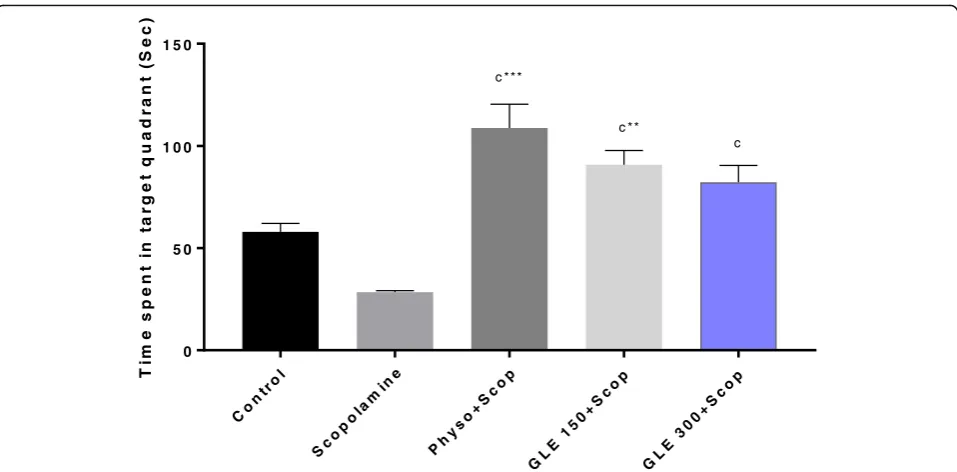
Effect ofGanoderma lucidumon TSTQ (time spent in target quadrant) in the Morris water maze
The results show that the time spent in target quadrant of Morris water maze was significantly decreased in the mice treated with scopolamine when compared with control group. On other hand, the mice in which
Ganoderma lucidum extract was co-administered with scopolamine showed significant increase in time spent in target quadrant when compared with scopolamine alone
administered group. This has proved that Ganoderma
lucidumextract has potential of increasing the retention
Co ntr
ol
Sc op
ola min
e
Ph ys
o+ Sc
op
GL E1
50 +S
co p
GL E3
00 +S
co p
0 5 0 1 0 0 1 5 0
R
e
te
n
ti
o
n
tr
ans
fe
r
la
tency
(S
ec.
)
c c * *
c * *
c * * ***
c
B
A
Fig. 1aEffect ofGanoderma lucidumon Initial Transfer Latency (ITL) in EPM. Animals per group (n) = 6; The values are mean ± SEM (One-way ANOVA
The Escape Latency (EL) of different groups on 6th to 9th day of drug administration was also assessed. It was observed that on 6th day of the drug administration the escape latency of scopolamine alone treated animals was significantly increased when compared with control
group. Co-administration ofGanoderma lucidumextract
with scopolamine showed significant decrease in EL when compared with scopolamine alone treated mice on
6th and 9th day of the study (Table1).
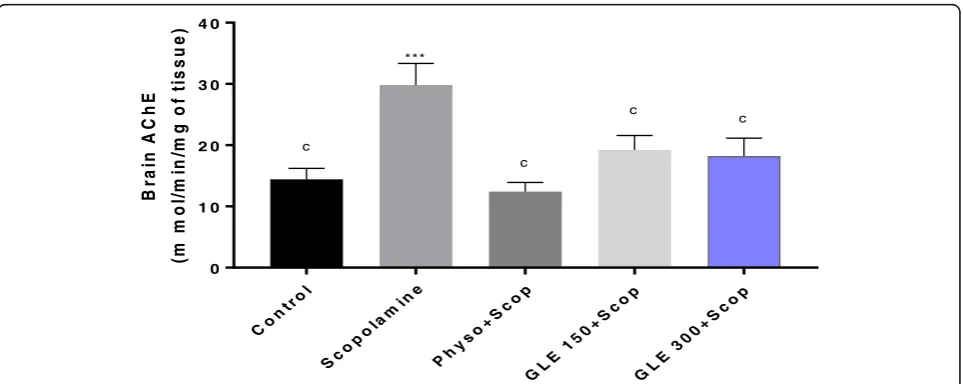
Effect ofGanoderma lucidumon brain acetylcholinesterase (AchE) activity
The results of the activity of AchE in mice brain sug-gested that scopolamine alone treated group has signifi-cantly increased brain AchE activity when compared
with control group. Ganoderma lucidum extract,
co-administered with scopolamine, and physostigmine co-administered with scopolamine, have significantly re-duced the brain AChE activity in mice brain when
com-pared with the scopolamine alone treated group (Fig.3).
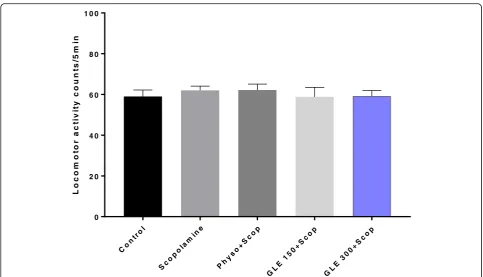
Effect ofGanoderma lucidumon locomotor activity in mice The results show that the locomotor activity of the dif-ferent groups was similar when compared with control group and scopolamine induced memory deficit mice.
This showed thatGanoderma lucidumextract has no
ef-fect on the motor activity of the mice (Fig.4).
Discussion
Numerous scientific studies have been carried on
Ganoderma lucidumfor evaluating the pharmacological activities of the mushroom. This research was performed to evaluate the nootropic effect of the ethanol extract of
Ganoderma lucidum in memory impaired swiss albino male mice. The memory was impaired by using scopol-amine. Scopolamine is an alkaloidal drug which is
ex-tracted out from Datura stramonium. Scopolamine has
tendency to impair memory in humans and animals, that is why it is used to cause long term or short-term mem-ory impairment in rodents [30].
Learning process and memory in rodents is mainly evaluated by using elevated plus maze (EPM) model. It is considered as the validated model for the assessment of memory [29]. Transfer Latency (TL) of this model is found to be useful parameter for the assessment of cog-nition. TL is basically time taken by the rodent to shift itself into one of the closed arms from the open arms. In EPM, acquisition (learning) can be considered as transfer latency on first day trials and the retention/consolidation (memory) is assessed after 24 h.
Ganoderma lucidum significantly reduced the Initial Transfer Latency (ITL) on 10th day of the treatment.
Moreover, Ganoderma lucidum also significantly
re-duced the Retention Transfer Latency (RTL) on 11th day of the treatment after administration of scopolamine
for the impairment of memory, indicating that
Co ntr
ol
Sc op
ola min
e
Ph ys
o+ Sc
op
GL E1
50 +S
co p
GL E3
00 +S
co p
0 5 0 1 0 0 1 5 0
T
im
es
pe
nt
in
ta
r
ge
t
qua
d
r
a
nt
(S
e
c
)
c * * c * * *
c
Fig. 2Effect ofGanoderma lucidumon time spent in target quadrant (TSTQ) in MWM on 10th day of the study. Animals per group (n) = 6; The
Ganoderma lucidum improved the learning task and
retained the information [10,21,30].
In Morris water maze, a decrease in escape latency (EL) during training and an increase in time spent in the target quadrant during retrieval indicated improvement of learning and memory respectively; and vice versa.
Ganoderma lucidumdid not produce any significant al-teration in locomotor functions of the animals when compared with distilled water treated control group, hence, the drug did not show any motor effects.
There-fore, memory boosting activity ofGanoderma lucidumis
specific and not false positive.
Scopolamine induced memory impairment causes in-crement in AchE action and oxidative stress in brain. Furthermore, it is believed that scopolamine has got ten-dency to hinder the neurogenesis process of the brain which causes impairment in cognition [21]. Many stud-ies have shown that scopolamine alters the process of re-ceiving, collecting and remembrance of information.
Drugs which have potential of increasing the cholinergic neuronal activity, are effective against memory impair-ment. Physostigmine is one of the drugs which increases cholinergic neuronal activity in brain and can combat the memory impairment [30].
Acetylcholinesterase activity was analyzed in the brain sample of mice. This marker enzyme is essential for de-tecting the cholinergic status in the brain [31]. The acetylcholinesterase determination has supported the re-sults of elevated plus maze and Morris water maze test activity of mice in which the statistical reduction in the AChE activity caused the increment in the acetylcholine level in the brain of the mouse which resulted in in-creased function of memory. Therefore, the current
study suggests that the ethanol extract of Ganoderma
lucidum has dose dependent potential on cholinergic neuronal system and this resulted in elevating the brain acetylcholine level which resulted in improvement of
memory function [30,32].
Table 1Effect ofGanoderma lucidumon Escape Latency (sec) in Morris Water Maze
Treatment group Dose EL (Sec) Day 6 EL (Sec) Day 7 EL (Sec) Day 8 EL (Sec) Day 9
Control 10 ml/Kg 28.4 ± 2.4 14.4 ± 1.2 13.2 ± 1.1 12.4 ± 0.9
Scopolamine 0.4 mg/Kg 70.6 ± 2.5*** 71.6 ± 3.4*** 69.6 ± 4.4*** 67.6 ± 4.8***
Physo + Scop 0.1 mg/Kg + 0.4 mg/Kg 27.4 ± 1.9 12.8 ± 0.9 11.8 ± 0.9c 11.0 ± 0.8c
GLE 150 mg + Scop 150 mg/Kg + 0.4 mg/Kg 29.4 ± 2.7 26.4 ± 1.8 12.8 ± 0.8 13.6 ± 0.8c
GLE 300 mg + Scop 300 mg/Kg + 0.4 mg/Kg 27 ± 3.5 23.2 ± 2.0 10.8 ± 0.5c** 10.0 ± 0.3c**
Animals per group (n) = 6; The values are mean ± SEM (One-way ANOVA followed by Tukey’s Post hoc test)
a
p< 0.05,b
p< 0.01,c
p< 0.001 when compared with scopolamine alone treated group
*p< 0.05,**p< 0.01,***p< 0.0001 when compared with DW treated (control) group
DWdistilled water,GLE 150 Ganoderma lucidumextract (150 mg/kg),GLE 300 Ganoderma lucidumextract 300/kg,ScopScopolamine,PhysoPhysostigmine
Co ntr
ol
Sc op
ola min
e
Ph yso
+S cop
GL E1
50+ Sc
op
GL E3
00+ Sc
op
0 1 0 2 0 3 0 4 0
B
ra
inA
C
hE
(m
mo
l/m
in/
mg
of
ti
s
s
u
e
)
c
c
c
c * * *
c
Fig. 3Effect ofGanoderma lucidumon brain acetylcholinesterase in mice. Animals per group (n) = 6; The values are mean ± SEM (One-way ANOVA
Conclusion
The study has revealed that ethanol extract of
Ganoderma lucidum has nootropic potential and has capability of improving the memory of learning and ongoing tasks. Furthermore, the results of the study
indicate that ethanol extract of Ganoderma lucidum
exerts reversal action on scopolamine induced im-paired memory and can be used as an agent for en-hancing the cognition pattern.
Abbreviations
AchE:Acetylcholinestrases; ANOVA: Analysis of variance; CNS: Central nervous system; EL: Escape latency; EPM: Elevated plus maze; GLE:Ganoderma lucidumextract; Kg: Kilogram; Mg: Milligram; MWM: Morris water maze; Rpm: Rotations per minute; SEM: Standard error of mean; TL: Transfer latency; TSTQ: Time spent in target quadrant
Acknowledgements Not applicable.
Funding
This research study was not granted any specific fund.
Availability of data and materials Not applicable.
Authors’contributions
Study design and supervision, analysis of data, graphical representation, interpretation of results and drafting manuscript were done by MA. Sample collection and laboratory experiments were performed by NK. Both authors read and approved the final manuscript.
Ethics approval and consent to participate
Handling of the animals was done according to the requirements mentioned in“Guidelines for the care and use of laboratory animals 8th edition”. Prior approval of the ethical review committee of Ziauddin University was taken before starting this research study.
Consent for publication Not applicable.
Competing interests
The authors declare that they have no competing interests.
Publisher’s Note
Springer Nature remains neutral with regard to jurisdictional claims in published maps and institutional affiliations.
Author details
1Department of Pharmacology, Faculty of Pharmacy, Ziauddin University,
Karachi 75600, Pakistan.2Department of Pharmacology, Faculty of Pharmacy, University of Sindh, Jamshoro 76080, Pakistan.
Received: 13 November 2018 Accepted: 3 January 2019
References
1. Kaur H, Singh D, Singh B, Goel RK. Anti-amnesic effect ofFicus religiosain scopolamine-induced anterograde and retrograde amnesia. Pharm Biol. 2010;48(2):234–40.
2. Henneges C, Reed C, Chen YF, Dell’Agnello G, Lebrec J. Describing the sequence of cognitive decline in Alzheimer’s disease patients: results from an observational study. J Alzheimers Dis. 2016;52(3):1065–80.
3. Iriti M, Vitalini S, Fico G, Faoro F. Neuroprotective herbs and foods from different traditional medicines and diets. Molecules. 2010;15(5):3517–55.
Co ntr
ol
Sc op
ola min
e
Ph ys
o+ Sc
op
GL E1
50 +S
co p
GL E3
00 +S
co p
0 2 0 4 0 6 0 8 0 1 0 0
Loc
om
ot
o
r
a
c
ti
v
ity
c
o
unt
s/
5
mi
n
Fig. 4Effect ofGanoderma lucidumon locomotor activity of mice. Animals per group (n) = 6; The values are mean ± SEM (One-way ANOVA
4. Knopman DS. Alzheimer disease biomarkers and insights into mild cognitive impairment. Neurology. 2013;80(11):978–80.
5. Lambracht-Washington D, Rosenberg RN. Anti-amyloid-beta to tau-based immunization: developments in immunotherapy for Alzheimer’s disease. Immunotargets Ther. 2013;2:105.
6. Sharma D, Puri M, Tiwary AK, Singh N, Jaggi AS. Antiamnesic effect of stevioside in scopolamine-treated rats. Indian J Pharmacol. 2010;42(3):164–7. 7. Chakravarthy M, Chen S, Dodd PR, Veedu RN. Nucleic acid-based theranostics
for tackling Alzheimer’s disease. Theranostics. 2017;7(16):3933–47. 8. Aslam M, Sultana N. Nootropic activity ofVitis viniferajuice in Normal and
memory-impaired mice using spatial learning and recognition memory paradigms. Turk J Pharm Sci. 2015;12(3):327–36.
9. Kanwal A, Mehla J, Kuncha M, Naidu VG, Gupta YK, Sistla R. Anti-amnesic activity ofVitex negundoin scopolamine induced amnesia in rats. Pharmacology & Pharmacy. 2010;1(01):1–8.
10. Choi YJ, Yang HS, Jo JH, Lee SC, Park TY, Choi BS, Seo KS, Huh CK. Anti-amnesic effect of fermented Ganoderma lucidum water extracts by lactic acid bacteria on scopolamine-induced memory impairment in rats. Prev Nutr Food Sci. 2015;20(2):126–32.
11. Aslam M, Najam R. A review of pharmacognostical, phytochemical and pharmacological properties ofLagenaria siceraria: a miracle herb. Int J Biomed Adv Res. 2013;4(5):266–74.
12. Wachtel-Galor S, Szeto YT, Tomlinson B, Benzie IF.Ganoderma lucidum (‘Lingzhi’); acute and short-term biomarker response to supplementation. Int J Food Sci Nutr. 2004;55(1):75–83.
13. Wasser SP. Reishi or Ling Zhi (Ganoderma lucidum). In: Encyclopedia of dietary supplements, vol. 1; 2005. p. 603–22.
14. Wachtel-Galor S, Benzie IF. Herbal medicine: biomolecular and clinical aspects; 2011.
15. Batra P, Sharma AK, Khajuria R. Probing Lingzhi or Reishi medicinal mushroomGanoderma lucidum(higher basidiomycetes): a bitter mushroom with amazing health benefits. Int J Med Mushrooms. 2013;15(2):127–43. 16. Zhu XL, Liu JH, Li WD, Lin ZB. Promotion of myelopoiesis in
myelosuppressed mice byGanoderma lucidumpolysaccharides. Front Pharmacol. 2012;3(20):1–7.
17. Gill BS, Sharma P, Kumar R, Kumar S. Misconstrued versatility ofGanoderma lucidum: a key player in multi-targeted cellular signaling. Tumor Biol. 2016; 37(3):2789–804.
18. Garber J, Barbee W, Bielitzki J, Clayton L, Donovan J, Kohn D, Lipman N, Locke P, Melcher J, Quimby F, Turner P, Wood G, Würbel H. Guidelines for care and use of laboratory animals. 8th ed. Washington: The National Academies Press; 2011.
19. Bigoniya P, Singh S, Singh CS, Shukla A. Anti-anemic potential estimation on mice and characterization of flavonoids using high performance thin layer chromatography inWrightia tinctoriabark fraction. Journal of Natural Pharmaceuticals. 2013;4(1):47.
20. Na K, Li K, Sang T, Wu K, Wang Y, Wang X. Anticarcinogenic effects of water extract of sporoderm-broken spores ofGanoderma lucidumon colorectal cancer in vitro and in vivo. Int J Oncol. 2017;50(5):1541–54.
21. Itoh J, Nabeshima T, Kameyama T. Utility of an elevated plus-maze for the evaluation of memory in mice: effects of nootropics, scopolamine and electroconvulsive shock. Psychopharmacology. 1990;101(1):27–33. 22. Kim KS, Zhao TT, Shin KS, Park HJ, Cho YJ, Lee KE, Kim SH, Lee MK.
Gynostemma pentaphyllumethanolic extract protects against memory deficits in an MPTP-lesioned mouse model of Parkinson's disease treated with L-DOPA. J Med Food. 2017;20(1):11–8.
23. Sodhi RK, Jaggi AS, Singh N. Animal models of dementia and cognitive dysfunction. Life Sci. 2014;109(2):73–86.
24. Komaki A, Karimi SA, Salehi I, Sarihi A, Shahidi S, Zarei M. The treatment combination of vitamins E and C and astaxanthin prevents high-fat diet induced memory deficits in rats. Pharmacol Biochem Behav. 2015;131:98–103. 25. Schimanski LA, Barnes CA. Insights into age-related cognitive decline:
coupling neurophysiological and behavioral approaches. In: The Maze Book. New York: Humana Press; 2015. p. 121–42.
26. Liao JC, Tsai JC, Liu CY, Huang HC, Wu LY, Peng WH. Antidepressant-like activity of turmerone in behavioral despair tests in mice. BMC Complement Altern Med. 2013;13(1):299.
27. Lee MS, Kim YH, Park WS, Ahn WG, Park OK, Kwon SH, Morita K, Shim I, Her S. Novel antidepressant-like activity of propolis extract mediated by enhanced glucocorticoid receptor function in the hippocampus. Evid Based Complement Alternat Med. 2013;2013:217853.
28. Sujith K, Darwin CR, Suba V. Memory-enhancing activity ofAnacyclus pyrethrumin albino Wistar rats. Asian Pac J Trop Dis. 2012;2(4):307–11. 29. Ellman GL, Courtney KD, Andres V Jr, Featherstone RM. A new and rapid
colorimetric determination of acetylcholinesterase activity. Biochem Pharmacol. 1961;7(2):88–95.
30. Kouémou NE, Taiwe GS, Moto FC, Pale S, Ngoupaye GT, Njapdounke JS, Nkantchoua GC, Pahaye DB, Bum EN. Nootropic and neuroprotective effects ofdichrocephala integrifoliaon scopolamine mouse model of Alzheimer’s disease. Front Pharmacol. 2017;8:847.
31. Sudha S, Lakshmana MK, Pradhan N. Changes in learning and memory, acetylcholinesterase activity and monoamines in brain after chronic carbamazepine administration in rats. Epilepsia. 1995;36(4):416–22. 32. Agarwal NB, Agarwal NK, Mediratta PK, Sharma KK. Effect of lamotrigine,