https://doi.org/10.5194/jsss-8-185-2019
© Author(s) 2019. This work is distributed under the Creative Commons Attribution 4.0 License.
Employing correlation for wireless components and
device characterization in reverberation chambers
Christoph Cammin, Dmytro Krush, Ralf Heynicke, and Gerd Scholl
Electrical Measurement Engineering, Helmut Schmidt University/University of the Federal Armed Forces Hamburg, Holstenhofweg 85, 22043 Hamburg, Germany
Correspondence:Christoph Cammin ([email protected])
Received: 27 September 2018 – Revised: 6 February 2019 – Accepted: 20 April 2019 – Published: 7 May 2019
Abstract. Reverberation chambers are well-proven test environments for radio frequency (RF) measurements. Typically, mean values are taken from the measurements to characterize the equipment under test. In the novel approach presented in this paper, the correlation of measured sample sequences is utilized to detect deviations, in particular of the radiation characteristics, from reference equipment. This approach is exemplified by a measure-ment setup using several different antennas with the same housing. The complex correlation coefficient and the correlation coefficient with respect to the transferred power of two measured sample sequences are calculated and evaluated for a suitable frequency range to detect differences between the radiation characteristics.
1 Introduction
Reverberation chambers (RCs) are suggested as reproducible test environments for electromagnetic compatibility (e.g., Schwab and Kürner, 2011; Deutsches Institut für Nor-mung e.V. (DIN), 2011) and antenna and wireless mod-ule performance testing (e.g., Holloway et al., 2006; Kildal et al., 2012). RCs generally consist of an electromagneti-cally shielded volume with an equipment under test (EUT) inside, at least one fixed antenna for electromagnetic field excitation and at least one mode stirrer. The latter may be, e.g., mechanically moving or rotating mode stirrers or a turntable to modify the wave propagation inside the volume. Single measurements are performed for the various condi-tions provided by the mode stirrer(s). Over a full mode stir-ring sequence, the EUT is exposed to a stochastically quasi-isotropic and quasi-homogeneous electromagnetic field with Rayleigh-distributed magnitude. The mean value of the char-acteristic parameter is independent of the EUT’s position and orientation (e.g., Deutsches Institut für Normung e.V. (DIN), 2011; Kostas and Boverie, 1991).
Usually, mean values are processed from the raw data cap-tured in the RC, e.g., by averaging the individual measure-ment samples over the mode stirring sequence. So the ex-act chronological order of individual sample points within a time series is typically not relevant for the overall
mea-surement result, such as the “total radiated power (TRP)”, “total isotropic sensitivity (TIS)”, or radiated emissions in general (e.g., 3GPP, 2017a, 2016; Deutsches Institut für Nor-mung e.V. (DIN), 2011). As a consequence, the detailed ra-diation characteristics of an EUT like the polarization prop-erties are not specified in a RC such that differences between the radiation characteristics of two EUTs remain undetected as the RC provides a quasi-isotropic field. Instead, only dif-ferences in mean radiated power or radiation efficiency can be detected.
2 Approach
per-formed for passive EUTs, in particular antennas. However, the approach can also be transferred to active EUTs, like wireless sensor/actuator nodes, or included in wireless test equipment (e.g., as presented in Cammin et al., 2018).
Various studies on correlation between the individual mea-surement series were performed, typically with the inten-tion of estimating the uncertainty of RC measurements (e.g., Chen, 2013; Pirkl et al., 2012). In particular, commonly the number of individual samples is estimated by utilizing auto-correlation of a measurement sample sequence (e.g., Delan-gre et al., 2009; Pfennig, 2016). Spatial correlation and cor-relation between multiple ports of a multi-port antenna are important factors of influence for input multiple-output (MIMO) wireless devices, and therefore they need to be evaluated for comparable performance analysis and test scenarios (e.g., Kildal and Rosengren, 2004; Amador et al., 2011; Chen et al., 2011; Janssen et al., 2013; Gradoni et al., 2013; Chen and Kildal, 2015; 3GPP, 2017b). Nevertheless, to the authors’ knowledge, no studies on sample correlation of similar or identically constructed EUTs have already been presented.
2.1 Measurement setup
The measurements presented in the following sections were performed in five trials (1 to 5) on different days. A vec-tor network analyzer (VNA) was used to capture the sam-ple sequences of comsam-plex-valuedS21parameters and was
re-calibrated for every measurement trial. Each trial consisted of one full mode stirring sequence per EUT (antenna), re-sulting in a particular “sample sequence” for every antenna listed in Table 1.
The VNA (type: ZNB4, Rohde & Schwarz, 2019) was set to sweep over the frequency band from 2.4 to 2.5 GHz in 1001 frequency steps with a measurement bandwidth of 100 kHz and an output power of 0 dBm. The VNA was con-nected with port 1 at the outer connector of the RC to the fixed antenna and with port 2 at the connector of the EUT antenna, as shown in Fig. 1. The VNA was re-calibrated at the indicated calibration planes for every measurement trial. The measurements were all performed in a RTS60-type RC from the manufacturer Bluetest (datasheet: Bluetest AB, 2018). This RC has two translational moving mode stirrers (one at the side wall and one at the ceiling), a turntable for the EUT and three fixed antennas which are switched to excite different polarizations, as shown in Fig. 1. A shielding blade is mounted between the fixed antennas and the turntable in order to suppress a direct line-of-sight (LOS) path. A detailed explanation of the construction of this RC is also given in Kildal et al. (2012). The RC was stepwise op-erated with a total of 600 steps or, more specifically, com-binations of fixed antennas and mode stirrer states. No ab-sorbers were installed to load the RC. The RC has an expo-nentially decreasing power delay profile with a time constant τRMS≈200 ns, according to Cammin et al. (2017).
Figure 1.Sketch of the measurement setup within the RC.
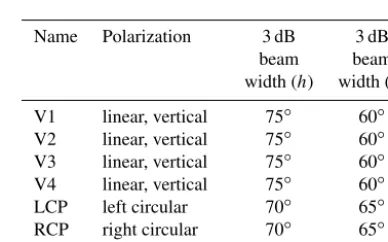
Table 1.Antenna description.
Name Polarization 3 dB 3 dB beam beam width (h) width (v)
V1 linear, vertical 75◦ 60◦ V2 linear, vertical 75◦ 60◦ V3 linear, vertical 75◦ 60◦ V4 linear, vertical 75◦ 60◦ LCP left circular 70◦ 65◦ RCP right circular 70◦ 65◦ DEF (linear, vertical) (75◦) (60◦)
Different antennas were utilized as EUTs. All antennas originate from the same product family by Huber+Suhner, have the same casing and were mounted within the RC in the same orientation. As indicated in Table 1, antennas “V1” to “V4” are identically constructed vertically polarized types (datasheet: Huber+ Suhner, 2019c). Antenna “LCP” is left circularly polarized (datasheet: Huber+ Suhner, 2019a) and antenna “RCP” is right circularly polarized (datasheet: Hu-ber+ Suhner, 2019b). Antenna “DEF” is identical to anten-nas “V1” to “V4”, but the casing was intentionally opened and the cover in the radiation direction was removed. There-fore, it is treated as a defect antenna.
In the following sections, the complex-valued correlation coefficientρcompl.,i,j with respect to the complex-valuedS21
parameters, as well as the correlation coefficientρpwr,i,j with respect to the transferred power to theith andjth antenna of two sample sequences, were calculated.
600 is the total number of steps (or step combinations). S21,i,n andS21,j,n are the S21 parameter for the nth mode
stirrer step and antenna i or j, respectively, andS21,i rep-resents its mean value over the mode stirring sequence. The (. . . )∗ indicates the complex conjugate and|. . .|represents the absolute value of their arguments, respectively.
ρcompl.,i,j= Ntotal
P
n=1
h
S21,i,n−S21,i ∗
· S21,j,n−S21,j i
s Ntotal
P
n=1
|S21,i,n−S21,i|2· Ntotal
P
n=1
|S21,j,n−S21,j|2 (1)
The definition of ρpwr,i,j with respect to the transferred power to theith andjth antenna is given in Eq. (2), whereby nis the individual mode stirrer step (combination),Ntotal=
600 is the total number of steps (or step combinations) and |S21,i|2represents the mean value of|S21,i|2over the mode stirring sequence for theith antenna, respectively.
In order to distinguish easily between the two correlation coefficients,ρcompl.,i,j will be denoted “complex correlation coefficient”, whereasρpwr,i,j will be denoted “power corre-lation coefficient” in the following sections. Note that both correlation coefficients depend on frequency.
The approach to consider the power correlation coeffi-cientρpwr,i,jin terms of transferred power has the advantage that it can also be applied for measurements of active devices (e.g., a wireless sensor/actuator node), which typically pro-vide only a RSSI (received signal strength indication) value without any information on phase or reflections due to a mis-matched antenna.
ρpwr,i,j=
Ntotal
P
n=1
h
|S21,i,n|2− |S21,i|2
·
|S21,j,n|2− |S21,j|2 i
s Ntotal
P
n=1
|S21,i,n|2− |S21,i|2 2
· Ntotal
P
n=1
|S21,j,n|2− |S21,j|2 2
(2)
The mode stirring sequence and other settings such as the loading of the chamber were kept constant for all measure-ment trials. The antenna holder was kept in the same position during measurement trials 1 to 4. For measurement trial 5, the position of the antenna holder for the EUT antennas was changed on the turntable.
3 Measurement results
This section is subdivided into different parts, focusing on distinct configurations and corresponding measurements. In the following subsections the measured sample sequences are correlated within the trials with the same configuration and antenna holder position (either trials 1 to 4 or trial 5), as a modification causes decorrelation (e.g., Amador et al., 2011). (The values in the following tables are rounded to two digits after the decimal point.)
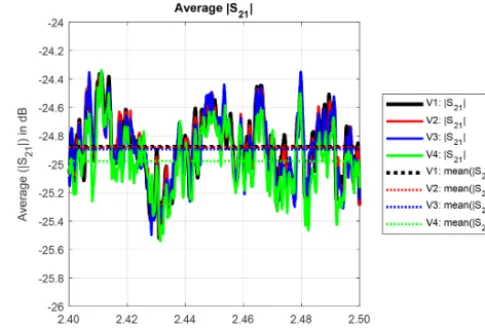
Figure 2.Average transmission for identically constructed anten-nas and measurement trial 4.
3.1 Identically constructed antennas within the same measurement trial
Within the scope of the proposed scenario, typically identi-cally constructed EUTs will be considered within an associ-ated measurement trial.
The magnitude of the average transmission over the full mode stirring sequence for the different antennas is exem-plarily shown for measurement trial 4 in Fig. 2. Since the antennas are identically constructed, they exhibit nearly the same characteristics, in particular the same magnitude of the average transmission over the full mode stirring sequence. The mean values over frequency differ by less than 0.2 dB. Corresponding figures for the other measurement trials are not shown here as they essentially show the same behavior.
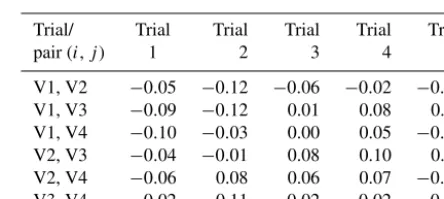
The real and imaginary parts of the complex correlation coefficients over frequency are shown in Figs. 3 and 4, re-spectively. As expected, the measured sample sequences for identically constructed antennas are highly correlated: the real part of the complex correlation coefficients is close to 1 and independent of the frequency. The imaginary part is al-most 0 and also independent of the frequency. This can be interpreted as no difference in the phases of the underlying sequence of complex-valuedS21parameters.
Figure 3.Real part of the complex correlation coefficients for iden-tically constructed antennas and measurement trial 4.
Figure 4.Imaginary part of the complex correlation coefficients for identically constructed antennas and measurement trial 4.
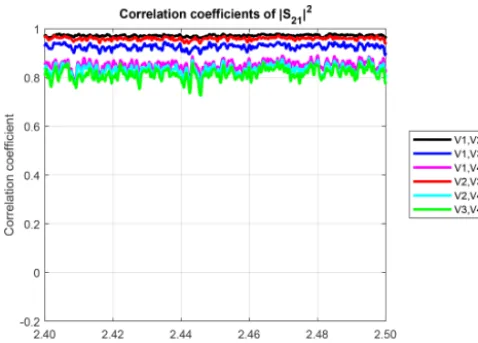
The power correlation coefficients over frequency are emplarily shown for measurement trial 4 in Fig. 5. As ex-pected, the measured sample sequences in terms of transmit-ted power for identically constructransmit-ted antennas are also highly correlated and almost constant over frequency.
Table 4 lists the mean values (over frequency) of the power correlation coefficients for the identically constructed an-tenna pairs and the different measurement trials 1 to 5. The overall mean value of the power correlation coefficients in this scenario is about 0.9. The power correlation coefficients are slightly lower than the absolute values of the complex correlation coefficients, by tendency.
Table 2.Mean values of the real part of the complex correlation coefficient over frequency for different antenna pairs.
Trial/ Trial Trial Trial Trial Trial pair (i,j) 1 2 3 4 5
V1, V2 0.97 0.91 0.99 0.99 0.94 V1, V3 0.95 0.85 0.98 0.96 0.94 V1, V4 0.95 0.86 0.99 0.92 0.92 V2, V3 0.98 0.88 0.98 0.97 0.95 V2, V4 0.98 0.87 0.98 0.91 0.94 V3, V4 1.00 0.97 0.98 0.90 0.96
Table 3.Mean values of the imaginary part of the complex correla-tion coefficient over frequency for different antenna pairs.
Trial/ Trial Trial Trial Trial Trial
pair (i,j) 1 2 3 4 5
V1, V2 −0.05 −0.12 −0.06 −0.02 −0.05 V1, V3 −0.09 −0.12 0.01 0.08 0.03 V1, V4 −0.10 −0.03 0.00 0.05 −0.09 V2, V3 −0.04 −0.01 0.08 0.10 0.09 V2, V4 −0.06 0.08 0.06 0.07 −0.03 V3, V4 −0.02 0.11 −0.02 −0.02 −0.12
3.2 Identically constructed antennas across different measurement trials
If measurements are performed over a large time span, the original calibration of the VNA might not be available or valid any more. The extent to which the measured sample se-quences correlate for identically constructed antennas origi-nating from different measurement trials (i.e., different VNA calibrations) is evaluated in this section.
Antenna V1 is considered here as a reference, whereby the first columns in the tables in this section indicate from which measurement trial (1 to 5) the sample sequences orig-inate. The correlation coefficients over frequency and the av-erage transmission are not shown here, as they are essentially equivalent to the results in Sect. 3.1.
The mean values (over frequency) of the real part and imaginary part of the complex correlation coefficient are listed in Tables 5 and 6, respectively.
Figure 5.Power correlation coefficients for identically constructed antennas and measurement trial 4.
Table 4.Mean values of the power correlation coefficient over fre-quency for different antenna pairs.
Trial/ Trial Trial Trial Trial Trial pair (i,j) 1 2 3 4 5
V1, V2 0.94 0.84 0.98 0.97 0.88 V1, V3 0.92 0.75 0.96 0.93 0.88 V1, V4 0.91 0.74 0.97 0.85 0.86 V2, V3 0.96 0.78 0.97 0.96 0.92 V2, V4 0.96 0.76 0.96 0.83 0.89 V3, V4 0.99 0.95 0.95 0.81 0.94
differences in the measured sample sequences. However, the measured sample sequences are still highly correlated.
The mean values of the power correlation coefficients over frequency for different antenna pairs are listed in Table 7. As before, the lines containing sample sequences originating from measurement trial 5 and reference sample sequences from other measurement trials are shown in italics and lead to correlation values around zero as well. The overall mean of the remaining (non-zero) power correlation coefficients is about 0.76, whereby the individual mean power correlation coefficients just slightly fluctuate around that value.
3.3 Different antenna types within the same measurement trial
Different antenna types with the same casing but electrically different design, in particular different polarizations, were also measured. Figure 6 shows the average transmission for the antennas V1, V2, LCP and RCP exemplarily for mea-surement trial 4. The average transmissions of all antennas are very similar and the mean values over frequency deviate only by about 0.3 dB. Therefore, it is not possible to differen-tiate between these antennas from the average transmission, even though the antennas have opposite polarizations.
Table 5.Mean values of the real part of the complex correlation coefficients over frequency for different antenna pairs. The first col-umn indicates from which measurement trial the measured sample sequences of the specified antenna originate.
Antenna: trial V1, V2 V1, V3 V1, V4
V1: 1; V2, V3, V4: 2 0.86 0.87 0.89 V1: 1; V2, V3, V4: 3 0.85 0.88 0.86 V1: 1; V2, V3, V4: 4 0.93 0.92 0.90 V1: 2; V2, V3, V4: 3 0.84 0.86 0.86 V1: 2; V2, V3, V4: 4 0.83 0.84 0.84 V1: 3; V2, V3, V4: 4 0.85 0.85 0.85
V1: 1; V2, V3, V4: 5 −0.03 −0.03 −0.03
V1: 2; V2, V3, V4: 5 −0.02 −0.02 −0.02
V1: 3; V2, V3, V4: 5 −0.03 −0.03 −0.03
V1: 4; V2, V3, V4: 5 −0.03 −0.03 −0.03
Table 6.Mean values of the imaginary part of the complex corre-lation coefficients over frequency for different antenna pairs. The first column indicates from which measurement trial the measured sample sequences of the specified antenna originate.
Antenna: trial V1, V2 V1, V3 V1, V4
V1: 1; V2, V3, V4: 2 −0.06 −0.08 0.01 V1: 1; V2, V3, V4: 3 −0.12 −0.06 −0.07 V1: 1; V2, V3, V4: 4 −0.08 0.01 −0.01 V1: 2; V2, V3, V4: 3 −0.16 −0.11 −0.12 V1: 2; V2, V3, V4: 4 −0.11 −0.04 −0.05 V1: 3; V2, V3, V4: 4 −0.01 0.07 0.06
V1: 1; V2, V3, V4: 5 0.02 0.02 0.02
V1: 2; V2, V3, V4: 5 0.02 0.02 0.02
V1: 3; V2, V3, V4: 5 0.01 0.02 0.02
V1: 4; V2, V3, V4: 5 0.02 0.02 0.02
Table 7.Mean values of the power correlation coefficients over frequency for different antenna pairs. The first column indicates from which measurement trial the measured sample sequences of the specified antenna originate.
Antenna: trial V1, V2 V1, V3 V1, V4
V1: 1; V2, V3, V4: 2 0.73 0.77 0.80 V1: 1; V2, V3, V4: 3 0.75 0.77 0.75 V1: 1; V2, V3, V4: 4 0.88 0.84 0.81 V1: 2; V2, V3, V4: 3 0.73 0.75 0.75 V1: 2; V2, V3, V4: 4 0.70 0.71 0.71 V1: 3; V2, V3, V4: 4 0.73 0.73 0.73
V1: 1; V2, V3, V4: 5 0.01 0.01 0.01
V1: 2; V2, V3, V4: 5 0.01 0.01 0.01
V1: 3; V2, V3, V4: 5 0.01 0.01 0.01
Figure 6.Average transmission for different antennas and measure-ment trial 4.
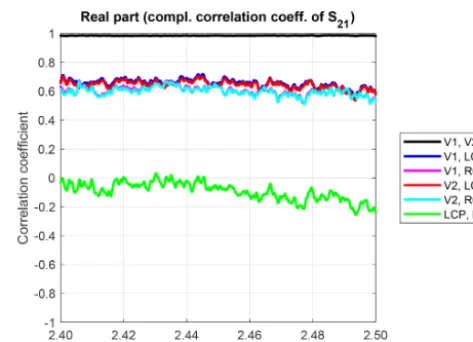
The real part and the imaginary part of the complex corre-lation coefficients (over frequency) are depicted in Figs. 7 and 8, respectively. Tables listing mean values (over fre-quency) of the real part and the imaginary part of the complex correlation coefficients for the different measurement trials are not explicitly shown here as the results are essentially the same as in trial 4 with minor fluctuations as in the previous sections.
The real part for the identically constructed antenna pair V1 and V2 is almost 1. For the antenna pairs consist-ing of one vertically polarized antenna (V1 or V2) and one circularly polarized antenna (LCP or RCP), the real parts lie approximately between 0.6 and 0.7. These values are very close to the theoretical value of the polarization loss between a linearly and a circularly polarized antenna of 3 dB, which is 1/
√
2≈0.71 for amplitude quantities.
The real and imaginary parts of the complex correlation coefficients between the antennas LCP and RCP are almost zero. Therefore, different polarizations can be detected even if the average transmissions are almost identical. The power correlation coefficients between the antennas LCP and RCP are almost zero, too. As a consequence, different polariza-tions can also easily be detected by calculating the power correlation coefficient.
Figure 9 shows the power correlation coefficients for these antennas and for measurement trial 4. The mean values over frequency for all antennas are listed in Table 8. The power correlation coefficient between one vertically polarized an-tenna (V1 or V2) and one circularly polarized one (LCP or RCP) lies between 0.2 and 0.6 with mean values (over fre-quency) between 0.32 and 0.44.
These values are lower than the expected loss due to po-larization mismatch of 3 dB or 0.5 (in terms of power) be-tween a linear polarized antenna (or electromagnetic wave) and a circularly polarized antenna (or electromagnetic wave). A slightly smaller correlation coefficient may also be caused
Figure 7.Real part of the complex correlation coefficients for dif-ferent antennas and measurement trial 4.
Figure 8.Imaginary part of the complex correlation coefficients for different antennas and measurement trial 4.
by the minor differences in the horizontal and vertical beamwidth between the vertically polarized and circularly polarized antennas, as shown in Table 1.
3.4 Defect antenna
The average transmission of the defect antenna (DEF) with-out housing cover is abwith-out 5 dB lower than the average trans-missions of the other ones (V1, LCP and RCP), as shown in Fig. 10.
correla-Figure 9.Correlation coefficients for different antennas and mea-surement trial 4.
Table 8.Mean values of the power correlation coefficient over fre-quency for different antenna pairs.
Trial/ Trial Trial Trial Trial Trial pair (i,j) 1 2 3 4 5
V1, V2 0.94 0.84 0.98 0.97 0.88 V1, LCP 0.42 0.34 0.36 0.44 0.38 V1, RCP 0.39 0.32 0.34 0.38 0.34 V2, LCP 0.43 0.35 0.36 0.43 0.44 V2, RCP 0.41 0.33 0.33 0.37 0.38 LCP, RCP 0.03 0.03 0.03 0.03 0.03
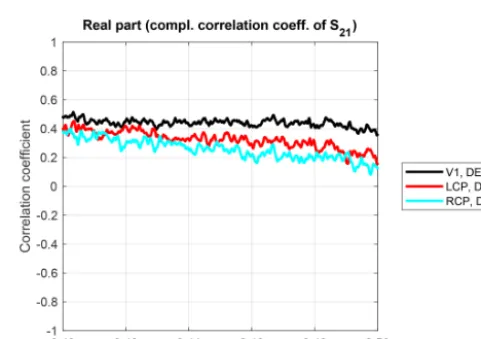
tion coefficients is no longer close to zero, but notably nega-tive, indicating a negative phase offset of the underlyingS21
-parameter sequences.
The power correlation coefficients for the antennas DEF, V1, LCP and RCP in trial 4 are shown in Fig. 13. The mean values (over frequency) for all antennas in measure-ment trial 4 are listed in Table 9.
The mean power correlation coefficients between the ver-tically polarized antennas and the defect one are about 0.65 and are significantly lower than the pairwise power corre-lation coefficients between two vertically polarized anten-nas, which are about 0.9 (see Table 4). However, the mean power correlation coefficients between the defect antenna and a circularly polarized antenna are about 0.29 and even slightly lower than the mean correlation coefficients between a vertically and a circularly polarized antenna, as shown in Sect. 3.3. As a consequence, the defect antenna can also be detected by a low power correlation coefficient, but neverthe-less the strongly reduced average transmission in this case is an indication of a deviation or defect, too.
Figure 10.Average transmission for different antennas and mea-surement trial 4.
Figure 11.Real part of the complex correlation coefficients for dif-ferent antennas and measurement trial 4.
3.5 Different antenna types across different measurement trials
Different antenna types with corresponding sample se-quences originating from different measurement trials are in-vestigated in this section. Sample sequences of antennas V1, LCP and RCP originating from measurement trials 1 to 3 are used as references and correlated with the sample sequence of antennas DEF, LCP and RCP from measurement trial 4. Hence, the feasibility of detecting a defect antenna or an an-tenna with another polarization across different measurement trials is investigated here. Tables 10 and 11 list the mean val-ues (over frequency) of the real and imaginary parts of the complex correlation coefficients.
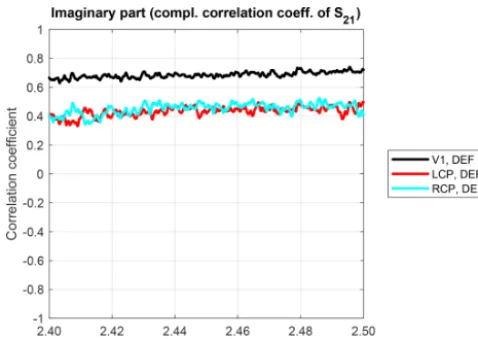
Figure 12.Imaginary part of the complex correlation coefficients for different antennas and measurement trial 4.
Figure 13.Power correlation coefficients for different antennas and measurement trial 4.
addition, the values are almost independent of the trial. The real parts for a circularly polarized antenna and V1 are ap-proximately 0.55. Pairs consisting of the same antenna (ei-ther only antenna LCP or only antenna RCP) lead to highly correlated sample sequences with mean values of the real part of approximately 0.9. These results are on the same order of magnitude as in Sect. 3.2, in particular Table 5 for identi-cally constructed antennas across different measurement tri-als. Instead, pairs consisting of the antennas LCP and RCP cause uncorrelated sample sequences, as already indicated in Sect. 3.3. Therefore both the mean real and imaginary corre-lation coefficients are close to zero in Tables 10 and 11.
The mean values of the imaginary parts for the defect an-tenna DEF are close to 0.67 with anan-tenna V1 as a reference and close to 0.44 with any circularly polarized antenna as a reference. As a consequence, the differences between the antennas across different measurement trials can easily be detected from the complex correlation coefficients.
Table 9.Mean values of the power correlation coefficients over fre-quency for different antenna pairs.
Pair (i,j) Trial 4
V1, DEF 0.66 V2, DEF 0.65 V3, DEF 0.64 V4, DEF 0.65 LCP, DEF 0.30 RCP, DEF 0.28
Table 10.Mean values of the real part of the complex correlation coefficients over frequency for different antenna pairs. The Roman numerals indicate from which measurement trial the measured sam-ple sequences of the specified antenna originate.
Antenna: trial DEF: 4 LCP: 4 RCP: 4
V1: 1 0.48 0.63 0.58
V1: 2 0.53 0.56 0.53
V1: 3 0.48 0.57 0.55
LCP: 1 0.31 0.98 −0.09 LCP: 2 0.37 0.92 −0.09 LCP: 3 0.33 0.91 −0.10 RCP: 1 0.27 −0.09 0.95 RCP: 2 0.32 −0.08 0.87 RCP: 3 0.30 −0.09 0.88
Table 11.Mean values of the imaginary part of the complex cor-relation coefficients over frequency for different antenna pairs. The Roman numerals indicate from which measurement trial the mea-sured sample sequences of the specified antenna originate.
Antenna: trial DEF: 4 LCP: 4 RCP: 4
V1: 1 0.65 0.01 −0.05 V1: 2 0.63 −0.02 −0.06
V1: 3 0.73 0.06 0.00
LCP: 1 0.45 0.06 0.01 LCP: 2 0.39 −0.10 0.02 LCP: 3 0.45 0.04 0.00 RCP: 1 0.45 −0.02 −0.02 RCP: 2 0.42 −0.01 −0.09 RCP: 3 0.46 −0.01 −0.03
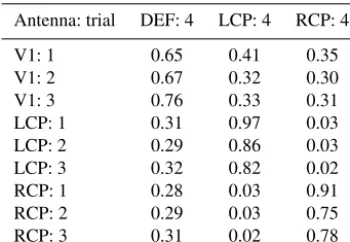
Table 12.Mean values of the power correlation coefficients over frequency for different antenna pairs. The Roman numerals indicate from which measurement trial the measured sample sequences of the specified antenna originate.
Antenna: trial DEF: 4 LCP: 4 RCP: 4
V1: 1 0.65 0.41 0.35
V1: 2 0.67 0.32 0.30
V1: 3 0.76 0.33 0.31
LCP: 1 0.31 0.97 0.03 LCP: 2 0.29 0.86 0.03 LCP: 3 0.32 0.82 0.02 RCP: 1 0.28 0.03 0.91 RCP: 2 0.29 0.03 0.75 RCP: 3 0.31 0.02 0.78
The power correlation coefficients for the pairs including a circularly polarized antenna (LCP or RCP) and the defect antenna are around 0.3 and therefore on the same order of magnitude as in Sect. 3.4. As a consequence, there is only a marginal deviation due to different trials, and the difference between the antennas is notable.
4 Conclusions
A novel approach to utilize the correlation between mea-sured sample sequences of EUTs in a RC in order to detect deviations from a reference has been presented in this pa-per. If the position of the EUT and the configuration of the RC were kept the same, identically constructed EUTs induce highly correlated sample sequences, whereas differences be-tween the radiation characteristics, in particular different po-larizations, can easily be detected. Furthermore, identically constructed EUTs measured on different days with different VNA calibrations (i.e., across different measurement trials) are highly correlated. Hence it is possible to utilize sample sequences measured as a reference for a re-calibrated setup, typically. Also, differences between the directional diagrams of two EUTs can be detected, as this also results in a different weighting of the electromagnetic field components and thus causes decorrelation.
The measurements indicate that the complex correlation coefficients are more sensitive to deviations as they allow an analysis by the corresponding real and imaginary parts. In particular, if the underlaying sample sequences originate from different measurement trials, the complex correlation coefficients are more suitable than the power correlation co-efficients. Nevertheless, as many active devices provide only a magnitude (like a RSSI value without any phase informa-tion), the measurements show that deviations from a given reference can also be detected by utilizing the power correla-tion coefficients, generally.
This new approach can be used to extend the existing methods to measure, e.g., TRP or TIS in a RC (e.g., 3GPP,
2017a, 2016). For example, two EUTs with the same hous-ing were measured in a RC with the classic method and showed the same TRP or TIS values. Using the approach pre-sented above to apply correlation, the two measured sample sequences can provide a conclusion on the equality of the radiation characteristics. Therefore, no extra measurement equipment or measurement time is needed, as the measure-ment sample sequences are recorded anyway, typically.
Data availability. The underlying measurement data are not pub-licly available and can be requested from the authors if required.
Competing interests. The authors declare that they have no con-flict of interest.
Special issue statement. This article is part of the special issue “Sensors and Measurement Systems 2018”. It is a result of the “Sen-soren und Messsysteme 2018, 19. ITG-/GMA-Fachtagung”, Nürn-berg, Germany, from 26 June 2018 to 27 June 2018.
Acknowledgements. This article is an extended article version of the article “Employing correlation for wireless device charac-terization in reverberation chambers” presented at the Conference “19. ITG/GMA-Fachtagung Sensoren und Messsysteme”, Nurem-berg, Germany, 26 June–27 June 2018. It is published with the kind permission of VDE VERLAG GmbH, Berlin, Germany.
Review statement. This paper was edited by Leonhard Reindl and reviewed by three anonymous referees.
References
Amador, E., Lemoine, C., and Besnier, P.: Numerical study of spatial correlation in reverberation chamber, Electron. Lett., 47, 1319–1320, https://doi.org/10.1049/el.2011.3180, 2011. Bluetest AB: Reverberation Test Systems RTS 60,
avail-able at: https://bluetest.se/products/chambers (last access: 26 April 2019), 2018.
Cammin, C., Krush, D., Heynicke, R., and Scholl, G.: Messtech-nische Evaluierung einer Modenverwirbelungskammer als Tes-tumgebung für drahtlose Sensor/Aktor-Module, tm – Technis-ches Messen, 84, 106–115, https://doi.org/10.1515/teme-2017-0049, 2017.
Cammin, C., Krush, D., Heynicke, R., and Scholl, G.: Test method for narrowband F/TDMA-based wireless sensor/actuator networks including radio channel emulation in severe mul-tipath environments, J. Sens. Sens. Syst., 7, 183–192, https://doi.org/10.5194/jsss-7-183-2018, 2018.
Chen, X. and Kildal, P. S.: OnS-parameter based complex corre-lation of multi-port antenna, in: The 2015 9th European Confer-ence on Antennas and Propagation (EuCAP), 13–17 April 2015, Lisbon, Portugal, 1–4, 2015.
Chen, X., Kildal, P. S., and Carlsson, J.: Spatial correlations of in-cremental sources in isotropic environment such as reverbera-tion chamber, in: Proceedings of the 5th European Conference on Antennas and Propagation (EUCAP), 10–15 April 2011, Rome, Italy, 1753–1757, 2011.
Delangre, O., Doncker, P. D., Lienard, M., and Degauque, P.: Analytical angular correlation function in mode-stirred reverberation chamber, Electron. Lett., 45, 90–91, https://doi.org/10.1049/el:20093099, 2009.
Deutsches Institut für Normung e.V. (DIN): DIN EN 61000-4-21:2011-12; VDE 0847-4-21:2011-12, Elektromag-netische Verträglichkeit (EMV) – Teil 4–21: Prüf- und Messverfahren – Verfahren für die Prüfung in der Modenverwirbelungskammer (IEC 61000-4-21:2011); Deutsche Fassung EN 61000-4-21:2011, available at: http://www.beuth.de/de/norm/din-en-61000-4-21/145741951 (last access: 26 April 2019), 2011.
Gradoni, G., Primiani, V. M., and Moglie, F.: Determination of the reverberation chamber stirrer uncorrelated positions by means of the spatial and frequency correlation matrix, in: 2013 In-ternational Symposium on Electromagnetic Compatibility, 2– 6 September 2013, Brugge, Belgium, 425–430, 2013.
Holloway, C. L., Hill, D. A., Ladbury, J. M., Wilson, P. F., Koepke, G., and Coder, J.: On the Use of Reverberation Cham-bers to Simulate a Rician Radio Environment for the Testing of Wireless Devices, IEEE T. Anten. Propag., 54, 3167–3177, https://doi.org/10.1109/TAP.2006.883987, 2006.
Huber+Suhner: SENCITY Spot-S Indoor Antenna 1324.19.0007, available at: https://ecatalog.hubersuhner.com/product/ E-Catalog/Radio-frequency/Antennas-accessories/Antennas/ 1324-19-0007 (last access: 26 April 2019), 2019a.
Huber+Suhner: SENCITY Spot-S Indoor Antenna 1324.19.0008, available at: https://ecatalog.hubersuhner.com/product/ E-Catalog/Radio-frequency/Antennas-accessories/Antennas/ 1324-19-0008 (last access: 26 April 2019), 2019b.
Huber+Suhner: SENCITY Spot-S Indoor Antenna 1324.19.0002, avialable at: https://ecatalog.hubersuhner.com/product/ E-Catalog/Radio-frequency/Antennas-accessories/Antennas/ 1324-19-0002 (last access: 26 April 2019), 2019c.
Janssen, N., Remley, K. A., Holloway, C. L., and Young, W. F.: Correlation coefficient and loading effects for MIMO antennas in a reverberation chamber, in: 2013 International Symposium on Electromagnetic Compatibility, 2–6 September 2013, Brugge, Belgium, 2013.
Kildal, P. S. and Rosengren, K.: Correlation and capacity of MIMO systems and mutual coupling, radiation efficiency, and diver-sity gain of their antennas: simulations and measurements in a reverberation chamber, IEEE Commun. Mag., 42, 104–112, https://doi.org/10.1109/MCOM.2004.1367562, 2004.
Kildal, P. S., Chen, X., Orlenius, C., Franzen, M., and Patane, C. S. L.: Characterization of Reverberation Cham-bers for OTA Measurements of Wireless Devices: Phys-ical Formulations of Channel Matrix and New Uncer-tainty Formula, IEEE T. Anten. Propag., 60, 3875–3891, https://doi.org/10.1109/TAP.2012.2201125, 2012.
Kostas, J. G. and Boverie, B.: Statistical Model for a Mode-Stirred Chamber, IEEE T. Electromag. Compatibil., 33, 366–370, https://doi.org/10.1109/15.99120, 1991.
Pfennig, S.: A General Method for Determining the Independent Stirrer Positions in Reverberation Chambers: Adjusting the Cor-relation Threshold, IEEE T. Electromag. Compatibil., 58, 1252– 1258, https://doi.org/10.1109/TEMC.2016.2567541, 2016. Pirkl, R. J., Remley, K. A., and Patane, C. S. L.:
Reverberation Chamber Measurement Correlation, IEEE T. Electromag. Compatibil., 54, 533–545, https://doi.org/10.1109/TEMC.2011.2166964, 2012.
Rohde & Schwarz: R & S ZNB Vector Network Ana-lyzer – Brochures and Data Sheets, available at: https: //www.rohde-schwarz.com/us/brochure-datasheet/znb/, last ac-cess: 26 April 2019.
Schwab, A. J. and Kürner, W.: Elektromagnetische Vertäglichkeit, in: VDI-Buch, 6. bearb. und aktualisierte Aufl. edn., Springer, Berlin, 2011.
3GPP: 3GPP TS 34.114 V12.2.0 (2016-09): User Equip-ment (UE)/Mobile Station (MS) Over The Air (OTA) antenna performance; Conformance testing, available at: https://portal.3gpp.org/desktopmodules/Specifications/ SpecificationDetails.aspx?specificationId=2361 (last access: 26 April 2019), 2016.
3GPP: 3GPP TR 25.914 V14.0.0 (2017-03): Measurements of radio performances for UMTS terminals in speech mode, avail-able at: https://portal.3gpp.org/desktopmodules/Specifications/ SpecificationDetails.aspx?specificationId=1343 (last access: 26 April 2019), 2017a.