
E-ISSN 2308-9830 (Online) / ISSN 2410-0595 (Print)
A Survey on Boosting Channel Capacity through Optical
Modulation
Aisha Ejaz1, Haad Akmal2 and Mohammad Mohsin3
1
Alumni, Department of Electrical Engineering, COMSATS Lahore, Pakistan
2
Department of Electrical Engineering, COMSATS Lahore, Pakistan
3
Department of Computing and Communications, Lancaster University, UK
E-mail: [email protected], [email protected], [email protected]
ABSTRACT
Optical fiber systems have become the linchpin of modern telecommunications for the broadband networks worldwide. Wide Bandwidth transmission of a signal with low latency is a necessity in today’s applications. Optical fibers posses the characteristics of offering huge transmission bandwidth with meager delay and a choice on selecting transmission medium intended for transmission of high data rate in telecommunication networks. This survey paper gives an overview on the evaluation of traffic trends in optical communication networks and discusses their key technologies. It emphasizes the anticipated capacity dilemma and required challenges to acquire by presenting an optimal solution to compete with the traffic growth in the next decade.
Keywords:
Broadband networks, Bandwidth, Channel capacity, Optical Fiber Communication (OFC),
Optical Modulation, Optical networks.1 INTRODUCTION
Optical fiber transmission became a prominent feature in the end of 19th century because of its remarkable feature. It was experimented that by using signaling lamps, optical fibers were successfully encoded for message transmission early in the 2nd century B.C. The existing copper wire transmission system has served the whole world for a long time before the arrival of optical fiber. But the explosive growth of internet traffic and users demands high capacity networks. Only optical networks can provide the required capacity and bandwidth-on-demand. An optical fiber is composed of silica; therefore, it is transparent and flexible filament with a diameter thicker than a human hair. .It acts as a medium for light, so that light could travel through it. A communication technology based on light (when it passes through fiber) is called Optical Fiber Communication (OFC).
Communications Networks forming global information infrastructure and worldwide Broadband internet access would not have been possible today without high capacity optical fibers. Fiber optics shares significant role in the progress of telecommunication systems in terms of speed and quality and their use is not only confined to telecom links but also used in cable TV, internet traffic and within buildings. OFC Developments projects range in scale from global to interoffice [1].
Fig. 1. Fiber Networks as Broadband Infrastructure [2]
Advances in long-haul network technology in optical reach and fiber capacity over the last decade have passed the core network’s bandwidth to access and metro networks [3]. For the past three decades, a remarkable increase has been seen in the capacity of single mode fibers rising up to 10,000 times [4]. Network traffic has increased to a hundredfold during this time period. Due to the current growth rate between traffic demand and fiber capacity, it is predicted that capacity shortage is likely to occur within 10-15 years.
The early years of optical communication underwent a massive development of technology. These systems observed bit rate increment at a moderate rate in the single optical channel and the optical transmission windows gradually shifted from 800 to 1300 to 1550 nm [5]-[7]. Introduction of Wavelength Division Multiplexing (WDM) in the late 90’s caused capacity to grow at a dramatic rate resulting in a factor of 1000 increase in a decade. Whereas the progress has slowed down as all the available bandwidth is occupied and improvement in the utilization of optical bandwidth are required for the increase in capacity.
The current growth rate predicts that capacity will be lagging traffic by a factor 10 over the next decade [4]. Introduction of WDM and optical amplifiers has caused the traffic growth to shift the core network’s interface requirement to terabit per second from the few gigabits per second. Till 1996, all the available channels were filled and the experiment on 1 Tb/s was performed and during this duration, researched switched to Spectral Efficiency (SE) in order to increase the further capacity. This system capacity has been doubled every 6 months and light wave systems were directed by WDM technique to operate at a bit rate of 10 Tb/s by 2001 [8]. The significant emphasis of These WDM based light wave systems is to transmit many channels through the WDM technique in order to increase capacity. From that
time until present, a slow capacity rate has been observed as research focused on spectral efficiency (SE). Fig 2 shows relation of achieved SE with years starting from years 1990 to 2020. The fig clearly indicates that improvement in SE has lead to improvement in capacity and 2015 has been marked as an approaching year directing to fiber capacity limit.
Fig. 2. SE achieved in research demonstrations versus year [4]
Less speed is the reason behind capacity shortage and on the other hand there is a sharp increase in network traffic. Higher capacity systems generally means higher spectral efficiencies and data rate of optical channels. The current capacity record of 101.7 Tb/s achieved a spectral efficiency of 11 b/s H(z) [7] using methods of pilot tone based phase noise mitigation, coherent detection and offline processing.. The modulation format is QAM with 128 constellation points.
1.1 Fiber Linear and Non-Linear Effects
Chromatic Dispersion is a key stimulus that limits the BW of SMFs. It is a phenomenon associated with wave length dependent pulse spreading of output light pulse. When light of different wavelengths travels along the fiber at different velocities and reaches the receiver end at different times, thereby, creating this dispersion effect. Polarization mode dispersion (PMD) causes pulse broadening by changing fiber polarization properties. One of its reasons is the asymmetry of fiber core. It is independent of wavelength but relies on fiber length considerably [16].
The nonlinear fiber capacity is due to power dependency of refractive index. This well known phenomenon called the Kerr effect is referred to as fiber non-linearity [17]. It is also affected by system length and fiber parameters. These parameters namely: the fiber loss coefficient α, fiber dispersion D and fiber nonlinear coefficient ϒ. With reference to [4], after observing graphs and details of calculated maximum spectral efficiency for parameters of SMFs, it is concluded that these factors would not be sufficient and don’t have significant impact on improving fiber capacity as desired in upcoming years.
Spatial multiplexing, on the other hand, can increase the fiber capacity by having a large effect on system’s cost only if the similar increase has been observed in the capacity of subsystems attached to the fiber. Spatial multiplexing development in fiber requires a major breakthrough in the vast area related to integrate technology including optical amplifiers, receivers, transmitters and other components.
Although fiber is a high capacity system but nowadays communication growth is at its peak from a surge in increased number of users and with the consumption in bandwidth-intensive applications. The growth of triple play services especially video traffic has increased capacity demands, making it the most significant factor [18]. In June 2011, Cisco forecast that the annual global Internet traffic will quadruple between 2010 and 2015, to reach 966 Exabyte’s - or nearly a zettabyte 1021 bytes of data [19]. Internet video will constitute 61 percent of the total traffic carried in 2015, up from 26 percent in 2010 (Figure 3). The forecast will doubly increase Internet-enabled device connections by 2015.
Fig. 3. Internet Traffic (Cisco VNI Forecast) [19]
Its usage will cause capacity requirement to shoot causing an alarming situation within coming years. These advancements call for such ways that are scalable to increase capacity and there are four approaches to do so:
1. Optical Transmitter
2. Optical Receiver
3. Optical Fiber
4. Optical Modulation
The progress of optical transmitter and receiver technology is playing a key factor in the commercialization of OFC.
A single-channel 2 μm transmitter capable of delivering >52Gbit/s data signals is demonstrated in [20], which twice the previously attained capacity. The 2 μm wave band is likely to replace traditional 1.55 μm region with its distinct features making it a
potential new window for optical
telecommunications. This new approach is implemented using Digital Signal Processing (DSP). Maximized signal quality and required capacity for a particular bandwidth is obtained with it. Discrete Multitone Modulation (DMT) is deployed by a Fabry–Perot semiconductor laser via direct current modulation thereby making transmitter low-cost. DMT mitigates frequency selective fading and transmits information on the best-performing subcarriers. It is very beneficial from the point of attaining high transmission capacity for channels [20].
the end of the link, at the receiver, without the inclusion of new components within the link. As optical fibers carry maximum amount of data on them, therefore enhancing capacity using this way is more crucial. Current capacity of fiber is unable to cope with the context of increasing demand with internet usage, thus the easier and cheaper way is to modify the receivers rather than relaying cables [21].
A procedure that simultaneously captures a set of optical channels along with a single receiver is, known as a super-channel. The researchers used a '16 Quadrature-Amplitude-Modulation (QAM) super-channel' to create a high-capacity optical signal made of different frequencies using frequency, amplitude and phase. The super-channel was then detected using a high-speed super-receiver and latest signal processing techniques enabled the reception of all the channels together and without error. Further new methods will be tested on super channels by researchers namely digital cable TV, cable modems and Ethernet connections by deploying M-QAM (64,256 and 1024 constellation points) [21].
Designing of a new transmitter and receiver by changing its specifications or replacing by latest innovations can resolve this issue of “Capacity Crunch” to quite an extent but requires hardware for its implementation which was not possible for research purpose in the current circumstances [22].
Optical fiber provides unsurpassed transmission bandwidth, but light propagates 31% slower in a silica glass fiber than in vacuum, thus compromising latency. Air guidance in Hollow-Core Fiber (HCF) reduces this problem of fiber latency quite extensively as it confines the light to the core using a cladding structure [23]. Despite of
its potential to increase SE, however, state-of-the-art technology cannot accomplish the combined values of loss, bandwidth and mode-coupling characteristics necessitate for the transmission of high-capacity data.
This is currently one of the primary obstacles of deploying hollow-core fiber for the purposes of increasing capacity. In 2013, Coriant demonstrated a capacity of 57.6 Tbps HCF using space division multiplexing and aims to incorporate HCF in 1.55 µm window [24].
Similarly, Multicore fiber (MCF) is among the innovative fibers which themselves are a part of elastic optical network based on Space-Division Multiplexing (SDM) technology. It has a tendency to overcome the physical limitations of existing fibers because it possesses a larger transmission capacity as compared to traditional SMFs. This innovative fiber, however, holds a significant problem due to multiple crowded cores embedded in fiber’s cladding. Signals transmitted within these cores suffer from intercore crosstalk, ultimately limiting transmission performance.
It is a very serious impact from the perspective of networking but can be improved on exhibiting trade-off policies as proposed in [25].Complex Digital Signal Processing (DSP) can also tackle the signals affected from crosstalk. Therefore, replacement of current Optical network with these fibers in the long run is also not economically feasible.
Fig. 4. Flowchart for Capacity Upgrading Implementation
2 OPTICAL MODULATION TECHNIQUES
2.1Optical Modulation
For the effective transmission of message signal, some of the parameters (amplitude, frequency and phase) of carrier signals are varied relating to the message signal. This conversion process is called Modulation. The modulation of light beam with respect to optical fiber communication (OFC) or the mapping of digital information on an optical carrier is known as Optical Modulation. Various parameters of optical fiber are varied namely refractive index, light coherency, transmission and reflection factor. Direct modulation may result in loss of information; pulse spreading that is why optical modulation is preferred.
The major advantage of using digital modulation formats in fiber optics is reduced hardware complexity, interference and noise. It provides more information capacity, better communication and high data security whereas in the case of analogue signals, a large number of wave forms are required resulting in a large bandwidth for the transmitted symbol [26].
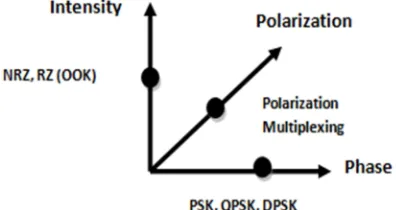
Different optical modulation techniques are required as well to encode or extract information from the transmission medium (optical fiber). In contrast to electrical communication, information is transmitted in optical format by changing these three characteristics as shown in Fig 5:
I. Phase ( includes frequency too)
II. Intensity
III. Polarization
2.2Modulation Formats
When the data rate of 40 G b/s started to enter optical networking, line coding and modulation formats became the center of interest along with the achievement of high spectral efficiencies.
These formats combat mitigate against linear and non-linear impairments from OFC. Due to current data rate limitation, it is of utmost importance to consider practical aspects of modulation and modulator technology while designing optical modulation format for a specific system. Three basic widely used modulators are electro absorption modulator, directly modulated laser and Mach-Zehnder modulators (MZMs) [27].
MZM works on the interference principle and is managed by optical phase modulation. Due to their good modulation performance and the independent possibility of modulating intensity, many of the advanced optical modulation formats are based on using it [29].
In this paper intensity and phase modulation will be focused only because polarization is affected by nonlinear effects and thus attenuates. Modulation techniques promises to eliminate capacity limitation but their implementation in fiber optic system invokes certain challenges which will be discussed below:
2.3Intensity Modulation Formats
It is the most popular type of modulation used in fiber-optic communications system. Digital signal is represented by instantaneous optical power levels in optical intensity modulation.
2.3.1 Binary Amplitude Shift Keying (ASK)
Amplitude shift keying (ASK) or On-Off Keying (OOK) in its various flavors has been used widely in OFC with its simplicity and cheapest digital coding schemes, where ASK and OOK represent digital signals.
In this technique, the baseband signal is multiplied by a carrier frequency; the binary 0 is represented by no pulse (“0” W) and binary 1 is represented by a positive pulse (“A” W) [29]. Figure 6 illustrate a ASK modulated signal.
Fig. 6. BASK modulated signal [30]
Positive Aspects: In advanced communication systems, multilevel signaling is a technique that utilizes more number of bits per symbol to achieve high transmission capacity.
In ASK, 4-ary digital modulation formats are developed having M= where b shows bits per symbol .M=4 symbolize 4-ary format and therefore increases the transmission capacity to double up while the spectral width is maintained [31]. It also shows good performance in integration and hardware implementation. It has its application in very low speed telemetry circuits.
Drawbacks: The 8-ary ASK is also deployed in OFC to three-fold increase the transmission capacity. Channel capacity is improved despite the drawbacks of receiver sensitivity and OSNR degradation. It is no longer an optimal format for next generation high capacity optical networking systems [29]. It has following line coding schemes used to incorporate in different modulation methods while generating these formats:
a) Non-Return-to-Zero (NRZ-OOK)
The non-return-to-zero (NRZ) is the simplest and most dominant modulation format in optical fiber communication (OFC) systems based on direct detection method. NRZ is used in the early days as it requires low electrical bandwidth as compared to RZ and other simplest formats. The narrow spectrum width of NRZ improves the dispersion tolerance but is severely affected by inter symbol interference (ISI) [32]. In this simplest modulation scheme, logic 0 is represented by a dark period and logic 1 by a flash of light. As shown in figure 7, logic 1 is transmitted as an electric pulse with amplitude (A) in volts and the duration Ԏ (tau) in nano seconds. Similarly logic 0 is represented as 0 V during tau ns. The maximum data rate is up to 100 Gb/s.
b) Return-to-zero (RZ-OOK)
The RZ pulse width occupies half bit slot but utilizes twice the B.W as compared to NRZ. The RZ pulse shape has high robustness to fiber nonlinear effects .It has reduce spectral efficiency and dispersion tolerance owing to its broad spectrum [27]. It represents logic 1 as a pulse with amplitude (A) and the duration ( ), while logic 0 is represented by a zero signal shown in figure 7. The upper limit of RZ data rate is 50G b/s. NRZ modulation format is preferred by commercial systems; however, it is merely used nowadays and trend is increasing to switch to alternate formats like RZ.
c. Carrier-Suppressed Return-to-Zero (CSRZ)
In CS-RZ pulse, there is a suppressed carrier with a π phase shift between adjacent bits. Therefore, the average optical field in it is zero (there is no DC component) [34]. It is also a sub form of RZ pulse. Two electro-optical modules are required by CS-RZ for its generation.
CS-RZ is a better tolerant to chromatic dispersion (CD) and fiber nonlinearity. It also provides robustness against transmission impairments [35].It is compatible for long distances due to low BER.
2.3.2 Binary Frequency Shift Keying (FSK)
Frequency shift keying (FSK) uses two frequencies for the representation of 0 (low) and 1(high) as depicted in fig below. FSK system is defined by modulation index. The value of modulation index can be used to change FSK based modulations format even a small change enables compressed optical [36]. The total bandwidth of a FSK signal is calculated by 2∆f+2B, where B is the bit rate. When ∆f>>B, the BW is bit rate independent and becomes 2∆f.
Fig. 8. BFSK [37]
Positive Aspect: Its information carrying capacity is better than ASK [38].Moreover, it is used in high performance digital radio systems.
Drawbacks: In this modulation technique the envelope of optical signal does not change as compared of varying amplitude of ASK. Therefore, the complexity of receiving system increases causing inefficiency. The main drawback of this new technique is that the transmitter and receiver parameters have to be in-line (equivalent) with the transmission line characteristic. The second major disadvantage is complex signal detection of FSK-based formats that is why they cannot be deployed in current transmission systems [34].
Current Evolution: Recently, Dispersion Supported Transmission (DST), a FSK-based modulation format, was considered for the MAN networks execution.
2.4Differential Phase Modulation Formats
When Digital signal are signified by the optical carrier phase, this phenomenon is known as optical phase-shift-keying (PSK).
2.4.1 Binary Phase Shift Keying (BPSK)
The binary 1 is shown as sinωt and 0 is shown as –sinωt. The information capacity of BPSK is two times the BFSK. In BPSK modulation technique, modulation of binary data is performed on the optical carrier phase (binary 0 and 1). An optical PSK signal encodes information by illustrating a constant signal envelope and narrow spectrum as shown in figure. Phase locked loop (PLL) is an important factor to synchronize the local oscillator to the received signal.
Fig. 9.BPSK [39]
Fig. 10. BPSK Constellation Diagram
Drawbacks: Basically, PSK signals permits only coherent detection. Its demodulation process is very complex in contrast to other digital modulation formats.
PSK signals improve nonlinear tolerance but sensitivity to multi channel effects; phase modulations in this case, cause errors at the receiver end [36].
Advantage: PSK-based modulation improves receiver sensitivity (up to 6 dB) as compared to ASK- based formats [29]. It founds its applications in space and quasi-optical wireless array applications.
2.4.2 Differential PSK (DPSK)
In DPSK signals, phase change comprises of encoded information between two successive bits. DQPSK further improves the code efficiency using different Quadrature phases with half symbol rate for each signal.
Positive Aspects: DPSK is preferred in optical transmission system because it is resilient against dispersive signal distortions (PMD, CD) and non-linear propagation [40]. It is a stable modulation format well suited for many optical applications due to its easy implementation. It has a lower phase error rate and as compared to binary PSK. The information capacity is twice the BFSK.
Fig. 11.DPSK [41]
Drawbacks: Limited OSNR tolerance and transmission reach.
Recent progress: Apart from the high complexity of PSK modulation, both DPSK and DQPSK systems are good competitors and alternatives to ASK-based modulation formats as well in high speed future WDM systems [42].
2.4.3 Quadrature Phase Shift Keying (QPSK)
QPSK is said to be quaternary modulation. In QPSK, two bits from the bit stream and four phases ( ,,) from the carrier frequency represent the four combinations of the two bits: 00, 01, 10 and 11. By encoding two bits in one symbol, symbol/line rate of QPSK is double as compared to OOK [42]. Polarization Division Multiplexing (PM) can be applied to reduce the symbol rate. As a result the symbol rate becomes half or the line rate doubles [43].
Fig. 12. Constellation Diagram for QPSK [44]
Positive Aspects: In QPSK, the bandwidth efficiency and optical power requirement is very high in comparison to other primary optical digital modulation techniques .Error performance is also better over BFSK and BPSK. Most considerable plus point of this modulation format is that the information capacity is twice the Binary Frequency Shift Keying (BFSK) which gives major effect on different primary modulation techniques [38]. Drawbacks: Receiver and transmitter’s complexity and increased system cost [32].
2.4.4 Differential Quadrature Phase Shift
Keying (DQPSK)
Whenever taking advanced communication into consideration, ary DPSK is always similar to M-ary ASK. Differential Quadrature PSK (DQPSK) or 4-ary DPSK allows information transmission at four different level of phase (0, +, −, π). It is the only multilevel modulation format so far to get positive reception in optical communications [29].
Fig. 13.DQPSK [45]
Positive Aspects: It has an advantage over DPSK is that it has narrower optical and strong optical filtering. As a result, DQPSK allows processing of 40 G b/s data rate in a 50GHz channel spacing system [42].
The bandwidth saving of DQPSK over both DD-OOK and DPSK suggest that DQPSK can improve efficiency of WDM systems. It has high spectral efficiency based on experimental results and chromatic dispersion (CD) tolerance also. Both DPSK and DQPSK mitigate the cross phase modulation (XPM) and self phase modulation (SPM) causing signal distorting effect over the optical fiber links [32].
2.5Polarization
2.5.5 Polarization Shift Keying
In this exotic modulation format, for the generation of PolSK signal, polarized signal is made to switch between its two orthogonal polarization states. PolSK signals also exhibits constant signal envelope which helps to improve nonlinear effects and enhance sensitivity of system BW quite efficiently [36].
Drawbacks: They have a complex detection and signal generation system. Transmission lines suffers from polarization disturbances as it gives rise to sensitivity issue and in return increases data rate in channel.
Recent progress: Generally, recent optic-fiber system use DPSK formats but factors like polarization-mode dispersion (PMD) and fiber nonlinearity seems to limit the system format. A differential polarization-phase shift keying (DPolPSK) system is explained in [43].It encodes information in phase and polarizations by employing direct detection of multilevel and reduces nonlinear polarization scattering effect too.
2.6Quadrature Amplitude Modulation (QAM)
In Quadrature amplitude modulation two carriers are shifted in phase by 90 degrees comprising of in-phase and Quadrature components. Grouping of Phase and amplitude modulation is called QAM [46]. Recently 16 QAM along with polarization multiplexing has accomplished a channel rate of 200 Gb/s. Single time slot is allotted to M bits for transmission in M-QAM.
Positive Aspect: It has greater spectral efficiency (SE) and BW efficiency along with 4 bits transfer per cycle. Its usage is more preferable in cable Spectral Efficiency can further improve by high order modulation formats like QAM-16. Increasing modulation level, nonetheless costs high Optical Signal to Noise Ratio (OSNR), the reason being reduced minimum distance between high constellation states and onwards.
Table 1: OSNR Penalty for Multi-level Formats. [47]
Drawbacks: It is susceptible to noise & interfering signals and is less power efficient.
2.7Multicarrier (MC) modulation formats
One of the MC modulation formats is Optical OFDM (O-OFDM) transmission that supports high bandwidth channels. O-OFDM signals have rectangular shape and it proves to be a huge advantage for high capacity transmission. This is done by allocating multiple signals of OFDM without guard bands quite closely in the frequency domain [38]. A number of experiments based on
transmission by using PM-O-OFDM and
polarization multiplexed O-OFDM transporting Tb/s super channels have been reported over submarine distances [48].
2.8Minimum Shift Keying (MSK)
MSK has the high spectral efficiency as compared to other digital modulation formats. Its transmitter is based on 2 Mach-Zehnder Modulators (MZM) analogous to the DQPSK transmitter [31]. The MSK receiver is used for direct detection with one delay and adds filter (DAF) and photodiodes like its counterpart DPSK receiver. Bandwidth (BW) efficiency is; however, lower than QPSK [42].
Table 1: Compares different QAM formats with (Polarization Multiplexing) PM-QPSK for required OSNR with bit rates ranging from 100 G bit/s to 1 T bit/s. This OSNR penalty decreases the achievable transmission reach [47].
Table 2: Comparison of Different modulation formats [42]
Serial No.
Digital Modulation
Information Capacity
Error performance
Demodulation performance
Advantages Disadvantages
1. BASK Poor Linear
Region is Restricted
Easy
Low Cost and Simple Hardware Implementation
Poor BW
2. BFSK Better than Good Matched filter
Low Cost and Simple
Hardware Design of Modulation
Formats
PM- 16-QAM
PM- 256-QAM
PM-1024- QAM
PM-QPSK
Symbol Rate (GBd)
50 50 50 25
OSNR Penalty (dB)
10 21 28 0
Data Rate (Gb/s)
BASK Performance detectors used Hardware Implementation
Receiver is Complex
3. BPSK Twice BFSK Small Error
Rate
Complex receiver structure
Suitable for Satellite communication
Inefficient
4. DPSK Twice BFSK Required 3dB
Less than BFSK
Receiver requires more
memory
Introduces the Complexities of Receiver
Design
Less Efficient than Coherent
PSK
5. QPSK Twice BFSK
Better Performance
than BPSK and BFSK
Phase Shift Detection is
Used
Bandwidth Efficient than
BPSK
Complex Design of Receiver Structure
6. QAM
Better than BASK
Small Error Rate
Coherent Detection
Better Transmission
BW Same as PSK and ASK
3 SHANNON’S RELATION WITH OPTICAL MODULATION
In 1948, the notion of channel “capacity” was introduced by Claude Shannon. Asymptote of the maximum rate of information transmission achievable with arbitrarily low error rate over a communication path is called capacity [49]. There is a physical bandwidth limitation for every transmission medium concluded through Shannon– Hartley theorem. This theorem provides with a formula to determine the maximum bit rate over a transmission media keeping in view the function of signal-to noise ratio (SNR) values.
The following formula defines the channel capacity C:
C= B ) (1)
C= B ) (2)
Here;
C is the channel capacity in bits per second (bps),
B is the B.W of channel in Hertz (Hz),
S is the average received signal power in Watts (W),
N is the average noise power (W),
S/N is the signal-to-noise ratio(decibel, dB).
Is the signal power
Is the noise spectral density.
The maximum theoretical channel capacity as shown in equation (i) is called the Shannon Limit.
The SNR declines with enhancing crosstalk and attenuation. Reducing these two factors can
increase channel capacity and SNR. A number of factors are responsible for the attainable speed or data rate on the network. The length and cable type of a one critical factor-transmission media will find out the theoretical maximum speed [50]. New transmission technologies are intended to advance towards the theoretical channel capacity as stated in the Shannon theorem. Further Improvements can be made through either by lessening crosstalk impact or by incorporating efficient modulation schemes to encode the data.
3.1Capacity with increasing signal power
Signal level can be split into more number of levels while increasing the power of signal and keeping probability of error low. Hence raising signal power will add more capacity [51]. However, incrementing capacity is a logarithmic function of power; its outcomes are likely to be depreciative.
Graph. 1. Capacity vs. Power [51]
3.2 Capacity with increasing bandwidth
1.Higher bandwidth is equivalent to many transmissions per second, thus raising the capacity.
2.More bandwidth will lead to generate additional noise power at the receiver.
Graph. 2. Capacity vs. BW [51]
4 CONCLUSION
The main objective of this paper is the assessment of different approaches to overcome the capacity shortage in optical fiber communication. Optical transmitters, receivers and media are not preferred owing of high cost, unavailability of
complex hardware setups and economic
infeasibility of upgrading media. Consequently, Optical modulation is the sole and promising technique with cost effectiveness in the current scenario. By incorporating certain modulation scheme in optical transmitter and receiver only data-to-be-sent is required to modulate before sending. It will help to cater this capacity crisis quite effectively. In the past few years, advanced modulation formats have received considerable attention in WDM networks with data rate of 40G b/s and above to spur the usage of capacity and transmission links robustness.
An elaborated comparison of modulation techniques is focused in table 2 by taking into consideration B.W, BER, and most importantly information capacity. BASK and BFSK show poor information capacity as compared to others. BPSK, DPSK, and QPSK have information capacity twice FSK and QAM better than BASK. When choosing a modulation scheme the trend is to consider one with high spectral efficiency and power efficiency in order to gain high data rate at a low cost, while maintaining low BER with ease of implementation. The most important technical issue is increasing spectral efficiency of a particular modulation scheme while maintaining OSNR tolerance in attaining greater capacity. The larger channel capacity can save optical power as well. All of
these factors are based on some tradeoffs and communication system requirement of a particular application.
Binary modulation formats (BASK, BFSK, BPSK) are rather inapplicable and incompetent for future high speed networks because of lower spectral efficiency. They are prone to OSNR degradation as well. In the light of discussion done so far, it can be said that only multilevel modulation is the key to increase capacity within optical BW. QAM modulation has better spectral efficiency due to greater information transmission per symbol but lags behind being less power efficient and increased sensitivity. OFDM is also a strong candidate in obtaining high SE but at the cost of dense constellation diagram and complex structure of transmitter. QPSK and DQPSK are the best solution amongst all the modulation schemes in terms of low error rate, reduced symbol rate and
B.W efficiency. QPSK shows best BER
performance with double data rate but optical power requirement is high too.
M-PSK increases the BW efficiency of PSK. BW of 8-PSK (Octa Phase Shift Keying) is 1/3rd of BPSK’s BW and information rate is thrice than it. Similarly, BW of 16-PSK (Hexa Phase Shift Keying) is 1/4th of BPSK’s BW but exhibits high error rates in exchange of high data rate.
There exists a reasonable compromise between efficiency and reliability. High level modulation techniques (M-PSK) are always preferred for high data rate. So as the error rate increments with increasing M; it will cause the signal distortions at the expense of high data rate; lower level should be preferred in that case for long distance communication and vice versa.
5 REFERENCES
[1] M. Selva Balan, Parag G. Kokaje, Dr. R. S. Kawitkar.”Review of Recent Development in Optical Fiber Technology”, International Journal of Advanced Research in Electrical, Electronics and Instrumentation Engineering. Vol. 4, Issue 3, March 2015”Web.
[2] “Fiber Networks as Broadband Infrastructure.” Optical Fiber Communication. Lecture Slides, Web.
[3] A. A. M. Saleh, “Transparent optical networking in backbone networks,” in Proc. OFC, Baltimore, MD, Mar. 7–10, 2000, pp. 62–64, Paper ThD7.
[4] ESSIAMBRE, RENE-JEAN, ROBERT W,
[5] E. B. Basch, Optical-Fiber Transmission. Sams Technical Publishing, 1986.
[6] H. Kogelnik, “High-capacity optical communications: Personal recollections,” IEEE J. Sel. Topics Quantum Electron., vol. 6, no. 6, pp. 1279–1286, Nov./Dec. 2000.
[7] G. P. Agrawal, Fiber-Optic Communication Systems, 3rd ed. Hoboken, NJ: Wiley-Interscience, 2010.
[8] Sabapathi, T., S. Sundaravadivelu, and A. Vairamuthu. "Analysis of Optical Modulation Formats for DWDM System." Proc. of
Advanced Computing (ICoAC), 2011,
Chennai. IEEE, Dec. 14-16, 2011, pp. 68-73. Web.
[9] R.-J. Essiambre, G. Kramer, P. J. Winzer, G. J. Foschini, and B. Goebel, “Capacity limits of optical fiber networks,” J. Lightw. Technol., vol. 28, pp. 662–701, 2010.
[10]A. R. Chraplyvy, “Limitations on lightwave communications imposed by optical-fiber nonlinearities,” J. Lightw. Technol., vol. 8, pp. 1548–1557, Oct. 1990.
[11]R.-J. Essiambre, G. Raybon, and B. Mikkelsen, “Pseudo-linear transmission of high-speed TDM signals: 40 and 160 Gb/s,” in Opt. Fiber Telecommun. IV, I. Kaminow and T. Li, Eds. New York: Academic Press, 2002, pp. 232– 304.
[12]G. P. Agrawal, Nonlinear Fiber Optics, 4th ed. San Diego: Elsevier Science & Technology, 2006.
[13]D. Tse and P. Viswanath, Fundamentals of Wireless Communication. Cambridge, U.K.: Cambridge Univ. Press, 2005.
[14]A. Goldsmith, Wireless Communications. Cambridge, U.K.: Cambridge Univ. Press, 2005.
[15]G. J. Foschini and M. J. Gans, BOn limits of wireless communications in a fading environment when using multiple antennas,[ Wireless Personal Commun., vol. 6, no. 3, pp. 311–335, 1998.
[16]"Fiber-Optic Communications Technology” by D.K. Mynbaev, L.L. Scheiner, Pearson Education Asia, 2001 edition.
[17]Binh, Le Nguyen. "MATLAB Simulink Simulation Platform for Photonic Transmission Systems." IJCNS International Journal of Communications, Network and System Sciences 02.02 (2009): 97-117. Web.
[18]Saleh, Adel A.M., and Jane M. Simmons. "Evolution toward the Next-generation Core
Optical Network." LIGHTWAVE
TECHNOLGY 24.9 (2006). IEEE. Sept. 2006. Web.
[19]Broadband Access in the 21st Century: Applications, Services, and Technologies. Rep. USA: Cisco, 2011. Print.
[20]Liu, Zhixin, Yong Chen, Zhihong Li, Brian Kelly, Richard Phelan, John Ocarroll, Tom Bradley, John P. Wooler, Natalie V. Wheeler, Alexander M. Heidt, Thomas Richter, Colja Schubert, Martin Becker, Francesco Poletti, Marco N. Petrovich, Shaif-Ul Alam, David J. Richardson, and Radan Slavik. "High-Capacity Directly Modulated Optical Transmitter for 2-μm Spectral Region." J. Lightwave Technol. Journal of Lightwave Technology 33.7 (2015): 1373-379. Web.
[21]"New Technique Doubles the Distance of Optical Fiber Communications." 3 Feb. 2015. Web.
[22]Chralyvy, Andrew. "Plenary Paper : The Coming Capacity Crunch." Bell Labs Tech. J. Bell Labs Technical Journal 14.2 (2009): 251-60. Web.
[23]Poletti, F., N. V. Wheeler, M. N. Petrovich, N. Badella, E. Numkam Fakaoua, J. R. Hayes, D. R. Gray, Z. Li, R. Slavik, and D. J. Richardson. "Towards High-capacity Fiber-optic Communications at the Speed of Light in Vacuum." (2013): 24 Mar. 2013. Web.
[24]SPACE DIVISION MULTIPLEXING A New Milestone in the Evolution of Fiber Optic Communication. Rep. Munich: Coraint, 2013. Web.
[25]Fujii, Shohei, Yusuke Hirota, Hideki Tode, and Koso Murakami. "On-Demand Spectrum and Core Allocation for Reducing Crosstalk in Multicore Fibers in Elastic Optical Networks." OPT. COMMUN. NETW.6.12 (2014). IEEE. Dec. 2014. Web.
[26]D.K Sharma,A.Mishra and R.Saxena “analog and digital modulation techniques : An overview ” TECHNIA- international journal of computing scienceand communication technologies. Vol 3,No.1,july 2010. Web.
[27]Winzer, Peter J., and RENE-JEAN
ESSIAMBRE. "Advanced Modulation Formats for High-Capacity Optical Transport
Networks." LIGHTWAVE TECHNOLGY
24.12 (2006). IEEE, Dec. 2006. Web.
[28]Ali, Raza, Muhammad Shoaib Ali, Talha Mir, Bilal Shabir, and Umar Farooq Lilla. "Analytical Review of Advance Optical Modulation Formats."Electrical and Electronics Engineering: An International Journal ELELIJ4.1 (2015): 35-43. Web. [29]Amouzad, Ghafour, and Ahmad Fauzi.
Telecommunication Systems." Trends in
Telecommunications Technologies
(2010).Intechopen. Web.
[30]“ASK - Amplitude Shift Keying." Tmatlantic. T&M Atlantic. Web.
[31]N., Yeatman, E. M., Jones, M., & Hadjifotiou, A. (2006). Multilevel amplitude shift keying in dispersion uncompensated optical systems. Optoelectronics, IEEE Proceedings -, 153(3), 101-108
[32]Haris, Muhammad. ADVANCED
MODULATION FORMATS FOR
HIGH-BIT-RATE OPTICAL NETWORKS. Thesis.
School of Electrical and Computer Engineering Georgia Institute of Technology, 2008. 2008. Print.
[33]DeAndrea,John. “Simplifying NRZ-to-RZ Conversion for Metro Designs.” EE times, 2 Feb.2005. Web.
[34]Chhilar, Rahul, Jitender Khurana, and
Shubham Gandhi. "MODULATION
FORMATS IN OPTICAL
COMMUNICATION SYSTEM." IJCEM
International Journal of Computational Engineering & Management13 (2011). 13 July 2011. Web.
[35]Panter, Philip F. "Direct Detection Modulation Schemes." Fundamentals of Optical Communication. Tel-Aviv: Ministry of Defense Tadiran, Israel Electronics Industries, 1978. 49-60. Print.
[36]Jawla, Shashi. "Different Modulation Formats Used In Optical Communication System."
IOSR Journal of Electronics and
Communication Engineering IOSR-JECE 8.4 (2013): 15-18. Web.
[37]“FSK - Frequency Shift Keying." Tmatlantic. T&M Atlantic. Web.
[38]Mohapatra, Sumant Ku., Ramya Ranjan Choudhury, Rabindra Bhojray, and Pravanjan Das. "Performance Analysis and Monitoring of Various Advanced Digital Modulation and Multiplexing Techniques of F.O.C Within and Beyond 400 Gb/S." IJCNC International Journal of Computer Networks & Communications 6.2 (2014): 159-81. Web. [39]Frenze, Lou. "Understanding Modern Digital
Modulation Techniques."Electronic Design. 23 Jan. 2012. Web.
[40]M.Rohde,C.Caspar,N.Heimes,M.Konitzer,EJ.B achus and N.Hanik, “Robustness of DPSK direct detection transmission format in standard fiber WDM systems”Electron.Lett,vol 36,pp.1483-1484,2000.
[41]Kaminsky,Alan. “Data Communications and Networks Physical Layer Lecture Notes.”Data and communication network.2015.Web. [42]Mohapatra, S. K., R. Bhojray, and S. K.
Mandal. "International Journal of Electronics and Communication Engineering & Technology (IJECET), Volume 4, Issue 2, March – April (2013), ANALOG AND DIGITAL MODULATION FORMATS OF
OPTICALFIBER COMMUNICATION
WITHIN AND BEYOND 100 GB/S:
ACOMPARATIVE
OVERVIEW."INTERNATIONAL JOURNAL
OF ELECTRONICS
ANDCOMMUNICATION ENGINEERING & TECHNOLOGY (IJECET) 4.2 (2013): 198-216. Mar.-Apr. 2013. Web.
[43]A. Carena, V. Curri, R. Gaudino, N. Greco, P. Poggiolini, and S. Benedetto, “ Polarization modulation in ultra-long haul transmission systems: A promising alternative to intensity modulation,” European Conference on Optical
Communication (ECOC), 1:429–430,
September 1998.
[44]"Qpsk Constellation." TheRedish. Web. [45]“DQPSK.” Aiasmarques.Web.
[46]Djaja, NEVENA. OPTICAL WIRELESS
CHANNEL SIMULATION. Rep. Atlanta, 2012. Print.
[47]Schubert, Colja, Johannes K. Fischer, Carsten Schmidt-Langhorst, Robert Elschner, Lutz Molle, Markus Nölle, and Thomas Richter. "New Trends and Challenges in Optical Digital Tranmission Systems." European Conference and Exhibition on Optical Communication (2012). Web.
[48]S. Chandrasekhar et al., Transmission of a 1.2-Tb/s 24-carrier no-guard interval coherent OFDM super channel over 7200-km of ultra-large-area fiber, in: ECOC 2009, post-deadline paper PD 2.6
[49]C. E. Shannon, “A mathematical theory of communication,” The Bell Syst. Technol. J., vol. 27, pp. 379–423, 623–656, 1948.
[50]Zhao, Rong, Wolfgang Fischer, and Edgar Aker. White Paper: Broadband Access Technologies. Rep. Ed. Pauline Rigbey. FTTH Council, 2013. Print.
![Fig. 1. Fiber Networks as Broadband Infrastructure [2]](https://thumb-us.123doks.com/thumbv2/123dok_us/1328415.1641053/2.612.97.298.94.239/fig-fiber-networks-broadband-infrastructure.webp)
![Fig. 3. Internet Traffic (Cisco VNI Forecast) [19]](https://thumb-us.123doks.com/thumbv2/123dok_us/1328415.1641053/3.612.315.524.93.225/fig-internet-traffic-cisco-vni-forecast.webp)
![Fig. 6. BASK modulated signal [30]](https://thumb-us.123doks.com/thumbv2/123dok_us/1328415.1641053/6.612.316.513.594.719/fig-bask-modulated-signal.webp)
![Fig. 9.BPSK [39]](https://thumb-us.123doks.com/thumbv2/123dok_us/1328415.1641053/7.612.320.503.295.501/fig-bpsk.webp)
![Fig. 13.DQPSK [45]](https://thumb-us.123doks.com/thumbv2/123dok_us/1328415.1641053/8.612.332.503.356.533/fig-dqpsk.webp)
![Table 1: OSNR Penalty for Multi-level Formats. [47]](https://thumb-us.123doks.com/thumbv2/123dok_us/1328415.1641053/9.612.317.528.129.230/table-osnr-penalty-multi-level-formats.webp)
![{N′ [(E) (5 Bromo 2 oxidophenyl)(phenyl)methylene] 4 chlorobenzohydrazidato}pyridinenickel(II)](data:image/gif;base64,R0lGODlhAQABAIAAAP///wAAACH5BAEAAAAALAAAAAABAAEAAAICRAEAOw==)