Abstract— Mobility management in wireless Internet environment has become a vital issue. To handle the mobility in Internet the mostly used protocol is Mobile IPv4. In Mobile IPv4 protocol the two new entities are introduced. The entities are Home Agent (HA) and Foreign Agent (FA). The HA resides in home network of mobile node and it is used to track the current position of mobile node. The foreign agent resides in the foreign network which maintains the link with the home network of the mobile node on behalf of mobile node. But due to the limitation of address capability, triangle delay problem of Mobile IPv4 a new protocol is proposed which is known as Mobile IPv6. Mobile IPv6 [2] protocol enhances the communication system in mobile environment of Internet. But the major drawback of Mobile IPv6 is that it suffers from handover latency and packet loss problem. A new scheme is proposed in this paper to remove the limitations of Mobile IPv6. The newly proposed scheme uses the probability mechanism which is based on stochastic process. This probability mechanism is used to predict the future destination of mobile node in network domains. It is expected that it will reduce the handover delay and also reduce the packet loss during the communication in mobile environment of internet.
Index Term—MIPv6, HMIPv6, FMIPv6,LRIMIPv6
I. INT RODUCT ION
Mobility is a feature, which has become the important part of real-time system. So handling the mobile terminals has become a vital issue in our present network communication technology. IPv4 and IPv6 are the network layer protocols, which are mainly used for handling the communication at network layer. There are mainly two types of mobility. One is local mobility and another is global mobility. In case of local mobility the mobile nodes move among the routers within a network domain. In global mobility the mobile nodes move from one network domain to another network domain. In this paper the new scheme is proposed for global mobility. In order to handle the mobility several schemes are previously proposed such as FMIPv6[13] and HMIPv6[13]. In FMIPv6 the handover is initiated by the mobile node and there is no agent in the foreign
network. FMIPv6 configures complex network system as it uses link layer triggering to detect the future location of the mobile node. In HMIPv6 a new entity called Mobile Anchor Point (MAP) is introduced and the mobile node has to maintain two Care of Addresses (CoA). One is Regional CoA, which is for the MAP, and another is local CoA, which is for the local routers within the MAP domain. In HMIPv6 the MAP perfo rms the operation on behalf of mobile node and HMIPv6 does not use route optimization mechanism of basic Mobile IPv6. The major drawback of HMIPv6 is that in case of failure MAP the whole system will be out of order. These schemes are mainly used for reducing the handover latency and registration time. The newly proposed scheme is known as Latency Reduction in MIPv6 (LRIMIPv6). In this new scheme only one agent is used called home agent and the home agent detects the future location of the mobile node based on the probability mechanism. So the new scheme provides the predicted solution rather than the deterministic solutions. The new scheme reduces the handover latency and packet loss as well as removes the limitations of previous schemes.
This paper is organized as follows: In the second section the previous schemes are discussed elaborately along with the problems. The third section of this paper provides description of the main deficiencies of MIPv6. The fourth section provides the description of the newly proposed scheme. In fifth section the new scheme is compared with the previous schemes and in the sixth section simulation result of the new scheme is shown. Last of all the section seven provides the conclusion and future work.
II. THE BACKGROUND OFPREVIOUS SCHEMES
To provide the seamless handover is a crucial issue in Internet communication. FMIPv6 [13] and HMIPv6 [13] are the mostly used schemes to handle the mobility problem in Internet.
A. FMIPv6
FMIPv6 reduces the handover latency of Mobile IPv6. In FMIPv6 the mobile node can initiate the handover while the
An efficient Scheme for Handling the Mobility
with reduced packet loss in Internet
Communication
mobile node gets layer two trigger from link layer. This is known as mobile node initiated handover. On the other hand the handover can be initiated by the previous access router whenever it gets the layer two triggering. This is known as network initiated handover. The mobile node accepts layer two trigger from the networking system and sends the Router Solicitation for Proxy (RtSolPr) message to the old access router. This RtSoPr message contains the link layer address of the new access router. The old access router has the capability to retrieve the IP address of new access router and prefix of Care of Address (CoA) of mobile node in new access router using the information of the RtSolPr message and sends this retrieved information through Proxy Router Advertisement (PrRtADV) message to the mobile node. The mobile node generates the CoA for the new access router and sends this new generated CoA to the previous access router using Fast Binding Update (FBU). After getting the FBU the old access router sends Handover Initiation (HI), which includes the new CoA defined in FBU and the old CoA of mobile node to the new access router for authenticating the duplicate address. After getting the HACK from the new access router the old access router creates a tunnel with new access router and sends the packets, which are destined for the mobile node. At the same time the previous access router sends Fast Binding Acknowledgement (FBack) to the previous link and to the new link of the mobile node so that the mobile gets the FBack message. After getting the FBack the mobile node sends Fast Neighbor Advertisement (FNA) to get the packets from the new access routers. But it has some drawbacks. In FMIPv6 the mobile can detect the future network point of attachment using link layer triggering and the mobile node can generate the new care of address with the help of information collected from the previous access router even when the mobile node resides in the previous link. Thus the time required for generating a new care of address at the new access router is being deleted. This reduces the resuming communication time between the mobile node and the correspondent node or the home agent. FMIPv6 is a more complex network system as it uses link layer triggering and it is not clearly defined how new CoA is generated in mobile node. In FMipv6 the previous access router functions as temporary home agent. Although FMIPv6 reduces the handover latency it does not reduce the packe t loss problem.
B. HMIPv6
In order to enhance the FMIPv6, a new scheme is proposed which is known as HMIPv6. In HMIPv6 an entity called Mobile Anchor Point (MAP) is introduced which works on behalf of mobile node. In this case the MAP contains the numbers of routers in its own domain and the mobile node has to handle two CoA addresses. One is regional CoA and another is local CoA address. The mobile node has to register itself with the
home address and LCoA to MAP and the MAP sends the registration confirmation message to the mobile node along with RCoA. When the mobile node changes the access router within the domain of the MAP, it does not require to send this address change information to the HA. Because the MAP sends BU (binding update) message to the HA on behalf of mobile node. This BU message holds the RCoA. The MAP handles all the handoff operation of mobile node within its domain. When the mobile node leaves the old access router and approaches to new access router, it performs the same operations like FMIPv6. The only difference is that instead of PAR, MAP performs the operations of PAR. HMIPv6 reduces the registration time, handover latency and packet loss. But the major drawback is that in case of failure of MAP the whole system will be out of order. So it is required to provide the new scheme for seamless efficient handoff operation.
III. DEFICIENCY OF MIPV6
In the current scheme the home agent of the mobile node does not know the future location of the mobile node. So the home agent is blind about the future location of the mobile node. The home agent does not maintain any mechanism to detect the future location of the mobile node. The mobile node reaches the new foreign link and sends the Binding Update (BU) message to the home agent. After getting the BU the home agent becomes aware of the new location of the mobile node and sends the data packets to the mobile node coming from the correspondent node. But this process is time consuming and within this time period (the transition period of the mobile node from one foreign link to another foreign link) all the packets sent to the home agent destined for the mobile node will be lost. On the other hand, the home agent does not maintain any buffer at the home agent side. As a result the home agent cannot store any data for the mobile node coming from the correspondent node.
IV. PROPOSED NEW SCHEME
The characteristics of the new solution are given below:
Home agent uses the probability mechanism to define the new next access router to which mobile node is going to be connected. The home agent and the access router maintain an additional buffer mechanism.
Home agent contains the neighboring cache where the IP addresses and layer two addresses of the nearest access routers are stored and also store the IP address of the visited router of the mobile node and the care of address of the mobile node in visited access routers.
While mobile node reaches the new access router it sends Release Message (RM), which contains the request for sending the buffered data.
In this new scheme the home agent sends Handover Start (HS) message to the predicted access router to create the tunnel with the access router. The HS message contains the care of address of the mobile node (care of address which is used by the mobile node in that access router), the home address of the mobile node and the IP address of that access router. The predicted access router authenticate the HS message and sends Handover Acknowledgement (HA) to the home agent and the tunnel is created between the home agent and the predicted access router.
A. The Operation of Proposed Scheme
Our proposed s cheme supports the basic operation of the Mobile IPv6. Only difference is that in our proposed scheme the home agent will maintain the database of the numbers of routers visited by the mobile node. Using this database the home agent will calculate the probability and detect the future access router of the mobile node. The details of the probability mechanism are described in the following:
The home agent tracks the current location of the mobile node within the registered time and stores the all care of addresses of the access routers of the mobile node. The home agent also counts the numbers of times the mobile node tracks same access router.
The database is as follows:
R1 R2 R3 R4
R1 C11 C12 C13 C14
R2 C21 C22 C23 C24
R3 C31 C32 C33 C34
R4 C41 C42 C43 C44
Here Cm n defines the no. of times the mobile node visits n router while it resides in m router. The home agent uses the following formulas to calculate the probability:
Pm j= Cm j /∑ Cm j , where 1<=j<=n
m defines the router where the mobile node is currently situated.
j defines the router to which the mobile node will go from the router m.
The summation of probabilities must be 1 that means ∑Pm j=1. The home agent will select the access router as the future access router of the mobile node which has the highest
probability,Pm j . The home agent also maintains a cache which stores the care of addresses of the mobile node in these access router and the IP addresses of those routers. So when the home agent calculates the probability, based on the highest probability the home agent sends Probability Message (PM) to the mobile node to its current location. This PM contains the IP address of the predicted future access router and the care of address of the mobile node in that predicted access router.
The details operation of the new solution is described in the following:
While the mobile node resides in the foreign link the home agent will calculate the probability and sends the PM to the mobile node to its current position. At the same time the home agent creates a tunnel with the predicted access router by sending Handover Start (HS) and sends the data coming from the correspondent node to that predicted router. The home agent will store a copy of each data packets in its cache which is sent to the predicted access router .The predicted router will store these packets for the mobile node in its buffer. The access routers maintain an additional buffer mechanism to store the data packet for the mobile node whenever it gets HS message from the home agent.
The mobile node reaches the new access router and the mobile node matches the subnet prefix of the care of address which it gets from the PM with the subnet prefix of the new access router. If the subnet prefixes are same, the following operations are performed:
1. The mobile node sends Binding Update (BU) to the home agent and the correspondent node. The mobile node will establish the direct communication with correspondent node using route optimization method. In route optimization method the mobile node has to complete the Return Reputability Procedure (RRP) before establishing the direct communication with the correspondent node. By this time the mobile node will maintain the communication with the correspondent node via home agent.
2. The mobile node sends the Release Message (RM) to new access router to release the data packet from the new access router which is stored in router’s cache. The new access router will forward the data packets to the mobile node.
3. As the care of address is sent by the home agent to the mobile node the time required for generating the care of address at the new access router is reduced.
V. COMPARISON
A. The comparison between the FMIPV6 and my new method called LRIMIPv6 is given below:
Characteristics FM IPv6 LRIM IPv6
Hanover Initiation
It is mobility controlled that means handover is initiated by mobile nodes.
It is network-controlled
mechanism.
Layer Two Trigger
FM IPv6 uses layer two triggering to detect the mobility which makes the system more complex.
This scheme only works at the network layer and no adjacent layer signaling is used in this case.
Network Overload
In this the access router works as proxy home agent for the mobile node which increases the network overload.
Only one agent called home agent is used. No additional agent is required in this new scheme.
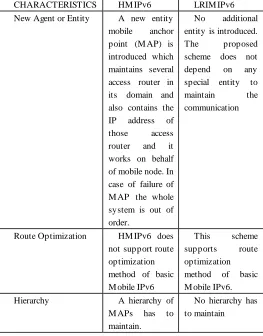
B. The comparison between the hierarchical mobile IPv6 (HMIPv6) and my solution LRIMIPv6 are given below:
CHARACTERISTICS HM IPv6 LRIM IPv6
New Agent or Entity A new entity mobile anchor point (M AP) is introduced which maintains several access router in its domain and also contains the IP address of those access router and it works on behalf of mobile node. In case of failure of M AP the whole system is out of order.
No additional entity is introduced. The proposed scheme does not depend on any special entity to maintain the communication
Route Optimization HM IPv6 does not support route optimization method of basic M obile IPv6
This scheme supports route optimization method of basic M obile IPv6. Hierarchy A hierarchy of
M APs has to maintain.
No hierarchy has to maintain
VI. SIMULAT ION RESULT
We have simulated our proposed scheme using OPNET simulator to compare the performance of the proposed scheme with the existing Mobile IPv6 in terms no. of packet loss. In this simulation we have considered that the correspondent node is the fixed node. The simulation results are given in the following: Normal MIPv6 0 50 100 150 200 250 300 350 400
0 2000 4000
Time(s) N o . o f P a c k e ts paper_resear ch-scenario1-DES-1: Video Conferencing. Traffic Received (packets/sec) paper_resear ch-scenario1-DES-1: Video Conferencing. Traffic Sent (packets/sec)
Fig. 1. Normal Mobile IPv6
Proposed Scheme 0 50 100 150 200 250
0 2000 4000
Time(s) N o . o f P a c k e ts paper_researc h_withqos- scenario1-DES-1: Video Conferencing.T raffic Received paper_researc h_withqos- scenario1-DES-1: Video Conferencing.T raffic Sent
Fig. 2. Proposed Scheme
According to the simulation result the average packet loss of the normal Mobile IPv6 is 14.80 and the average packet loss of the proposed scheme is 7.04. So the reduction of the average packet loss is 7.96.
VII. CONCLUSION &FUT URE WORK
communicating nodes and the all the communicating nodes are mobile.
REFERENCES
[1] Farouk Belghoul, Yan Moret, Christian Bonnet, 2003,“ IP-based Handover Management over Heterogeneous Wireless Networks”, 28th Annual IEEE International Conference on Local Computer Networks (LCN'03).
[2] Claude Castelluccia, 1998 “ A Hierarchical Mobile IPv6 Proposal”, INRIA, 655, av. de l’Europe; 38330 Montbonnot St Martin; France
[3] Miska Sulander, T imo Hamaleinen, Ari Viinikainen, Jani Puttonen, Sept. 2004“ Performance Evaluation of the Flows-based fast handover method for mobile IPv6 network,”, Volume: 6, On page(s): 4437- 4441 Vol. 6, ISSN: 1090-3038, ISBN: 0-7803-8521-7, Digital Object Identifier: 10.1109/VET ECF.2004.1404918
[4] Daniel Plasto, 2003 “ Fast RSVP handover in mobile IPv6”,
Proceedings of the First Australian Undergraduate Students’ Computing Conference.
[5] Liu Li Hong Peilin Lu Hancheng, Oct., 2006, “ Mobile IPv6 with Multiple Interfaces in Heterogeneous Networks.”, Volume , Issue , 25-27 Oct. 2006 Page(s):1 – 3, Digital Object Identifier 10.1109/CHINACOM.2006.344777.
[6] Kempf, J., June 2002,"Supporting Optimized Handover for Mobility Requirements for Underlying Systems," ID draft -manyfolks-l2-mobilereq-02.txt.
[7] Albert Cabellos-Aparicio, Rene Serral-Gracia, Lorand Jakab, Jordi Domingo-Pascual,2002,“ Measurement Based Analysis of the handover in a WLAN MIPv6 Scenario”, www.comp.brad.ac.uk/het -net/HET -NET s05./P16.pdf [8] Miska Sulander, T imo Hamaleinen, Ari Viinikainen, Jani
Puttonen, May 2004, “ Flows-based fast handover method for
mobile IPv6 network”,
users.jyu.fi/~timoh/kurssit/verkot/fh.pdf.
[9] Puttonen, J. Suutarinen, H. Ylonen, T . Viinikainen, A. Sulander, M. Hamalainen, T . Dept. of Math. Inf. T echnol., Jyvaskyla Univ., Finland, June 2005 “Flow-based fast handover performance analysis in mobile IPv6 for Linux environment,” Volume: 4, On page(s): 2575- 2579 Vol. 4 , ISSN: 1550-2252, ISBN: 0-7803-8887-9, Digital Object Identifier: 10.1109/VET ECS.2005.1543800.
[10]Xavier Perez Costa, Ralf Schmitz, Hannes Hartenstein, Marco Leibsch, 2002, “A MIPv6, FMIPv6 and HMIPv6 handover latency study : Analytucal approach”. Network Laboratories, NEC Europe Ltd., Adenauerplatz 6, 69115 Heidelberg, Germany T el: +49 6221 13708 -15, E-mail: [email protected],
http://xavierperezcosta.com/publications/IST %2002%20%20 MIPv6%20FMIPv6%20HMIPv6%20Handoff%20 Latency.pd f
[11]G.T sirtsis, A.Yegin, C.Perkins, G. Dommety, K.EL-Malki, and M.Khalil, September 2002,“Fast Handovers for Mobile IPv6,”
Internet Draft, work in progress,
http://tools.ietf.org/html/draft -daley-magma-mobile-00. [12]D. B. Johnson, C.Perkins, and Jari Arkko, January 2003 “
Mobility Support in IPv6,”Internet Draft, working
progress.http://www.join.unimuenster.de/Dokumente/drafts/draft parkfasthandoveragent -fmipv6-00.txt .
[13]Janne Lundberg, May 2003, “ An Analysis of T he Fast Handovers for Mobile IPv6 Protocol,” IEEE CCECE 2003. Canadian Conference on, Volume 2, 4-7 May 2003.
[14]F. Andre, J-M Bonnin, B. Deniaud, K. Guillouard, N. Montavont , 2003,“ Optimized Support of Multiple Wireless Int erfaces within an IPv6 End-T erminal”.http://lsiit.ustrasbg.fr/Publications/2003/ABDGMNS03/SOC03
-MontavontN.pdf
[15]Fang Feng, Douglas S.Reeves, 2004, “Explicit Proactive Handoff with Motion Prediction for Mobile IP”. In Proceedings of the Wireless Communications and Networking Conference (WCNC), Vol. 2 (March 2004), pp. 855 -860. [16]www.citeulike.org/group/5303/article/2820652
[17]Marc T orrent Moreno , Xavier PérezCosta , Sebastià Sallent -Ribes,2003,“ Aperformance Study of Handovers for Mobile IPv6,” ACM SIGMOBILE Mobile Computing and Communications Review, Volume 7 , Issue 4 (October 2003) , Pages: 5 – 19, ISSN:1559-1662 .
[18]C. Perkins, October 1996, “ IP Mobility Support,” RFC 2002. [19]K.EI-Malki, al., June, 2007, “ Low Latency in Mobie Ipv4,”