e-ISSN: 2278-067X, p-ISSN: 2278-800X, www.ijerd.com
Volume 11, Issue 12 (December 2015), PP.10-15
Concept for Structuring and Derivation of Technology Fields in
the Context of Cyber-Physical Production Systems (CPPS)
G. Schuh
1, S. Schröder
2*, N. Schön
2, P. Kabasci
2, T. Drescher
21
Laboratory of Machine Tools and Production Engineering, Chair of Production Systems RWTH Aachen University, Aachen 52074, Germany
2Fraunhofer Institute for Production Technology IPT, Dept. of Technology Management,
Aachen 52074, Germany
Abstract:- First cyber-physical-production systems (CPPS) are already in use in factories and their number will increase significantly in the next years. Thereby they are heralding the fourth industrial revolution, denominated »Industrie 4.0« in Germany. The implementation of this proclaimed industrial revolution will come along with crucial technological changes and business model innovations, including enormous opportunities for companies but also serious risks, if critical or disruptive technological changes are not identified early enough and corresponding reactions are not initiated. Thus an efficient and effective technology forecasting is crucial for companies to benefit from »Industrie 4.0«. But companies’ business intelligence departments are facing the major difficulty to identify the relevant technological inventions in a new and so far unstructured technological environment. Therefore this paper presents a concept for the identification and structuring of application technologies and the demand-oriented derivation of structured search fields for the technology forecasting process in the context of CPPS. The concept was developed within the research project »Industrie 4.0 – International Benchmark, Future scenarios and recommendations for production research (INBENZHAP)«, funded by the German Federal Ministry of Education and Research (BMBF).
Keywords:- Industrie 4.0; cyber-physical-production-systems; technology forecasting; search fields.
I.
INTRODUCTION
Cyber-physical systems (CPS) have changed everyday life in society, particularly smart phones as the most popular mobile CPS. Physical systems, in terms of conventional technical systems, become a CPS by integrating computational intelligence in the physical processes [1] and thus make these systems mission and situation aware [2]. From an abstract point of view CPS are the result of the further development and integration of two major innovation fields, embedded systems and global data networks, and the next important step on the evolution to an internet of things, data, and services [3].
The impact of CPS on production is proposed to be mainly driven by four preconditions in the production system that can be classified in two levels (Fig. 1): The first level makes a distinction between the physical and cyber dimension, the second level differentiates the hard and soft component perspective.
The combination of these two levels lead to the following four main preconditions: IT-Globalization, single source of truth, automation and cooperation in business and social communities. These four preconditions can be considered as enablers for collaboration productivity as a main driver of productivity growth in context of a new industrial revolution [4]. The four enablers of collaboration productivity are proposed to lead to an increased application of cyber-physical production systems (CPPS) (CPS applied in the manufacturing industry) in the future manufacturing environment.
Due to the fact that CPPS will have an impact on technical systems in several industries, the German government launched a project called »Industrie 4.0« as part of the »New High-Tech Strategy«. This project promotes the computerization of the manufacturing industry in Germany [6]. One of the main objectives of the project »Industrie 4.0« is realizing the intelligent or smart factory, which is characterized by resource efficiency, adaptability, increased ergonomic and more efficient interaction between workers and manufacturing processes as well as the integration of customers and business partners in business and value processes within the production [6]. CPS and the Internet of Things are the technological basis for realizing the goals of »Industrie 4.0« 6].
Within the framework of the overall German government project »Industrie 4.0«, an ongoing research project called »Industrie 4.0 – International Benchmark, Future scenarios and recommendations for production research (INBENZHAP)« is inter alia dealing with a systematic technology intelligence in the context of CPPS. One main goal of the technology intelligence is to structure and identify fields of applications of CPPS which will have a significant impact on the efficiency of a factory in future. While the function and application space of the application fields is already existent in the vision of Industrie 4.0, however, the technological solution space of these application fields is not defined. Therefore, according to the fields of application, another objective is to provide a structured search for basic technologies that contribute to the identified fields of application.
II.
PROBLEM
The main goal of technology intelligence is to provide relevant information on the technological environment of a company on time, i.e. to create a transparent reliable information basis on current and future potentially relevant technologies for decision making [7]. Because of limited resources technology intelligence activities need to be focused on feasible search tasks and main objective should be the maximization of information effectiveness under given resources [8]. Practically, for a company an active search for existing and future technologies regarding an overall topic, e.g. »Industrie 4.0«, is only possible in structured search fields [9]. By using search fields the amount of relevant information needed is reduced, due to the definition of the dimensions of the information demand [10], [11], [12], [13].
»Industrie 4.0«, especially cyber-physical production systems, specifies a technology field that is extremely wide, heterogeneous and so far not well-defined. There is a lack of knowledge concerning what the relevant current and future applications and application fields of CPPS are and how they can be systematically structured as well as what the important basis technologies are, which enable the implementation of »Industrie
Fig. 2: Overall concept for the derivation of technology fields within the area of CPPS
environment »Industrie 4.0«
Products Production
Engineering
Production Processes
Production Elements
CPPS - fields of application
structured fields of »enabler« technologies
e.g. collect data
»function«
e.g. measure data e.g. read data
»sub function« ...
e.g. high-speed sensors
»...«
e.g. localization
»...«
»...« »...«
»...«
»enabler technology« fields
function
sub function
searching of technologies in technology fields
high-speed sensors
»enabler technology« fields
technologies
localization
»...«
optical sensors multi sensor systems
... ...
mobile radio
triangulation ...
application field, e.g. »bin picking«
Internet of Things
CPS
Required
functions for
CPPS-applications
concrete techn.
solutions for
application
CPPS-applications
(demand –
oriented)
con
cr
ete
ab
st
ract
techn. solutions to
fulfill functions
abstract concretize
orientation of search
problem space
solution space
4.0« applications.
Application fields and their included application technologies define companies’ need of new functionalities and innovative solutions within a smart factory and the future production environment, e.g. intelligent conveying systems, autonomous adjustment of machine tools or the predictive maintenance of machines. Therefore, application fields of CPPS are an appropriate initial point for a structured alignment of technology intelligence activities with a target-oriented search for technologies that fit to the demand of future factories.
From the current point of view this leads to the following three major existing challenges for a goal-oriented technology intelligence in the context of »Industrie 4.0« and CPPS:
- What are the relevant application fields of CPPS for a company?
- Which are the necessary basic technology fields to fulfill the demand of the selected application fields?
- How could a comprehensive identification of the needed technology fields be ensured?
Pre-structured technology search fields that contribute to specific application fields are a promising basis for an efficient and effective technology intelligence in context of CPPS, by aligning the search activities and focusing resources. Therefore they are also a promising solution for the identified major challenges.
III.
PROBLEM SOLVING APPROACHThe concept for the derivation of technological search fields as described below has been developed and used during the research project INBENZHAP, which is funded by the German Federal Ministry of Education and Research (BMBF). The major objective of the developed concept is the efficient identification of the key enabling basic technologies for the successful implementation of »Industrie 4.0«.
Therefore this paper strictly differentiates between application and basic technologies, using the following definition: Application technologies are defined as technologies whose use directly creates added value for companies and which are usually a combination of different »Industrie 4.0« relevant basic technologies. Examples for application technologies are a cognitive assembly cell or an intelligent and predictive maintenance management. Basic technologies are defined as the enabler of application technologies and their sol use usually does not directly create added value for companies. Examples therefore are real time data transfer or energy efficient networks. Thus basic technologies can be considered as the solution space for the realization of specific application technologies.
The chosen initial point for the derivation of the search fields are the application technologies. Compared to the direct definition of search fields for basic technologies, the derivation from application technologies leads to more demand-oriented instead of solution-oriented search fields. Thus the probability of missing future relevant basic technologies decreases. The exclusion of irrelevant application technologies further leads to an increasing efficiency of the search process. To ensure a real demand orientation the questions »What can be optimized by CPPS within the production?« and »How should my factory / production process ideally look like?« should be in the focus during the search process and less the question »How could it be technically implemented?«.
Besides the limitation of application technologies, which are relevant in the respective use case, the search space can also be divided in different fields of application technologies, denominated application fields in the following, to further systematize the search process. As shown in Fig. 2 the search space in the presented uses case is set very broad and considers all technologies in the field of CPPS, due to the overall focus on the production environment within the project. The used division for the search space is also shown in Fig. 2. The
CPPS application technologies are divided in four very generic application fields, according to the part of production-system they are influencing: Product (e.g. interface for remote maintenance), production element (e.g. flexible assembling modules), production process (e.g. bin picking) or production engineering (e.g. integrated systems engineering).
Industrie 4.0 is still in its initial stage and CPPS application technologies still in a very early stage of its development process or even more in a conceptual phase. Knowledge and information of this early stage mostly do not exist explicitly in form of scientific publications or books but implicitly [7]. Thus within the project the relevant application technologies have been identified during a workshop with several designated experts with a broad range expertise in different areas within the field of production and information technologies.
Subsequent to the collection and division of the relevant application technologies a direct derivation of search fields for the corresponding basic technologies is principally possible, but unadvisable due to the following reason. Many applications in the context of »Industrie 4.0« are far away from market readiness and often more on the level of visionary concepts or ideas, so that the concrete technological implementation is still unclear and the technological solution space still not fixed. The consequence is a high risk of forgetting future technological alternatives for the realization of certain applications which are less obvious or very unconventional from today’s perspective. But especially these technologies represent serious risks for companies and should be identified by effective and successful technology intelligence.
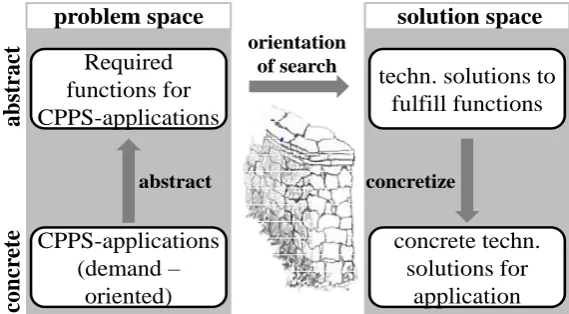
The developed solution for this problem is based on the idea of the TRIZ-theory (»theory of the resolution of invention-related tasks«) by Genrich Altschuller [14]. Within the developed concept, as shown in Fig. 3, the concrete demand oriented application technologies are first translated into abstract required functions, before in a second step technological solution fields which are able to fulfill the respective functions are sought.
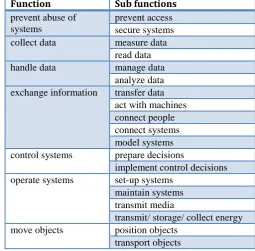
Tab. I: Proposal for an Function-Tree Regarding CPPS Application Technologies Function Sub functions
prevent abuse of systems
prevent access secure systems
collect data measure data
read data
handle data manage data
analyze data
exchange information transfer data
act with machines connect people connect systems model systems
control systems prepare decisions
implement control decisions
operate systems set-up systems
maintain systems transmit media
transmit/ storage/ collect energy
move objects position objects
transport objects
These »enabler technology fields« form the search fields for the technology intelligence process. Within these fields possible concrete technological solutions for the considered application technologies can be identified.
Due to the integration of an intermediate step via an abstract functional level the search space for possible technological solutions is widened and thereby the risk of forgetting less obvious or unconventional basic technologies, which would eventually not be found while exclusively considering the concrete application, decreases.
The shown tree is structured in the two hierarchical levels »functions« and »sub functions«. As shown in Fig. 2 the »sub functions« represent the search space for basic technology fields which are potentially able to fulfill the demand of the selected application technologies. These technology fields (e.g. wireless data transfer) consist several basic technologies (e.g. Long Term Evolution (LTE), Near Field Communication (NFC), etc.) and are not limited by number. Due to new technological developments and inventions the set of technologies within the identified search fields could change and thus not only the progress of the identified technologies but also the development of new technologies within a technological search field has to be monitored continuously.
IV.
CONCLUSIONS AND OUTLOOK
The digitalization of the production industry, proclaimed as the fourth industrial revolution »Industrie 4.0«, entails huge opportunities but also risk for companies. Companies have the challenge to identify future relevant technologies in a so far not well defined technological environment. Therefore we developed and presented a concept for the structuring of application and basic technologies in search fields. This includes an approach for a systematic derivation of these basic technology search fields for the technology forecasting process starting with the identification of relevant application technologies. Within this approach basic technology fields are derivated by an intermediate step via an abstract functional level. Thus the approach minimizes the risk of excluding or overlooking less obvious or unconventional technological solutions. Despite the development of the concept for the use within a public research project, its application in industry is also possible after adapting it to the use case of the respective company.
For an efficient and effective technology monitoring process a prioritization and systematic selection of the identified search fields as well as a combination to consistent search field bundles is very important [9]. So the efforts and intervals for the information search can be adapted corresponding to the prioritization level of the respective technology field. Despite the demand orientated and systematized derivation of the search fields, an evaluation of the technology fields regarding its importance for the respective company, its maturity level or its potential for a technological unique selling point are still missing. Thus we intend to expand the presented model with an approach for the assessment of basic technology fields in the context of CPPS, including the derivation of recommended actions for the technology forecasting process. Thereby we are aiming at a practical tool to support companies in the orientation of their technology forecasting activities.
ACKNOWLEDGMENT
The concept presented in this manuscript was developed and used during the German research project »Industrie 4.0 – International Benchmark, Future scenarios and recommendations for production research« (INBENZHAP). The project was initiated and is funded by the German Federal Ministry of Education and Research (BMBF). The authors gratefully like to thank the ministry for the funding of this project and all the participants of the expert workshops during the project for their feedback and input while developing and using the presented concept.
REFERENCES
[1]. Lee, E.: Cyber physical systems: Design challenges. In: 11th IEEE International Symposium on Object Oriented Real-Time Distributed Computing (ISORC). IEEE, 2008.
[2]. Lin, K.-J.; Panahi, M.: A Real-Time Service-Oriented Framework to Support Sustainable Cyber-Physical Systems. In 8th IEEE International Conference on Industrial Informatics (INDIN). IEEE, 2010.
[3]. Geisberger, E.; Cengarle, M. V.; Keil, P.; Niehaus J.; Thiel, C. Thönnißen-Fries, H.-J.: Cyber-Physical Systems. Driving force for innovation inmobility, health, energy and production (acatech Position paper). acatech (2011)
[4]. Schuh, G.; Potente, T.; Wesch-Potente, C.; Weber, A. R.; Prote, Jan-Philipp: Collaboration Mechanisms to increase Productivity in the Context of Industrie 4.0. In Robust Manufacturing Conference (RoMaC 2014).
[5]. Schuh G, Dölle C, Riesener M, Rudolf S (2014b) Lean Innovation durch globales
Komplexitätsmanagement, In Industrie 4.0: Aachen Perspektiven, Aachener
Werkzeugmaschinenkolloquium 2014, pp. 145–170.
[6]. Communication Promoters Group of the Industry-Science Research Alliance; acatec – National Academy of Science and Engineering: Recommendations for implementing the strategic initiative INDUSTRIE 4.0 – Final report of the Industrie 4.0 Working Group, April 2013.
[8]. Krystek, U. and Müller-Stevens, G. (1993) Frühaufklärung für Unternehmen: Identifikation und Handhabung zukünftiger Chancen und Risiken. Stuttgart: Schäffer-Poeschel.
[9]. Schuh, G.; Orilski, S.; Wellensiek, M.: Efficient Technology Intelligence by Search Field Strategies. In: Proceedings of The XX ISPIM Conference, Vienna, Austria – 21-24 June, 2009.
[10]. Rohrbeck, R.; Heuer, J. and Arnold, H. (2006) The Technology Radar – an Instrument of technology
Intelligence and Innovation Strategy. In: Conference Proceedings, The 3rd IEEE International Conference on Management of Innovation and Technology. Singapur, p. 978 – 983.
[11]. Lang-Koetz, C.; Ardilio, A. and Warschat, J. (2008) Technologie-Radar – Heute schon Technologien von morgen identifizieren. In: Bullinger, H.-J. (Ed.) Fokus Technologie: Chancen erkennen – Leistungen entwickeln. München: Hanser.
[12]. Gassmann, O. and Sutter, P. (2008) Praxiswissen Innovationsmanagement: Von der Idee zum Markterfolg. München: Hanser.
[13]. Reger, G. (2006) Technologie-Früherkennung: Organisation und Prozess. In: Gassmann, O. (Ed.) and
Kobe, C. (Ed.) Management von Innovation und Risiko: Quantensprünge in der Entwicklung erfolgreich managen. Berlin: Springer, p. 303 – 320.
![Fig. 1: Enabler for Collaboration Productivity [5]](https://thumb-us.123doks.com/thumbv2/123dok_us/1399161.1651747/1.595.71.528.613.764/fig-enabler-for-collaboration-productivity.webp)