E-ISSN 2308-9830 (Online) / ISSN 2410-0595 (Print)
Modelling and Analysis of Call Blocking Probability in an
Established CDMA Wireless Network
Ohaneme Cletus O.1, Ezeagwu Christopher O.2 and Nnebe Scholastica U.3
1, 2, 3 Department of Electronic and Computer Engineering, Nnamdi Azikiwe University Awka, Nigeria
1[email protected], 2[email protected], 3[email protected]
ABSTRACT
Millions of mobile subscribers are nowadays denied access to mobile network due to insufficient spectrum allocated to the networks by the communication control agencies. Since the spectrum is a scarce resource that cannot easily be created for its adequate use, it is therefore pertinent that the available spectrum is optimally utilized to serve the purpose for which it is meant for. In order to make the maximum use of the available spectrum, a Code Division Multiple Access (CDMA) technique which allows data to be represented by code words are used. This technique tries to reduce some of the impairments that are associated with other access techniques such as Frequency Division Multiple Access (FDMA) and Time Division Multiple Access (TDMA) techniques in efficient service delivery. Therefore, this work x-rays the CDMA wireless network and its use to evaluate these access denials and provides the models that can be deployed to ameliorate the number of access denials otherwise called call blockings. Statistical analysis is presented in this work to determine the call blocking probability in a CDMA wireless system. This will enable the proper analysis of the network to be carried out so as to provide the necessary technique that could be deployed to reduce the number of call blockings in wireless networks. The results obtained show that call blockings are drastically reduced to the tune of 25 % of the total placed calls.
Keywords:Call blocking probability, multiple access, wireless network, Signal-Interference plus Noise Ratio, channels, and Erlang.
1 INTRODUCTION
It is no longer uncommon for a call placed by a mobile user to be denied access in a communication medium in recent times. No thanks to the inability of the network to give proper access to intending network users. Millions of telephone and network subscriber have felt with nostalgia over their inaccessibility of the transmission media because of the inadequate scarce resource (spectrum) to achieve the dissemination of information. The efficiency of any network is measured by the number of subscribers that can be supported by the network at a particular period of time, otherwise called the capacity of the network.
Therefore, CDMA technique has in no small measure contributed to the successful transmission of signals from the source to destination or between one subscriber and another thereby improving the capacity of wireless network.
1.1 Theory of Call Drops in Cellular Network
come first serve bases as soon as a channel is free. This phenomenon is known as queuing. Queuing is one of the processes in wireless network where the limited resources are efficiently utilized to serve the mobile users at a particular time. After the predetermined period of time, and if there is still no available channel to support other users in the queue, the user is also blocked. The theory of queuing in cellular network was somehow not necessarily needed by some users because it is more annoying to block a call after queuing than blocking it at the first instance. Call blockings in cellular networks can be attributed to insufficient number of channels in the system with relative to the number of users trying to access the network simultaneously. Hence efficient channel utilization should be the cardinal focus of every network provider to contain the teaming number of subscribers trying to access the network for their satisfaction on the services being provided.
On the other hand, calls may be admitted into the network, but may be lost before the calling party concludes the call. This lost in the calls in session is known as call drops. Call drops can be as a result of
(i) Low signal strength being received by the mobile user as a result of the distance of the user from the transmitting base station,
(ii) The poor quality of the communication channel due to noise and interference,
(iii) The movement of mobile user from one cell to another cell, which can be regarded as call dropping due to unsuccessful handoff, e.t.c.
2 REVIEW OF RELATED LITERATURES
There are several works in which network performance in cellular network have been studied. In particular, how call drops and their probability are related to traffic parameters such as channel holding time, call drop intensity, handover rate etc. Most of these previous works assume the classical teletraffic theories, which assumes negative exponential distribution to model the channel holding time in large and single cell system for the sake of conveniences and tractability.
[2] Attempted in describing the channel holding time by the negative exponential distribution and he shows that the channel holding time can be seen as directly dependent on two other exponential process, namely: the total calls duration and the crossing boundaries. Also in their own research, [3] also assume the negative exponential distribution of channel holding time is limited to voice services,
however the second generation and beyond cellular network provides services such as voice, data, video etc. Hence the exponential hypothesis is not appropriate.
Also the channel holding time has been shown to fit lognormal distribution by [4] when they studied the call drop probability in a well established cellular Network. They were able to develop a new simple model to relate drop call probability with traffic parameters in the well established cellular network where handover failure becomes negligible. Handover failure is never a negligible factor in the network operating in Nigeria.
Furthermore, various other models have been proposed by many authors, such as the Sum of hyper-exponential distribution and the generalized Gamma distribution models. [5] used the generalized Gamma distribution to model the cell residence time. Unfortunately, the generalized gamma distribution leads to the loss of Markovian property in the resulting queuing model of the cellular network, which makes the resulting queuing system intractable. The author also modelled the cell residence time as SOHYP (sum of hyper exponential) random variable. The advantage of using SOPHY distribution is the preservation of the Markovian property in the queuing network model.
It had been shown that SOHYP model can be turned to have the coefficient of variation of the cell residence time less than, equal to and greater than unity, while the exponential and Erlang distribution model for cell residence time only applies to case where the coefficient of variation are less than unity. However, it is not known whether the SOHYP models have the capability of universal approximation.
More so, many other papers have studied call drop probability, one of such works is that which was done by [3]. In this work, drop call probability was analyzed with the classical assumption of exponential distribution for the channel holding time. In particular, it put emphasis on handover and its effects on performance. Handover is considered the main ease for call dropping.
[6] studied the performance of a cellular network by considering more general distribution for call and the channel holding times. Analytical expression for drop call probability is obtained showing the effect of more realistic assumption on system behaviour.
services is assumed. Each class has different call holding and cell residence times.
In [8] estimation, the drop call probability considering a wireless, multimedia network, adaptive bandwidth allocation algorithm is exploited to improve system performance and to reduce in particular, handover-blocking probability. Although the describe models were very useful in the early phase of mobile network deployment, they are not very effective in a well-established cellular network. In such a system, network-performance optimization is carried out continuously by mobile phone operators.
3 MODELLING CALL BLOCKING
PROBABILITY IN CDMA SYSTEM
The probability that a new call is blocked given by [1]
∑
where is the number of speech channels per cell, is the number of calls in progress and is the average offered traffic in units of users. This is called Erlang B formula which was evaluated for different values of channels in ascending order using matlab. The corresponding values of call blocking probabilities are tabulated against the number of channels as shown in Table 1.
Table 1: Call blocking probabilities evaluated from channel capacity
S/N Pr(Blocking
probability)
Number of channels
1 0.8902 100
2 0.8422 200
3 0.8276 300
4 0.8081 1000
5 0.8054 1500
The art of any network design is, to a large extent, to predict the call behaviours of users, and derive the physical infrastructure (i.e., available number of speech channels) that guarantees an acceptable grade of service. Several factors influence this design process:
The number and duration of calls on the time of the day. A busy hour (usually around 10.00 hour and 16.00 hour) can now be defined as the hour that determines the required optimum network capacity
The spatial distribution of users is time variant: while business districts (city centres) usually experience a lot of activity during the day time, suburbs and entertainment districts experience more traffic during the night time,
Changing user habits are also related to the offering of new service (e.g., data connections) and new pricing structures (e.g., free calls in the evening hours). The strategy of selling “minute accounts” that have to be used up each month also leads to longer talk times than a pricing strategy of charging per minute.
Based on statistical knowledge of user habits, a system can be designed with certain probability that allows a given number of users per cell to make a call. If, through a statistical fluke, all users want make a call simultaneously, some of the calls will be blocked. For the computation of the rate of blocking (blocking probability) of a simple system, the following assumptions are made:
The times when the calls are placed are statistically independent’
The duration of calls is an exponential distributed random variable,
If a user is rejected, his next call attempt is treated as a new user irrespective of his previous attempts. In other words, the blocked user retries immediately. After being blocked several times within a short time interval, he usually gives up and places the next call after a much longer waiting time. Such a system can be represented by Erlang B system, and probability of call blocking is given in equation 1. Rewriting the equation gives
∑
. If is very large, then the ratio is only less than unity, and becomes almost independent of the required blocking probability. Assuming again a required blocking probability of 1%, the ratio of possible offered traffic to available channels is about 0.9 for
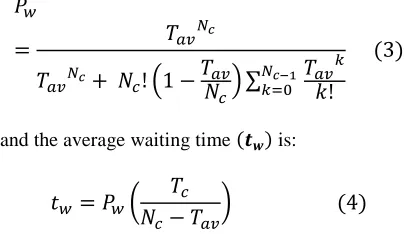
Alternative model assumes that any user that is not immediately assigned a channel is transferred to a waiting loop, and assigned a channel as soon as it becomes available. The probability that a user is put on hold (delay) according to [4] is:
(
) ∑
and the average waiting time is:
(
)
where is the average duration of the call.
The probability that a call can be placed, and is not blocked, is an important part of service quality: remember that quality of service is defined as 100% minus the percentage of blocked calls, minus ten times the percentage of lost calls. But the requirements for service quality differ vastly for different wireless services. One of the main indicators of service quality is speech services and file transfer speed for data services. Speech quality is measured by the mean opinion score (MOS) which represents the average of a large number of human assessments about the quality of received speech (listening). The speed of data transmission on the other hand is simply measured in bits/second- obviously a higher speed is better.
An even more important factor is the availability of a service. For cell phones and other speech services, the service quality is often computed as the compliment of “fraction” of blocked calls plus ten times the fraction of dropped calls (blocked calls encompass all failed call attempts, including those that are caused by insufficient signal strength, as well as insufficient network capacity). This formula takes into account that the dropping of an active call is more annoying to the user than the inability to make a call at all. However, for emergency services and military applications, service quality is better measured as the compliment of “fraction of blocked calls plus fraction of dropped calls”. Also during emergency
situation, the inability to make a call is as annoying as the situation of having a call interrupted.
A related aspect is also the admissible delay (latency) of the communication. For voice communications, the delays between the time when one person speaks, and the other hears the message, must not be longer than about 100ms. For such transmitted signal, it must be noted that the first transmitted data are the ones that would be made available to the receiving user first. Hence for data files, the acceptable delays can be usually longer, and the sequence with which the data arrive at the receiver is not critical (for example, when downloading e-mail from a server, it is not important whether the first or the seventh of the e-mail is the first to arrive). However, there are some data applications where small latency is vital; e.g., for control applications, security and safety monitoring e.t.c.
In an FDMA system, a large system load can lead only to blocked calls, but not lost calls, as long as each user stays in the coverage areas of the user’s base station. How-ever, calls can be dropped when a user with an ongoing call tries to move to a different cell whose BS is already fully occupied. A fully loaded system increases interferences with neighbouring cells, thus making the links in that cell more sensitive to fluctuations in signal strength, and possibly increasing the number of dropped calls due to insufficient signal-to-interference plus noise ratio (SINR).
It can therefore be found that the number of users that can be accommodated with a given QoS increases faster and linearly with the number of available speech channels. The difference between actual increase and linear increase is called the trunking gain. From a technical point of view, it is thus preferable to have a large pool of speech channels that serves all users. If only one operator owns the entire spectrum, this approach could be fulfilled. But due to political reasons (pricing and monopoly) this cannot be adopted.
4 SIMULATION AND RESULTS
communication channels available, there is no more call drops since enough channels are available for communication purposes.
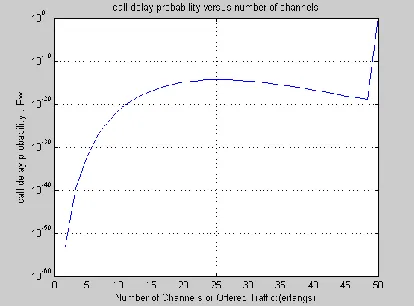
Besides, Fig. 2 shows how there are delays in mobile network as a result of increase in the number of traffic and insufficient number of channels in CDMA network. If enough channel is provided, several users should be connected to the network and also reduce the delays due to traffic congestion which may have arisen if insufficient channels were not provided. It shows that the call blockings vary exponentially with the number users (or offered traffic) in the network. Here, it is evident that the offered traffic determines the rate of blocking probability in CDMA system.
Fig. 1. Plot of Call blocking probability Vs Number of Channels
Fig. 2. Plot showing call delay probability versus Offered traffic
5 CONCLUSION
In the life of mobile communication users, it is evident that call denials and poor quality of services have been the bane of recent woes experienced in recent time. Therefore, this work has tried to proffer unwavering solution to the problem of call drops in wireless communication networks
especially CDMA system in the mist of the scarce resource (speech channels).
The network has been modelled in terms of call dropping probability. The call delays and call probability are compared with relative to number of users. It was discovered that the number of calls (users) determines the quality of the signals in terms of delay probability and call drop probability. Since the communication channel is scarce, it increases the interferences with neighbouring cells thereby making the links more sensitive to fluctuations in signal strength. It therefore increases the number of drop calls as a result of insufficient signal-to-interference plus noise ratio (SINR).
Hence, this paper has provided the models that can be used to minimize the call drops in the network thereby improving the QoS for mobile users.
6 REFERENCES
[1] Rappaport S, Theodore, “Wireless
Communications, Principles and practice”, Second Edition, Prentice Hall of India, 2008. [2] Roch A.Guerion, “Channel Occupancy Time
Distribution in a Cellular Radio System”, IEEE Trans. Veh. Tech.Vol 35, No.3, PP 89-99, 1987
[3] Hong D. and Rappaport T.S., “Traffic Model and Performance Analysis for Cellular Mobile Radio Telephone System with Prioritized and Non-prioritized Handoff Procedure”, IEEE Trans.Veh., Vol.35, No. 3 pp 77-92,1986 [4] Gennario Boggia, Pietro Camarda, and
Alessandro D’Alconzo, “Modelling of Call Dropping in Well Established Cellular Network” EURASIP journal on wireless
communications and networking”,
Vol.2007,Article ID:17826,PP 11. 2007. [5] Zonoozi M.M, Dassanayake P., “User Mobility
Modelling and Characterization of Mobility Pattern”, IEEE Selected Area Comm. Vol.15. No.7 Pp 1239-1252, Oct 1997.
[6] Yuguang Fang, Imrich Chlamtac, “Tele-traffic Analysis and Mobility Modelling of PCS Network”, IEEE Trans.Comm. Vol 47 No.7, July 1999.
[7] Nasser N., “Enhanced Blocking Probability in Adaptive Multimedia Wireless Network”, In
Proceeding Of The 25th IEEE
IPCCC.Vol.2006,Pp 647-657,USA April 2006. [8] Honda Khedher, Frbrice Valois, “Channel
AUTHOR PROFILES:
Cletus Ogbonna Ohaneme: was born in Nanka in Anambra State of South-East Nigeria. He holds B.Eng. in Electrical/Electronic Engineering, M.Eng. in Electronic and Communication Engineering and Ph.D. in Communication Engineering from Enugu State University of Science and Technology (ESUT) Enugu, Nigeria in 1994, 1998 and 2012 respectively. He is presently a lecturer in the Department of Electronic Engineering Nnamdi Azikiwe University, Awka Nigeria. Besides, he is a member of several professional bodies including Nigeria Society of Engineers (NSE), Nigerian Institution of Electrical and Electronic Engineers (NIEEE), Council for the Regulation of Engineering in Nigeria (COREN) as a Registered Engineer, and International Association of Engineers (IAENG). His research interest is on Wireless Communication Networks and Spectrum Management.
E-mail: [email protected] &
Christopher Ogwugwaum Ezeagwu: is currently a lecturer in the department of Electronic and Computer Engineering Nnamdi Azikiwe University Awka Nigeria. He hails from Ezi, Aniocha Local Government Area of Delta South-South region of Nigeria. He holds B.Eng. in Electrical/Electronic Engineering, M.Eng. in Electronic and Communication Engineering from Enugu State University of Science and Technology (ESUT) Enugu, Nigeria in 1986, and 2008 respectively. He is presently a doctoral student with special interest in Communication Engineering in the Department of Electrical/Electronic Engineering ESUT, Enugu, Nigeria. Besides, he is a member of several professional bodies including Nigeria Society of Engineers (NSE), Nigerian Institution of Electrical and Electronic Engineers (NIEEE), Institute of Electrical Electronic Engineers (IEEE), Council for the Regulation of Engineering in Nigeria (COREN) as a Registered Engineer, and International Association of Engineers (IAENG) among others. His research interest is on Optic Fibre Communication Systems.
E-mail: [email protected]
Scholastica Ukamaka Nnebe: is currently a lecturer in the department of Electronic and
Computer Engineering, Nnamdi Azikiwe
University Awka, Nigeria. She holds B.Eng. degree in Electrical/Electronic and Computer Engineering, M.Eng. degree in Electronic and Communication Engineering and Ph.D degree in Communication
Engineering from Nnamdi Azikiwe University Awka, Nigeria in 2006, 2009 and 2013 respectively. She hails from Umuonaga Awka, Awka South Local Government of Anambra State, Nigeria. Besides, she is a member of several professional bodies including Nigeria Society of Engineers (NSE), Nigerian Institution of Electrical and Electronic Engineers (NIEEE), Council for the Regulation of Engineering in Nigeria (COREN) as a Registered Engineer, International Association of Engineers (IAENG) and Institution of Electrical and Electronic Engineers (IEEE). Her research interest is on Wireless Sensor Networks and Communications Systems.
E-mail: [email protected] or