470 | International Journal of Computer Systems, ISSN-(2394-1065), Vol. 03, Issue 07, July, 2016 Available at http://www.ijcsonline.com/
Identify the Attack in Embedded Image with Steganalysis Detection Method by
PSNR and RGB Intensity
Md. Sohel Ansari A, Prof. Deepak JainB Ȧ
JNCT, Bhopal, India ḂProfessor, JNCT, Bhopal, India
Abstract
In this research paper we plot experimental result and analysis report of propose a high-tech region-adaptive steganalysis algorithm which will be used for the legend application to detect watermark attacks. From the experiment result it is clear that major benefits of the proposed steganalysis detection technique is RGB Intensity value, PSNR values and NC values which is allows tamper detection using linear classifier by given that these discerning features. In addition, there is a new use the major region-adaptive steganalysis technique to detect attack, if certain types of attack have occurred. As will be elaborate, we find that the method is improve the efficiency of detection, testing of the robustness of the projected steganalysis method. We use some major attack technique which is given as Sharpen, Histogram Equalization, Salt and Pepper Noise, Gaussian Noise, Smoothing, and JPEG Compression. Were different system are effect the robustness of the projected steganalysis which are scaling, rotation, and translation belongs to geometric attacks. The cruelty of these attacks can be adjusted by adjusting their equivalent factor values. Experimental results and Analysis report show that will detect the cryptical data on the original Host image or targeted images file.
Keywords: Image steganography, Linear Classifier, RGB Color Intensity, Message Encryption, Image encryption, PSNR.
I. INTRODUCTION
In Current era we know that one of the supreme significant problems, which affect the commerce of digital media, is how to protect copyright and ownership. Digital watermarking, one of the popular approaches considered as a tool for providing the copyright protection, is a technique based on embedding a specific mark or signature into the digital products.
Watermarking relational database is a technique which can provide ownership protection and temper proofing for relational databases. Although it has been developed over ten years, it is still not popular. For attracting more people to study this technique, they introduce it in detail in this paper [1]. The main contributions of this paper include: 1) To the best of our knowledge, this is the first paper
which specially surveys data distortion watermarking relational databases;
2) We define a new requirement analysis table for data distortion watermarking relational databases and use it to analyze important and the newest research of data distortion watermarking relational databases;
3) We explain background knowledge of watermarking relational databases, such as types of attacks, requirements, and basic techniques.
While several watermarking algorithms have been proposed [2], transform domain schemes, such as discrete wavelet transform (DWT) based watermarking have shown more advantages and provide higher performance than others. The result, there is a constant challenge on the researchers to keep improving the robustness of the watermarking technique while at the same time maintaining its transparency as to not intruding any
legitimate use of the media. Progress in this area has been steady as can be seen from a healthy number of publications in the field and the sheer number of institutes around the world that deal with the issue [3]. In the more specific field of digital image watermarking, one of the most notable techniques is region-based image watermarking [4]. The paper described a method for embedding and detecting chaotic watermarks in large images. An adaptive clustering technique is employed in order to derive a robust region representation of the original image. The robust regions are approximated by ellipsoids, whose bounding rectangles are chosen as the embedded area for the watermark. The drawback of this technique is due to limited number of suitable regions for storing the watermark the watermark storing capacity can be low.
II. SURVEY REPORT
In this Research paper [6] here they advancement of digital image watermarking technology have reviewed an analysis of on a number of attack types on image watermarking. The analysis was carried out using two image analysis tools namely Image Histogram and Fourier Spectrum for frequency domain analysis. Using the results of the experiments, they argue that existing techniques have different sensitivity and robustness levels to different attacks. The results also uncover a number of common similarities between different types of watermark attack. They have presented a novel digital image watermarking technique that takes into account the results of previous analysis and testing of the hypothesis. There technique utilizes a number of technologies namely dual watermarking, image segmentation and partitioning, and DWT-SVD to fulfill the design criteria set to prove the hypothesis. The experiment results show that the technique is more robust to attacks than the original DWT-SVD technique. The watermark detection process uses coefficients derived from the Region-Adaptive Watermarking algorithm in a linear classifier. The experiment conducted to validate this feature shows that in average 94.5% of all watermark attacks can be correctly detected and identified.
With the rapid development of internet technology [7], the connection between man and internet is closer and closer. When people is communicating with others through internet, some malicious intruders may want to eavesdrop or peep the communicators. In order to evade being watching, people use anonymous communication systems to communicate. The anonymity system can encrypt the content of communication and the identity of the communicators. But if the communicators want to know who is talking to them at the other end, they must correlate the outgoing and incoming flows to identify a host or a person. As an active traffic analysis approach, network flow watermarking technology can detect the correlation of flows, and then make the anonymous communicators accountable. While network flow watermarking technology achieves good detecting rate and low false positive rate, it could be an effective way to trace the communication connections and supervise anonymous communication. So it is a widely used way for tracing in anonymity systems.
A watermarking technique based on the frequency domain is presented in this research work [8]. The JPEG is a usually file format for transmitting the digital content on the network. Thus, the proposed algorithm can used to resist the JPEG attack and avoid the some weaknesses of JPEG quantification. And, the information of the original host image and watermark are not Needed in the extracting process.
In this research work [8], a modified algorithm is presented to improve the defect of the JPEG quantification in order to reduce the bit error rate (BER) of the retrieved watermark. Addition, two parameters are regarded as the controlling factors. They are used to adjust the value of the DCT coefficient in order to trade-off the qualities between the Watermarked images and retrieve watermark.
Moreover, the proposed algorithm is design as a blind mechanism. Thus, the original image and watermark are not needed for extracting watermark.
To demonstrate the robustness given in author proposed scheme the peak signal to noise rate (PSNR) is used to estimate the quality between the original image and the watermarked image [9].
III. PROPOSED TECHNIQUE
A. PSNR
In order to improved evaluate this novel method with the obtainable algorithm based on 8 bits binary information, the cryptical capacity of an image along with the PSNR value (Peak Signal to Noise Ratio).
The PSNR is defined as:
)
(
)
(
log
10
2 10MSE
I
MAX
PSNR
B. RGB intensity
Consider an image (Io) with dimension M×N×P, Where, P corresponds to color combination (3 for a color image); M, N symbolizes rows and column of intensity point. Separate R, G, B matrix of Image and change every R, G, B matrix into single array (1×mn).
For encryption we primary generate elements beginning chaos map equal to the dimension of 3×M×N matrix. C. Linear Classifier
Linear classification be in the right place to the field of statistical classification; the objective of statistical classification is to employ an object’s characteristics to identify which class or group it fit in to. A linear classifier attains this by making a classification decision based on the value of a linear grouping of the characteristics. Suppose some given data positions each belong to one (1) of two (2) classes, and the aim is to decide which class a new data point will be in. If two variables are intimately related, the correlation coefficient is secure to the value 1. On the other hand, if the coefficient is secure to 0, two variables are not related. The coefficient r can be calculated and show by the following formula.
i i iYm
Yi
Xm
Xi
Ym
Yi
Xm
Xi
r
2 2)
(
)
(
)
)(
(
WhereIf RGB Intensity values are Match with tested embedded image, it represents original embedded image and tested embedded image are almost identified. If RGB Intensity values is not Match with tested embedded image, then it means that tested embedded image suffer from attack after that, we will signify what type of attack has been applied to the tested embedded image. We implement our algorithm in matlab. A true color image is an image in which each pixel is specified by three values one each for the red, blue, and green components of the pixel's color. MATLAB store true color images as an m-by-n-by-3 data array that defines red, green, and blue color components for each individual pixel. True color images do not use a color map. The color of each pixel is determined by the combination of the red, green, and blue intensities stored in each color plane at the pixel's location.
Fig 1 Original Host Image before embedded data
Graphics file formats store true color images as 24-bit images, where the red, blue, and green components are 8 bits each. This yields a potential of 16 million colors. The precision with which a real-life image can be replicated has led to the commonly used term true color image.
Fig 2 Original embedded Host Image after embedded data A true color array can be of class single, double, uint8, uint16. In a true color array of class single or double, each color component is a value between 0 and 1. A pixel whose color components are (0, 0, 0) is displayed as black, and a pixel whose color components are (1, 1, 1) is displayed as white. The three color components for each pixel are stored along the third dimension of the data array. For example, the red, green, and blue color components of the pixel (10,5) are stored in RGB(10,5,1), RGB(10,5,2), and RGB(10,5,3), respectively.
To further illustrate the concept of the three separate color planes used in a true color image, the code sample below creates a simple image containing uninterrupted areas of red, green, and blue, and then creates one image for each of its separate color planes (red, green, and blue).
IV. TEST RESULTS AND ANALYSIS In this experiment applied the embedded technique to hiding data inside the image and after hiding data we try to Steganalysis attacked detection in given embedded image. The host image has dimension are more than 512×512 pixels and data file is more than 1 kb.
Fig 3 Embedded Host Image before attack and after attack
As a measureable degree of the degradation effect caused by the attacks we use Peak-Signal-to-Noise Ratio (PSNR). The formulation between the original and the attacked embedded images can be found described in [2]. High PSNR values indicate lower degradation hence indicating that the embedded technique is more robust to that type of attack.
The first experiment is aimed to verify that inserted embedded images can be extracted with minimal distortion.
To detect the embedded attack we test in the experiment for the robustness of the proposed embedding scheme, seven embedded removal attacks are applied to the embedded image.
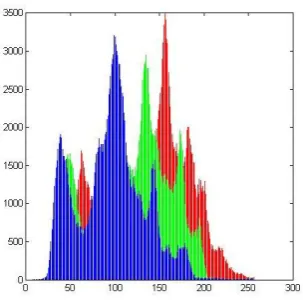
Fig 5 RGB value of Original Host Image before
The PSNR of each embedded image will be given of each picture however these pictures are only to be taken lightly. PSNR does not take aspects of the HVS into effect so images with higher PSNR’s may not necessarily look better than those with a low PSNR.
Fig 6 RGB value of Original embedded Image Before attack
Performance requirements are similarly only to be used as a rough guideline. In general, algorithms were implemented in the most straightforward way, not the most computationally optimal. Furthermore, MATLAB may handle certain programming constructs differently from
other languages, thus the best performing algorithm may vary for each language and implementation.
Fig 7 RGB intensity of Sohel Image After attack
Different embedded attacks have different coefficient. Some of the attacks only require one coefficient which include Gaussian noise and salt and pepper noise, moreover, the rest of them need 2 factors. And also we propose to check The PSNR values between the unmodified embedded image and the attacked embedded image are then averaged. After PSNR we compare RGB intensity of both image original and attacked embedded image.
Here theoretical it is clear that after check RGB intensity and PSNR technique In addition to the improving the robustness of the embedded to attacks, they can also show a novel use the embedding technique as a means to detect if certain type of attacks have occurred. This is a unique feature of embedding algorithm which separates it from other state-of-the-art embedding techniques.
Table 1. Show Different Attacker S. No Attackers
1 JPEG compression 2 Median filter 3 Gaussian noise 4 Salt and pepper noise
5 Smoothing
6 Histogram equalization
7 Sharpen
Table 2 Comparing PSNR Vale before and after Attack PSNR
File size
(KB) Before After
22 89.01 50.95
50 88.84 50.20
69 87.82 49.27
96 86.95 49.13
190 85.58 48.45
210 83.11 47.88
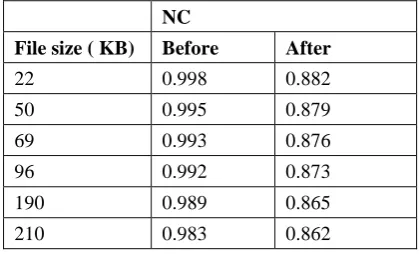
They show a novel use the region-adaptive steganalysis technique as a means to detect if certain type of attacks has occurred. This is a unique feature of our steganalysis algorithm which separates it from other state-of-the-art steganalysis techniques. The watermark detection process uses coefficients derived from the Region-Adaptive Steganalysis algorithm in a linear classifier. The experiment conducted to validate this feature shows that in average 98% of all watermark attacks can be acceptably detected and identified.
Table 3 Comparing NC Vale before and after Attack NC
File size ( KB) Before After
22 0.998 0.882
50 0.995 0.879
69 0.993 0.876
96 0.992 0.873
190 0.989 0.865
210 0.983 0.862
Our Proposed Algorithm is able to detect any kind of attack if apply in Steganalysis image. Improvement the speed of detection, and also test the robustness of the Steganalysis images.
In this Research paper we use a digital image cryptically steganalysis detection technique with the help of PSNR Value, RGB intensity and NC values with their property approach. We are taken Different different size of File to emended and attacked technique in experiment. Were after and before calculating the RGB color intensity value of the original host image and the data embedded image, and again with other technique, in which order to count both high frequency and low frequency type attacks by computing PSNR value. In our experiment we find that the qualities (NC and PSNR) of the embedded Image with respect to the attack embedded image better. In our algorithm we are able to embed large size file type like TXT, ZIP, RAR etc. Hence this new stegnanalysis algorithm is very efficient to hide the data inside the image. In order to count both high frequency and low frequency
type attacker by calculating RGB intensity value and PSNR value.
REFERENCES
[1] Ming-Ru Xie, Chia-Chun Wu, Jau-Ji Shen, Min-Shiang Hwang, ―A Survey of Data Distortion Watermarking Relational Databases‖, International Journal of Network Security, Vol.18, No.6, PP.1022-1033, Nov. 2016 1022.
[2] G. Voyatzis, N. Nikolaidis and I. Pitas, ―Digital watermarking: An overview‖, EUSIPCO, vol. 1, pp. 9-12, 1998.
[3] Petitcolas, F.A.P., Anderson, R.J., Kuhn, M.G., Information Hiding—A survey, Proceeding of the IEEE, Special Issue on Protection of Multimedia Content, 1062-1078, July 1999. [4] Qiuyu Zhang, Zhao Liu, Yibo Huang, ―Adaptive Audio
Watermarking Algorithm Based on Sub-band Feature‖, Journal of Information & Computational Science 9: 2 (2012) 305–314 [5] H. X. Wang Overview of content based adaptive audio
watermarking. Journal of Southwest Jiao tong University. 44(3), 2009, 430-437 (in Chinese).
[6] S.Sudirman, m.merabti, d.aljumeily, ―Region-Adaptive Watermarking System and Its Application‖, Developments in E-systems Engineering, PP-215-220, IEEE 2011
[7] Tianbo Lu, Rui Guo, Lingling Zhao and Yang Li, ―A Systematic Review of Network Flow Watermarking In Anonymity Systems‖, International Journal of Security and Its Applications Vol. 10, No. 3 (2016), pp.129-138 http://dx.doi.org/10.14257/ijsia. 2016.10.3.12 ISSN: 1738-9976 IJSIA 2016 SERSC.
[8] Huang-Chi Chen, Yu-Wen Chang, Rey-Chue Hwang, "A watermarking technique based on the frequency domain", journal of multimedia, vol. 7, no. 1, February 2012.