Energy Efficient Algorithm based on Virtualization
in Cloud Computing
1
Amanpreet Kaur,
2Dr. Sawtantar Singh Khurmi
1,2Dept. of Computer Science, Desh Bhagat University, Mandi Gobindgarh, India
Abstract
The implementation of cloud computing has attracted computing
as a utility and enables penetrative applications from scientific, consumer and business domains. However, this implementation faces tremendous energy consumption, carbon dioxide emission
and associated costs concerns. As energy consumption is becoming
key issue for the operation and maintenance of cloud datacenters,
cloud computing providers are becoming profoundly concerned.
In this paper, we present formulations and solutions for Green Cloud Environments (GCE) to minimize its environmental impact
and energy consumption under new models by considering static and dynamic portions of cloud components. The proposed methodology captures cloud computing data centers and presents a generic model for them. It investigates the energy consumption
patterns and shows that by applying suitable optimization policies (ABC(Artificial Bee Colony) + NN (Neural Network)) directed through the energy consumption models, it is possible to save
considerable percentage of energy consumption in cloud data centers.
Keywords
Energy Utilization, Cloud Computing, Virtual Machine, ABC, Neural Network
I. Introduction
Cloud computing is emerging as a new paradigm of largescale Cloud computing. It has moved registering and information far
from desktop and compact PCs, into extensive server farms [1]. It has the ability to outfit the power of Internet and Wide Area Network (WAN) to utilize resources that are accessible remotely, subsequently giving financially savvy answer for the vast majority of the genuine prerequisites. It gives the adaptable IT resources, for example, applications and administrations, and additionally the foundation on which they work, over the Internet, on pay-per-use premise to modify the limit rapidly and
effortlessly. It suits changes sought after and helps any association
in maintaining a strategic distance from the capital expenses of programming and equipment [2-3]. Hence, Cloud computing is a system for empowering a reasonable, on-interest system access to a mutual pool of registering resources (e.g. systems, servers, storage, applications, and administrations). These resources can be provisioned and de-provisioned rapidly with insignificant administration exertion or administration supplier association.
This further aides in advancing accessibility [4]. Time variations in renewable energy availability and cloud computing environments
efficiencies provide both opportunities and challenges for managing
IT workload and cloud computing datacenters. Representation of
the per-server utilization with µSrv, where the subscript denotes the server in question as follows:
(1)
The individual server utilization, µSrv, as a function of U and a measure of task consolidation, , to abstract the effect of
consolidation. is used to capture the degree of which load is
distributed across cloud datacenter‟s servers. It can be defined individual server utilization as:
(2)
µSrv Only holds meaning for the N U USrv( (1) ) servers
that are non-idle. Fig. 1 depicts the relationship among µSrv, U,
and , = 0 corresponds to perfect consolidation. The cloud's
workload is packed onto the minimum number of servers, and the utilization of any active server is 1. = 1 represents the opposite
extreme of perfect load balancing. All servers are active with:
Srv =U (3)
Because of the exponential development of Cloud computing, it has been broadly received by the business and there is a quick extension in server farms. The connection between energy utilization and carbon production has offered ascend to anenergy
administration issue which is to enhance energy productivity [19]
in Cloud computing to accomplish Green computing [6]. Other than this, there are numerous other existing issues like Load Balancing, Virtual Machine Migration, Server Consolidation and so on, that have not been completely tended to [5] [19]. In this work, energy efficiency in cloud computing is considered as the main case. Virtual Machine Migration empowered by virtualization can help in energy efficiency, empowering exceptionally responsive
provisioning and staying away from problem areas. Energy
efficiency helps in lessening load in network by equitably circulating the heap and minimizing the resource utilization. This paper concentrates on the common energy efficiency methods in
Cloud computing environment.
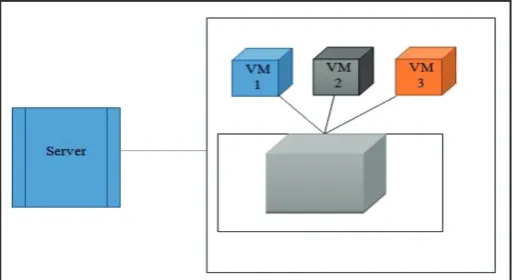
Fig. 1: Virtualization in Cloud Computing
consequently enhancing the general execution and resourceutility
of the framework. It guarantees that each computingresource is
circulated effectively and reasonably [13]. Virtual Machine (VM) migration is a powerful management technique that gives data centre operators the ability to adapt the placement of VMs in order to better satisfy performance objectives, improve resource utilization and communication locality, mitigate performance hotspots, achieve fault tolerance, reduce energy consumption [6, 5, 19].
The idle energy consumption of a server can be determined by
applying the following well known equation: From Joule's Ohm's law:
E= I * V (4)
Where E denotes the energy or power (Watt), I represents the electric current (Ampere) and V indicates the voltage.
Fig. 2: Services in Cloud Computing
Utilization of resources and protection of energy are not generally a prime center of examination in Cloud computing. Nonetheless, resource utilization can be kept to a base with appropriate
loadbalancing which helps in lessening costs as well as making
undertakings greener [6] [13]. Versatility which is one of the
critical components of Cloud computing is likewise empowered
by loadbalancing. Henceforth, enhancing resource utility and the execution of a conveyed framework in such a way will lessen the energy utilization and carbon impressions to accomplish Green processing [6] [7] [8] [10] [11] [12].
The above equation can be adopted in order to determine the idle
energy consumption at core level by assuming that each core
contributes equally to the overall idle energy consumption of a
processor
E i= Ii * Vi (5)
where, Ei, Ii,Vi, represents respectively the power, current and
voltage of the corresponding core i.
II. Energy Efficiency in Cloud Network
The cloud datacenter energy efficiency (CDCEE) metric may thus de defined as follows:
CDCEE = ITU * ITE / PUE (6)
where the IT utilization ( ITU ) denotes the ratio of average IT use over the peak IT capacity in the cloud datacenter, and the IT efficiency ( ITE ) is the amount of useful IT work done per
joule of energy.The total energy consumption of an active server
∆ ETotal=∆ EFix+∆ EDym (7)
There is additional energy is generated by scheduling overhead, denoted by ESched. This makes the energy consumption of two tasks, not equivalent to the sum of individual consumed energy. In this paper, we focus on the energy consumed by, server idle state, computation, and storage and communication resource utilizations.
These are defined as follows:
Energy consumption of server idle mode is denoted by
•
EIdle
Energy consumption of VM system is denoted by EVM •
Energy consumption of computation resources is denoted
•
by ECompu
Energy consumption of storage resources is denoted by
•
EStore
Energy consumption of communication resources is denoted
•
by ECommu
So, overall energy can be written as:
ETotal= EIdle+ EVM+ ECompu+ EStore
+ ECommunication (8)
III. Artificial Bee Colony (ABC)
By the foraging behavior of the colony, the artificial bees in ABC algorithm can be divided in three groups: employed bees, onlooker
bees and scout bees.
In ABC algorithm, a food source and its nectar amount are defined as a possible solution and its fitness value, respectively. Since each employed bee is associated with one and only one food source, the number employed bees is equal to the number of food sources.
Assume that the search space is n-dimension, the position of the i-th food source can be expressed as an-dimension vectorxi = (xi,1,xi,2,•••,xi,n),i = 1,•••,SN, SN is the number of food
sources.
Generally, ABC algorithm contains four phases: initialization phase, employed bees phase, onlooker bees phase and scout bees
phase.
Initialization phase: In this phase, the initial food sources can be generated randomly by the following equation:
xi,j = xlj + rand(0,1)* (xuj – xlj), (9)
where i {1,2,•••,SN},j
{1,2,•••,n},xlj and xuj are the lower bound and upper bound for the jth dimension, respectively.
(10)
After initialization, compute the fitness fit(xi) for each solution x.
Employed bees phase: In this phase, each employed bee generates
a new food source vi in the neighborhood of its present position
xi by using the following equation:
Once vi is obtained, a greedy selection mechanism is employed
between vi and xi: if f(vi) ≤ f(xi), vi will replace xi and become a
new member of the population, otherwise, xi is retained.
Onlooker bees phase: In this phase, each onlooker bee selects a food source according to the probability based on its fitness
value.
IV. Neural Network
Neural networks are typically organized in layers. Layers are
made up of a number of interconnected 'nodes' which contain an 'activation function'. Patterns are presented to the network via the
'input layer', which communicates to one or more 'hidden layers'
where the actual processing is done via a system of weighted
'connections'. Learning is a supervised process that occurs with
each cycle or 'epoch' (i.e. each time the network is presented with
a new input pattern) through a forward activation flow of outputs, and the backwards error propagation of = (,, weight adjustments. );
Algorithm can be described as below: Initialize
Max Epochs times
for each training data item
compute weights and bias deltas for current item adjust weights and bias values using deltas end for
end
MakeTrainTest(allData,out trainData,out testData); const int numInput = xi;
{ const int numHidden = xh; const int numOutput = xo;
NeuralNetwork nn = new NeuralNetwork(numInput,numH idden,
numOutput);
int maxEpochs = n; learnRate = xl;
nn.Train(trainData,maxEpochs,learnRate); end}
V. Related Work
This section shows large number of previous implemented
techniques for energy efficiency. (,,); Energy consumption is the key concern in content = ; distribution system and most distributed systems { = ; (Cloud systems). These demand an accumulation of = ; networked computing resources from one or multiple providers on datacenters extending over the world.
Techniques Environment Description Findings
Decentralized
content aware [21] Cloudcomputing
1. Uses a unique and special property(USP) of requests and computing nodes to help
scheduler to decide the best node for
processing the requests.
2. Uses the content information to narrow
down the search
1. Improves the searching performance hence increasing overall performance
2. Reduces idle time of the
nodes
LB for Internet Cloud
services [22] Cloud web servers
1. Uses a protocol to limit redirection rates to avoid remote servers overloading
2. Uses a middleware to support this protocol 3. Uses a heuristic to tolerate
abrupt load changes
1. Reduces service response
times by redirecting requests
to the closest servers without overloading them
2. Mean response time is 29% smaller than RR(Round Robin) and 31% smaller than SL(Smallest Latency)
Join-Idle-Queue [23] Cloud dat centers
1. First assigns idle processors to
dispatchers for the availability of the idle processors at each dispatcher
2. Then assigns jobs to processors to reduce average queue length of jobs at each
processor
1. Effectively reduces the system load
2. Incurs no communication
overhead at job arrivals
3. Does not increase actual
response times
Lock-free multiprocessing
[24] Multi-core 1. Runs multiple load-balancing processes in one load balancer 1. Improves overall performance of load balancer
Scheduling strategy on LB
of VM resources [25] Cloud Computing
1. Uses Genetic algorithm, historical data
and current state of system to achieve best load balancing and to reduce dynamic migration
1. Solves the problems of load
imbalance and high migration cost
Central LB policy for VMs
[26] Cloud Computing 1. Uses global state information to make load balancing decisions
1. Balances the load evenly to improve overall performance
2. Up to 20% improvement in
performance
3. Does not consider fault
LBVS: LB strategy for
Virtual Storage [27] Cloud Storage
1. Uses Fair-Share Replication strategy to achieve Replica Load balancing module
which in turn controls the access load balancing
2. Uses writing balancing algorithm to
control data writing load balancing
1. Enhances flexibility and
robustness
2. Provides large scale net data
storage and storage as a service
Task Scheduling Based on
LB [28] Cloud Computing 1. First maps tasks to virtual machines and then virtual machines to host resources
1. Improves task response time
2. Improves resource utilization
Honeybee Foraging
Behavior [14] Large scal Cloud Systems 1. Achieves global load balancing through local serve actions
1. Performs well as system diversity increases
2. Does not increase throughput as system size
increases
Biased Random Sampling
[14] Large scal Cloud Systems
1. Achieves load balancing across all system nodes using random sampling of the system domain
1. Performs better with high and similar population of resources
2. Degrades as population
diversity increases
Active Clustering [14] Large scal Cloud systems 1. Optimizes job assignment by connecting similar services by local re-wiring
1. Performs better with high resources
2. Utilizes the increased
system resources to increase throughput
3. Degrades as system diversity
increases
ACCLB (Ant Colony and Complex Network Theory)
[15]
Open Cloud Computing Federation
1. Uses small-world and scale-free characteristics of complex network to
achieve better load balancing
Overcomes heterogeneity
Adaptive to dynamic environments
Excellent in fault tolerance Good scalability
Two-phase scheduling(OLB
+ LBMM) [18] Three-level Cloud Computing Network
1. Uses OLB (Opportunistic Load Balancing) to keep each node busy and uses LBMM(Load Balance Min-Min) to
achieve the minimum
execution time of each task
1. Efficient utilization of
resources
2. Enhances work efficiency
Event-driven [20] Massively Multiplayer Online Games 1. Uses complete capacity event as input, analyzes its components and generates the
game session load balancing actions
1. Capable of scaling up and down a game session on multiple resources according to the variable user load
2. Occasional QoS breaches as low as 0.66%
Carton(LB + DRL) [17] Unifying framework for cloud control 1. Uses Load Balancing to minimize the associated cost and uses Cloud Rate
Limiting for fair allocation of resources
1. Simple
2. Easy to implement 3.Very low computation and
communication overhead
Compare and Bal-ance [16] Intra-Cloud 1. Based on sampling2. Uses adaptive live migration of virtual
machines
1. Balances load amongst servers
2. Reaches equilibrium fast 3. Assures migration of VMs from high-cost physical hosts to low-cost host
4. Assumption of having enough memory with each physical host
VectorDot [29] Datacenters with integrated server and
storage virtualization
1. Uses dot product to distinguish node
based on the item requirement
1. Handles hierarchical and
Multidimensional resource
constraints
VI. Simulation Model
Cloud server scheduling and maintenance is one of the most
difficult and complicated tasks in any cloud server. There are several tasks at any cloud server which need frequent attention. The cloud server doesn‟t communicate directly for execution of all the jobs and it is done via sub - servers. Consider following assumptions for proposed work:
System has single main server •
Requests are handled via sub- servers. •
Requests are handled at different or same time using VM. •
Requests can be handled only via subservers. •
Requests must be handled within coverage area. •
Energy for creation of VM must low than energy of allocation •
of jobs.
All therequests are handled by sub-server. Every request must lie
between the transmission ranges called coverage set. The cloud
client presents the no. of requests to the cloud supplier to be executed. A Provider gets the client's requests, executes them at a particular sub- server, then sends the outcomes back to the clients. Now, when the load at sub- servers get increased then usage of VM machines is done. Here, some energy can be utilized for task execution, but the main aim of this work is to reduce the energy by broadcasting. So, for given interval of time, the creation energy for VM must less than the allocation energy of VM for jobs for
broadcasting.
Algorithm 1: Generation and implementation of VM machines
GenerateEnvironment(host,VM) // host= no. of host; // VM= no. of VMs
fori=1:host
host_ram(i) = xrandom(); ram for Host Machines
host_space(i) = xrandom(); space for Host Machines
host_ramcost(i) = xrandom(); ram cost for Host Machines
host_hddcost(i) = xrandom(); End for;
for j=1:VM
vm_ram(j) = xrandom(); vm_space(j) = xrandom(); vm_time(j) = xrandom(); end for;
The steps generated a dynamic runtime allocation and scheduling environment.A host virtual machine is the server component of
a virtual machine (VM), the underlying hardware that provides
computing resources to support a particular guest virtual machine.
The host VM is the hardware that provides it with computing resources such as processing power, memory, disk and network I/O (input/output), and so on.
Algorithm 2: Generation and implementation of ABC algorithm;
Implement ABC (population, data)
// data is the target element ones which the ABC algorithm has
to be applied.
// Population contains the count of each bid which has been
made.
For each do in population
K = find (data, ele) // finding ele in the entire data
End
For each node k: length
Avg- bd = L = random ();
Ki = generate- random (0, 1);
The alone algorithm takes the output of ABC algorithm as input
and applies the neural network to find it and find the fittest ant of the fit data.
If KP = 0
L = -l ; // minimum charge
End if
Avg- bid = avg- bid + l;
The ABC algorithm creates a randomly distributed initial
population of solutions (f = 1,2,…..,Eb), where „f‟ signifies the size of population and „Eb‟ is the number of employed bees. Each solution xf is a Ddimensional vector, where D is the number of parameters to be optimized.
Algorithm 3: Generation and implementation of broadcasting method
The message that is transported through the communication
network in a given slot t is denoted by function broadcast (b). Let p denote the sender of slot t. If no link failure occurs during slot t, all non-faulty processors q receive the message sent by p:
Received (b,p)= sent (b,p)
The message received by a processor p in slot t is either the one that is broadcast or null.
Received(b,p)= Broadcast (b,p)V received (b,p)
The cloud does not use only virtualization technique, in addition to this, it also use the broadcasting method as shown above. There is a sense of request independence where theproposed application can run in any of the provisioned resources which fit the application of
broadcasting. This is achieved by using the broadcasting method which schedules the application components to the underlying provisioned computing resources
VII. Results and Discussion
The work mainly focuses on energy efficiencythrough VM utilization in Cloud Computing. GA+ ACO+Min-max algorithm is used for energy efficiency in cloud computing. It can be analyzed from the simulation results that SLA violations with VM comes out to be better w.r.t without VM results. Also job scheduling with VM has good rate w.r.t without VM machines.
Case 1: For 100 Jobs
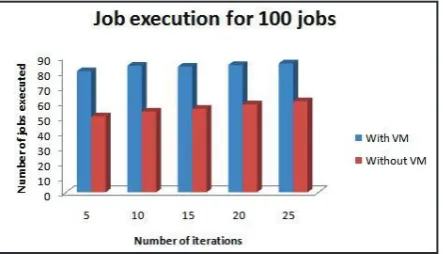
Fig. 3 shows the graph which shows the result evaluation values for 100 jobs with and without utilization of virtual migration technique. In below figure, Blue color bar graph shows the total job executed with virtual machine and red color bar graph represents the total number of jobs executed without virtual machine. It can be seen from the graph that jobs execution percentage is more
Fig. 3: Job Execution With VM and Without VM for 100 jobs
Table 1: Job Executionwith and Without VM Results
To reduce a burden of a Physical Machine, a Virtual Machine is created which intakes the memory of Physical Machine itself. From result simulations in fig. 3. with and without VM the results
are 80.33 and 56.33 respectively. It has been seen that with VM machines the obtained result values is better than without VM result values. In above figue blue color denotion is for with VM and orange color bar is for without VM.In cloud computing there are many jobs that requires to be executed on the available resources to achieve best minimal execution time. In this paper, a systematic technique of ABC+NN based job scheduling is presented.
Fig. 4: SLA Violations with VM and without VM for 100 jobs
Table 2: SLA Violations with and without VM Results
Fig. 4 shows the graph of SLA violation w.r.t VM machines. 0.29 SLA migrations has been found in the above graph. In above figue blue color denotion is for with VM and orange color bar is for without VM. SLA violation must be low in order to have good accuracy. SLA Violations shows that with VM machines the obtained result values is better than without VM result values. It‟s values must be low to have good algorithm. Service Level Agreements (SLAs) establish the Quality of Service (QoS) agreed between service-based systems. In proposed system we focus on reducing SLA Violation as a requirement to satisfy QoS.
Case 2: For 150 Jobs
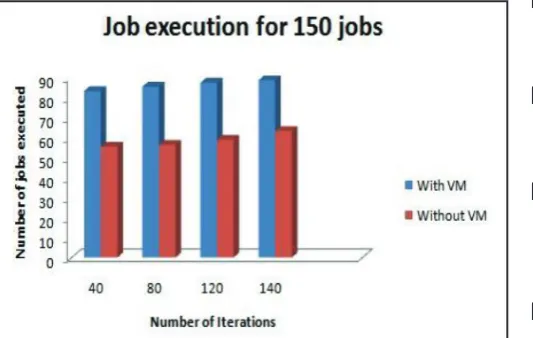
Below graphs for 150 jobs has been shown as well as in form
of table data with and without utilization of virtual migration technique. In above figure blue color denotion is for with VM and orange color bar is for without VM.With virtualization results
obtained will be better w.r.t without virtual migration concept. It
has been seen that with VM machines the obtained result values is better than without VM result values.
Fig. 5: SLA Violations for 150 Jobs
Table 3: SLA Violations with and without VM Results
Fig. 6: Job Execution for 150 Jobs
Table 4: Job Execution with and without VM Results
Fig. 6 shows the job scheduling w.r.t VM machines. Job scheduling must be high in order to have good accuracy. It leads to execute the jobs in good and sequenced manner. In above figue blue color denotion is for with VM and orange color bar is for without VM. The proposed QoS approach employs two complementary techniques; ABC+NN to provide good energy efficient algorithm to achieve scalability. Analysis has been done using the MATLAB simulator and it shows the high job execution values.
VIII. Conclusion
This paper has proposed energy efficient algorithm in cloud computing. The aim of energy efficiency method is that when server gets the requests, then sub- server s1→ sn, executes that request r1→ rn. So, when the load at sub- servers increases then the usage of VM machines is completed so that jobs can be executed equally.The energy utilized for task execution andthe energy created by Virtual Machine is counted in proposed work. So, the reduction of the overall energy (Etotal= E1, E2…En) has been achieved using this. Therefore, for given interval of time, the creation of energy for VM must less than the allocation energy of VM for jobs by utilizing proposed method.
References
[1] M. Armbrust, A. Fox, R. Griffith, A. D. Joseph, R. Katz, A. Konwinski, G. Lee, D. Patterson, A. Rabkin, I. Stoica, M. Zaharia, “Above the Clouds: A Berkeley View of Cloud Computing”, EECS Department, University of California, Berkeley, Technical Report No., UCB/EECS-2009- 28, pp. 1-23, February 2009.
[2] R. W. Lucky, “Cloud computing”, IEEE Journal of Spectrum, Vol. 46, No. 5, pp. 27-45, May 2009.
[3] M. D. Dikaiakos, G. Pallis, D. Katsa, P. Mehra, A. Vakali, “Cloud Computing: Cloud Internet Computing for IT and Scientific Research”, IEEE Journal of Internet Computing, Vol. 13, No. 5, pp. 10-13, September/October 2009. [4] G. Pallis,“Cloud Computing: The New Frontier of Internet
Computing”, IEEE Journal of Internet Computing, Vol. 14, No. 5, pp. 70-73, September/October 2010.
[5] B. P. Rima, E. Choi, I. Lumb,“A Taxonomy and Survey of Cloud Computing Systems”, Proceedings of 5th IEEE International Joint Conference on INC, IMS and IDC, Seoul, Korea, pp. 44-51, August 2009.
[6] R. Mata-Toledo, P. Gupta,“Green data center: how green can we perform”, Journal of Technology Research, Academic and Business Research Institute, Vol. 2, No. 1, pp. 1-8, May 2010.
[7] S. K. Garg, C. S. Yeob, A. Anandasivamc, R. Buyya, “Environment-conscious scheduling of HPC applications on Cloud Cloud-oriented data centers”, Journal of Parallel and Cloud Computing, Elsevier, Vol. 70, No. 6, pp. 1-18, May 2010.
[8] K. M. Nagothu, B. Kelley, J. Prevost, M. Jamshidi, “Ultra low energy cloud computing using adaptive load prediction”, Proceedings of IEEE World Automation Congress (WAC), Kobe, pp. 1-7, September 2010.
[9] B. P. Rimal, E. Choi, I. Lumb,“A Taxonomy, Survey, and Issues of Cloud Computing Ecosystems, Cloud Computing: Principles, Systems and Applications”, Computer Communications and Networks, Chapter 2, pp. 21-46, 2010.
[10] S. Kabiraj, V. Topka, R. C. Walke,“Going Green: A Holistic Approach to Transform Business”, International Journal of Managing Information Technology (IJMIT), Vol. 2, No. 3, pp. 22-31, August 2010.
[11] K. T. Rao, P. S. Kiran, L. S. S. Reddy, “Energy Efficiency in Datacenters through Virtualization: A Case Study”, Global Journal of Computer Science and Technology, Vol. 10, No. 3, pp. 2-6, April 2010.
[12] J. Baliga, R. W. A. Ayre, K. Hinton, R. S. Tucker, “Green Cloud Computing: Balancing Energy in Processing, Storage, and Transport”, Proceedings of the IEEE, Vol. 99, No. 1, pp. 149-167, January 2011.
[13] A. M. Alakeel, “A Guide to dynamic Load balancing in Cloud Computer Systems”, International Journal of Computer Science and Network Security (IJCSNS), Vol. 10, No. 6, pp. 153-160, June 2010.
[14] M. Randles, D. Lamb, A. Taleb- Bendiab, “A Comparative Study into Cloud Load Balancing Algorithms for Cloud Computing”, Proceedings of 24th IEEE International Conference on Advanced Information Networking and Applications Workshops, Perth, Australia, pp. 551-556, April 2010.
[15] Z. Zhang, X. Zhang,“A Load Balancing Mechanism Based on Ant Colony and Complex Network Theory in Open Cloud Computing Federation”, Proceedings of 2nd International Conference on Industrial Mechatronics and Automation (ICIMA), Wuhan, China, pp. 240243, May 2010.
[16] Y. Zhao, W. Huang,“Adaptive Cloud Load Balancing Algorithm based on Live Migration of Virtual Machines in Cloud”, Proceedings of 5th IEEE International Joint Conference on INC, IMS and IDC, Seoul, Republic of Korea, pp. 170-175, August 2009.
[17] R. Stanojevic, R. Shorten,“Load balancing vs. Cloud rate limiting: A unifying framework for cloud control”, Proceedings of IEEE ICC, Dresden, Germany, pp. 1-6, August 2009.
Chengdu, China, pp. 108-113, September 2010.
[19] Q. Zhang, L. Cheng, R. Boutaba,“Cloud computing: state-of-the-art and research challenges”, Journal of Internet Services and Applications, Vol. 1, No. 1, pp. 7-18, 2010.
[20] V. Nae, R. Prodan, T. Fahringer,“Cost- Efficient Hosting and Load Balancing of Massively Multiplayer Online Games”, Proceedings of the 11th IEEE/ACM International Conference on Grid Computing (Grid), IEEE Computer Society, pp. 9-17, October 2010.
[21] H. Mehta, P. Kanungo, M. Chandwani,“Decentralized
content aware load balancing algorithm for Cloud
computing environments”, of the ACM/IEEE conference on Supercomputing (SC), November 2008. Proceedings of the International Conference Workshop on Emerging Trends in Technology (ICWET), pp. 370-375, February 2011. [22] A. M. Nakai, E. Madeira, L. E. Buzato,“Load Balancing for
Internet Cloud Services Using Limited Redirection Rates”, 5th IEEE Latin-American Symposium on Dependable Computing (LADC), pp. 156-165, 2011.
[23] Y. Lua, Q. Xiea, G. Kliotb, A. Gellerb, J. R. Larusb, A. Greenber,“Join-Idle-Queue: A novel load balancing algorithm for dynamically scalable web services”, An international Journal on Performance evaluation, In Press, Accepted Manuscript, Available online 3 August 2011.
[24] Xi. Liu, Lei. Pan, Chong-Jun. Wang, Jun-Yuan. Xie,“A Lock-Free Solution for Load Balancing in Multi-Core Environment”, 3rd IEEE International Workshop on Intelligent Systems and Applications (ISA), pp. 1-4, 2011. [25] J. Hu, J. Gu, G. Sun, T. Zhao,“A Scheduling Strategy on Load
Balancing of Virtual Machine Resources in Cloud Computing Environment”, Third International Symposium on Parallel Architectures, Algorithms and Programming (PAAP), pp. 89-96, 2010.
[26] A. Bhadani, S. Chaudhary,“Performance evaluation of web
servers using central load balancing policy over virtual
machines on cloud”, Proceedings of the Third Annual ACM Bangalore Conference (COMPUTE), January 2010. [27] H. Liu, S. Liu, X. Meng, C. Yang, Y. Zhang,“LBVS: A
Load Balancing Strategy for Virtual Storage”, International Conference on Service Sciences (ICSS), IEEE, pp. 257-262, 2010.
[28] Y. Fang, F. Wang, J. Ge,“A Task Scheduling Algorithm Based on Load Balancing in Cloud Computing”, Web Information Systems and Mining, Lecture Notes in Computer Science, Vol. 6318, pp. 271-277, 2010.