Comparative Study of Performance and Exhaust
Emissions of a Diesel Engine Fueled with Algal, Used
Cooked and Jatropha Oils Biodiesel Mixtures
Farouk K. El-Baz
a, M. S. Gad
b, Sayeda M. Abdo
c, H. M. Abu Hashish
daPlant Biochemistry Department, National Research Centre (NRC), 33 El Bohouth st. (former El Tahrirst.)-Dokki, Giza,
Egypt.
bMechanical Engineering Department, Faculty of Engineering, Fayoum University, Egypt.
cWater pollution Research Department, National Research Centre (NRC), 33 El Bohouth st. (former El Tahrirst.)-Dokki,
Giza, Egypt.
dMechanical Engineering Department, National Research Centre (NRC), 33 El Bohouth st. (former El Tahrirst.)-Dokki,
Giza, Egypt.
bCorresponding author email: [email protected]
Abstract--The continuous increase in energy demand, consumption of fossil fuels, exhaust emissions and global warming, all these led to search for alternative fuels. Biodiesel was produced from different feedstocks such as algae, used cooked oil and Jatropha oils by transesterification process. Biodiesel blends of 10 and 20% volume percentages from different feedstocks were prepared. Physical and chemical properties of biodiesel blends of B10 and B20 were close to diesel oil. These experimental tests were run on a diesel engine at different engine loads from zero to full load. Performance and exhaust emissions of a diesel engine burning blends of biodiesel and diesel fuels were studied.Biodiesel blends achieved increases in exhaust gas temperatures and specific fuel consumptions and decreases in thermal efficiencies compared
to diesel fuel. Reductions in CO, NOx and smoke emissions for
biodiesel blends compared to diesel fuel were shown. Biodiesel
blends produced from S. obliquusalgae used cooked oil and
Jatropha biodiesel blends of B10 and B20 showed higher performance and less exhaust emissions compared to diesel fuel and other blends.
Index Term--Microalgae- Used cooked oil- Jatropha- Biodiesel- Performance- Exhaust emissions.
1.
INTRODUCTIONBiodiesel as an alternative fuel has recently received the attention due to the depletion of fossil fuels and harmful pollution problems. Biodiesel is produced from different vegetable oils such as Jatropha and used cooked oils. Microalgae have a great potential for biodiesel production. Algae oil content is usually ranged from 20 to 50%. Microalgae production take place in open ponds and photo biological reactors [1-5]. Microalgae are a good source for fuel production due to their higher growth rate, yield and oil content compared with other sources [2, 6,11- 12]. Tests carried out on engine recommended using blends with diesel oil up to 20% [13]. The rest material of algal cells after oil extraction can be used for nutraceuticals production [14-16]. Algal biodiesel and diesel oil blends were tested on a diesel engine compared to diesel fuel.
Decreases in thermal efficiency and increases in specific fuel consumption for biodiesel blends were shown [9, 10,11].
Used cooked oil (UCO) resulted from different sources is a problematic waste which requires suitable management. Used cooked oil causes environmental pollution of rivers and underground water. Using used cooked oil as a biodiesel saves money and overcomes different problems [17, 18]. Improvement of diesel engine performance can be achieved by reducing oil viscosity by transesterification process. Specific fuel consumption of biodiesel blend B25 derived from used cooked oil increased up to 5.69% compared to diesel fuel. Biodiesel blend B25 showed a decrease in thermal efficiency compared to diesel fuel. Reductions in carbon mono oxide and HC emissions for used cooked oil biodiesel were 11.66 and 23.12%, respectively [19]. Used cooked oil biodiesel fuel had shown very promising chemical and physical properties near to diesel fuel. Used cooked oil biodiesel of B50 resulted in a considerable reduction in unburned HC emissions associated with an increase in CO2 emissions. Specific fuel consumption
increase associated with engine thermal efficiency decrease compared to diesel fuel were due to the oxygen content and lower calorific value of biodiesel compared to diesel fuel [20].
In addition, biodiesel blend B20 gave reductions in CO, HC and increase in NOx emissions and produced higher exhaust gas
biodiesel and its blends. Decrease of thermal efficiency with increase of biodiesel percentage in biodiesel blends [25-29]. Jatropha oil yield is ranged from 28 to 32% [30]. The main problem of using Jatropha oils as fuels is their higher viscosity and lower volatility which cause poor combustion in diesel engines. Transesterification process of the oil reduces the viscosity to a range of 4–5 mm2/s closer to that of diesel fuel.
Jatropha biodiesel was produced from Jatropha oil with biodiesel yield higher than 98% using KOH and methanol as catalyst and molar ratio of at a temperature of 64 ºC [31-35]. An experimental was performed to evaluate performance and exhaust emissions of a diesel engine fueled with Jatropha methyl ester and its blends of 20, 40, 60, 80 and 100% with diesel fuel. Biodiesel blends improve engine performance and reduce exhaust emissions, reduce smoke opacity, unburned hydrocarbons, carbon dioxide and carbon monoxide emissions but nitrogen oxide emissions have slightly increased. Results
also showed that lower volume percentages of biodiesel blends up to 20% volume act as the optimum alternative fuel among all tested fuel [36 -40]. Fuel consumptions are slightly higher when fuelled Jatropha biodiesel [41].
The current work proposed to evaluate the effect of biodiesel blends produced from microalgae S. obliquus, Jatropha and used cooked oil and diesel oils on performance parameters and exhaust emissions of a diesel engine compared to diesel fuel.
2.MATERIALS AND METHODS 2.1Cultivation of S. obliquus
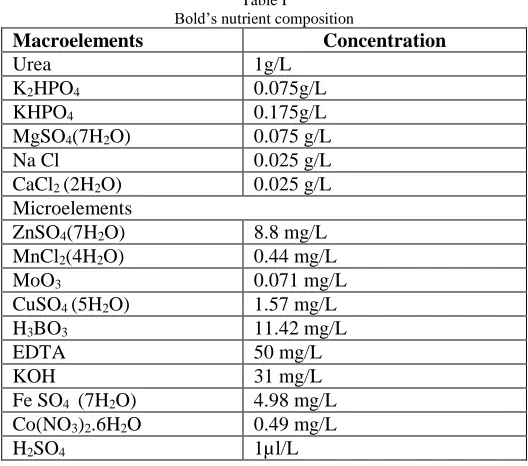
Scenedesmus obliquus was cultivated on laboratory scale in 15 L flasks containing Bold’s basal media[17]. After growing for 10 days, the inoculum was transferred to a photo bioreactor with a capacity of 4000 liters as shown in Fig. 1. Preparation of chemical composition of Bolds media is presented in table I.
Table I
Boldʼs nutrient composition
Macroelements Concentration
Urea 1g/L
K2HPO4 0.075g/L
KHPO4 0.175g/L
MgSO4(7H2O) 0.075 g/L
Na Cl 0.025 g/L
CaCl2 (2H2O) 0.025 g/L
Microelements
ZnSO4(7H2O) 8.8 mg/L
MnCl2(4H2O) 0.44 mg/L
MoO3 0.071 mg/L
CuSO4 (5H2O) 1.57 mg/L
H3BO3 11.42 mg/L
EDTA 50 mg/L
KOH 31 mg/L
Fe SO4 (7H2O) 4.98 mg/L
Co(NO3)2.6H2O 0.49 mg/L
H2SO4 1µl/L
Microalgae cells were harvested by settling and the settled biomass was subjected to centrifugation at a speed of 2000 rpm for 10 min. The collected biomass was dried at a temperature of 60ºC [42].
2.2 Fatty Acids profile Analysis
The fatty acids profile of the extracted oil sample of S. obliquus were determined by converting the fatty acids in the oil to fatty acid methyl esters (FAMEs) according to Mohod et al. [27]. The fatty acids profile of the extracted oil sample of all species were determined by converting the fatty acids in the oil to fatty acid methyl esters (FAMEs). FAME composition was determined using a Gas Chromatography (GC) with a split automatic injector and silica capillary column DB-5 (length: 60 m; ID: 0.32 mm.). Helium was used as carrier gas at a flow rate of 1 ml/min. The column was held at a temperature of 150 ºC for 1 min. and ramped to a temperature of 240 ºC at a rate of 30 ºC/min and it was then held at temperature of 240 ºC for 30 min. Standards were used to give rise to well-individualized peaks that allow the identification of the fatty acid composition.
2.3 Biodiesel preparation from Jatropha, used cooked oil and algae
The biomass of microalgae was dried and grounded into homogenous fine powder. The dried cells were blended with Hexane and Isopropanol with the ratio of 3:2 (volume/volume). The homogenous mixture was subjected to a magnetic stirrer at a temperature of 30°C for 2 hrs. The filtrate material was transferred into a separating funnel and sufficient water was added to induce biphasic layering. After settling, the solvent mixture was separated into two distinct phases of top dark green hexane layer containing most of the extracted lipids and bottom light green layer containing most of the co-extracted non lipids [43].
Biodiesel was produced by transesterification process from green algae S.obliquus. The reaction was carried out using sulfuric acid as a catalyst (100% in relation to the mass of lipid). Methanol was added to the lipid and the ratio of alcohol to lipid was 30:1 (volume/weight). Half of the methanol volume was previously added in order to dissolve the oil then the other volume of methanol mixed with sulfuric acid. The reaction was run at a temperature of 60°C for 4 hrs. under constant continuous stirring in a water bath with reflux condenser. The excess alcohol is removed by evaporation using a rotary evaporator. The mixture was transferred to a separating funnel and left to be settled. After settling, the mixture was separated into two distinct phases of upper layer containing fatty acid methyl ester (FAME) and a bottom layer containing the glycerol [44].
Transesterification was used to convert used cooked oil to biodiesel. Used cooked oil was blended with methanol in the presence of base catalyst of sodium hydroxide producing fatty acids methyl ester. Sodium hydroxide catalyst of 1% and 20
% methanol at the temperature range of 65-69°C were used. The time of reaction was two hours and biodiesel yield was 92.5% [45, 46]. Two stage processes is used for biodiesel production from Jatropha oil by esterification followed by transesterification [16-18]. Esterification is used to reduce the
free fatty acid content in Jatropha oil with methanol (99% pure) and acid catalyst (sulfuric acid of 98% purity) in three hours reaction time at 80 ºC. In transesterification process, Jatropha oil was heated up to 70 ºC to get off moisture and stirred vigorously. Potassium hydroxide KOH of 1% was dissolved in methanol with molar ratio of 6:1 and the mixture was stirred continuously. The mixture is allowed to settle under gravity for 12 hours in a separating funnel. The products formed during biodiesel production were Jatropha oil methyl ester and glycerin. The upper layer consists of biodiesel, alcohol and some soap. The glycerine was separated and the fatty acid methyl ester was water washed to remove unreacted methoxide by water washing with air bubbling. It was then heated to remove the water traces to obtain pure biodiesel [47, 48].
Jatropha biodiesel was blended with diesel, algal biodiesel and used cooked oil biodiesel by volume percentages of 10 and 20% by volume percentages. Pure diesel fuel was named as D100. (U+A) B10 biodiesel blend was prepared as 5% used cooked oil biodiesel, 5% algal biodiesel and 90% diesel oil. (U+J) B10 biodiesel blend was prepared as 5% used cooked oil biodiesel, 5% Jatropha biodiesel and 90% diesel oil.(J+A) B10 biodiesel blend was prepared as 5% Jatropha biodiesel, 5% algal biodiesel and 90% diesel oil. (U+A) B20 biodiesel blend was prepared as 10% used cooked oil biodiesel, 10% algal biodiesel and 80% diesel oil. (U+J) B20 biodiesel blend was prepared as 10% used cooked oil biodiesel, 10% Jatropha biodiesel and 800% diesel oil. (J+A) B20 biodiesel blend was prepared as 10% used Jatropha biodiesel, 10% algal biodiesel and 80% diesel oil.
2.4 Experimental test rig
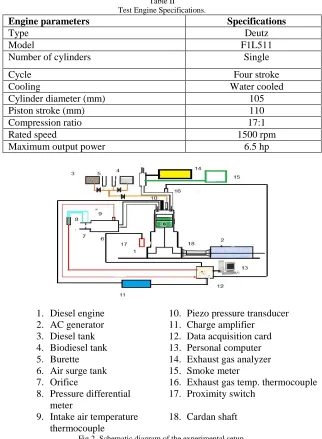
The tested diesel engine specifications were given in Table II. This engine was connected to an eddy current dynamometer to measure the engine speed and load. The engine was equipped to measure fuel consumption, engine speed and exhaust gas temperature. This engine received air through an air box fitted with an orifice for measuring air consumption. A U tube manometer was used to measure the pressure difference between the two sides of the orifice. Fuel consumption rate was measured using a glass burette and stop watch. Engine speed was measured using a digital tachometer. Exhaust gas analyzer of MRU DELTA 1600-V model was used for measurement of exhaust emission concentrations of CO, HC, CO2 and NOx.
OPA 100 smoke meter was used to measure smoke emissions. Schematic diagram of experimental set up was shown in Fig.2. Measurements were recorded after the engine reached its stable condition. The engine was operated with blends of diesel fuel, algal oil, used cooked oil and jatropha biodiesel blends of B10 and B20. At every engine load, the engine speed was maintained constant at rated speed of 1500 rpm. Performance parameters were studied such as specific fuel consumption, thermal efficiency, exhaust gas temperature and air- fuel ratio. Exhaust emissions concentrations were recorded such as CO2,
Table II Test Engine Specifications.
Engine parameters Specifications
Type Deutz
Model F1L511
Number of cylinders Single
Cycle Four stroke
Cooling Water cooled
Cylinder diameter (mm) 105
Piston stroke (mm) 110
Compression ratio 17:1
Rated speed 1500 rpm
Maximum output power 6.5 hp
1. Diesel engine 10. Piezo pressure transducer
2. AC generator 11. Charge amplifier
3. Diesel tank 12. Data acquisition card
4. Biodiesel tank 13. Personal computer
5. Burette 14. Exhaust gas analyzer
6. Air surge tank 15. Smoke meter
7. Orifice 16. Exhaust gas temp. thermocouple
8. Pressure differential meter
17. Proximity switch
9. Intake air temperature thermocouple
18. Cardan shaft
Fig.2. Schematic diagram of the experimental setup.
3.RESULTS AND DISCUSSIONS 3.1. Fatty acids composition
The results in Table III indicated that there was a variation in fatty acids fractions between all samples. Palmitic acid (C16:0) was present in all samples with higher percentages of 19.4, 19.4 and 20.85% for algal biodiesel, Jatropha and used cooked oil samples, respectively. Palmetolic acid was detected in algal biodiesel and Jatropha biodiesel but was not detected in used cooked oil. Satearic acid (C:18:0) was found in all samples however it showed relatively higher concentration in algal biodiesel and UCO. Linoleic acid (C:18:2) was found in all biodiesel samples with relatively higher concentrations, where the percentages were 31.6, 41 and 54.3% for algal biodiesel, Jatropha and used cooked oil, respectively. The fatty acids with more than three double ponds were not detected in biodiesel samples, this indicated that biodiesel produced from three different sources was appropriate to be
used as a biodiesel source. Most commonly synthesized fatty acids are with chain length ranged between C16 and C18. Palmitic and oleic acids are the main compositions of fatty acids fraction. Oils with higher content of oleic and palmitic acids have been found to have a good quality of fuel. Synthesized membrane lipids in algae are glycosylglycerides and phosphoglycerides [49-52].
Table III
Fatty acids composition of biodiesel from S. obliquus Jatropha oil and used cooked oil (UCO)
3.2 Physical and Chemical properties of biodiesel blends
The main fuel properties and ASTM standards of 10 and 20% biodiesel blends of Jatropha, algae and used cooked oil as compared to diesel fuel and ASTM standards were shown in Table IV.
Table IV
Properties of biodiesel blends B10 and B20 compared to diesel fuel according to ASTM standards.
Properties Method Diesel oil
D100
(U+A) B10
(U+J) B10 (J+A)
B10
(U+A) B20
(U+J) B20
(J+A) B20
Density @ 15.56°C
ASTM
D-1298 837.8 838 847 838.5 831.5 851 831.5
Kinematic viscosity, cSt, @ 40o C
ASTM D-445
1.91 3.3 1.77 3.32 3.31 4.51 2.98
Cetane Index ASTM
D-976
68.75 57 51 57 58.5 53 57
Gross Calorific value, kJ / Kg
ASTM D-240
44401 44585 44422 44779 44900 44251 44956
Net Calorific value, kJ / Kg
ASTM D-224
42000 41500 41300 41652 41800 41100 41560
Viscosity of biodiesel blends (U+A) B10, (J+A) B10, (U+A)
B20, (U+J) B20 and (J+A) B20 were higher than diesel fuel
according to ASTM standards values. Viscosity of biodiesel blend (U+J) B10 is lower than diesel fuel. The heating values for different biodiesel blends B10 and B20 were within the acceptable limit of ASTM standards of diesel fuel. Cetane numbers of biodiesel blend B10 and B20 were lower than diesel oil, so biodiesel blends quality was higher than that of diesel fuel.
3.3 Specific fuel consumptions of biodiesel blends
Variation of specific fuel consumption with engine load for biodiesel blends is shown in Fig.3. The decrease in specific fuel consumption with the engine load increase for biodiesel blends was due to fuel consumption increases with engine load. At engine loads of 1 and 2 kW, biodiesel blends showed decreases in specific fuel consumptions about diesel fuel except for (U+A) B20. At engine load of 3 kW, biodiesel blends showed
Fatty acids Common name Algae Jatropha Used cooked oil
C:12:0 Lauric 9.27 - -
C:14:0 Myristic 1.48 - 0.1
C:16:0 Palmitic 19.4 19.4 20.85
1C:16:1 Palmetolic 5.4 1.74 -
Total C:16 24.8 21.14 20.85
C:17:0 Margaric acid 0.67 - -
C:18:0 stearic acid 24.28 15.86 22.33
C:18:1 Oleic 5.2 22 16.08
C:18:2 Linoleic 31.6 41 34.3
C:18:3 Linolenic 2.7 - 6.34
Total C:18 63.78 82.89 79.05
Lipid profile
Total saturated (T.S.) 55.1 35.26 43.28
decreases in specific fuel consumptions about diesel fuel except for (U+A) B20 and (U+J) B20. At engine load of 4 kW, biodiesel blends showed decreases in specific fuel consumptions about diesel fuel except for (U+A) B20, (U+J) B20, (U+A) B10 and (U+J) B10. Specific fuel consumptions of biodiesel blends are higher than diesel oil because of lower calorific values with respect to diesel oil. Specific fuel
consumptions of biodiesel blend of (J+A) B20 and (J+A) B10 achieved maximum decreases about diesel fuel and other biodiesel blends. Specific fuel consumption of (J+A) B10 achieved maximum decrease about diesel fuel by about 1% at higher engine load. These results agreed with references [15, 21, 33].
0 0.1 0.2 0.3 0.4 0.5 0.6 0.7 0.8
1 2 3 4
Sp
ec
ifi
c f
ue
l
co
ns
um
pt
io
n,
k
g/
kW
.h
r
Engine load, kW
D100
(J+A) B10
(U+A) B10
(U+J) B10
(J+ A) B20
(U+A) B20
(U+J) B20
Fig. 3. Specific fuel consumptions variations with engine load for blends of diesel and biodiesel.
3.4 Thermal efficiency of biodiesel blends
Variation of thermal efficiency with engine load for biodiesel blends is shown in Fig.4. Increase of thermal efficiencies at different engine loads were due to heat loss decrease. Thermal efficiencies of biodiesel blends showed increases in thermal
efficiencies about diesel fuel because of fuel consumptions and lower calorific values decreases. Thermal efficiency of (J+A) B10 achieved maximum increase about diesel fuel by about 1%. at full load. Similar results are obtained by references [16, 24, 32].
0 0.05 0.1 0.15 0.2 0.25 0.3
0 1 2 3 4
Th
erm
al
e
ffi
cie
nc
y,
%
Engine load, kW
D100
(J+A) B10
(U+A) B10
(U+J) B10
(J+ A) B20
(U+A) B20
(U+J) B20
Fig. 4.Thermal efficiencies variations with engine load for blends of diesel and biodiesel.
3.5 Exhaust gas temperatures of biodiesel blends
Exhaust gas temperatures of biodiesel blends at different engine loads were shown in Fig.5. The Increase of exhaust gas temperature for biodiesel blends at different engine loads was because of fuel consumption and heat loss increases. Biodiesel blends B10 and B20 showed higher exhaust gas temperatures about diesel fuel. This was because of increases in fuel
0 50 100 150 200 250 300 350 400
0 1 2 3 4
Ex
ha
us
t ga
s t
em
pe
ra
tu
re
, °
C
Engine load, kW
D100
(J+A) B10
(U+A) B10
(U+J) B10
(J+ A) B20
(U+A) B20
(U+J) B20
Fig. 5.Exhaust gas temperatures variations with engine load for blends of diesel and biodiesel. 3.6 Air-fuel ratios of biodiesel blends
Air- fuel ratios of biodiesel blends at different engine loads is shown in Fig. 6. Air fuel ratios decreased with the increase of engine load, this may be due to the increase in fuel consumption and the richer mixture at higher loads. Decreases of fuel consumptions for biodiesel blends B10 and B20 about diesel
fuel led to increase of air-fuel ratios. Values of air- fuel ratios for (J+A) B10, (U+A) B10, (U+J) B10, (J+A) B20, (U+A) B20 and (U+J) B20 and diesel fuel at full loads are 18.8, 18.9, 17, 17.25, 18.3, 17 and 17.5, respectively. These results agreed with these references [23, 30].
0 10 20 30 40 50 60 70
0 1 2 3 4
Ai
r-fu
el
ra
tio
Engine load, kW
D100
(J+A) B10
(U+A) B10
(U+J) B10
(J+ A) B20
(U+A) B20
(U+J) B20
Fig. 6.Air-fuel ratios variations with engine load for blends of diesel and biodiesel.
3.7 CO2 emissions of biodiesel blends
Figure 7 showed the effect of biodiesel blends on CO2
emissions at different engine loads. CO2 emissions increased
with the engine load increase because of fuel consumptions increases at higher engine loads. Increases of CO2 emissions for
biodiesel blends B10 and B20 about diesel fuel were because of higher percentages of carbon to hydrogen ratio of biodiesel
blends. Combustion improvement and oxygen content of biodiesel blends led to increase of CO2 emissions [24, 27, 35].
Increases of CO2 emission for biodiesel blends (J+A) B10,
0 0.5 1 1.5 2 2.5 3 3.5
0 1 2 3 4
CO
2
em
is
si
on
, %
Engine load, kW
D100
B10 (U+A)
B10 (U+J)
B10 (J+A)
B20 (U+A)
B20 (U+J)
B20 (J+A)
Fig. 7.CO2 emissions variations with engine load for blends of diesel and biodiesel.
3.8 CO emissions of biodiesel blends
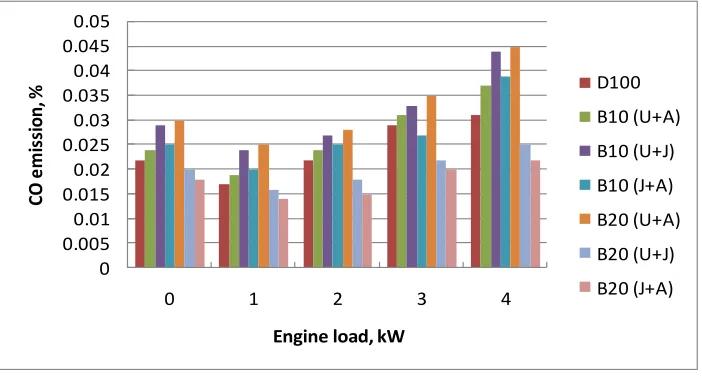
CO emissions of biodiesel blends at different engine loads are presented in Fig. 8. Increases of CO emissions with engine load increase from lower loads to medium loads and increased in higher engine loads. Increase of CO emission is due to higher combustion temperature at higher engine loads. More oxygen molecules, lower carbon content, enhanced vaporization and
atomization in biodiesel blends led to decrease of CO emissions of biodiesel blends compared to diesel fuel. Maximum decreases in CO emission of (U+A) B20 and (J+A) B20 biodiesel blends about diesel fuel by about 20 and 22%, respectively. These results agreed with these references [22, 27, 30].
0 0.005 0.01 0.015 0.02 0.025 0.03 0.035 0.04 0.045 0.05
0 1 2 3 4
CO
e
m
is
si
o
n
, %
Engine load, kW
D100
B10 (U+A)
B10 (U+J)
B10 (J+A)
B20 (U+A)
B20 (U+J)
B20 (J+A)
Fig. 8.CO emissions variations with engine load for blends of diesel and biodiesel.
3.9 HC emissions of biodiesel blends
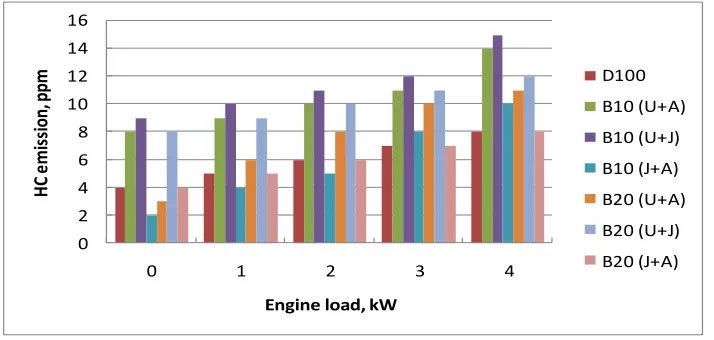
Figure 9 indicated the effect biodiesel blends on HC emissions at different engine loads. Increases of HC emissions with increase of engine load were due to fuel consumptions increases. This is because of the presence of fuel rich mixture and lack of oxygen resulting from engine operation. HC emissions of biodiesel blend (J+A) B20 was lower than diesel
0 2 4 6 8 10 12 14 16
0 1 2 3 4
H
C
em
is
si
on
, p
pm
Engine load, kW
D100
B10 (U+A)
B10 (U+J)
B10 (J+A)
B20 (U+A)
B20 (U+J)
B20 (J+A)
Fig. 9.HC emissions variations with engine load for blends of diesel and biodiesel.
3.10 NOx emissions of biodiesel blends
Figure 10 explained the variations in NOx emissions for
biodiesel blends at different engine loads. Increases of NOx
emissions were due to higher fuel consumptions and combustion chamber temperatures. Oxygen inside the combustion chamber, combustion flame temperature and reaction time affect on NOx emission formation. Lower ignition
delay, higher cetane number and shorter duration of premixed
combustion led to NOx emission decrease. NOx emissions of
B10 and B20 biodiesel blends decreased about diesel fuel due to
lower combustion chamber temperatures. Maximum
concentrations of NOx emissions at full load for diesel, biodiesel
blends (J+A) B10, (U+A) B10, (U+J) B10, (J+A) B20, (U+A) B20 and (U+J) B20 were 85, 44, 53, 57, 69, 80 and 47 ppm, respectively. These results are closer to the results reported by references [16, 17, 25].
0 10 20 30 40 50 60 70 80 90
0 1 2 3 4
N
o
x
e
m
is
si
o
n
, p
p
m
Engine load, kW
D100
B10 (U+A)
B10 (U+J)
B10 (J+A)
B20 (U+A)
B20 (U+J)
B20 (J+A)
Fig. 10.NOx emissions variations with engine load for blends of diesel and biodiesel.
3.11 Smoke emissions of biodiesel blends
Variations of smoke emissions for biodiesel blends with engine load are shown in Fig. 11. Smoke emission increased with engine output power increase for all fuels. Increase of fuel consumption led to increase of smoke emission. Presence of branched and ring structures in diesel fuel increases the smoke levels. Biodiesel blends produced smoke emissions less than diesel oil because of inbuilt oxygen and complete combustion in biodiesel blends . At engine loads of 0 and 1 kW, Smoke emission for all biodiesel blends decreased about diesel fuel
0 10 20 30 40 50 60
0 1 2 3 4
Sm
ok
e
op
ac
it
y,
%
Engine load, kW
D100
B10 (U+A)
B10 (U+J)
B10 (J+A)
B20 (U+A)
B20 (U+J)
B20 (J+A)
Fig. 11.Smoke emissions variations with engine load for blends of diesel and biodiesel.
4. CONCLUSION
Biodiesel blends produced from S. obliquus is algae, Jatropha and used cooked oils showed higher performance and less exhaust emissions about diesel fuel. Biodiesel blends should be used up to 20% in diesel engine.
ACKNOWLEDGEMENT
This work was supported and funded by the project entitled "Biodiesel production from algae as a renewable energy source ". Funding organization: Research Development and Innovation programme (RDI), Funding Program: EU-Egypt Innovation Fund, 2014-2017.
REFERENCES
[1] Y. Chisti," Biodiesel from microalgae", Biotechnology Adv., Vol.25, No.3, pp. 294–306, 2007.
[2] S.D. Romano, P.A. Sorichetti, "Dielectric Spectroscopy in Biodiesel Production and Characterization", Green Energy and Technology, 519-4_2, 2011.
[3] S.H. Al-lwayzy, T. Yusaf, R. A. Al-Juboori, "Biofuels from the Fresh Water MicroalgaeChlorella vulgaris (FWM-CV) for Diesel Engines", Energies, Vol.7, pp.1829-185, 2014.
[4] J. Singh, S. Gu, "Commercialization potential of microalgae for biofuels production", Renewable and Sustainable Energy Reviews., Vol.14, No.9pp.2596–2610, 2010.
[5] M. Balat,"Potential alternatives to edible oils for biodiesel production A review of current work", Energy Conversion and Management, Vol.52, No.2,pp.1479-1492, 2011.
[6] X. Miao, Q. Wu Q, "Biodiesel production from heterotrophic microalgal oil". Bioresources Technology, Vol. 97, No.6,pp.841– 846, 2006.
[7] X. Zhang, J. Rong, H. Chen, C. He, Q. Wang, "Current status and outlook in the application of microalgae in biodiesel production and environmental protection", Frontiers in Energy Research, "Vol.2, No.32, pp.1-15, 2014.
[8] Á. Sánchez, R. Maceiras, Á. Cancela, A. Pérez, "Culture aspects of
Isochrysis galbana for biodiesel production", Applied Energy, Vol.101, pp.192–197, 2013.
[9] Y. Unpaprom, S. Tipnee, R. Rameshprabu, "Biodiesel from green alga Scenedesmus acuminatus", International Journal of Sustainable and Green Energy ,Vol. 4, No.1, pp.1-6, 2015.
[10] A.B.M. Hossain Sharif, A. Salleh, A. Nasrulhaq, P. Chowdhury, M. Naqiudden, "Biodiesel fuel production from algae as renewable energy", American Journal of Biochemistry and Biotechnology, Vol.4, No.3, pp. 250–245, 2008.
[11] A. Converti, A.A. Casazza, E.Y. Ortiz, P. Perego, M. del Borghi, "Effect of temperature and nitrogen concentration on the growth and lipid content of Nannochloropsis oculataand Chlorella vulgaris for biodiesel production", Chem. Eng. Process., Process Intensif, Vol. 48, pp.1146–1151, 2009.
[12] A. Demirbas, M. F. Demirbas, "Importance of algae oil as a source of biodiesel", Energy Conversion and Management, Vol.52, No.1, pp.163–170, 2011.
[13] A. Demirbas, "Importance of biodiesel as transportation fuel", Energy Policy, Vol. 35, No.9, pp.4661–4670, 2007.
[14] S. Amin, "Review on biofuel oil and gas production processes from microalgae", Energy Conversion and Management, Vol.50, No.7, pp.1834–1840, 2009.
[15] T. Varghese, J. Raj, E. Raja, C. Thamotharan,"Performance and Emission Testing on Algae Bio Fuel using Additives", International Journal of Engineering and Advanced Technology (IJEAT), Vol. 4, No.5, pp.28- 33, 2015.
[16] R. Velappan, S. Sivaprakasam," Investigation of Single Cylinder Diesel Engine using Bio Diesel from Marine Algae", International Journal of Innovative Science, Engineering and Technology, Vol.1, No.4, pp.399-403, 2014.
[17] D. K. Ramesha, G. Prema Kumara, Lalsaheb, Aamir V. T. Mohammed, Haseeb A. Mohammed, Mufteeb Ain Kasma," An experimental study on usage of plastic oil and B20 algae biodiesel blend as substitute fuel to diesel engine", Environ. Sci. Pollut. Res., Springer, December 2015.
[18] S. John, et al., " Life Cycle Inventory of Biodiesel and Petroleum Diesel for use in an Urban Bus", Final Report for U.S. Dept. of Energy’s Office of Fuel Development and the U.S. Dept. of Agriculture’s Office of Energy, The National Renewable Energy Laboratory, NREL/ SR-580-24089, May 1998.
[19] N. H. Abdullah, S. H. Hasan, N.R. M. Yusoff, "Biodiesel Production Based on Waste Cooked Oil (WCO) ", International Journal of Materials Science and Engineering Vol. 1, No. 2, 2013.
[20] Rasim Behcet, Recep Yumrutas, and Hasan Oktay, "Effects of fuels produced from fish and cooked oils on performance and emissions of a diesel engine", Energy, Vol.71, pp.645-655, 2014.
[21] A. Abu-Jrai, Jehad A. Yamin, Ala,a H. Al-Muhtaseb, M. A. Hararah,
"Combustion characteristics and engine emissions of a diesel engine fueled with diesel and treated waste cooked oil blends", Chemical Engineering Journal, Vol.172, pp.129-136, 2011.
[22] K. Muralidharan, D. Vasudevan, "Performance, emission and combustion characteristics of a variable compression ratio engine using methyl esters of waste cooked oil and diesel blends", Applied Energy, Vol.88, pp.3959-3968, 2011.
[24] Yage Di, C. S. Cheung, and Z. Huang, "Experimental investigation on regulated emissions of a diesel engine fueled with ultra- low sulfur diesel fuel blended with biodiesel from waste cooked oil", Science of The total Environment Journal, Vol.407, pp.835-846, 2009.
[25] Ozer Can, "Combustion characteristics, performance and exhaust emissions of a diesel engine fueled with a waste cooked oil biodiesel mixture", Energy Conversion and Management, Vol.87, pp.676-686, 2014.
[26] C. C. Enweremadu, H. I. Rutto, "Combustion, emission and engine performance characteristics of used cooked oil biodiesel-A review", Renewable and Sustainable Energy Reviews, Vol.14, pp.2863-2873, 2010.
[27] Tushar R. Mohod, Prashant C. Jikar, Vishwanath S. Khobragade, "Experimental Investigation of a Diesel Engine Fueled With Waste Cooked Oil Ethyl Ester", International Journal of Research in Engineering and Technology (IJRET), Vol.2, No.5, pp.240-244, 2013. [28] B. Ghobadian, H. Rahimi, A. M. Nikbakht, G. Najafi, T. F. Yusaf,
"Diesel engine performance and exhaust emission analysis using waste cooked biodiesel fuel with an artificial neural network", Renewable Energy, Vol.34, pp.976-982, 2009.
[29] R. B. Sharma, Amit Pal, Juhi Sharaf, "Production of Bio-Diesel from Waste Cooked Oil", Journal of Engineering Research and Applications,Vol.4, No.6, pp.1629-1636, December 2013.
[30] S. D. Romano, P. A. Sorichetti," Dielectric Spectroscopy in Biodiesel Production and Characterization" , Green Energy and Technology, 2011.
[31] M. Balat, ''Current alternative engine fuels'', Energy Sources 2005, 27(6): 569-77.
[32] Lu HF, Liu YY, Zhou H, Yang Y, Chen MY, Liang B., ''Production of biodiesel from Jatropha curcas L. oil'',Computers and Chemical Engineering 2009; 33(5): 1091–6.
[33] Kumara G, Kumarb D, Joharia R, Singhb CP.,''A continuous transesterification process of Jatropha curcas oil in the presence of biodiesel as a green solvent'', Bioresource Technology 2010, doi:10.1016/j.biortech.2010.07.123.
[34] Achten WMJ, Verchot L, Franken YJ, Mathijs E, Singh VP, Aerts R, et al., ''Jatropha bio-diesel production and use'', Biomass and Bioenergy 2008; 32(12):1063–84.
[35] Sahoo PK, Das LM, Babu MKG, Arora P, Singh VP, Kumar NR, et al.,'' Comparative evaluation of performance and emission characteristics of Jatropha, Karanja and Polanga based biodiesel as fuel in a tractor engine'', Fuel 2009; 88(9):1698–707.
[36] Basha SA, Gopal KR, Jebaraj S., ''A review on biodiesel production, combustion, emissions and performance'', Renewable and Sustainable Energy Reviews 2009; 13(6–7):1628–34. [37] Bozbas K., ''Biodiesel as an alternative motor fuel: production and
policies in the European Union'', Renewable and Sustainable Energy Reviews 2008; 12(2):542–52.
[38] P.Q. Tan, Z.Y. Hu, D.M. Lou, and Z.J. Li, "Exhaust emissions from a light-duty diesel engine with Jatropha biodiesel fuel", Energy, vol. 39, pp. 356-362, 2012.
[39] S. Jain, and M. P. Sharma, "Study of oxidation stability of Jatropha curcas biodiesel / diesel blends", Energy and Environment, Vol. 2, pp. 533-542, 2011.
[40] Venkata Ramesh Mamilla, M.V. Mallikarjun, Dr. G.Lakshmi Narayana Rao., ''Effect of combustion chamber design on a DI diesel engine fuelled with Jatropha Methyl Esters Blends with diesel'', Procedia Engineering 64 ( 2013 ),479 – 490.
[41] Syarifah Yunusa, Amirul Abd Rashida, Nik Rosli Abdullaha, Rizalman Mamatb, Syazuan Abdul Latipa, ''Emissions of transesterification Jatropha-Palm blended biodiesel'' Procedia Engineering, 68 (2013), 265 – 270.
[42] R. Halim, B. Gladman, M. K. Danquah, P. A. Webley, "Oil extraction from Microalga for Biodiesel Production", Bioresource Technology, Vol. 102, pp.178-185, 2011.
[43] M. M. G. D’Oca, C. V. Viêgas, J. S. Lemões, E. K. Miyasaki, J. A. Morón-Villarreyes, E. G. Primel, P. C. Abreub, "Production of FAMEs from Several Microalgal Lipidic Extracts and Direct Transesterification of the Chlorella pyrenoidosa", Biomass and Bioenergy, Vol.35, pp.1533-1538, 2011.
[44] L. Gouveia, AC Oliveira, "Microalgae as a raw material for biofuels production", J. Ind. Microbiol. Biotechnol., Vol.36,pp.269-274, 2009.
[45] E.M. Shahid, Y. Jamal, A. N. Shah, N. Rumzan, M. Munsha, "Effect of Used Cooked Oil Methyl Ester on Compression Ignition Engine", Journal of Quality and Technology Management, Vol.VIII, Issue II, pp.91-104, 2012.
[46] Pedro Felizardo, M. Joana Neiva Correia, Idalina Raposo, Joao F. Mendes, Rui Berkemeier, Joao Moura Bordado, "Production, of biodiesel from waste frying oils", Waste Management Journal,Vol.26, No.3, pp.487-494, 2006.
[47] Jindal S, Nandwana BP, Rathore NS, Vashistha V.,'' Experimental investigation of the effect of compression ratio and injection pressure in a direct injection diesel engine running on Jatropha methyl ester'', Applied Thermal Engineering 2010; 30(5):442–8. [48] Huang J, Wang Y, Qin J-b, Roskilly AP., ''Comparative study of
performance and emissions of a diesel engine using Chinese pistache and Jatropha biodiesel'', Fuel Processing Technology 2010:017.
[49] Q. Hu, M. Sommerfeld, E. Jarvis, M. Ghirardi, M. Posewitz, M. Seibert, A. Darzins, ''Microalgal triacylglycerols as feedstocks for bio-fuel production: perspectives and advances'', Plant J 54:621– 639, 2008.
[50] J. Ohlrogge, J. Browse, ''Lipid biosynthesis'', Plant Cell 7:957–970, 1995.
[51] M. A. Borowitzka, ''Microalgae for aquaculture: opportunities and constraints'', J Appl Phycol 9:393–401, 1997.
[52] M. Piorreck, P. Pohl, ''Formation of biomass, total protein, chlor-ophylls, lipids and fatty acids in green and blue-green algae during one growth phase'', Phytochem 23:217–223, 1984.
[53] G. Knothe, ''Dependence of biodiesel fuel properties on the structure of fatty acid alkyl esters'', Fuel processing technology, Vol.86, pp.1059-1070, 2005.