Visualization using Augmented Reality
Yash Thakkar, Jay Tandel, Riti Sharma
Mentor: Prof. Hetal Bhaidasna
Dept. of Computer Science and Engineering,
Parul Insitute of Engineering and Technology
Vadodara, India
Abstract
—
This document explains the concept of 'Augmented Reality' and how it can be used as a guide to find different location. Different authors have demonstrated the use of Augmented Reality with the help of 'Unity', in finding the location with the help of augmented guide. The applications are also capable of providing the information(history) about the places.Keywords
—
Augmented Reality,VirtualEnvironments, Unity3D, Vuforia, Application, Camera,University.
I.
I
NTRODUCTION'Augmented Reality' is an emerging technology in which one’s perception of the real-time environment is enhanced by superimposing computer-generated information such as graphical, textual, or audio content, as well as objects onto a display screen, basically it's a concept of augmenting the real world with virtual objects created through the computer graphics. Similarly 'Virtual Reality' is something that immerse the users in a complete artificial user friendly environment [3].
For developing the applications which shows the use of Augmented Reality 'Unity' engine is used embedded with 'Vuforia SDK' [3].
Vuforia SDK uses vision-based augmented reality technology to process feature points of 2D /3D planes from real world camera images [3].
Vuforia enables the development of applications in Unity to later migrate to the Android framework [7]. It uses mobile devices display to show the augmented world [5]. By using Unity Engine different virtual applications are made [6]. Augmented reality (AR) is an interactive experience of a real-world environment where the objects that reside in the real-world are enhanced by computer-generated perceptual information, sometimes across multiple sensory modalities, including visual, auditory. The overlaid sensory information can be constructive (i.e. additive to the natural environment) or destructive (i.e. masking of the natural environment) and is seamlessly interwoven with the physical world such that it is perceived as immersive aspect of the real environment.[3] In this way, augmented reality
alters one's ongoing perception of a real-world environment [15].
II. IMPLEMENTION
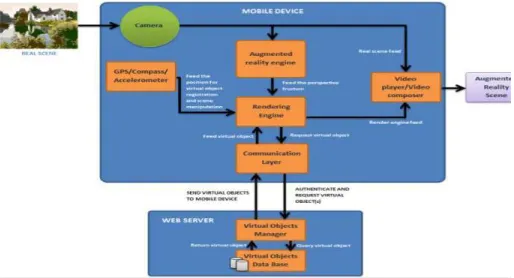
.The architecture of the Augmented Reality based system is shown in the figure 1. This architecture helps in understanding how the work is done using Augmented Reality and every component has its own task to perform. As it can be seen in the Figure 1, the proposed architecture mainly has the following components:
1)Camera, to capture the images and transmit the content to the tracker.
3)Tracker, which contains the algorithms of computerized vision to detect and track the objects in the real world in frames.
4)Video background renderer, to reproduce the camera image stored in the object.
5)Application code, which queries the object state to new detected targets.
6)Device database, to store the target markers.
III.
APPLICATIONS OF
AUGMENTED REALITY
• AR applications can be used in theeducation industry. Apps are being developed which embed text, images, and videos, as well as real-world curriculum.
• Printing and advertising industries are developing apps to display digital content on top of real-world magazines.
• With help of AR, travellers can access real-time information of historical places just by pointing their camera viewfinder to subjects.
• AR is helpful in the development of
translation apps that can interpret the text in other languages for you.
• Location-based AR apps are major
forms of AR apps. Users can access information about nearest places
relative to current location. They can get information about places and choose based on user reviews.
• With the help of Unity 3d Engine, AR is being used to develop real-time 3D Games.
• Another use of augmented reality is in the realm of social messaging apps. Consider the app Tada Time where you can create your very own virtual avatar. You can also customize it to look, talk and act exactly like you. The TaDa app also consists of a number of cool animations that you can use on any an occasion. The app also enables you to talk to family and friends like they were actually there in person.
IV. OVERVIEW OF THE PROJECT
Generally when people are not familiar with the place they find it difficult to reach to the particular destination. This project is all about guiding the people about the university and taking them to the particular sector in the university with the help of Augmented Reality.IV.I HOW IT WORKS
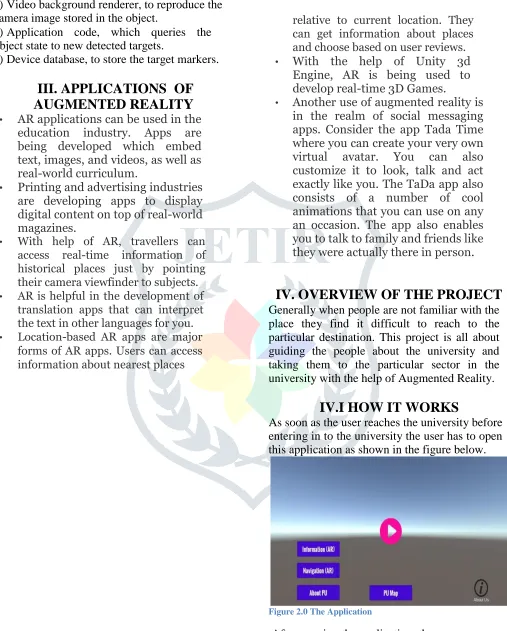
As soon as the user reaches the university before entering in to the university the user has to open this application as shown in the figure below.
Figure 2.0 The Application
After opening the application, the user can choose any of the tabs: Information(AR),
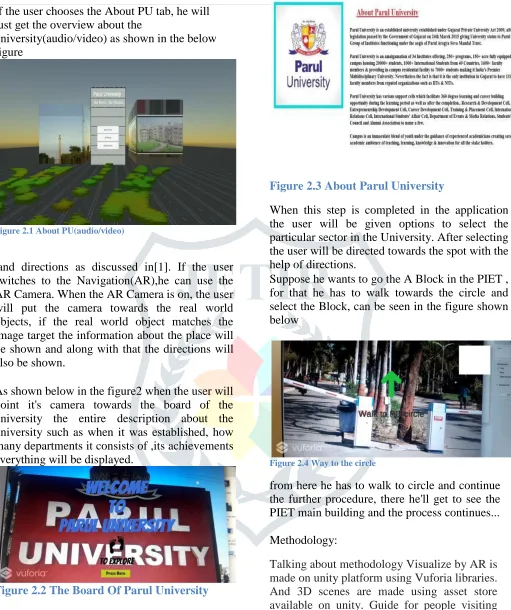
If the user chooses the About PU tab, he will just get the overview about the
university(audio/video) as shown in the below figure
Figure 2.1 About PU(audio/video)
and directions as discussed in[1]. If the user switches to the Navigation(AR),he can use the AR Camera. When the AR Camera is on, the user will put the camera towards the real world objects, if the real world object matches the image target the information about the place will be shown and along with that the directions will also be shown.
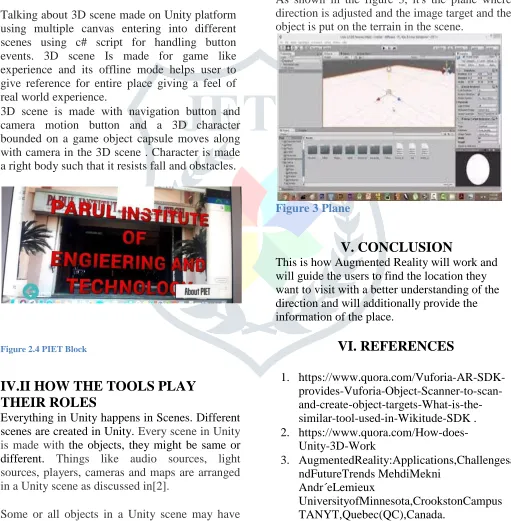
As shown below in the figure2 when the user will point it's camera towards the board of the university the entire description about the university such as when it was established, how many departments it consists of ,its achievements everything will be displayed.
Figure 2.2 The Board Of Parul University
As shown in the figure it's the end result that will be displayed, the limitation is that the user must have a phone with good quality of camera and must have a AR supported feature in it.
Figure 2.3 About Parul University
When this step is completed in the application the user will be given options to select the particular sector in the University. After selecting the user will be directed towards the spot with the help of directions.
Suppose he wants to go the A Block in the PIET , for that he has to walk towards the circle and select the Block, can be seen in the figure shown below
Figure 2.4 Way to the circle
from here he has to walk to circle and continue the further procedure, there he'll get to see the PIET main building and the process continues...
Methodology:
university with voice based navigation is made keeping in mind problem of large location tag radius. Guide or navigation is made with help of image detection and canvas Enable/Disable using C# script. Four Direction four Canvas with changing target images and based on selection of destination from available options on the screen. Also Enabling/Disabling sound listener based on canvas selected.
Talking about 3D scene made on Unity platform using multiple canvas entering into different scenes using c# script for handling button events. 3D scene Is made for game like experience and its offline mode helps user to give reference for entire place giving a feel of real world experience.
3D scene is made with navigation button and camera motion button and a 3D character bounded on a game object capsule moves along with camera in the 3D scene . Character is made a right body such that it resists fall and obstacles.
or JavaScript) and these scripts are attached to the objects that needs coding in[2].
Vuforia AR SDK is embedded in Unity. It provides Vuforia Object Scanner to scan and create object targets. as discussed in[1].
As shown in the figure 3, it's the plane where direction is adjusted and the image target and the object is put on the terrain in the scene.
Figure 3 Plane
Figure 2.4 PIET Block
IV.II HOW THE TOOLS PLAY
THEIR ROLES
Everything in Unity happens in Scenes. Different scenes are created in Unity. Every scene in Unity
is made with the objects, they might be same or
different. Things like audio sources, light sources, players, cameras and maps are arranged in a Unity scene as discussed in[2].
Some or all objects in a Unity scene may have
scripts that tell them what to do, when to do it.
These scripts involve writing code (Usually C#
V. CONCLUSION
This is how Augmented Reality will work and will guide the users to find the location they want to visit with a better understanding of the direction and will additionally provide the information of the place.
VI. REFERENCES
1. https://www.quora.com/Vuforia-AR-SDK- provides-Vuforia-Object-Scanner-to-scan- and-create-object-targets-What-is-the-similar-tool-used-in-Wikitude-SDK . 2.
https://www.quora.com/How-does-Unity-3D-Work
3. AugmentedReality:Applications,Challengesa ndFutureTrends MehdiMekni
Andr´eLemieux
UniversityofMinnesota,CrookstonCampus TANYT,Quebec(QC),Canada.
4. Offline Mobile Application for Places
Marjury D´ıaz H., Karen Barber´an C., Diana Mart´ınez-M., Gabriel L´opez F. Departamento de Electr´onica, Telecomunicaciones y Redes de Informaci´on Escuela Polit´ecnica Nacional, Ladr´on de Guevara, E11-253, Quito-Ecuador.
5. Experimentation of visual augmented reality for visiting the historical monuments of the medina of Fez. Mohamed Zaifri Computer Science and Modeling Laboratory (LIM) Computer Science Department Sidi Mohamed Ben Abdellah University (FSDM) Fez, Morocco
Ahmed Azough Computer Science and Modeling Laboratory (LIM) Computer Science Department Sidi Mohamed Ben Abdellah University (FSDM) Fez, Morocco Said Ouatik El Alaoui Computer Science and Modeling Laboratory (LIM) Computer Science Department Sidi Mohamed Ben Abdellah University (FSDM) Fez, Morocco 6. An Educational Augmented Reality App To
Facilitate Learning Experience.
7. Sidharth Sunil Indian School, Al See Muscat Sultanate of Oman.
Smitha Sunil Kumaran Nair, Member, IEEE Department of Computing Middle East College affiliated to Coventry University, UK Knowledge Oasis Muscat.
8. Implementation of Mobile Augmented Reality Based on Vuforia and Rawajali Cheng Xiao, Zhang Lifeng School of Information Science andTechnology,Jiujiang University Jiujiang, JiangxiProvince, China 9. Research and Application of Indoor
Guide Based on Mobile Augmented Reality System.
Xingya Yan ,Wei Liu , Xiaoyun Cui Xi’an University of Post & Telecommunications, Xi’an , China.
10.An Implementation of Generic Augmented Reality in Mobile Devices.
Qingfeng Zhang1, Weilong Chu1, Changhong Ji2, Chengyuan Ke3, Yamei Li1 1.Dep. CS, Jinan Univ. Guangzhou, P.R.C. 2.SANGFOR Inc., Shenzhen, P.R.C. 3. Gree Electric Appliances, Zhuhai, P.R.C.
11.Augmented Reality and Its Technologies Vikas Tiwari1, Vijay Prakash Tiwari2, Dhruvesh Chudasama3, Prof. Kumkum Bala (Guide)4
12.Virtual Ornaments and Fabric Try-on Reality
Application 1G.Rajaram,
2B.Anandavenkatesan.
13.Research on the Application of Products based on Unity3D.
Lehui Huang1,a,Bin Gui2,b 1Education School, Jiangxi Science&Technology Normal University, Nanchang, China 2Education School, Jiangxi Science&Technology Normal University, Nanchang, China [email protected] , [email protected]
14.International Journal of Advanced Research in Computer Science and Software Engineering
Research Paper
Available online at: www.ijarcsse.com Marker Based Augmented Reality Using Android OS.