e-ISSN: 2278-067X, p-ISSN: 2278-800X, www.ijerd.com
Volume 13, Issue 3 (March 2017), PP.48-56
Study on Strength Properties of Concrete with Partial
Replacement of Fine Aggregate with Copper Slag
K Rajasekhar
1, B Leela Tejaswi
21
Asst. Professor, Department of Civil Engineering, Andhra University, Visakhapatnam - 03
2
M.tech, Department of Civil Engineering, Andhra University, Visakhapatnam - 03
Abstract
:
One of the major challenges in our present society is the protection of environment. Some of the important elements in this respect are the reduction in the consumption of energy and natural raw materials and consumption of waste materials must be increased. This experimental study is to investigate the effect of using copper slag as a replacement of fine aggregate on the strength properties. The common management options for copper slag are recycling, recovering of metal, production of value added products such as abrasive tools, roofing granules, cutting tools, abrasive tiles, glass, rail road ballast, asphalt pavements. Despite increasing reusing of copper slag, the huge amounts of its annual production is disposed in dumps or stockpiles. In the present study experimental investigation has been carried out on M25 grade concrete is used and tests were conducted for various percentage replacement of fine aggregate with copper slag in concrete. The obtained results were compared with those of control concrete made with ordinary portland cement and sand. The use of copper slag in concrete provides potential environment as well as economic benefits for all related industries, particularly in areas where a considerable amount of copper slag is produced. This study reviews the characteristics of copper slag and its effect on the engineering properties of M25 grade concrete.Index terms - Compressive Strength, Copper Slag, Fine Aggregate, Flexural Strength, Reusing Copper Slag,
Environmental Friendly, Split Tensile Strength
I. INTRODUCTION
In the present scenario,as a result of continuous growth in population, rapid industrialization, the rate of discharge of pollutants into the atmosphere has also increased.Copper slag is one of the industrial waste which comes out from blast furnace during metal extraction process. After repetitive recycling and reuse, copper slag is not useful and should be disposed in landfills. However, copper slag can be used in many beneficial ways. It can be used as replacement of fine aggregate in the concrete construction, the slag serves as a fine, or binding agent which helps to hold large gravel particles within the concrete together. It can be used as fill material that is to build up the earth to support roads, buildings or other surfaces. One of the primary advantages of copper slag is the low risk it poses to health and the environment. An attempt has been made to study the possibility of reusing copper slag as a substitute to fine aggregate in the concrete.
The main objective of this paper is to determine the strength parameters of M25 grade concrete when made with replacement of fine aggregate with copper slag. Compressive strength, split tensile strength and flexural strength of the concrete is evaluated with different percentage replacement of fine aggregate with copper slag. The results obtained were encouraging to use copper slag as an alternative to fine aggregate in the concrete. There is need to discover a cost effective and energy efficient building materials in the present phase of scarce, expensive and traditional building materials are in use abundantly. Therefore, evaluating selected industrial wastes for civil engineering construction should be encouraged. As an attempt to find an alternative to fine aggregate, copper slag is used in this study.
II. LITERATURE REVIEW
Arino and Mobasher (1999) presented the effect of ground copper slag on the strength and manufacture of cement-based materials. Portland cement was replaced with ground copper slag up to 15% by mass. The test results indicated that GCS concrete was stronger but more brittle than ordinary Portland cement concrete. AyyanoToshiki et al (2001) presented the problems in using copper slag as a concrete aggregate. One of them is excess bleeding attributed to the glassy surface of copper slag. In this paper, the strength, setting time, durability of concrete with copper slag was clarified.
Bipragorai et al (2003) reviewed the characteristics of copper slag and preparation of valued added products from copper slag. The favorable physio-mechanical and chemical characteristics of copper slag lead to its utilization to prepare various value added products such as cement, fill, ballast, abrasive, cutting tools, aggregate, tiles etc… The utilization of copper slag in such manners may reduce the cost disposal. This may also leads to lessenvironmental problems.
Persson (2004) made a comparison between performance of vibrated concrete and SCC under elevated temperature. Cylinders and columns were tested for compressive loading with high temperature. It was observed from the test results that explosive spalling took place for columns with SCC but not for columns with vibrated concrete, even though the vibrated concrete columns were cured exactly as SCC columns. It was found that the fire spalling mainly depended on the stress in the concrete.
Byung Sik Chun et al (2005) conducted several laboratory tests and evaluated the applicability of copper slag as a partial replacement for sand. From the various tests performed, the strength of composite ground was compared studied and analyzed by monitoring the stress and ground settlement of clay, sand compaction pile and copper slag compaction pile.
Shanmuganathan et al (2007) mentioned that large amounts of copper slag are generated as waste worldwide. They suggested that the slag is considered to be safe for use in a wide variety of applications such as tiles and bituminous pavement constructions.
Caijun Shi et al (2008) reviewed the effect of copper slag on the engineering properties of cement mortars and concrete. They reported that the utilization of copper slag in cement mortar and concrete is very effective ad beneficial for all related industries, particularly in areas where a considerable amount of copper slag is produced.
Chavan & Kulkarni (2013) conducted experimental investigations to study the effect of using copper slag as a replacement of fine aggregate on strength properties and concluded that the maximum compressive strength of concrete increased by 55% at 40% replacement of fine aggregate by copper slag and flexural strength increased by 14% for 40% replacement
Washington Almeida Moura et al (2007) presented the results of copper slag as pozzolanic supplementary cement material for use in concrete. The results pointed out that there is a potential for the use of copper slag as a supplementary cementing material to concrete production. The concrete batches with copper slag addition has shown greater mechanical strength and durability.
III. EXPERIMENTAL WORK
A. Experimental Materials1. Cement: The 43 grade ordinary portland cement conforming to IS specifications was used in the experimental study. The cement is tested for various properties as per IS 4031 conforming to the specifications given in IS 12269-1987. The specific gravity of cement was found to be 3.12.
2.Aggregate - Coarse aggregate: The coarse aggregate forms the main matrix of the concrete. The aggregate retained on IS 4.75mm sieve is termed as coarse aggregate. The aggregate used was hard, angular, and possessed good crushing strength. Crushed stone has been used as coarse aggregate in the present study.
2. Aggregate - Fine Aggregate: The fine aggregate forms the filler matrix between the coarse aggregate and cement. The aggregate which passes through IS 4.75mm sieve and retains on 150 microns sieve is termed as fine aggregate. Angular grained fine aggregate produces strong concrete because of good interlocking property. Natural river sand conforming to IS: 383 has been used in the study.
Table I: Properties of Fine Aggregate
S.No Particulars Fine Aggregate
1 Zone Zone II (IS:383-1970)
2 Specific gravity 2.64
3 Fineness Modulus 2.77
Table II: Physical Properties of Copper Slag
Table III: Chemical Properties of Copper Slag
4. Water: Water is the most important and but the least expensive ingredient of concrete.. A part of mixing water is utilized in the hydration of cement to form the binding matrix and the remaining water acts as lubricant to make the concrete readily placeable.
5. Chemical Admixture: Admixture is defined as a material which increases the workability of concrete and also produces high strength concrete. The chemical admixture used in this experiment is Conplast SP-430 to arrive at workable mix for 0.48 water cement ratio, conforming to IS: 9103-1999. The content of admixture used for the designed mix was 0.5% of cement content.
IV. MIX PROPORTION
The process of relative proportions of cement, sand, coarse aggregate and water, so as to obtain a concrete of desired quality is known as the proportioning of concrete. The mix is designed as per IS: 10262:2009 and it is presented in the table IV below.
Table IV: Mix Proportion
V. RESULTS AND DISCUSSIONS
A. Compressive Strength of ConcreteCompressive strength is the most common test conducted on hardened concrete, because of its ease to conduct and most of the desirable characteristic properties of concrete are qualitatively related to its compressive strength. Test for compressive strength was conducted according to IS:516-1959. The cube specimens of size 150mmx150mmx150mm were cast and tested at respective days of curing. Also specimens were heated to temperatures 100oC,200oC,300oC and 400oC for one hour duration to evaluate respective residual
PHYSICAL PROPERTIES PROPERTIES OF COPPER SLAG
Particle shape Irregular
Appearance Black and glassy
Type Air cooled
Specific Gravity 3.53
Percentage of voids 43.20%
Bulk Density 2.08 g/cc
Fineness Modulus 3.4
S.NO CHEMICAL COMPONENT PERCENTAGE OF CHEMICAL COMPONENT
1 Sio2 25.84
2 Fe203 68.29
3 Al2O3 0.22
4 CaO 0.15
5 Na2O 0.58
6 K2O 0.23
7 LoI 6.59
8 Mn2O3 0.22
9 TiO2 0.41
10 SO3 0.11
11 CuO 1.20
12 Sulphide Sulphur 0.25
13 Insoluble residue 14.88
14 Chloride 0.018
WATER CEMENT FINE
AGGREGATE
COARSE AGGREGATE
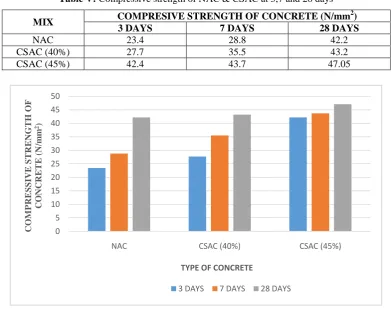
Table V: Compressive strength of NAC & CSAC at 3,7 and 28 days
Fig. 1: Comparision of Compressive Strength of NAC & CSAC at 3,7 and 28 days
From Fig. 1, it can be observed that the compressive strength of copper slag aggregate with 40% and 45% replacement is observed to be high when compared to NAC at all the ages. Concrete with 45% replacement yielded maximum compressive strength of 47.05 N/mm2at 28 dayswhereas for normal aggregate concrete a value of 42.2 N/mm2is observed. The cause forthe considerable increase in the strength of concrete is due to increased workability of concrete.
Table VI: Residual Compressive Strength of Concrete at Elevated Temperature 0
5 10 15 20 25 30 35 40 45 50
NAC CSAC (40%) CSAC (45%)
CO
M
PRES
S
IV
E
S
TREN
G
TH
O
F
CO
NC
RETE
(N/m
m
2)
TYPE OF CONCRETE
3 DAYS 7 DAYS 28 DAYS
MIX COMPRESIVE STRENGTH OF CONCRETE (N/mm 2)
3 DAYS 7 DAYS 28 DAYS
NAC 23.4 28.8 42.2
CSAC (40%) 27.7 35.5 43.2
CSAC (45%) 42.4 43.7 47.05
S.NO TEMPERAT URE
NATURAL COARSE AGGREGATE
COPPER SLAG COARSE AGGREGATE
PERCENTAGE CHANGE
40%COPPER SLAG
45% COPPER
SLAG
40% COPPER
SLAG
45% COPPER
SLAG
1 - 42.2 43.3 47.05 +2.36 +11.49
2 1000C 40.69 43.3 41.3 +6.41 +1.49
3 2000C 41.1 53.5 49.95 +30.17 +21.53
4 3000C 38.6 39.3 45.50 +1.81 +17.8
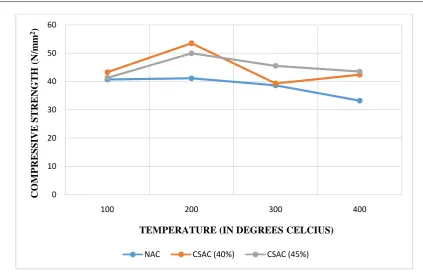
Fig. 2: Variation of Compressive Strength ofNAC & CSAC at elevated temperatures
The variation of compressive strength with elevated temperatures at 28 days is shown for NAC & CSAC in Fig.2. It is observed that there is a decrease in strength at 100oC and increase at 2000C for 40% replacement of fine aggregateand there is marginal decrease in strength for 300oC, 400oC for 45% replacement. The test result shows different losses in compressive strength at different temperatures. It is known that the concrete consists of discrete aggregate dispersed in a continuous cement paste matrix, and the transition between cement paste and aggregate is considered to be a critical zone and evidently effects the concrete performance exposed to high temperatures. It is noticed that the changes occurring in this zone is responsible for the loss of compressive strength through the pore structure coarse for the cement paste structure and aggregate. As a result of non-thermo identification between the cement paste and the aggregate surface, in addition to the effect of vaporized water pressure during the heating process, the chemical changes occurring in this zone represented by the loss of free moisture, the increase in calcium content (C-S-H) and from elongation of calcium hydroxide crystals tightly in cement paste as temperatures rise.
B. Split Tensile Strength of Concrete
Tensile Strength is an important property of concrete because structures are highly vulnerable to tensile cracking due to various kinds of effects and applied loading. However, tensile strength of concrete is very low compared to its compressive strength. The split tensile strength was conducted according to IS: 5816-1999. The cylinder specimens of size 150mmx300mmx300mm were cast and tested at respective days of curing. Also specimens were heated to temperatures 100oC,200oC,300oC and 400oC for one hour duration for evaluation of respective residual split tensile strengths.
Table VII: Split Tensile Strength of NAC & CSAC at 3,7 and 28 days 0
10 20 30 40 50 60
100 200 300 400
CO
M
P
RE
SS
IVE
ST
RE
NG
T
H
(
N/m
m
2)
TEMPERATURE (IN DEGREES CELCIUS)
NAC CSAC (40%) CSAC (45%)
MIX SPLIT TENSILE STRENGTH OF CONCRETE (N/mm 2
)
3 DAYS 7 DAYS 28 DAYS
NAC 2.10 2.41 4.42
CSAC (40%) 2.61 3.145 3.51
Fig. 3: Comparision of split tensile strength of NAC & CSAC at 3, 7 and 28 days
From the above Fig. 3, it is observed that the an increase in split tensile strength for 40% and 45% replacement of fine aggregate with copper slag. The reason for improvement in strength is, copper slag is better compressible than sand. It is known that the sand has good abrasion properties because of its rough surface, which can improve the cohesion between cement paste and coarse aggregate. The angular shape edges of copper slag particles have the ability to compensate to some extent of the adverse effect of sand and thus, further improve the cohesion of concrete. This leads to improve in the mechanical performance of copper slag admixed concrete.
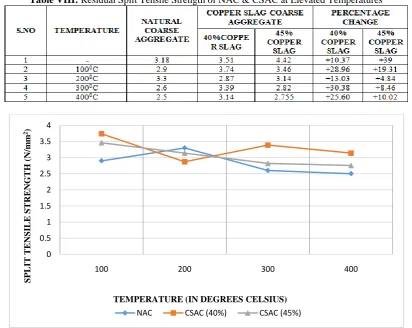
Table VIII: Residual Split Tensile Strength of NAC & CSAC at Elevated Temperatures 0
0.5 1 1.5 2 2.5 3 3.5 4 4.5 5
NAC CSAC (40%) CSAC (45%)
S
PLIT
TENSILE
S
TREN
G
TH
O
F
CO
NC
RETE
(N/m
m
2)
TYPES OF CONCRETE
3 DAYS 7 DAYS 28 DAYS
0 0.5 1 1.5 2 2.5 3 3.5 4
100 200 300 400
S
PLIT
TENSILE
S
TREN
G
TH
(N/m
m
2)
TEMPERATURE (IN DEGREES CELSIUS)
From the Table VIII, it can be noted that the CSAC with 40% replacement of fine aggregate with copper slag possessed more strength when compared to CSAC with 45% replacement at different elevated temperatures of 1000C, 2000C, 3000C and 4000C for duration of 1 hour. But CSAC with 45% replacement possessed more strength than 40% replacement when compared to NAC. Further it is observed that there is marginal decrease in split tensile strength at 3000C and 4000C for 28 days. This is because it begins to experience dehydration reactions, possible thermal incompatibilities between paste and aggregate and eventual physiochemical deterioration of the aggregate.
C. Flexural Strength of Concrete
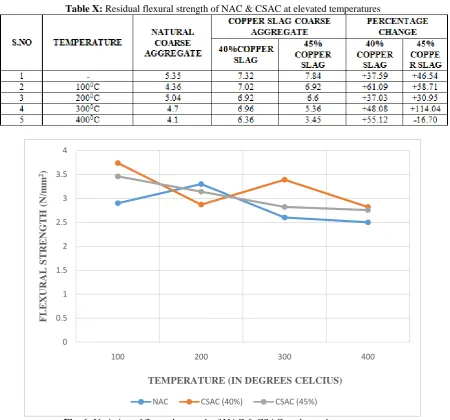
Concrete is relatively strong in compression and weak in tension. In reinforced concrete members, a small dependence is placed on the tensile strength of concrete since steel reinforcing bars are provided to resist all tensile forces. The flexural strength test was conducted according to IS: 516-1959. The prism specimens of size 100mmx100mmx500mm were cast and tested at respective days of curing. Also specimens were heated to temperatures 100oC,200oC,300oC and 400oC for one hour duration for evaluation of residual flexural strength.
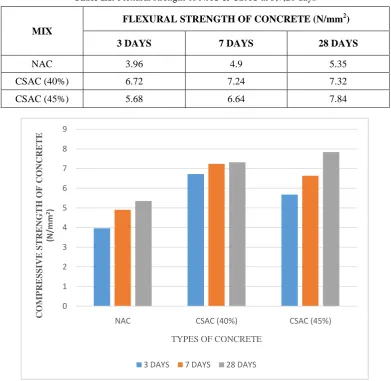
Table IX: Flexural strength of NAC & CSAC at 3,7,28 days
Fig. 5: Variation of flexural strength of concrete at age of 3,7 and 28 days
From Fig. 5, the test results indicate that the flexural strength of concrete with 45% of replacement of fine aggregate shown strength less than 40% of replacement. The reason for reduction in strength was low absorption properties of copper slag can leave excess water in concrete, which can cause bleeding at higher copper slag content. There is a slight increase of 46.54% in the flexural strength of concrete with 45% replacement than the concrete with 40% of replacement at 28 days.
0 1 2 3 4 5 6 7 8 9
NAC CSAC (40%) CSAC (45%)
C
O
M
PR
ESSIV
E
STR
EN
G
TH
O
F
C
O
N
C
R
ET
E
(N
/mm
2)
TYPES OF CONCRETE
3 DAYS 7 DAYS 28 DAYS
MIX
FLEXURAL STRENGTH OF CONCRETE (N/mm2)
3 DAYS 7 DAYS 28 DAYS
NAC 3.96 4.9 5.35
CSAC (40%) 6.72 7.24 7.32
Table X: Residual flexural strength of NAC & CSAC at elevated temperatures
Fig. 6: Variation of flexural strength of NAC & CSAC at elevated temperatures
From the above Fig. 6, it can be observed that the flexural strength of CSAC with 40% replacement has shown more strength when compared to CSAC with 45% replacement when exposed to different elevated temperatures for 1 hour duration. However the flexural strength of CSAC is observed to be higher when compared to NAC with elevated temperatures. It is further observed that the strength decreased at 1000C for 28 days and then there is marginal increase in flexural strength at 2000C for 28 days.
VI. CONCLUSIONS
1.The specific gravity of copper slag being higher than the raw materials of concrete, it helps in increasing the density of concrete which results in less pores and high compacted concrete.
2.Concrete gained early strength and hence shuttering can be removed early thereby reducing secondary overead cost
3.Compressive strength, flexural strength and split tensile strength of concrete with 45% replacement of fine aggregate with copper slag have shown maximum increase in respective strengths when compared to normal aggregate concrete.
Therefore, it can be concluded that copper slag can be used as an alternative to fine aggregate. The cost of concrete production will be reduced and strength will increase. Hence it will be economical.
0 0.5 1 1.5 2 2.5 3 3.5 4
100 200 300 400
F
L
E
XURA
L
ST
RE
NG
T
H
(
N/m
m
2)
TEMPERATURE (IN DEGREES CELCIUS)
REFRENCES
[1] Al-Jabri, K.S. Abdullah, Al-Saidy and Ramzi Taha. “Effect of copper slag as a fine aggregate on the properties of cementmortars and concrete”, Construction and building materials, Vol. 25, pp. 933-938, 2011
[2] Amena.I Tamboli and Dr. S.B. Shinde, “Partial replacement of cement with unprocessed steel slag in concrete” International Journal of Civil Engineering & Technology, Volume 4, Issue 5, 2013, pp.55-60, ISSN Print: 0976-6308, ISSN online: 0976-6316
[3] Arino, A.M and Mobasher B, “Effect of copper slag on the strength and toughness of cementitious mixtures”, ACI Materials journal, Vol. 96,No.1 pp. 68-75, 1999
[4] Ayano Toshiki, Kuramoto Osamu, and Sataka kenji, “ Concrete with copper slag fine aggregate”, Society of Material Science, vol.49, pp. 1097-1102, 2000
[5] Bipra Gorai, Jana R.K and Premchand, “Charactersistics and utilisation of copper slag - a review”, Resources, conversation and recycling, vol.39, No.4, pp. 299-313, 2002
[6] Caijun Shi, Christian Meyer, and Ali Behnood, “Utilization of copper slag in cement and concrete”, Resources conservation and recycling, Vol.52, pp.1115-1120, 2008
[7] Chavan R, D B Kulkarni, “Performance of copper slag on strength properties as partial replacement of fine aggregate in concrete mix design”, International Journal of advanced engineering resaerch and studies, July-Sept., 2013, pp. 95-98
[8] Perrson B, “Fire resistance of delf compacting concrete, SCC”, Materials and structures, 37, November 2004, pp 575-584
[9] Teik Thye Luin and Chu J, “Use of copper slag for land reclamation”, Waste management and research, Vol.42, pp.67-73, 2004