Combination of IEEE 802 1x/EAP-TTLS &
RADIUS protocols to approach for efficient
authentication and security mechanism design
in Wireless Networks.
Sudan Jha
Department of Computer Science and Engineering
Eastern Engineering College, Biratnagar, Nepal
Prof. Dr. Bikram K. Ratha
PG Department of Computer Science and Application Utkal University, Vani Vihar, Bhubaneswar, Odisha, India - 751004
Abstract- Despite of a lot of protocols implemented for the wireless network system and other mechanism and algorithms that are webbed altogether to suite the current wireless security system, still they have a lot of several flaws. There is a severe need of increasing the already existing protocols in the wireless network domain. The authentication is made for wireless networks that include 802.1x and 802.11. 802.11 is the method of authentication and the use of open authentication, SSID, client MAC verification and shared key authentication have their own vulnerabilities share. Port based authentication is supported by 802.1x and it includes management key features that suffers lack of mutual authentication as well as hijacking attacks. The one way authentication is inadequate as it is only the server who can authenticate the client. The server’s identity cannot make sure by the clients. The proposed security system and authentication procedures are further explained in our study along with a study about EAP and RADIUS protocols. For EAP-TTLS the the 802.1x protocol is suitable and for the RADIUS protocol the most ideal in the authentication server. EAP-TTLS is chosen as the most preferable protocol and it is made only after a thorough study of various protocols that are mentioned. The authentication protocols are studied to know their vulnerabilities which are documented in this paper. The study reveals that combination of the IEEE 802. 1x/EAP-TTLS protocol and RADIUS protocol are the main way of approaching for an authentication and security mechanism design. A mutual and strong authentication is provided through the setup. It’s also securing the resources of Ethernet from malevolent users. The man in the middle stacks, directory attacks and session hijacking are some of the various kinds of attacks that it mitigates.
Keywords – Wireless Network System, Flaws, 802.1x Protocol, 802.11 Protocol, Authentication, SSID, Vulnerabilities, EAP & RADIUS Protocols
I. INTRODUCTION
International Journal of New Innovations in Engineering and Technology
Volume 3 Issue 1 – March 2015 39 ISSN : 2319-6319 II. IEEE 802.11 AND ITS VULNERABILITIES
Wireless LANs, because of their broadcast nature, require the addition of User authentication to prevent unauthorized access to network resources and data privacy to protect the integrity and privacy of transmitted data The 802.11 specification stipulates two mechanisms for authenticating wireless LAN clients: open authentication and shared key authentication. Two other mechanisms the Ser-vice Set Identifier (SSID) and authentication by client Media Access Control (MAC) address are also commonly used. The weaknesses are explained as below:
2.1 Service Set Identifier (SSID)
SSID is a 32-character unique identifier attached to the header of packets sent over a WLAN that acts as a password when a mobile device tries to connect to the BSS. The SSID differentiates one WLAN from another, so all access points and all devices attempting to connect to a specific WLAN must use the same SSID. A device will not be permitted to join the BSS unless it can provide the unique SSID. Because an SSID can be sniffed in plain text from a packet it does not supply any security to the network. The SSID does not provide any data-privacy functions, nor does it truly authenticate the client to the access point.[2]
2.2 802.11 Station Authentication
Authentication in the 802.11 specification is based on authenticating a wireless station or device instead of authenticating a user. The specification provides for two modes of authentication: open authentication and shared key authentication. The 802.11 client authentication process consists of the following transactions:
Fig:1Showing the transactions of 802.11 client authentication process
The picture depicts that firstly Client broadcasts a probe request frame on every channel, and then the Access points within range respond with a probe response frame. The client decides which access point (AP) is the best for access and sends an authentication request. The access point will send an authentication reply. Upon successful authentication, the client will send an association request frame to the access point which will reply with an association response. The client is now able to pass traffic to the access point [2]
2.2.1 Probe Request and Response: -
Once the client becomes active on the medium, it searches for access points in radio range using the 802.11 management frames known as probe request frames. The probe request frame is sent on every channel the client supports in an attempt to find all access points in range that match the SSID and client-requested data rates.[2] All access points that are in range and match the probe request criteria will respond with a probe response frame containing synchronization information and access point load. The client can determine which access point to associate to by weighing the supported data rates and access point load. Once the client determines the optimal access point to connect to, it moves to the authentication phase of 802.11 network access.[2]
2.2.2 Open Authentication
Fig: 2 Open Authentications
Open authentication consists of two messages: Firstly, the authentication request and secondly the authentication response. Open authentication allows any device network access. If no encryption is enabled on the network, any device that knows the SSID of the access point can gain access to the network. With WEP encryption enabled on an access point, the WEP key itself becomes a means of access control. If a device does not have the correct WEP key, even though authentication is successful, the device will be unable to transmit data through the access point. Neither can it decrypt data sent from the access point.[2]
2.2.3 Shared Key Authentication
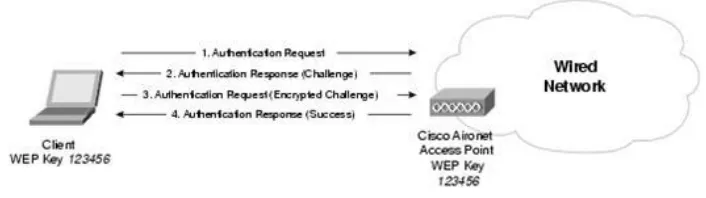
Shared key authentication is the second mode of authentication specified in the 802.11 standard. Shared key authentication requires that the client configure a static WEP key. Following figure describes the shared key authentication process.
Fig 3: Shared Key Authentication
Here, the client sends an authentication request to the access point requesting shared key authentication and then the access point responds with an authentication response containing challenge text. The client uses its locally configured WEP key to encrypt the challenge text and reply with a subsequent authentication request. If the access point can decrypt the authentication request and retrieve the original challenge text, then it responds with an authentication response that grants the client access.[2]
International Journal of New Innovations in Engineering and Technology
Volume 3 Issue 1 – March 2015 41 ISSN : 2319-6319 MAC address authentication is not specified in the 802.11 standard, but many vendors-including Cisco-support it. MAC address authentication verifies the client’s MAC address against a locally configured list of allowed addresses or against an external authentication server. MAC authentication is used to augment the open and shared key authentications provided by 802.11, further reducing the likelihood of unauthorized devices accessing the network.[2]
Fig 4 MAC Address Authentication
2.3 Authentication Vulnerabilities
Use of SSID: The SSID is advertised in plain-text in the access point beacon messages. Although beacon messages are transparent to users, an eavesdropper can easily determine the SSID with the use of an 802.11 wireless LAN packet analyzer, like Sniffer Pro. Some access-point vendors, including Cisco, offer the option to disable SSID broadcasts in the beacon messages. The SSID can still be determined by sniffing the probe response frames from an access point. The SSID is not designed, nor intended for use, as a security mechanism. In addition, disabling SSID broadcasts might have adverse effects on Wi-Fi interoperability for mixed-client deployments.
Open Authentication Vulnerabilities: Open authentication provides no way for the access point to determine whether a client is valid. This is major security vulnerability if WEP encryption is not implemented in a wireless LAN. In scenarios in which WEP encryption is not needed or is not feasible to deploy, such as public wireless LAN deployments; strong, higher-layer authentication can be provided by implement-ing a Service Selection Gateway (SSG).
MAC Address Authentication Vulnerabilities: MAC addresses are sent in the clear as required by the 802.11 specification. As a result, in wireless LANs that use MAC authentication, a network attacker might be able to subvert the MAC authentication process by “spoofing” a valid MAC address. MAC address spoofing is possible in 802.11 network interface cards (NICs) that allow the universally administered ad-dress (UAA) to be overwritten with a locally administered address (LAA). A network attacker can use a protocol analyzer to determine a valid MAC address in the business support system (BSS) and an LAA-compliant NIC with which to spoof the valid MAC address.
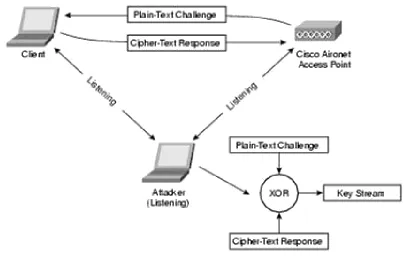
Shared Key Authentication Vulnerabilities: Shared key authentication requires the client use a pre shared WEP key to encrypt challenge text sent from the access point. The access point authenticates the client by decrypting the shared key response and validating that the challenge text is the same.
Fig 5: Authentication Vulnerabilities
III. IEEE 802.1X AND ITS VULNERABILITIES
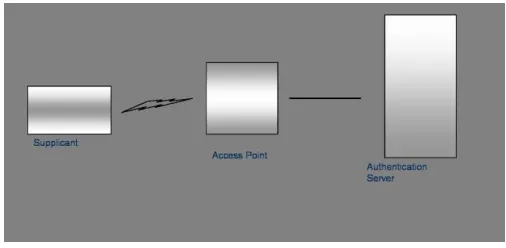
IEEE 802.1x is a port-based authentication protocol. There are three different types of entities in a typical 802.1x network, including a supplicant, an authenticator and an authentication server. To permit the EAP traffic before the authentication succeeds, a dual-port model is used in IEEE 802.1x specifications. In an unauthorized (uncontrolled) state, the port allows only DHCP and EAP traffic to pass through. Main Features of IEEE 802.1x include two main parts: Firstly logical ports and secondly Key management.
3.1.1 Logical Ports
Unlike wired networks, wireless stations are not connected to the network by physical means. They must have some sort of association relation with an AP in order to use the WLAN. This association is established by allowing the clients and the AP to know each other’s MAC address. This combination of MAC address of the AP and that of the station acts as a logical port. This then acts as a destination address in EAPOL protocol exchanges.
3.1.2 Key Management:
IEEE 802.1x specifications do not emphasize on using WEP key for encryption. This is because key information is passed from an AP to a station using EAPOL-Key message. Keys are generated dynamically, at a per-session basis.
3.2 WLAN Configuration Using 802.1x
Messages are exchanged between the Supplicant and the Authenticator to establish the Supplicant’s identity. The Authenticator then transfers the Supplicant’s information to the Authentication Server using RADIUS. All communications between the Authentication Server and the Supplicant passes through the Authenticator using EAP over LAN (i.e., EAPOL) and EAP over RADIUS, respectively. This creates an end-to-end EAP conversation between the Supplicant and the Authentication Server.
3.3 Vulnerabilities
International Journal of New Innovations in Engineering and Technology
Volume 3 Issue 1 – March 2015 43 ISSN : 2319-6319 Fig 6: Typical configuration of a WLAN using IEEE 802.1x
3.3.1 Lack of Mutual Authentication
According to 802.1x specifications, a Supplicant always trusts the Authenticator but not vice versa. Consider Figure 2. There is no EAP Request message originating from the Supplicant (the client). It only responds to the requests sent by the Authenticator (the AP). This one-way authentication opens the door for ”MAN IN THE MIDDLE AT-TACK”.
3.3.2 Session Hijacking
With IEEE 802.1x, RSN (Robust Security Network) association has to take place before any higher layer authentication. Thus we have two state machines. One is classic 802.11 and the other is 802.1x based RSN state machine. Their combined action should dictate the state of authentication. However, due to a lack of clear communication between these two state machines and message authenticity, ”Session Hijacking Attack” becomes possible.
IV. PROPOSED SOLUTION : THE PROTOCOLS
Our solution is the use of a combination of protocols which impart Mutual Authentication to the Authentication and Security Mechanism de-signed by us.
4.1 Mutual Authentication
Authentication in an information system takes place in a client/server context, in which the individual user is the client and some computer is a form of server. However, if the user is authenticating to a computer accessed via a communication network, there is often no way to verify that the computer at the other end of the communication path is the one that the user is trying to contact. The user typically relies on the communication infrastructure operating properly and thus connecting him or her to the intended computer. This assumption may be violated by any of a number of attacks against the communication path, starting with the computer that the user is employing locally. This lack of explicit, secure, two-way authentication can subvert many types of individual authentication mechanisms. If a user provides an secret(for eg. Password) to the wrong Authenticator, both security and privacy are adversely affected. Thus, two-way authentication is preferred so that a user can verify the identity of the Authenticating Server to which a secret may be disclosed.
As we have seen, Mutual Authentication is not a standard feature both with 802.1x and CHAP. One way Authentication creates possibilities of Session Hijack and Man in the Middle attack. One Way Authentication is clearly not safe and not enough.
We use RADIUS (Remote Access Dial In User Service) protocol to setup our Authen-tication Server. We provide a tightly coupled Authentication mechanism by providing User Authentication rather than Device Authentication. The shortcomings of WEP are overcome by using EAP-TTLS along with 802.1x. By providing Mutual Authentication, we mitigate the problems associated with one-way authentication.
4.2 RADIUS Protocol
RADIUS stands for Remote Authentication Dial-In User Service. RADIUS is a widely deployed protocol enabling centralized authentication, authorization, and accounting for network access. Originally developed for dial-up remote access, RADIUS is now supported by virtual private network (VPN) servers, wireless access points, authenticating Ethernet switches, Digital Subscriber Line (DSL) access, and other network access types.
4.2.1 Key Features of RADIUS
Following are the key features of RADIUS[8]:
Client/Server Model: A Network Access Server (NAS) operates as a client of RADIUS. The client is responsible for passing user information to designated RA-DIUS servers, and then acting on the response which is returned. RADIUS servers are responsible for receiving user connection requests, authenticating the user, and then returning all configuration information necessary for the client to deliver service to the user. A RADIUS server can act as a proxy client to other RADIUS servers or other kinds of authentication servers.
Network Security: Transactions between the client and RADIUS server are au-thenticated through the use of a shared secret, which is never sent over the network. In addition, any user passwords are sent encrypted between the client and RADIUS server, to eliminate the possibility that someone snooping on an unsecured network could determine a user’s password.
Flexible Authentication Mechanisms: The RADIUS server can support a variety of methods to authenticate a user. When it is provided with the user name and original password given by the user, it can support PPP PAP or CHAP, UNIX login, and other authentication mechanisms.
Extensible Protocol: All transactions are comprised of variable length Attribute-Length-Value 3-tuples. New attribute values can be added without disturbing exist-ing implementations of the protocol.
4.2.2 RADIUS Operation
When a client is configured to use RADIUS, any user of the client presents authentication information to the client. This might be with a customizable login prompt, where the user is expected to enter their username and password. Alternatively, the user might use a link framing protocol such as the Point-to-Point Protocol (PPP), which has authentication packets which carry this information.
Once the client has obtained such information, it may choose to authenticate using RA-DIUS. To do so, the client creates an ”Access-Request” containing such Attributes as the user’s name, the user’s password, the ID of the client and the Port ID which the user is accessing. When a password is present, it is hidden using a method based on the RSA Message Digest Algorithm MD5. The Access-Request is submitted to the RADIUS server via the network. If no response is returned within a length of time, the request is re-sent a number of times.
Once the RADIUS server receives the request, it validates the sending client. A re-quest from a client for which the RADIUS server does not have a shared secret MUST be silently discarded. If the client is valid, the RADIUS server consults a database of users to find the user whose name matches the request. The user entry in the database contains a list of requirements which must be met to allow access for the user. This always includes verification of the password, but can also specify the client(s) or port(s) to which the user is allowed access.
If any condition is not met, the RADIUS server sends an ”Access-Reject” response indicating that this user request is invalid. If desired, the server MAY include a text message in the Access-Reject which MAY be displayed by the client to the user. No other At-tributes (except Proxy-State) are permitted in an Access-Reject.
If all conditions are met and the RADIUS server wishes to issue a challenge to which the user must respond, the RADIUS server sends an”Access-Challenge” response. It MAY include a text message to be displayed by the client to the user prompting for a response to the challenge, and MAY include a State attribute.
International Journal of New Innovations in Engineering and Technology
Volume 3 Issue 1 – March 2015 45 ISSN : 2319-6319 If all conditions are met, the lists of configuration values for the user are placed into an”Access-Accept” response. These values include the type of service (for example: SLIP, PPP, Login User) and all necessary values to deliver the desired service. For SLIP and PPP, this may include values such as IP address, subnet mask, MTU, desired compression, and desired packet filter identifiers. For character mode users, this may include values such as desired protocol and host. [4]
4.3 Extensible Authentication Protocol
The Extensible Authentication Protocol (EAP) was originally developed as an extension to PPP allowing for deployment of arbitrary network access authentication mechanisms. With EAP, each PPP peer negotiates to perform EAP during the connection authentication phase. When the connection authentication phase is reached, the peers negotiate the use of a specific EAP authentication scheme known as an EAP type. [5]
Once the EAP type is agreed upon, EAP allows for an open-ended exchange of messages between the access client and the authenticating server (the RADIUS server) that can vary based on the parameters of the connection. The conversation consists of requests for authentication information and the responses. The length and detail of the authentication conversation is dependent upon the EAP type.
In addition to support within PPP, EAP is also supported within the IEEE 802 link layer. IEEE 802.1X, an IEEE standard for network port authentication defines how EAP is used for authentication by IEEE 802 devices, including IEEE 802.11b wireless access points and Ethernet switches. IEEE 802.1X differs from PPP in that only EAP authentication methods are supported. As a result, it is not possible to negotiate the use of PAP with IEEE 802.1X. As stated above, our approach to WLAN Security provides centralized and mutual authentication. This is achieved by the use of 802.1x/EAP.
The three main elements of an 802.1X and EAP approach follow:
Mutual authentication between client & authentication (Remote Access Dial-In User Service [RADIUS]) server
Encryption keys dynamically derived after authentication
Centralized policy control, where session time-out triggers
Re-authentication and new encryption key generation
When these features are implemented, a wireless client that associates with an access point cannot gain access to the network until the user performs a network logon. After association, the client and the network (access point or RADIUS server) exchange EAP messages to perform mutual authentication, with the client verifying the RADIUS server credentials, and vice versa. An EAP supplicant is used on the client machine to obtain the user credentials (user ID and password, user ID and one-time password [OTP], or digital certificate). Upon successful client and server mutual authentication, the RADIUS server and client then derive a client-specific WEP key to be used by the client for the current logon session. User passwords and session keys are never transmitted in the clear, over the wireless link.
As per the figure we can see that a wireless client associates with an access point. The access point blocks all attempts by the client to gain access to network resources until the client logs on to the network. The user on the client supplies network login credentials (user ID and password, user ID and OTP, or user ID and digital certificate) via an EAP supplicant. Using 802.1X and EAP, the wireless client and a RADIUS server on the wired LAN perform a mutual authentication through the access point in two phases. In the first phase of EAP authentication, the RADIUS server verifies the client credentials, or vice versa. In the second phase, mutual authentication is completed by the client verifying the RADIUS server credential, or vice versa. When mutual authentication is successfully completed, the RADIUS server and the client determine a WEP key that is distinct to the client. The client loads this key and prepares to use it for the logon session. The RADIUS server sends the WEP key, called a session key, over the wired LAN to the access point. The access point encrypts its broadcast key with the session key and sends the encrypted key to the client, which uses the session key to decrypt it. The client and access point activate WEP and use the session and broadcast WEP keys for all communications during the remainder of the session or until a time-out is reached and new WEP keys are generated. Both the session key and broadcast key are changed at regular intervals. The RA-DIUS server at the end of EAP authentication specifies session key time-out to the access point and the broadcast key rotation time can be configured on the access point.[6]
This approach provides three significant benefits over the 802.11 Security:
implementation of RC4 had no flaws, there would still be the administrative difficulty of distributing static keys to all the access points and clients in the network. Each time a wireless device was lost, the network would need to be rekeyed to prevent the lost system from gaining unauthorized access.
The third benefit is the ability to define centralized policy control, where session time-out triggers re-authentication and new key derivation.[6]
Fig 7: The sequence of events follows:
4.3.1 EAP Authentication Protocols
Following are the various authentication protocols used with EAP:
LEAP: Lightweight Extensible Authentication Protocol, or LEAP, is a proprietary implementation by Cisco Systems. With LEAP, mutual authentication relies on a shared secret, the user’s logon password, which is known by the client and the network. The RADIUS server sends an authentication challenge to the client. The client uses a one-way hash of the user-supplied password to fashion a response to the challenge and sends that response to the RADIUS server. Using information from its user database, the RADIUS server creates its own response and compares that to the response from the client. When the RADIUS server authenticates the client, the process repeats in reverse, enabling the client to authenticate the RADIUS server. When this is complete, an EAP-Success message is sent to the client and both the client and the RADIUS server derive the dynamic WEP key.
PEAP: PEAP uses a digital certificate for server authentication. For user authenti-cation, PEAP supports various EAP-encapsulated methods within a protected TLS tunnel.
EAP-MD5: EAP-MD5 is a IETF open standard, but offers minimal security. The MD5 cipher is vulnerable to dictionary attacks, and as used in EAP does not support dynamic WEP.
International Journal of New Innovations in Engineering and Technology
Volume 3 Issue 1 – March 2015 47 ISSN : 2319-6319 issuer of the certificate (certificate authority server entity) and the contents of the digital certificate. When this is complete, an EAP-Success message is sent to the client and both the client and the RADIUS server derive the dynamic WEP key.
EAP-TTLS: EAP-TTLS provides secure user authentication, using a TLS tunnel to encrypt password-based credentials that would be otherwise subject to dictio-nary attack on the wireless link. It provides strong security, while supporting legacy password protocols, enabling rapid deployment against your existing security infrastructure.[5]
4.3.2 Benefits of EAP-TTLS
EAP-TTLS provides the following benefits.
Completely protects connection credentials from attack: EAP-TTLS pro-vides complete security for users? Connection credentials (i.e., user name and pass-word) as they’re being authenticated to the network. With EAP-TTLS, a WLAN user’s identity and password-based credentials are tunneled during authentication negotiation, and are therefore not observable in the communications channel. This strong security prevents dictionary attacks, man-in-the-middle attacks, and hijacked connections by wireless eavesdroppers? And protects the network from the havoc an attacker who’s connecting with valid credentials can wreak. EAP-PEAP and EAP-TLS also provide this high level of credential security; LEAP does not. With LEAP, passwords which are short or insufficiently random are vulnerable to dictionary attack.
Supports all password protocols, for compatibility with existing authentication scheme: EAP-TTLS supports all major password protocols, including PAP, CHAP, MS-CHAP, MS-CHAP-V2, MD5Challenge, and EAP-TokenCard. So, with EAP-TTLS, WLAN users can safely connect using the connection credentials they’re accustomed to using. This simplifies the access process of WLAN users. Neither EAP-TLS, EAP-PEAP, nor LEAP offers this level of compatibility with existing authentication schemes.
Does not require the use of client certificates: Unlike EAP-TLS, EAP-TTLS does not require the use of client certificates to provide strong credential security. EAP-TTLS and EAP-TLS are similar in that both use TLS (Transport Layer Security, the successor to SSL) as the underlying strong cryptography. However, EAP-TTLS differs in that only the RADIUS servers, not the users, are required to have certificates. The user is authenticated to the network using ordinary password-based credentials, whose use is made proof against active and passive attack by enclosing it in the TLS security wrapper. Users of EAP-TTLS are, therefore, spared the administrative burden associated with setting up and maintaining a certificate infrastructure.
Provides data security, plus strong mutual authentication of client and server: Beyond its strong credential security and ease of management, EAP-TTLS provides additional security techniques to further protect the security of a WLAN user?s connection. With EAP-TTLS, dynamic per-session keys are generated to encrypt the wireless connection and protect data privacy. Frequent re-keying thwarts known attacks against the encryption method used in wireless communications (WEP). In addition, EAP-TTLS provides strong mutual authentication of Client and Server, preventing an intrusion onto the network by an unauthorized user, and ensuring that the client is connecting to the right server.
With its strong security and compatibility with existing authentication databases and infrastructure, EAP-TTLS puts secure WLAN authentication within any organizations’ reach.[6]
V. IMPLEMENTATION DETAILS AND TESTING
Due to their benefits over the other existing protocols as described above, RADIUS Protocol (for Authenticator Server) and IEEE802.1x/EAP-TTLS (as WLAN Protocol) are our protocols of choice for the Authenticating and Security Mechanism.
What follows is the setup of our Mechanism:
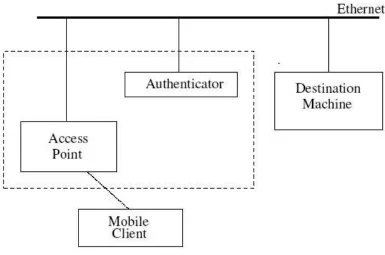
Fig 8: Showing XSupplicant, Linksys AP and RADIUS
5.1 Hardware and Software Details
FreeRADIUS Server: FreeRadius v1.0.0 OpenSSL openssl 0.9.7a-23
Access Point: Linksys WirelessG WAP54G Access Point
XSupplicant: xsupplicant v1.0 OpenSSL openssl-0.9.7a-23
5.2 Authentication Process
The Authentication Procedure is depicted in the above figure. The Authentication Re-quest of the XSupplicant is forwarded by the AP to the RADIUS Server which, by referring to its internal database, accepts the user or rejects the user. The corresponding response of the RADIUS server is sent to user. An authenticated user only can access the Ethernet Resources.
5.3 Configuration
Files Modified:
client.conf: The secret shared between AP and Authenticator is stored in this file.
users: RADIUS stores user information in this file. New users are added by us and their service parameters are set.
huntgroups: This file stores the information of huntgroups. A huntgroup is formed by a NAS(Network Access Server) and a set of its ports that are being referred by RADIUS Server.
radusd.conf: This is RADIUS Authenticator Configuration file and is used to set various server parameters.
eap.conf: The use of EAP is configured from this file by activating EAP-TTLS Module.
On Access Point, Gateway configuration is performed. The Gateway of AP is set to RA-DIUS Server. Installation and configuration of X Supplicant is done on client side.
5.4 Testing and Results
V. CONCLUSION
The vulnerabilities of various authentication protocols are studied by us and are documented in this report. Our study reveals that the best approach towards the design of an Authentication and Security Mechanism is a combination of RADIUS Protocol and IEEE 802.1x/EAP-TTLS Protocol. The setup described by us thus provides strong mutual authentication and complete security of Ethernet resources from malicious users. It also mitigates various attacks, including Man in the Middle attack, Session Hijacking and dictionary attacks.
REFERENCES
[1] Zahur Y. and Yang T.A., ”Wireless LAN Security and Laboratory Designs”, JCSC 19,3 January 2004 [2] www.cisco.com, ”A Comprehensive Review of 802.11 Wireless LAN Security”
[3] Mishra A. and Arbaugh W.A., ”An Initial Security Analysis of The IEEE 802.1x Standard” [4] RADIUS Protocol rfc www.freeradius.org/rfc/rfc2865.html
[5] www.en.wikipedia.org
[6] www.cisco.com Wireless LAN Security in Depth