MINE VENTILATION NETWORK OPTIMIZATION TO REDUCE
WITH
Hengqing Ge
1,21School of Physics and Electronic Electrical Engineering Huaiyin Normal University Huaian 223001, China 2School of Information and Control Engineering, China University of Mining and Technology, Xuzhou 221116, China
3Western Australian School of Mines, Curtin University, Kalgoorlie 6430, Australia
A R T I C L E I N F O
INTRODUCTION
The main aim of mine ventilation is to supply fresh air to designated areas, which increases underground oxygen concentration and removes underground contaminants effectively [1, 2]. It helps to create a safe
working environment for mining. With the increasing of mining depth and the development of mechanization, the cost of safety operation, maintenance and management of a mine ventilation network increases continuously. The research and application of ventilation network optimization that aims at reducing energy consumption of mine ventilation are becoming more and more important.
The main fans are responsible for providing the total air quantity required for the whole mine. However, more ofte than not, certain working places in the mine requires different amount of air to be delivered [3]. One common way of achieving this is by the use of regulators to adjust the resistances of one or more airways. This will change the main fan’s operating points and thus influence their power consumption.
International Journal of Current Advanced Research
ISSN: O: 2319-6475, ISSN: P: 2319-6505,
Available Online at www.journalijcar.org
Volume 7; Issue 11(C); November 2018
DOI: http://dx.doi.org/10.24327/ijcar.2018
Copyright©2018 HengqingGe et al. This is an open access article distributed under the Creative Commons Attribution License, which permits unrestricted use, distribution, and reproduction in any medium, provided the original work is properly cited.
Article History:
Received 10th August, 2018 Received in revised form 2nd September, 2018
Accepted 26th October, 2018
Published online 28th November, 2018
Key words:
Ventilation network; λ-PSO algorithm; High dimensional; nonlinear constrained
optimization;
*Corresponding author: Guang Xu
Western Australian School of Mines, Curtin University, Kalgoorlie 6430, Australia
MINE VENTILATION NETWORK OPTIMIZATION TO REDUCE POWER CONSUMPTION
WITH AN IMPROVED PSO ALGORITHM
1,2
., Guang Xu
3*., Jinxin Huang
3and Xiaoping Ma
School of Physics and Electronic Electrical Engineering Huaiyin Normal University Huaian 223001, China School of Information and Control Engineering, China University of Mining and Technology, Xuzhou 221116, China
rn Australian School of Mines, Curtin University, Kalgoorlie 6430, Australia
A B S T R A C T
Underground mines are becoming deeper due to the depletion of shallower mineral resources. An effective mine ventilation network can save tremendous of electricity cost used by fans. This requires the ventilation system to be regulated so that the required airflow to the mine key areas are met with minimum power consumption.
ventilation networks are internal coupled strongly. The air
may be changed if only one of the branches air-flow is regulated. Such a problem becomes more complicated if multiple main fans are installed. The Hardy Cross method can determine the flow in pipe network systems where the inputs and outputs are known with iterative method. But it is difficult to find the optimum regulating scheme with iterative method such as Hardy Cross, because the inputs of the network systems are the regulating variables. They are not known or constant. This paper established a mine ventilation optimization model, and proposed a λ-PSO optimization algorithm to solve the model. By applying it to a typical mine ventilation network case, it is demonstrated that the proposed algorithm can reach the global optimal solution in shorter computational time. It is recommended to incorporate the algorithm to commercial ventilation network analysis software to assist with cost effective ventilation planning.
The main aim of mine ventilation is to supply fresh air to designated areas, which increases underground oxygen concentration and removes underground contaminants effectively [1, 2]. It helps to create a safe and comfortable working environment for mining. With the increasing of mining depth and the development of mechanization, the cost of safety operation, maintenance and management of a mine ventilation network increases continuously. The research and ation of ventilation network optimization that aims at reducing energy consumption of mine ventilation are
The main fans are responsible for providing the total air quantity required for the whole mine. However, more often than not, certain working places in the mine requires different amount of air to be delivered [3]. One common way of achieving this is by the use of regulators to adjust the resistances of one or more airways. This will change the main ints and thus influence their power
In a complex ventilation network, there are several main fans and many different combinations of regulator adjustment solution to achieve the same airflow requirement on one specific airway. But these different combinations result in mine total resistance and total fans power consumption differences [4]. Optimization method can be used to solution that use minimum total fans power. The optimization aim is to minimize the total power of the ventilation network by satisfying the demand for air flow in each branch, the balance law of air quantity and pressure, and the ability of resistance regulation on the branches. This is a nonlinear programming problem. The number of the unknown variables is more than that of the constraint equations, thus, it is an indefinite solution problem [5]. It will become more complicated if multiple fans ar
network. Thus, an effective solution for such problems is challenging and has attracted more research attention [6]. The nonlinear programming method in many previous studies require the derivative solution for a function, the
matrixes, and the solutions are sensitive to the initial values. These make the method more complex and less effective [7 H Wang et al [10] attempted to solve the problem by firstly solve the required flow in each branch, and then find the optimal regulator adjustment method that consumes the least fan power. However, as the problem is simplified to a local
International Journal of Current Advanced Research
6505, Impact Factor: 6.614
www.journalijcar.org
November 2018; Page No. 16323-16328
//dx.doi.org/10.24327/ijcar.2018.16328.3013
This is an open access article distributed under the Creative Commons Attribution License, which permits unrestricted use, distribution, and reproduction in any medium, provided the original work is properly cited.
Western Australian School of Mines, Curtin University,
POWER CONSUMPTION
and Xiaoping Ma
1School of Physics and Electronic Electrical Engineering Huaiyin Normal University Huaian 223001, China School of Information and Control Engineering, China University of Mining and Technology, Xuzhou 221116, China
rn Australian School of Mines, Curtin University, Kalgoorlie 6430, Australia
Underground mines are becoming deeper due to the depletion of shallower mineral mine ventilation network can save tremendous of electricity cost used by fans. This requires the ventilation system to be regulated so that the required airflow to the mine key areas are met with minimum power consumption. But mine internal coupled strongly. The air-flow of all the other branches flow is regulated. Such a problem becomes more complicated if multiple main fans are installed. The Hardy Cross method can in pipe network systems where the inputs and outputs are known with the optimum regulating scheme with iterative method such as Hardy Cross, because the inputs of the network systems are the regulating This paper established a mine ventilation PSO optimization algorithm to solve the model. By applying it to a typical mine ventilation network case, it is demonstrated that the proposed algorithm can reach the global optimal solution in shorter computational time. It is recommended to incorporate the algorithm to commercial ventilation network analysis software to assist with cost effective ventilation planning.
In a complex ventilation network, there are several main fans binations of regulator adjustment solution to achieve the same airflow requirement on one specific airway. But these different combinations result in mine total resistance and total fans power consumption differences [4]. Optimization method can be used to find a solution that use minimum total fans power. The optimization aim is to minimize the total power of the ventilation network by satisfying the demand for air flow in each branch, the balance law of air quantity and pressure, and the ability of ance regulation on the branches. This is a nonlinear programming problem. The number of the unknown variables is more than that of the constraint equations, thus, it is an indefinite solution problem [5]. It will become more complicated if multiple fans are applied in the ventilation network. Thus, an effective solution for such problems is challenging and has attracted more research attention [6]. The nonlinear programming method in many previous studies require the derivative solution for a function, the inversion of matrixes, and the solutions are sensitive to the initial values. These make the method more complex and less effective [7-9]. [10] attempted to solve the problem by firstly solve the required flow in each branch, and then find the optimal regulator adjustment method that consumes the least fan power. However, as the problem is simplified to a local
Research Article
optimization problem, it is still a non-convex and nonlinear optimization model, which has the same shortcomings of the previous nonlinear programming method.
With the development of intelligent optimization algorithms, genetic algorithms have been applied to solve such problems [11-14]. However, due to the limited exploration ability in the unknown spaces, it is more likely for the method to fall into the local optimal solution. In addition, its processing capacity for high-dimensional optimization problems is limited, which makes it computationally expensive to deal with ventilation network with large scale and complex structures. A hierarchical encoding method and a way to eliminate the infeasible solutions were proposed by Y Guo [15]. To shorten the computational time, she introduced the cultural particle swarm optimization algorithm (CPSO) to deal with this problem without considering the possible high dimensional combinatorial explosion issue [16]. She found that the PSO algorithm has the disadvantage of local convergence in solving high-dimensional constrained optimization problems [17], especially when there are large number of nonlinear constraint conditions [18].
To overcome the disadvantage of the PSO algorithm in solving high-dimensional constrained optimization problems [19], a γ-PSO ventilation network optimization algorithm was proposed in this paper. By using a broader range of solutions searching variable, this algorithm has the advantage of finding the global optimal solution and avoiding local convergence. We have used a mine ventilation network example with three main fans and compared the solution acquired by the γ-PSO with three other algorithms. Results showed that the γ-PSO algorithm is the fastest and the solution had the lowest power consumption.
The optimization model
The objective function of the ventilation network optimization is to minimize the ventilation energy consumption with the least branches regulated. Total fans power is the major component of energy consumption, thus, it is set as the objective function [20]:
min ( , , ) = +
∈
(1)
Where: L is fans quantity, FHj, FQj are air pressure and air quantity, respectively; j denotes the branch number. FR is the total number of resistance-adjusted branches
The ventilation pressure and air quantity are governed by the Kirchhoff’s Laws of Flow [21]. It forms the constraint condition in the optimization model:
1. Kirchhoff’s 1st Law: in the ventilation network, the inflow rate is equal to the outflow rate at any node at any time [22].
= 0 = 1,2 ⋯ ,
= 1 −1 0
ℎ,
ℎ,
ℎ
(2)
Where: Ni is the total number of branches associated with node
i in the network, Qj is the air quantity of branch j, and J is the number of nodes in the ventilation network.
2. Kirchhoff’s 2nd Law: in a ventilation network, the algebraic sum of various energy is zero in any closed circuit [23].
+ ∆ − − = 0 = 1,2, ⋯ , .
=
⎩ ⎪ ⎨ ⎪
⎧ 1 ℎ ℎ ℎ ℎ ℎ .
−1 ℎ ℎ ℎ −
ℎ .
0 ℎ .
(3)
Where: Mj is the number of branches in closed circuit i, O is the number of closed circuit in the ventilation network, Hj, ∆Hj, Pj, FHj represents air pressure, airway resistance, natural ventilation pressure, and fan pressure, respectively. The air quantity and air pressure should be within the upper and lower limits [24]:
_ ≤ ≤ _
_ ≤ ≤ _ (4)
Where: Qj_min, Qj_max represent upper, lower ventilation quantity limits of branch j respectively. Hj_min, Hj_max, represent upper, lower ventilation pressure limits of branch j
respectively.
According to the theory of ventilation network solution of circuit air-quantity method, if there is a spanning tree with m
nodes and n branches, adding each branch of the b=n-m+1
cotree can determine an independent circuit [25]. The airflow rate is equal to that of the cotree branch [26]. Suppose there are k branches with known airflow rate and b-k branches with unknown airflow rate in b cotree branches, the airflow rate of any branch in the ventilation network can be expressed as [27]:
= + = 1,2, ⋯ (5)
Where ∑ represents total air quantity of known branches, while∑ is the total air quantity of unknown branches. Csjrepresents element of independent circuit matrix corresponds to the selected spanning tree. Obviously, Equation (5) satisfies Kirchhoff’s 2nd Law.
Constraints for the above equation is given as:
∈
− + = 0
= 1,2, ⋯ ,
(6)
Where np represents the number of closed circuit in ventilation network, rj is the air way resistance of branch j. Rij represents selected independent path matrix element:
= 1 ℎ .
0 ℎ ′ .
min ( , , ) = + +
∈
. .
− + = 0
∈
+ = 0
≤ ≤
≤ ≤
(7)
This model has one objective function and 4 constraint conditions. In order for the PSO algorithm to be able to solve such a problem, the constraint conditions are converted to exterior penalty functions [28]. The range of upper and lower limits of the adjustable resistance for branches are wide, and a reasonable search value range is set to save computation time. Finally, the ventilation network optimization problem is transformed into an unconstrained optimization problem as shown in Equation (8).
min ( , , ) = +
∈
+
+∅ −
∈
+
+ min 0, − + min 0, −
(8)
Where∅ and represent penalty factor of the upper and lower limits for air pressure and quantity. They increase with iteration number.
The λ-PSO algorithm
The particle swarm optimization algorithm (PSO) is an evolutionary computation technique derived from the study of predicting birds’ behaviours. This optimization tool was first proposed by Dr. Barnhart and Dr. Kennedy in 1995[29]. The underlying principle is initializing a set of random solutions and iteratively searching for the optimal values. In the basic PSO algorithm, the particle swarm is composed of n particles, and the position ⃑ of each particle represents the potential solution of the optimization problem in the D dimensional search space. The particle travels in the search space at a certain speed, which dynamically adjusts the next flight direction and distance based on the flight experience of its own and companions [30]. All the particles have an adaptation value determined by the objective function, and the best position that they have found so far (local extreme⃑) and their current position (⃑) are memorized. Each particle also knows the best position of all particles (global extremum ⃑), which is the best position in all the local best positions. Each particle i
contains a Ddimensional position vector ⃑ = ( , , ⋯ , ) and velocity vector ⃑ = ( , , ⋯ , ). When the particle i searches for the solution space, the optimal experience location
⃑ = ( , , ⋯ , ) is saved. At the beginning of each
iteration, the particle adjusts its position through changing velocity vector, based on its inertia and experience and swarm's optimal experience location ⃑ = , , ⋯ , . In the expression (10), c1 and c2 represent acceleration factors,
both of which are positive constant; rand(0,1) generates random numbers distributed on interval [0, 1]; d is dimension;
ω is the inertia weighting factor (0<ω<1) which decreases as the number of iterations increases. Each particle's position and velocity are updated as following:
= + (9)
= + (0,1)( − )
+ (0,1)( − ) (10)
Equation (10) consists of three parts. The first item on the right hand of Equation (10) is the original particle velocity. A larger velocity benefits global search, while smaller velocity is good for local search. Therefore, the method has the balanced ability for global and local search. The second item in Equation (10) is the influence of the history best location to the current location. Randomly adjusted by c1rand(0, 1), it makes use of particles’ history experience to obtain a strong global searching capability. The third part in Equation (10) is the influence of all particle’s best location to the current location. It reflects the information sharing and social collaboration between particles. This is also randomly adjusted by
c2rand(0,1). Under the combined effect of these three factors, the particle adjusts its speed and position to effectively reach the best position.
The optimization model constructed in Section 2 has high dimensional, complex, and nonlinear constraints. It is difficult for the PSO algorithm to converge in the feasible solution domain[31]. At the beginning of iterations, particle velocities are high, and it is easy for them to fly to the boundary of the searching space that is far away the optimal solution. After a certain number of iterations, most particles would converge to a very small domain around a certain position ⃑, given
as: ⃑ − ⃑ → 0 and ⃑ − ⃑ → 0. As ω<1, when the iteration
reaches to a certain number, the flying speed of particles also tends to 0 with a single flight direction. This may lead to the potential issue of converging too fast and fall into the local extremum. To solve these problems, the rand () of PSO algorithm was extended from (0, 1)to (-1, 1), thus, Equation (10)was transformed to (11). This revised PSO algorithm is called the γ-PSO algorithm.
= + (−1,1)( − )
+ (−1,1)( − ) (11)
Optimization case study
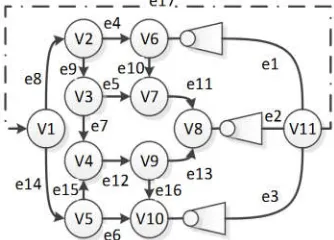
A ventilation network from the literature was chosen as a case for validating the proposed optimization method. As shown in Figure 1, it is an exhausting ventilation network system with 3 fans, 17 branches, 11 nodes and 7 independent circuit [13]. The fans are locates on branches e1, e2 and e3.
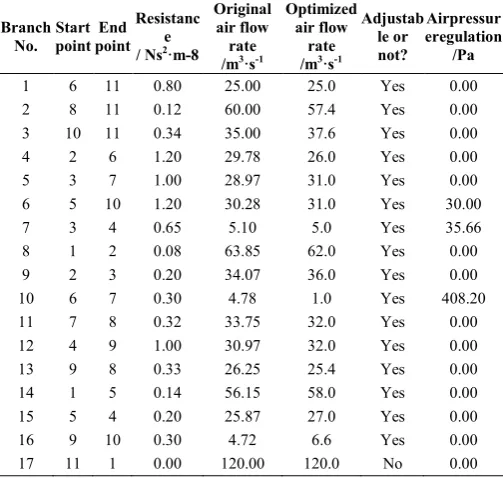
Branchese4, e5,e6,e10 and e12 has a fixed ventilation demand of 26, 31, 31, 1, 32 m3/s, respectively. The basic ventilation parameters can be found in Table1. The original airflow rates are the result of natural split. Choose the spanning tree of T= [{V1,V2,… V11},{e1,e2,e3,e11,e13,e17,e8,e9,e14,e15}], the corresponding cotrees are {e4,e5,e6,e7,e10,e12,e16}. Therefore, 7 independent circuit are obtained by adding the spanning tree with each of the cotree branch. Assume the airflow in the 7 independent circuits are q1 to q7, and the flow directions are the same with that in the cotrees. The independent circuits are listed below:
q1:e4-e1-e17-e8; q2:e5-e11-e2-e17-e8-e9;
q3:e6-e3-e17-e14; q4:e7-(-e15)-(-e14)-e8-e9;
q5:e10-e11-e2-(-e1); q6:e12-e13-e2-e17-e14-e15;
q7:e16-e3-(-e2)-(-e13);
The air quantity of each independent circuit equals to the air quantity of the added cotree. The results are:
q1=Qe4=26m3/s;
q2= Qe5=31m3/s;
q3= Qe6=31m3/s;
q4= Qe7;
q5= Qe10=1m3/s;
q6= Qe12=32m3/s;
q7= Qe16;
Table 1 Basic ventilation parameters and comparison before and after optimization.
Branch No.
Start point
End point
Resistanc e
/ Ns2·m-8
Original air flow rate
/m3·s-1
Optimized air flow
rate
/m3·s-1
Adjustab le or not?
Airpressur eregulation
/Pa
1 6 11 0.80 25.00 25.0 Yes 0.00 2 8 11 0.12 60.00 57.4 Yes 0.00 3 10 11 0.34 35.00 37.6 Yes 0.00 4 2 6 1.20 29.78 26.0 Yes 0.00 5 3 7 1.00 28.97 31.0 Yes 0.00 6 5 10 1.20 30.28 31.0 Yes 30.00 7 3 4 0.65 5.10 5.0 Yes 35.66 8 1 2 0.08 63.85 62.0 Yes 0.00 9 2 3 0.20 34.07 36.0 Yes 0.00 10 6 7 0.30 4.78 1.0 Yes 408.20 11 7 8 0.32 33.75 32.0 Yes 0.00 12 4 9 1.00 30.97 32.0 Yes 0.00 13 9 8 0.33 26.25 25.4 Yes 0.00 14 1 5 0.14 56.15 58.0 Yes 0.00 15 5 4 0.20 25.87 27.0 Yes 0.00 16 9 10 0.30 4.72 6.6 Yes 0.00 17 11 1 0.00 120.00 120.0 No 0.00
According to the circuitair-quantity method, the airflow rate of each branch is the sum of the airflows of the independent circuit that flows through the branch. It is positive when they have the same direction, otherwise negative. Hereby, the airflow rates of each branches are:
e1: Q1=q1-q5=25;
e2: Q2=q2+q5+q6-q7=64-q7; e3: Q3=q3+q7=31+q7; e4: Q4=26;
e5: Q5=31; e6: Q6=31;
e7: Q7=q4;
e8: Q8=q1+q2+q4=26+31+q4=57+q4; e9: Q9=31+q4;
e10: Q10=1;
e11: Q11=q2+q5=32; e12: Q12=32;
e13: Q13=q6-q7=32-q7; e14: Q14=q3+ q6-q4=63-q4; e15: Q15=q6-q4=32-q4; e16: Q16=q7;
e17: Q17=q1+q2+q3+q6=120;
In this case study, fan pressure is restricted to less than 5000 Pa, and airflow rate is constraint within [-100, +100]. The number of particles was set as 30 and the penalty coefficients φ and ψ were set as 100. For performance comparison purposes, the λ-PSO algorithm was compared with the Trelea's types1 PSO, Trelea's type 2PSO, and the Clerc's Constricted PSO algorithm. Figure 2 and Table2 show the convergence performance and the parameter values for each algorithm. The basic principles for these algorithms are the same, but they have different treatment in the key parameters
(a)
(b)
(c)
g
b
e
s
t
v
a
l
g
b
e
s
t
v
a
(d)
Figure 2 Comparison of four PSO optimization procedures (a) Clerc’s
Constricted PSO optimization procedure; (b) Trelea Type1 PSO optimization procedure; (c) Trelea Type1 PSO optimization procedure; (d) λ-PSO
optimization procedure.
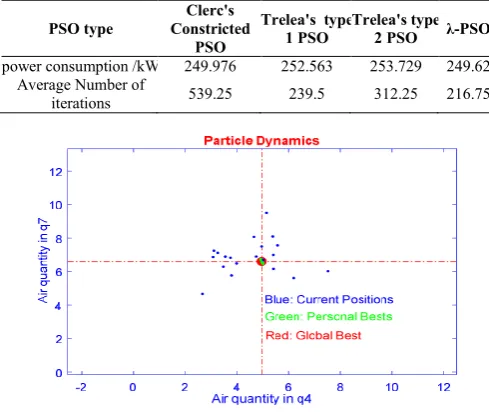
From the optimization process, it is obvious that Clerc's Constricted PSO has global search capability with relatively slow convergence speed, which converges to the global optimum after more than 500 iterations. Trelea’s types1 and type2 PSO, which converged to a local optimum after about 300 iterations. It converges quickly while its global search ability is limited. The λ-PSO algorithm converged to the global optimal solution after only about 200 iterations. Meanwhile, different from the other three algorithms, when the λ-PSO algorithm converges to the global optimal solution, all the particles disperse over the searching space instead of clustered around one solution (demonstrated in Figure.3 which only shows flow quantity in branch q4 and q7). This ensures active and global search capability of particles to prevent limiting the solution local optimal values. Therefore, λ-PSO algorithm over performs the other algorithms in both calculation speed and global searching capability. According to the optimization result, the optimal air quantity and resistance of branches were calculated and shown in Table1. Based on the result of the λ-PSO optimization, the operational point for each fan and their power consumptions are listed in Table 3. It is obvious that the ventilation power consumption was reduced from 261.9 kW to 249.62 kW.
Table 3 Ventilation energy consumption before and after optimization
Fan No.
Original data Optimized data air quantity
/m3·s-1
air pressure /Pa
Power /kW
air quantity /m3·s-1
air pressure /Pa
Power /kW
1 25.0 2055.0 51.4 25.0 1613 40.33
2 60.0 2315.0 138.9 57.4 2173 124.73
3 35.0 2046.0 71.6 37.6 2249 84.56
Total power
/kW 261.9 249.62
CONCLUSION
As shallow mineral resources are depleting, current underground mines become deeper. This requires a more powerful and reliable ventilation system. As air flow paths are longer for deeper mines, the power cost associated with ventilation is tremendous. Thus, an optimized ventilation system is essential for the cost efficiency of a mine. Ventilation needs to be regulated so more air can reach to the area where contamination levels are high or work activities are intensive. This can be achieved by regulating the resistance of one or several airways, and many combinations of ways can result in the required air flow in one area. However, the method with the lowest power consumption should be selected to save ventilation power cost with the least branches regulated.
This paper developed a mine ventilation optimization model and used an improved particle swarm optimization algorithm to solve the model. Through comparison with other algorithms, results show that this method has the ability to find the global optimization value with the lowest power consumption within the shortest time. To the authors knowledge, the current commercially available mine ventilation network analysis software does not have this function yet. The proposed algorithm can be incorporated to these software for fast and cost efficient ventilation planning.
Acknowledgement
This work was supported by the Key research and development plan of Jiangsu Province: Key technology research and development of mine ventilation safety and energy saving measurement and control (BE2016046), and the Independent Research Projects of State Key Laboratory of Coal Resources and Safe Mining, CUMT (SKLCRSM15KF01).
References
1. Ge, H.; Ma, X.; Wu, X.; Liang, C. Study on mine main fan switchover aiming at invariant ventilation based on nonlinear constrained programming.
International Journal of Digital Content Technology and its Applications2012, 6, 496-505.
2. Ge, H.Q.; Ma, X.; Wu, X.Z.; Zhang, J. Fuzzy PID Control of Mine Main Fan Switchover Aiming at Invariant Ventilation, International Conference on Intelligence Science and Information Engineering, 2011; pp. 325-328.
3. Nyaaba, W.; Frimpong, S.; El-Nagdy, K.A. Optimisation of mine ventilation networks using the Lagrangian algorithm for equality constraints.
International Journal of Mining, Reclamation and Environment2015, 29, 201-212.
Table 2 PSO algorithms result comparison
PSO type
Clerc's Constricted
PSO
Trelea's type 1 PSO
Trelea's type
2 PSO λ-PSO
power consumption /kW 249.976 252.563 253.729 249.62 Average Number of
iterations 539.25 239.5 312.25 216.75
Figure 3 Particle distribution when λ-PSO converges to the global
4. Minkang, T.; Yuanchun, D. The Reliability of Ergonomics in the Ventilation System of an Underground Metal Mine. Procedia Engineering2011, 26, 1705-1711.
5. W Yong, C Zixing, Z Yuren, et al. Constrained Optimization Evolutionary Algorithms. Journal of Software, 2009, 01,11-29.
6. J., S.; L., Y.; H., F.; Z., H. Mine Airflow Optimizing Control Based on Harmony Annealing Search, International Conference of Information Science and Management Engineering, 2010; pp 295-298.
7. Ueng, T.H.; Wang, Y.J. Analysis of mine ventilation networks using nonlinear programming techniques.
International Journal of Mining Engineering1984, 2, 245-252.
8. Hu, W.; Longson, I. The optimization of airflow distribution in ventilation networks using a nonlinear programming method. Mining Science &
Technology1990, 10, 209-219.
9. Xie, X.P.; Zhao, Z. Nonlinear Programming Problems in mine Ventilation Networks and Their Solutions. T
Nonferr Metal SOC1993, 88-91.
10. H Wang, W Hu, H Li. Theory and algorithm of mine ventilation network. Xuzhou China: China University of Mining and Technology Press, 1996.
11. Lowndes, I.S.; Yang, Z.Y. The application of GA optimisation methods to the design of practical ventilation systems for multi-level metal mine operations. Mining Technology2004, 113, 43-58. 12. Lowndes, I.S.; Fogarty, T.; Yang, Z.Y. The
application of genetic algorithms to optimise the performance of a mine ventilation network: the influence of coding method and population size. Soft Comput 2005, 9, 493-506.
13. L I Jiang, C Kai-yan, L Bai-quan. Genetic Algorithm for the Optimization of Mine Ventilation Network.
Journal of China University of Mining & Technology, 2007, 36(6):789-793
14. S Xiang-yang, C Xin-tan. Integrative optimization algorithm of min ventilation networks based on genetic algorithm. Journal of Central South University, 2011, 42(6):1676-1684.
15. G Yinan, C Jian, C Meirong, et al. Mine ventilation network optimization adopting hierarchy cultural algorithm. Control and Decision, 2012, Vol.27 (10):1542-1546.
16. G Yinan, W Chun, Y Jichao. Mine Ventilation Network Based on Cultural Particle Swarm Optimization Algorithm. Journal of Southeast Univesity (Natural Science Edition), 2013, Vol.43 (S1):48-53.
17. Clerc, M.; Kennedy, J. The particle swarm - explosion, stability, and convergence in a multidimensional complex space. IEEE T Evolut Comput 2002, 6, 58-73.
18. Mostaghim, S.; Branke, J.; Schmeck, H. Multi-objective particle swarm optimization on computer grids, GECCO '07: Proceedings of the Conference on Genetic and Evolutionary Computation, 2007; pp 869-875.
19. Borenstein, Y.; Poli, R. Decomposition of Fitness Functions in Random Heuristic Search, International Conference on Foundations of Genetic Algorithms, 2007; pp 123-137
20. Babu, V.R.; Maity, T.; Burman, S. Energy saving possibilities of mine ventilation fan using particle swarm optimization, Institute of Electrical and Electronics Engineers Inc.: Palnchur, Chennai, Tamilnadu, India, 2016; pp 676-681.
21. Bhamidipati, S.S. Mathematical models for the Simulation of Mine Ventilation Networks (Pipe Flow, Hardy Cross, Kirchhoff's LAWS). In The University of Utah: Ann Arbor, 1985; p 159.
22. Castilla-Gomez, J.; Herrera-Herbert, J.; Campillos-Prieto, A. Modelling and optimization of a ventilation network in underground mines5; International Multidisciplinary Scientific Geoconference: Albena, Bulgaria, 2015; pp 469-475.
23. E., W.; K., H.J. Air flow modeling in deepwells: Application to mining ventilation, IEEE International Conference on Automation Science and Engineering, 2008; pp 845-850.
24. Chen, K.; Si, J.; Zhou, F.; Zhang, R.; Shao, H.; Zhao, H. Optimization of air quantity regulation in mine ventilation networks using the improved differential evolution algorithm and critical path method.
International Journal of Mining Science and Technology2015, 25, 79-84.
25. Parra, M.T.; Villafruela, J.M.; Castro, F.; Méndez, C. Numerical and experimental analysis of different ventilation systems in deep mines. BUILD
ENVIRON2006, 41, 87-93.
26. Karakurt, I.; Aydin, G.; Aydiner, K. Mine ventilation air methane as a sustainable energy source.
Renewable and Sustainable Energy Reviews2011, 15,
1042-1049.
27. Wallace, K.; Prosser, B.; Stinnette, J.D. The practice of mine ventilation engineering. International Journal
of Mining Science and Technology2015, 25, 165-169.
28. Semin, C.; Young-Tark, K.; Tae-Hyoung, K. A Diversity-Enhanced Constrained Particle Swarm Optimizer for Mixed Integer-Discrete-Continuous Engineering Design Problems. ADV Mech ENG2013, 5, 130750.
29. Kennedy, J.; Eberhart, R. Particle swarm optimization, Proceedings of IEEE International Conference on Neural Networks, Piscataway: IEEE Service Center, 1995; pp 1942-1948.
30. Kalayci, C.B.; Gupta, S.M. A particle swarm optimization algorithm with neighborhood-based mutation for sequence-dependent disassembly line balancing problem. The International Journal of
Advanced Manufacturing Technology2013, 69,
197-209.
31. Trelea, I.C. The particle swarm optimization algorithm: convergence analysis and parameter selection. Inform Process LETT 2003, 85, 317-325.