142401-9696-IJMME-IJENS © February 2014 IJENS I J E N S
Application of QFD and CFD for Increasing the
Efficiency of 30TR FRP Cooling Tower-A Review
and Case Studies
R.UmeshSundar*
a,Dr.G.MohanKumar
babDepartment of Mechanical Engineering,
Park College of Engineering and Technology, Kaniyur, Coimbatore-641 659, Tamilnadu, India [email protected] [email protected]
Abstract
--
This paper deals with the study of the performance analysis of 30 Ton of Refrigeration (TR), Fiber Reinforced Plastic (FRP) cooling tower. The cooling tower manufactured in GEM Equipments Ltd, Coimbatore is taken as the study subject and various parameters are analyzed to rectify the major defects. Quality Function Deployment is the method used to analyze the different process defects associated with the cooling tower and the design defects are analyzed using Computational Fluid Dynamics Software Package. Quality Function Deployment is the best process analysis tool used in of product development. This can also be used in the defects study tool for any product. The results obtained from QFD shows certain major design defects that are to be rectified so as to make the cooling tower reliable and efficient. The various design defects analyzed using CFD supports the finding done by QFD. These design defects are remodeled and rectified and again analyzed using both the tools and thus the proposed system is proved to be efficient.Index Term
--
QFD, CFD, Approach, Cooling tower, Effectiveness, FRP, Range1. INTRODUCTION
In the world market, especially in the present industrial sector, continuous improvement on existing product is a tedious process and equally risky in order to satisfy the customer needs. QFD is used to solve all these problems at ease. The industrial sectors always require products of better efficiency, good quality and performance in a very shorter and predictable development cycle times and at a lower cost. QFD is not only a technical tool but also a managerial philosophy that can enhance the organizational and management process.Dudley J. Benton et al. (2002) discussed an improvement of cooling tower simulation algorithm which was developed for the Cool Tools simulation model so as to support the optimal design of chilled water systems. These authors used the CFD software tool to analyze the fills in the cooling system and have found exact solutions in heat removal. A.Mandal et al.(2000) have discussed on Controlling of Cooling Tower Return Temperature and Energy Saving, In their paper it has been shown that apart from conventional mode of controlling, varying load can also be significantly reduced by the use of variable frequency drive thus reducing vibration.Bilal A. Qureshiand Syed M. Zubair (2006) pictures the thermodynamic analysis of counter flow wet cooling towers and evaporative heat exchangers using both the first and second laws of thermodynamics to improve
the cooling tower performance. Jameel-Ur-Rehman Khan et al.(2003) presented the performance characteristics of counter flow wet cooling tower. This paper demonstrate the investigate of heat and mass transfer systems from a water droplet in a cooling tower as the air moves in the vertical direction.KLM technology group(2011) presented cooling tower selection and sizing. This paper stated how to improve the design characteristics and efficiency of cooling tower system. S.V.Bedekar (1998) proposed an experimental investigation of the performance of a counter flow, packed bed mechanical cooling tower.
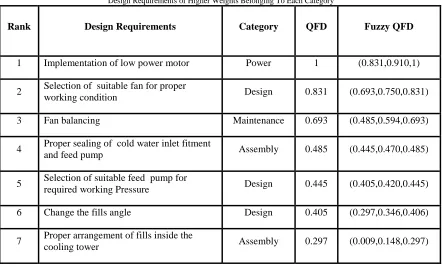
In the previous articleR.UmeshSundar et al. (2012) “Application of Quality Function Deployment method and fuzzy logic for improving the design characteristics in FRP cooling tower-case study” the rankings are found out using Fuzzy QFD method based on the major design requirements. The critical parameters found out are given higher ranks in order. The higher priority requirements are given more importance and the least priority requirements are given less importance. Suitable design solutions are suggested for each problems found out.
The ultimate aim of this article is to increase the efficiency of the FRP cooling tower, satisfy the customer’s expectation and simultaneouslyto improve the quality characteristics, to reduce the costs and increase the production rate with reference to the results obtained from fuzzy QFD method. Many researcherscomment that the QFD and fluent is the best process design tool, to satisfy the customer requirements and improve the products’ quality; it also helps the design team to generate new ideasin identifying and rectifying the existing process problem at ease. So in this article the QFD and fuzzy QFD method is approached to identify the defects in a30TR FRP cooling tower and the efficiency of cooling tower is improved by remodeling and analysis usingsoftware’s like CATIA, fluent and Ansys.
2. EXPERIMENTAL REVIEW
2.1. Major Design Requirements
142401-9696-IJMME-IJENS © February 2014 IJENS I J E N S design requirements have to be improved and re-modified based on the fuzzy QFD rank.
Table I
Design Requirements of Higher Weights Belonging To Each Category
Rank Design Requirements Category QFD Fuzzy QFD
1 Implementation of low power motor Power 1 (0.831,0.910,1)
2 Selection of suitable fan for proper
working condition Design 0.831 (0.693,0.750,0.831)
3 Fan balancing Maintenance 0.693 (0.485,0.594,0.693)
4 Proper sealing of cold water inlet fitment
and feed pump Assembly 0.485 (0.445,0.470,0.485)
5 Selection of suitable feed pump for
required working Pressure Design 0.445 (0.405,0.420,0.445)
6 Change the fills angle Design 0.405 (0.297,0.346,0.406)
7 Proper arrangement of fills inside the
cooling tower Assembly 0.297 (0.009,0.148,0.297)
3. CFD ANALYSIS OF PROPOSED 30TR FRP COOLING TOWER
3.1. Computational Fluid Dynamics
Computational fluid dynamics (CFD) is a branch of fluid mechanics that uses numerical methods and algorithms to solve and analyze problems that involve fluid flows. Computers are used to perform the calculations required to simulate the interaction of liquids and gases with surfaces
defined by boundary conditions. In this article CFD is used to analyze the thermal analysis of proposed 30TR FRP cooling tower. A 3D model by using CATIA software package is created as per dimensions and this 3D model is meshed by using Gambit software package. By using fluent software the meshed 3D model is analyzed. This analytical result is compared with the theoretical result of existing 30TR FRP cooling tower. The analysis results are shown in figure given below.
142401-9696-IJMME-IJENS © February 2014 IJENS I J E N S Fig.2.30TR FRP Cooling Tower Meshed Model
Fig.3. Fluid FlowProcess Analysis
Fig.4. Fluid Flow Analysis for Olutlet Temperature Initial Boundary condition
Sprinkler Pressure =1 bar, sprinkler speed = 15 rpm
Inlet hot Water Temperature = 37°C
Exhaust Fan Static Pressure = 4.16 mm H2o
142401-9696-IJMME-IJENS © February 2014 IJENS I J E N S The above figures (3, 4) shows the result of
proposed 30TR FRP cooling tower by using fluent analysis software. First the initial boundary conditions are set.The boundary conditions includes inlet hot water temperatureat37ºC, Exhaust fan static pressure of 4.16mmH2O, sprinkler pressure of 1bar and a sprinkler speed of 15rpm. Then the solve option is usedto start the analysis process for fluid flow. The analyzed result is plotted in the fluid work place. The above analysis has been carried out upto
135627 iteration process in order to get the optimal cold water
temperature(outlet). The optimal cold water
temperature(outlet) value obtained from the fluent analysis is 305.481 K/32.481º C.
4.THEORETICAL PERFORMANCE ANALYSIS OF 30TR FRPCOOLING TOWER
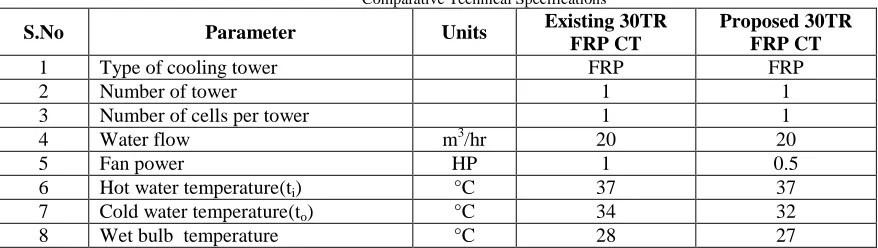
The major design requirements are analyzed theoretically and the overall performance of FRP cooling tower has to be calculated.
Table II
Comparative Technical Specifications
S.No Parameter Units Existing 30TR
FRP CT
Proposed 30TR FRP CT
1 Type of cooling tower FRP FRP
2 Number of tower 1 1
3 Number of cells per tower 1 1
4 Water flow m3/hr 20 20
5 Fan power HP 1 0.5
6 Hot water temperature(ti) °C 37 37
7 Cold water temperature(to) °C 34 32
8 Wet bulb temperature °C 28 27
The existing FRP cooling tower valves are measured from Eltech Equipments, Coimbatore, and Tamilnadu, India.
4.1. Performance Calculations of Existing 30TR FRP Cooling Tower
Observations
Capacity of FRP cooling tower = 30TR
Inlet hot water temperature = 37°C
Outlet cold water temperature = 34°C
Air wet bulb temperature = 28°C
Air dry bulb temperature = 32°C
Water flow rate = 20 m3/hr
1. Range (R) = Inlet hot water temperature - Outlet cold water temperature
= 37-34
= 3°C
2. Approach (A) = Outlet cold water temperature - Air wet bulb temperature
= 34-28
= 6°C
3. Effectiveness or efficiency (η) =
( )
=
( )
142401-9696-IJMME-IJENS © February 2014 IJENS I J E N S 4. Cooling capacity(C) = m x cp x (ti-to)
= 30000 x 4.187 x (310-307)
= 376.83 x 10³ KJ
5. Evaporation loss (E) = 0.00085 X circulating water rate x (ti-to)
= 0.00085 X 20 X (37-34)
= 0.051m3/hr
4.2. Performance Calculation of Proposed 30TR FRP Cooling Tower
Observations
Capacity of FRP cooling tower = 30TR
Inlet hot water temperature = 37°C
Outlet cold water temperature = 32°C
Air wet bulb temperature = 27°C
Air dry bulb temperature = 33°C
Water flow rate = 20 m3/hr
1. Range (R) = Inlet hot water temperature- Outlet cold water temperature
= 37-32
= 5°C
2. Approach (A) = Outlet cold water temperature- Air wet bulb temperature
= 32-27
= 5°C
3. Effectiveness or efficiency (η) =
( )
=
( )
= 50%
4. Cooling capacity(C) = m x cpx (ti-to)
= 30000 x 4.187 x (310-305)
= 628.05 x 10³ kJ
5. Evaporation loss (E) = 0.00085 X circulating water rate x (ti-to)
= 0.00085 X 20 X (37-32)
142401-9696-IJMME-IJENS © February 2014 IJENS I J E N S Table III
Comparative Performance of 30TR FRP Cooling Tower
S.No Parameter Units Existing 30TR
FRP CT
Proposed 30TR FRP CT
1
Wet bulb temperature
°C
28
27
2
CT inlet temperature
°C
37
37
3
CT outlet temperature
°C
34
32
4
Range
°C
3
5
5
Approach
°C
6
5
6
Effectiveness
%
33.33
50
7
Cooling capacity
kJ
376.83 x 10
3628.05 x 10
38
Evaporation loss
m
3/hr
0.051
0.085
5. RESULT AND DISCUSSIONS
Generally the performance of 30TR FRP cooling tower is analyzed based on range, approach and efficiency. In this research the existing 30TR FRP cooling tower inlet hot water temperature was found to be 37ºC and outlet cold water temperature as 34 ºC. Based on the inlet hot water and outlet cold water temperature the range, approach and efficiency were found. The efficiency of the existing FRP cooling tower
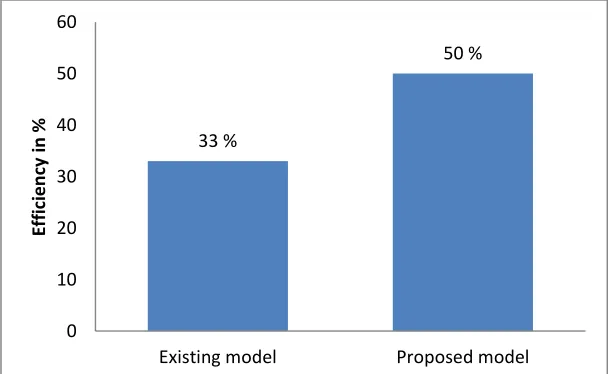
was found to be33.33%. This efficiency is very less. Therefore in order to improve the efficiency, the major design requirements are analyzed using the fuzzy QFD rank and found that the efficiency of the proposed 30TR FRP cooling tower is a much satisfying 50%. The comparative efficiency is shown in figure.5. The efficiency has been increased to 34% for the proposed 30TR FRP cooling tower by using fluid flow analysis and ANSYS12 software package.
Fig.5.Comparison of Existing and Proposed 30TR FRP Cooling Tower Vs Efficiency
COST ESTIMATION
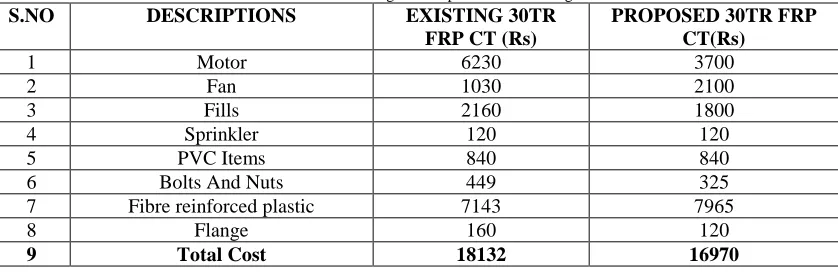
The tableIV.show the cost comparison of the existing and proposed 30TR FRP cooling tower. The cost hasbeen
reduced to 6.4% in the proposed cooling tower compared to the existing 30TR FRP cooling tower.
33 %
50 %
0 10 20 30 40 50 60
Existing model Proposed model
Eff
ic
ie
n
cy
in
142401-9696-IJMME-IJENS © February 2014 IJENS I J E N S Table IV
Cost Estimation of Existing and Proposed FRP Cooling Tower
S.NO DESCRIPTIONS EXISTING 30TR
FRP CT (Rs)
PROPOSED 30TR FRP CT(Rs)
1 Motor 6230 3700
2 Fan 1030 2100
3 Fills 2160 1800
4 Sprinkler 120 120
5 PVC Items 840 840
6 Bolts And Nuts 449 325
7 Fibre reinforced plastic 7143 7965
8 Flange 160 120
9 Total Cost 18132 16970
No. of units produced/month = 3 No’s
No. of units produced/year = 3x12 = 36 No’s
Existing 30TR FRP CT Cost per unit = Rs.18132
Total cost of Existing 30TR FRP CT per year = Rs.18132x36
= Rs.6, 52752
Proposed FRP CT Cost per unit = Rs.16970
Total cost of Proposed30TR FRP CT per year = Rs.16970x36=R.s.6, 10920
Net Savings per year = Rs. 6, 52752 - R.s.6, 10920
= Rs.41,832/-
6.CONCLUSIONS
The QFD and CFD analysis of the existing cooling tower is done to find the major areas of design lapse. It is clearly understood that there must be certain design improvements that has to be made to make the system more efficient. The various defects found out using QFD are analyzed using CFD and the major defects are taken into consideration. The remodeled design is also put into the same process of analysis that was done for the existing system. It is found out that the proposed model shows an improved efficiency from 33% to 50%. Hence by increasing the overall efficiency the cooling tower is made more compact and energy efficient.
REFERENCES
[1] Ahmed (2006), Developing quality healthcare software using
quality function deployment: a case study based on sultan qaboobs university hospital,Int.j.business information system, 1: 408-425.
[2] Aniyan.T.S(2011), Quality function deployment in manufacturing
industry(Improving existing SB CNC 40/60 slant bed turning centre in HMT,Kalamassery), Tenth International Conference on Operations and Quantitative Management organized by Symbiosis Institute of Operations Management, Nashik, India,609-617.
[3] Benton.J(2002),An Improved Cooling Tower Algorithm for the
Cool Tools Simulation Model,ASHRAE Transactions,108:1-10.
[4] Bouchereau and Rowlands (2000),Methods and techniques to help
quality function deployment, Bench marketing, An International Journal, 7:8-19.
[5] Celik. 2008),An integrated fuzzy QFD model proposal on routing of
shipping investment 3 decisions in crude oil tanker market, Expert system with application, 36: 6227-6235.
[6] chyuan Lin (2004),Using Fuzzy QFD for Design of Low-end Digital
Camera,International Journal of Applied Science and Engineering, 3:222-233.
[7] Dimsey and Mazur(2002),QFD to Direct Value Engineering in the
Design of a Brake System,QFD institute.650-659.
[8] Erkarslan and Yilmaz (2011),Optimization Of Product Design
Through Quality Function Deployment And Analytical Hierarchy Process: Case Study Of A Ceramic Washbasin,METU JFA, 28:1-22.
[9] Gholizadeh and Momayyeza(2011),The estimation of the cooling
tower height by modeling the water and air contact situation in cooling tower falling film,Journal of Chemical Engineering and Materials Science,2: 21-27.
[10] Gonzalez (2003),Improving Product Design Using Quality Function
Deployment: The School Furniture Case in Developing Countries, Quality Engineering,16: 47–58.
[11] Hsuan Chen (2004),An evaluation approach to engineering
designing QFD processes using fuzzy goal programming models,European Journal of Operational Research,172:230–248.
[12] Hung hsu(2011),Green supply implementation based on fuzzy
142401-9696-IJMME-IJENS © February 2014 IJENS I J E N S
[13] Jin Shim (2008),Performance Characteristics of a Closed Circuit
Cooling Tower with Multi Path,Engineering and Technology, 46:310-314.
[14] Kahraman (2004), A fuzzy optimization model for QFD planning
process using analytic network approach, European Journal of Operational Research,1-22.
[15] kannan.G(2008),Implementation of fuzzy quality function
deployment in an automobile component to improve the quality characteristics, Quality Engineering, 20:321-33.
[16] karsak.E(2004),Fuzzy multiple objective programming framework
to prioritize design requirements in quality function deployment” Computers & Industrial Engineering ,47:149–163.
[17] Kwong.C.K and Bai.H (2002),An fuzzy AHP approach to
determination of importance weights of Customer requirements in quality function deployment, journal of intelligent manufacturing, 13: 367-377.
[18] Oke.S.A (2009),Application of QFD and VA tools in the design of
an automobiles, Int.J.Productivity And Quality Management, 4:525-548.
[19] Prasad.K.G (2011),Cost engineering with QFD : A mathematical
model,International Journal For Quality Research,4:33-37.
[20] Raissi.S(2011),A novel method on customer requirements
preferences based on common set of weight, Australian Journal Of Basic And Applied Sciences, 5:1544-1552.
[21] Rehman Khan 2003),Performance characteristics of counter flow
wet cooling towers”Energy Conversion and Management, 44:2073– 2091.
[22] Umesh Sundar.R and Mohan Kumar.G (2011), Imparting
integration of quality function deployment and value engineering-case study, CiiT international journal of software engineering and technology , 3:545-550.
[23] Umesh Sundar.R and Mohan Kumar.G (2012), Implementation of
Traditional QFD with Fuzzy System to Improve the Design Characteristics in FRP Cooling Tower-Case Study, International Conference on Recent Advances in Mechanical Engineering, Dr.M.G.R educational and research institute university, Chennai.
[24] Umesh Sundar.R and Mohan Kumar.G (2012), Application Of