Low Cost Video Conferencing over VOIP Using TDM to PCM Interface
Guru Prakash.S1 and Kasthuri.N2
1,2Department of ECE, Kongu Engineering College, Erode. Email:[email protected]1, [email protected]2
Article Received: 01 March 2018 Article Accepted: 09 April 2018 Article Published: 28 April 2018
1. INTRODUCTION
VoIP is a type of correspondence that enables you to make telephone brings over a broadband web association
rather than run of the mill simple phone lines. Essential VoIP get to for the most part enables you to call other
people who are likewise accepting brings over the web. Interconnected VoIP benefits additionally enable you to
make and get calls to and from customary landline numbers, as a rule for an administration charge. [8] Some VoIP
administrations require a PC or a committed VoIP telephone, while others enable you to utilize your landline
telephone to put VoIP calls through an uncommon connector. The working framework with Asterisk is introduced
in Raspberry Pi. Indicator bolsters sound conventions, for example, SIP which is Session Initiation Protocol
utilized for the sound correspondence. This bundle comprises of a few highlights, for example, Voicemail, Call
Waiting, Caller ID, and Call Transfer et cetera.
The test is to give a similar administration over cell phone at no cost, as it has been depicted in this venture. Two
methodologies are proposed in this paper to meet the target of having free communication benefits over cell
phones. These are the utilization of WIFI innovation over AP (Access Point) and WIFI over p2p (Peer-to-Peer).
1.1.ASTERISK
Reference bullet is a product usage of a phone private branch trade (PBX); it enables joined phones to make calls to
interface with other telephone utilities, for example, the Public Switched Telephone Network (PSTN) and Voice
over Internet Protocol (VoIP) administrations. Its name originates from the reference bullet image "*". The
Asterisk programming incorporates numerous highlights accessible in restrictive PBX frameworks: voice message,
gathering calling, intuitive voice reaction (telephone menus), and programmed call appropriation. Clients can make A B S T R A C T
new usefulness by composing dial design contents in Asterisk's very own few expansions dialects, by including
custom loadable modules written in C, or by executing Asterisk Gateway Interface (AGI) programs utilizing any
programming dialect equipped for conveying by means of system TCP attachments.
Reference bullet underpins a few standard voice over IP conventions, including the Session Initiation Protocol
(SIP), the Media Gateway Control Protocol (MGCP), and H.323. Indicator bolsters most SIP phones, acting both as
enlistment center and consecutive client specialist, and can fill in as a passage between IP telephones and the Public
Switched Telephone Network (PSTN) by means of T-or E-bearer interfaces or simple FXO cards. Numerous VoIP
specialist organizations bolster it for call fulfillment into the PSTN, frequently in light of the fact that they
themselves have sent Asterisk or offer it as a facilitated application. A few phones likewise bolster the IAX
convention. [7]
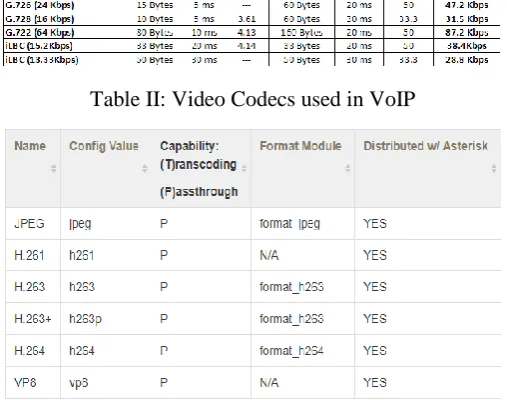
Different codecs are utilized for pressure and decompress the sound and video flags and are recorded in table I and
table II individually.
Table I: Audio Codecs used in VoIP
Table II: Video Codecs used in VoIP
Notwithstanding VoIP conventions, Asterisk bolsters customary circuit-exchanging conventions, for example,
ISDN and SS7. This requires fitting equipment interface cards, advertised by outsider merchants. Every convention
requires the establishment of programming modules.
1.2.TDM to PCM Interface
A TDM to PCM Interface, additionally called computer– phone mix or CTI, is a typical name for any innovation
depict work area based cooperation for helping clients be more effective, however it can likewise allude to
server-based usefulness, for example, programmed call directing. CTI empowers control of the telephone through
the PC as appeared in figure 1.
Fig. 1.Computer Telephony Integration (CTI)
1.3.IP Telephone
IP communication (Internet Protocol communication) is a general term for the advancements that utilization the
Internet Protocol's bundle changed associations with trade voice, fax, and different types of data that have
customarily been persisted the devoted circuit-exchanged associations of the Public Switched Telephone Network
(PSTN). Utilizing the Internet, calls go as parcels of information on shared lines, keeping away from the tolls of the
PSTN. VoIP is a sorted out push to institutionalize IP communication. IP communication is an imperative piece of
the merging of PCs, phones, and TV into a solitary coordinated data condition. VoIP telephones can be
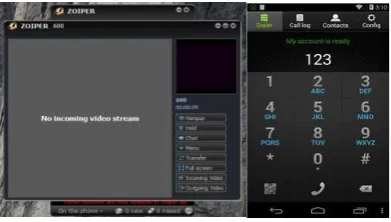
straightforward programming based softphones as in figure 3 or reason manufactured equipment gadgets as in
figure 2 that seem much like a standard phone or a cordless telephone.
Fig. 2. IP Phone – Audio Codecs 320HD
1.4. Wireless Integration
A Wireless Network Interface Controller (WNIC) is utilized for remote system joining which associates with a
remote radio-based PC organize, instead of a wired system, for example, Token Ring or Ethernet. A WNIC, much
the same as different NICs, chips away at the Layer 1 and Layer 2 of the OSI Model. This card utilizes a radio wire
to convey by means of microwave radiation with different speeds as appeared in figure 4 and range as in figure 5. A
WNIC in a work station is generally associated utilizing the PCI transport. [3]
Fig. 4.Data rate vs. Distance graph for 802.11acn
Fig. 5. Dual Band 802.11acn WNIC
2. PROPOSED WORK
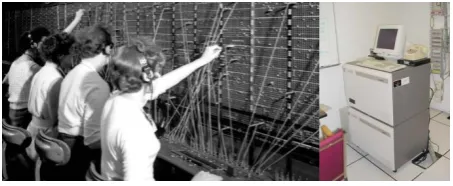
In the early years of phone lines, calls experienced open switchboards, where administrators physically guided
them to the right beneficiaries and are known as Electronic Private Branch Exchange (EPBX) as appeared in figure
6(left). As PCs built up, a refresh to PBX showed up this empowers the PBX to naturally course the calls to the
beneficiary. This framework is known as Electronic Private Automatic Branch Exchange (EPABX) and is appeared
in figure 6(right).
Fig. 6. PBX and EPABX system
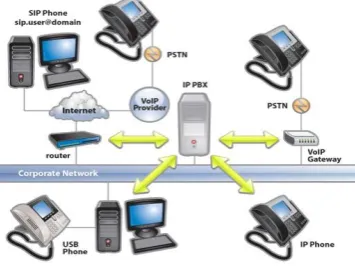
In traditional system, the phones are connected using the copper wire system. In this system, the phones are
connected using the available wifi facility inside an organization and the general schematic of VoIP is shown in
Fig. 7. Basic VoIP network Layout
2.1. Problem Statement
The reason for this examination is to outline and actualize a radio framework that utilizations existing LAN (Local
Area Network) or WLAN (Wireless Local Area Network) as a methods for correspondence between cell phones
and existing radio frameworks at no cost. This framework will enable client to make voice and video discussion.
Notwithstanding that phone calls can likewise be made at free of cost. Distinctive security administrations
important for VoIP are exhibited and we contend that conclusion to-end confirmation and encryption ought to be
given as a matter of course.
Fig. 8. Block Diagram of Proposed IP-PBX system
Principle goal of the undertaking is to manufacture a typical IP-PBX framework for conventional simple phone
framework, computerized softphone and devoted VOIP telephones utilizing Asterisk server as appeared in figure 8.
Correspondence is set up among different hubs utilizing the Soft-directing. With a specific end goal to interface the
remote hubs to this system, a remote access point is made, through which the advanced mobile phones are
associated with this VOIP arrange.
2.2. Advantages of Proposed System
1. Proposed framework is very solid, as it is worked in LAN and WLAN. Notwithstanding that, it can be
worked utilizing little battery as the power necessity is less when contrasted with the current framework.
2. Better sound quality can be gotten by utilizing the CODECs for lossless pressure. And furthermore better
3. Since the raspberry pi is completely adjustable and reprogrammable, the client or association can have the
total access and control.
4. It isn't compulsory to have the IP-telephones. Rather than that, cell phones, PCs, and LAPTOPs can be
utilized as IP-Phones utilizing the softphone programming.
3. HARDWARE DESCRIPTION
Hardware components of the proposed work explained briefly along with their specifications as below:
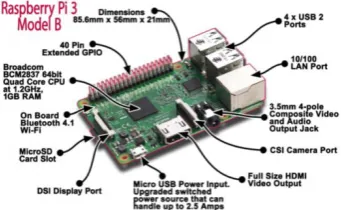
3.1. RASPBERRY PI 3 - MODEL B
The Raspberry Pi 3 Model B is the third era Raspberry Pi as appeared in figure 9. This intense Master card
estimated single board PC can be utilized for some applications and supersedes the first Raspberry Pi Model B+ and
Raspberry Pi 2 Model B. [8] Additionally it includes remote LAN and Bluetooth availability making it the perfect
answer for effective associated plans.
Fig. 9. Raspberry pi 3 – Model B
3.2. HYBERTONE HT842T FXO ATA
FXS Series Gateway is the execution Gateway, which created by HYBERTONE Co. FXS Series portals worked in
H.323 and SIP conventions. Exceedingly solid line recognition keeps the line hanging passing in the biggest tent.
Helpful and commonsense capacity of a broken system escape, when disengage the system, or VOIP logon falls
flat, FXS to say the chance to bounce specifically to the outside PSTN. It can forward outside Caller ID Number
under the SIP convention, which is an imperative capacity of PBX application. Super Echo Cancelation Algorithm
and Balanced Circuit influence line to resound least. Low value, Stable and execution are pronoun of the FXS
Series items; it is the main selection of PXS Manufacturers, Call Center and System Integrators. Figure 10
demonstrates the HT842T simple connector.
3.3. WIFI Router
A remote switch is a gadget that plays out the elements of a switch and furthermore incorporates the elements of a
remote access point. Double Band Wireless Routers have the capacity to transmit on the 5 GHz and 2.4 GHz remote
band. 2.4GHz however more far reaching in utilization (each of the 802.11b and g gadgets keep running on 2.4GHz
just) has just 3 non-covering channels for transmission, which are swarmed because of a ton of meddling gadgets
other Wi-Fi get to focuses, microwave broilers, cordless telephones, Bluetooth gadgets, child screens, and so forth
all make for a boisterous domain which increment obstruction and corrupt the execution. Wi-Fi or WiFi is an
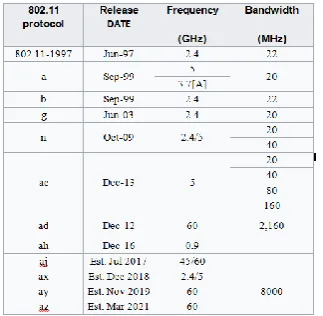
innovation for remote neighborhood with gadgets in light of the IEEE 802.11 principles. Table III shows different
802.11 principles alongside their transmission capacity.
Table III : 802.11 physical layer standards
TP-Link's Archer C50 accompanies the cutting edge Wi-Fi standard – 802.11ac as appeared in figure 11, 3 times
speedier than remote N speeds and conveying a consolidated remote information exchange rate of up to 1.2Gbps.
With 300Mbps over the 2.4GHz band and 867Mbps remote speeds over the perfectly clear 5GHz band, the Archer
C50 is the predominant decision for consistent HD gushing, web based gaming and other transfer speed serious
errands. Synchronous Dual Band offers you the adaptability of two devoted systems – with different circumstances
the data transmission for your requirements.
Fig. 11. TP-link Archer C50 – 50 user Wi-Fi router with Dual band
3.4. IP-Phone
A VoIP telephone or IP telephone utilizes voice over IP advancements for putting and transmitting phone brings
The 320HD IP Phone is a completely included phone that gives voice correspondence over an IP arrange, enabling
you to put and get telephone calls, put approaches hold, exchange calls, make phone calls, et cetera.
Fig. 12. AudioCodec 320HD IP-Phone
4. SOFTWARE DESCRIPTION
4.1. ASTERISK WITH FREEPBX
FreePBX is an electronic open source graphical UI (GUI) that oversees Asterisk, a voice over IP and
communication server. FreePBX is authorized under the GNU General Public License variant 3. It is a segment of
the FreePBXDistro, which is an autonomously kept up Linux framework got from the source code of the CentOS
dispersion, having Asterisk pre-introduced. Figure 13 demonstrates the FreePBX managerial board for reference
mark.
Fig. 13. FREEPBX control panel
4.2. LINUX OS in ATA
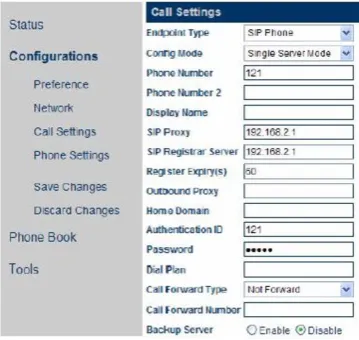
Figure 14 shows the configuration of the analog phone using the SIP protocol in the gateway web server.
4.3. IP-PHONE CONFIGURATION
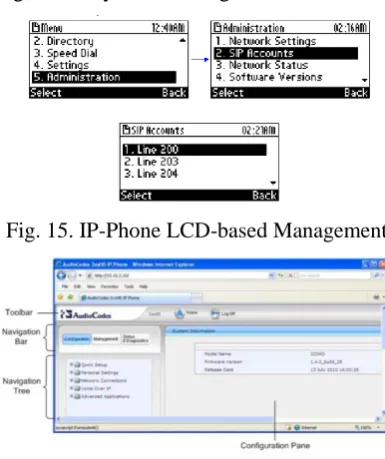
In order to connect the IP-Phone with this asterisk, it has to be configured with an IP-address along with the phone
extension. This IP-Phone can be configured using LCD and keypad on the Phone or by using the configuration
webpage. Figure 15 shows the configuration by LCD and figure 16 shows the configuration by web page.
Fig. 15. IP-Phone LCD-based Management
Fig. 16. IP-Phone WEB-based Management
4.4. OZEKI VoIP Softphone
A delicate telephone is a product program for making phone brings over the Internet utilizing a universally useful
PC, instead of utilizing committed equipment. A softphone enables you to make and get VoIP telephone calls from
and by PCs, workstations, or other registering gadgets. Generally, the interface looks like a telephone with catches
speaking to the keys, which you squeeze utilizing the mouse to dial as appeared in figure 17. For talking and tuning
in, a headset and amplifier do the trick.
Fig. 17. Ozeki VoIP SIP Softphone
A run of the mill softphone work with Ozeki SDK is appeared in figure 18.
5. RESULT AND DISCUSSION
The proposed IP-PBX utilizing the raspberry-pi is tried by running the framework for ceaselessly for 6 hours and
followed the movement of the framework for glitch. In a similar way the framework is tried for 3 days. While
testing the video calls, the most extreme rate that the framework can endure is 324kb/s. This reasons the rate of
information relies upon the Wi-Fi dongle utilized, which is 802.11n and has the transmission capacity of 20MHz in
the band of 2.4GHz. This conclusion likewise fulfills with the Sampling hypothesis as beneath.
T=N/fs=64/(20MHz)=3.2μs
From the day and age the recurrence is 312.5 KHz. Here 802.11n 20 MHz utilizes 64 subcarriers. Among them 48
subcarriers are information, 4 are pilots, 11 are zero-cushioned on either side of the range, and 1 is the invalid DC
subcarrier. The zero-cushioning additionally diminishes impedance between nearby recurrence channels.
Fig. 19. Connection layout of proposedIP-PBX system
By utilizing the arrangement appeared in figure 19, the video call is set up between the PC and the cell phone by
utilizing the zoiper softphones. At the point when the information rate is underneath 256Kbps, at that point there is
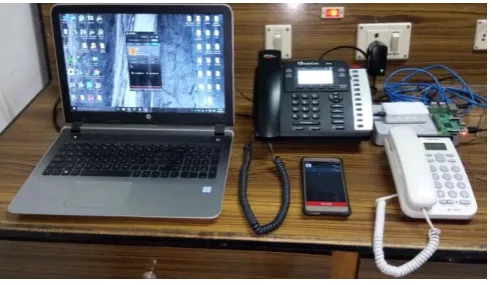
no jitter in the call. Figure 20 demonstrates the genuine equipment setup.
Fig. 20. Hardware setup of proposed IP-PBX system
6. CONCLUSION
The raspberry pi based radio framework can be introduced effortlessly alongside the current radio or LAN or
WLAN frameworks. This compose change empowers the client to utilize the cell phone as a hub of radio
can bear the cost of this framework with less venture. At that point by introducing this framework in Public Wi-Fi,
free calling office can be given to the Public.
7. FUTURE SCOPE
When every one of the regions are introduced with this IP-PBX radio framework as appeared in figure 21, voice
and video calls can be set up with no jitter and at free of cost. By utilizing this office, Emergency Communication
Services (ECS) can be given by utilizing the Wi-Fi and under-ground fiber optic links. Since, amid catastrophe, the
GSM system may fall flat, and around then, the individual in threat can be effortlessly imparted utilizing this
framework and number lives can be spared. Since video call can likewise be built up, First AID can be given by
specialists over video conferencing for individuals whom are disengaged, because of debacle.
Fig. 21.Wi-Fi based ECS system using IP-PBX
REFERENCES
[1] Ashwini S. Gawarle (2017), “Design a Free Voice Calling System Using Raspberry Pi”, International
Journal of Research in Engineering and Applied Sciences (IJREAS).
[2] Chunhui Yuan and Hongli Zhao (2016), “Implementing VoIP Voice Communication System based on
Soft-switch Technology”, 2016 International Conference on Cyber-Enabled Distributed Computing and
Knowledge Discovery.
[3] Hussein Al-Saadawi and AsafVarol (2017), “Voice over IP Forensic Approaches: A Review”,
978-1-5090-5835-8/17/$31.00 ©2017 IEEE.
[4] Nikhil A.karotiya, Nikhil P.Wyawahare and Dr.S.L.Haridas (2016), “Review paper on Point to Point
Communication with the use of Power over Ethernet based on VOIP system on Asterisk”, International
Conference on Advances in Electrical, Electronics, Information, Communication and Bio-Informatics
(AEEICB16).
[5] Pramila.B Bamnote (2016), “Design and implementation of wifi based intercom system using Arm11”,
International Research Journal of Engineering and Technology (IRJET).
[6] Rahul C. Vaidya and Prof. S.S. Kulkarni (2012), “Voice over IP Mobile Telephony Using WIFI”,
[7] Ryota Nishimura, Koji Sugioka, Daisuke Yamamoto, Takahiro Uchiya, and Ichi Takumi (2014), “A
VoIP-based Voice Interaction System for a Virtual Telephone Operator Using Video Calls”, 2014 IEEE
3rd Global Conference on Consumer Electronics (GCCE).
[8] Serge Fabrice Mbianda Ngongang, Navid Tadayon and Georges Kaddoum (2016), “Voice over Wi-Fi: