e-ISSN: 2278-7461, p-ISSN: 2319-6491
Volume 6, Issue 6 [June. 2017] PP: 49-57
Inhibitive Influence of Carica Papaya and AzadirachtaIndica
Leaves Extracts on the Corrosion of Mild Steel in H2SO4
Environment.
J.C. Ugwuoke
1and N. I. Amalu
21Department of Metallurgical and Materials Engineering, Enugu State University of Science and Technology,
Enugu, Nigeria.
2
Engineering Research, Development and Production Department, Projects Development Institute (PRODA), Enugu.
Corresponding Author: J.C. Ugwuoke
Abstract:-
The inhibitive influence of pawpaw (carica papaya) and neem (azadirachtaindica) leaf extracts onthe corrosion of mild steel in H2S04 environment at normal temperature has been investigated. The study was
carried out using the weight loss technique. The results obtained show carica papaya and azadirachtaindica leaves extracts as potential inhibitors of mild steel corrosion in H2S04 environment. The result revealed that the
rate of corrosion of mild steel in H2S04 increases with increase in the concentration of the acid and that the
leaves extracts inhibits the corrosion of mild steel in H2S04 via adsorption of the inhibitor molecules on the
metal surface. The inhibition efficiency of the extracts increases with increase in the concentration of the extracts. The best result was obtained with 60ml of (CP+AI) leaves extracts as inhibitors with an inhibition efficiency of 92.20%. The poorest inhibition efficiency (11.71%) came from the inhibition with 10ml AI leaves extracts. The inhibition efficiency of the leaves extracts follows the trend (CP+AI) > CP > AI.
Keywords:
Azadirachtaindica, Carica papaya, Corrosion, Inhibitors, Weight loss techniques.--- --- Date of Submission: 28-07-2017 Date of acceptance: 18-08-2017 --- ---
I.
INTRODUCTION
Corrosion may be described as the deterioration of a material, (usually metals) and their properties arising from its interaction with its environment. Corrosion impairs materials usefulness by deterioration of its mechanical properties such as ductility and strength [1].
Corrosion commonly occurs at the metal surface in the presence of oxygen and moisture, involving two electrochemical reactions. Oxidation takes place at the anodic site and reduction occurs at the cathodic sites. Corrosion problems have received considerable amount of attention because of their economic and safety consequences [2]. The corrosion behavior of carbon steel in acidic solution is a subject of pronounced practical significance considering its wide application mainly in the manufacture of pipeline for petroleum industries. Mild steel finds a variety of application industrially, in mechanical and structural purposes, like bridge work, building, boiler plates, steam engine parts and automobile. These applications occur under severe corrosion in aggressive environment, and needs to be protected [3].
The corrosion of metals in many industries, constructions, installations and civil services such as electricity, water and sewage supplies is a serious problem. In order to prevent or minimize corrosion, inhibitors are usually used especially in flow cooling system. Organic, inorganic or a mixture of both inhibitors can inhibit corrosion by either chemisorption on the surface or reacting with metal ions and forming barrier type precipitate on its surface. [4,5,6,7]
II.
EXPERIMENTAL PROCEDURE
2.1 Equipment
The equipment used in this work include beakers(1200ml), volumetric flask(250ml), funnels, round bottom flask(1000ml), measuring cylinder (1000ml), nylon thread, hacksaw, metre rule, caliper, metalwork vice, electronic weighing machine, emery paper, mortar and pestle, filter papers, pH meter.
2.2 Materials and Methods
on each sides of the dimension for suspension. A fine grade of emery paper was used to abrade the specimen before washing in distilled water, then rinsed with acetone and spread on a clean glass for drying. The dried coupons were weighed and the initial weight was recorded, consequently, stored in an air – tight desiccators prior to use.
Inhibitors
The two plant extracts used as inhibitors in this study were. a. Neem (Azadirachtaindica leaves extracts)
b. Pawpaw (Carica papaya leaves extracts)
Fresh leaves of the above different plants were harvested and washed with cold tap water and ground using a manual grinding machine, squeezed to obtain corresponding extracts without the addition of water, then filtered. 10ml, 20ml, 30ml, 40ml, 50ml, 60ml set of the filtered different plants extracts were weighed with an electronic weighing machine.The aggressive solution used was of analytical grade with percentage assay of 98%. Acetone (CH3)2CO from BDH with 99.5% assay. The appropriate concentration of acid was prepared using distilled water. Different concentrations were preparedfrom concentrated H2SO4 acid, the volume of diluted acid per cm3 was worked out using the following relation:
Vc = M VD Z ⁄ 10PS
Vc = Volume of concentrated acid to be diluted M = Molarity of diluted acid
VD = Volume of distilled water which dilution is to be made (1dm3 = 1000cm3) Z = The molar mass of the substance (H2SO4 = 98)
P = Percentage assay of solute (98%)
S = Specific gravity of H2SO4 = 1.84
The prepared coupons were labeled and immersed into aggressive solutions with and without inhibitors and the pH measurement of the solutions were taken and recorded. After the withdrawal of the coupons, they were rinsed in distilled water, swabbed in acetone, air dried, and weighed. The difference in weight was recorded as the weight loss.
III.
RESULTS AND DISCUSSIONS.
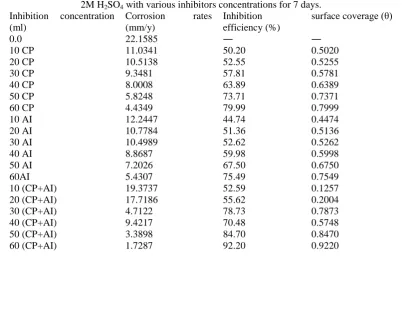
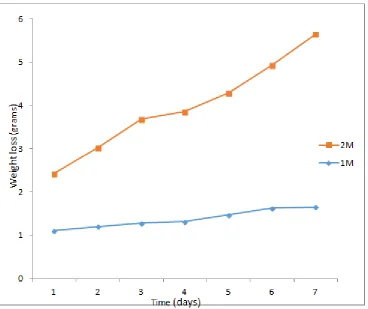
The corrosion of mild steel in different concentration of H2SO4 (1M and 2M) in the presence of an inhibitive plant extracts of carica papaya or azadirachtaindica at room temperature were investigated and the weight loss per day for seven days were summarized together with the media pH in tables 1 and 2 and figures 3 to 10. The result obtained from this experiment showed that the weight loss of mild steel coupons in H2SO4 solution increases with increase in acid concentration and pH decreases. The weight loss for 2M of H2SO4 is several times more than those obtained for either 1M of H2SO4. This could be due to the increased concentration of sulphate ions in the acid solution which readily destroy the passive nature of the mild steel surface.
Table 1: Corrosion rate and inhibition efficiency data obtained from weight loss measurements for mild steel in 1M H2SO4 with various concentrations of inhibitors for7 days.
Inhibitor concentration (ml)
Corrosion rate (mm/y) Inhibition efficiency (%)
Surface coverage (θ)
0.0 9.1344 ― ―
10 CP 8.8853 2.73 0.0273
20 CP 8.6086 5.76 0.0576
30 CP 8.3561 8.52 0.0852
40 CP 7.7227 15.45 0.1545
50 CP 7.7329 15.34 0.1534
60 CP 7.4804 18.11 0.1811
10 AI 8.9783 1.71 0.0171
20 AI 8.8012 3.65 0.0365
30 AI 8.5521 6.37 0.0637
40 AI 8.2997 9.14 0.0914
50 AI 8.0473 11.90 0.1190
60 AI 7.6044 16.75 0.1675
10 (CP+AI) 5.5248 39.52 0.3952
20 (CP+AI) 1.7160 81.21 0.8121
30 (CP+AI) 4.9768 45.52 0.4552
40 (CP+AI) 1.2178 86.67 0.8667
60 (CP+AI) 1.2798 85.99 0.8599
Figure 1: Variation of inhibition efficiency with extracts concentration for mild steel coupons in 1M H2SO4 solution.
Table 2: Corrosion rate and inhibition efficiency data obtained from weight loss measurements for mild steel in 2M H2SO4 with various inhibitors concentrations for 7 days.
Inhibition concentration (ml)
Corrosion rates (mm/y)
Inhibition efficiency (%)
surface coverage (θ)
0.0 22.1585 ― ―
10 CP 11.0341 50.20 0.5020
20 CP 10.5138 52.55 0.5255
30 CP 9.3481 57.81 0.5781
40 CP 8.0008 63.89 0.6389
50 CP 5.8248 73.71 0.7371
60 CP 4.4349 79.99 0.7999
10 AI 12.2447 44.74 0.4474
20 AI 10.7784 51.36 0.5136
30 AI 10.4989 52.62 0.5262
40 AI 8.8687 59.98 0.5998
50 AI 7.2026 67.50 0.6750
60AI 5.4307 75.49 0.7549
10 (CP+AI) 19.3737 52.59 0.1257
20 (CP+AI) 17.7186 55.62 0.2004
30 (CP+AI) 4.7122 78.73 0.7873
40 (CP+AI) 9.4217 70.48 0.5748
50 (CP+AI) 3.3898 84.70 0.8470
60 (CP+AI) 1.7287 92.20 0.9220
0 20 40 60 80 100 120 140
1 2 3 4 5 6
CP + AI
CP AI In h ib itio n ef fici en cy
(%
)
Figure 2: Variation of inhibition efficiency with extracts concentration for mild steel coupons in 2M H2SO4.
Figure 4: Variation of weight loss with time for the corrosion of mild steel in different concentrations of CP inhibitors in 1M H2SO4
Figure 6: variation of weight loss with time for the corrosion of mild steel in different concentrations of (CP+AI) inhibitors in 1M H2SO4
Figure 8: Variation of weight loss with time for the corrosion of mild steel in different concentrations of AI inhibitors in 2M H2SO4
Figure 10:Variation of corrosion rate with time for the corrosion of mild steel in different concentrations of CP inhibitors in 1M H2SO4
Figure 3 shows variation of weight loss of mild steel with time in 1M H2S04 solution without inhibitor and weight loss of mild steel with time in 2M H2S04 solution without inhibitor. It can be seen that the corrosion of mild steel increases as the concentration of the corrodent increases. Several authors have also reported that the increase in corrosion rate with concentration may be attributed to the increase in concentration of the active ion in the corrosion reaction.[5,6,7,8]
At the initial period when the coupons were immersed into the beakers containing corrodent, it was observed that the coupons were rapidly attacked by the corrodent, which afterwards maintain its uniform attack throughout the coupon. The reason is that when the coupons were immersed, immediately the active sites of the corrodent attacked them greatly but with time the corrodent was uniformly distributed throughout the coupons thereby making them move from active sites to passive sites in the media. As these happen, the corrosion rate decreases in the media.With 2M H2SO4, all the mild steel coupons were attacked severely compared with that of 1M H2SO4 because moresulphuric acid which deteriorate the arrangement of the compositions of mild steel coupons was introduced. This increases the corrosion rate of the mild steel coupons immersed in the media.
Figure 10 shows variation of corrosion rate of mild steel with time in 1M H2SO4 solution with 10ml carica papaya as inhibitor. The corrosion rate with 10ml pawpaw extract is lower compared to corrosion rate of mild steel with time in 1M H2SO4 solution without inhibitor. This is also true and likewise at 2M H2SO4.
The results obtained from this study clearly showed that the inhibition efficiency increases with concentration of the extracts which indicated that the inhibition mechanism is due to chemical adsorption of the molecular components of carica papaya and azadirachtaindica leaves extracts on the surface of the metal.
Also, combination of the two leaves extracts as inhibitor produced a superior inhibition efficiency greater than the sum of their separate inhibition efficiency.The highest inhibitor concentration that is 60ml of carica papaya, azadirachtaindica and (carica papaya + azadirachtaindica) leaves extracts for 1M of H2SO4 has inhibition efficiency of 18.11%, 16.75% and 85.99% respectively.
The inhibition efficiency of carica papaya is higher than the inhibition efficiency of azadirachtaindica, whereas the inhibition efficiency of the leaves extracts synergy that is (carica papaya + azadirachtaindica) is higher than the inhibition efficiency of carica papaya leaves extracts.
Hence, the inhibition efficiency of the studied plants leaves extracts follows the trend AI < CP < (CP + AI).
IV.
CONCLUSION
Acids are used for drilling operations, pickling baths and in descaling process and other process where mild steels are involved. Mild steel suffers from severe corrosion in aggressive environment and it has to be protected.
An environmentally acceptable, inexpensive, readily available, renewable source of materials and ecological acceptable inhibitors has been considered as good inhibitors.
The inhibitor efficiency of all the extracts increased with increase in extract concentration.
1. The best result was obtained with 60ml of (CP+AI), that is 30ml each of carica papaya and azadirachtaindicaleaves extracts as inhibitors with an inhibition efficiency of 92.20%.
The poorest inhibitor efficiency 44.74% came from the inhibition with 10ml of AI (azadirachtaindica) leaves extracts.
2. Saponins, Tannins, Flavonoids, Alkaloids, Glycosides present in carica papaya and azadirachtaindica are responsible for the reduction of the corrosion rate of mild steel in H2S04.
3. The inhibitor efficiency of all the extracts increased with increase in extract concentration until maximum inhibitor efficiency was obtained.
4. The inhibitive performance of the organic inhibitors could be enhanced in synergism.
REFERENCES
[1] Dr. Neife S.I. Corrosion and oxidation of materials, a semester handout of MME Dept. ESUT (MME 464). (2006)
[2] Khaled K.F. New Synthesized Guanidine derivative as a green corrosion inhibitor for mild steel in acidic solution. International Journal of Electrochemistry Science, (2008) Vol. 3, 462-475.
[3] Sethi T., Charturdi A, Updyay R.K, and Mathur S.P., corrosion inhibitory effect of some schiffs base on mild steel in acid media. Journal OF Chilean Chemical Society, (2007) 52, No.3:1206-1213.
[4] H. AI-sehaibani. Evaluation of extracts of henna leaves as environmentally friendly corrosion inhibitors for metals. (2000) onlinelibrary.wiley.com>doi
[5] Abdalla A. Guar Gum as corrosion inhibitor for carbon steel in sulphuric acid solution portugaliaeelectrochemiceacta, (2004), vol. 22,161-175.
[6] P.B. raja and M.G. Sethuramani, Atropine sulphate as corrosion inhibitor for mild steel in sulphuric acid medium, material letters, Elsevier, 2008, volume 62, issues 10-11, pages1602-1604.
[7] HeloIndya 2001. helloindya.com/neem/chemical composition.