e-ISSN: 2278-7461, p-ISSN: 2319-6491
Volume 5, Issue 3 [February 2016] PP: 45-56
Study on Supply Chain Coordination via Option Contract
Azamat Rajapov
1, Jamshid Valiyev
2, Sanjar Rajapov
31 School of Transportation and Logistics, Southwest Jiaotong University, Chengdu, China
2School of Mechanical Engineering, Southwest Jiaotong University, Chengdu, China
3School of Computer & Science, Southwest Jiaotong University, Chengdu, China
Abstract: Due to poor performance of supply chain we have studied supply chain contract, which is based on the basic contract model. On the basis, four kinds of typical contract models are analyzed and summarized, In order to make supply chain more effective we have designed coordination mechanism, increase retailer profit, increase supplier profit, coordinate the supply chain occur an important effect in practice, we have run basic portfolio contract model that make the supply chain coordination comes to realize to truth, in decentralized supply chain design option contract in order to increase profit of both members also in the numerical part we illustrated normal probability function and normal cumulative function using Matlab software and summarized the paper with conclusion part.
Keywords: Coordination Mechanism, Supply Chain Coordination, Supply Chain Contract, Option Contract
I.
INTRODUCTION
The contract is mainly used in the field of economy and law, and supply chain contract is a kind of economic contract theory in supply chain. In this form, the research is mainly on the theory of multi - stage inventory.
Harris Ford [1] is aware of the first time in 1915 to put forward the concept of inventory, Clark and Scarf [2] together in 1960 will be extended to the case of multi - stage inventory, a relatively independent and identical distribution of demand is established by dynamic programming. The optimal order quantity and trading strategy of a product, which is extended to the lower reaches of the retailer, can be regarded as the supply chain. Since then, with the Clark and Scarf inventory model as the core, the scholars on the multi stage inventory in different directions, a lot of research has been carried out and Federgruen[3] have been carried out in detail. The core problem of the research on the multi - stage inventory is to make the upper and lower reaches through the optimization of the inventory time and the number of stocks. While the interests of the industry increase, but the upper and lower reaches of the enterprise tend to their own interests. So the scholars began to look at the study of the entire supply and sales system coordination and hope that through the arrangement and agreement between the supplier and the retailer to make the individual and the whole to achieve the best in order to achieve coordination. These arrangements and the agreement mainly include: the allocation of decision-making power, inventory number and cost optimization, pricing strategy, information sharing and coordination between the supplier and the retailer. Because the cooperation between the supplier and the retailer is generally general the contract arrangement is realized, so the scholars begin to apply the contract theory of law and economics to the supply chain. Period through the corresponding contract terms to achieve the above arrangements and conventions.
kinds of contracts, or by one of the two or several of the contract. For example: the number of contract can be derived from the quantity flexibility contract and the pre contract can be evolved by the buyback contract or by the combination of the wholesale price contract and the number of flexible contracts, in the wholesale price contract to increase the incentive and punishment mechanism, in this paper we evolved into a quantity discount contract and reward and punishment contract. Obviously, from the content and model of the study of the four typical contract models are more representative. However, the coordination mechanism and the interaction between the contract parameters are often able to get through the contract model more specifically, so from the perspective of the research approach, according to the different contract model to explain it is more detailed and nuanced. So this paper is based on the research of supply chain contract, which is based on the basic contract model. On the basis, four kinds of typical contract model are summarized and finishing, to establish a more uniform structure and coherence, and the function and coordination mechanism are analyzed, and the method to determine the optimal contract parameters is given.
II.
SUPPLY CHAIN CONTRACT BASIC MODEL
2.1 basic hypothesisSupply chain contract research is generally composed of a supplier (manufacturer) and a retailer consisting of two level supply chains, as shown in figure 1. The retailer faces a random market demand, products are seasonal, and the ordering cycle longer. According to the LF game (Leader-Follower Game) the interaction between the theoretical study of supplier and retailer, supplier is a leader, the retailer is a follower, the supplier is given a set of contract parameters, and the retailer determines its optimal product. Order quantity at the same time, the product market is open, the market price, demand distribution and inventory cost of the products are related to the market. Such information is symmetric. Therefore, as a leader, the supplier can obtain all the necessary information to infer the retailer's property. Order quantity, and make the best decision. Suppliers and retailers are risk-neutral and fully rational, based on expectations.
Supplier
Retailer
c
w
Q
Q
p
D
(
p
)
m i n [
Q
,
D
(
p
) ]
c
:
production cost
w
:
wholesale payment
p
:
retailer price
Q
;
retailer order
( )
D p
: market demand
funds
material
information
Figure 1. The basic supply chain model between a supplier and a retailer
The market demand for products assuming D 0, the cumulative distribution function (CDF) and the probability density function (PDF) are F x( ) , f( )x and F( 0 ) 0 , F x( ) 1 F x( ),
0
( ) ( )
E x x f x d x
, D is market demand the production cost of the supplier is c, the retailer is single,is ch , the unit product's stock loss (for example: The loss of credibility, customer loss etc.) cu , after the season, retailers will stock products handled by price pin Sale, in order to guarantee the supply chain of limited profit, set c. S q( ), said retailers' expectations of sales, when the order ofq, the actual demand ofx q , the retailer's production Product sales ofs q( ) x ; when the actual demand forx q, s q( ) q sales, therefore, as a function of sales: s q( ) m in ( ,q x), t - transportation cost from retailer to the supplier, not included purchased cost.
If S q( ) is used to represent the retailer's expected sales, the meaning isS q( ) E s q[ ( ) ], the use of mathematical statistics knowledge can be deduced as follows:
0 0 0 0 0
( ) ( ) ( ) ( ) ( ) ( )
q x q q
y
S q q x f x d x d y f x d x f x d x d y F x d x
Where is
The retailer's expected inventory is: I q( ) E q( x) q S q( )
The retailer's expected shortage of goods: L q( ) E x( q) S q( )
2.2 Basic Model
Supply chain coordination is to achieve the supply chain as a whole decision-making is the best, in the supply chain as a whole to increase the overall revenue from suppliers and retailers. To this end, we first discuss the situation of centralized decision - oriented supply chain. In the centralized supply chain, supply chain production of q products, and directly to the retail price rsold to consumers, the objective is to determine an optimal order quantity to maximize the overall profit of the supply chain. According to the above assumptions can be retail the expected profit of retailer:
( ) ( ) ( ) ( )
r r S q I q c I qh c L qu w q
Supplier's expected profit:
( )
s w c t q
It expects overall profits of the supply chain as follows:
I r s
( ) ( ) ( ) ( ) ( ) ( ) ( ) ( )
I r S q I q c I qh c L qu c t q r ch cu S q c t ch q cu
According to Leibniz rule, knownI, is a concave function,I partial derivative of q was:
' * *
( ) ( ) ( ) ( )
I
h u h h u h
r c c S q c c t r c c F q c c t
q
Order I 0
q
, we can get the optimal order quantity of the supply chain function is:
*
( ) u
h u
r c c t F q
r c c
* 1 u
h u
r c c t q F
r c c
Suppose the retailer's optimal order quantity isqr*, andq*r a r g m a xr. On this basis, supply chain collaboration contract the research focused on two aspects: one is the amount of the retailer's order how to make optimal supply chain efficiency; another term of suppliers and retailers is how to allocate the profits of the supply chain.
According to the above hypothesis and contract model, four kinds of typical supply chain contract models are discussed respectively
Wholesale-price contract model Revenue sharing contract model Buy-back contract model
Quantity elasticity contract model
2.3 Wholesale price contract model
The price only contract is the sign of the supplier and retailer. The wholesale price contract, the retailer according to the market demand and the wholesale price to decide the order quantity, the supplier according to the retailer's order the amount of organization and production, the retailer is not sold out of all the products sold. The supplier's profit run is determined, do not assume the market risk, and the retailer will bear all the market demand risk. Wholesale price contracts in order to say is the most common one kind of contract pattern, also is the most simple one kind of contract pattern, its contract cost is also relatively low. In most of the supply chain management models, the wholesale price is considered to be fixed, and is not negotiable. When the wholesale price contract, the retailer's profit is:
( ) ( ) ( ) ( ) ( ) ( ) ( )
r r S q I q c I qh c L qu w q r ch cu S q w ch q cu
The function is a concave function, which is the q for the partial derivative, and the equation is equal to zero, and the optimal order quantity of the retailer can be obtained:
* 1 u
h u
r c w q F
r c c
optimal discount policy. Jeuland and Shugan[10] discussed the pricing strategy in the channel coordination, they think the number quantity discounts can be coordinated with the channel members of the operational performance, but also to share new interests, however, they also recognize that, there is a legal barrier to the realization of coordination, in particular, the relevant parameters of the discount, the need to understand all of the this information. Weng [11] extends the conclusion of Jeuland and Shugan to extend the entire supply from the supplier's perspective. Should be the chain to investigate the quantity discount strategy, through the analysis of the relationship between the supplier and the retailer, he believes that by providing a quantity discount can coordinate the supply chain in the relationship between the supplier and the retailer, and can realize the supply chain overall profit maximization. Weng[11] also analyzes the pricing strategy, the purpose is to coordinate the relationship between manufacturers and distributors through price. He compares the system manufacturers and distributors independently pricing and jointly determine the operating performance of the system and the production and order situation, explain how to cooperate increase system profit, and increase the number of how to depend on the change of system parameters. Weng[11] also discussed a similar problem, only the assumption that the cost and the target has changed, he assumed the two production cost function, the distributor of the service constrained by the level of service, the optimal strategy and the formation of the optimal strategy are obtained by the system's optimal strategy and the optimal strategy. Transaction price, In addition, Cachon[12] and Ferguson[13], who proposed the concept of the two order, that is, to provide two suppliers wholesale price, one is the wholesale price in advance, the other is according to the market demand to take the emergency order. His wholesale price, the wholesale price is higher than the wholesale price in advance. In the model of the two orders, the retailer can be the first. First with a lower wholesale price to book a product, if after a period of observation, the market demand is greater than the order when purchasing quantity, the retailer can use the higher wholesale price from the supplier to obtain the badly needed product, thus reducing the lack of loss of goods. They found that using the two order strategy, suppliers and distributors can benefit from it. We can see from the above wholesale price contract, due to the simple wholesale price contract cannot achieve supply chain collaboration, therefore, almost no one advocates the use of wholesale price contracts to improve the overall efficiency of the supply chain. About pure the research literature on the wholesale price contract is also less, and most of the literature has incorporated the wholesale price contract into other cooperative contracts. However, due to the relatively small contract price of the wholesale price contract, and there is no return cost, therefore, the product value is small, the high cost of the return of the case, a simple wholesale Price contracts may be more effective than other collaborative strategies, while wholesale price contracts are still low, due to their simplicity and low implementation costs. And it has been widely used in practice.
2.4 Revenue-sharing contract model
The so-called revenue sharing contract is the supplier to the retailer with a lower wholesale price, and gets a part retailer's sales revenue. At present, the domestic commonly used franchise mode is the typical case of the revenue sharing contract. If the supplier has the share of sales revenue for the share of , retailers (1 ) profits for retailers:
(1 )[ ( ) ( )] ( ) ( )
[(1 )( ) ] ( ) [ (1 ) ]
r h u
h u h u
r S q I q w q c I q c L q
r c c S q w c q c
The optimal order quantity of the retailer is:
* 1 (1 )
(1 ) ( ) u
h u
r c w q F
r c c
* *
r q q
( ) ( )
(1 ) ( ) u h u u
h u
c c r c c t
w c t c
r c c
(1 ) ( ) h u ( )
r I u
h u h u
r c c r
c
r c c r c c
The vendor's profit:
( ) ( )
( )
s I r I u I u
h u h u
r r
c c
r c c r c c
Among them ( )
h u
p
r c c
Obviously0 1, so the revenue sharing contract can achieve coordination of supply chain. Retailers and suppliers according to the public share the benefits of the supply chain at different ratios and by determine the optimal wholesale pricew. Rental revenue sharing contract in foreign countries industry has been successfully applied. Mortimer [14] the application of revenue sharing contract in the video rental industry carried out empirical research from the perspective of economics found that the revenue sharing contract about the overall profit of the supply chain has increased by seven percentage points. However, Cachon and Lariviere[15] think there are two factors that can cause the failure of the revenue sharing contract, one is the implementation of the revenue sharing contract management costs are too high; two is the implementation of the revenue sharing contract may reduce the marketing enthusiasm of the retailer. At the same time, they find that the demand is random and the price is under the premise of the correlation, the revenue sharing contract can still achieve the supply chain collaboration. Dana and Spier [16] application of benefit sharing contract in the perfect competition market. Pasternack[17] for some of the products using revenue sharing, At the same time, the research of the combination contract of the wholesale price contract is carried out, and the profits of the supplier and the retailer are found, the application of the revenue sharing contract in two cases is analyzed: First, the demand is random, the downstream business in the actual demand to determine the price and inventory; two is the need to predict and decreased with the passage of time, the price is variable. Giannoccaro and Pontrandolfo[18] the analysis of the three levels of supply chain (manufacturer, a distributor and a retailer) the supply chain cooperation strategy is adopted to adjust the supply chain contract parameters, Can improve supply chain efficiency, increase the interests of all members of the supply chain. Li [19], in his doctoral dissertation, the concept of profit sharing contract is proposed. He made the following assumptions about the profit sharing contract:
(1) Wholesale price of w is:w k r( cs cr)cs, here 0 w 1, which is the market price: r , cs, cr for production cost.
(2) For the products that are not sold, the supplier agrees to pay the retailer's return price b k p According to the above two hypotheses, that the retailer's profit model, r (1k)I, the supplier's profit model.
s k I
, The total profit of the supply chain. So k is regarded as the distribution factor to share the profit of supply chain. Profit there is two different points between the share contract and the revenue sharing contract between Cachon and Lariviere [15]:
2.5 Buy-back contract model
Repurchase contract, also known as return policy, is currently the most widely used in a collaborative mechanism. The so-called repurchase contract is the supply of a reasonable price b (b v) from the retailer to buy back the product sales not to sell the product, so as to stimulate the retailer to increase the amount of order, expand the sales of products. Buy back contract fashion products, such as books, magazines, newspapers, audio and video products, computer software, are used for the more stringent requirements of time. And hardware, greeting cards, and medical products, etc... The profit of the retailer in the buy-back contract is:
( ) ( ) ( ) ( ) ( ) ( ) ( )
r r S q b I q c I qh c L qu w q r ch cu b S q w ch b q cu
Retailers can obtain the optimal order quantity:
* 1 u
h u
r c w q F
r c c r
* *
r q q
( ) ( u )
h u
b r c c t
w c t
r c c
The formula above, finishing available:
h u
r I u
h u h u
r c c b b
c
r c c r c c
The vendor's profit:
( )
s I r T u I u
h u h u
b b
c c
r c c r c c
Among them
h u
b
r c c
2.6 Quantity elasticity contract model
The quantity flexibility contract means that the retailer orders a part of the product before the sales season. After the market demand is determined by business, the final purchase can be determined in the quantity of the product supplied by the supplier. The amount of relative to the purchase price of the repurchase contract to adjust the price adjustment, the number of flexible contract is concerned about the adjustment of the number of products ordered, play in the electronic and computer industry, the number of contracts has been widely used, such as Microsystems Sun, Nippon Otis, Solectron, IBM, HP, Compaq and other large companies. Under the assumption that the situation of the retailer to predict the market demand for q her lowest commitment to buy the amount of(1)q, suppliers The production capacity ofqs (1)q, which is less than or equal to 0
and less than or equal to 0 1, 0 . Then: The retailer's expectations of the purchase volume and the desired volume of sales are:
(1 ) (1 )
0 (1 ) (1 )
(1 ) (1 )
0 0
( , , ) (1 ) ( ) ( ) (1 ) ( )
( (1 ) ) ( ) , ( (1 ) ) ( )
q q
q q
q q
N q q f x d x x f x d x q f x d x
S q F x d x S q F x d x
Retailer's expected profit:
( (1 )) ( (1 )) ( (1 )) ( (1 )) ( , , )
r r S q I q c I qh c L qu w N q
0 r q * *
(1) (r wcu)F( (1)q )(1) (w ch)F( (1)q ) 0
(1 ) , (1 ) * * (1 ) s
q q
*
*
( )
[1 ( ) ]
( )
s u
s h
q r w c
F F q
w c
* * 1 u
s
h u
r c c t
q q F
r c c
1 1 1 h h u h
h u h u
c t c
w c
r c c t c t c
F F
r c c r c c
can be viewed as an elastic metric for quantitative elasticity. According to the formula, consider two
extremes The situation, if the infinite elasticity ( , , 1), while retailers out of stock loss is zero
the sales season, retailers ordered the total amount of y products according to historical data, and the price of
c prepaid. (1)y the deposit of y products, after the start of the selling season, retailers and then to the price of c to buy y products, if the market demand, Below the original order quantity, the retailer is required to pay compensation for the excess of the product, through the compensation agreement can simultaneously to improve the supply chain coordination. Model their basic idea is that when the retailer initially provides an order q , the supplier will agree to produce (1)q . Products, at the same time, vendors to buy at least (1d q) products. After a period of observation, the retailer may in ((1d q) ) and (1)q any number of products orderedq . They unanimously believe that by providing a number of flexible contracts approximately, the profit of the supply chain can be effectively improved. Subsequently, Tsay and Lovejioy[28] are extended to a number of flexible contracts In the case of multi demand stage, multi inventory location, delayed delivery and demand update, we find that the single phase is due to random demand. And the expected return can be improved in many stages. Bassok and Anupindi[29] are more realistic than Tsay and Lovejoy, and they have a deeper analysis. The effect of elastic quantity contract in multi period supply chain on the order flexibility. Schuster- Barnes, et al. The demand has a correlation with the two periodic elastic quantity contract problem, they assume that after the first phase of the demand is observed to buy the second phase of the sale of some of the privileges, and demonstrates the privilege to improve the supply chain collaboration The importance of benefit. Anupindi and Bassok [29] assumed that retailers to suppliers purchase a total of at least a certain amount in limited time. Products, the purchase of a certain number of other products, the same price, and then buy the product price will be higher. The research of this paper the purpose is to make the total cost of the retailer is minimal, the demand is divided into static demand and stochastic demand, the optimal strategy here should be modified late elastic quantitative strategies. In order to describe the flexibility that the buyer needs to study the buyer's price the uncertainty of the lattice, with the drift of the geometric Brown motion model to describe the price. They aim to evaluate the number and time of with regard to the value of flexibility in deciding on the structure of the cost of the contract, the design of the risk sharing price, the price of the answer The dynamic characteristics of the lattice fluctuations are more appropriate in the circumstances. This agreement by the parameters (r c, ) said that in the sales season, the buyer agreed to purchase the total amount of y The unit product, and immediately to the price of c to buy (1 )y number of products, in the observation of two weeks after the sale of data, the use of Bias method predicts and revised the seasonal demand, the buyer can add the order of the original price c, the number of orders in the 0 and y Between retailer's rapid delivery. For the y in the number of products not to buy, per unit product penalty forb . Pass points It can be concluded that the contract with the supplementary agreement is better to improve the double party interests. Recently, the Wu[30] has been analyzed using the Bayesian updating method. Quantitative contract model, through the comprehensive analysis of the elasticity of the mountainsw , the transfer payment c and Bias update numbern, he concluded that for, the more flexible the order quantity, it is always better to the retailer, but the supplier only in the interest of the small. Bassok and Anupindi[29] research hypothesis premise for the retailer's initial forecast and in the phase of the modified market field demand forecast, the article analyzes the forecast and purchase behavior. The paper addresses the modeling problem as follows: (1) In the first phase of the estimated purchase amount: (2) the actual purchase amount per phase. The author finds that the problem is very complicated, which is determined by numerical method. Cachon and Lafivieret and Lariviere the interaction between the amount of elasticity and the forecast is studied, and they think that retailers in the supply chain can be more than the suppliers. Well forecast demand, and suppliers are encouraged to try to encourage vendors to improve their level of demand forecasting.
III.
NUMERICAL STUDY
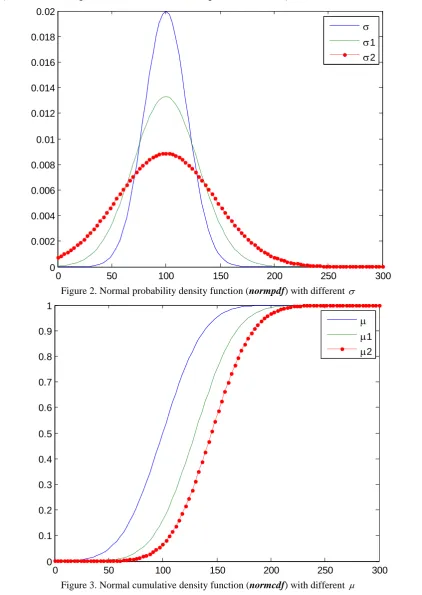
the selling product is w 6 0 0 Yuan/kg, the production cost for the supplier c 3 6 0Yuan/kg. For the retailer selling price per unit for the market p 8 0 0Yuan/kg and for the retailer salvaging price per unit S 2 0 0Yuan/kg and salvaging price for the supplier h 3 0 0Yuan/kg. Random variable x is on the market that we get the range of random variable from 100 to 200 to make easy numerical calculation. In order to better understanding we get different variables: Fig.2 shows that normal probability function with , , 1, 2. Fig.3 shows that when same (sigma) and different (mu).
0 50 100 150 200 250 300
0 0.002 0.004 0.006 0.008 0.01 0.012 0.014 0.016 0.018 0.02
1
2
Figure 2. Normal probability density function (normpdf) with different
0 50 100 150 200 250 300
0 0.1 0.2 0.3 0.4 0.5 0.6 0.7 0.8 0.9 1
1
2
IV.
CONCLUSION
In this paper, the model of supply chain contract is the typical model of supply chain contract, the origin of supply chain contract, the coordination of the basic contract model and coordination mechanism, the typical contract model the methods of the type of expansion and the coordination of the emphasis on the determination of the optimal contract parameters were studied. Through the survey we have found that the supply chain contract is not only through the quantity and price of two parameters to achieve the supply chain coordination, but also there is a strong correlation between the contract, can achieve the same coordination effect through mutual combination, The wholesale price contract is widely used because of its low cost and transaction process, but it cannot be realized. Supply chain coordination, so it is often used in combination with other contracts to achieve supply chain coordination. Wholesale price contract, the purchase contract and revenue sharing contract are mainly realized through price parameters, and the quantity of the supply chain is coordinated. In this paper, we will further explore options contracts on the basis of the above research. Information structure characteristics and the role of different organization structure in the supply chain process and the role of the mechanism, is not difficult to see, the text the typical contract in the present study is similar to the study of the best performance in the supply chain. They exist in the supply chain information and organizational structure characteristics and differences, these differences are not the difficulty of modeling and optimization of the subsequent coordination mechanism is more difficult, which is the value of this paper.
REFERENCES
[1] Harris F W. Operations and Cost (Factory Management Service). Shaw: Chicago, 1915.
[2] Clark A J, Scarf H. Optimal Policies for a Multi-Echelon Inventory Problem. Management Science, 1960, (6):475-490.
[3] Federgruen A. Centralized Planning Models for Multi-Echelon Inventory Systems Under Uncertainty, Handbooks in Operations Research and Management Science, Vol.4, Elsevier Science Publishing Company B.V., Amsterdam, The Netherlands, 1993L:133.173.
[4] Pasternack B A. Optimal pricing and returns policies for perishable commodities. Marketing Science, 1985, 4:166-176.
[5] Spengler J. Vertical integration and antitrust policy. Journal of Political Economy,1950, 8: 347-352. [6] Monahan J P. A quantity discount pricing model to increase vendor profits, Management Science, 1984
30: 720-726.
[7] Rosenblatt M J,Lee H L Improving profitability with quantity discounts under fixed demand.HE Transactions,1985,17(4):388—395.
[8] Lee H L, Rosenblar M J. A generalized quantity discount pricing model to increase supplier’s profits. Management Science, 1986, 30:1179-1187.
[9] Banerjee A. A joint economic-lot-size model for purchaser and vendor. Decision Science, 1986, 17: 292-311.
[10] Jeuland A P, Shugan S M. Managing channel profits. Marketing Science, 1983. 2: 239 – 272.
[11] Weng Z K. Channel coordination and quantity discounts. Management Science, 1995. 41: 1509-1522. [12] Cachon G P. The allocation of inventory risk and advanced purchase discounts in a supply chain.
University of Pennsylvania working paper,2002.
[13] Ferguson M, DeCroix G and Zipkin P. When to commit in a multi-echelon supply chain with partial information updating. Duke University working paper,2002.
[14] Mortimer J H. The effects of revenue-sharing contracts on welfare in vertically separated markets: evidence from the video rental industry. University of California at Los Angeles working paper, Los Angeles, CA. 2000.
[15] Cachon G P, Lariviere M A. Supply Chain Coordination with Revenue- Sharing Contracts: Strengths and Limitations, University of Pennsylvania working paper,2002.
[16] Dana J, Spier K. Revenue sharing and vertical control in the video rental industry. The Journal of Industrial Economics, 2001, 49(3): 223-245.
[18] Giannoccaro I, Pontrandolfo E Supply chain coordination by revenue sharing contracts International Journal of Production Economics, 2004, 89:131-13
[19] Li Y. Supply chain modeling: pricing contracts and coordination. PhD Dissertation, Division of SEEM, Chinese University of Hong Kong, 2002.
[20] Kandel E The right to return. Journal of Law and Economics, 1996, 39: 329 – 356.
[21] Tagaras G Cohen M A. Pooling in two-location inventory systems with no negligible replenishment lead times Management Science, 1992, 38(8): 1067-1083.
[22] Anupindi R, Bassok Y and Zemel E. A general framework for the study of decentralized distribution systems. Manufacturing and Service Operations Management. 2001, 3(4): 349-368.
[23] Padmanabhan V, Png I Manufacturer’s returns policy and retail competition. Marketing Science, 1997, 16(1): 81-94
[24] Taylor T. Coordination under channel rebates with sales effort effect. Stanford University working paper, Stanford CA.2000.
[25] Tsay A A. Risk sensitivity in distribution channel partnerships: implications for manufacturer return policies. Journal of Remiling, 2002, 78:147-160.
[26] Sigorelli S, Heskett J L. Harvard Business School Case 9-685-0141, 1984.
[27] Eppen G, Lyer A. Backup agreements in fashion buying the value of upstream flexibility Management Science, 1997,43(11):1469-1484.
[28] Tsay A A, Lovejoy W S.Quantity—flexibility contracts and supply chain performance. Manufacturing and Service Operations Management, 1999, 1(2):118-149.
[29] Bassok Y Anupindi R.Analysis of supply contracts with forecasts and flexibility. Northwestern University working paper, 1995.