ISMB TUMS
High-Level Vancomycin-Resistant Staphylococcus aureus (VRSA) in
Iran: A Systematic Review
Emran Askari
1, 2, Ahmadreza Zarifian
1, 2, Mohammad Reza Pourmand
3,
Mahboobeh Naderi-Nasab
1, 4*1
Mashhad Medical Microbiology Student Research Group, Mashhad University of Medical Sciences, Mashhad, IR Iran
2
Student Research Committee, Faculty of Medicine, Mashhad University of Medical Sciences, Mashhad, IR Iran
3
Department of Pathobiology, School of Public Health, Tehran University of Medical Sciences, Tehran, IR Iran
4
Department of Medical Bacteriology and Virology, Imam Reza Hospital, Faculty of Medicine, Mashhad University of Medical Sciences, Mashhad, IR Iran
ARTICLE INFO ABSTRACT
Article type:
Review Article Background: Staphylococcus aureus is a major human pathogen world-wide. Vancomycin has been used for decades to treat multidrug resistant
S. aureus. Ten years has passed since the first report of vancomycin
re-sistant S. aureus (VRSA). The objective of this systematic review was to determine the total number of VRSA isolates that have been reported from Iran.
Methods: Search terms reflected“Iran”, “vancomycin” and “S. aureus”
were searched in the ISI web of knowledge, PubMed, SciVerse, and Google scholar. Also two Persian scientific databases and 13 recent na-tional congresses were investigated. Articles / abstracts working on S.
aureus in Iran, evaluating vancomycin MIC and / or PCR of vanA/B were
included in this systematic review.
Results: Out of the 3484 records found in mentioned resources, 13 re-lated studies were included in the final analysis. The result showed that at least 24 VRSA isolates which have been reported from Iran up to Sep-tember 2012.
Conclusion: It seems that many Iranian researchers did not follow a spe-cific guideline for reporting and confirming VRSA. Establishing an Ira-nian reference center where studies on VRSA can be registered, evaluat-ed and confirmevaluat-ed is strongly recommendevaluat-ed.
Article history: Received: 10 Nov 2012 Revised: 04 Dec 2012 Accepted: 23 Dec 2012 Keywords:
Iran
Vancomycin Resistance
Staphylococcus aureus
Introduction
Staphylococcus aureus is undoubtedly one
of the most hazardous agents among bacterial pathogens and nowadays has become a major threat both in hospital and community set-tings. About 1% of all admitted patients in U.S. hospitals are infected with S. aureus. In other words, approximately 400,000 infec-tions are being reported annually in the U.S. (1).
Moreover, antibiotic resistance has compli-cated treatment procedure.
The resistance causes extra treatment costs and also longer length of stay; it may result in treatment failure as well (2).
Before the discovery of antibiotics, mortali-ty rate of S. aureus strains was more than 75 % (3). After penicillin was discovered, soon resistant strains appeared and restricted
phy-sicians’ choices for treating staphylococcal in fections. Then methicillin was used as the ne-w antibiotic therapy against this pathogen. Shortly after the introduction of methicillin,
S. aureus acquired resistance and the first
methicillin resistant S. aureus (MRSA)
strains were reported in 1961 in London but this was partly ignored at that time (4).
In the later decades, resistance rate among S.
aureus strains increased dramatically and
M-RSA became a worldwide hazard (5).
For instance, in the past ten years, the preva-lence of MRSA in many hospitals is reaching 50% (5, 6). Thus, the high prevalence of M-RSA forced clinicians to use vancomycin, which is a glycopeptide antibiotic discovered before methicillin, as the first-line of treatment against M- RSA despite its side effects (7).
Sixty years has passed since the discovery of vancomycin but vancomycin resistant S.
au-reus (VRSA) appeared only in a limited
number of cases and just in the last ten years. A brief history of vancomycin is shown in Figure 1 (8-13). In the past 20 years, vanA-me diated vancomycin resistance has been desc ribed in detail (14).
Briefly, the resistance ge- ne is located on a transposon called Tn1546. This transposon contains a set of genes (including vanA) which encode enzymes that replace the C-terminal D-Ala-D-Ala residues of the
pepti-doglycan precursor with D-Ala-D-Lac.
Vancomycin binds to normal precursors by forming hydrogen bonds between its peptide portion and the D-Ala-D-Ala dipeptide. The structural change in the precursor leads to loss of vital hydrogen bonds and extreme re-duction in affinity of vancomycin to these cell wall precursors (14, 15).
By phenotypic approach, as described in clinical and laboratory standards institute (CL SI), VRSA is defined as an isolate with min-imum inhibitory concentration (MIC) of vancomycin greater than or equal to 16
μg.mL-1 as determined with broth microdi-lution (16). However there are some reports regarding the genotype-negative phenotype-positive VRSA (i.e. va nA/B negative but within resistance range according to MIC) (17, 18).
Figure 1. A brief history of vancomycin resistance
PRSA: penicillin resistant S. aureus / FDA: food and drug administration / VRE: vancomycin resistant Enterococcus
/ VISA: vancomycin intermediate S. aureus / VRSA: vancomycin resistant S. aureus / CLSI: clinical and laboratory
standards institute/ EUCAST: European committee on antimicrobial susceptibility testing / CDC: centers for disease control and prevention
Methods
Searching in references
Searched time periods and search engines
All articles that were indexed prior to Sep-tember 2012 in the ISI web of knowledge, SciVerse, PubMed, Google Scholar, Scien-tific Information Database (SID) and Iran-Medex search engines were searched.
Searching for English articles
All articles that contained the words “Iran”, “vancomycin” and “Staphylococcus aureus”
were searched in the ISI web of knowledge, PubMed and SciVerse. Google scholar was
also searched with keywords of “vancomy
-cin”, “Staphylococcus aureus”, “Iran” and “minimum inhibitory concentration”.
Searching for Farsi articles
IranMedex and Scientific Information Da-tabase (SID) were searched for the keywords
of “vancomycin” and “aureus” in both En g-lish and Farsi.
Supplementary search with “Google domain search” option
All academic Farsi websites (.ac.ir) were searched with Google domain search for the
words “vancomycin”, “aureus”, “MIC” and “minimum”.Searching in the full-text of Far-si articles in SID webFar-site (Far-sid.ir) was done by Google domain search with the same key-words used for SID.
Updating the results
After completing the search in November 2011, the results of English engines were up-dated using Google Scholar Alert with the same strategy used in Google Scholar. Farsi results were updated weekly using Google domain search in Persian websites (.ir) with
keywords of “aureus” and “vancomycin”.
Searching in the abstract books of congresses
anti-biotic resistance, rational usage of antianti-biotics, 10th-13th microbiology and 1stmedical bacte-riology) were investigated.
Contacting experts
Iranian researchers in the field of staphylo-cocci were asked if they were working on re-sistance to vancomycin. If the answer was po sitive, they were asked to send supplementary information.
Defining the resistance to vancomycin
According to CLSI (2012), all strains with vancomycin “broth microdilution” MIC of ≥
16μg.mL-1 are defined as VRSA (16). How-ever, in Iran (based on the current restric-tions) this method is rarely used. So, we
con-sidered all strains with MIC≥16μg.mL-1that were determined by either of the existing methods (i.e. broth macro- and microdilution, agar dilution and E-test) as VRSA.
Omitting disc diffusion results
From 2009 and forward, CLSI has excluded the zone diameters of vancomycin for S.
au-reus (16). All strains identified as VRSA only
by the disc diffusion method (not MIC) were excluded.
Inclusion and Exclusion criteria
All the studies working on S. aureus in Iran, evaluating vancomycin MIC and/or PCR of
vanA/B were included in our analysis.
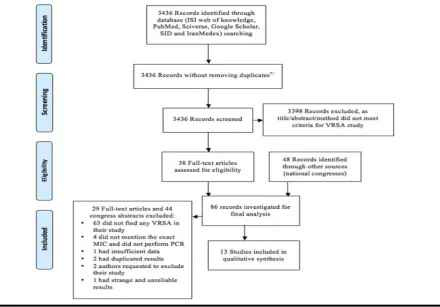
Exclu-sion criteria are shown in Figure 2.
*1: Duplicate results could not possibly be re-moved because:
(A) The exported bibliographic data exported from Google Scholar were not identical to those of PubMed and the reference managing software did not recognize "duplicates" properly; (B) The Sciverse engine by itself had many duplicate records; (C) The bibliographic data was not ex-portable from Farsi search engines. Neverthe-less, the authors made sure that duplicate data was not included for the final synthesis.
Designing results summary file
First and second author read the articles and summarized the results based on a previously designed format in excel. If they did not agree on the interpretation of the results, fourth
au-thor (referee) was asked to determine the cor-rect interpretation.
Results
Out of the 3436 reviewed articles, 9 related studies were chosen for final analysis. In ad-dition, we found 48 related studies in national congresses from which 4 abstracts were add-ed to the final analysis (Figure 2).
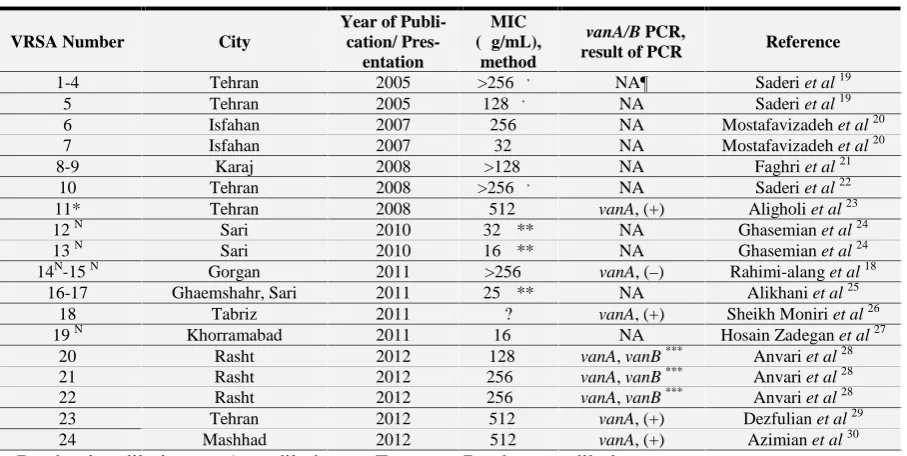
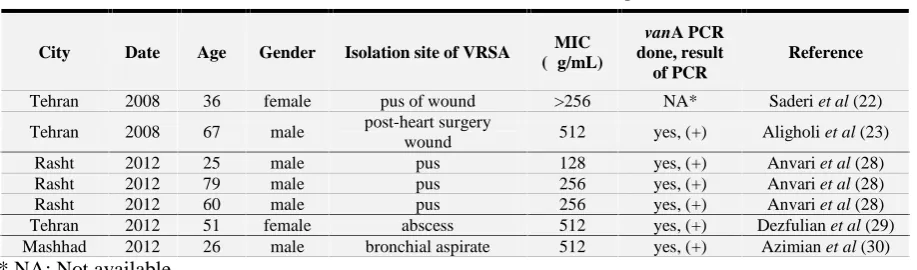
The final analysis revealed that to date, at least 24 VRSA isolates have been reported from Iran (Table 1). (18-30) Clinical infor-mation for five of these isolates was also available (Table 2) (22, 23, 28-30).
Ψ: Broth microdilution; Ω: Agar dilution; Σ: E-test; Π: Broth macrodilution;
¶ NA: Not available; N: Nasal sample
* Two VRSA strains were mentioned in the study, but later one of them found to be mixed with
Entero-cocci and was therefore excluded from this review (Dr. Mohammad Emaneini, department of
microbiol-ogy, school of medicine, Tehran University of Medical Sciences, personal communication). ** Personal communication
*** Authors used primers nearly similar to the ones used by Clark et al (31) but in this study, vanA and
vanB primer bands were 474 and 800 bp, respectively.
Table 1. Detailed information about VRSA isolates reported in Iran
VRSA Number City
Year of Publi-cation/
Pres-entation
MIC (μg/mL),
method
vanA/B PCR,
result of PCR Reference
1-4 Tehran 2005 >256Ω, Σ NA¶ Saderi et al19
5 Tehran 2005 128Ω, Σ NA Saderi et al19
6 Isfahan 2007 256Σ NA Mostafavizadeh et al20
7 Isfahan 2007 32Σ NA Mostafavizadeh et al20
8-9 Karaj 2008 >128Π NA Faghri et al21
10 Tehran 2008 >256Ω, Σ NA Saderi et al22
11* Tehran 2008 512Ψ vanA, (+) Aligholi et al23
12N Sari 2010 32Ψ** NA Ghasemian et al24
13N Sari 2010 16Ψ** NA Ghasemian et al24
14N-15N Gorgan 2011 >256Σ vanA, (–) Rahimi-alang et al18
16-17 Ghaemshahr, Sari 2011 25Ψ** NA Alikhani et al25
18 Tabriz 2011 ? vanA, (+) Sheikh Moniri et al26
19N Khorramabad 2011 16Ω NA Hosain Zadegan et al27
20 Rasht 2012 128Ω vanA, vanB*** Anvari et al28
21 Rasht 2012 256Ω vanA, vanB*** Anvari et al28
22 Rasht 2012 256Ω vanA, vanB*** Anvari et al28
23 Tehran 2012 512Ψ vanA, (+) Dezfulian et al29
Table 2. Clinical information available from some of VRSA reported cases in Iran
City Date Age Gender Isolation site of VRSA MIC (μg/mL)
vanA PCR done, result of PCR
Reference
Tehran 2008 36 female pus of wound >256 NA* Saderi et al (22)
Tehran 2008 67 male post-heart surgery
wound 512 yes, (+) Aligholi et al (23)
Rasht 2012 25 male pus 128 yes, (+) Anvari et al (28)
Rasht 2012 79 male pus 256 yes, (+) Anvari et al (28)
Rasht 2012 60 male pus 256 yes, (+) Anvari et al (28)
Tehran 2012 51 female abscess 512 yes, (+) Dezfulian et al (29)
Mashhad 2012 26 male bronchial aspirate 512 yes, (+) Azimian et al (30) * NA: Not available
Discussion
The total number of VRSA in the world is claimed to be fewer than twenty (32). At least three of these resistant strains are reported from Iran (23, 29, 30). Nevertheless, our re-sults show that a greater number of VRSA strains have been reported from Iran and the resistance of S. aureus to vancomycin is ac-tually worse than estimations and expecta-tions. This underestimation may be due to the fact that almost all studies in Iran did not in-clude a molecular approach for vancomycin resistance. Consequently, from international perspectives, the reported resistant strains would not be accepted as VRSA (33). Also, most of these studies did not completely fol-low a specific guideline such as the one rec-ommended by centers for disease control and prevention (CDC) (34).
Health care workers can carry resistant strains of S. aureus in their noses. In this study we found 2 articles reported health care workers who carried VRSA strains in their noses. This can pose a threat to patients, es-pecially those who undergo operations and the ones who need extensive care (35). Nasal carriage of VRSA should be taken seriously because the bacteria may spread by contact.
In conclusion, the number of VRSA re-ported in Iran is extremely high. Following the CDC guideline, performing molecular te-chniques and validating PCR results in an independent outside laboratory is recom-mended. We also suggest establishing an Ira-nian reference center where studies on VRSA can be registered, evaluated and confirmed.
Acknowledgement
None declared.
Conflict of Interest
None declared conflicts of interest.
References
1. Noskin GA, Rubin RJ, Schentag JJ, Kluytmans J, Hedblom EC, Jacobson C, et al. National trends in
Staphylo-coccus aureus infection rates: impact
on economic burden and mortality ov er a 6 year period (1998-2003). Clin
Infect Dis 2007; 45: 1132-40.
associated with methicillin-resistant an d methicillin-susceptible Staphylococc
us aureus bacteremia: a meta-analysis. Clin Infect Dis 2003; 36 (1): 53-9.
3. Van Hal SJ, Jensen SO, Vaska VL, Espedido BA, Paterson DL, Gosbell IB. Predictors of mortality in Staph
ylococcus aureus bacteremia. Clin Mi crobiol Rev 2012; 25 (2): 362-86.
4. Jevones MP. Celbenin-resistance sta-phylococci. Br Med J 1961; 1: 124-5.
5. Grundmann H, Aires-de-Sousa M, B
oyce J, Tiemersma E. Emergence and resurgence of meticillin-resistant
Sta-phylococcus aureus as a publiche alth
threat. Lancet 2006; 368 (9538): 874-85.
6. Stefani S, Chung DR, Lindsay JA, Friedrich AW, Kearns AM, Westh H,
et al. Meticillin-resistant Staphyloco ccus aureus (MRSA): global
epi-demiology and harmonisation of typ-ing methods. Int J Antimicrob Agents 2012; 39 (4): 273-82.
7. Tenover FC, Biddle JW, Lancaster MV. Increasing resistance to vanco-mycin and other glycopeptides in Sta
phylococcus aureus. Emerg Infectdis
2001; 7(2): 327-32.
8. Noble WC, Virani Z, Cree RG. Co-transfer of vancomycin and other re-sistance genes from Enterococcus fae
calis NCTC 12201 to Staphylococcus aureus. FEMS Microbiol Lett 1992;
72 (2): 195-8.
9. Hiramatsu K, Hanaki H, Ino T, Ya-buta K, Oguri T, Tenover FC. Methi-cillin-resistant Staphylococcus aureus clinical strain with reduced vancomy
cin susceptibility. J Antimicrob Chemother 1997; 40 (1): 135-6.
10. Howden BP, Davies JK, Johnson PD, Stinear TP, Grayson ML. Reduced vancomycin susceptibility in Staphy
lococcus aureus, including van-comycin-intermediate and heteroge-neous vanco mycin-intermediate strains: resistance mechanisms, laboratory detec-tion, and clinical implications. Clin
Microbiol Rev 2010; 23 (1): 99-139.
11. Chang S, Sievert DM, Hageman JC, Boulton ML, Tenover FC, Downes FP, et al. Infection with vancomycin-resistant Staphylococcus aureus con-taining the vanA resistance gene. N
Engl J Med 2003; 348 (14): 1342.
12. Perichon B, Courvalin P. vanA-type vancomycin-resistant Staphylococcus
aureus. Antimicrob agents chemother
2009; 53 (11): 4580-7.
13. Levine DP. Vancomycin: a History.
Clin Infect Dis 2006; 42 (1): S5-S12.
14. Perichon B, Courvalin P, 2012. Glyco-peptide Resistance. In: Dougherty TJ, Pucci MJ. (Eds.), Antibiotic discovery
and development, 1st ed. Springer, USA, New York, pp. 515-42.
15. Bugg TDH, Wright GD, Dutka-Malen
S, Arthur M, Courvalin P, Walsh CT. Molecular basis for vancomycin re-sistance in Enterococcus faecium BM 4147: biosynthesis of a depsipeptide
peptidoglycan precursor by
vancomycin resistance proteins vanH and vanA. Biochemistry 1991; 30 (43): 10408-15.
16. Clinical and Laboratory Standards In-stitute. Performance standards for
informational supplement M100-S22, CLSI, Wayne, PA, 2012.
17. Tiwari HK, Sen MR. Emergence of vancomycin resistant Staphylococcus
aureus (VRSA) from a tertiary care
hospital from northern part of India.
BMC Infect Dis 2006; 6: 156.
18. Rahimi-Alang S, Amini A. Vanco-mycin resistant Staphylococcus
au-reus: 2 isolates communication. The
Abstract book of 5thIranian Congress of Clinical Microbiology 8-10 No-vember 2011, Shiraz, Iran.
19. Saderi H, Owlia P, Shahrbanooie R. Vancomycin resistance among clini-cal isolates of Staphylococcus aureus.
Arch Iran Med 2005; 8 (2): 100-3.
20. Mostafavizadeh K, Khorvash F,
Mo-basherizadeh S, Fasihi Dastjerdi M. Study of nosocomial Staphylococcus
aureus resistance with E-test method. Journal of Medical Council of Is-lamic Republic of Iran 2007; 26 (4):
522-9.
21. Faghri J, Azimian A, Sadighian H, Khosrojerdi M. Occurance of the methicillin-resistant Staphylococcus
aureus (MRSA) among respiratory
tract samples in patients of selected Tehran hospitals. The Abstract book of 4th Iranian Congress of Clinical Microbiology. 9-11 November 2010, Isfahan, Iran.
22. Saderi H, Owlia P, Maleki Z, Habibi M, Rahmati N. Susceptibility to van-comycin in Staphylococcus aureus isolated from patients of four univer-sity-affiliated hospitals in Tehran.
Iran J Pathol 2008; 3 (3): 161.
23. Aligholi M, Emaneini M, Jabalameli
F, Shahsavan S, Dabiri H, Sedaght H. Emergence of high-level vancomy-cin-resistant Staphylococcus aureus in the Imam Khomeini Hospital in Tehran. Med Princ Pract 2008; 17 (5): 432-4.
24. Ghasemian R, Najafi N, Makhlough A, Khademloo M. Frequency of na-sal carriage of Staphylococcus aureus and its antimicrobial resistance pat-tern in patients on hemodialysis. Iran
J Kidney Dis 2010; 4 (3): 218-22.
25. Alikhani A, Tiroum S, Khademloo M, Tayyebi ME, Shoujaiifar, Dou-dangeh M. A microbiological study and MIC determination of ventilator-associated pneumonia causing agents in two university associated
hospit-als’ ICUs. Abstract book of the First
Iranian International Congress of Me dical Bacteriology. 5-8 September 20 11, Tabriz, Iran.
26. Sheikh Moniri S, Mubayen H, Mir-zaee H, Munes Rast S. A study of vancomycin-resistance and identifi-cation of vanA gene in
Staphylococ-cus aureus strains isolated from
Ta-briz Shuhada Hospital through E-test and PCR methods. First International and 12th Iranian Congress of Micro-biology. 23-26 May 2011, Kerman-shah, Iran.
27. Hosain Zadegan H, Menati S. The prevalence of methicillin and vanco-mycin resistant Staphylococcus
au-reus nasal carriage in large teaching
hospital personnel. Afr J Microbiol
28. Anvari M, Ranji N, Khoshmaslak F. Antibacterial Susceptibility of Three Vancomycin-Resistant Staphylococc
us aureus Strain Isolated from Nor
thern Part of Iran. J Pure Appl
Microbiol 2012; 6 (2): 671-5.
29. Dezfulian A, Aslani MM, Oskoui M,
Farrokh P, Azimirad M, Dabiri H, et al. Identification and character ization of a high vancomycinresistan t Staphylococcus aureusharboring va
nA gene cluster isolated from diabetic
foot ulcer. Iran J Basic Med Sci 2012; 15: 803-6.
30. Azimian A, Havaei SA, Fazeli H, Na-deri M, Ghazvini K, Mirab Samiee S,
et al. Genetic characterization of a
vancomycin-resistant Staphylococcus
aureus isolated from respiratory tract
of a hospitalized patient in a university hospital in north east of Iran. J Clin
Microbiol 2012; 50 (11): 3581-5.
31. Clark NC, Cooksey RC, Hill BC, Swenson JM, Tenover FC. Characte-rization of glycopeptide-resistant
En-terococci from U.S. hospitals. An-timicrob Agents Chemother 1993; 37
(11): 2311-7.
32. Van Hal SJ, Paterson DL. New
gram-positive antibiotics: better than vancomycin. Curr Opin Infect Dis 2011; 24 (6): 515-20.
33. Gould IM. Clinical activity of anti-gr am-positive agents against methicillin resistant Staphylococcus aureus. J
Antimicrob Chemother 2011; 66 (Suppl 4): iv17-iv21.
34. Centers for disease control and pre-vention. Algorithm for testing S.
au-reus with vancomycin (VA) Retrie ved
on Saturday, August 18, 2012 from http://www.cdc.gov/HAI/pdfs/visa_v rsa/VRSA_testing_algo2010.pdf.
35. Wertheim HF, Melles DC, Vos MC,