246
International Journal of Pharmaceutical Sciences and Drug Research
2018; 10(4): 246-251
Research Article
CODEN (USA): IJPSPP
ISSN: 0975-248X
Development and Evaluation of Multilayered Layered Matrix Tablets of
Water Soluble Drug
Ravi Shekhar
1*, P. Sharma
21Department of Pharmacy, Dr. Bhimrao Ambedkar University, Agra, Uttar Pradesh, India
2Department of Pharmacology, S. N. Medical College, Agra, Uttar Pradesh, India
Copyright © 2018 Ravi Shekhar et al. This is an open access article distributed under the terms of the Creative Commons
Attribution-NonCommercial-ShareAlike 4.0 International License which allows others to remix, tweak, and build upon the work non-commercially, as long as the author is credited and the new creations are licensed under the identical terms.
ABSTRACT
A new approach to zero- order drug delivery that includes geometric factors is described. Systems such as multilayered tablets and other geometrically altered devices have been created to perform this function. The multi-layered matrix system overcomes inherent disadvantages of non-linearity associated with diffusion controlled matrix devices by providing additional release surface with time to compensate for the decreasing release rate. These formulations designed to deliver the drug at predetermined rate, maintain therapeutically
effective concentrations in systemic circulation for prolonged period of time.Recently, pharmaceutical research
has focused on controlled drug delivery offer definite advantages over conventional release formulation of the same drug. Controlled delivery systems that can provide zero-order drug delivery have the potential for maximizing efficacy while minimizing dose frequency and toxicity. In the present study, guar gum was used as hydrophilic matrix carrier for designing oral controlled drug delivery systems of highly soluble drug lamivudine. Three layered matrix tablets of lamivudine prepared by wet granulation technique were subjected for various evaluating parameters and optimized.
Keywords:Multi layered tablet, lamivudine, controlled drug delivery system.
DOI: 10.25004/IJPSDR.2018.100406 Int. J. Pharm. Sci. Drug Res. 2018; 10(4): 246-251
*Corresponding author: Mr. Ravi Shekhar
Address: Department of Pharmacy, Dr. Bhimrao Ambedkar University, Agra, Uttar Pradesh, India Tel.: +91-9359066235
E-mail: [email protected]
Relevant conflicts of interest/financial disclosures: The authors declare that the research was conducted in the absence of any commercial or financial relationships that could be construed as a potential conflict of interest.
Received: 07 May, 2018; Revised: 05 June, 2018; Accepted: 08 June, 2018; Published: 20 July, 2018
INTRODUCTION
Multi-layered matrix tablet is a drug delivery device, which comprises a matrix core containing the active solute and one, or more barriers (modulating layers) incorporated during the tableting process. The modulating layers delay the interaction of active solute
Int. J. Pharm. Sci. Drug Res. July-August, 2018, Vol 10, Issue 4 (246-251) reduced hydration rate and controlled area for solute
release at the core. Thus burst effect can be smoothened and the release can be maintained at a relatively constant level during the barrier layers’ swelling and erosion process. After this phase, during the subsequent portion of the dissolution process, these swollen barriers are erosion dominated and the surface available for drug release slowly increases. In this way the decrease of delivery rate due to the increase of diffusion path-length (saturation effect) is counterbalanced by the simultaneous increase of the area available for drug release. By this way, combining a time-dependent control of the hydration rate of the device with the reduction of tablet surface exposed to the dissolution medium, it is feasible to achieve a linear release profile. It is also possible to obtain various dissolution patterns such as multi modal, pulsatile or delayed delivery, extended release (characterized by reasonably constant rate) for different drugs by varying the formulations of layers. In all the applications, the multi-layered system should swell gel and finally erode completely, leaving negligible residue in the gastro-intestinal tract. The system is a unique drug delivery device, which overcomes the major disadvantage of non-linear release associated with most diffusion controlled matrix devices. This system also has the advantage of being compatible with conventional manufacturing methods. [1-3]
MATERIALS AND METHODS
Lamivudine was supplied by Aurobondo Pharma Ltd, Hyderabad, as a gift sample, guar gum, hydroxyl propyl methyl cellulose, starch, talc and magnesium stearate were obtained from Central Drug House (P) Ltd, New Delhi. All other ingredients used were of analytical grade and used as provided. Spectrophotometric studies carried out by using double beam UV spectrometer, Pharmaspec 1800, Shimadzu, Japan.
Preparation of multilayered tablet Preparation of granules for middle layer
Lamivudine garanules were prepared using 20% to 30% by weight of guar gum as a matrix former, by using the wet granulation method. HPMC was used as diluent, and guar gum was included in the formulation in various proportions. The compositions of guar gum matrix granules formulations used in the study containing 200 mg of lamivudine in each case are shown in Table 1.The powders were blended in poly begs and granulated with 10% w/v starch paste. The wet mass was screened through sieve no 16 and the granules were dried in air at room temperature for half an hour. The dried granules were shifted through sieve no 22 and the granules were lubricated with magnesium stearate (2% w/w) and followed by addition of (1% w/w) talc. [4-7] The release-retardant
layers were also prepared by wet granulation method using 10% w/v starch paste as binder. The composition of release retardant layer in each case is shown in Table
1. The formulation of three layered matrix tablet were made using different combination of drug loaded matrix layer (M1-M3) and release retardant layers (T1-T3) and formulation codes are presented in Table 1. [4-7]
Table 1: Composition (in mg) of Lamivudine Middle Matrix Layer Containing 20% (M1), 25% (M2) and 30% (M3) by Weight of Guar Gum and Composition (in mg) of Release Retardant Layer Containing 70% (T1), 75% (T2) and 80% (T3) by Weight of Guar Gum
Ingredients M1 M2 M3 T1 T2 T3
Lamivudine 200 200 200 - - -
Guar gum 80 100 120 140 150 160
Starch paste (10% w/v) 40 40 40 20 20 20
HPMC 68 48 28 34 24 14
Talc 04 04 04 02 02 02
Magnesium stearate 08 08 08 4 4 4
Weight of
Middle Layer Each 400 400 400 200 200 200
Total Weight of layered
tablet (mg) 800 800 800 800 800 800
Preparation of three layer matrix tablets
The three layered matrix tablets of lamivudine containing 200 mg of controlled release dose were prepared by wet granulation technique. The layered tablets containing 200 mg of each release retardant layer of guar gum granules on both sides of middle matrix layer thus resulted in tablet with a total weight of 800 mg. Initially, the volume of die was adjusted equivalent to total weight of three-layer matrix tablet (800 mg). Then preweighed amount of guar gum granules equivalent to bottom layer (200 mg) was taken and placed in the die cavity and slightly compressed for uniform spreading. The upper punch was lifted up, and 400 mg of drug granules were placed over the bottom layer of guar gum granules (200 mg) in the die cavity (Figure 1) and again slightly compressed. The remaining volume of die cavity was filled with preweighed amount of guar gum granules equivalent to top layer and finally compressed with maximum force of compression on a single station punching machine. [4-7]
Fig. 1: Approach of three layer matrix tablet
Evaluation methods for layered matrix tablets Diameter and Thickness
Diameter and thickness was measured using instrument vernier calliper. Three tablets from each formulation were selected and diameter and the crown thickness were measured with a vernier calliper and an average of six determinations was established.
Hardness
Int. J. Pharm. Sci. Drug Res. July-August, 2018, Vol 10, Issue 4 (246-251) compressible spring. The pressure required for the
tablet to just crack was recorded directly on the gauge attached to the spring.
Weight variationtest
Weight variation test was performed for twenty tablets from each batch using an electronic balance (K Roy, India) and average values were calculated. [8]
Percentage drug content
The tablet of each formulation (F1-F9) was weighed and powered. Each tablet of lamivudine containing quantity equivalent to 200 mg was taken and transferred to a 100 ml volumetric flask and extracted with double distilled water and the percentage drug content was calculated from the calibration curve of lamivudine in double distilled water. An average of values was calculated mean ± S.D for three determinations.
In-vitro drug release studies
Preparation of simulated gastric fluid (pH 1.2 Buffer)
8.5 ml concentrated hydrochloric acid was dissolved in distilled water and diluted to 1000 ml to give 0.1 N hydrochloric acid. 0.85 ml concentrated hydrochloric acid was dissolved in distilled water and diluted to 1000 ml to give 0.01 N hydrochloric acid and pH 1.2 was adjusted with the help of dilute acid and base.
Preparation of simulated intestinal fluid (pH 7.4 buffer)
50 ml of 0.2M Potassium di-hydrogen phosphate was placed in a 200 ml volumetric flask, 49.1 ml of 0.2M Sodium hydroxide was added to it and the volume was made up to 200 ml with distilled water.
Preparation of 0.2 M Potassium dihydrogen phosphate
Dissolved 27.218 g of Potassium dihydrogen phosphate was dissolved in small amount of distilled water and the volume was made up with 1000 ml of distilled water.
Preparation of 0.2 M Sodium hydroxide
Dissolved 8.0 g of Sodium hydroxide in distilled water and volume was made up to 1000 ml with distilled water. [9]
Drug excipients compatibility studies
Fourier transform infrared (FTIR) spectra were also recorded to assess the chemical interaction or changes during formulation preparation. FTIR spectra of the pure drug, multi layered formulation of drug with different polymers were recorded in potassium bromide disc using a Shimadzu Model 8400 FTIR spectrometer.
Images of layered matrix tablets
The photographs of multi-layered tablets and its cross section were taken before and after swelling for three hours in distilled water by digital camera. [10]
SEM studies of three layered matrix tablet
The three-layered matrix tablet were cut into two halves by use of a sharp razor and coated with gold palladium under an argon atmosphere using a gold sputter module in a high vacuum evaporator. The gold palladium coated tablets were then observed with a scanning electron microscope.
Stability studies
Stability studies were carried out as per ICH Q1A
stability testing guidelines for zone III. The formulated three-layered matrix tablets were subjected to storage condition of 40°C ± 2.0/ 75% RH ± 5 for 3 months. The sampling intervals were 0, 1, 2, and 3 months. The samples were evaluated for hardness and percentage drug content. [11]
Table 2: Compiled Data for Diameter, Thickness, Hardness, Drug Content and Weight Variation of Three Layered Matrix Tablets Formulatio
n Code
Diamet er (mm)
Thicknes s (mm)
Hardnes s (Kg)
Drug content
(%)
Weight Variati on Test
F1 11.3 ± 0.047 6.02 ± 0.046 3.63 ± 0.543 100.84 ± 0.543 Pass
F2 11.2 ± 0.094 6.03 ± 0.094 3.76 ± 0.205 100.408 ± 0.205 Pass
F3 11.1 ± 0.047 6.04 ± 0.047 3.50 ± 0.215 100.108 ± 0.215 Pass
F4 11.4 ± 0.012 6.04 ± 0.016 3.46 ± 0.309 99.218 ± 0.309 Pass
F5 11.2 ± 0.092 6.04 ± 0.082 3.43 ± 0.329 99.201 ± 0.329 Pass
F6 11.3 ± 0.081 6.04 ± 0.012 3.63 ± 0.377 100.201 ± 0.377 Pass
F7 11.5 ± 0.082 6.04 ± 0.016 3.66 ± 0.478 100.165 ± 0.478 Pass
F8 11.4 ± 0.047 6.05 ± 0.081 3.73 ± 0.094 99.201 ± 1.94 Pass
F9 11.4 ± 0.013 6.04 ± 0.081 4.03 ± 0.098 97.923 ± 1.98 Pass
RESULTS AND DISCUSSION Diameter and Thickness
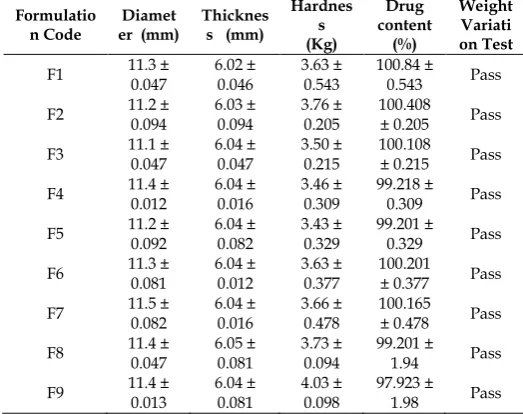
Three tablets from each formulation were selected and diameter and the crown thickness were measured with a vernier calliper and an average of six determinations was calculated and the mean values for diameter and thickness are tabulated in Table 2 and indicating appropriateness of the tooling used for compression.
Hardness
The hardness of tablets formulated (F1–F9) was evaluated using Pfizer hardness tester. The mean values of hardness of multi-layered tablets were in the range of 3.43-4.03 kg (Table 2). For the purpose of study, a tablet with hardness of more than 3 kg was selected as optimum value as it did not present handling problems. Thus all the formulations passed the above mentioned criteria.
Weight Variation
Twenty tablets from each batch were randomly selected and weighed and the average weight was calculated, not more than two of the individual weight deviated from the average weight by more than the 5% of average weight percentage as per IP limit (800 mg ± 40) and none deviated more than twice of that and the tablets passed the weight variation test and limits given in Indian pharmacopoeia. [8]
Percentage Drug Content
Int. J. Pharm. Sci. Drug Res. July-August, 2018, Vol 10, Issue 4 (246-251) the drug content was well within the range of
contained 97.923 ± 1.98 – 100.84 ± 0.543 (Table 2), indicating uniform mixing of guar gum, drug and other formulation excipients. [12]
0 20 40 60 80 100
0 4 8 12 16 20 24
Time (hrs)
P
er
ce
nt
age
dr
ug
re
le
as
e
F1 F2 F3
Fig. 2: In-vitro dissolution profile of formulation of formulation F1, F2 and F3
0 20 40 60 80 100
0 4 8 12 16 20 24
T ime (hrs)
Pe
rc
en
ta
ge
d
ru
g
re
le
as
e
F4
F5
F6
Fig. 3: In-vitro dissolution profile of formulation of formulation F4, F5 andF6
0 20 40 60 80 100
0 4 8 12 16 20 24
T ime (hrs)
Pe
rc
en
ta
ge
d
ru
g
re
le
as
e
F7 F8 F9
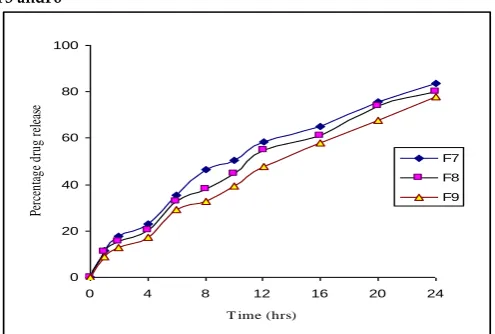
Fig. 4: In-vitro dissolution profile of formulation of formulation F7, F8 and F9
In-vitro drug release studies
The three-layer matrix tablet that restricts the matrix area exposed to the dissolution medium may lead to a dual control in the system performance. This is possible for two reasons (a) matrix hydration rate and the consequent swelling are lowered and (b) the surface through which the drug can be delivered is reduced.
These effects, possibly more effective in the initial phase of the dissolution process and less pronounced as swelling proceeds, lead to linearization of the release profile.
The drug release mechanism from the three-layered tablets involves the following sequence. In initial phase, barriers applied to the core are able to delay the interaction of the core with the dissolution medium by reducing the surface available for drug release and by limiting the solvent penetration rate. Thus, in this system the burst effect is controlled and the area available for drug release is maintained at relatively at constant level. The percentage in vitro drug release (Figure 2) of formulations (F1-F3) ranges from 99.145 ± 1.477 to 87.321 ± 2.329, similarly in case of formulation (F4-F6) the drug released up to 90.678 ± 2.530 to 84.86 ± 3.386 (Figure 3) and Figure 4 shows 83.591 ± 4.668 to 77.887 ± 2.165 for formulation (F7-F9). Thus on the basis of drug release, this is evident that on increasing the amount of guar gum in release retardant layers from 70% to 80% by weight on both sides of middle matrix layer the percentage cumulative release of all formulations decreased.
Drug excipients incompatibility studies
The Figure 5 clearly showed that there were no major changes in the DSC thermograms of pure drugs in presence of excipients, indicating absence of interactions between the drug and other excipients. [13]
Fig. 5:Shows the DSC thermo grams obtained during the heating stage for Lamivudine (1), Guar Gum (2), HPMC (3), Starch (4), Magnesium Stearate (5), Talc (6) and formulation (7)
Images of layered matrix tablets
The photographs shown in Figure 6 were taken before and after swelling for three hours. It is clearly visible that the tablet is undergoing surface swelling of release retardant layers containing high percentage of guar gum. The cross section of tablet clearly indicates separate layers of release retardant and middle layer present in formulation. This clearly indicates that the drug diffusion from middle matrix drug layer is retarded due to surface swelling of release retardant layer and hence meets the theoretical concept of
Int. J. Pharm. Sci. Drug Res. July-August, 2018, Vol 10, Issue 4 (246-251)
Fig. 6: Images of Layered Matrix Tablets before and after Swelling for 3 Hours
Scanning electron microscopy (SEM) studies of three layered matrix tablet
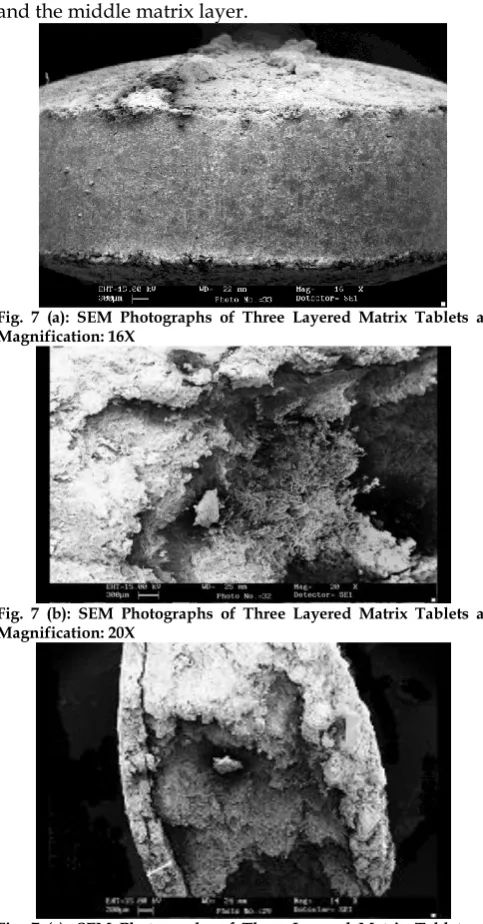
SEM was carried out to study the formation of three-layer tablet matrix of lamivudine. The images clearly showed the three distinct layers (Figure 7 a-c) and were used to determine thickness of release retardant layers and the middle matrix layer.
Fig. 7 (a): SEM Photographs of Three Layered Matrix Tablets at Magnification: 16X
Fig. 7 (b): SEM Photographs of Three Layered Matrix Tablets at Magnification: 20X
Fig. 7 (c): SEM Photographs of Three Layered Matrix Tablets at Magnification: 14X
Stability studies
Based on the results of the in-vitro drug release studies, three-layer guar gum matrix tablets of lamivudine are found to provide the required oral controlled drug delivery. Hence, stability studies were carried out by storing the selected formulation at 40°C/75% RH for 3 months (climatic zone III conditions for accelerated testing) to assess their long-term stability. At the end of the storage period, studies were conducted on lamivudine three-layer matrix tablets to assess their stability with respect to their physical appearance, hardness, drug content and release characteristics. The three-layer tablets after storing at 40°C/75% RH for 3 months showed (Table 3a and Table 3b), no significant change either in physical appearance, drug content or in dissolution pattern.
Table 3 (a): Stability Data of Selected Layered Tablet Formulation Time
Interval
(Month) 0 1 2 3
Physical
Appearance No change No change No change No change
Hardness
(kg) 4.03 ± 0.098 3.91 ± 0.512 3.97 ± 0.215 4.01 ± 0.332
Percent Drug
Content 97.923 ± 1.98 97.54 ± 2.22 98.82 ± 1.04 99.04 ± 0.82
Table 3 (b): Percent Cumulative Drug Release of Three Layer Matrix Tablet before and after Stability Studies of Selected Formulation F9
Time (h)
Time (month)
0 1 2 3
0 0 0 0 0
1 8.786 9.521 8.592 8.810
2 12.782 12.652 12.752 12.712
4 17.409 18.051 18.520 18.259
6 28.991 29.101 28.995 28.919
8 32.697 32.991 33.012 32.698
10 39.521 40.052 40.567 40.025
12 47.757 48.251 48.658 47.582
16 57.989 58.101 58.991 58.321
20 67.486 68.212 68.326 68.159
24 77.887 78.919 78.215 78.214
It was possible to design a novel triple layered tablet dosage form based on multi-layered tablet technology and the desired surface area exposed per unit time. Successful formulation of various highly soluble drugs laminated with hydrophilic matrices was also possible and it was feasible to achieve a variety of drug release profiles, such as zero order, first order and multi-modal, by slightly varying the breakup of drug content between the layers and the polymer concentration and composition in core tablet. The system has the advantages of relatively low cost and potentially feasible to large-scale production using layered tablet process.
REFERENCES
1. Colombo PU, Conte A, Gazzaniga L, Maggi ME, Sangalli NA,
Peppas A. et al. Drug release modulation by physical
Int. J. Pharm. Sci. Drug Res. July-August, 2018, Vol 10, Issue 4 (246-251)
2. Conte U, Maggi L, Colombo P, La Manna A. Multi-layered
hydrophilic matrices as constant release devices (Geomatrixk
Systems*). J. Control. Release. 1993; 26:39-47.
3. Conte U, Maggi L. Multilayer tablets as drug delivery
devices. Pharm. Technol. 1998; 22(3):174-182.
4. Krishnaiah YSR. Karthikeyan RS. Satyanarayana V. A
three-layer guar gum matrix tablet for oral controlled delivery of highly soluble metoprolol tartrate. J. Control. Release. 2002;
24:45–46.
5. Krishnaiah YSR. Karthikeyan RS. Gouri Sankar V.
Satyanarayana V. Three-layer guar gum matrix tablet formulations for oral controlled delivery of highly soluble
trimetazidine dihydrochloride. J. Control. Release. 2002;
81:45-46.
6. Krishnaiah YSR. Karthikeyan RS. Satyanarayana V.
Bioavailability studies on guar gum-based three-layer matrix tablets of trimetazidine dihydrochloride in human volunteers. J. Controlled Release. 2002; 83:231-239.
7. Pathak K. Shekhar R. Gupta R. Preparation and evaluation of
three layer matrix tablet for oral controlled delivery of tramadol HCL. The Pharma Review. 2007; 155-160.
8. Indian Pharmacopoeia, Controller of publication New Delhi,
1996a, Volume 2, 736.
9. Indian Pharmacopoeia, Controller of publication New Delhi,
1996b, Volume 2, A-144-145
10. Qiu Y. Chidambaram N. Porter W. Flood K. Formulation and
characterization of new layered diffusional matrices for zero-order sustained release. J. Control. Release. 1998; 51:123-130.
11. Rahman Z. Ali M. Khar RK. Design and evaluation of bilayer
floating tablets of captopril. Acta Prarm. 2006; 56:49-57.
12. United States Pharmacopeia & National Formulary twenty
fifth edition. The United States Pharmacopeial Convention Inc. USP 2009, Volume 2, 2747-2748.
13. Singh AV. Nath LK. Evaluation of compatibility of
lamivudine with tablet excipients and a novel synthesized polymer. J. Mater. Environ. Sci. 2011; 2(3):243-250.
HOW TO CITE THIS ARTICLE:Shekhar R, Sharma P. Development and Evaluation of Multilayered Layered
Matrix Tablets of Water Soluble Drug. Int. J. Pharm. Sci. Drug Res. 2018; 10(4): 246-251. DOI: