95610-7474 IJVIP NS-IJENS © December 2009 IJENS
I J E N S
An Efficient Rate Allocation Scheme with Selective
Weighted Function for Optimum Peak-to-Average
Power Ratio for Transmission of Image Streams
Over OFDM Channels
Usama S. Mohammed
#1, and H. A. Hamada
*2#
Department of Electrical Engineering- Electrical Engineering Department, Assiut University - South Valley University Assiut 71516, Egypt , Aswan, Egypt
1
2
Abstract— This paper proposes new scheme for efficient rate
allocation in conjunction with reducing peak-to-average power ratio (PAPR) in orthogonal frequency-division multiplexing (OFDM) system. Modification of the set partitioning in hierarchical trees (S PIHT) image coder is proposed to generate four different groups of bit-stream relative to its significances. The significant bits, the sign bits, the set bits and the refinement bits are transmitted in four different groups. The proposed method for reducing the PAPR utilizes twice the unequal error protection (UEP) using the Read-S olomon codes (RS ) in conjunction with rate allocation. The output bit-stream from the source code (S PIHT) will be started by the most significant types of bits (first group of bits). The optimal unequal error protection (UEP) of the four groups is proposed. As a result, the proposed structure gives a significant improvement in bit error rate (BER) performance. Performed computer simulations have shown that the proposed scheme outperform the performance of most of the recent PAPR reduction techniques in most cases. Moreover, the simulation results indicate that the proposed scheme provides significantly better PS NR performance in comparison to well -known robust coding schemes.
Index Term— SPIHT coding, unequal error protection
(UEP), rate allocation, RS codes, OFDM, PAPR.
I. INT RODUCT ION
Orthogonal frequency-division mu ltip le xing (OFDM ) scheme [1], [2] is used in most recent wireless communicat ions systems due to its high spectrum e fficiency and robustness in mu lti-path propagation. OFDM is a special form of mu lti-carrier modu lation and mit igate inter symbol interfe rence (ISI) by mult iple xing the data on orthogonal property. Moreover, it is, spectrally, mo re sufficient technique
than a conventional signal carrier modulat ion technique. However, one of ma jor dra wbacks of OFDM is the high peak-to-average power ratio (PAPR) of the transmitted signal [3].
The high PAPR of the transmitted signal significantly reduces the average power at the output of the high powe r
Fig. 1. Block description of the OFDM system
In OFDM system, a bloc k of N co mple x symbols is fo rmed with each symbol modulation one of N subcarriers with frequency for The N-subcarrier is chosen as orthogonal. The comple x envelope of the transmitted OFDM signal is represented by [2]:
N 1
0 n
t n f j2π e n S N
1
x(t)
( (1)
Where is the data symbol, N is number of subcarriers and represents frequency of n-th subcarriers, the OFDM system shown in Fig. 1. In this work, a new scheme co mb ines simp ly modification of the set partitioning in hierarchica l trees (SPIHT) image coding technique followed by an optimu m UEP technique is proposed. The modified SPIHT coder will generate four groups of bit-strea m. The significant bits, the sign b its, the set bits, and the re fine ment bits are transmitted in four different groups. The ma in idea behind this approach is that the output of the SPIHT image coding (source code) will be sent relative to its significant informat ion. The idea of the proposed algorithm can be used with any scalable image coding technique.
The paper is organized as follows: the source code and the PAPR proble m in OFDM are d iscussed in the next section; the proposed algorithm is introduced in Section III. Weighted function are presented in section IV. Se lective weighted function are presented in section V. Imple mentations and computer results are presented in section VI. Finally, conclusions are given in Section VII.
II. SOURCE CODE PEAK-T O-AVERAGE POWER RAT IO PROPLEM
A. Peak -to-Average Power Ratio proplem
OFDM consist of many modulated subcarriers. As mentioned in the previous section, this leads to a problem with the peak to average power ratio. If N subcarrie rs are added up
coherently, the peak power is N times the average power in the case of the baseband signal. The PAPR is defined [8], [9] as follows:
2 t x E
2 t x max
PAPR (2)
It is clear, fro m Equation (2), that the PAPR reduction techniques are concerned with reducing ma x . However, since most systems emp loy discrete-time signals, the amp litude of samples of x(t) is dealt with in many of the PAPR reduction techniques. Since symbol spaced sampling of Equation (1) sometimes misses some of the signal peaks and results in optimistic results for the PAPR, signal samples are obtained by oversampling (1) by a factor of L to approximate the true PAPR better. The L-t imes oversampled time-do main sa mples are obtained by an LN-point inverse discrete Fourier t ransform (IDFT) of the data block with (L -1) N ze ro-padding. It was shown in [10] that L=4 is sufficient to capture the peaks.
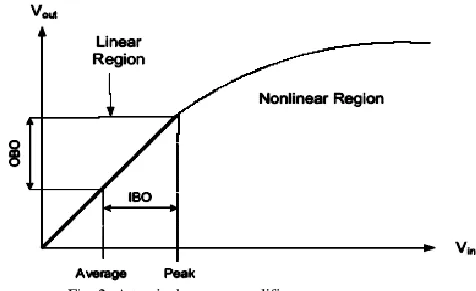
A large number of OFDM PAPR reduction techniques have appeared in the literature, all having the purpose of reducing the required HPA back-off and the effects of its nonlinearity. Fig. 2 shows a typical AM/AM response for an HPA, with the associated input and output back-off regions (IBO and OBO), respectively.
Fig. 2. A typical power amplifier response.
The various approaches are quite different fro m each other and impose different constraints. First, coding in [11] relies on using several bits or b it sequences which would carry a properly chosen code (sometimes with erro r
Data
Source
E C O D E R
S/P
M A P P E R
I F F T
M O D U L A T O R P /S
D E C O D E R
P /S
D E M A P P E R
F F
T S/P
Data
Sink
correcting capabilities) that minimizes the PAPR of the resulting transmitted signal. The PAPR is reduced, b ut so is the data rate. Other methods use phase manipulations (e.g. Selective Mapping (SLM ), Pa rtia l Transmit Sequences (PTS), Rando m Phasor [12-14]). A lthough these methods are very e ffective, it has a high co mple xity and also requires side information coded to be transmitted. This fact raises problems in terms of co mpliance to standards. Other methods such as Tone Reservation [15] propose inserting anti-peak signals in unused or reserved subcarriers. The method does not cause any in-band distortion, but it reduces the useful data rate. Although suited in some imple mentations (IEEE 802.16e for e xa mp le), it is not always standard compliant (the bandwidth sacrifice required by this method is not acceptable in IEEE 802.16d ).Another methods proposes altering the QAM constellation in order to reduce high signal peaks. The first method relying on the principle of constellation e xpansion was Tone Injection [15]. It involves a comp le x optimizat ion process that ma kes it scarcely attractive for systems with a high nu mber o f carrie rs. Simp ler constellation e xtension methods were recently developed. Active constellation e xtension (ACE) [16] a llo ws the corner QAM constellation points to be moved within the quarter p lanes outside their no mina l values. The other border points are allowed to be d isplaced along rays pointing towards the e xterior of the constellation. The interior points are not modified, in order to p reserve the minimu m d istance between the constellation symbols. Recently, a simp le non-iterative PAPR reduction method relying on metric -based symbol pre-distortion (M BSP) was proposed in [17]. Fro m a ll of the algorith ms described above, only the last two are suited for a pract ical imple mentation in a system co mp liant to the IEEE 802.16d standard. In this work we use The HighPower A mplifie r (HPA) is Rapp’s solid state power a mplifie r model (SSPA) [34, 35] with the characteristic
(3)
where vin, vout are the comple x input and output signals, respectively. vsat is the output saturation level. The parameter p , often called “knee factor”, controls the smoothness of the characteristic.
The input back-off (IBO) with respect to the saturation values can be defined as,
(4)
In this paper, a rapp model HPA is assumed with knee factor p = 2, IBO = 3.5 dB.
B. Source code (SPIHT) and the UEP process
The SPIHT method is consider the best image coding technique in terms of decoded image quality, p rogressive rate control and transmission, and the simplic ity of the coding process [18].
In the SPIHT coding a lgorith m, after the wavelet transform using 9/7 tap wave lets fro m Antonini et al. [20] is applied to
an image, the ma in algorith m wo rks by partitioning the wavelet deco mposed image into significant and insignificant partitions based upon the following function
otherwise
0,
2n
}
j)
b(i,
{
T
j)
(i,
max
1,
(T)
n
S
( (5) where Sn (T) is the significance of the set of coordinates T, and b(i,j) is the coeffic ient value at coordinate (i,j). There are two passes to the algorithm, the sorting pass and the refinement pass. The sorting pass is performed on the list of insignificant sets (LIS), list of insignificant pixels (LIP) and the list of significant pixe ls (LSP). The LIP and LSP consist of nodes that contain single pixels wh ile the LIS contains nodes that have descendants. The ma ximu m nu mber of b its required to represent the largest coeffic ients in the spatial orientation tree is obtained and designed as nma x and is given by
max
{
b(i,
j)
}
j)
(i,
log 2
nmax
(6)During the sorting pass, those coordinates of the pixels which re ma in in the LIP are tested for significance by using equation (5). The result Sn(T) is sent to the output. Those that are significant will be transferred to the LSP as we ll as have their sign bit output. Sets in the LIS will also have their significance tested and if found to be significant, will re moved and partitioned into subsets. Subsets with a single coeffic ient and found to be significant will be added to the LSP, or e lse they will be added to the LIP. During the refinement pass, the n-th most significant bit of the coeffic ients in the LSP is output. The value of n is decreased by 1 and the sorting and refine ment passes occur again. This continues until e ither the desired rate is reached or until n=0 and all nodes in the LSP have all their bits output.
0 1 2 3 4 5 6 7 8 9 10 0
500 1000 1500 2000 2500 3000 3500 4000 4500
Packet Number
M
S
E
Error in Significance bit Error in Sign bit Error in Set bit Error in Refinement bit
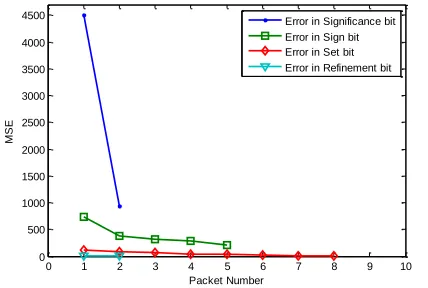
Fig. 3. Error bit sensitivities within the SPIHT coded bit stream In Fig.3, the order of significance fro m the most significant types of bits to the least significant is: significance b its > sign bits > set bits > refine ment bits. In the first step of the proposed schame, Spiht coder will be modified to generate four groups of bit stream re lated to the order significance i.e .; the output bit stream will be started by the most significant types of bit (first group of bits).
The optimu m bit rate for each group of bits is computed using the optimization algorithm. The inputs to the optimization a lgorith m are the pac ket length, the bit erro r rate (BER), and the e xpected decrease in the distortion of packets. The output rate allocation vectors are used with RS codes to generate the transmitted bit-stream.
III. PROPOSED OPT IMUM DOUBLE CODING T ECHNIQUE FOR OVER ALL DIST ORT ION REDUCT ION
OFDM system use RS (Reed-So lo mon) coder as channel coder it protect data transmit only on one direct ion colu mn or row. In this work we mod ified the system ma king RS coder protect the data transmit on t wo way colu mn and row, protection data on two way will ma ke b it rate increase. A comprehensive review o f the great variety of erro r control and concealment techniques has been presented in the paper by Wang and Zhu [21]. Unequal error protection (UEP)[22] can significantly incrtease the robustness of the transmission and provide graceful degradation of the picture quality in case of a deteriorating channel. UEP was adapted to packet networks by Albanese et al. in their priority encoding transmission (PET) scheme . Optimization of the rate allocation in such a scheme was addressed by [23]-[24] ]. Wireless image transmission using turbo codes and optima l unequal error protection is proposed by Thomos et al. [25]. They proposed a novel scheme based on the SPIHT source coder applied in conjunction with the application of the turbo codes [26]. The ir methodology, termed turbo-coded SPIHT (TCS), was imp le mented and tested in conjunction with two protection strategies, one using equal error protection (EEP) and the other using (UEP). The TCS with successive decoding (terms TCSD) was also imple mented and evaluated in this work.
In this work, the prople m of UEP will be studied fro m diffe rent view. The source code (SPIHT for image) is modified to generate four diffe rent bitstreams. The contribution of each one in the overall peak signal – to – noise ratio PSNR in the received image is estimated and the protection of each one is based on this estimation.
A. Problem formulation
In this work, the proble m of FEC using RS codes will be introduced. We assume that the image source is encoded by the SPIHT coder. The generated bitstream is partitioned into a sequence of packets.
Let denote the expected decrease in distortion if the ith packet is decoded. The overall distortion can be written as follows:
l
1 i
i i 0 P ΔD
D D(l)
(7) Where D0 is the e xpected distortion when the rate is zero, Pi
is the probability that the ith packet and its preceding packets are rece ived correctly, and l is the nu mber of source packets that the transmitter chose to send. The probability Pi
can be written in the form:
i 1 j
j j
i Q (r )
P
(8) Where Qj(rj) is the probability that the jth layer of source packet is received correctly when sending by a rate of . Substituting from equation (8) in equation (7) yields to:
i i
1 j
j j l
1 i
0 ( Q (r ))ΔD
D D(l)
D(r)
(9) With the distortion e xpression in equation (9), for any rate allocation vector . we can min imize the expected distortion subject to a transmission rate constraint. The problem can be formulated as follows:
l 1 j
R j r to subject D(r)
min
r (10)
Where R is the total transmission rate. B. Forward Error Correction with RS Codes
Assuming that, the stream is partitioned into coding blocks. Each coding block has k source packet. For each block of k source packets, we assume that parity packets are produced using a systematic style erasure correction code. is the ma ximu m a mount of redundancy that will needed by the transmitter to protect the source. . In this work, we study the signal transmition over BSC and AWGN channel. First Let the packet transmitted through binary symmetric channel with bit error rate . Then, the packet loss probability is given by:
(11) Assuming independent bits and is the number of bits in the packet. For AW GN channel packet is transmitted symbol by symbol through the channel, where each MQAM symbol has b bits in it, modulated using fixed powe r MQAM. Thus, each packet corresponds to
MQAM symbols. We assume additive wh ite Gaussian noise at the receiver frontend, and no interference fro m other signals. The channel is narrowband, so the power spectra of both the received signal and the noise have no frequency dependence, i.e., the channel is characterized by a single path gain variable. For
Where is the per symbol, is the symbol error
rate where of MQAM in channels is
(approximately) given by [27].
(13) It is shown in [28] that the output of a linear minimu m mean-square error detector is approximated by a Gaussian distribution. After channel decoding with a RS code for source layer , the probability that the layer of source packet is received correctly can be written as follows [29]:
(14)
Where is the expected number of source packets that can be recovered and it can be written as follows: k (P)) S (1 (P) S v r r v (P)) S (1 (P) S v r (P) S k, , EP(r v j v r j r k v j 1 -k 1 v j v j v r j j j j j j j
(15) Hence, with the e xpected distortion expression in equations (9), (13) and (14), for any rate allocation vector , we can optimize the rate vector to min imize the e xpected distortion subject to a transmission rate constraint.C. The Optimization Technique.
Equation (10) can be solved by finding the rate allocation vector r that minimizes the Lagrangian equation.
OR
l 1 i i r λ D(r) λ) J(r, (15)
l 1 i i 1 j i i j j0
[(
Q
(r
))
ΔD
λr
]
D
λ)
J(r,
(16) The solution of this problem is characterized by the set of distortion increment Di, and Qj(rj)with wh ich the
layer source packet is recovered correctly. In this work, the problem is solved by using an iterative approach that is based on the method of alte rnating variab les [30]. The objective function J(r1,…….,rl) in equation (16) is minimized one variab le at a time, keeping the other variables constant, until convergence. To be specific, let r( 0) be any initial rate allocation vector and let r( t) =(r1(t),……, rl(t)) be determined for t=1,2,… as follo ws: select one component x {r1,……,rl} to optimize at step t. this can be
done in a round-robin style. Then, for x = ri we can perform
the following rate optimization:
l i v v 1 j i v j j ri (t) l (t) 1 ri (t) i λr ΔD )) (r Q ( min arg ) r ,..., J(r min arg r (17) For fixed λ the minimization problem can be solved using standard non-linear optimization procedures, such as gradient-descent type algorithm [30]. In our simu lationresults, we a lways start with the init ial rate a llocation vector r= (1, 1,……,1).
D. The proposed scheme
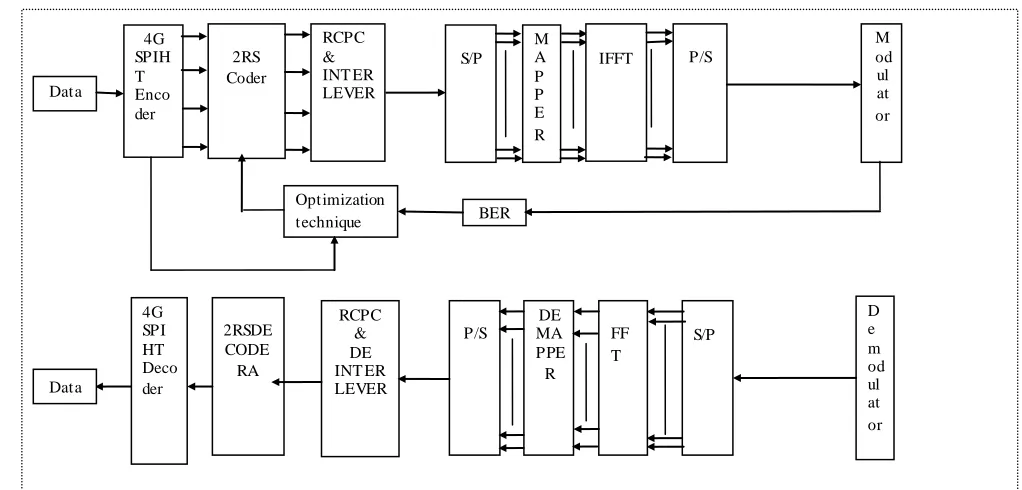
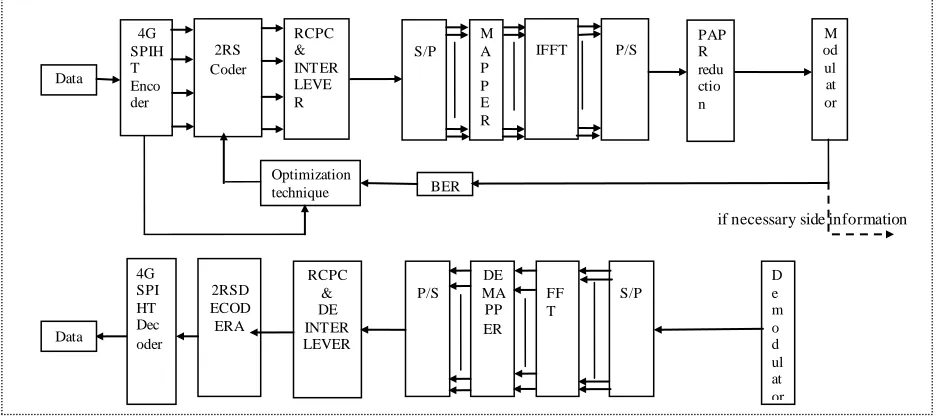
In the beginning as shown in Fig. 4, the SPIHT coder output bitstream modificat ion has done. The modification process is based on the type of bits and their contribution in the PSNR o f the reconstructed image. The bit error sensitivity (BES) study is performed by first coding the original image using the SPIHT coder. One b it in the coded image is then corrupted, starting fro m the first bit to the last bit. Each time a bit is corrupted, the coded image is decoded and the resultant MSE is calculated. The corrupted bit is corrected before proceeding on to the next bit. On analysis, the resultant BES study is carried out on a 256*256*8 image of Lena coded at source code rate of 0.5 bpp using th e SPIHT algorith m. On analysis, there are 4 ma jor types of bit sensitivities within the SPIHT coded bits, as shown in Fig.3. the output bitstream will be started by the most significant types of bits (first group of bits). The proposed scheme can be summarized as follows: (1) the SPIHT image coding technique is modified to generate 4 groups of bitstream related to the order of significance , (2) the output data is partitioned into a sequence of packets, (3) the changing in MSE is calculated and the expected decrease in distortion
i
ΔD is then approximately estimated, (4) the optimization algorithm is applied to generate the optimum bit rate for each group of bits. The inputs to the optimization algorithm are the packet length, the bit error rate , and expected distortion ΔDi, (5) the output are the rate allocation vectors used with RS codes to generate the transmitted bitstream, (6) the receiver will decode the receiving bitstream by using RS decoder and the modified SPIHT decoder.
E. Image Transmission over OFDM system with RS channel coding (FEC)
0.01 and 0.001, for gray-scale Lena image. Firstly the wavelet transform using 9-tap lo w pass filter and 7-tap high-pass filter a re applied to the original image to decompose it into sub-images. Only 6-layer is used in our test. The modified SPIHT coder is then applied to the wavelet coeffic ients to generate the source bitstream with a bit rate of 0.5 bpp. The source bitstram is divided into packets of lenght
0 2 4 6 8 10 12 14 16 18 20 0 1 2 3 4 5 6 7 8 9 10 Packet Number N u m b e r o f R S s y m b o l b e r C o lu m n
0 2 4 6 8 10 12 14 16 18 20 0 1 2 3 4 5 6 7 8 9 10 Packet Number N um b er o f R S s y m b o l b e r R o w
Fig. 4. modified OFDM system
S/P M A P P E R
P/S
DE MA PPE R
FF T
S/P
D e m od ul at or IFFT
2RSDE CODE
RA 4G
SPI HT Deco der Data
e
2RS Coder 4G
SPIH T Enco der
Optimization technique
M od ul at or P/S
RCPC & INT ER LEVER
RCPC & DE INT ER LEVER
BER
Data
sign bit, (3) 8 packets for the set bit, (4) 2 packets for the refinement bits.
Fig. 5. Channel rates for the protection of “ Lena” as determined using the algorithm
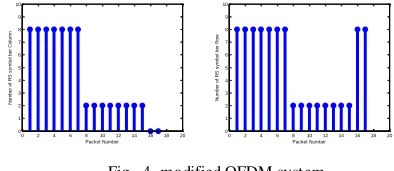
In the beginning, we tried to put the results of the method in a co mparison form with the result of the equal error protection method. In the case of , the number o f RS symbols is selected to be 8-symbol for each row of packet that make the total symbols per packet a re 450 symbol ber pac ket. In the case of , the total symbols per packet ( in Eq.9) is selected to be no more than 450 symbol ber packet and the optimization algorith m is used to determine the number of RS symbols for each column and row of packets. The result of this step is shown in Fig.5. It is c lear fro m Fig. 5 that the significance and sign packets are protected by 8-symbol for colu mn and row, the set packets are protected by 2-symbol for colu mn and row, and the refine ment packets are protected by 8-symbol fo r row and zero for column.
Fig . 6 depicts the average PSNR of the decoded Lena image as a function of the transmission rate for the EEP and the UEP coding method. In particular, our proposed scheme for UEP outperforms the system of EEP by 4.2 dB.
1 2 3 4 5 6 7 8 9 10
x 10-3 10
15 20 25 30 35
Bit Error Rate
P
S
N
R
(d
B
)
EEP UEP
Fig. 6. the average PSNR of the decoded Lena image as a function of the channel BER for the RS (EEP & UEP) channel coding.
IV. WEIGHT ING FUNCT ION
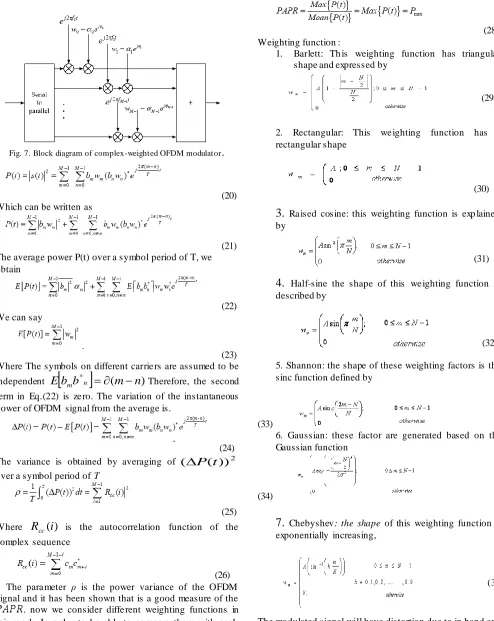
This method addresses the PAPR reduction of OFDM by combination of both signal scramb ling and signal distortion techniques [31]. The PAPR is to be reduced by both amp litude we ighting and random phase updating. The OFDM signal for one symbol interval 0 ≤t ≤T is written as
Ttm j
m
m
w
e
b
t
s
(
)
2( (18) Where M is number of subcarriers,
b
m is modulation data of the subcarriers, T is the OFDM symbol period, andis a complex factor defined as
( (19)
Fig. 7. Block diagram of complex-weighted OFDM modulator
.
( (20) Which can be written as
( (21) The average power P(t) over a symbol period of T, we obtain
( (22) We can say
( (23) Where The symbols on different carrie rs are assumed to be independent
E
b
mb
*n
(
m
n
)
Therefore, the secondterm in Eq.(22) is ze ro. The variation of the instantaneous power of OFDM signal from the average is.
( (24) The variance is obtained by averaging of
(
P
(
t
))
2 over a symbol period of T
( (25) Where
R
cc(
i
)
is the autocorrelation function of the complex sequence(26) The para meter ρ is the power variance of the OFDM signal and it has been shown that is a good measure of the . now we consider diffe rent weighting functions in this work. In order to be able to co mpare the m with each other we assume the power of a ll we ighting factors be constant,
1
1 0
2
M
m m
W
(27) the PAPR of OFDM signal can be written as
( (28)
Weighting function :
1. Barlett: Th is weighting function has triangular shape and expressed by
( (29)
2. Rectangular: This we ighting function has a rectangular shape
(30)
3.
Ra ised cosine: this weighting function is exp lained by(31)
4.
Half-sine the shape of this we ighting function is described by
( (32)
5. Shannon: the shape of these weighting factors is the sinc function defined by
(33)
6. Gaussian: these factor are generated based on the Gaussian function
(34)
7.
Chebyshev: the shape of this weighting function is exponentially increasing,( (35)
The modulated signal will have distortion due to in band and out of band distortion and PAPR reduction using we ighted function make system more sensitive for noise of channel.
V. SELECTIVE WEIGHTING FUNCTION
S/P M A P P E R
P/S DE MA PP ER
FF T
S/P
D e m o d ul at or IFFT
2RSD ECOD ERA 4G
SPI HT Dec oder Data
e
2RS Coder 4G
SPIH T Enco der
Optimization technique
M od ul at or P/S
RCPC & INTER LEVE R
RCPC & DE INTER LEVER
BER
Data
PAP R redu ctio n
if necessary side information
Fig. 8. modified OFDM system with selective weighted function method for PAPR reduction
The weighted function method for PAPR has high distortion due to channel noise that will e ffect on signal recover. In this work, we don’t added weighted function to all t ransmit ion fra me . As shown in Fig.8, the fra me pass through PAPR reduction block test.
The PAPR reduction block test flowshart shown in Fig .9 If the PAPR larger than PAPRo (peak-to-average power
ratio threshold) we ma ke fra m pass through mu ltip le weighted function then test PAPR of each fra m and select one wh ich gave minimu m PAPR and transmit side information.
Fig. 9. Selective weighted PAPR reduction method flowshart
VI. COM PUTER RESULTS
We compare between the result of data transmit over original and modified OFDM systems using Barlett weighting function PAPR reduction method, Co mpound method PAPR reduction
method [32], and PAPR reduction using selective weigthing function.
A. Barlett Weighting function with original and modified OFDM system
We use the Barlett weighting function method and compare the simulat ion result for original and modified OFDM system. data transmition over t wo type of channel, b inary symitric channel and AWGN Chennal.
1) Binary symitric channel:
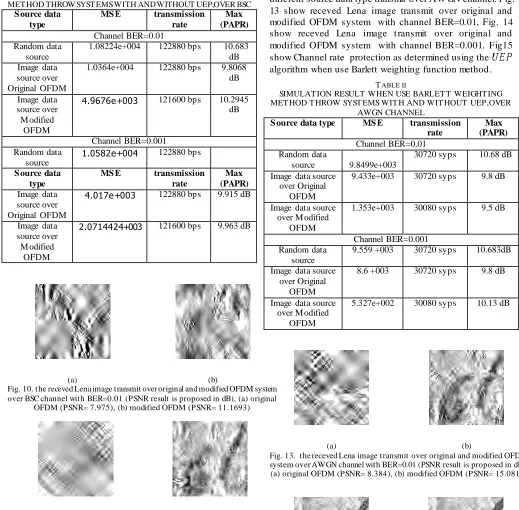
Here the data transmit over b inary symitric channel. Table I. show simulat ion result when use this method throw systems with and without UEP at Different kinds of sources transmited over BSC. Fig. 10 show receved Lena image transmit over orig inal and modified OFDM system with channel BER=0.01, and Fig. 11 show receved Lena image t ransmit over original and modified OFDM system with channel BER=0.001, Fig12 show Channel rate protection as determined using the algorithm when use Ba rlett weighting function method.
PAPR measurment
If PAPR >PAP Ro
Use weighted function and select minimum
PAPR
T ransmit the frame
TABLE 1
SIMULAT ION RESULT WHEN USE BARLET T WEIGHT ING MET HOD THROW SYST EMS WITH AND WITHOUT UEP,OVER BSC
S ource data type
MS E transmission
rate
Max (PAPR)
Channel BER=0.01 Random data
source
1.08224e+004 122880 bps 10.683 dB Image data
source over Original OFDM
1.0364e+004 122880 bps 9.8068 dB
Image data source over M odified
OFDM
4.9676e+003 121600 bps 10.2945
dB
Channel BER=0.001 Random data
source
1.0582e+004 122880 bps
S ource data type
MS E transmission
rate
Max (PAPR)
Image data source over Original OFDM
4.017e+003 122880 bps 9.915 dB
Image data source over M odified
OFDM
2.0714424+003 121600 bps 9.963 dB
(a) (b)
Fig. 10. the receved Lena image transmit over original and modified OFDM system over BSC channel with BER=0.01 (PSNR result is proposed in dB), (a) original
OFDM (PSNR= 7.975), (b) modified OFDM (PSNR= 11.1693)
(a) (b)
Fig. 11. the receved Lena image transmit over original and modified OFDM system over BSC channel with BER=0.001 (PSNR result is p roposed in dB), (a) original OFDM (PSNR= 12.09), (b) modified OFDM (PSNR= 14.968)
0 2 4 6 8 10 12 14 16 18 20 0
1 2 3 4 5 6 7 8 9 10
Packet Number
N
u
m
b
e
r
o
f
R
S
s
y
m
b
o
l
b
e
r
R
o
w
0 2 4 6 8 10 12 14 16 18 20 0
1 2 3 4 5 6 7 8 9 10
Packet Number
N
u
m
b
e
r
o
f
R
S
s
y
m
b
o
l
b
e
r
C
o
lu
m
n
Fig .12. Channel rates protection as determined using the algorithmfor Lena image for BSC with BER=0.01
2) AWGN channel:The transmited bit stream transmit over AWGN channel, Table II show simulat ion result when use
this method throw systems with and without UEP at diffe rent source data type transmit over AW GN channel. Fig. 13 show receved Lena image transmit over origina l and modified OFDM system with channel BER=0.01, Fig. 14 show receved Lena image t ransmit over origina l and modified OFDM system with channel BER=0.001. Fig15 show Channel rate protection as determined using the algorithm when use Barlett weighting function method .
TABLE II
SIMULAT ION RESULT WHEN USE BARLET T WEIGHT ING MET HOD T HROW SYST EMS WIT H AND WIT HOUT UEP,OVER
AWGN CHANNEL
S ource data type MS E transmission
rate
Max (PAPR)
Channel BER=0.01 Random data
source
9.8499e+003
30720 syps 10.68 dB
Image data source over Original
OFDM
9.433e+003 30720 syps 9.8 dB
Image data source over M odified
OFDM
1.353e+003 30080 syps 9.5 dB
Channel BER=0.001 Random data
source
9.559 +003 30720 syps 10.683dB
Image data source over Original
OFDM
8.6 +003 30720 syps 9.8 dB
Image data source over M odified
OFDM
5.327e+002 30080 syps 10.13 dB
(a) (b)
Fig. 13. the receved Lena image transmit over original and modified OFDM system over AWGN channel with BER=0.01 (PSNR result is proposed in dB), (a) original OFDM (PSNR= 8.384), (b) modified OFDM (PSNR= 15.0815)
(a) (b)
0 2 4 6 8 10 12 14 16 18 20 0
1 2 3 4 5 6 7 8 9 10
Packet Number
N
u
m
b
e
r
o
f
R
S
s
y
m
b
o
l
b
e
r
R
o
w
0 2 4 6 8 10 12 14 16 18 20 0
1 2 3 4 5 6 7 8 9 10
Packet Number
N
u
m
b
e
r
o
f
R
S
s
y
m
b
o
l
b
e
r
C
o
lu
m
n
Fig. 15. Channel rates protection as determined using the
algorithm for AWGN channel with BER=0.01
B. compound method simulation result
We use the compound method [32] for original and modified OFDM system the data will pass over two type of channel BSC and AWGN.
1) BS Channel
: Data transmit over BSC, Tab le 3 show simu lation result when use co mpound method throw systems with and without UEP at diffe rent source data type over BSC. Fig 16 show receved Lena image transmit over original and mod ified OFDM system with channel BER=0.01, Fig 17 show receved Lena image transmit over original and mod ified OFDM system with channel BER=0.001, Fig 18 show Channel rate protection as determined using the algorith m when use compound method.TABLE III
SIMULAT ION RESULT WHEN USE COMPOUND METHOD THROW SYST EMS WIT H AND WIT HOUT UEP,OVER BSC
S ource data type MS E transmission
rate
Max (PAPR)
Channel BER=0.01
Random data
source
1.03324e+004
122880 bps 7.739
dB
Image data source
over Original
OFDM
1.166778e+004
122880 bps 8.5378
dB
Image data source
over M odified
OFDM
4.0651e+003 121600 bps 7.5253
dB
Channel BER=0.001
Random data
source
1.006e+004 122880 7.739
dB
Image data source
over Original
OFDM
1.03695e+003 122880 bps 8.5378
dB
Image data source
over M odified
OFDM
5.47694e+002 117760 bps 8.6578
dB
(a) (b)
Fig. 16. the receved Lena image transmit over original and modified OFDM system over BSC with BER=0.01 (PSNR result is proposed in dB), (a) original
OFDM (PSNR= 7.46), (b) modified OFDM (PSNR= 12.04)
(a) (b)
Fig. 17. the receved Lena image transmit over original and modified OFDM system over BSC with BER=0.001 (PSNR result is proposed in dB), (a) original OFDM (PSNR=
17.973), (b) modified OFDM (PSNR= 20.7454)
2) AWGN channel: He re we use co mpound method and AWGN channel, Table IV show simulat ion result when use compound method throw systems with and without UEP at diffe rent source data type over AWGN channel. Fig 19 show receved Lena image transmit over orig inal and modified OFDM system with channel BER=0.01, Fig 20 show receved Lena image transmit over origina l and modified OFDM system with channel BER=0.001, Fig 21 show Channel rate protection as determined using the algorithm when use compound method.
0 2 4 6 8 10 12 14 16 18 20 0
1 2 3 4 5 6 7 8 9 10
Packet Number
N
u
m
b
e
r
o
f
R
S
s
y
m
b
o
l
b
e
r
R
o
w
0 2 4 6 8 10 12 14 16 18 20 0
1 2 3 4 5 6 7 8 9 10
Packet Number
N
u
m
b
e
r
o
f
R
S
s
y
m
b
o
l
b
e
r
C
o
lu
m
n
Fig. 18. Channel rates protection as determined using
the algorithm for Lena image over BSC with
TABLE IV
SIMULAT ION RESULT WHEN USE COMPOUND METHOD THROW SYST EMS WIT H AND WIT HOUT UEP,OVER AWGN CHANNEL
Source data type MSE transmission rate
Max (PAPR)
Channel BER=0.01 Random data source
9.8069e+003
30736 syps 7.739 dB Image data source over
Original OFDM
4.3469e+003
30736 syps 7.6733 dB
Image data source over Modified OFDM
1.55262e+003 29455 syps 7.6733 dB
Channel BER=0.001
Random data source 9.45e+003 30736 syps 7.74 dB
Image data source over
Original
4.4014+002 30736 syps 8.5378 dB
Source data type MSE transmission rate
Max (PAPR)
Image data source over
Modified OFDM
1.585e002 28480 syps 7.7989 dB
(a) (b)
Fig. 19. the receved Lena image transmit over original and modified OFDM system over AWGN BER=0.01 (PSNR result is proposed in dB), (a) original
OFDM (PSNR= 14.26), (b) modified OFDM (PSNR= 16.22)
0 2 4 6 8 10 12 14 16 18 20 0
1 2 3 4 5 6 7 8 9 10
Packet Number
N
um
be
r
of
R
S
s
ym
bo
l b
er
R
ow
0 2 4 6 8 10 12 14 16 18 20 0
1 2 3 4 5 6 7 8 9 10
Packet Number
N
um
be
r
of
R
S
s
ym
bo
l b
er
C
ol
um
n
Fig. 21. Channel rates protection as determined using the algorithm for Lena image over AWGN channel with
BER=0.01.
C. Selective Weighting function with original and modified OFDM system
Here we use our proposed method (selective weight ing function) and compare the simulation result for original and modified OFDM system, the data will pass over two type of channel BSC and AWGN channel co mpare the result with result of compound method and the Barlett PAPR method.
1) BS Channel:
Data transmit over BSC, Table. V show simu lation result when use this method throw systems with and without UEP at different source data type and BSC. Fig.22 show receved Lena image transmit over orig inal and modified OFDM system with channel BER=0.01. Fig. 23 show receved Lena image t ransmit over origina l and modified OFDM system with channel BER=0.001.Fig. 24 show Channel rate protection as determined using the algorithm.TABLE V
SIMULAT ION RESULT WHEN USE SELECT IVE WEIGHT ED MET HOD THROW SYST EMS WITH AND WITHOUT UEP,OVER BSC
CHANNEL
S ource data type MS E transmission
rate
Max (PAPR)
Channel BER=0.01 Random data
source
1.0022e+004 122944 bps 8.738 dB
Image data source over Original OFDM
1.87672e+003 122944 bps 8.75 dB
Image data source over M odified OFDM
8.873685e+002 120380 bps 8.7263 dB
Channel BER=0.001
Source data type 9.8e+004 122944 bps 8.738 dB Random data
source
4.27316e+002 122944 bps 8.7263 dB Image data
source over Original OFDM
1.3246e+002 120336 bps 8.748 dB
(a) (b)
Fig. 22 the receved Lena image transmit over original and modified OFDM system over BSC with BER=0.01 (PSNR result is proposed in dB), (a) original OFDM (PSNR= 18.384) , (b) modified OFDM (PSNR= 19.815)
(a) (b)
Fig. 20. T he receved Lena image transmit over original and modified OFDM system over AWGN channel with BER=0.001 (PSNR result is proposed in dB), (a) original OFDM (PSNR= 21.6948), (b) modified
(a) (b)
Fig.23 the receved Lena image transmit over original and modified OFDM system over BSC with BER=0.001 (PSNR result is proposed in dB), (a) original OFDM (PSNR= 21.6948), (b) modified OFDM (PSNR= 26.13)
0 2 4 6 8 10 12 14 16 18 20 0
1 2 3 4 5 6 7 8 9 10
Packet Number
N
u
m
b
e
r
o
f
R
S
s
y
m
b
o
l
b
e
r
R
o
w
0 2 4 6 8 10 12 14 16 18 20 0
1 2 3 4 5 6 7 8 9 10
Packet Number
N
u
m
b
e
r
o
f
R
S
s
y
m
b
o
l
b
e
r
C
o
lu
m
n
Fig. 24. Channel rates protection as determined for Lena image using the algorithm over BSC with
BER=0.01
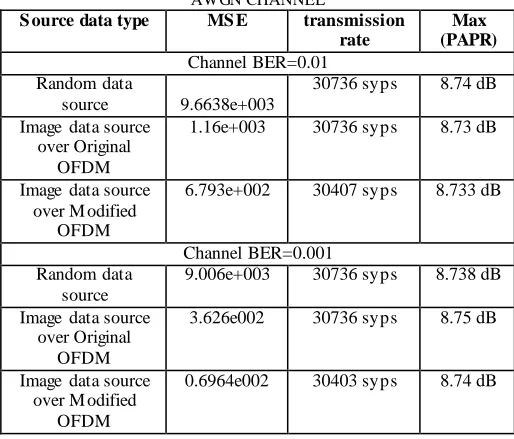
3) AWGN Channel: Here data
transmit over AWGN channel, Table VI show simu lation result when use this method throw systems with and without UEP at diffe rent source data type and transmit over AW GN channel. Fig. 25 show receved Lena image transmit over orig inal and modified OFDM system with channel BER=0.01. Fig. 26 show receved Lena image transmit over origina l and modified OFDM system with channel BER=0.001. Fig. 27 show Channel rate protection as determined using the algorithm.
4)
TABLE VI
SIMULAT ION RESULT WHEN USE SELECT IVE WEIGHT ED MET HOD T HROW SYST EMS WIT H AND WIT HOUT UEP,OVER
AWGN CHANNEL
S ource data type MS E transmission
rate
Max (PAPR)
Channel BER=0.01 Random data
source
9.6638e+003
30736 syps 8.74 dB
Image data source over Original
OFDM
1.16e+003 30736 syps 8.73 dB
Image data source over M odified
OFDM
6.793e+002 30407 syps 8.733 dB
Channel BER=0.001 Random data
source
9.006e+003 30736 syps 8.738 dB
Image data source over Original
OFDM
3.626e002 30736 syps 8.75 dB
Image data source over M odified
OFDM
0.6964e002 30403 syps 8.74 dB
(a) (b)
Fig.25 the receved Lena image transmit over original and modified OFDM system over AWGN channel with BER=0.01 (PSNR result is proposed in dB), (a) original OFDM (PSNR= 18.384), (b) modified OFDM (PSNR= 19.815)
(a) (b)
Fig. 26. T he receved Lena image transmit over original and modified OFDM system over AWGN channel channel BER=0.001 (PSNR result is proposed in dB), (a) original OFDM (PSNR=22.53), (b) modified OFDM
(PSNR=29.7)
0 2 4 6 8 10 12 14 16 18 20 0
1 2 3 4 5 6 7 8 9 10
Packet Number
N
u
m
b
e
r
o
f
R
S
s
y
m
b
o
l
b
e
r
R
o
w
0 2 4 6 8 10 12 14 16 18 20 0
1 2 3 4 5 6 7 8 9 10
Packet Number
N
u
m
b
e
r
o
f
R
S
s
y
m
b
o
l
b
e
r
R
o
w
Fig. 27. Channel rates protection as determined using the algorithm when data transmit over AWGN with BER=0.01.
0 2 4 6 8 10 12
10-2 10-1 100
PAPRo
p
r
(
P
A
P
R
>
P
A
P
R
o
)
Conventional SLM, u = 4 CLP Huffmant Barlett weighted Proposed method Compound method
Fig. 28. CCDF Comparison of the proposed algorithm with Slm u=4,Huffman coder,clipping,compound and Barlett weighting function
VII. CONCLUSIONS
In this paper we have conseder the proplem of reduction PAPR in OFDM system by an effic ient rate a llocation scheme with selective we ighted function effic int rate allocation done useing Reed So lo mon coder porotection with an UEP, study result over two type of channel and compare result by two method Barlett and compound method, the proposed method reduce the PAPR more than , Conventional system, SLM (selective mapping u=4) [37], clping method[36], Ba rlett we igthed function,Huffmant method [33], and less than compound but the over all distortion less than all, UEP ma ke improve ment in the transmission rate.
REFERENCES
[1] Nee, R.V. and R. Prased, OFDM for wireless Multimedia Communications, Norwood, MA: Artech House Publishers (2000). [2] L. Hanzo, M. Munster, B.J. Choi and T . Keller, OFDM and
MC-CDMA: for Broadband Multi-user Communications, WLANs and Broadcasting, John Wiley & Sons Ltd, West Sussex, England Copyright (2003).
[3] Stefan H. Muller and Johannes B. Huber, A comparison of Peak Power Reduction for OFDM, Proc. Of IEEE Global Telecom. Conf., GLOBECOM '97, USA (1997).
[4] Rakesh Rajbanshi, Peak to Average Power Ratio Reduction T echniques Survey and Analysis, EECS 800 (2004).
[5] Ashraf A. Eltholth, Adel R. Mikhail, A. Elshirbini, Moawad I. Moawad, A. I. Abdelfattah, "Peak-to-Average Power Ratio Reduction in OFDM Systems using Huffman Coding", Proc. Of World Academy of Science, Engineering and T echnology 33(2008). [6] Kyeongcheol Yang and Seok-Il Chang, Peak-to-Average Power Control in OFDM Using Standard Arrays of Linear Block Codes, IEEE Comm. Letters 7(4) (2003) 174-176.
[7] H. Zhang, D. Yuan, F. Zhao, PAPR comparison of different orthogonal base in multicarrier systems, in: IEEE 7th International Conference on Advanced Communication Technology (ICACT ’2005), Phoenix Park, Korea, (2005) 21–23.
[8] G. Freiman, S. Litsyn, A. Yudin, A method to suppress high peaks in BPSK-modulated OFDM Signal, IEEE Trans. Commun. 52 (9) (2004) 1440–1443.
[9] Cimini L. J. & Nelson R. Sollenberger, Peak-to-Average Power Ratio reduction of an OFDM signal using partial transmit sequence, IEEE Comm. Letters 4(2000) 6-88.
[10] C. T ellambura, Computation of the continuous-time PAR of an OFDM signal with BPSK subcarriers, IEEE Comm. Letters 5 (2001) 185–18.
[11] K. Patterson, Generalized Reed-Muller Codes and Power Control in OFDM Modulation, IEEE Transactions on Information Theory 46(2000)104-120.
[12] C. Tellambura, Phase Optimization Criterion for Reducing Peak -to-Average Power Ratio in OFDM, Electronics Letters, 3 4(1998)169-170.
[13] M. Breiling, S. H. Muller, and J. B. Huber, “ SLM Peak-Power Reduction without Explicit Side Information,” IEEE Communications Letters, 5(2001) 239-241.
[14] S. H. Muller and J. B. Huber, OFDM with Reduced Peak -to-Average Power Ratio by Optimum Combination of Partial Transmit Sequences, Electronics Letters, 33(1997) 368-369.
[15] J. T ellado, Multicarrier Modulation with Low Peak to Average Power Applications to xDSL and Broadband Wireless, Boston/Dordrecht/London: Kluwer Academic Publishers, (2000). [16] B. S. Krongold and D. L. Jones, “PAR Reduction in OFDM via
Active Constellation Extension,” IEEE Transactions on Broadcasting, 3(2003) 258-268.
[17] S. Sezginer and H. Sari, Peak Power Reduction in OFDM Systems Using Dynamic Constellation Shaping, Proceedings of EUSIPCO 2005, Turkey.
[18] A. Said and W. Pearlman, A new, fast and efficient image codec based on set partitioning in hierarchical trees," in IEEE Trans. Circuits and Systems for Video T echnology. 6(3) (1996) 243 -250. [19] S. Lin and D.J. Costello, Error Control Coding: Fundamentals and
Applications. Englewood Cliffs, NJ: Prentice-Hall, 1983.
[20] M. Antonini, M. Barlaud, P. Mathieu, and I. Daubechies, Image coding using wavelet transform," IEEE Trans. Image Processing (1992) 205-220.
[21] Y. Wang and Q.-F., “ Error Control and Concealment for Video Communication: A Review,” Proceeding of the IEEE, vol.86, no. 5, pp. 974-997, May 1998
[22] J. Hagenauer, “Rate-Compatible Punctured Convolutional Codes (RCPC Codes) and Their Applications,” IEEE Trans. Com, vol. 36, no. 4, pp. 389-400, April 1989
[23] A. Albanese, J. Blomer, J. Edmonds, M. Luby, and M. Sudan, “Priority Encoding T ransmission,” IEEE Trans. Inform. Theory, vol.42, pp.1737-1744, Nov. 1996.
[24] R. Puri and K. Ramchandran, “Multiple Description Source Coding through Forward Error Correction Codes,” in Proc. Asilomar Conference on Signals, Systems, and Computers, Asilomar, CA, Oct. 1999.
[25] N. Thomos, N.V. Boulgouris, and M.G. Strintzis, “Wireless Image Transmission Using Turbo Codes and Optimal Unequal Error Protection,” IEEE Trans. Image Proc., vol. 14, no. 11, pp. 1890-1901, Nov. 2005.
[26] C. Berrou and A. Glavieux, “Near Optimum Error Correcting Coding and Decoding: Turbo Codes,” IEEE Trans. Commun., vol.44, no. 10, pp. 1261-1271, Oct. 1996.
[27] J. G. Proakis, Digital Communication, 4th Ed, New York:
McGraw-Hill, 2000
[28] Shengjie Zhao, “Video Transmission Over Wireless Networks” Doctor of Philosophy
[29] P. A. Chou, A. Mohr, A. Wang, “Error control for receiver-driven layered multicast of audio and video,” IEEE Trans. Multimedia, vol.3, no. 1, pp. 108–122, Mar. 2001.
[30] R. Fletcher, Practical Methods of Optimization, 2nd ed., New York: Wiley, 19
[31] Nikoobar H. & R. Prasad, Weighted OFDM for wireless multipath channels. LEICE trans. Commun, E83-B: 1864-1872, 2000. [32] H. Y. Sakran ,M. Shokair, A. Abou Elazm “Wimax Performance
with Compander for PAPR Reduction in the Presence of Non -Linear Power Amplifier over SUI Multipath Channels” 26th NRSC, New Cairo, Egypt,March 17-19,2009
[33] Ashraf A.Eltholth,Adel R. Mikhail, A. Elshirbini, Moawad I. Moawad, A. I. Abdelfattah “Peak-to-average power ratio reduction in OFDM system using Huffman Coding”. Pwaset. Vol. 33 Septum. 2008
[34] Ciochina, C., F. Buda, and H. Sari, “An analysis of OFDM peak power reduction techniques for WiMAX systems,” IEEE International Conference on Communications, Vol. 10, 4676–4681, ICC apos, Jun. 2006.
[35] Gregorio, F. H., “Analysis and compensation of nonlinear power amplifier effects in multi antenna OFDM systems,” Dissertation for the degree of Doctor of Science in T echnology, 2007.
[36] Kusha Raj Panta and Jean Armstrong, “ Use of a Peak-to-Average Power Reduction T echnique in HIPERLAN2 and its Performance in a Fading Channel”, Department of Electrical Engineering, La Trobe University, Bundoora, VIC 3086, Australia, pp.1-5.